SECTION 3-3
Complex Numbers
ESSENTIAL QUESTIONS
➤ How do you perform operations with pure imaginary
numbers?
➤ How do you perform operations with imaginary
numbers?
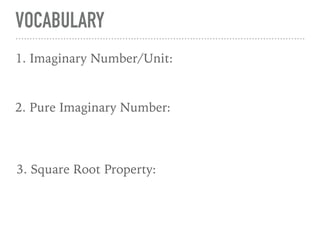
VOCABULARY
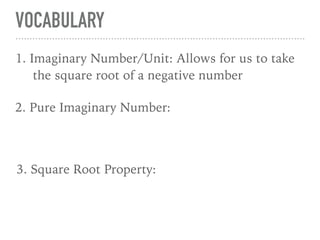
11. Imaginary Number/Unit:
2. Pure Imaginary Number:
3. Square Root Property:
VOCABULARY
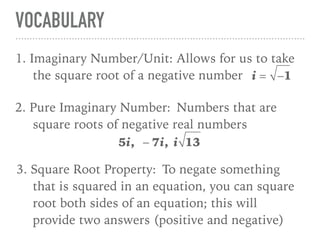
11. Imaginary Number/Unit: Allows for us to take
the square root of a negative number
2. Pure Imaginary Number:
3. Square Root Property:
VOCABULARY
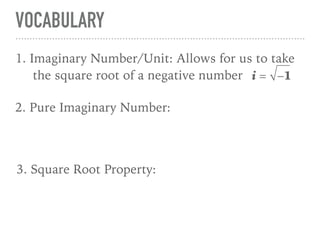
11. Imaginary Number/Unit: Allows for us to take
the square root of a negative number i = −1
2. Pure Imaginary Number:
3. Square Root Property:
VOCABULARY
11. Imaginary Number/Unit: Allows for us to take
the square root of a negative number i = −1
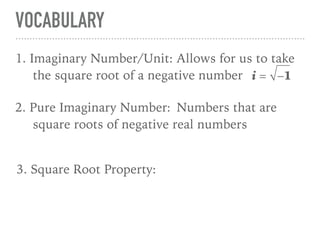
2. Pure Imaginary Number: Numbers that are
square roots of negative real numbers
3. Square Root Property:
VOCABULARY
11. Imaginary Number/Unit: Allows for us to take
the square root of a negative number i = −1
2. Pure Imaginary Number: Numbers that are
square roots of negative real numbers
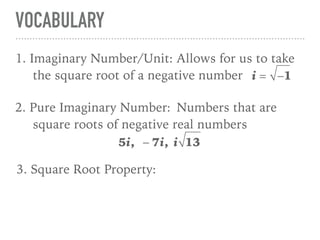
5i, − 7i, i 13
3. Square Root Property:
VOCABULARY
11. Imaginary Number/Unit: Allows for us to take
the square root of a negative number i = −1
2. Pure Imaginary Number: Numbers that are
square roots of negative real numbers
5i, − 7i, i 13
3. Square Root Property: To negate something
that is squared in an equation, you can square
root both sides of an equation; this will
provide two answers (positive and negative)
VOCABULARY
4. Complex Number:
5. Complex Conjugate:
VOCABULARY
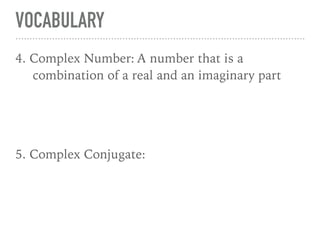
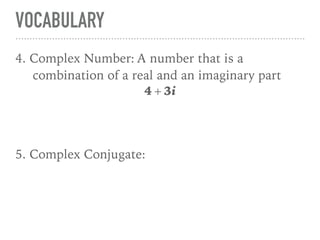
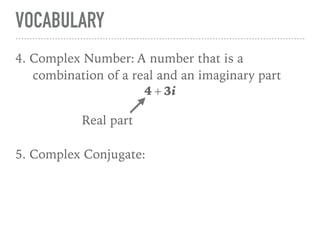
4. Complex Number: A number that is a
combination of a real and an imaginary part
5. Complex Conjugate:
VOCABULARY
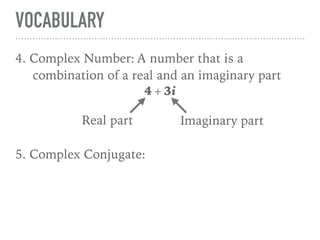
4. Complex Number: A number that is a
combination of a real and an imaginary part
4 + 3i
5. Complex Conjugate:
VOCABULARY
4. Complex Number: A number that is a
combination of a real and an imaginary part
4 + 3i
5. Complex Conjugate:
Real part
VOCABULARY
4. Complex Number: A number that is a
combination of a real and an imaginary part
4 + 3i
5. Complex Conjugate:
Real part Imaginary part
VOCABULARY
4. Complex Number: A number that is a
combination of a real and an imaginary part
4 + 3i
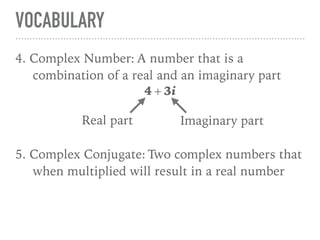
5. Complex Conjugate: Two complex numbers that
when multiplied will result in a real number
Real part Imaginary part
VOCABULARY
4. Complex Number: A number that is a
combination of a real and an imaginary part
4 + 3i
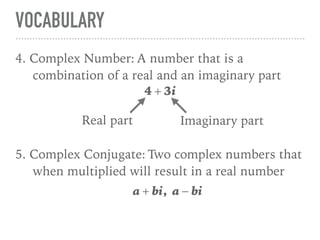
5. Complex Conjugate: Two complex numbers that
when multiplied will result in a real number
a + bi, a − bi
Real part Imaginary part
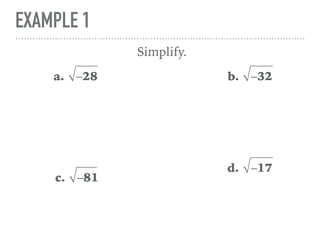
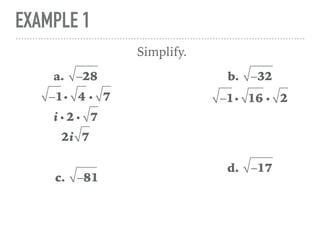
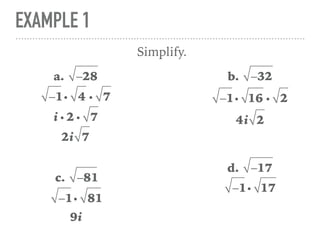
EXAMPLE 1
a. −28
Simplify.
b. −32
c. −81
d. −17
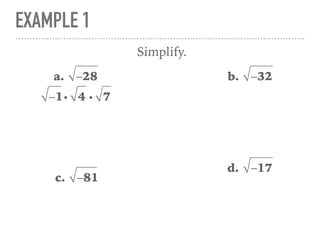
EXAMPLE 1
a. −28
Simplify.
−1i 4 i 7
b. −32
c. −81
d. −17
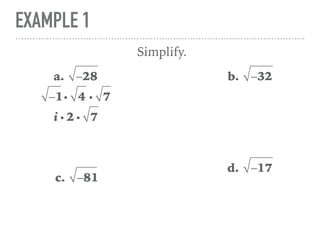
EXAMPLE 1
a. −28
Simplify.
−1i 4 i 7
i i 2 i 7
b. −32
c. −81
d. −17
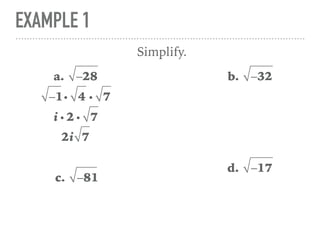
EXAMPLE 1
a. −28
Simplify.
−1i 4 i 7
i i 2 i 7
2i 7
b. −32
c. −81
d. −17
EXAMPLE 1
a. −28
Simplify.
−1i 4 i 7
i i 2 i 7
2i 7
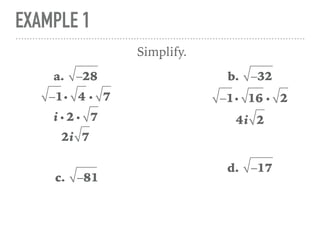
b. −32
−1i 16 i 2
c. −81
d. −17
EXAMPLE 1
a. −28
Simplify.
−1i 4 i 7
i i 2 i 7
2i 7
b. −32
−1i 16 i 2
4i 2
c. −81
d. −17
EXAMPLE 1
a. −28
Simplify.
−1i 4 i 7
i i 2 i 7
2i 7
b. −32
−1i 16 i 2
4i 2
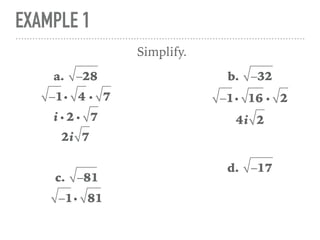
c. −81
−1i 81
d. −17
EXAMPLE 1
a. −28
Simplify.
−1i 4 i 7
i i 2 i 7
2i 7
b. −32
−1i 16 i 2
4i 2
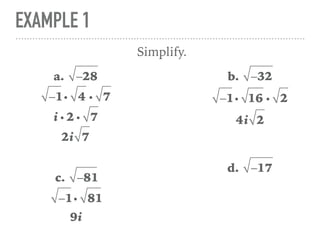
c. −81
−1i 81
9i
d. −17
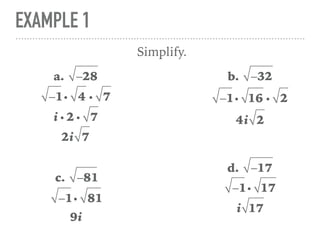
EXAMPLE 1
a. −28
Simplify.
−1i 4 i 7
i i 2 i 7
2i 7
b. −32
−1i 16 i 2
4i 2
c. −81
−1i 81
9i
d. −17
−1i 17
EXAMPLE 1
a. −28
Simplify.
−1i 4 i 7
i i 2 i 7
2i 7
b. −32
−1i 16 i 2
4i 2
c. −81
−1i 81
9i
d. −17
−1i 17
i 17
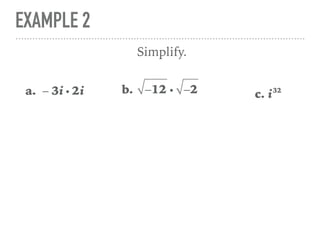
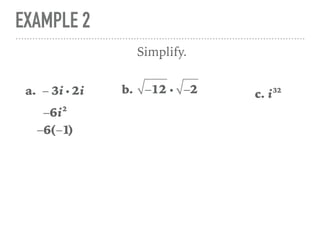
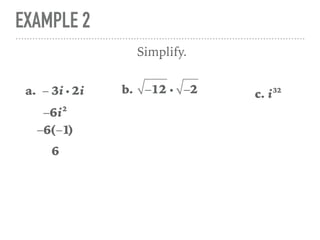
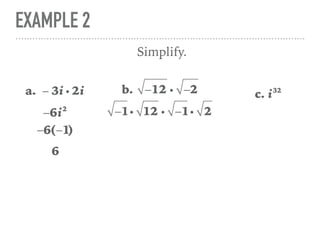
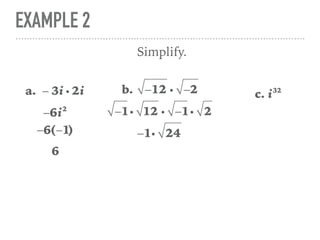
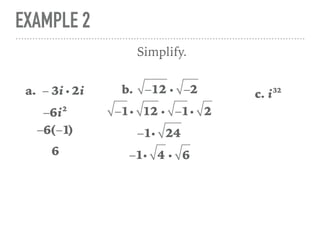
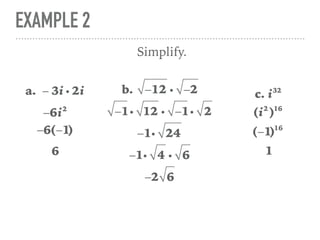
EXAMPLE 2
a. − 3i i 2i
Simplify.
b. −12 i −2 c. i32
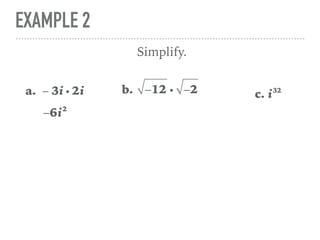
EXAMPLE 2
a. − 3i i 2i
Simplify.
−6i2
b. −12 i −2 c. i32
EXAMPLE 2
a. − 3i i 2i
Simplify.
−6i2
−6(−1)
b. −12 i −2 c. i32
EXAMPLE 2
a. − 3i i 2i
Simplify.
−6i2
−6(−1)
6
b. −12 i −2 c. i32
EXAMPLE 2
a. − 3i i 2i
Simplify.
−6i2
−6(−1)
6
b. −12 i −2
−1i 12 i −1i 2
c. i32
EXAMPLE 2
a. − 3i i 2i
Simplify.
−6i2
−6(−1)
6
b. −12 i −2
−1i 12 i −1i 2
−1i 24
c. i32
EXAMPLE 2
a. − 3i i 2i
Simplify.
−6i2
−6(−1)
6
b. −12 i −2
−1i 12 i −1i 2
−1i 24
c. i32
−1i 4 i 6
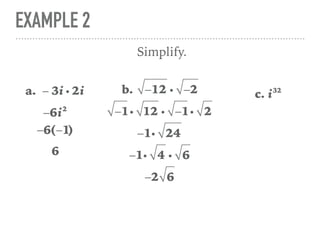
EXAMPLE 2
a. − 3i i 2i
Simplify.
−6i2
−6(−1)
6
b. −12 i −2
−1i 12 i −1i 2
−1i 24
c. i32
−1i 4 i 6
−2 6
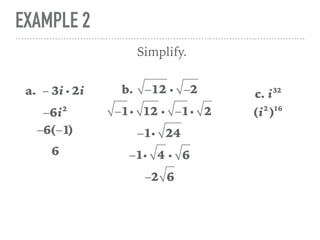
EXAMPLE 2
a. − 3i i 2i
Simplify.
−6i2
−6(−1)
6
b. −12 i −2
−1i 12 i −1i 2
−1i 24
c. i32
(i2
)16
−1i 4 i 6
−2 6
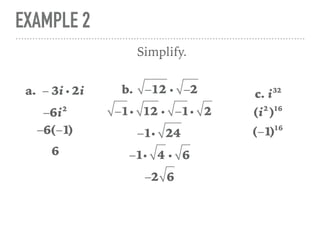
EXAMPLE 2
a. − 3i i 2i
Simplify.
−6i2
−6(−1)
6
b. −12 i −2
−1i 12 i −1i 2
−1i 24
c. i32
(i2
)16
(−1)16
−1i 4 i 6
−2 6
EXAMPLE 2
a. − 3i i 2i
Simplify.
−6i2
−6(−1)
6
b. −12 i −2
−1i 12 i −1i 2
−1i 24
c. i32
(i2
)16
(−1)16
−1i 4 i 6
−2 6
1
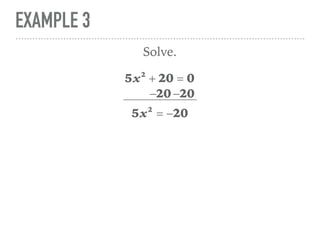
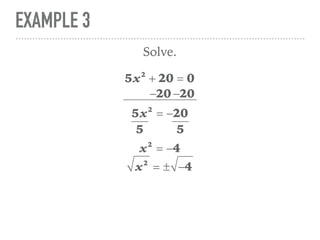
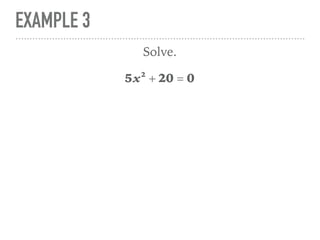
EXAMPLE 3
5x2
+ 20 = 0
Solve.
EXAMPLE 3
5x2
+ 20 = 0
Solve.
−20 −20
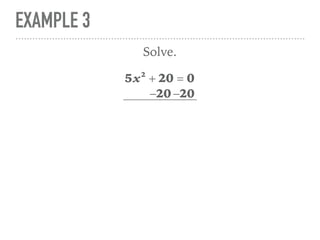
EXAMPLE 3
5x2
+ 20 = 0
Solve.
5x2
= −20
−20 −20
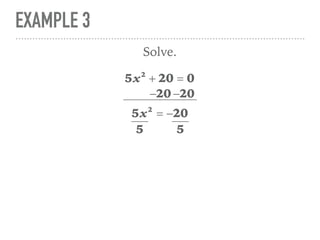
EXAMPLE 3
5x2
+ 20 = 0
Solve.
5x2
= −20
−20 −20
5 5
EXAMPLE 3
5x2
+ 20 = 0
Solve.
5x2
= −20
x2
= −4
−20 −20
5 5
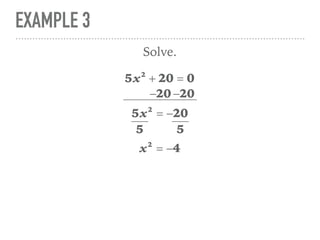
EXAMPLE 3
5x2
+ 20 = 0
Solve.
5x2
= −20
x2
= −4
−20 −20
5 5
x2
= ± −4
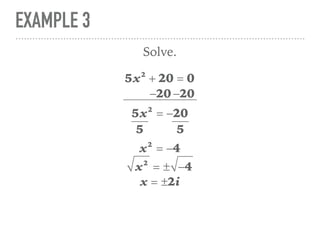
EXAMPLE 3
5x2
+ 20 = 0
Solve.
5x2
= −20
x2
= −4
−20 −20
5 5
x2
= ± −4
x = ±2i
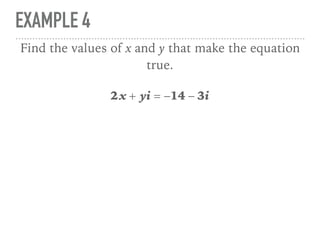
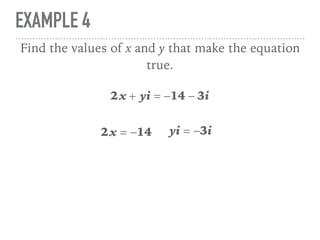
EXAMPLE 4
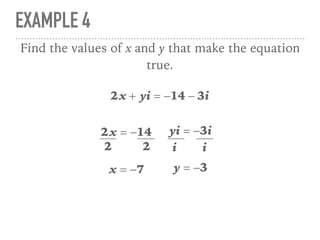
2x + yi = −14 − 3i
Find the values of x and y that make the equation
true.
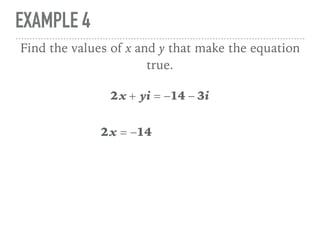
EXAMPLE 4
2x + yi = −14 − 3i
Find the values of x and y that make the equation
true.
2x = −14
EXAMPLE 4
2x + yi = −14 − 3i
Find the values of x and y that make the equation
true.
2x = −14 yi = −3i
EXAMPLE 4
2x + yi = −14 − 3i
Find the values of x and y that make the equation
true.
2x = −14 yi = −3i
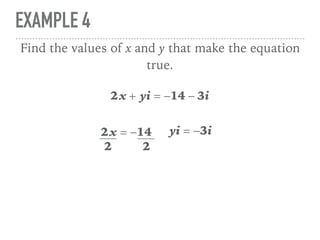
2 2
EXAMPLE 4
2x + yi = −14 − 3i
Find the values of x and y that make the equation
true.
2x = −14 yi = −3i
2 2
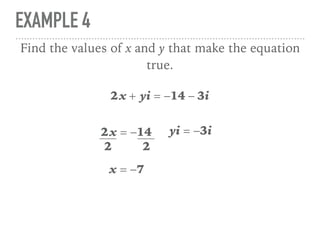
x = −7
EXAMPLE 4
2x + yi = −14 − 3i
Find the values of x and y that make the equation
true.
2x = −14 yi = −3i
2 2
x = −7
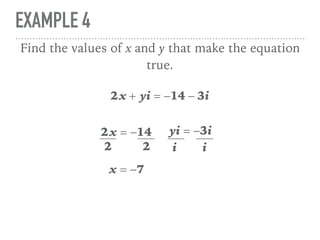
i i
EXAMPLE 4
2x + yi = −14 − 3i
Find the values of x and y that make the equation
true.
2x = −14 yi = −3i
2 2
x = −7
i i
y = −3
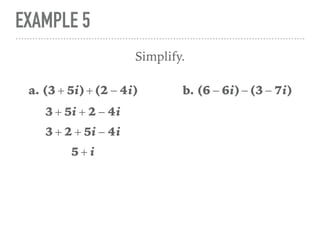
EXAMPLE 5
Simplify.
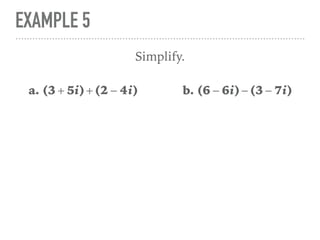
a. (3 + 5i)+(2 − 4i) b. (6 − 6i)−(3 − 7i)
EXAMPLE 5
Simplify.
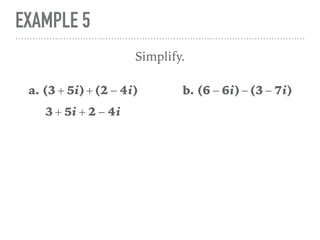
a. (3 + 5i)+(2 − 4i)
3 + 5i + 2 − 4i
b. (6 − 6i)−(3 − 7i)
EXAMPLE 5
Simplify.
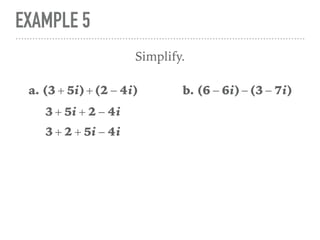
a. (3 + 5i)+(2 − 4i)
3 + 5i + 2 − 4i
3 + 2 + 5i − 4i
b. (6 − 6i)−(3 − 7i)
EXAMPLE 5
Simplify.
a. (3 + 5i)+(2 − 4i)
3 + 5i + 2 − 4i
3 + 2 + 5i − 4i
5 + i
b. (6 − 6i)−(3 − 7i)
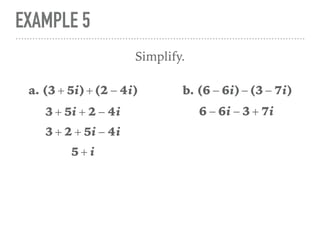
EXAMPLE 5
Simplify.
a. (3 + 5i)+(2 − 4i)
3 + 5i + 2 − 4i
3 + 2 + 5i − 4i
5 + i
b. (6 − 6i)−(3 − 7i)
6 − 6i − 3 + 7i
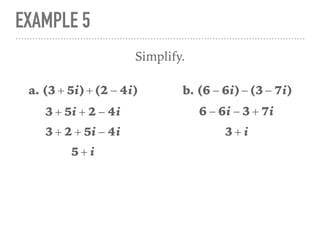
EXAMPLE 5
Simplify.
a. (3 + 5i)+(2 − 4i)
3 + 5i + 2 − 4i
3 + 2 + 5i − 4i
5 + i
b. (6 − 6i)−(3 − 7i)
6 − 6i − 3 + 7i
3 + i
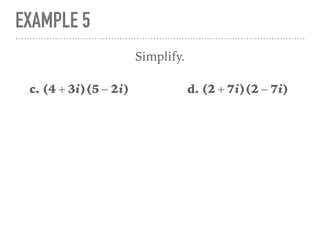
EXAMPLE 5
Simplify.
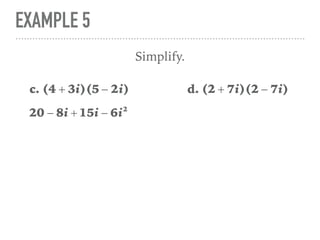
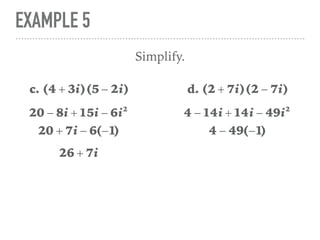
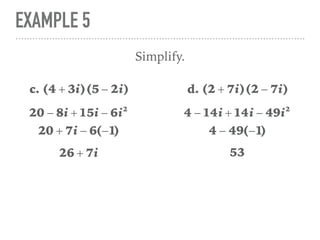
c. (4 + 3i)(5 − 2i) d. (2 + 7i)(2 − 7i)
EXAMPLE 5
Simplify.
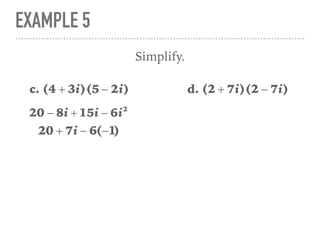
c. (4 + 3i)(5 − 2i)
20 − 8i + 15i − 6i2
d. (2 + 7i)(2 − 7i)
EXAMPLE 5
Simplify.
c. (4 + 3i)(5 − 2i)
20 − 8i + 15i − 6i2
20 + 7i − 6(−1)
d. (2 + 7i)(2 − 7i)
EXAMPLE 5
Simplify.
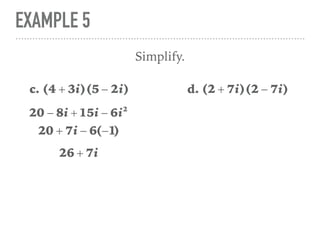
c. (4 + 3i)(5 − 2i)
20 − 8i + 15i − 6i2
20 + 7i − 6(−1)
26 + 7i
d. (2 + 7i)(2 − 7i)
EXAMPLE 5
Simplify.
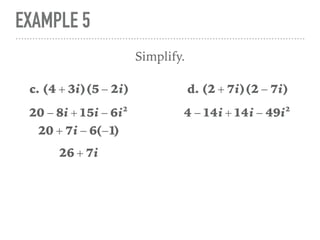
c. (4 + 3i)(5 − 2i)
20 − 8i + 15i − 6i2
20 + 7i − 6(−1)
26 + 7i
d. (2 + 7i)(2 − 7i)
4 − 14i + 14i − 49i2
EXAMPLE 5
Simplify.
c. (4 + 3i)(5 − 2i)
20 − 8i + 15i − 6i2
20 + 7i − 6(−1)
26 + 7i
d. (2 + 7i)(2 − 7i)
4 − 14i + 14i − 49i2
4 − 49(−1)
EXAMPLE 5
Simplify.
c. (4 + 3i)(5 − 2i)
20 − 8i + 15i − 6i2
20 + 7i − 6(−1)
26 + 7i
d. (2 + 7i)(2 − 7i)
4 − 14i + 14i − 49i2
4 − 49(−1)
53
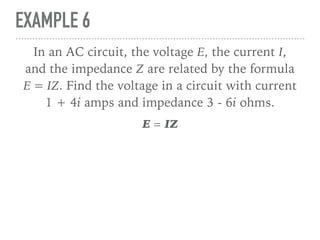
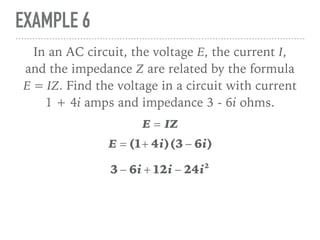
EXAMPLE 6
In an AC circuit, the voltage E, the current I,
and the impedance Z are related by the formula
E = IZ. Find the voltage in a circuit with current
1 + 4i amps and impedance 3 - 6i ohms.
E = IZ
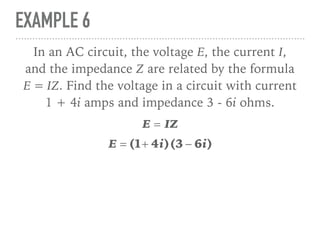
EXAMPLE 6
In an AC circuit, the voltage E, the current I,
and the impedance Z are related by the formula
E = IZ. Find the voltage in a circuit with current
1 + 4i amps and impedance 3 - 6i ohms.
E = IZ
E = (1+ 4i)(3 − 6i)
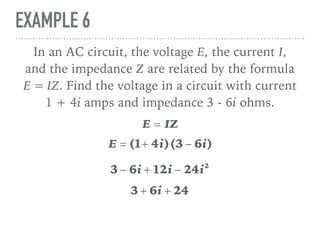
EXAMPLE 6
In an AC circuit, the voltage E, the current I,
and the impedance Z are related by the formula
E = IZ. Find the voltage in a circuit with current
1 + 4i amps and impedance 3 - 6i ohms.
E = IZ
E = (1+ 4i)(3 − 6i)
3 − 6i + 12i − 24i2
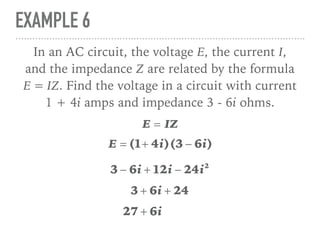
EXAMPLE 6
In an AC circuit, the voltage E, the current I,
and the impedance Z are related by the formula
E = IZ. Find the voltage in a circuit with current
1 + 4i amps and impedance 3 - 6i ohms.
E = IZ
E = (1+ 4i)(3 − 6i)
3 − 6i + 12i − 24i2
3 + 6i + 24
EXAMPLE 6
In an AC circuit, the voltage E, the current I,
and the impedance Z are related by the formula
E = IZ. Find the voltage in a circuit with current
1 + 4i amps and impedance 3 - 6i ohms.
E = IZ
E = (1+ 4i)(3 − 6i)
3 − 6i + 12i − 24i2
3 + 6i + 24
27 + 6i
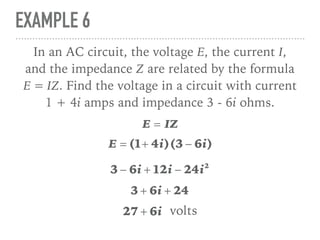
EXAMPLE 6
In an AC circuit, the voltage E, the current I,
and the impedance Z are related by the formula
E = IZ. Find the voltage in a circuit with current
1 + 4i amps and impedance 3 - 6i ohms.
E = IZ
E = (1+ 4i)(3 − 6i)
3 − 6i + 12i − 24i2
3 + 6i + 24
27 + 6i volts
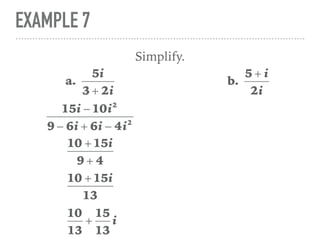
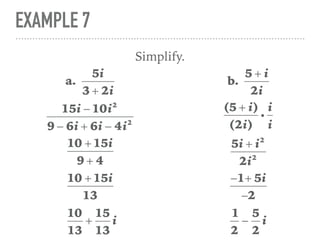
EXAMPLE 7
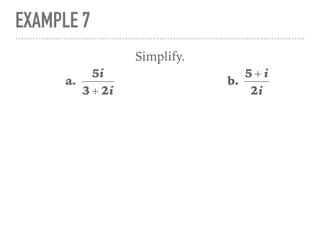
Simplify.
a.
5i
3 + 2i
b.
5 + i
2i
EXAMPLE 7
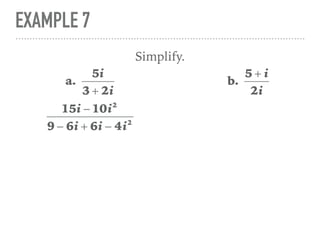
Simplify.
a.
5i
3 + 2i
15i − 10i2
9 − 6i + 6i − 4i2
b.
5 + i
2i
EXAMPLE 7
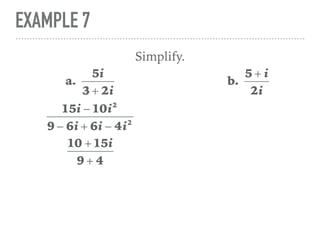
Simplify.
a.
5i
3 + 2i
15i − 10i2
9 − 6i + 6i − 4i2
10 + 15i
9 + 4
b.
5 + i
2i
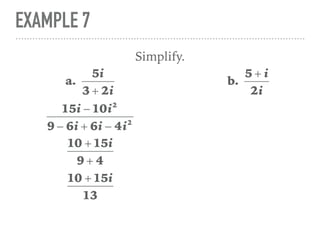
EXAMPLE 7
Simplify.
a.
5i
3 + 2i
15i − 10i2
9 − 6i + 6i − 4i2
10 + 15i
9 + 4
10 + 15i
13
b.
5 + i
2i
EXAMPLE 7
Simplify.
a.
5i
3 + 2i
15i − 10i2
9 − 6i + 6i − 4i2
10 + 15i
9 + 4
10 + 15i
13
10
13
+
15
13
i
b.
5 + i
2i
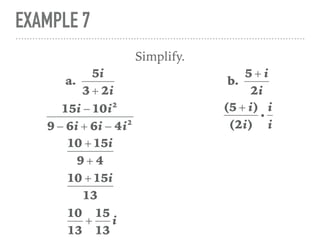
EXAMPLE 7
Simplify.
a.
5i
3 + 2i
15i − 10i2
9 − 6i + 6i − 4i2
10 + 15i
9 + 4
10 + 15i
13
10
13
+
15
13
i
b.
5 + i
2i
(5 + i)
(2i)
i
i
i
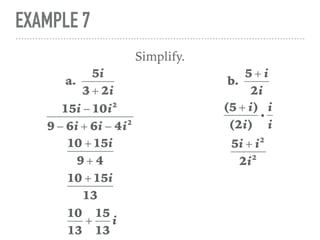
EXAMPLE 7
Simplify.
a.
5i
3 + 2i
15i − 10i2
9 − 6i + 6i − 4i2
10 + 15i
9 + 4
10 + 15i
13
10
13
+
15
13
i
b.
5 + i
2i
(5 + i)
(2i)
i
i
i
5i + i2
2i2
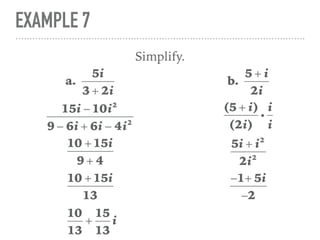
EXAMPLE 7
Simplify.
a.
5i
3 + 2i
15i − 10i2
9 − 6i + 6i − 4i2
10 + 15i
9 + 4
10 + 15i
13
10
13
+
15
13
i
b.
5 + i
2i
(5 + i)
(2i)
i
i
i
5i + i2
2i2
−1+ 5i
−2
EXAMPLE 7
Simplify.
a.
5i
3 + 2i
15i − 10i2
9 − 6i + 6i − 4i2
10 + 15i
9 + 4
10 + 15i
13
10
13
+
15
13
i
b.
5 + i
2i
(5 + i)
(2i)
i
i
i
5i + i2
2i2
−1+ 5i
−2
1
2
−
5
2
i

Algebra 2 Section 3-3

  • 1.
  • 2.
    ESSENTIAL QUESTIONS ➤ Howdo you perform operations with pure imaginary numbers? ➤ How do you perform operations with imaginary numbers?
  • 3.
    VOCABULARY 11. Imaginary Number/Unit: 2.Pure Imaginary Number: 3. Square Root Property:
  • 4.
    VOCABULARY 11. Imaginary Number/Unit:Allows for us to take the square root of a negative number 2. Pure Imaginary Number: 3. Square Root Property:
  • 5.
    VOCABULARY 11. Imaginary Number/Unit:Allows for us to take the square root of a negative number i = −1 2. Pure Imaginary Number: 3. Square Root Property:
  • 6.
    VOCABULARY 11. Imaginary Number/Unit:Allows for us to take the square root of a negative number i = −1 2. Pure Imaginary Number: Numbers that are square roots of negative real numbers 3. Square Root Property:
  • 7.
    VOCABULARY 11. Imaginary Number/Unit:Allows for us to take the square root of a negative number i = −1 2. Pure Imaginary Number: Numbers that are square roots of negative real numbers 5i, − 7i, i 13 3. Square Root Property:
  • 8.
    VOCABULARY 11. Imaginary Number/Unit:Allows for us to take the square root of a negative number i = −1 2. Pure Imaginary Number: Numbers that are square roots of negative real numbers 5i, − 7i, i 13 3. Square Root Property: To negate something that is squared in an equation, you can square root both sides of an equation; this will provide two answers (positive and negative)
  • 9.
  • 10.
    VOCABULARY 4. Complex Number:A number that is a combination of a real and an imaginary part 5. Complex Conjugate:
  • 11.
    VOCABULARY 4. Complex Number:A number that is a combination of a real and an imaginary part 4 + 3i 5. Complex Conjugate:
  • 12.
    VOCABULARY 4. Complex Number:A number that is a combination of a real and an imaginary part 4 + 3i 5. Complex Conjugate: Real part
  • 13.
    VOCABULARY 4. Complex Number:A number that is a combination of a real and an imaginary part 4 + 3i 5. Complex Conjugate: Real part Imaginary part
  • 14.
    VOCABULARY 4. Complex Number:A number that is a combination of a real and an imaginary part 4 + 3i 5. Complex Conjugate: Two complex numbers that when multiplied will result in a real number Real part Imaginary part
  • 15.
    VOCABULARY 4. Complex Number:A number that is a combination of a real and an imaginary part 4 + 3i 5. Complex Conjugate: Two complex numbers that when multiplied will result in a real number a + bi, a − bi Real part Imaginary part
  • 16.
    EXAMPLE 1 a. −28 Simplify. b.−32 c. −81 d. −17
  • 17.
    EXAMPLE 1 a. −28 Simplify. −1i4 i 7 b. −32 c. −81 d. −17
  • 18.
    EXAMPLE 1 a. −28 Simplify. −1i4 i 7 i i 2 i 7 b. −32 c. −81 d. −17
  • 19.
    EXAMPLE 1 a. −28 Simplify. −1i4 i 7 i i 2 i 7 2i 7 b. −32 c. −81 d. −17
  • 20.
    EXAMPLE 1 a. −28 Simplify. −1i4 i 7 i i 2 i 7 2i 7 b. −32 −1i 16 i 2 c. −81 d. −17
  • 21.
    EXAMPLE 1 a. −28 Simplify. −1i4 i 7 i i 2 i 7 2i 7 b. −32 −1i 16 i 2 4i 2 c. −81 d. −17
  • 22.
    EXAMPLE 1 a. −28 Simplify. −1i4 i 7 i i 2 i 7 2i 7 b. −32 −1i 16 i 2 4i 2 c. −81 −1i 81 d. −17
  • 23.
    EXAMPLE 1 a. −28 Simplify. −1i4 i 7 i i 2 i 7 2i 7 b. −32 −1i 16 i 2 4i 2 c. −81 −1i 81 9i d. −17
  • 24.
    EXAMPLE 1 a. −28 Simplify. −1i4 i 7 i i 2 i 7 2i 7 b. −32 −1i 16 i 2 4i 2 c. −81 −1i 81 9i d. −17 −1i 17
  • 25.
    EXAMPLE 1 a. −28 Simplify. −1i4 i 7 i i 2 i 7 2i 7 b. −32 −1i 16 i 2 4i 2 c. −81 −1i 81 9i d. −17 −1i 17 i 17
  • 26.
    EXAMPLE 2 a. −3i i 2i Simplify. b. −12 i −2 c. i32
  • 27.
    EXAMPLE 2 a. −3i i 2i Simplify. −6i2 b. −12 i −2 c. i32
  • 28.
    EXAMPLE 2 a. −3i i 2i Simplify. −6i2 −6(−1) b. −12 i −2 c. i32
  • 29.
    EXAMPLE 2 a. −3i i 2i Simplify. −6i2 −6(−1) 6 b. −12 i −2 c. i32
  • 30.
    EXAMPLE 2 a. −3i i 2i Simplify. −6i2 −6(−1) 6 b. −12 i −2 −1i 12 i −1i 2 c. i32
  • 31.
    EXAMPLE 2 a. −3i i 2i Simplify. −6i2 −6(−1) 6 b. −12 i −2 −1i 12 i −1i 2 −1i 24 c. i32
  • 32.
    EXAMPLE 2 a. −3i i 2i Simplify. −6i2 −6(−1) 6 b. −12 i −2 −1i 12 i −1i 2 −1i 24 c. i32 −1i 4 i 6
  • 33.
    EXAMPLE 2 a. −3i i 2i Simplify. −6i2 −6(−1) 6 b. −12 i −2 −1i 12 i −1i 2 −1i 24 c. i32 −1i 4 i 6 −2 6
  • 34.
    EXAMPLE 2 a. −3i i 2i Simplify. −6i2 −6(−1) 6 b. −12 i −2 −1i 12 i −1i 2 −1i 24 c. i32 (i2 )16 −1i 4 i 6 −2 6
  • 35.
    EXAMPLE 2 a. −3i i 2i Simplify. −6i2 −6(−1) 6 b. −12 i −2 −1i 12 i −1i 2 −1i 24 c. i32 (i2 )16 (−1)16 −1i 4 i 6 −2 6
  • 36.
    EXAMPLE 2 a. −3i i 2i Simplify. −6i2 −6(−1) 6 b. −12 i −2 −1i 12 i −1i 2 −1i 24 c. i32 (i2 )16 (−1)16 −1i 4 i 6 −2 6 1
  • 37.
  • 38.
    EXAMPLE 3 5x2 + 20= 0 Solve. −20 −20
  • 39.
    EXAMPLE 3 5x2 + 20= 0 Solve. 5x2 = −20 −20 −20
  • 40.
    EXAMPLE 3 5x2 + 20= 0 Solve. 5x2 = −20 −20 −20 5 5
  • 41.
    EXAMPLE 3 5x2 + 20= 0 Solve. 5x2 = −20 x2 = −4 −20 −20 5 5
  • 42.
    EXAMPLE 3 5x2 + 20= 0 Solve. 5x2 = −20 x2 = −4 −20 −20 5 5 x2 = ± −4
  • 43.
    EXAMPLE 3 5x2 + 20= 0 Solve. 5x2 = −20 x2 = −4 −20 −20 5 5 x2 = ± −4 x = ±2i
  • 44.
    EXAMPLE 4 2x +yi = −14 − 3i Find the values of x and y that make the equation true.
  • 45.
    EXAMPLE 4 2x +yi = −14 − 3i Find the values of x and y that make the equation true. 2x = −14
  • 46.
    EXAMPLE 4 2x +yi = −14 − 3i Find the values of x and y that make the equation true. 2x = −14 yi = −3i
  • 47.
    EXAMPLE 4 2x +yi = −14 − 3i Find the values of x and y that make the equation true. 2x = −14 yi = −3i 2 2
  • 48.
    EXAMPLE 4 2x +yi = −14 − 3i Find the values of x and y that make the equation true. 2x = −14 yi = −3i 2 2 x = −7
  • 49.
    EXAMPLE 4 2x +yi = −14 − 3i Find the values of x and y that make the equation true. 2x = −14 yi = −3i 2 2 x = −7 i i
  • 50.
    EXAMPLE 4 2x +yi = −14 − 3i Find the values of x and y that make the equation true. 2x = −14 yi = −3i 2 2 x = −7 i i y = −3
  • 51.
    EXAMPLE 5 Simplify. a. (3+ 5i)+(2 − 4i) b. (6 − 6i)−(3 − 7i)
  • 52.
    EXAMPLE 5 Simplify. a. (3+ 5i)+(2 − 4i) 3 + 5i + 2 − 4i b. (6 − 6i)−(3 − 7i)
  • 53.
    EXAMPLE 5 Simplify. a. (3+ 5i)+(2 − 4i) 3 + 5i + 2 − 4i 3 + 2 + 5i − 4i b. (6 − 6i)−(3 − 7i)
  • 54.
    EXAMPLE 5 Simplify. a. (3+ 5i)+(2 − 4i) 3 + 5i + 2 − 4i 3 + 2 + 5i − 4i 5 + i b. (6 − 6i)−(3 − 7i)
  • 55.
    EXAMPLE 5 Simplify. a. (3+ 5i)+(2 − 4i) 3 + 5i + 2 − 4i 3 + 2 + 5i − 4i 5 + i b. (6 − 6i)−(3 − 7i) 6 − 6i − 3 + 7i
  • 56.
    EXAMPLE 5 Simplify. a. (3+ 5i)+(2 − 4i) 3 + 5i + 2 − 4i 3 + 2 + 5i − 4i 5 + i b. (6 − 6i)−(3 − 7i) 6 − 6i − 3 + 7i 3 + i
  • 57.
    EXAMPLE 5 Simplify. c. (4+ 3i)(5 − 2i) d. (2 + 7i)(2 − 7i)
  • 58.
    EXAMPLE 5 Simplify. c. (4+ 3i)(5 − 2i) 20 − 8i + 15i − 6i2 d. (2 + 7i)(2 − 7i)
  • 59.
    EXAMPLE 5 Simplify. c. (4+ 3i)(5 − 2i) 20 − 8i + 15i − 6i2 20 + 7i − 6(−1) d. (2 + 7i)(2 − 7i)
  • 60.
    EXAMPLE 5 Simplify. c. (4+ 3i)(5 − 2i) 20 − 8i + 15i − 6i2 20 + 7i − 6(−1) 26 + 7i d. (2 + 7i)(2 − 7i)
  • 61.
    EXAMPLE 5 Simplify. c. (4+ 3i)(5 − 2i) 20 − 8i + 15i − 6i2 20 + 7i − 6(−1) 26 + 7i d. (2 + 7i)(2 − 7i) 4 − 14i + 14i − 49i2
  • 62.
    EXAMPLE 5 Simplify. c. (4+ 3i)(5 − 2i) 20 − 8i + 15i − 6i2 20 + 7i − 6(−1) 26 + 7i d. (2 + 7i)(2 − 7i) 4 − 14i + 14i − 49i2 4 − 49(−1)
  • 63.
    EXAMPLE 5 Simplify. c. (4+ 3i)(5 − 2i) 20 − 8i + 15i − 6i2 20 + 7i − 6(−1) 26 + 7i d. (2 + 7i)(2 − 7i) 4 − 14i + 14i − 49i2 4 − 49(−1) 53
  • 64.
    EXAMPLE 6 In anAC circuit, the voltage E, the current I, and the impedance Z are related by the formula E = IZ. Find the voltage in a circuit with current 1 + 4i amps and impedance 3 - 6i ohms. E = IZ
  • 65.
    EXAMPLE 6 In anAC circuit, the voltage E, the current I, and the impedance Z are related by the formula E = IZ. Find the voltage in a circuit with current 1 + 4i amps and impedance 3 - 6i ohms. E = IZ E = (1+ 4i)(3 − 6i)
  • 66.
    EXAMPLE 6 In anAC circuit, the voltage E, the current I, and the impedance Z are related by the formula E = IZ. Find the voltage in a circuit with current 1 + 4i amps and impedance 3 - 6i ohms. E = IZ E = (1+ 4i)(3 − 6i) 3 − 6i + 12i − 24i2
  • 67.
    EXAMPLE 6 In anAC circuit, the voltage E, the current I, and the impedance Z are related by the formula E = IZ. Find the voltage in a circuit with current 1 + 4i amps and impedance 3 - 6i ohms. E = IZ E = (1+ 4i)(3 − 6i) 3 − 6i + 12i − 24i2 3 + 6i + 24
  • 68.
    EXAMPLE 6 In anAC circuit, the voltage E, the current I, and the impedance Z are related by the formula E = IZ. Find the voltage in a circuit with current 1 + 4i amps and impedance 3 - 6i ohms. E = IZ E = (1+ 4i)(3 − 6i) 3 − 6i + 12i − 24i2 3 + 6i + 24 27 + 6i
  • 69.
    EXAMPLE 6 In anAC circuit, the voltage E, the current I, and the impedance Z are related by the formula E = IZ. Find the voltage in a circuit with current 1 + 4i amps and impedance 3 - 6i ohms. E = IZ E = (1+ 4i)(3 − 6i) 3 − 6i + 12i − 24i2 3 + 6i + 24 27 + 6i volts
  • 70.
  • 71.
    EXAMPLE 7 Simplify. a. 5i 3 +2i 15i − 10i2 9 − 6i + 6i − 4i2 b. 5 + i 2i
  • 72.
    EXAMPLE 7 Simplify. a. 5i 3 +2i 15i − 10i2 9 − 6i + 6i − 4i2 10 + 15i 9 + 4 b. 5 + i 2i
  • 73.
    EXAMPLE 7 Simplify. a. 5i 3 +2i 15i − 10i2 9 − 6i + 6i − 4i2 10 + 15i 9 + 4 10 + 15i 13 b. 5 + i 2i
  • 74.
    EXAMPLE 7 Simplify. a. 5i 3 +2i 15i − 10i2 9 − 6i + 6i − 4i2 10 + 15i 9 + 4 10 + 15i 13 10 13 + 15 13 i b. 5 + i 2i
  • 75.
    EXAMPLE 7 Simplify. a. 5i 3 +2i 15i − 10i2 9 − 6i + 6i − 4i2 10 + 15i 9 + 4 10 + 15i 13 10 13 + 15 13 i b. 5 + i 2i (5 + i) (2i) i i i
  • 76.
    EXAMPLE 7 Simplify. a. 5i 3 +2i 15i − 10i2 9 − 6i + 6i − 4i2 10 + 15i 9 + 4 10 + 15i 13 10 13 + 15 13 i b. 5 + i 2i (5 + i) (2i) i i i 5i + i2 2i2
  • 77.
    EXAMPLE 7 Simplify. a. 5i 3 +2i 15i − 10i2 9 − 6i + 6i − 4i2 10 + 15i 9 + 4 10 + 15i 13 10 13 + 15 13 i b. 5 + i 2i (5 + i) (2i) i i i 5i + i2 2i2 −1+ 5i −2
  • 78.
    EXAMPLE 7 Simplify. a. 5i 3 +2i 15i − 10i2 9 − 6i + 6i − 4i2 10 + 15i 9 + 4 10 + 15i 13 10 13 + 15 13 i b. 5 + i 2i (5 + i) (2i) i i i 5i + i2 2i2 −1+ 5i −2 1 2 − 5 2 i