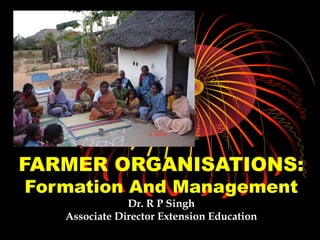
FARMER ORGANISATIONS:
Formation And Management
               Dr. R P Singh
   Associate Director Extension Education
New Roles
    for Extension

•   Empowerment Role
•   Community – Organizing Role
•   Human Resource Development Role
•   Problem solving and Education Role
Involve of the target people in planning, implementation,
      and maintenance as well as management of
       infrastructure and development programs
When the farmers unite…


They can clearly articulate their needs, organize different


services like inputs, credit, implements and transport,


access different service providers and if necessary, act as


pressure groups and demand services
What is Farmer Organization ?

 Farmer organization is a group of
 farmers with special interests and
 concerns with developed structure,
 formal membership, status and
 functions for its members and with a
 set of byelaws and rules
Farmer organizations : Features
• Common interest
• Dynamic and flexible, norms and operating
  procedures
• Both long and short term objectives and plan of
  action
• Enrolment through membership fee
• Democracy through regular elections
• Clear and transparent transactions
• Capacity of the organization should be strong to
  ensure its long term stability and sustainability
• Linkages and network with other farmer
  organizations
• Committed leadership
Why Farmers’
  Organizations?
• Farmers’ organizations influence policies and
  demand for required services.
• Farmers can participate in the decision making
  process of the developmental activities.
• Service system becomes more effective and
  accountable
• They get better access to latest markets and
  technology
• FOs can involve in Farmer and market led
  extension activities
Why Farmers organizations ?
• Build interactions between research,
  extension and farming systems
• Enable farmers to organize themselves for
  action or to share resources
• Analyze farmers problems with extension
  support
• More services can be made available to
  farmers through a single point
• Provide more effective learning environment
Role of
Farmer organizations

  • Representational role
     • Technology role
       • Service role
Types of
Farmer Organizations

 Community based, resource oriented
 farmer organizations
 Commodity based, market oriented
 farmer organizations
Activities of FOs
•   Management of activities
•   Management of environment
•   Management of machinery
•   Management of fields ( Collective production )
•   Management of communal granaries / food
    banks
•   Bulk purchase of inputs
•   Collective requests for credit
•   Management for selling of produce
•   Advice to producers
•   Training to farmers
Steps in Establishing Farmer Organizations
1. Understanding the village community
2. Identifying potential leaders in the community
3. Talking to the identified leaders and seeking
    cooperation from other agencies
4. Helping local leaders to call community meetings
5. Nominating core group leaders to develop the FO
6. Developing an organizational structure for the FO
7. Developing the FO’s management through
    education and action learning
8. Gearing up for action
9. Implementing selected projects
10. Monitoring and Evaluating the FO’s progress
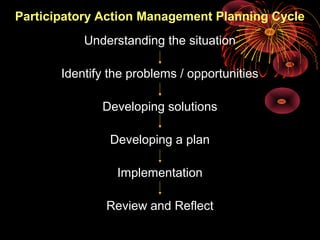
Participatory Action Management Planning Cycle
           Understanding the situation

       Identify the problems / opportunities

              Developing solutions

                Developing a plan

                 Implementation

               Review and Reflect
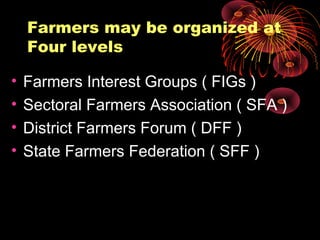
Farmers may be organized at
    Four levels

•   Farmers Interest Groups ( FIGs )
•   Sectoral Farmers Association ( SFA )
•   District Farmers Forum ( DFF )
•   State Farmers Federation ( SFF )
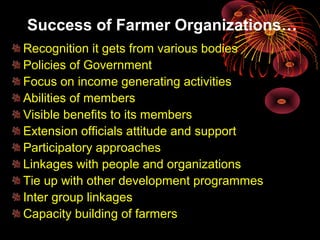
Success of Farmer Organizations…
Recognition it gets from various bodies
Policies of Government
Focus on income generating activities
Abilities of members
Visible benefits to its members
Extension officials attitude and support
Participatory approaches
Linkages with people and organizations
Tie up with other development programmes
Inter group linkages
Capacity building of farmers
How to Strengthen existing FOs
1. Understanding the village community and gaining
   their trust
2. Talking to leaders about why FOs are less active
3. Seeking ideas on strengthening and revitalizing
   community FOs
4. Encouraging local leaders to call community
   meetings
5. Establishing a core group of leaders to draft a
   proposal
6. Getting comments on and community
   endorsement of the strategy
Role of
Extension
Professionals …
 Mobilization and organization role
 Capacity building role
 Problem solving and educating role
 Business support provider role
Examples…

• KERALA initiated group approach
  to extension for RICE farming in
  1989 and subsequently extended to
  other crops
• Formation of community groups to
  improve productivity and reduce
  cost of cultivation
Kerala - Group Approach
• In Kerala there are around 60 farmers organizations of
  varying sizes and mandate, operating in Calicut district
  providing extension services. These organizations are
  formed by the sole initiative of local village leaders without
  any direct involvement of formal or political leaders. All the
  groups are registered as per the cooperative societies act
  and function within the framework of by-laws. Some groups
  are smaller in size serving a single village while some are
  bigger with 300-400 members serving a cluster of villages.
  The bigger organizations are having a federated
  administrative structure with committees at district,
  panchayat and ward levels. The decision making power is
  vested with the central or executive committees which are
  answerable to the General body. The periodicity of core
  committee meetings varies from 1-2 months while that of GB
  is a year
• Kerala Horticultural Development
  Programme (KHDP) formed SHGs of
  vegetable and fruit growers to promote
  new technology and PTD skills, access
  to credit and strengthen their negotiation
  power through collective marketing
• Emerged as Vegetable and Fruit
  Promotion Council, Kerala
• RAJASTHAN adopted the group
  approach to extension in 1992 and
  currently VEO visits village and
  impart training to kisan mandal
  farmers once in a fortnight
• HIMACHAL PRADESH is forming
  Farmer Interest Groups (FIGs) to
  implement many schemes
• The Central Sector Scheme on
  Women in Agriculture (CSSWA) is
  being implemented through women
  SHGs promoted through this
  programme
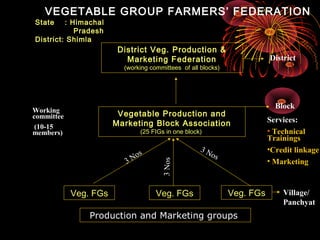
VEGETABLE GROUP FARMERS’ FEDERATION
State    : Himachal
            Pradesh
District: Shimla
                        District Veg. Production &
                          Marketing Federation                           District
                         (working committees of all blocks)


                                                                           Block
Working
committee               Vegetable Production and
                       Marketing Block Association                       Services:
 (10-15
members)                       (25 FIGs in one block)                    • Technical
                                                                         Trainings
                                                    3N                   •Credit linkage
                               s                      os
                          3 No                                           • Marketing
                                      3 Nos


            Veg. FGs                Veg. FGs                  Veg. FGs       Village/
                                                                             Panchyat
                Production and Marketing groups
Abhyudaya Karshak Parishat,
Mukkamala, EG, A.P
•   Estd in 1989
•   Trainings on Paddy and Coconut
•   Emphasis on IPM and INM
•   Farmer to farmer extension
•   Productivity
•   Field visits
FEDERATION OF WOMEN SHGs
        State: Andhra
               Pradesh

                                  Mandal Level Federation                           Services:
                                                                                    • Savings
                                                                                    • Group loans
                                                             3-4 VOs
                                         Cluster                                    • IG activities
                                                                                    •Implementation
Executive                                                                           of govt. programs
body           VOs 1                      VOs 2                    VOs 3..

2 nos.from
each SHG
for VO

                    SHGs SHGs                  SHGs SHGs                  SHGs SHGs
             SHGs                       SHGs                       SHGs
                    SHGs                       SHGs                       SHGs
             SHGs          SHGs         SHGs          SHGs         SHGs          SHGs
    SHGs      SHGs SHGs                  SHGs SHGs                     SHGs SHGs
• Cashew Ratna in MAHARASHTRA :
  Cashew growers in Ratnagiri formed
  into groups and marketed cashew
  under the name of Cashew Ratna and
  reaped benefits
• Commodity Based Groups – Block
  Level Processors Group – District
  level
• Grading, Packing, Marketing
CASHEW RATNA

State     :Maharashtra
District :Ratnagiri


     •Further grading                 District Level Cp
     •Packing                          & Farmer Orgn.
     •Marketing


     Common
     Godown                      Block Level Processors
     •Grading                            Group
     •Packing


                 1                2                 3     4
   Processors
   Group

                         Commodity Based Groups
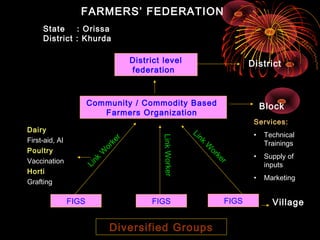
FARMERS’ FEDERATION
     State    : Orissa
     District : Khurda

                                  District level                                    District
                                  federation


                       Community / Commodity Based                                       Block
                          Farmers Organization
                                                                                     Services:
Dairy                                                   Li
                                                          nk                         •   Technical


                                          Link Worker
First-aid, AI
                              r


                                                               W                         Trainings
                            ke


                                                                   or
                         or


Poultry                                                               ke
                        W


                                                                         r           •   Supply of
Vaccination
                      nk


                                                                                         inputs
                   Li


Horti
                                                                                     •   Marketing
Grafting

                FIGS                    FIGS                                 FIGS          Village

                           Diversified Groups
Raitha Mitra Yojane:
Karnataka
is the new demand driven agricultural extension
   system of the Karnataka state. It has replaced
   the earlier T & V system of agricultural
   extension. The agricultural extension centers
   opened under this new programme at hobli
   level are called raitha samparka kendras (rsk)
   with the multidisciplinary approach taking the
   help of input agencies and NGOs
Punjab – Farmers Association
    for Extension Services
•   In Punjab the farmers associations are formed with
    an objective of providing seed production,
    multiplication and demonstration, extension
    education to farming communities.
•   These associations act as a forum for highlighting
    the problems of farming community by imparting
    them new technology and assistance in production.
•   They also create awareness of new high yielding
    varieties of horticulture crops.
•   It also provides for reclamation of land and
    organizing seminars and training camps
Conclusions…
• Sustainable organizations are must for over all
  development
• Extension strategies should involve FOs
• Public, Private extension agencies and NGOs
  should involve FOs
• Govt departments should play a supporting role
  in formation and management of FOs
• Extension functionaries should have skills of
  facilitation
Farmer organisations

Farmer organisations

  • 1.
    FARMER ORGANISATIONS: Formation AndManagement Dr. R P Singh Associate Director Extension Education
  • 2.
    New Roles for Extension • Empowerment Role • Community – Organizing Role • Human Resource Development Role • Problem solving and Education Role
  • 3.
    Involve of thetarget people in planning, implementation, and maintenance as well as management of infrastructure and development programs
  • 4.
    When the farmersunite… They can clearly articulate their needs, organize different services like inputs, credit, implements and transport, access different service providers and if necessary, act as pressure groups and demand services
  • 5.
    What is FarmerOrganization ? Farmer organization is a group of farmers with special interests and concerns with developed structure, formal membership, status and functions for its members and with a set of byelaws and rules
  • 6.
    Farmer organizations :Features • Common interest • Dynamic and flexible, norms and operating procedures • Both long and short term objectives and plan of action • Enrolment through membership fee • Democracy through regular elections • Clear and transparent transactions • Capacity of the organization should be strong to ensure its long term stability and sustainability • Linkages and network with other farmer organizations • Committed leadership
  • 7.
    Why Farmers’ Organizations? • Farmers’ organizations influence policies and demand for required services. • Farmers can participate in the decision making process of the developmental activities. • Service system becomes more effective and accountable • They get better access to latest markets and technology • FOs can involve in Farmer and market led extension activities
  • 8.
    Why Farmers organizations? • Build interactions between research, extension and farming systems • Enable farmers to organize themselves for action or to share resources • Analyze farmers problems with extension support • More services can be made available to farmers through a single point • Provide more effective learning environment
  • 9.
    Role of Farmer organizations • Representational role • Technology role • Service role
  • 10.
    Types of Farmer Organizations Community based, resource oriented farmer organizations Commodity based, market oriented farmer organizations
  • 11.
    Activities of FOs • Management of activities • Management of environment • Management of machinery • Management of fields ( Collective production ) • Management of communal granaries / food banks • Bulk purchase of inputs • Collective requests for credit • Management for selling of produce • Advice to producers • Training to farmers
  • 12.
    Steps in EstablishingFarmer Organizations 1. Understanding the village community 2. Identifying potential leaders in the community 3. Talking to the identified leaders and seeking cooperation from other agencies 4. Helping local leaders to call community meetings 5. Nominating core group leaders to develop the FO 6. Developing an organizational structure for the FO 7. Developing the FO’s management through education and action learning 8. Gearing up for action 9. Implementing selected projects 10. Monitoring and Evaluating the FO’s progress
  • 13.
    Participatory Action ManagementPlanning Cycle Understanding the situation Identify the problems / opportunities Developing solutions Developing a plan Implementation Review and Reflect
  • 14.
    Farmers may beorganized at Four levels • Farmers Interest Groups ( FIGs ) • Sectoral Farmers Association ( SFA ) • District Farmers Forum ( DFF ) • State Farmers Federation ( SFF )
  • 15.
    Success of FarmerOrganizations… Recognition it gets from various bodies Policies of Government Focus on income generating activities Abilities of members Visible benefits to its members Extension officials attitude and support Participatory approaches Linkages with people and organizations Tie up with other development programmes Inter group linkages Capacity building of farmers
  • 16.
    How to Strengthenexisting FOs 1. Understanding the village community and gaining their trust 2. Talking to leaders about why FOs are less active 3. Seeking ideas on strengthening and revitalizing community FOs 4. Encouraging local leaders to call community meetings 5. Establishing a core group of leaders to draft a proposal 6. Getting comments on and community endorsement of the strategy
  • 17.
    Role of Extension Professionals … Mobilization and organization role Capacity building role Problem solving and educating role Business support provider role
  • 18.
    Examples… • KERALA initiatedgroup approach to extension for RICE farming in 1989 and subsequently extended to other crops • Formation of community groups to improve productivity and reduce cost of cultivation
  • 19.
    Kerala - GroupApproach • In Kerala there are around 60 farmers organizations of varying sizes and mandate, operating in Calicut district providing extension services. These organizations are formed by the sole initiative of local village leaders without any direct involvement of formal or political leaders. All the groups are registered as per the cooperative societies act and function within the framework of by-laws. Some groups are smaller in size serving a single village while some are bigger with 300-400 members serving a cluster of villages. The bigger organizations are having a federated administrative structure with committees at district, panchayat and ward levels. The decision making power is vested with the central or executive committees which are answerable to the General body. The periodicity of core committee meetings varies from 1-2 months while that of GB is a year
  • 20.
    • Kerala HorticulturalDevelopment Programme (KHDP) formed SHGs of vegetable and fruit growers to promote new technology and PTD skills, access to credit and strengthen their negotiation power through collective marketing • Emerged as Vegetable and Fruit Promotion Council, Kerala
  • 21.
    • RAJASTHAN adoptedthe group approach to extension in 1992 and currently VEO visits village and impart training to kisan mandal farmers once in a fortnight
  • 22.
    • HIMACHAL PRADESHis forming Farmer Interest Groups (FIGs) to implement many schemes • The Central Sector Scheme on Women in Agriculture (CSSWA) is being implemented through women SHGs promoted through this programme
  • 23.
    VEGETABLE GROUP FARMERS’FEDERATION State : Himachal Pradesh District: Shimla District Veg. Production & Marketing Federation District (working committees of all blocks) Block Working committee Vegetable Production and Marketing Block Association Services: (10-15 members) (25 FIGs in one block) • Technical Trainings 3N •Credit linkage s os 3 No • Marketing 3 Nos Veg. FGs Veg. FGs Veg. FGs Village/ Panchyat Production and Marketing groups
  • 24.
    Abhyudaya Karshak Parishat, Mukkamala,EG, A.P • Estd in 1989 • Trainings on Paddy and Coconut • Emphasis on IPM and INM • Farmer to farmer extension • Productivity • Field visits
  • 25.
    FEDERATION OF WOMENSHGs State: Andhra Pradesh Mandal Level Federation Services: • Savings • Group loans 3-4 VOs Cluster • IG activities •Implementation Executive of govt. programs body VOs 1 VOs 2 VOs 3.. 2 nos.from each SHG for VO SHGs SHGs SHGs SHGs SHGs SHGs SHGs SHGs SHGs SHGs SHGs SHGs SHGs SHGs SHGs SHGs SHGs SHGs SHGs SHGs SHGs SHGs SHGs SHGs SHGs
  • 26.
    • Cashew Ratnain MAHARASHTRA : Cashew growers in Ratnagiri formed into groups and marketed cashew under the name of Cashew Ratna and reaped benefits • Commodity Based Groups – Block Level Processors Group – District level • Grading, Packing, Marketing
  • 27.
    CASHEW RATNA State :Maharashtra District :Ratnagiri •Further grading District Level Cp •Packing & Farmer Orgn. •Marketing Common Godown Block Level Processors •Grading Group •Packing 1 2 3 4 Processors Group Commodity Based Groups
  • 28.
    FARMERS’ FEDERATION State : Orissa District : Khurda District level District federation Community / Commodity Based Block Farmers Organization Services: Dairy Li nk • Technical Link Worker First-aid, AI r W Trainings ke or or Poultry ke W r • Supply of Vaccination nk inputs Li Horti • Marketing Grafting FIGS FIGS FIGS Village Diversified Groups
  • 29.
    Raitha Mitra Yojane: Karnataka isthe new demand driven agricultural extension system of the Karnataka state. It has replaced the earlier T & V system of agricultural extension. The agricultural extension centers opened under this new programme at hobli level are called raitha samparka kendras (rsk) with the multidisciplinary approach taking the help of input agencies and NGOs
  • 30.
    Punjab – FarmersAssociation for Extension Services • In Punjab the farmers associations are formed with an objective of providing seed production, multiplication and demonstration, extension education to farming communities. • These associations act as a forum for highlighting the problems of farming community by imparting them new technology and assistance in production. • They also create awareness of new high yielding varieties of horticulture crops. • It also provides for reclamation of land and organizing seminars and training camps
  • 31.
    Conclusions… • Sustainable organizationsare must for over all development • Extension strategies should involve FOs • Public, Private extension agencies and NGOs should involve FOs • Govt departments should play a supporting role in formation and management of FOs • Extension functionaries should have skills of facilitation