




NETWORKING WITH
FARMERS &
FARMERGROUPS
R P Singh
Associate Director Extension
Directorate of Extension
Education
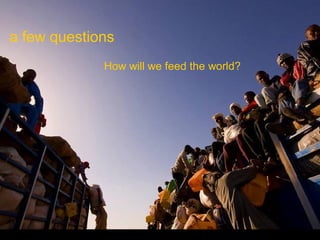
How will we feed the world?
a few questions
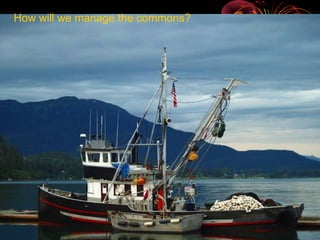
How will we manage the commons?
How will we allocate the world’s biomass to meet
our food, feed, fuel, and fiber needs?
How do we keep market forces from
squeezing out small producers?
How do we make public food service
a driver of sustainability and health?
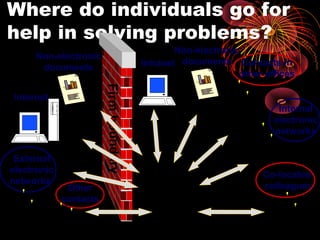
Where do individuals go for
help in solving problems?
Co-located
colleagues
Intranet
Non-electronic
documents
Internal
electronic
networks
Contacts in
other offices
Firmboundary
External
electronic
networks
Internet
Non-electronic
documents
Other
contacts
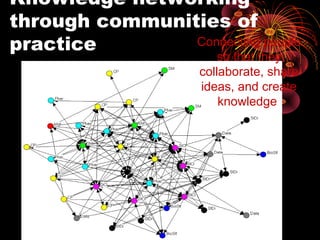
Knowledge networking
through communities of
practice Connecting people
so that they
collaborate, share
ideas, and create
knowledge
What are communities of
practice?
• Groups of people who come
together to share and to learn from
one another face-to-face and/or
virtually.
• They are held together by a
common interest in a body of
knowledge and are driven by a
desire and need to share problems,
experiences, insights, templates,
tools, and best practices.
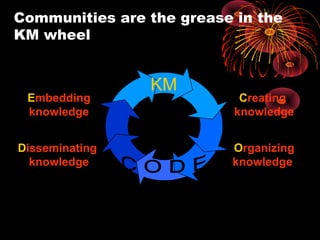
Communities are the grease in the
KM wheel
Creating
knowledge
Embedding
knowledge
Disseminating
knowledge
Organizing
knowledge
C
KM
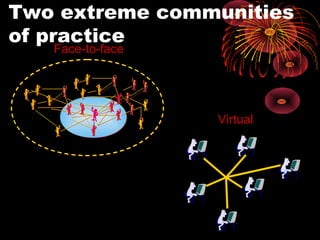
Two extreme communities
of practice
Face-to-face
Virtual
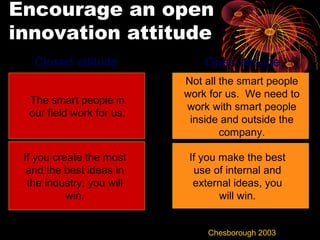
Encourage an open
innovation attitude
Not all the smart people
work for us. We need to
work with smart people
inside and outside the
company.
The smart people in
our field work for us.
If you create the most
and the best ideas in
the industry, you will
win.
If you make the best
use of internal and
external ideas, you
will win.
Closed attitude Open attitude
Chesborough 2003
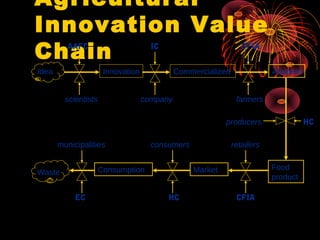
Agricultural
Innovation Value
Chain
Idea
scientists
AAFC
Innovation
IC
company
Commercialized
CFIA
farmers
Adopted
Food
product
HCproducers
retailers
CFIA
Market
consumers
HC
ConsumptionWaste
EC
municipalities
Group Dialogue
• Dialogue is NOT:
• Discussion, deliberation,
negotiation
• Committee, team, task or
working group
• Majority wins, minority
dominance, groupthink
• Dialogue IS:
• Free-flowing exchange of ideas
among equals
• All ideas are solicited and are
considered
( Sunstein, 2006)
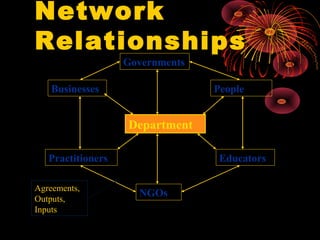
Network
Relationships
Department
Businesses
Governments
People
Practitioners
NGOs
Educators
Agreements,
Outputs,
Inputs
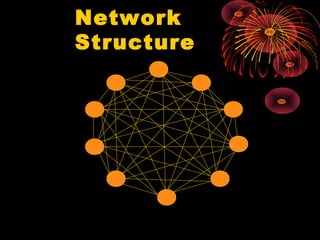
Network
Structure
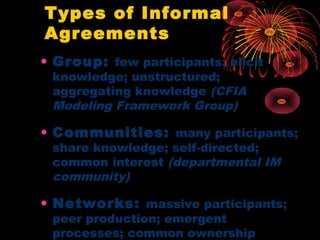
Types of Informal
Agreements
• Group: few participants; elicit
knowledge; unstructured;
aggregating knowledge (CFIA
Modeling Framework Group)
• Communities: many participants;
share knowledge; self-directed;
common interest (departmental IM
community)
• Networks: massive participants;
peer production; emergent
processes; common ownership
Is there a place for family farms?
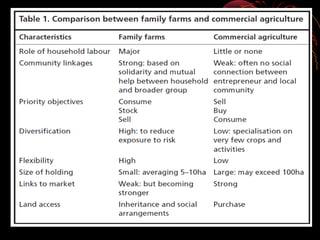
Family Farming
• Versus agro-industrial
farming
• Family has control over
resources
• Family takes decisions in
relation to the
management of the farm
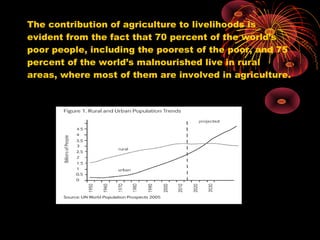
The contribution of agriculture to livelihoods is
evident from the fact that 70 percent of the world’s
poor people, including the poorest of the poor, and 75
percent of the world’s malnourished live in rural
areas, where most of them are involved in agriculture.
So what’s wrong?
•Food crisis
•Environmental crisis
•Climate crisis
•Financial crisis
All of them are interlinked…
CRISIS
•Ecological: deforestation, genetic resources disappear,
toxic wastes, climate change,Hunger and Poverty:
• Food Production: 175 % increase between 1975 and 2005
16 % more food per person
• 15 % world population undernourished
Financial crisis interlinked
Solution for one; more problems for others?
Technology and science
•Green revolution did NOT improve access to food for
poor people; wonder seeds are not pro-poor, don’t
take into account the complexity of farming systems
•India: poorest 30 % of population (285 million!) no
increase in food and nutrient intake during the last 25
years
•Environmental problems: erosion, soil intoxification,
increase in pests and diseases…
Can family farming feed the world?
•‘You don’t have another choice than promote small-scale
agriculture. Those small farmers don’t have another option, there
are no jobs in industry or services for them. In the short term you
can only strive for more means for small farmers, if not, you will
create a massive emigraton from rural areas.‘
• ‘There’s more, small-scale agriculture has 3 big advantages.
Firstly there’s more respect for the environment, just because
there’s no money for pesticides and chemical fertilizers. That
kind of agriculture is more in harmony with the environment and
the climate.
•Secondly, it is a labour-intensive production, creating a lot of
jobs.
•And thirdly, it can be a very productive agriculture, on the
condition that those farmers have access to the know-how that is
needed.
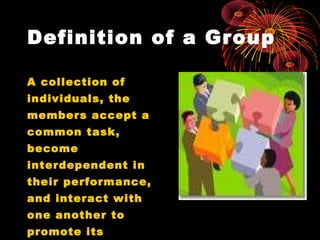
Definition of a Group
A collection of
individuals, the
members accept a
common task,
become
interdependent in
their performance,
and interact with
one another to
promote its
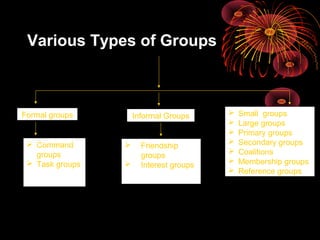
Various Types of Groups
Formal groups Informal Groups  Small groups
 Large groups
 Primary groups
 Secondary groups
 Coalitions
 Membership groups
 Reference groups
 Command
groups
 Task groups
 Friendship
groups
 Interest groups
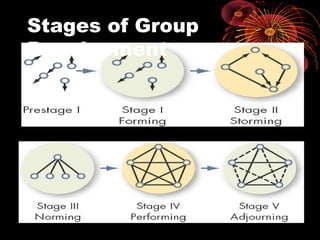
Stages of Group
Development
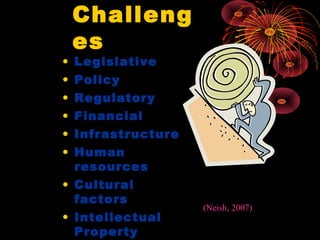
Challeng
es
• Legislative
• Policy
• Regulatory
• Financial
• Infrastructure
• Human
resources
• Cultural
factors
• Intellectual
Property
(Neish, 2007)
Road to
Success• Support from
senior
management
• Clear
understandable
statement of what
you want to do and
why
• Good working
relationships with
corporate and
legal enablers
• Willingness to
compromise on
issues that are not
mission critical
• Perseverance and
(Neish, 2007)
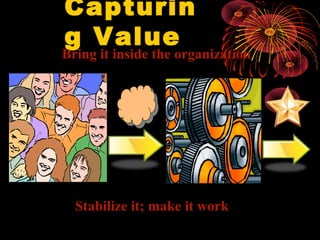
Capturin
g Value
Bring it inside the organization
Stabilize it; make it work
Conclusi
ons
• Social networks have both promise
and peril
• Consider both strengths and
weaknesses
• Analyze both opportunities and
threats
• Is it a tool in search of a problem,
or does it solve a recognized
problem?
• What will it do (or do better) that
Thanks for your attention…
Can I shed
more light on
the subject?

Networking with farmers & farmergroups

  • 1.
    NETWORKING WITH FARMERS & FARMERGROUPS RP Singh Associate Director Extension Directorate of Extension Education
  • 2.
    How will wefeed the world? a few questions
  • 3.
    How will wemanage the commons?
  • 4.
    How will weallocate the world’s biomass to meet our food, feed, fuel, and fiber needs?
  • 5.
    How do wekeep market forces from squeezing out small producers?
  • 6.
    How do wemake public food service a driver of sustainability and health?
  • 7.
    Where do individualsgo for help in solving problems? Co-located colleagues Intranet Non-electronic documents Internal electronic networks Contacts in other offices Firmboundary External electronic networks Internet Non-electronic documents Other contacts
  • 8.
    Knowledge networking through communitiesof practice Connecting people so that they collaborate, share ideas, and create knowledge
  • 9.
    What are communitiesof practice? • Groups of people who come together to share and to learn from one another face-to-face and/or virtually. • They are held together by a common interest in a body of knowledge and are driven by a desire and need to share problems, experiences, insights, templates, tools, and best practices.
  • 10.
    Communities are thegrease in the KM wheel Creating knowledge Embedding knowledge Disseminating knowledge Organizing knowledge C KM
  • 11.
    Two extreme communities ofpractice Face-to-face Virtual
  • 12.
    Encourage an open innovationattitude Not all the smart people work for us. We need to work with smart people inside and outside the company. The smart people in our field work for us. If you create the most and the best ideas in the industry, you will win. If you make the best use of internal and external ideas, you will win. Closed attitude Open attitude Chesborough 2003
  • 13.
  • 14.
    Group Dialogue • Dialogueis NOT: • Discussion, deliberation, negotiation • Committee, team, task or working group • Majority wins, minority dominance, groupthink • Dialogue IS: • Free-flowing exchange of ideas among equals • All ideas are solicited and are considered ( Sunstein, 2006)
  • 15.
  • 16.
  • 17.
    Types of Informal Agreements •Group: few participants; elicit knowledge; unstructured; aggregating knowledge (CFIA Modeling Framework Group) • Communities: many participants; share knowledge; self-directed; common interest (departmental IM community) • Networks: massive participants; peer production; emergent processes; common ownership
  • 18.
    Is there aplace for family farms?
  • 19.
    Family Farming • Versusagro-industrial farming • Family has control over resources • Family takes decisions in relation to the management of the farm
  • 21.
    The contribution ofagriculture to livelihoods is evident from the fact that 70 percent of the world’s poor people, including the poorest of the poor, and 75 percent of the world’s malnourished live in rural areas, where most of them are involved in agriculture.
  • 22.
    So what’s wrong? •Foodcrisis •Environmental crisis •Climate crisis •Financial crisis All of them are interlinked…
  • 23.
    CRISIS •Ecological: deforestation, geneticresources disappear, toxic wastes, climate change,Hunger and Poverty: • Food Production: 175 % increase between 1975 and 2005 16 % more food per person • 15 % world population undernourished Financial crisis interlinked Solution for one; more problems for others?
  • 24.
    Technology and science •Greenrevolution did NOT improve access to food for poor people; wonder seeds are not pro-poor, don’t take into account the complexity of farming systems •India: poorest 30 % of population (285 million!) no increase in food and nutrient intake during the last 25 years •Environmental problems: erosion, soil intoxification, increase in pests and diseases…
  • 25.
    Can family farmingfeed the world? •‘You don’t have another choice than promote small-scale agriculture. Those small farmers don’t have another option, there are no jobs in industry or services for them. In the short term you can only strive for more means for small farmers, if not, you will create a massive emigraton from rural areas.‘ • ‘There’s more, small-scale agriculture has 3 big advantages. Firstly there’s more respect for the environment, just because there’s no money for pesticides and chemical fertilizers. That kind of agriculture is more in harmony with the environment and the climate. •Secondly, it is a labour-intensive production, creating a lot of jobs. •And thirdly, it can be a very productive agriculture, on the condition that those farmers have access to the know-how that is needed.
  • 26.
    Definition of aGroup A collection of individuals, the members accept a common task, become interdependent in their performance, and interact with one another to promote its
  • 27.
    Various Types ofGroups Formal groups Informal Groups  Small groups  Large groups  Primary groups  Secondary groups  Coalitions  Membership groups  Reference groups  Command groups  Task groups  Friendship groups  Interest groups
  • 28.
  • 29.
    Challeng es • Legislative • Policy •Regulatory • Financial • Infrastructure • Human resources • Cultural factors • Intellectual Property (Neish, 2007)
  • 30.
    Road to Success• Supportfrom senior management • Clear understandable statement of what you want to do and why • Good working relationships with corporate and legal enablers • Willingness to compromise on issues that are not mission critical • Perseverance and (Neish, 2007)
  • 31.
    Capturin g Value Bring itinside the organization Stabilize it; make it work
  • 32.
    Conclusi ons • Social networkshave both promise and peril • Consider both strengths and weaknesses • Analyze both opportunities and threats • Is it a tool in search of a problem, or does it solve a recognized problem? • What will it do (or do better) that
  • 33.
    Thanks for yourattention… Can I shed more light on the subject?

Editor's Notes

  • #8 My research at three different companies, Cap Gemini, Icon Medialab, and Ericsson. What do you think used most?
  • #9 See that increasingly through informal networks that info is found and work gets done. Considerable research done on communities of practice, networks of practice. Temporary structures – cps Why do you think this way? Easier than following the traditional chains, don’t know the person, prestige, speak same language, identify with individual, trust. Result is that informal structure better at promoting flexibility, innovation, efficiency Yet unfortunately, mgt in many orgs do not pay attention or provide these networks with resources. Often know little about our own networks outside the closest 5-6 people. And in fact we often treat as invisible enemy, can’t see it, can’t manage it, and one that keeps decisions from being made and work from getting done. But today hope to deepen your understanding of these networks. Company’s intelligence is in its social systems, not in its computer systems – this is data. Tools for developing mutual knowledge
  • #10 Communities of Practice: Boundary spanning A channel for knowledge to flow Means to strengthen the social fabric The locus of knowledge creation and use Solve the problem of getting knowledge to those who need it. COPs, more than any other organization, develop strong feelings of social capital Communication and Ke exchange a regular part of COPs Development of special codes and routines (overlapping knowledge) Training new members - mix of experts/novices New ideas easily flow War stories and gossip critical for exchanging knowledge
  • #11 End this session with our definition of KM
  • #13 Alliances - In addition, they found that successful collaboration between university and industry was often the result of emergent personal relationships. Kreiner & Schulz RD - 40% of potential solutions and opportunities derived from personal external contacts powell et al - interorganizational networks in biotech industry provide knowledge critical to innovation mgt unaware of what going on - 10 vs 57 ongoing efforts at partnering in multinational telecom company.
  • #15 It is important to understand that social networking groups are different from traditional groups found in government departments. Describe what they are not. Describe what they are.
  • #16 This chart places a department in the context of various types external organizations that it might interact with. Discuss the six types of organizations. Note that governments refer to other departments or governments. Interactions with the parent government is through the departmental mandate and budget. Each of these is situated in a different region of the service delivery spectrum, meaning that each type of interaction will be different. Note that these organizations interact with each other as well as a department. The arrows represent two-way agreements between our department and other organizations, the flow of outputs (services) from us to external organizations, and the flow of inputs (services) from external organizations to us. This is a simplified view.
  • #17 A network really looks something like this, with every department connected to every other department. Each connection in a network is called a “node.” Reflect, for a moment on everything that each of the simple connecting lines represents: agreements, content, services, and delivery strategy.
  • #18 Informal agreements can be grouped into three categories. Groups consist of 5-10 people; any larger and synergy is lost in the logistics of participation. Eliciting knowledge means finding out what people might know but haven’t or can’t express. Unstructured means going wherever the dialogue leads and taking whatever time is needed to understand things. Aggregating means considering everything that is known by all members of the groupThe best answers will probably be found in the outliers, not in what everyone already knows. Communities comprise 20-30 people with a common interest; an adequate sample but allows personal trust. More about finding existing expertise and experience; avoiding duplication, reinvention. Self-directed means that the community itself sets the rules of participation, not the organization. Passive mechanisms are needed to “harvest” community outputs to benefit an organization Networks normally comprise more than 100 people; most problems can be solved with enough “eyeballs.” Peer production means that all participants and all knowledge are equal. Emergent processes (complexity theory) means that with enough “agents” outcomes emerge that could not have been predicted.
  • #30 There are a number of challenges to implementing social networks in government departments. A department’s legal mandate may not be suited to SN The policy framework may not permit SN Regulatory activities may be incompatible with SN Financing external activities may be problematic for SN The departmental infrastructure may not support SN HR capacity may be inadequate to implement SN Creating a sharing culture remains a key barrier to SN Protecting departmental IP may be difficult with SN
  • #31 Fortunately, there is a path that leads to social networking success. Describe the five steps.
  • #32 The key question is: if a department participates in a social network, how does it “capture value” from commonly held external intellectual property? The answer, in a few words, is to bring it inside the organization. The common property has to be stabilized. A report, policy, or regulation cannot change once it is formalized. Internal value has to be added by ensuring that it works. For example, in policy, all stakeholder concerns must be addressed; in business, an innovation must be producible and marketable. A key implication is that a department must retain enough internal core capacity to be able to add value to commonly-held IP.
  • #33 In summary, there are a few important things to consider about social networking. Describe the three analyses Describe the two questions
  • #34 I’ll conclude with a few words from THE management guru of the 20 th century. Meanwhile, I’ll be happy to answer any questions that you might have.