Nutrition, Sustainable Livelihoods
and Extension: Linking Agriculture,
 Human Health and Nutrition with
            ENAM Project

     Owuraku Sakyi-Dawson, PhD
         Agricultural Extension Department
   College of Agriculture and Consumer Sciences
                University of Ghana, Legon


           The ENAM Project is funded through the Global
        Livestock-CRSP funded in part by US-AID Grant No.
      PCE-G-00-98-00036-00; Women in Development, US-AID
Overview
• Describe evolution of a framework for
  sustainable linkage between
  agriculture, nutrition and human
  health based on the experiences of
  the ENAM project’s research and
  development approach

• Outline a Nutrition, Sustainable
  Livelihoods and Extension course
  developed from the framework
Sources of the childhood
       malnutrition

• Primarily vegetarian diets
• Deficiencies in micronutrients
      – Vitamin A, B-12, riboflavin,
  calcium, iron and zinc
• Sub-optimal child feeding practices and
  styles
Improved nutrition for better
    health requirements?
• Field fortification / Food systems
  paradigm for sustainable production of
  nutritious food
• Improve diet quality e.g. through
  consumption of Animal Source Food
  (ASF)
     - Challenge – Required increases in
      income and household production
• Knowledge on importance and how of
  improved nutrition
Suitable Framework’s Attributes
• Holistic food-based & integrated
• Diets – balanced, safe / wholesome,
  adequate quantities
• Efficiency in role of agriculture as source
  of inputs for diets (availability and
  diversity), lower prices
• Efficiency in the post-harvest handling,
  distribution - more competitive and lower
  prices
• Agriculture’s role as direct & indirect
  improved income source - accessibility
Primary objectives of ENAM Project
      Planning Grant 2003 - 2004
•Develop a Problem Model with key stakeholders to study the
constraints to the intake of animal source food (ASF) in children

•Identify potential mechanisms to increase the consumption of
ASF

     Primary objectives of ENAM Project
         Research Grant 2004 - 2009
* Implement a multi-sectoral sustainable intervention
(health, agriculture, and business development) to respond to
the constraints identified in the Problem Model

* Integrate training and research for capacity building
Phase 1
  Participatory process to develop
problem model for constraints on use
      of ASF in children’s diets


              Phase 2
 Implement an income-generation
     and education intervention
   (Microfinance, entrepreneurial
 education and nutrition education)


              Phase 3
Transfer of activities to local agents
Phase 1

 Participatory process to develop problem
model for constraints on animal source foods
                   (ASF)
                 Availability
                Accessibility
                 Utilization
  (Based on Food / Nutrition Security
   Framework and Multi- Stakeholder
                 Process)
Problem model for constraints on ASF


                     Feeding skills
                                      Number of extension
     Seasonality     and nutrition        field staff
                      knowledge
   Processing                             Household
   and storage                          food allocation

                         ASF
Pests and diseases    Availability          Household size

                     Accessibility
    Marketing         Utilization       Cultural beliefs
     linkages                            and attitudes

                                        Caregiver
Financial services                    empowerment
                        Income
Suggested interventions to overcome constraints

 Community level
 Stimulate income-generation activities (IGA)
 Provide access to micro-credit loans
 Food processing/storage training
 Entrepreneurship/marketing training


 Nutrition education training for caregivers

 Dialogue with leaders/communities to
change commonly held beliefs and support
women

 Regional/country level
 Extension continuing education
    ●
     Ministry and NGO staff
Phase 2
Implementation of an income-generation and education
                     intervention


  Participatory research and development
  interventions - PRA tools + Multi-Stakeholder
  processes

     - Stakeholder key informants interviews
     - Synthesis
     - Validation workshops
     - Social Mapping / wealth ranking
     - Causal diagramming
Intervention process: identify IGA


     Community                ENAM Team           Community


  Develop list of IGA
                           Consensus on IGA to
                                support
                                                 Promotion of
Reviewed IGA suitability
                                                 selected IGA

                             Develop support
                              packages for
  Cash flow analysis          selected IGA
What are the “best practices” for IGA?
Best practices
   Individual IGA – on-farm and off-farm
   Both cash and real input may be required
   Loan guaranteed by group (social collateral)
   Small weekly loan repayments
   Renewal of loan upon repayment
   Education linked to financial services


 Identified gaps
     Limited emphasis on ASF-specific IGA
     Inconsistent involvement with market linkages
     Limited emphasis on nutrition education & evaluation

     Mixture of activities, actors, service provision
VALUE CHAIN
         APPROACH/FRAMEWORK
Agricultural Value chain—all the activities and
services that bring an agricultural product (or a
service) from its conception to its end use are
important for addressing nutrition


Input    Production          Processing      Wholesale   Retail
supply
                 Financial
                 Services


                                          Services
                                          Support
 Value chain approach—identifying opportunities
 and addressing their constraints throughout the
 value chain at community and industry wide level
VALUE CHAIN FRAMEWORK


      Global Enabling Environment Global
                                  Retailers                   End Markets
     National / Local / Informal
     Enabling Environment                        National
                                                 Retailers
             Sector-specific       Exporters
                                                Wholesalers    Vertical
             providers                                         Linkages


             Cross-cutting           Buyers
             providers                                         Horizontal
                                                               Linkages
                                         Producers
             Financial (cross
             cutting)
                                     Input Suppliers
Supporting
Markets
Sustainable
Livelihoods
Framework                                                                         Livelihood
                                                                                   Outcomes
                                                                              • + Sustainable
                         Livelihood                                           use of NR base
                        Capital Assets                                        • + Income
                                                           Policies &         • + Well-being
                              Human                       Institutions        • - Vulnerability
                                                         (Transforming        • + Food /
                                                          Structures &        Nutrition security
              Social                     Natural           Processes)
                                                    • Structures
                                                           ●
                                                             Government
                                                           ●
                                                             Private Sector
                                                    • Processes
                                                                                 Livelihood
                                                           ●
                                                             Laws                Strategies
                   Physical        Financial               ●
                                                             Policies
                                                           ●
                                                             Culture
   Vulnerability                                           ●
                                                             Institutions
     Context
• Shocks
• Trends
• Seasons
                                         Presentation © IDL
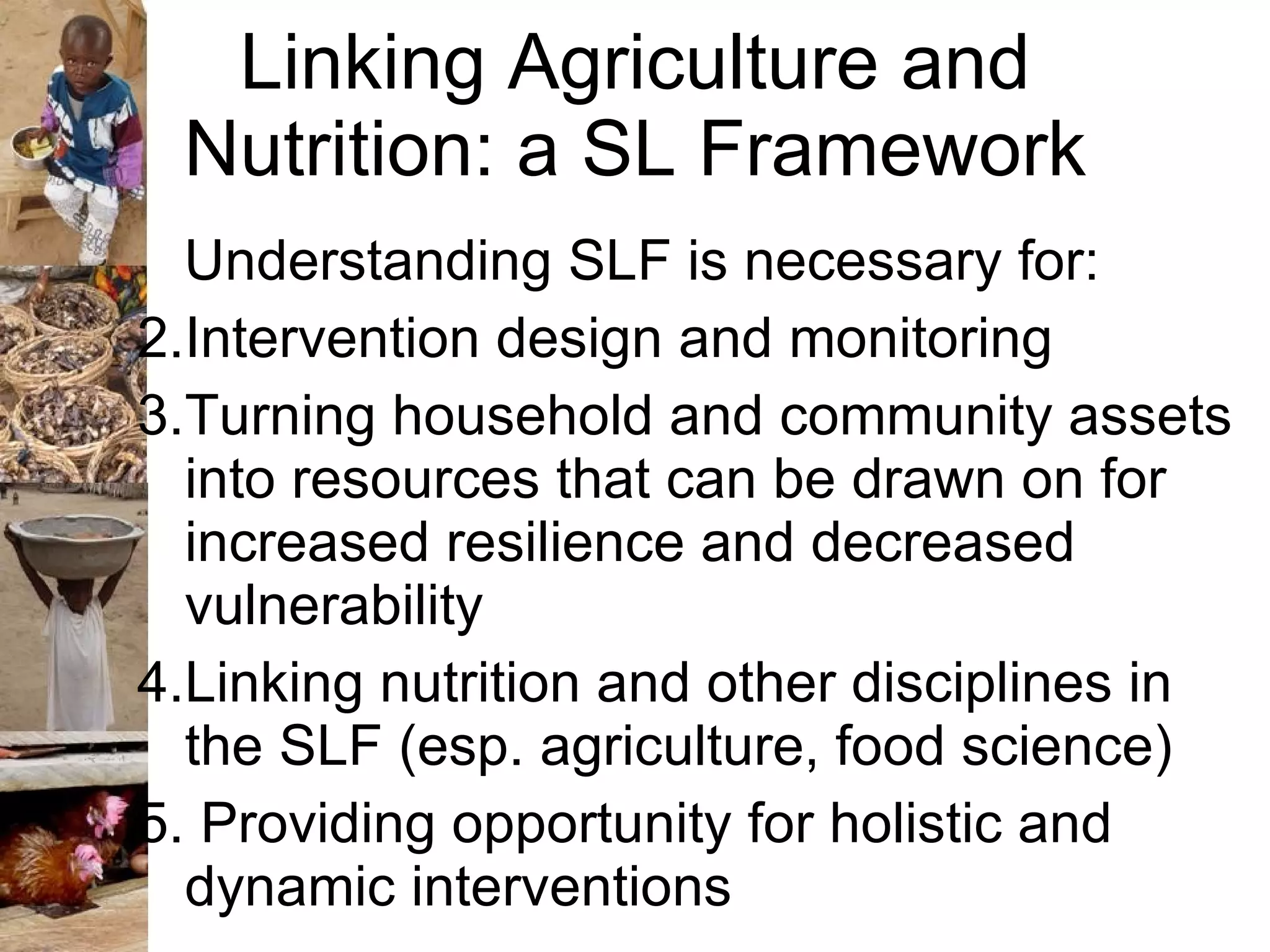
Linking Agriculture and
 Nutrition: a SL Framework
  Understanding SLF is necessary for:
2.Intervention design and monitoring
3.Turning household and community assets
  into resources that can be drawn on for
  increased resilience and decreased
  vulnerability
4.Linking nutrition and other disciplines in
  the SLF (esp. agriculture, food science)
5. Providing opportunity for holistic and
  dynamic interventions
Phase 3
Transfer of activities to local agents
         for sustainability
Phase 3
   Sustainability: transfer of activities to local agents

Making the intervention sustainable

(1) Profitable Income Generation Activities


(2) Continued access to financial services
     Transfer to rural banks

(3) Nutrition education
      Transfer to rural banks
      Transfer to community peer counselors
      Work towards certificate course for extension staff
Partnerships to strengthen sustainability


                Microfinance    Entrepreneurial          Nutrition
ENAM
interventions
                                   activities            education


Enabling         Freedom                                   Peer
institutions       from                Heifer
                                                         Education
& processes       Hunger

                Capacity building and systems strengthening

Permanent                Rural Banks            Communities
Institutions
Lessons for Curriculum
       Development
• A framework for “holistic” food-based
  linkages between agriculture, human
  nutrition and health can address
  malnutrition sustainably if:
  it integrates several components including
  food / nutrition security, value chain,
  sustainable livelihoods, and multi-
  stakeholder processes.
Nutrition, Sustainable Livelihoods and
Extension 2 Credits Course : Univ. of Ghana

• Basic Nutrition
• Nutrition and the SLF
• Role of extension in Nutrition
• Qualitative Assessment Tools w.r.t SLF
  (Multi-Stakeholder Processes)
• Improving Nutrition through Behavior
  Change
• Fieldwork on PRA Tools/ MSPs, Value
  Chains (Food tracking), Assessment of
  Community Nutrition Programs
Good nutrition for healthy lives

Nutrition, Sustainable Livelihoods, and Extension: Linking Agriculture, Human Health, and Nutrition with ENAM

  • 1.
    Nutrition, Sustainable Livelihoods andExtension: Linking Agriculture, Human Health and Nutrition with ENAM Project Owuraku Sakyi-Dawson, PhD Agricultural Extension Department College of Agriculture and Consumer Sciences University of Ghana, Legon The ENAM Project is funded through the Global Livestock-CRSP funded in part by US-AID Grant No. PCE-G-00-98-00036-00; Women in Development, US-AID
  • 2.
    Overview • Describe evolutionof a framework for sustainable linkage between agriculture, nutrition and human health based on the experiences of the ENAM project’s research and development approach • Outline a Nutrition, Sustainable Livelihoods and Extension course developed from the framework
  • 3.
    Sources of thechildhood malnutrition • Primarily vegetarian diets • Deficiencies in micronutrients – Vitamin A, B-12, riboflavin, calcium, iron and zinc • Sub-optimal child feeding practices and styles
  • 4.
    Improved nutrition forbetter health requirements? • Field fortification / Food systems paradigm for sustainable production of nutritious food • Improve diet quality e.g. through consumption of Animal Source Food (ASF) - Challenge – Required increases in income and household production • Knowledge on importance and how of improved nutrition
  • 5.
    Suitable Framework’s Attributes •Holistic food-based & integrated • Diets – balanced, safe / wholesome, adequate quantities • Efficiency in role of agriculture as source of inputs for diets (availability and diversity), lower prices • Efficiency in the post-harvest handling, distribution - more competitive and lower prices • Agriculture’s role as direct & indirect improved income source - accessibility
  • 6.
    Primary objectives ofENAM Project Planning Grant 2003 - 2004 •Develop a Problem Model with key stakeholders to study the constraints to the intake of animal source food (ASF) in children •Identify potential mechanisms to increase the consumption of ASF Primary objectives of ENAM Project Research Grant 2004 - 2009 * Implement a multi-sectoral sustainable intervention (health, agriculture, and business development) to respond to the constraints identified in the Problem Model * Integrate training and research for capacity building
  • 7.
    Phase 1 Participatory process to develop problem model for constraints on use of ASF in children’s diets Phase 2 Implement an income-generation and education intervention (Microfinance, entrepreneurial education and nutrition education) Phase 3 Transfer of activities to local agents
  • 8.
    Phase 1 Participatoryprocess to develop problem model for constraints on animal source foods (ASF) Availability Accessibility Utilization (Based on Food / Nutrition Security Framework and Multi- Stakeholder Process)
  • 9.
    Problem model forconstraints on ASF Feeding skills Number of extension Seasonality and nutrition field staff knowledge Processing Household and storage food allocation ASF Pests and diseases Availability Household size Accessibility Marketing Utilization Cultural beliefs linkages and attitudes Caregiver Financial services empowerment Income
  • 10.
    Suggested interventions toovercome constraints Community level  Stimulate income-generation activities (IGA)  Provide access to micro-credit loans  Food processing/storage training  Entrepreneurship/marketing training  Nutrition education training for caregivers  Dialogue with leaders/communities to change commonly held beliefs and support women Regional/country level Extension continuing education ● Ministry and NGO staff
  • 11.
    Phase 2 Implementation ofan income-generation and education intervention Participatory research and development interventions - PRA tools + Multi-Stakeholder processes - Stakeholder key informants interviews - Synthesis - Validation workshops - Social Mapping / wealth ranking - Causal diagramming
  • 12.
    Intervention process: identifyIGA Community ENAM Team Community Develop list of IGA Consensus on IGA to support Promotion of Reviewed IGA suitability selected IGA Develop support packages for Cash flow analysis selected IGA
  • 13.
    What are the“best practices” for IGA? Best practices Individual IGA – on-farm and off-farm Both cash and real input may be required Loan guaranteed by group (social collateral) Small weekly loan repayments Renewal of loan upon repayment Education linked to financial services Identified gaps Limited emphasis on ASF-specific IGA Inconsistent involvement with market linkages Limited emphasis on nutrition education & evaluation Mixture of activities, actors, service provision
  • 14.
    VALUE CHAIN APPROACH/FRAMEWORK Agricultural Value chain—all the activities and services that bring an agricultural product (or a service) from its conception to its end use are important for addressing nutrition Input Production Processing Wholesale Retail supply Financial Services Services Support Value chain approach—identifying opportunities and addressing their constraints throughout the value chain at community and industry wide level
  • 15.
    VALUE CHAIN FRAMEWORK Global Enabling Environment Global Retailers End Markets National / Local / Informal Enabling Environment National Retailers Sector-specific Exporters Wholesalers Vertical providers Linkages Cross-cutting Buyers providers Horizontal Linkages Producers Financial (cross cutting) Input Suppliers Supporting Markets
  • 16.
    Sustainable Livelihoods Framework Livelihood Outcomes • + Sustainable Livelihood use of NR base Capital Assets • + Income Policies & • + Well-being Human Institutions • - Vulnerability (Transforming • + Food / Structures & Nutrition security Social Natural Processes) • Structures ● Government ● Private Sector • Processes Livelihood ● Laws Strategies Physical Financial ● Policies ● Culture Vulnerability ● Institutions Context • Shocks • Trends • Seasons Presentation © IDL
  • 17.
    Linking Agriculture and Nutrition: a SL Framework Understanding SLF is necessary for: 2.Intervention design and monitoring 3.Turning household and community assets into resources that can be drawn on for increased resilience and decreased vulnerability 4.Linking nutrition and other disciplines in the SLF (esp. agriculture, food science) 5. Providing opportunity for holistic and dynamic interventions
  • 18.
    Phase 3 Transfer ofactivities to local agents for sustainability
  • 19.
    Phase 3 Sustainability: transfer of activities to local agents Making the intervention sustainable (1) Profitable Income Generation Activities (2) Continued access to financial services Transfer to rural banks (3) Nutrition education Transfer to rural banks Transfer to community peer counselors Work towards certificate course for extension staff
  • 20.
    Partnerships to strengthensustainability Microfinance Entrepreneurial Nutrition ENAM interventions activities education Enabling Freedom Peer institutions from Heifer Education & processes Hunger Capacity building and systems strengthening Permanent Rural Banks Communities Institutions
  • 21.
    Lessons for Curriculum Development • A framework for “holistic” food-based linkages between agriculture, human nutrition and health can address malnutrition sustainably if: it integrates several components including food / nutrition security, value chain, sustainable livelihoods, and multi- stakeholder processes.
  • 22.
    Nutrition, Sustainable Livelihoodsand Extension 2 Credits Course : Univ. of Ghana • Basic Nutrition • Nutrition and the SLF • Role of extension in Nutrition • Qualitative Assessment Tools w.r.t SLF (Multi-Stakeholder Processes) • Improving Nutrition through Behavior Change • Fieldwork on PRA Tools/ MSPs, Value Chains (Food tracking), Assessment of Community Nutrition Programs
  • 23.
    Good nutrition forhealthy lives