
Seminar II
              Seminar
                 On
                 On

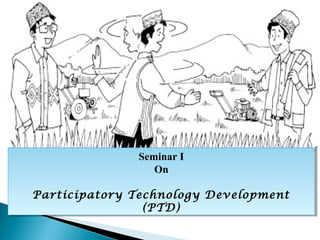
Participatory Technology Development
                (PTD)
                 (PTD)
Introduction
 Agricultural technology needs to be developed keeping the farmers’ livelihoods at the

   center of the innovation process.

 In order to be useful to the farmers, the technology needs to be rooted in their natural,

social and cultural reality.

 Scientists, extensionists and other NGOs are outsiders to a community, hence there is need


   for involvement of farmers in the process of technology development.

 Conventional approaches, based on research station trials followed by unidirectional

   technology transfer, are unlikely to be fruitful.
Definition
“PTD is a long-term interaction between outsiders and local people,
with the aim of generating innovations based on indigenous
knowledge and cultures to develop sustainable livelihood systems”.


More broadly, PTD deals with natural resources management by
strengthening the local indigenous specialists and their communities
to carry out experiments in becoming more sustainable and self
reliant through drawing on their local resources.
Participatory: involving and empowering local people


Technology: based on local people’s knowledge and practical
methods of experimentation


Development: people-centered sustainable agricultural development
based on technological generation from within
Some fundamental aspects of participatory processes:

 Consultation and access to information for the local people about the intentions of

outsiders

 Freedom of choice for local people to engage in a process of innovation.

 Empowerment through redistribution of power on the basis of equity and compatibility.

 Mutual trust and respect

 Distribution of benefits to partners equally.

 Adaptability and flexibility of outside institutions to changing and sometimes unforeseen

   circumstances.
The meaning of technology in PTD
Technology has to do with the ways and means with which humans
apply them-selves to their environment to obtain sustenance and create
a way of life.


The Meaning of Development in PTD
The concept of development in the context of PTD emphasizes the
creativity of local people, their imagination to carry out self-defined
paths in the future.
Participatory Technology Development (PTD) offers a way forward,

through active, involvement of farmers in decision-making and in

every stage of technology development right from the beginning i.e.

identifying their problems


Participatory technology development has been applied to the

process and methodology by which various partners cooperate in

technology development.
History of PTD

Resource-poor farmers (RPFs) had been slow or unable to adopt

recommendations because of the fact that the technologies were not

appropriate for them.

This contributed to the emergence of the Farming Systems Research (FSR)

movement in the 1970s. This was soon followed, and to some extent

paralleled, by the growth of Farmer Participatory Research (FPR) and

Participatory Technology Development (PTD) during the 1980s and 1990s.
Problems with Traditional Technology Development (TTD) method


 Scientist who design the research problem is based on previous work
        done in the area
 Research layouts are done in the research stations which many times
differ from the actual situations of user
 TTD emphasis results in small area, the results of which are apportioned
        to larger area
 The scientist concentrate on one aspect while user is concerned about
related aspects too
How PTD over come these problems

   It involves users in all the stages of technology development, designing to

evaluation of results

   Experiments are conducted in user/farmer situations

   User wisdom is used while deciding the treatments

   Technology are evolved in larger and in multiple locations

   User is involved in evaluation of treatments/experiments
Characteristics of participatory technology development

 The main goal of farmer participatory research is to develop
   appropriate agricultural technology to meet the production needs of
   the small, resource-poor farmers.
 Farmers participate actively in the entire farmer participatory research


   process.
 Both farmers’ and researchers’ knowledge are crucial in coming up
   with technologies that fit local environment and circumstances.
 Research is conducted in farmers’ fields.
 The scientist is an investigator, colleague and advisor.
• Farmer participatory research is based on a systems perspective. A farm is a
 system composed of interacting subsystems that include land, labor, capital,
 crop and animal production, off farm income, social and economic
 components, physical and biological components, etc.


• Farmer participatory research promotes innovative methodologies and
  flexibility.


• Participatory research promotes low cost technologies and a minimum of
 external inputs by using locally-available resources and strengthening the
 farmer’s experimental capacity.
ROLE OF PTD

 To improve indigenous technologies by careful use of external

inputs.

 To enable greater acceptance of eco-friendly technologies by

farmers.

 To faster effective spread of new technologies within a region.
Six basic steps in PTD process


Step I: Getting started
Step II: Understanding problems and opportunities
Step III: Looking for things to try
Step IV: Experimentation
Step V: Sharing the results
Step VI: Keeping up the process
Getting started


 Receiving a request to start collaboration, or selecting communities with
   which collaboration will be sought;
 Gathering and analyzing existing secondary data;
 Making an inventory of existing organizations;
 Clarifying one’s own agenda and possibilities for follow-up after situation
   analysis;
 Building a relationship with the local people and coming to a basic
   agreement on the form of future collaboration.
Understanding problems and opportunities

 Sharing impressions of trends and problems in local farming;
 Supporting farmers in identifying and analyzing their problems and the
   cause-effect relationships involved;
 Clarifying whose problems have been identified;
 Discussing the context of the problems (e.g. wider agro-ecological systems,
   socio-political changes) and analyzing driving/ restraining forces;
 Making an inventory of opportunities and potential resources, including
   human resources and good ideas. The PRA (Participatory Rural Appraisal)
   toolbox is an important source of methods and techniques for these
   activities.
Looking for things to try


 Gathering information for detailed analysis of the identified concerns and

   priority problems;

 Identifying promising solutions from local experience, farmer experts and


   sources outside the community;

 Making a critical review of the options by establishing criteria for

   selecting initial activities and assessing advantages and disadvantages;
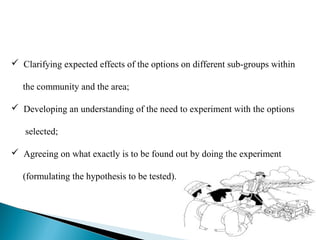
 Clarifying expected effects of the options on different sub-groups within

   the community and the area;

 Developing an understanding of the need to experiment with the options

   selected;

 Agreeing on what exactly is to be found out by doing the experiment

   (formulating the hypothesis to be tested).
Experimentation

 Reviewing farmers’ existing experimental practices;

 Designing selected experiments;

 Defining evaluation criteria and choosing monitoring and evaluation

tools;

 Training farmer experimenters;

 Establishing and managing the experiments;
     Monitoring by the farmer-experimenters supported by PTD

facilitators;

 Evaluating results, both during the course and at the end of the

    experiments, to decide if the option is suitable locally, to develop

    possible technical guidelines for applying it and/or to identify any need

    for further experiments;

 Reviewing the experience of collaboration and experimentation with a

     view to improving the PTD process.
Sharing the results


 Studying the existing patterns and channels of f a r m e r - t o - f a r m e r

        exchange and learning;

 Strengthening farmer-to farmer exchange: visits, farmer-to-farmer training


   through learning-by doing; developing manuals and audiovisuals by and

   for farmers;

 Training farmers as grassroots extensionists/ promoters.
Keeping up the process


 Stimulating group development and linking groups with farmers’

organizations;

 Providing training in fields related to management;

 Strengthening linkages between (groups of) farmers and service

organizations;

     C o n s o l i d a t i n g institutional and policy support to PTD

processes;

    Documenting the process and methods of experimentation and
 Supporting evaluation of the impacts of technologies and the PTD process on

         the livelihood system.

 Consolidated community networks or organizations for agricultural self

management;

 A more supportive i n s t i t u t i o n a l environment;

 Documented and operationalised PTD approach and resource materials;

 Relevant services and input supply
ADVANTAGES

         PTD builds trust between farmers and outsiders

         It strengthens the link between indigenous and scientific knowledge

         It builds human capacity for self reliance


DISADVANTAGES

         The PTD approach takes a long time

         Demands patience

         Humility on the part of the outsiders
Outcomes of using participatory research
The major outcomes expected from using participatory research are related to
behavioral change, resulting benefits and finally impact.

• Research more responsive to farmer needs and adjustment of the research

        agenda to being more relevant:

• First-hand appreciation of the diversity of farmer problems;

• Incorporation of farmers’ criteria into technology design and technology

evaluation;

• Multi-disciplinary teams increase appreciation of socioeconomic factors

by biophysical scientists;
• Identification and use of information technology knowledge (ITK) and
       appreciation for farmer innovation adds value;


• Expanding the integrated application of technologies through farmers’
adaptation and use of system improvement principles;


• Generation of win-win technologies (those that improve food, feed,
income and environment) using farmer-led experimentation;


• Collaborative activities and synergies between farmers, development
partners and researchers have improved chances for change.
A cAse on PTD
A cAse on PTD
Project title: Participatory Technology Development and Participatory

                            Technology Transfer

Collaborators: Sugarcane breeding institute

                 Annamalai university

                NPKRR co-operative sugar mills

Project Area: Nagapattinam district (Thiruvali, Athukudi and Keelaiyer

                villages)
 Nagapattinam district is located in the Cauvery delta region in the east

   coast zone of Tamilnadu

 Rice is the predominantly grown traditional crop

 Establishment of sugar factories encouraged farmers to cultivate

   sugarcane

 Farm holding size varies from 0.25 ha to 5.00 ha

 Average sugarcane yield was around 100 tons per hectare
Steps followed
              Interaction meeting
              Yield gap analysis at macro level
              Selection of three villages with high yield gap
              RRA exercise – transect analysis
              Micro level survey for constraint analysis
              Studying the community protocol
              Organizing cane growers clubs
              Prioritization
              Identification of technologies
              Farmers-scientist workshop
              Conducting PTD experiments
Transect analysis

                Conducted during August, 1993

                To identify the problems

                Constraints affecting sugarcane productivity were listed

                Suggestions were discussed

                Treatments to be included and observation to be recorded

                       were finalized
Name of the trail: Selection of sugarcane verities for wetland conditions
 14 pre-release and released verities were included in the trial
 Farmers assembled in large numbers on the day of planting and on the day of
         recording tiller count
 Farmers themselves were involved in taking yield measurements
 Taking into consideration of the yield obtained from different varieties, it was
         decided that farmers in the village would take up planting of CoG
93076, Co 8021 and Co 89010
 It was observed that the variety CoG 93076 spread very fast and was under
cultivation in more than 800 ha
Name of the trail: Ratoon management
 Treatments included in the trail were “local practice”, “gap filling by
quartering”, “gap filling with polybag seedling” and “local practice +   trash
mulching”
 It was observed that farmers practice of gap filling gave better results
compared to others
 The farmers were visibly happy that their traditional practice would give
better yields
 It was decided that this ITK could be popularized in other parts of the state
 It was further decided that the farmers would take up trash mulching also
wherever possible
BAIF/NRI (Natural resources institute) Goat Research Project
 To identify and address feed-related constraints affecting goat
 Production in semi-arid India.
 Conducted in Rajasthan and Dharwad District, Karnataka, primarily with poor
        people,
 Surveys were conducted in selected villages and constraints were identified
 Project then established some ‘in village’ trials to address one of the priority
problems or needs identified.
 Three technologies developed to address these constraints
 Natural products were seen by both farmers and researchers as being locally
available at minimum cash outlay compared with pharmaceuticals,
Technologies developed through PTD in VFPCK


     To minimize flower drop and increase the yield of cow pea
     To boost bunch weight of banana
     To control pseudo stem borer in banana
     To control of pod borer in cowpea
     To increase the growth and yield of amaranths
     To control American Serpentine Leaf Miner spray Neem Oil Garlic Emulsion
     Managing Sigatoka in banana
Participatory Technology Development (PTD) in Ginger in Sikkim


 Bilateral project between Swiss Development Cooperation (SDC) and Government of
Sikkim, which is implemented by Inter-cooperation (IC) of Switzerland
 The project aims to improve the livelihoods of small and marginal farmers of Sikkim
through natural resource management
 Since 2002
 In August 2002, PTD concept was introduced to ten officials of the DOH from four
districts of Sikkim
 In September 2002, a training was conducted at Gangtok for the DOH field staff and
newly     selected NGO staff to introduce the steps in PTD
 Along side the PTD process, formation of SHG and strengthening them was also

undertaken

 The project provided a grant @ of Rs 1,000/- per farmer to each group so that farmers

          can take loan for timely purchase of inputs and operations

 The DOH provides technical backstopping to PTD in providing the necessary technical

          training on ginger cultivation and management of disease and soil

 A management structure and framework was put in place for timely decision making

and       smooth implementation of the PTD process. NGOs act as intermediary between

          the farmers and the DOH

 Between November 2002 and March 2003, farmers in each SHG analyzed problems

with ginger cultivation
 The problem analysis of ginger cultivation was presented at the four day long Ginger

Platform meeting consisting of farmers, DOH, Scientists from the region, IISR and

abroad and ISPS and ETC India

 The scientists and DOH experts gave potential solution for the problems presented by the

         farmers. This basket of options was later presented to the farmers and the farmers

         selected options based on their priority problem

 Each farmer keeps record of the activities in each of the PTD ginger plots

 Farmers also record qualitative observations pertaining to disease incidence, plant growth

         and health during the growing season and at the time of harvest.
 The farmers in the neighboring village had been observing the PTD process

 The farmers from these villages came forward to join the PTD process. In the second year

          (2004), 5 more farmer groups joined and in the third year (2005), 7 farmer groups

          joined the PTD programme making it a total of 17 PTD SHG groups in the East

          and South districts of Sikkim.

Results

Ginger yield increased from 1:3 to 1:6 to 10 in the plots which were relatively free of

diseases. Farmers who got high yields adopted all the management practices like selection of

healthy seeds, planting on raised beds, good drainage, thick mulching and appropriate

nutrient management and maintaining hygienic conditions in the fields to avoid diseases.

Farmers are able to identify diseases at different stages and take appropriate measures.
WESTERN ORISSA RURAL LIVELIHOODS PROJECT


“PARTICIPATORY TECHNOLOGY DEVELOPMENT AND PROMOTION
OF MICRO IRRIGATION”


Technologies were designed according to the need of the farmers, which directly related to

water lifting, storage, distribution, application, etc.

The design and development of technology was made in such a way that it reduces women

drudgery such as Surface Treadle Pump (STP), Pressure Pump (PP), Rope & Washer Pump

(R&WP), KB Drip Irrigation Systems (Bucket Kit, Drum Kit & Customized drip), Water

Storage Bag, etc.
Some important NGOs which exclusively use PTD are

        Peermade Development Society (Kerala)

        AME Foundation

        BIRD-K

        Action for Social Advancement (Bhopal)
CONCLUSION

PTD is not a substitute for conventional research or researcher- managed on-farm trials. It is

a complementary process which involves linking the power and capacities of agricultural

science to the priorities and capacities of farming communities, in order to develop

productive and sustainable farming systems.


‘An active participation of the beneficiaries in the generation of technology can ensure

that it is ‘user-friendly’.
Participatory technology development

Participatory technology development

  • 1.
    Seminar II Seminar On On Participatory Technology Development Participatory Technology Development (PTD) (PTD)
  • 2.
    Introduction  Agricultural technologyneeds to be developed keeping the farmers’ livelihoods at the center of the innovation process.  In order to be useful to the farmers, the technology needs to be rooted in their natural, social and cultural reality.  Scientists, extensionists and other NGOs are outsiders to a community, hence there is need for involvement of farmers in the process of technology development.  Conventional approaches, based on research station trials followed by unidirectional technology transfer, are unlikely to be fruitful.
  • 3.
    Definition “PTD is along-term interaction between outsiders and local people, with the aim of generating innovations based on indigenous knowledge and cultures to develop sustainable livelihood systems”. More broadly, PTD deals with natural resources management by strengthening the local indigenous specialists and their communities to carry out experiments in becoming more sustainable and self reliant through drawing on their local resources.
  • 4.
    Participatory: involving andempowering local people Technology: based on local people’s knowledge and practical methods of experimentation Development: people-centered sustainable agricultural development based on technological generation from within
  • 5.
    Some fundamental aspectsof participatory processes:  Consultation and access to information for the local people about the intentions of outsiders  Freedom of choice for local people to engage in a process of innovation.  Empowerment through redistribution of power on the basis of equity and compatibility.  Mutual trust and respect  Distribution of benefits to partners equally.  Adaptability and flexibility of outside institutions to changing and sometimes unforeseen circumstances.
  • 6.
    The meaning oftechnology in PTD Technology has to do with the ways and means with which humans apply them-selves to their environment to obtain sustenance and create a way of life. The Meaning of Development in PTD The concept of development in the context of PTD emphasizes the creativity of local people, their imagination to carry out self-defined paths in the future.
  • 7.
    Participatory Technology Development(PTD) offers a way forward, through active, involvement of farmers in decision-making and in every stage of technology development right from the beginning i.e. identifying their problems Participatory technology development has been applied to the process and methodology by which various partners cooperate in technology development.
  • 8.
    History of PTD Resource-poorfarmers (RPFs) had been slow or unable to adopt recommendations because of the fact that the technologies were not appropriate for them. This contributed to the emergence of the Farming Systems Research (FSR) movement in the 1970s. This was soon followed, and to some extent paralleled, by the growth of Farmer Participatory Research (FPR) and Participatory Technology Development (PTD) during the 1980s and 1990s.
  • 9.
    Problems with TraditionalTechnology Development (TTD) method  Scientist who design the research problem is based on previous work done in the area  Research layouts are done in the research stations which many times differ from the actual situations of user  TTD emphasis results in small area, the results of which are apportioned to larger area  The scientist concentrate on one aspect while user is concerned about related aspects too
  • 10.
    How PTD overcome these problems It involves users in all the stages of technology development, designing to evaluation of results Experiments are conducted in user/farmer situations User wisdom is used while deciding the treatments Technology are evolved in larger and in multiple locations User is involved in evaluation of treatments/experiments
  • 11.
    Characteristics of participatorytechnology development  The main goal of farmer participatory research is to develop appropriate agricultural technology to meet the production needs of the small, resource-poor farmers.  Farmers participate actively in the entire farmer participatory research process.  Both farmers’ and researchers’ knowledge are crucial in coming up with technologies that fit local environment and circumstances.  Research is conducted in farmers’ fields.  The scientist is an investigator, colleague and advisor.
  • 12.
    • Farmer participatoryresearch is based on a systems perspective. A farm is a system composed of interacting subsystems that include land, labor, capital, crop and animal production, off farm income, social and economic components, physical and biological components, etc. • Farmer participatory research promotes innovative methodologies and flexibility. • Participatory research promotes low cost technologies and a minimum of external inputs by using locally-available resources and strengthening the farmer’s experimental capacity.
  • 13.
    ROLE OF PTD To improve indigenous technologies by careful use of external inputs.  To enable greater acceptance of eco-friendly technologies by farmers.  To faster effective spread of new technologies within a region.
  • 14.
    Six basic stepsin PTD process Step I: Getting started Step II: Understanding problems and opportunities Step III: Looking for things to try Step IV: Experimentation Step V: Sharing the results Step VI: Keeping up the process
  • 15.
    Getting started  Receivinga request to start collaboration, or selecting communities with which collaboration will be sought;  Gathering and analyzing existing secondary data;  Making an inventory of existing organizations;  Clarifying one’s own agenda and possibilities for follow-up after situation analysis;  Building a relationship with the local people and coming to a basic agreement on the form of future collaboration.
  • 16.
    Understanding problems andopportunities  Sharing impressions of trends and problems in local farming;  Supporting farmers in identifying and analyzing their problems and the cause-effect relationships involved;  Clarifying whose problems have been identified;  Discussing the context of the problems (e.g. wider agro-ecological systems, socio-political changes) and analyzing driving/ restraining forces;  Making an inventory of opportunities and potential resources, including human resources and good ideas. The PRA (Participatory Rural Appraisal) toolbox is an important source of methods and techniques for these activities.
  • 17.
    Looking for thingsto try  Gathering information for detailed analysis of the identified concerns and priority problems;  Identifying promising solutions from local experience, farmer experts and sources outside the community;  Making a critical review of the options by establishing criteria for selecting initial activities and assessing advantages and disadvantages;
  • 18.
     Clarifying expectedeffects of the options on different sub-groups within the community and the area;  Developing an understanding of the need to experiment with the options selected;  Agreeing on what exactly is to be found out by doing the experiment (formulating the hypothesis to be tested).
  • 19.
    Experimentation  Reviewing farmers’existing experimental practices;  Designing selected experiments;  Defining evaluation criteria and choosing monitoring and evaluation tools;  Training farmer experimenters;  Establishing and managing the experiments;
  • 20.
    Monitoring by the farmer-experimenters supported by PTD facilitators;  Evaluating results, both during the course and at the end of the experiments, to decide if the option is suitable locally, to develop possible technical guidelines for applying it and/or to identify any need for further experiments;  Reviewing the experience of collaboration and experimentation with a view to improving the PTD process.
  • 21.
    Sharing the results Studying the existing patterns and channels of f a r m e r - t o - f a r m e r exchange and learning;  Strengthening farmer-to farmer exchange: visits, farmer-to-farmer training through learning-by doing; developing manuals and audiovisuals by and for farmers;  Training farmers as grassroots extensionists/ promoters.
  • 22.
    Keeping up theprocess  Stimulating group development and linking groups with farmers’ organizations;  Providing training in fields related to management;  Strengthening linkages between (groups of) farmers and service organizations;  C o n s o l i d a t i n g institutional and policy support to PTD processes;  Documenting the process and methods of experimentation and
  • 23.
     Supporting evaluationof the impacts of technologies and the PTD process on the livelihood system.  Consolidated community networks or organizations for agricultural self management;  A more supportive i n s t i t u t i o n a l environment;  Documented and operationalised PTD approach and resource materials;  Relevant services and input supply
  • 24.
    ADVANTAGES PTD builds trust between farmers and outsiders It strengthens the link between indigenous and scientific knowledge It builds human capacity for self reliance DISADVANTAGES The PTD approach takes a long time Demands patience Humility on the part of the outsiders
  • 25.
    Outcomes of usingparticipatory research The major outcomes expected from using participatory research are related to behavioral change, resulting benefits and finally impact. • Research more responsive to farmer needs and adjustment of the research agenda to being more relevant: • First-hand appreciation of the diversity of farmer problems; • Incorporation of farmers’ criteria into technology design and technology evaluation; • Multi-disciplinary teams increase appreciation of socioeconomic factors by biophysical scientists;
  • 26.
    • Identification anduse of information technology knowledge (ITK) and appreciation for farmer innovation adds value; • Expanding the integrated application of technologies through farmers’ adaptation and use of system improvement principles; • Generation of win-win technologies (those that improve food, feed, income and environment) using farmer-led experimentation; • Collaborative activities and synergies between farmers, development partners and researchers have improved chances for change.
  • 27.
    A cAse onPTD A cAse on PTD
  • 28.
    Project title: ParticipatoryTechnology Development and Participatory Technology Transfer Collaborators: Sugarcane breeding institute Annamalai university NPKRR co-operative sugar mills Project Area: Nagapattinam district (Thiruvali, Athukudi and Keelaiyer villages)
  • 29.
     Nagapattinam districtis located in the Cauvery delta region in the east coast zone of Tamilnadu  Rice is the predominantly grown traditional crop  Establishment of sugar factories encouraged farmers to cultivate sugarcane  Farm holding size varies from 0.25 ha to 5.00 ha  Average sugarcane yield was around 100 tons per hectare
  • 30.
    Steps followed  Interaction meeting  Yield gap analysis at macro level  Selection of three villages with high yield gap  RRA exercise – transect analysis  Micro level survey for constraint analysis  Studying the community protocol  Organizing cane growers clubs  Prioritization  Identification of technologies  Farmers-scientist workshop  Conducting PTD experiments
  • 31.
    Transect analysis  Conducted during August, 1993  To identify the problems  Constraints affecting sugarcane productivity were listed  Suggestions were discussed  Treatments to be included and observation to be recorded were finalized
  • 32.
    Name of thetrail: Selection of sugarcane verities for wetland conditions  14 pre-release and released verities were included in the trial  Farmers assembled in large numbers on the day of planting and on the day of recording tiller count  Farmers themselves were involved in taking yield measurements  Taking into consideration of the yield obtained from different varieties, it was decided that farmers in the village would take up planting of CoG 93076, Co 8021 and Co 89010  It was observed that the variety CoG 93076 spread very fast and was under cultivation in more than 800 ha
  • 33.
    Name of thetrail: Ratoon management  Treatments included in the trail were “local practice”, “gap filling by quartering”, “gap filling with polybag seedling” and “local practice + trash mulching”  It was observed that farmers practice of gap filling gave better results compared to others  The farmers were visibly happy that their traditional practice would give better yields  It was decided that this ITK could be popularized in other parts of the state  It was further decided that the farmers would take up trash mulching also wherever possible
  • 34.
    BAIF/NRI (Natural resourcesinstitute) Goat Research Project  To identify and address feed-related constraints affecting goat  Production in semi-arid India.  Conducted in Rajasthan and Dharwad District, Karnataka, primarily with poor people,  Surveys were conducted in selected villages and constraints were identified  Project then established some ‘in village’ trials to address one of the priority problems or needs identified.  Three technologies developed to address these constraints  Natural products were seen by both farmers and researchers as being locally available at minimum cash outlay compared with pharmaceuticals,
  • 35.
    Technologies developed throughPTD in VFPCK  To minimize flower drop and increase the yield of cow pea  To boost bunch weight of banana  To control pseudo stem borer in banana  To control of pod borer in cowpea  To increase the growth and yield of amaranths  To control American Serpentine Leaf Miner spray Neem Oil Garlic Emulsion  Managing Sigatoka in banana
  • 36.
    Participatory Technology Development(PTD) in Ginger in Sikkim  Bilateral project between Swiss Development Cooperation (SDC) and Government of Sikkim, which is implemented by Inter-cooperation (IC) of Switzerland  The project aims to improve the livelihoods of small and marginal farmers of Sikkim through natural resource management  Since 2002  In August 2002, PTD concept was introduced to ten officials of the DOH from four districts of Sikkim  In September 2002, a training was conducted at Gangtok for the DOH field staff and newly selected NGO staff to introduce the steps in PTD
  • 37.
     Along sidethe PTD process, formation of SHG and strengthening them was also undertaken  The project provided a grant @ of Rs 1,000/- per farmer to each group so that farmers can take loan for timely purchase of inputs and operations  The DOH provides technical backstopping to PTD in providing the necessary technical training on ginger cultivation and management of disease and soil  A management structure and framework was put in place for timely decision making and smooth implementation of the PTD process. NGOs act as intermediary between the farmers and the DOH  Between November 2002 and March 2003, farmers in each SHG analyzed problems with ginger cultivation
  • 38.
     The problemanalysis of ginger cultivation was presented at the four day long Ginger Platform meeting consisting of farmers, DOH, Scientists from the region, IISR and abroad and ISPS and ETC India  The scientists and DOH experts gave potential solution for the problems presented by the farmers. This basket of options was later presented to the farmers and the farmers selected options based on their priority problem  Each farmer keeps record of the activities in each of the PTD ginger plots  Farmers also record qualitative observations pertaining to disease incidence, plant growth and health during the growing season and at the time of harvest.
  • 39.
     The farmersin the neighboring village had been observing the PTD process  The farmers from these villages came forward to join the PTD process. In the second year (2004), 5 more farmer groups joined and in the third year (2005), 7 farmer groups joined the PTD programme making it a total of 17 PTD SHG groups in the East and South districts of Sikkim. Results Ginger yield increased from 1:3 to 1:6 to 10 in the plots which were relatively free of diseases. Farmers who got high yields adopted all the management practices like selection of healthy seeds, planting on raised beds, good drainage, thick mulching and appropriate nutrient management and maintaining hygienic conditions in the fields to avoid diseases. Farmers are able to identify diseases at different stages and take appropriate measures.
  • 40.
    WESTERN ORISSA RURALLIVELIHOODS PROJECT “PARTICIPATORY TECHNOLOGY DEVELOPMENT AND PROMOTION OF MICRO IRRIGATION” Technologies were designed according to the need of the farmers, which directly related to water lifting, storage, distribution, application, etc. The design and development of technology was made in such a way that it reduces women drudgery such as Surface Treadle Pump (STP), Pressure Pump (PP), Rope & Washer Pump (R&WP), KB Drip Irrigation Systems (Bucket Kit, Drum Kit & Customized drip), Water Storage Bag, etc.
  • 41.
    Some important NGOswhich exclusively use PTD are  Peermade Development Society (Kerala)  AME Foundation  BIRD-K  Action for Social Advancement (Bhopal)
  • 42.
    CONCLUSION PTD is nota substitute for conventional research or researcher- managed on-farm trials. It is a complementary process which involves linking the power and capacities of agricultural science to the priorities and capacities of farming communities, in order to develop productive and sustainable farming systems. ‘An active participation of the beneficiaries in the generation of technology can ensure that it is ‘user-friendly’.