FAILURE TO THRIVE
Dr Kaushik Barot
Assistant Professor ,Pediatrics
DESCRIPTION
Failure to thrive is
 Sustained weight loss.
 Failure to gain weight,
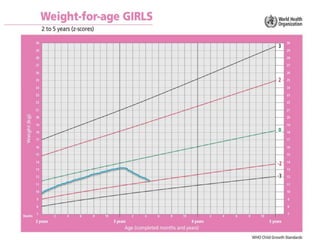
 Persistent fall in weight from the child`s normal
centile.
This excludes Constitutionally light child Transient
weight loss Associated with acute illness
Thrive=grow well
DEFINITION
ATTAINED GROWTH
• Wt for age < 3rd Centile
• Wt for Ht < 5th Centile
• Wt for Ht < 80 %
• Triceps skin fold thickness < 5 mm
RATE OF GROWTH
• < 20gms /day from 0-3 months
• <15gms / day from 3-6 months
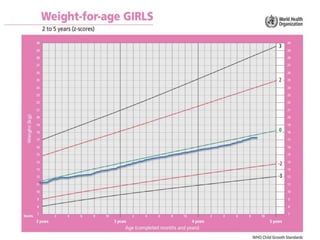
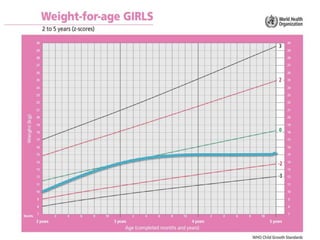
• Fall of from a previously established growth curve
• Downward crossing of > 2 major percentiles on growth chart
INTRODUCTION
 Loosely Applied
 Descriptive than Diagnostic
 Process with result of malnutrition!
 Usually, no apparent etiology
INTRODUCTION
Patho physiologically
 Calorie Insufficiency
 Growth Retardation
Risk Of
 Physical Sequalae
 Psychological Sequalae
 Emotional Sequalae
PITFALLS
• Single observation – avoid
• Observe growth – over a period
• Value of growth charts
• Usually, children < 3 yrs
• Maximum up to 5 yrs
• Small size alone – not adequate
• Remember constitutional & genetic factors
DIFFERENTIATE FROM
• Wasting: Loss of muscle mass.
• Emaciation:- Excessive loss of body fat.
• Cachexia: Only skin & bones, commonly associated
with tuberculosis & malignancy. TNF (also called as
cachexin), Interferon gamma & interleukin 6 like
inflammatory cytokines appear to play a role for
cachexia.
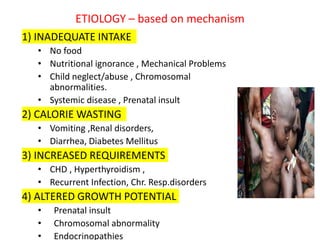
ETIOLOGY – based on mechanism
1) INADEQUATE INTAKE
• No food
• Nutritional ignorance , Mechanical Problems
• Child neglect/abuse , Chromosomal
abnormalities.
• Systemic disease , Prenatal insult
2) CALORIE WASTING
• Vomiting ,Renal disorders,
• Diarrhea, Diabetes Mellitus
3) INCREASED REQUIREMENTS
• CHD , Hyperthyroidism ,
• Recurrent Infection, Chr. Resp.disorders
4) ALTERED GROWTH POTENTIAL
• Prenatal insult
• Chromosomal abnormality
• Endocrinopathies
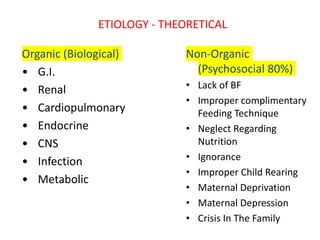
ETIOLOGY - THEORETICAL
Organic (Biological)
• G.I.
• Renal
• Cardiopulmonary
• Endocrine
• CNS
• Infection
• Metabolic
Non-Organic
(Psychosocial 80%)
• Lack of BF
• Improper complimentary
Feeding Technique
• Neglect Regarding
Nutrition
• Ignorance
• Improper Child Rearing
• Maternal Deprivation
• Maternal Depression
• Crisis In The Family
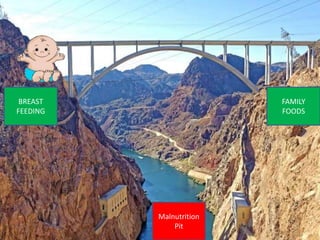
BREAST
FEEDING
FAMILY
FOODS
Malnutrition
Pit
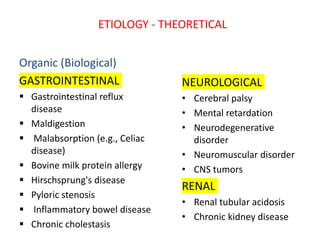
ETIOLOGY - THEORETICAL
Organic (Biological)
GASTROINTESTINAL
 Gastrointestinal reflux
disease
 Maldigestion
 Malabsorption (e.g., Celiac
disease)
 Bovine milk protein allergy
 Hirschsprung's disease
 Pyloric stenosis
 Inflammatory bowel disease
 Chronic cholestasis
NEUROLOGICAL
• Cerebral palsy
• Mental retardation
• Neurodegenerative
disorder
• Neuromuscular disorder
• CNS tumors
RENAL
• Renal tubular acidosis
• Chronic kidney disease
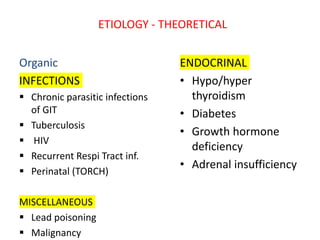
ETIOLOGY - THEORETICAL
Organic
INFECTIONS
 Chronic parasitic infections
of GIT
 Tuberculosis
 HIV
 Recurrent Respi Tract inf.
 Perinatal (TORCH)
MISCELLANEOUS
 Lead poisoning
 Malignancy
ENDOCRINAL
• Hypo/hyper
thyroidism
• Diabetes
• Growth hormone
deficiency
• Adrenal insufficiency
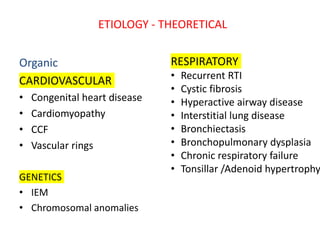
ETIOLOGY - THEORETICAL
Organic
CARDIOVASCULAR
• Congenital heart disease
• Cardiomyopathy
• CCF
• Vascular rings
GENETICS
• IEM
• Chromosomal anomalies
RESPIRATORY
• Recurrent RTI
• Cystic fibrosis
• Hyperactive airway disease
• Interstitial lung disease
• Bronchiectasis
• Bronchopulmonary dysplasia
• Chronic respiratory failure
• Tonsillar /Adenoid hypertrophy
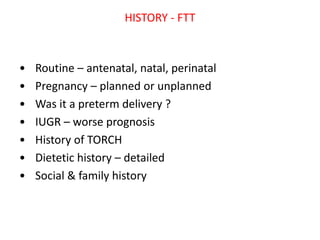
HISTORY - FTT
• Routine – antenatal, natal, perinatal
• Pregnancy – planned or unplanned
• Was it a preterm delivery ?
• IUGR – worse prognosis
• History of TORCH
• Dietetic history – detailed
• Social & family history
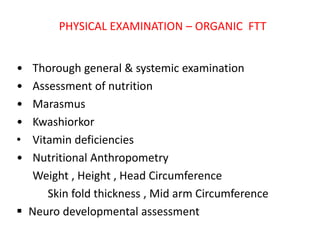
PHYSICAL EXAMINATION – ORGANIC FTT
• Thorough general & systemic examination
• Assessment of nutrition
• Marasmus
• Kwashiorkor
• Vitamin deficiencies
• Nutritional Anthropometry
Weight , Height , Head Circumference
Skin fold thickness , Mid arm Circumference
 Neuro developmental assessment
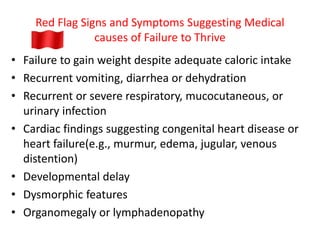
Red Flag Signs and Symptoms Suggesting Medical
causes of Failure to Thrive
• Failure to gain weight despite adequate caloric intake
• Recurrent vomiting, diarrhea or dehydration
• Recurrent or severe respiratory, mucocutaneous, or
urinary infection
• Cardiac findings suggesting congenital heart disease or
heart failure(e.g., murmur, edema, jugular, venous
distention)
• Developmental delay
• Dysmorphic features
• Organomegaly or lymphadenopathy
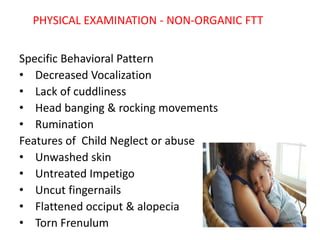
PHYSICAL EXAMINATION - NON-ORGANIC FTT
Specific Behavioral Pattern
• Decreased Vocalization
• Lack of cuddliness
• Head banging & rocking movements
• Rumination
Features of Child Neglect or abuse
• Unwashed skin
• Untreated Impetigo
• Uncut fingernails
• Flattened occiput & alopecia
• Torn Frenulum
LABORATORY AIDS TO DIAGNOSIS
• Indicated only in organic FTT
• Avoid unnecessary investigations
• Start with simple & noninvasive
• Proceed to complex & invasive
LABORATORY AIDS TO DIAGNOSIS
Initial Evaluation
•CBC & ESR
•Renal function tests & Serum electrolytes
•Liver function tests
•Complete Urine Analysis
•Stool Examination
•Mantoux Test ,CXR PA view
•X Rays – To Rule Out PC, Child Abuse , Bone Age
Estimation
•Celiac disease workup if suspected.
LABORATORY AIDS TO DIAGNOSIS
Definitive Tests
• Pattern I - No Further Test Except Maternal Psycho
Evaluation
• Pattern II - Evaluation of Malabsorption - Stool
Fat, Chymotrypsin, Sweat Chloride, Small Bowel
Biopsy , LFT
• Pattern III
A. With Vomiting - Electrolytes, pH, Glucose, BUN, Serum &
Urine Amino acids , Upper G.I. Contrast Studies
B. Without Vomiting - Barium Enema , TFT, IVP, Sigmoidoscopy
INDICATIONS FOR ADMISSION
•Weight for height less than 70 % of the median
•Detailed evaluation for suspected organic disorder
•Suspected child abuse or neglect
•Nonresponse to outpatient management
MANAGEMENT GOALS
•Nutritional rehabilitation
•Find and treat organic cause if any
•Address psychosocial and developmental issues
APPROACH TO A CHILD WITH FTT
NUTRITIONAL REHABILITATION – RESPONSE
PATTERN I - Intake adequate, Wt. gain satisfactory
- Feeding technique at fault
- Poverty & Ignorance
- Disturbed Infant Mother relationship
APPROACH TO A CHILD WITH FTT
NUTRITIONAL REHABILITATION – RESPONSE
PATERN II - Intake adequate , no
weight gain
Malabsorption - GIARDIASIS, C.F, LACT.
INTOL.
Renal - R.T.A. , D.I. , CRF
Diabetes Mellitus
Hyperthyroidism
APPROACH TO A CHILD WITH FTT
NUTRITIONAL REHABILITATION – RESPONSE
PATTERN III - Inadequate intake, No Wt Gain
–Difficulty in sucking & swallowing ( Mechanical or
Primary Neurological )
–Inability to take large quantities (Chr.Infection,
Cardio Pulm. disease )
–Vomiting ( GERD, CHPS, Metabolic disorders,
Increased ICT, Adrenal Insufficiency )
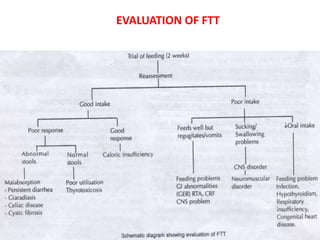
EVALUATION OF FTT
PROGNOSIS
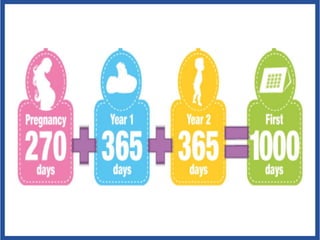
•FTT in first year of life regardless of etiology –
prognosis is ominous
•Maximal brain growth occurs during the first six to
twelve months of age .
•One third of children with Psychosocial FTT have
developmental delay, social & emotional problems
•Prognosis for organic FTT - variable - depends on
the etiology
Thank You

Failure to thrive

  • 1.
    FAILURE TO THRIVE DrKaushik Barot Assistant Professor ,Pediatrics
  • 5.
    DESCRIPTION Failure to thriveis  Sustained weight loss.  Failure to gain weight,  Persistent fall in weight from the child`s normal centile. This excludes Constitutionally light child Transient weight loss Associated with acute illness Thrive=grow well
  • 6.
    DEFINITION ATTAINED GROWTH • Wtfor age < 3rd Centile • Wt for Ht < 5th Centile • Wt for Ht < 80 % • Triceps skin fold thickness < 5 mm RATE OF GROWTH • < 20gms /day from 0-3 months • <15gms / day from 3-6 months • Fall of from a previously established growth curve • Downward crossing of > 2 major percentiles on growth chart
  • 7.
    INTRODUCTION  Loosely Applied Descriptive than Diagnostic  Process with result of malnutrition!  Usually, no apparent etiology
  • 8.
    INTRODUCTION Patho physiologically  CalorieInsufficiency  Growth Retardation Risk Of  Physical Sequalae  Psychological Sequalae  Emotional Sequalae
  • 10.
    PITFALLS • Single observation– avoid • Observe growth – over a period • Value of growth charts • Usually, children < 3 yrs • Maximum up to 5 yrs • Small size alone – not adequate • Remember constitutional & genetic factors
  • 11.
    DIFFERENTIATE FROM • Wasting:Loss of muscle mass. • Emaciation:- Excessive loss of body fat. • Cachexia: Only skin & bones, commonly associated with tuberculosis & malignancy. TNF (also called as cachexin), Interferon gamma & interleukin 6 like inflammatory cytokines appear to play a role for cachexia.
  • 12.
    ETIOLOGY – basedon mechanism 1) INADEQUATE INTAKE • No food • Nutritional ignorance , Mechanical Problems • Child neglect/abuse , Chromosomal abnormalities. • Systemic disease , Prenatal insult 2) CALORIE WASTING • Vomiting ,Renal disorders, • Diarrhea, Diabetes Mellitus 3) INCREASED REQUIREMENTS • CHD , Hyperthyroidism , • Recurrent Infection, Chr. Resp.disorders 4) ALTERED GROWTH POTENTIAL • Prenatal insult • Chromosomal abnormality • Endocrinopathies
  • 13.
    ETIOLOGY - THEORETICAL Organic(Biological) • G.I. • Renal • Cardiopulmonary • Endocrine • CNS • Infection • Metabolic Non-Organic (Psychosocial 80%) • Lack of BF • Improper complimentary Feeding Technique • Neglect Regarding Nutrition • Ignorance • Improper Child Rearing • Maternal Deprivation • Maternal Depression • Crisis In The Family
  • 14.
  • 15.
    ETIOLOGY - THEORETICAL Organic(Biological) GASTROINTESTINAL  Gastrointestinal reflux disease  Maldigestion  Malabsorption (e.g., Celiac disease)  Bovine milk protein allergy  Hirschsprung's disease  Pyloric stenosis  Inflammatory bowel disease  Chronic cholestasis NEUROLOGICAL • Cerebral palsy • Mental retardation • Neurodegenerative disorder • Neuromuscular disorder • CNS tumors RENAL • Renal tubular acidosis • Chronic kidney disease
  • 16.
    ETIOLOGY - THEORETICAL Organic INFECTIONS Chronic parasitic infections of GIT  Tuberculosis  HIV  Recurrent Respi Tract inf.  Perinatal (TORCH) MISCELLANEOUS  Lead poisoning  Malignancy ENDOCRINAL • Hypo/hyper thyroidism • Diabetes • Growth hormone deficiency • Adrenal insufficiency
  • 17.
    ETIOLOGY - THEORETICAL Organic CARDIOVASCULAR •Congenital heart disease • Cardiomyopathy • CCF • Vascular rings GENETICS • IEM • Chromosomal anomalies RESPIRATORY • Recurrent RTI • Cystic fibrosis • Hyperactive airway disease • Interstitial lung disease • Bronchiectasis • Bronchopulmonary dysplasia • Chronic respiratory failure • Tonsillar /Adenoid hypertrophy
  • 18.
    HISTORY - FTT •Routine – antenatal, natal, perinatal • Pregnancy – planned or unplanned • Was it a preterm delivery ? • IUGR – worse prognosis • History of TORCH • Dietetic history – detailed • Social & family history
  • 19.
    PHYSICAL EXAMINATION –ORGANIC FTT • Thorough general & systemic examination • Assessment of nutrition • Marasmus • Kwashiorkor • Vitamin deficiencies • Nutritional Anthropometry Weight , Height , Head Circumference Skin fold thickness , Mid arm Circumference  Neuro developmental assessment
  • 20.
    Red Flag Signsand Symptoms Suggesting Medical causes of Failure to Thrive • Failure to gain weight despite adequate caloric intake • Recurrent vomiting, diarrhea or dehydration • Recurrent or severe respiratory, mucocutaneous, or urinary infection • Cardiac findings suggesting congenital heart disease or heart failure(e.g., murmur, edema, jugular, venous distention) • Developmental delay • Dysmorphic features • Organomegaly or lymphadenopathy
  • 21.
    PHYSICAL EXAMINATION -NON-ORGANIC FTT Specific Behavioral Pattern • Decreased Vocalization • Lack of cuddliness • Head banging & rocking movements • Rumination Features of Child Neglect or abuse • Unwashed skin • Untreated Impetigo • Uncut fingernails • Flattened occiput & alopecia • Torn Frenulum
  • 22.
    LABORATORY AIDS TODIAGNOSIS • Indicated only in organic FTT • Avoid unnecessary investigations • Start with simple & noninvasive • Proceed to complex & invasive
  • 23.
    LABORATORY AIDS TODIAGNOSIS Initial Evaluation •CBC & ESR •Renal function tests & Serum electrolytes •Liver function tests •Complete Urine Analysis •Stool Examination •Mantoux Test ,CXR PA view •X Rays – To Rule Out PC, Child Abuse , Bone Age Estimation •Celiac disease workup if suspected.
  • 24.
    LABORATORY AIDS TODIAGNOSIS Definitive Tests • Pattern I - No Further Test Except Maternal Psycho Evaluation • Pattern II - Evaluation of Malabsorption - Stool Fat, Chymotrypsin, Sweat Chloride, Small Bowel Biopsy , LFT • Pattern III A. With Vomiting - Electrolytes, pH, Glucose, BUN, Serum & Urine Amino acids , Upper G.I. Contrast Studies B. Without Vomiting - Barium Enema , TFT, IVP, Sigmoidoscopy
  • 25.
    INDICATIONS FOR ADMISSION •Weightfor height less than 70 % of the median •Detailed evaluation for suspected organic disorder •Suspected child abuse or neglect •Nonresponse to outpatient management
  • 26.
    MANAGEMENT GOALS •Nutritional rehabilitation •Findand treat organic cause if any •Address psychosocial and developmental issues
  • 27.
    APPROACH TO ACHILD WITH FTT NUTRITIONAL REHABILITATION – RESPONSE PATTERN I - Intake adequate, Wt. gain satisfactory - Feeding technique at fault - Poverty & Ignorance - Disturbed Infant Mother relationship
  • 28.
    APPROACH TO ACHILD WITH FTT NUTRITIONAL REHABILITATION – RESPONSE PATERN II - Intake adequate , no weight gain Malabsorption - GIARDIASIS, C.F, LACT. INTOL. Renal - R.T.A. , D.I. , CRF Diabetes Mellitus Hyperthyroidism
  • 29.
    APPROACH TO ACHILD WITH FTT NUTRITIONAL REHABILITATION – RESPONSE PATTERN III - Inadequate intake, No Wt Gain –Difficulty in sucking & swallowing ( Mechanical or Primary Neurological ) –Inability to take large quantities (Chr.Infection, Cardio Pulm. disease ) –Vomiting ( GERD, CHPS, Metabolic disorders, Increased ICT, Adrenal Insufficiency )
  • 30.
  • 31.
    PROGNOSIS •FTT in firstyear of life regardless of etiology – prognosis is ominous •Maximal brain growth occurs during the first six to twelve months of age . •One third of children with Psychosocial FTT have developmental delay, social & emotional problems •Prognosis for organic FTT - variable - depends on the etiology
  • 32.