W. SIMWANZA
Failure to thrive
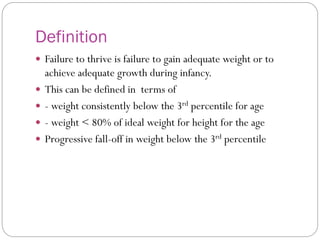
Definition
 Failure to thrive is failure to gain adequate weight or to
achieve adequate growth during infancy.
 This can be defined in terms of
 - weight consistently below the 3rd percentile for age
 - weight < 80% of ideal weight for height for the age
 Progressive fall-off in weight below the 3rd percentile
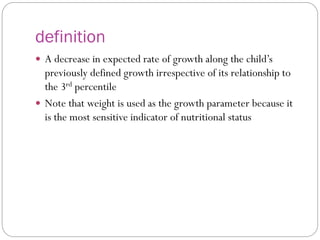
definition
 A decrease in expected rate of growth along the child’s
previously defined growth irrespective of its relationship to
the 3rd percentile
 Note that weight is used as the growth parameter because it
is the most sensitive indicator of nutritional status
definition
 Inhibition of expected height growth rate usually indicates
more severe and prolonged malnutrition
 A decrease in head circumference growth rate is a late
finding because of preferential brain sparing of protein and
energy utilization
 A decrease in head circumference indicates extreme or
chronic malnutrition
definition
 It is important to remember that 3% of “normal children”
will consistently have weight below the 3rd percentile.
Definition
 Failure to thrive: is used to designate growth failure both
as a symptom and as a syndrome.
 As a symptom, it occurs in patients with a variety of acute or
chronic illnesses that are known to interfere with normal
nutrient intake ,absorption, metabolism or excretion.
 The energy requirements are greater than the energy
required to sustain or promote growth. It is then referred to
as organic FTT.
definition
 As a syndrome, it mostly commonly refers to growth failure
in the infant or child who suffers from environmental neglect
or stimulus deprivation.Then designated non organic
FTT.(no physiological disorder)
definition
 There is the mixed aetiology group who have both organic
and non organic FTT, e.g. a child born prematurely but with
disproportionate growth failure in later infancy.
Aetiology and Pathology
 In FTT of any aetiology, the physiologic basis for impaired
growth is inadequate nutrition to support weight gain.
 In organic FTT, increased metabolism needs or decreased
ability to ingest, absorb or retain foods is the primary defect.
 In organic FTT there is an underlying medical problem
definition
 Nonorganic (psychosocial) failure to thrive occurs in a child who is
usually younger than 2 years old and has no known medical condition
that causes poor growth.
 There are usually psychological, social, or economic problems within
the family of inorganic failure to thrive.
 Inorganic FTT, lack of food may be due to impoverishment, poor
understanding of feeding techniques, improperly prepared formulae or
inadequate supply of breast milk.
 Emotional or maternal deprivation is often related to the nutritional
deprivation.The mother or primary caregiver may neglect proper
feeding of the infant because of preoccupation with the demands or care
of others, her own emotional problems, substance abuse, lack of
knowledge about proper feeding, or lack of understanding of the infant's
needs.

Risk factors for developing inorganic
FTT
 Infants born into families with psychological, social, or economic
problems are more at risk of developing nonorganic failure to thrive.
 Inorganic FTT occurs when maladaptive behaviors develop in both the
infant and the primary caregiver.
 Maladaptive behaviors may develop around problems establishing
regular, calm feeding routines, problems of attachment between the
mother and the infant, and/or problems of separation.
Other risk factors that put a child at risk for developing nonorganic failure
to thrive include mother or primary caregiver with any, or several, of
the following conditions present
 depression
 alcohol or drug abuse
 psychosocial stress
 lack of affection or warmth shown toward infant
definition
 Non- organic FTT
 may be due to a lack of a stimulating person e.g. a mother
secondary to loss of or depression, poor parenting skills,
sense of hostility towards child or response to other
stresses(financial difficulty, marital dysfunction)
Causes: Organic
 1.Inadequate food intake
 -Breastfeeding poorly
 -Bottle feeds too dilute
 -Exclusion diets
 -cleft palate
 -vomiting/reflexes
Causes: Organic
 2.Malabsorption
 -Pancreatic disease
 -shortgut syndrome
 -Enteropathy e.g. Coeliac disease
 -Cow’s milk protein intolerance
Causes: Organic
 3.Increased loss of nutrients
 -Protein losing enteropathy
 -Protein intolerance
 4.chronic illness
 -cardiac,renal,respiratory,
 -chronic infections:HIV,syphilis congenital
Causes: Organic
 5.Increased energy requirements
 -Tumour, catabolic state
 6.Metabolic
 -Hyperthyroidism
 -Congenital adrenal hyperplasia
Causes: Non organic
 1.Undernutrition
 -Poor parental understanding
 -low income
 -poor social support
 2.ChildAbuse
 -Deliberate starvation
 -Parental Psychiatric illness
 The following are the most common symptoms of failure to
thrive. However, each child may experience symptoms differently.
Symptoms may include:
lack of appropriate weight gain
 irritability
 easily fatigued
 excessive sleepiness
 lack of age-appropriate social response (i.e., smile)
 avoids eye contact
 lack of molding to the mother's body
 does not make vocal sounds
 delayed motor development
Diagnosis - history
 History:
 1.growth chart-from birth
 2.Meticulous dietary history including techniques of
milk/food preparation, adequacy of breast milk, weaning
time, schedule for feeds etc.
Diagnosis
 observation of care givers during feeding time will give vital
information. Easy fatigability may indicate underlying
exercise intolerance. Disinterest on part of caregiver – a sign
of depression.
Diagnosis
 3.Assessment of child elimination pattern to determine
abnormal losses through urine, stool, or emesis should be
undertaken to investigate for underlying renal disease,
malabsorption syndrome, pyloric stenosis or gastro
oesophageal reflux.
Diagnosis - history
 4. Past medical history: to evaluate intra uterine growth
retardation, prematurity with uncompensated growth,
chronic infections, neurological problems e.g. Cerebral palsy,
cardiac problems e.g. Congenital heart disease, pulmonary
disease and renal disease
 Family history to evaluate
 - growth patterns
 - recent deprivation of caregiver
Diagnosis – Physical examination
 Should include careful observation of child’s interaction with
individuals in the environment, evidence of self-stimulatory
behaviours e.g. Rocking , banging)
Diagnosis - Laboratory
 Investigations to be done include:
 - FBC, Esr, urinalysis including ph and specific gravity, U/E,
serum creatinine, urine culture, examination of stool for
parasites and reducing substances, odor, colour consistency
and fat content
 -Thyroxine levels if patients growth in height is more
severely affected than growth in weight
Diagnosis Laboratory
 Investigation for infectious disease.
 Radiological assessment for gastro-oesophageal reflux,
pyloric stenosis
Treatment
 Goal: to provide sufficient health and environmental
resources to promote satisfactory growth.
 A nutritionally appropriate diet containing adequate calories
– for catch up growth – 150% normal kcal requirement
/kg/24hr
 Individualised medical and social support
 Education and emotional support to caregiver to deal with
psychosocial issues
Treatment
 Involve parents in participation to in making decisions
concerning child
 Foster care placement may be necessary. Return to biological
parents only if demonstrates ability and resources to
adequately care for the child
Diagnosis - history
 Social history – acceptance of pregnancy, family composition,
socio-economic, financial difficulties
Failure_to_thrive.pdf

Failure_to_thrive.pdf

  • 1.
  • 2.
    Definition  Failure tothrive is failure to gain adequate weight or to achieve adequate growth during infancy.  This can be defined in terms of  - weight consistently below the 3rd percentile for age  - weight < 80% of ideal weight for height for the age  Progressive fall-off in weight below the 3rd percentile
  • 3.
    definition  A decreasein expected rate of growth along the child’s previously defined growth irrespective of its relationship to the 3rd percentile  Note that weight is used as the growth parameter because it is the most sensitive indicator of nutritional status
  • 4.
    definition  Inhibition ofexpected height growth rate usually indicates more severe and prolonged malnutrition  A decrease in head circumference growth rate is a late finding because of preferential brain sparing of protein and energy utilization  A decrease in head circumference indicates extreme or chronic malnutrition
  • 5.
    definition  It isimportant to remember that 3% of “normal children” will consistently have weight below the 3rd percentile.
  • 6.
    Definition  Failure tothrive: is used to designate growth failure both as a symptom and as a syndrome.  As a symptom, it occurs in patients with a variety of acute or chronic illnesses that are known to interfere with normal nutrient intake ,absorption, metabolism or excretion.  The energy requirements are greater than the energy required to sustain or promote growth. It is then referred to as organic FTT.
  • 7.
    definition  As asyndrome, it mostly commonly refers to growth failure in the infant or child who suffers from environmental neglect or stimulus deprivation.Then designated non organic FTT.(no physiological disorder)
  • 8.
    definition  There isthe mixed aetiology group who have both organic and non organic FTT, e.g. a child born prematurely but with disproportionate growth failure in later infancy.
  • 9.
    Aetiology and Pathology In FTT of any aetiology, the physiologic basis for impaired growth is inadequate nutrition to support weight gain.  In organic FTT, increased metabolism needs or decreased ability to ingest, absorb or retain foods is the primary defect.  In organic FTT there is an underlying medical problem
  • 10.
    definition  Nonorganic (psychosocial)failure to thrive occurs in a child who is usually younger than 2 years old and has no known medical condition that causes poor growth.  There are usually psychological, social, or economic problems within the family of inorganic failure to thrive.  Inorganic FTT, lack of food may be due to impoverishment, poor understanding of feeding techniques, improperly prepared formulae or inadequate supply of breast milk.  Emotional or maternal deprivation is often related to the nutritional deprivation.The mother or primary caregiver may neglect proper feeding of the infant because of preoccupation with the demands or care of others, her own emotional problems, substance abuse, lack of knowledge about proper feeding, or lack of understanding of the infant's needs. 
  • 11.
    Risk factors fordeveloping inorganic FTT  Infants born into families with psychological, social, or economic problems are more at risk of developing nonorganic failure to thrive.  Inorganic FTT occurs when maladaptive behaviors develop in both the infant and the primary caregiver.  Maladaptive behaviors may develop around problems establishing regular, calm feeding routines, problems of attachment between the mother and the infant, and/or problems of separation. Other risk factors that put a child at risk for developing nonorganic failure to thrive include mother or primary caregiver with any, or several, of the following conditions present  depression  alcohol or drug abuse  psychosocial stress  lack of affection or warmth shown toward infant
  • 12.
    definition  Non- organicFTT  may be due to a lack of a stimulating person e.g. a mother secondary to loss of or depression, poor parenting skills, sense of hostility towards child or response to other stresses(financial difficulty, marital dysfunction)
  • 13.
    Causes: Organic  1.Inadequatefood intake  -Breastfeeding poorly  -Bottle feeds too dilute  -Exclusion diets  -cleft palate  -vomiting/reflexes
  • 14.
    Causes: Organic  2.Malabsorption -Pancreatic disease  -shortgut syndrome  -Enteropathy e.g. Coeliac disease  -Cow’s milk protein intolerance
  • 15.
    Causes: Organic  3.Increasedloss of nutrients  -Protein losing enteropathy  -Protein intolerance  4.chronic illness  -cardiac,renal,respiratory,  -chronic infections:HIV,syphilis congenital
  • 16.
    Causes: Organic  5.Increasedenergy requirements  -Tumour, catabolic state  6.Metabolic  -Hyperthyroidism  -Congenital adrenal hyperplasia
  • 17.
    Causes: Non organic 1.Undernutrition  -Poor parental understanding  -low income  -poor social support  2.ChildAbuse  -Deliberate starvation  -Parental Psychiatric illness
  • 18.
     The followingare the most common symptoms of failure to thrive. However, each child may experience symptoms differently. Symptoms may include: lack of appropriate weight gain  irritability  easily fatigued  excessive sleepiness  lack of age-appropriate social response (i.e., smile)  avoids eye contact  lack of molding to the mother's body  does not make vocal sounds  delayed motor development
  • 19.
    Diagnosis - history History:  1.growth chart-from birth  2.Meticulous dietary history including techniques of milk/food preparation, adequacy of breast milk, weaning time, schedule for feeds etc.
  • 20.
    Diagnosis  observation ofcare givers during feeding time will give vital information. Easy fatigability may indicate underlying exercise intolerance. Disinterest on part of caregiver – a sign of depression.
  • 21.
    Diagnosis  3.Assessment ofchild elimination pattern to determine abnormal losses through urine, stool, or emesis should be undertaken to investigate for underlying renal disease, malabsorption syndrome, pyloric stenosis or gastro oesophageal reflux.
  • 22.
    Diagnosis - history 4. Past medical history: to evaluate intra uterine growth retardation, prematurity with uncompensated growth, chronic infections, neurological problems e.g. Cerebral palsy, cardiac problems e.g. Congenital heart disease, pulmonary disease and renal disease  Family history to evaluate  - growth patterns  - recent deprivation of caregiver
  • 23.
    Diagnosis – Physicalexamination  Should include careful observation of child’s interaction with individuals in the environment, evidence of self-stimulatory behaviours e.g. Rocking , banging)
  • 24.
    Diagnosis - Laboratory Investigations to be done include:  - FBC, Esr, urinalysis including ph and specific gravity, U/E, serum creatinine, urine culture, examination of stool for parasites and reducing substances, odor, colour consistency and fat content  -Thyroxine levels if patients growth in height is more severely affected than growth in weight
  • 25.
    Diagnosis Laboratory  Investigationfor infectious disease.  Radiological assessment for gastro-oesophageal reflux, pyloric stenosis
  • 26.
    Treatment  Goal: toprovide sufficient health and environmental resources to promote satisfactory growth.  A nutritionally appropriate diet containing adequate calories – for catch up growth – 150% normal kcal requirement /kg/24hr  Individualised medical and social support  Education and emotional support to caregiver to deal with psychosocial issues
  • 27.
    Treatment  Involve parentsin participation to in making decisions concerning child  Foster care placement may be necessary. Return to biological parents only if demonstrates ability and resources to adequately care for the child
  • 28.
    Diagnosis - history Social history – acceptance of pregnancy, family composition, socio-economic, financial difficulties