Failure to thrive
By Dr. Haitham Nabeel
Your Date Here Your Footer Here
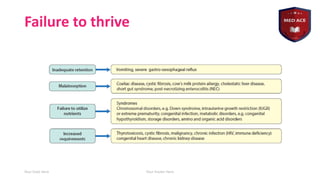
Failure to thrive
Failure to thrive
Your Date Here Your Footer Here 3
Clinical pearl!
Your Date Here Your Footer Here 4
A single
observation of weight is difficult to
interpret unless markedly discrepant
from the head circumference or
length.
Failure to thrive
• The normal
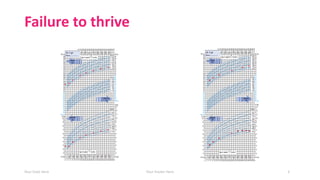
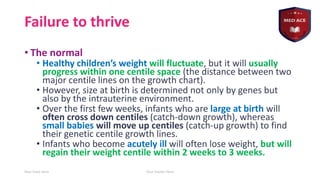
• Healthy children’s weight will fluctuate, but it will usually
progress within one centile space (the distance between two
major centile lines on the growth chart).
• However, size at birth is determined not only by genes but
also by the intrauterine environment.
• Over the first few weeks, infants who are large at birth will
often cross down centiles (catch-down growth), whereas
small babies will move up centiles (catch-up growth) to find
their genetic centile growth lines.
• Infants who become acutely ill will often lose weight, but will
regain their weight centile within 2 weeks to 3 weeks.
Your Date Here Your Footer Here 5
Failure to thrive
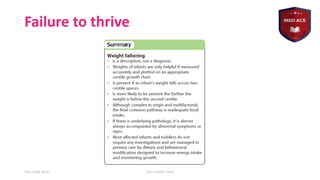
• Growth faltering
• A pattern of slow growth in children compared to the predicted values for their age and
sex
• Commonly used criteria include:
• Weight-for-age, length-for-age, BMI-for-age, or weight-for-length < 5th percentile
• A decrease across 2 major percentile lines from an already established growth velocity
• Childhood wasting
• Low body weight as a result of acute malnutrition, rapid weight loss, or insufficient weight
gain
• Characterized by a z score below 2 standard deviations in BMI-for-age charts or weight-for-
length charts
• Growth stunting
• Reduced height as a result of chronic malnutrition
• Characterized by a z score below 2 standard deviations in height-for-age charts; weight may
be proportional for height
Your Date Here Your Footer Here 6
Failure to thrive
Your Date Here Your Footer Here 7
Failure to thrive
Your Date Here Your Footer Here 8
Failure to thrive
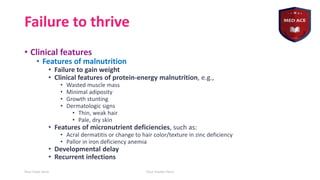
• Clinical features
• Features of malnutrition
• Failure to gain weight
• Clinical features of protein-energy malnutrition, e.g.,
• Wasted muscle mass
• Minimal adiposity
• Growth stunting
• Dermatologic signs
• Thin, weak hair
• Pale, dry skin
• Features of micronutrient deficiencies, such as:
• Acral dermatitis or change to hair color/texture in zinc deficiency
• Pallor in iron deficiency anemia
• Developmental delay
• Recurrent infections
Your Date Here Your Footer Here 9
Clinical pearl!
Your Date Here Your Footer Here 10
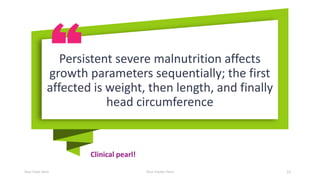
Persistent severe malnutrition affects
growth parameters sequentially; the first
affected is weight, then length, and finally
head circumference
Failure to thrive
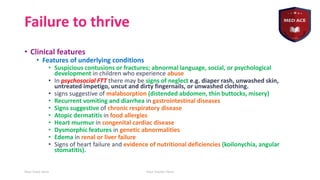
• Clinical features
• Features of underlying conditions
• Suspicious contusions or fractures; abnormal language, social, or psychological
development in children who experience abuse
• In psychosocial FTT there may be signs of neglect e.g. diaper rash, unwashed skin,
untreated impetigo, uncut and dirty fingernails, or unwashed clothing.
• signs suggestive of malabsorption (distended abdomen, thin buttocks, misery)
• Recurrent vomiting and diarrhea in gastrointestinal diseases
• Signs suggestive of chronic respiratory disease
• Atopic dermatitis in food allergies
• Heart murmur in congenital cardiac disease
• Dysmorphic features in genetic abnormalities
• Edema in renal or liver failure
• Signs of heart failure and evidence of nutritional deficiencies (koilonychia, angular
stomatitis).
Your Date Here Your Footer Here 11
Clinical pearl!
Your Date Here Your Footer Here 12
In psychosocial FTT there may be signs of
neglect e.g., diaper rash, unwashed skin,
untreated impetigo, uncut and dirty
fingernails, or unwashed clothing
Failure to thrive
• Diagnostic approach
• Obtain growth measurements and plot them on growth charts
appropriate to age and any underlying conditions.
• Confirm growth faltering by identifying either:
• Single point measurements in low percentiles
• OR significant delays in linear growth
• Perform a comprehensive clinical assessment to identify the etiology of
growth faltering.
• Consider diagnostic studies in patients with:
• Suspected micronutrient deficiencies
• Severe clinical features (e.g., weight gain velocity < 25% of expected)
• No response to initial management
• Concurrently assess for abnormal pediatric development.
Your Date Here Your Footer Here 13
Failure to thrive
• Clinical assessment
• Comprehensive pediatric history and physical examination
including family history and prenatal/birth history
• Feeding and nutrition history
• Number and frequency of feeds
• Food refusal
• Observation of a feed
• Social history: identify risk factors such as food insecurity,
lower socioeconomic status
• Identify features suggestive of an underlying etiology
Your Date Here Your Footer Here 14
Failure to thrive
• If weight faltering is confirmed, a dietary history
should be taken to include:
• history of milk feeding
• age at weaning
• range and type of foods now taken
• mealtime routine and eating and feeding behaviours
• a 3-day food diary will provide a more detailed and
accurate picture of intake
• if possible, observe a meal being taken.
Your Date Here Your Footer Here 15
Failure to thrive
• Consider also:
• was the child born preterm or had intrauterine growth
restriction?
• is the child well with lots of energy or does the child have
other symptoms such as diarrhoea, vomiting, cough, or
lethargy?
• the growth of other family members and any illnesses in the
family
• is the child’s development normal?
• are there psychosocial problems at home?
Your Date Here Your Footer Here 16
Clinical pearl!
Your Date Here Your Footer Here 17
CBP & GUE are good initial tests. Other
tests should be judicious &
relevant to the findings in hx or exam.
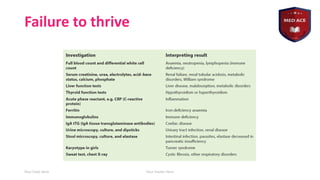
Failure to thrive
Your Date Here Your Footer Here 18
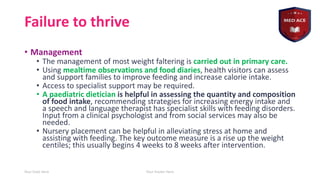
Failure to thrive
• Management
• The management of most weight faltering is carried out in primary care.
• Using mealtime observations and food diaries, health visitors can assess
and support families to improve feeding and increase calorie intake.
• Access to specialist support may be required.
• A paediatric dietician is helpful in assessing the quantity and composition
of food intake, recommending strategies for increasing energy intake and
a speech and language therapist has specialist skills with feeding disorders.
Input from a clinical psychologist and from social services may also be
needed.
• Nursery placement can be helpful in alleviating stress at home and
assisting with feeding. The key outcome measure is a rise up the weight
centiles; this usually begins 4 weeks to 8 weeks after intervention.
Your Date Here Your Footer Here 19
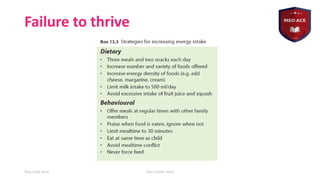
Failure to thrive
Your Date Here Your Footer Here 20
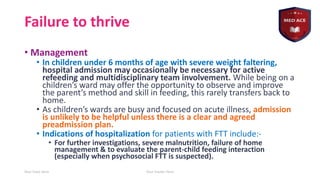
Failure to thrive
• Management
• In children under 6 months of age with severe weight faltering,
hospital admission may occasionally be necessary for active
refeeding and multidisciplinary team involvement. While being on a
children’s ward may offer the opportunity to observe and improve
the parent’s method and skill in feeding, this rarely transfers back to
home.
• As children’s wards are busy and focused on acute illness, admission
is unlikely to be helpful unless there is a clear and agreed
preadmission plan.
• Indications of hospitalization for patients with FTT include:-
• For further investigations, severe malnutrition, failure of home
management & to evaluate the parent-child feeding interaction
(especially when psychosocial FTT is suspected).
Your Date Here Your Footer Here 21
Failure to thrive
• Outcome
• Weight faltering appears to have a long-term effect on
growth, with children remaining on a low centile.
• However, a randomized controlled trial of primary care
intervention has shown that, at 4 years of age, children
who received intervention were heavier and taller than
untreated controls.
• Weight faltering also appears to have an adverse effect on
cognition, although this is small.
Your Date Here Your Footer Here 22
Failure to thrive
• Prognosis
• FTT in the 1st yr of life (regardless of cause) is ominous, because
maximal postnatal brain growth occurs in the 1st 6 mo of life as
well as brain grows as much in 1st yr as in the rest of the child's life.
• Thus all patient with FTT require frequent monitoring & assessment.
• Prognosis of patients with organic FTT is variable, whereas ≈ 30% of
children with psychosocial FTT may develop developmental delay
with social and emotional problems.
• Early FTT may be associated with ↑ risk factors for cardiovascular
disease e.g. dyslipidemia, HT, and glucose intolerance as an adult.
Your Date Here Your Footer Here 23
Failure to thrive
Your Date Here Your Footer Here 24
Do you have any questions?
THANK YOU!

Failure to thrive in children - Presentation and approach

  • 1.
    Failure to thrive ByDr. Haitham Nabeel Your Date Here Your Footer Here
  • 2.
    Your Date HereYour Footer Here Failure to thrive
  • 3.
    Failure to thrive YourDate Here Your Footer Here 3
  • 4.
    Clinical pearl! Your DateHere Your Footer Here 4 A single observation of weight is difficult to interpret unless markedly discrepant from the head circumference or length.
  • 5.
    Failure to thrive •The normal • Healthy children’s weight will fluctuate, but it will usually progress within one centile space (the distance between two major centile lines on the growth chart). • However, size at birth is determined not only by genes but also by the intrauterine environment. • Over the first few weeks, infants who are large at birth will often cross down centiles (catch-down growth), whereas small babies will move up centiles (catch-up growth) to find their genetic centile growth lines. • Infants who become acutely ill will often lose weight, but will regain their weight centile within 2 weeks to 3 weeks. Your Date Here Your Footer Here 5
  • 6.
    Failure to thrive •Growth faltering • A pattern of slow growth in children compared to the predicted values for their age and sex • Commonly used criteria include: • Weight-for-age, length-for-age, BMI-for-age, or weight-for-length < 5th percentile • A decrease across 2 major percentile lines from an already established growth velocity • Childhood wasting • Low body weight as a result of acute malnutrition, rapid weight loss, or insufficient weight gain • Characterized by a z score below 2 standard deviations in BMI-for-age charts or weight-for- length charts • Growth stunting • Reduced height as a result of chronic malnutrition • Characterized by a z score below 2 standard deviations in height-for-age charts; weight may be proportional for height Your Date Here Your Footer Here 6
  • 7.
    Failure to thrive YourDate Here Your Footer Here 7
  • 8.
    Failure to thrive YourDate Here Your Footer Here 8
  • 9.
    Failure to thrive •Clinical features • Features of malnutrition • Failure to gain weight • Clinical features of protein-energy malnutrition, e.g., • Wasted muscle mass • Minimal adiposity • Growth stunting • Dermatologic signs • Thin, weak hair • Pale, dry skin • Features of micronutrient deficiencies, such as: • Acral dermatitis or change to hair color/texture in zinc deficiency • Pallor in iron deficiency anemia • Developmental delay • Recurrent infections Your Date Here Your Footer Here 9
  • 10.
    Clinical pearl! Your DateHere Your Footer Here 10 Persistent severe malnutrition affects growth parameters sequentially; the first affected is weight, then length, and finally head circumference
  • 11.
    Failure to thrive •Clinical features • Features of underlying conditions • Suspicious contusions or fractures; abnormal language, social, or psychological development in children who experience abuse • In psychosocial FTT there may be signs of neglect e.g. diaper rash, unwashed skin, untreated impetigo, uncut and dirty fingernails, or unwashed clothing. • signs suggestive of malabsorption (distended abdomen, thin buttocks, misery) • Recurrent vomiting and diarrhea in gastrointestinal diseases • Signs suggestive of chronic respiratory disease • Atopic dermatitis in food allergies • Heart murmur in congenital cardiac disease • Dysmorphic features in genetic abnormalities • Edema in renal or liver failure • Signs of heart failure and evidence of nutritional deficiencies (koilonychia, angular stomatitis). Your Date Here Your Footer Here 11
  • 12.
    Clinical pearl! Your DateHere Your Footer Here 12 In psychosocial FTT there may be signs of neglect e.g., diaper rash, unwashed skin, untreated impetigo, uncut and dirty fingernails, or unwashed clothing
  • 13.
    Failure to thrive •Diagnostic approach • Obtain growth measurements and plot them on growth charts appropriate to age and any underlying conditions. • Confirm growth faltering by identifying either: • Single point measurements in low percentiles • OR significant delays in linear growth • Perform a comprehensive clinical assessment to identify the etiology of growth faltering. • Consider diagnostic studies in patients with: • Suspected micronutrient deficiencies • Severe clinical features (e.g., weight gain velocity < 25% of expected) • No response to initial management • Concurrently assess for abnormal pediatric development. Your Date Here Your Footer Here 13
  • 14.
    Failure to thrive •Clinical assessment • Comprehensive pediatric history and physical examination including family history and prenatal/birth history • Feeding and nutrition history • Number and frequency of feeds • Food refusal • Observation of a feed • Social history: identify risk factors such as food insecurity, lower socioeconomic status • Identify features suggestive of an underlying etiology Your Date Here Your Footer Here 14
  • 15.
    Failure to thrive •If weight faltering is confirmed, a dietary history should be taken to include: • history of milk feeding • age at weaning • range and type of foods now taken • mealtime routine and eating and feeding behaviours • a 3-day food diary will provide a more detailed and accurate picture of intake • if possible, observe a meal being taken. Your Date Here Your Footer Here 15
  • 16.
    Failure to thrive •Consider also: • was the child born preterm or had intrauterine growth restriction? • is the child well with lots of energy or does the child have other symptoms such as diarrhoea, vomiting, cough, or lethargy? • the growth of other family members and any illnesses in the family • is the child’s development normal? • are there psychosocial problems at home? Your Date Here Your Footer Here 16
  • 17.
    Clinical pearl! Your DateHere Your Footer Here 17 CBP & GUE are good initial tests. Other tests should be judicious & relevant to the findings in hx or exam.
  • 18.
    Failure to thrive YourDate Here Your Footer Here 18
  • 19.
    Failure to thrive •Management • The management of most weight faltering is carried out in primary care. • Using mealtime observations and food diaries, health visitors can assess and support families to improve feeding and increase calorie intake. • Access to specialist support may be required. • A paediatric dietician is helpful in assessing the quantity and composition of food intake, recommending strategies for increasing energy intake and a speech and language therapist has specialist skills with feeding disorders. Input from a clinical psychologist and from social services may also be needed. • Nursery placement can be helpful in alleviating stress at home and assisting with feeding. The key outcome measure is a rise up the weight centiles; this usually begins 4 weeks to 8 weeks after intervention. Your Date Here Your Footer Here 19
  • 20.
    Failure to thrive YourDate Here Your Footer Here 20
  • 21.
    Failure to thrive •Management • In children under 6 months of age with severe weight faltering, hospital admission may occasionally be necessary for active refeeding and multidisciplinary team involvement. While being on a children’s ward may offer the opportunity to observe and improve the parent’s method and skill in feeding, this rarely transfers back to home. • As children’s wards are busy and focused on acute illness, admission is unlikely to be helpful unless there is a clear and agreed preadmission plan. • Indications of hospitalization for patients with FTT include:- • For further investigations, severe malnutrition, failure of home management & to evaluate the parent-child feeding interaction (especially when psychosocial FTT is suspected). Your Date Here Your Footer Here 21
  • 22.
    Failure to thrive •Outcome • Weight faltering appears to have a long-term effect on growth, with children remaining on a low centile. • However, a randomized controlled trial of primary care intervention has shown that, at 4 years of age, children who received intervention were heavier and taller than untreated controls. • Weight faltering also appears to have an adverse effect on cognition, although this is small. Your Date Here Your Footer Here 22
  • 23.
    Failure to thrive •Prognosis • FTT in the 1st yr of life (regardless of cause) is ominous, because maximal postnatal brain growth occurs in the 1st 6 mo of life as well as brain grows as much in 1st yr as in the rest of the child's life. • Thus all patient with FTT require frequent monitoring & assessment. • Prognosis of patients with organic FTT is variable, whereas ≈ 30% of children with psychosocial FTT may develop developmental delay with social and emotional problems. • Early FTT may be associated with ↑ risk factors for cardiovascular disease e.g. dyslipidemia, HT, and glucose intolerance as an adult. Your Date Here Your Footer Here 23
  • 24.
    Failure to thrive YourDate Here Your Footer Here 24
  • 25.
    Do you haveany questions? THANK YOU!