Failure To Thrive (FTT)
Zach Jarou
Michigan State University
College of Human Medicine
January 23, 2013
Evolving Definitions of FTT
• FTT is not a syndrome, rather it is a physical
sign that a child is receiving inadequate
nutrition for optimal growth and development
• Older dichotomous view emphasized organic
(underlying medical condition, rare) vs. non-
organic causes (environmental, more common)
• Now appreciated to be most commonly
mixed/multi-factorial in cause
Chart-Based Definitions of FTT
• Children younger than 3 years of age,
• Below 3rd or 5th percentile for age on more than
one consecutive occasion
• Weight drops down two major percentile lines
• Whose weight is less than 80% of the ideal
weight for age
• Below the 3rd or 5th percentile on the weight-for-
length curve
Pathogenesis
• Loss of calories through malabsorption
• Increased caloric expenditure (hyperthyroidism,
congenital heart disease, chronic pulmonary
disease)
• Inadequate intake of calories (most frequent)
• Poor strength or neurologic ability to suck, chew,
or swallow adequate amounts of food
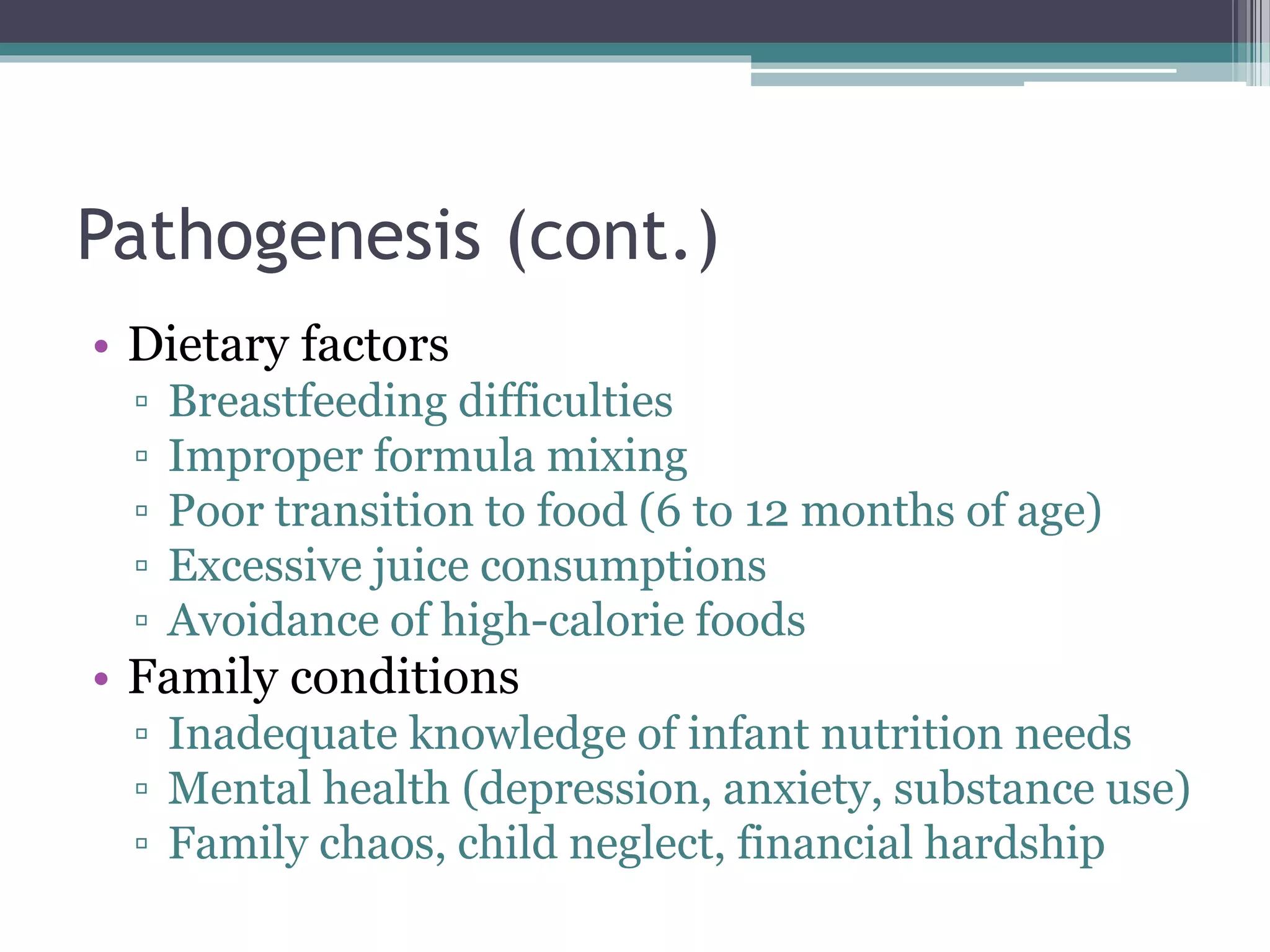
Pathogenesis (cont.)
• Dietary factors
▫ Breastfeeding difficulties
▫ Improper formula mixing
▫ Poor transition to food (6 to 12 months of age)
▫ Excessive juice consumptions
▫ Avoidance of high-calorie foods
• Family conditions
▫ Inadequate knowledge of infant nutrition needs
▫ Mental health (depression, anxiety, substance use)
▫ Family chaos, child neglect, financial hardship
Physical Exam
• Neurodevelopmental status
• Neurocutaneous markings
• Dysmorphic features
• Nutritional status
• Dehyrdration
• Feeding observation
▫ Bottle feeding
▫ Spoon/self-feeding
▫ Creating proper social environment
Laboratory Tests
• A shotgun approach is not cost-effective
• Tests must be performed based on positive findings
from history and physical
• Additional lab and imaging tests are completed for
children who do not respond to dietary intervnetion
• Important to review newborn metabolic screening
tests for inborn errors of metabolism and
hypothyroidism
• Routine tests in children 6-18 months are for iron
deficiency, lead poisoning, TB, chronic UTI
Differential Diagnosis
• 1) FTT with microcephaly
▫ TORCH infections
▫ Teratologic & genetic conditions
▫ Brain injury
• 2) FTT with short stature
▫ Genetic syndromes (Russell-Silver, Turner, Down)
▫ Endocrine (hypothyroid, hypophosphatemic
rickets, growth hormone deficiency)
▫ Teratologic conditions (fetal alcohol syndrome)
Differential Diagnosis
• 3) FTT characterized by adequate height for age
and normal head circumference
▫ Inadequate calories offered
(inadvertent/intentional)
▫ Child unwilling to accept food that is offered (poor
apetite, oral aversion, food aversion, oromotor
dysfunction)
▫ Caloric loss through vomiting or malabsorption or
hypermetabolic state
Management
• Nutritional education
• Feeding intervention
• Continue to monitor growth response
• Treat underlying medical conditions
• More serious problems such as electrolyte
disturbances and dehydration often require
hospitalization
Prognosis
• Almost all children show adequate improvement
with intervention
• Many improve even without intervention as they
become more independent in feeding themselves
when hungry
• A small percent of “picky eaters” have anxiety
disorders and a few have autism spectrum disorders
• Children who require gastrostomy feeding tubes and
who have neurologic dysfunction interfering with
swallowing usually require enteral feeding for life
Prognosis (cont.)
• Some evidence of poorer cognitive and school
outcomes of FTT children
• Early iron deficiency anemia leads may lead to
irreversible developmental deficits
• Children experiencing calorie malnutrition may
have also experienced environmental deficits
(parental attention, emotionally/cognitively
stimulating home)
• Should be monitored for developmental and
behavioral problems
Pearls
• FTT due to poor food intake = weight falls first, sparing length and
head circumference
• Symmetric fall in weight and height suggests a chronic medical
condition
• Short stature below 50th percentile with relative sparing of weight
suggests an endocrine disorder
• early drop-off in head circumference suggests a lack of brain growth
• Children born with genetic conditions must have their growth
plotted on adjusted curves
• Wasting = decreased weight for height, acute malnutirion,
decreased subQ fat, measured by triceps skinfold thickness
• Stunting = decreased height for age, can be sign of chronic
undernutrition
• Important to take into account family stature (genetic potential)
References
• Gahagan S (2006). Failure To Thrive: A
Consequence of Undernutrition. Pediatrics in
Review; 27 (1): e1-e11. (link)
• Jaffe AC (2011). Failure To Thrive: Current
Clinical Concepts. Pediatrics in Review; 32 (3):
100-108. (link)

Pediatrics: Failure To Thrive

  • 1.
    Failure To Thrive(FTT) Zach Jarou Michigan State University College of Human Medicine January 23, 2013
  • 2.
    Evolving Definitions ofFTT • FTT is not a syndrome, rather it is a physical sign that a child is receiving inadequate nutrition for optimal growth and development • Older dichotomous view emphasized organic (underlying medical condition, rare) vs. non- organic causes (environmental, more common) • Now appreciated to be most commonly mixed/multi-factorial in cause
  • 3.
  • 4.
    Chart-Based Definitions ofFTT • Children younger than 3 years of age, • Below 3rd or 5th percentile for age on more than one consecutive occasion • Weight drops down two major percentile lines • Whose weight is less than 80% of the ideal weight for age • Below the 3rd or 5th percentile on the weight-for- length curve
  • 5.
    Pathogenesis • Loss ofcalories through malabsorption • Increased caloric expenditure (hyperthyroidism, congenital heart disease, chronic pulmonary disease) • Inadequate intake of calories (most frequent) • Poor strength or neurologic ability to suck, chew, or swallow adequate amounts of food
  • 6.
    Pathogenesis (cont.) • Dietaryfactors ▫ Breastfeeding difficulties ▫ Improper formula mixing ▫ Poor transition to food (6 to 12 months of age) ▫ Excessive juice consumptions ▫ Avoidance of high-calorie foods • Family conditions ▫ Inadequate knowledge of infant nutrition needs ▫ Mental health (depression, anxiety, substance use) ▫ Family chaos, child neglect, financial hardship
  • 7.
    Physical Exam • Neurodevelopmentalstatus • Neurocutaneous markings • Dysmorphic features • Nutritional status • Dehyrdration • Feeding observation ▫ Bottle feeding ▫ Spoon/self-feeding ▫ Creating proper social environment
  • 8.
    Laboratory Tests • Ashotgun approach is not cost-effective • Tests must be performed based on positive findings from history and physical • Additional lab and imaging tests are completed for children who do not respond to dietary intervnetion • Important to review newborn metabolic screening tests for inborn errors of metabolism and hypothyroidism • Routine tests in children 6-18 months are for iron deficiency, lead poisoning, TB, chronic UTI
  • 9.
    Differential Diagnosis • 1)FTT with microcephaly ▫ TORCH infections ▫ Teratologic & genetic conditions ▫ Brain injury • 2) FTT with short stature ▫ Genetic syndromes (Russell-Silver, Turner, Down) ▫ Endocrine (hypothyroid, hypophosphatemic rickets, growth hormone deficiency) ▫ Teratologic conditions (fetal alcohol syndrome)
  • 10.
    Differential Diagnosis • 3)FTT characterized by adequate height for age and normal head circumference ▫ Inadequate calories offered (inadvertent/intentional) ▫ Child unwilling to accept food that is offered (poor apetite, oral aversion, food aversion, oromotor dysfunction) ▫ Caloric loss through vomiting or malabsorption or hypermetabolic state
  • 12.
    Management • Nutritional education •Feeding intervention • Continue to monitor growth response • Treat underlying medical conditions • More serious problems such as electrolyte disturbances and dehydration often require hospitalization
  • 13.
    Prognosis • Almost allchildren show adequate improvement with intervention • Many improve even without intervention as they become more independent in feeding themselves when hungry • A small percent of “picky eaters” have anxiety disorders and a few have autism spectrum disorders • Children who require gastrostomy feeding tubes and who have neurologic dysfunction interfering with swallowing usually require enteral feeding for life
  • 14.
    Prognosis (cont.) • Someevidence of poorer cognitive and school outcomes of FTT children • Early iron deficiency anemia leads may lead to irreversible developmental deficits • Children experiencing calorie malnutrition may have also experienced environmental deficits (parental attention, emotionally/cognitively stimulating home) • Should be monitored for developmental and behavioral problems
  • 15.
    Pearls • FTT dueto poor food intake = weight falls first, sparing length and head circumference • Symmetric fall in weight and height suggests a chronic medical condition • Short stature below 50th percentile with relative sparing of weight suggests an endocrine disorder • early drop-off in head circumference suggests a lack of brain growth • Children born with genetic conditions must have their growth plotted on adjusted curves • Wasting = decreased weight for height, acute malnutirion, decreased subQ fat, measured by triceps skinfold thickness • Stunting = decreased height for age, can be sign of chronic undernutrition • Important to take into account family stature (genetic potential)
  • 16.
    References • Gahagan S(2006). Failure To Thrive: A Consequence of Undernutrition. Pediatrics in Review; 27 (1): e1-e11. (link) • Jaffe AC (2011). Failure To Thrive: Current Clinical Concepts. Pediatrics in Review; 32 (3): 100-108. (link)