FAILURE TO THRIVE NANDINI JIJI KRISHNA
FAILURE TO THRIVE
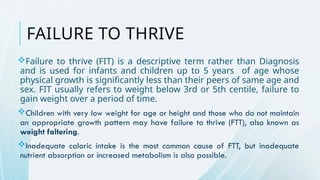
Failure to thrive (FIT) is a descriptive term rather than Diagnosis
and is used for infants and children up to 5 years of age whose
physical growth is significantly less than their peers of same age and
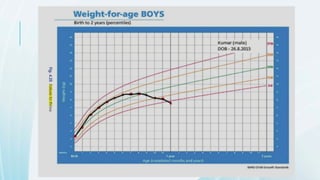
sex. FIT usually refers to weight below 3rd or 5th centile, failure to
gain weight over a period of time.
Children with very low weight for age or height and those who do not maintain
an appropriate growth pattern may have failure to thrive (FTT), also known as
weight faltering.
Inadequate caloric intake is the most common cause of FTT, but inadequate
nutrient absorption or increased metabolism is also possible.
.
.
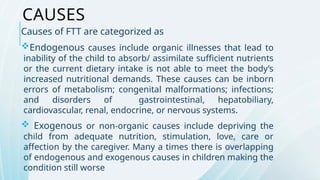
Causes of FTT are categorized as
Endogenous causes include organic illnesses that lead to
inability of the child to absorb/ assimilate sufficient nutrients
or the current dietary intake is not able to meet the body’s
increased nutritional demands. These causes can be inborn
errors of metabolism; congenital malformations; infections;
and disorders of gastrointestinal, hepatobiliary,
cardiovascular, renal, endocrine, or nervous systems.
 Exogenous or non-organic causes include depriving the
child from adequate nutrition, stimulation, love, care or
affection by the caregiver. Many a times there is overlapping
of endogenous and exogenous causes in children making the
condition still worse
CAUSES
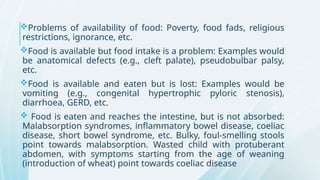
Problems of availability of food: Poverty, food fads, religious
restrictions, ignorance, etc.
Food is available but food intake is a problem: Examples would
be anatomical defects (e.g., cleft palate), pseudobulbar palsy,
etc.
Food is available and eaten but is lost: Examples would be
vomiting (e.g., congenital hypertrophic pyloric stenosis),
diarrhoea, GERD, etc.
 Food is eaten and reaches the intestine, but is not absorbed:
Malabsorption syndromes, inflammatory bowel disease, coeliac
disease, short bowel syndrome, etc. Bulky, foul-smelling stools
point towards malabsorption. Wasted child with protuberant
abdomen, with symptoms starting from the age of weaning
(introduction of wheat) point towards coeliac disease

Food that is eaten is absorbed, but is used up due to increased demand,
leaving hardly an thing for body building.

Endocrine: Hyperthyroidism, diabetes mellitus, diabetes insipidus, growth
hormone deficiency, etc. Polyuria, polydipsia and weight loss are the likely
presenting symptoms of diabetes mellitus.

Cardiac: Long-standing congestive cardiac failure

Respiratory: Long-standing pulmonary problems like cystic fibrosis, poorly
controlled asthma, etc

Hepatic: Cirrhosis, chronic active hepatitis.

Renal: Chronic renal failure, renal tubular acidosis.

Food that is eaten is absorbed and is used up properly, but the body has
inadequate potential for growth. Examples are syndromes of inadequate
growth potential like chromosomal anomalies.

Emotional deprivation is another example for a situation of failure
MANAGEMENT
Complete history, detailed physical examination including anthropometry and
careful observation of parent-child interaction will help in finding out the cause
and hence guide the management of a child with FTT.
Treatment includes identification and managing the primary cause; nutritional
rehabilitation, psychological intervention; and follow-up with careful monitoring
for response in terms of growth and developmental of the child
Treatment of failure to thrive is aimed at providing sufficient health and
environmental resources to promote satisfactory growth.
A nutritious diet containing adequate calories for catch-up growth (about 150% of
normal caloric requirement) and individualized medical and social supports are
usually necessary
Re-feeding the child for 2 days to 2 weeks to initiate catch-up growth
Providing social work support or other community resources to families with food
insecurity
Counseling caregivers on healthy food choices
Adjusting formula concentration for infants
FAILURE TO THRIVE, vit c, e, k def.pptx , failure to thrive

FAILURE TO THRIVE, vit c, e, k def.pptx , failure to thrive

  • 1.
    FAILURE TO THRIVENANDINI JIJI KRISHNA
  • 2.
    FAILURE TO THRIVE Failureto thrive (FIT) is a descriptive term rather than Diagnosis and is used for infants and children up to 5 years of age whose physical growth is significantly less than their peers of same age and sex. FIT usually refers to weight below 3rd or 5th centile, failure to gain weight over a period of time. Children with very low weight for age or height and those who do not maintain an appropriate growth pattern may have failure to thrive (FTT), also known as weight faltering. Inadequate caloric intake is the most common cause of FTT, but inadequate nutrient absorption or increased metabolism is also possible.
  • 3.
  • 4.
    Causes of FTTare categorized as Endogenous causes include organic illnesses that lead to inability of the child to absorb/ assimilate sufficient nutrients or the current dietary intake is not able to meet the body’s increased nutritional demands. These causes can be inborn errors of metabolism; congenital malformations; infections; and disorders of gastrointestinal, hepatobiliary, cardiovascular, renal, endocrine, or nervous systems.  Exogenous or non-organic causes include depriving the child from adequate nutrition, stimulation, love, care or affection by the caregiver. Many a times there is overlapping of endogenous and exogenous causes in children making the condition still worse CAUSES
  • 5.
    Problems of availabilityof food: Poverty, food fads, religious restrictions, ignorance, etc. Food is available but food intake is a problem: Examples would be anatomical defects (e.g., cleft palate), pseudobulbar palsy, etc. Food is available and eaten but is lost: Examples would be vomiting (e.g., congenital hypertrophic pyloric stenosis), diarrhoea, GERD, etc.  Food is eaten and reaches the intestine, but is not absorbed: Malabsorption syndromes, inflammatory bowel disease, coeliac disease, short bowel syndrome, etc. Bulky, foul-smelling stools point towards malabsorption. Wasted child with protuberant abdomen, with symptoms starting from the age of weaning (introduction of wheat) point towards coeliac disease
  • 6.
     Food that iseaten is absorbed, but is used up due to increased demand, leaving hardly an thing for body building.  Endocrine: Hyperthyroidism, diabetes mellitus, diabetes insipidus, growth hormone deficiency, etc. Polyuria, polydipsia and weight loss are the likely presenting symptoms of diabetes mellitus.  Cardiac: Long-standing congestive cardiac failure  Respiratory: Long-standing pulmonary problems like cystic fibrosis, poorly controlled asthma, etc  Hepatic: Cirrhosis, chronic active hepatitis.  Renal: Chronic renal failure, renal tubular acidosis.  Food that is eaten is absorbed and is used up properly, but the body has inadequate potential for growth. Examples are syndromes of inadequate growth potential like chromosomal anomalies.  Emotional deprivation is another example for a situation of failure
  • 7.
    MANAGEMENT Complete history, detailedphysical examination including anthropometry and careful observation of parent-child interaction will help in finding out the cause and hence guide the management of a child with FTT. Treatment includes identification and managing the primary cause; nutritional rehabilitation, psychological intervention; and follow-up with careful monitoring for response in terms of growth and developmental of the child Treatment of failure to thrive is aimed at providing sufficient health and environmental resources to promote satisfactory growth. A nutritious diet containing adequate calories for catch-up growth (about 150% of normal caloric requirement) and individualized medical and social supports are usually necessary Re-feeding the child for 2 days to 2 weeks to initiate catch-up growth Providing social work support or other community resources to families with food insecurity Counseling caregivers on healthy food choices Adjusting formula concentration for infants