Correctness and appropriateness Factors Participants Social context Topic Function Speech functions
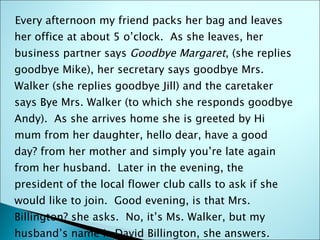
Every afternoon my friend packs her bag and leaves her office at about 5 o’clock.  As she leaves, her business partner says  Goodbye Margaret , (she replies goodbye Mike), her secretary says goodbye Mrs. Walker (she replies goodbye Jill) and the caretaker says Bye Mrs. Walker (to which she responds goodbye Andy).  As she arrives home she is greeted by Hi mum from her daughter, hello dear, have a good day? from her mother and simply you’re late again from her husband.  Later in the evening, the president of the local flower club calls to ask if she would like to join.  Good evening, is that Mrs. Billington? she asks.  No, it’s Ms. Walker, but my husband’s name is David Billington, she answers.  What can I do for you?  Finally, a friend calls Hello Meg, owz it goin?
Every afternoon my friend packs her bag and leaves her office at about 5 o’clock.  As she leaves, her business partner says  Goodbye  Margaret , (she replies goodbye Mike), her secretary says goodbye  Mrs. Walker  (she replies goodbye Jill) and the caretaker says Bye  Mrs. Walker  (to which she responds goodbye Andy).  As she arrives home she is greeted by Hi  mum  from her daughter, hello  dear , have a good day? from her mother and simply  you’re  late again from her husband.  Later in the evening, the president of the local flower club calls to ask if she would like to join.  Good evening, is that  Mrs. Billington?  she asks.  No, it’s Ms. Walker, but my husband’s name is David Billington, she answers.  What can I do for you?  Finally, a friend calls Hello  Meg , owz it goin?
People can mean something quite different from what their words mean
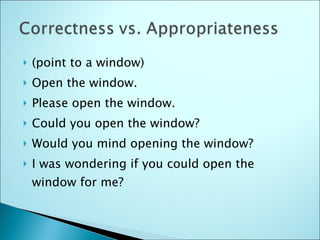
(point to a window) Open the window. Please open the window. Could you open the window? Would you mind opening the window? I was wondering if you could open the window for me?
Correctness refers to being grammatically correct. Appropriateness refers to saying the right thing at the right time to the right person
Participants Social context Topic Function
Participants Who is speaking? Who are they speaking to?
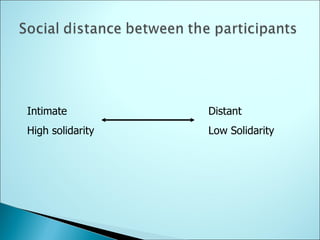
Intimate High solidarity Distant Low Solidarity
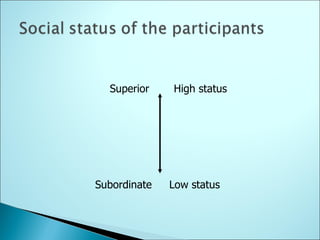
Superior  High status   Subordinate   Low status
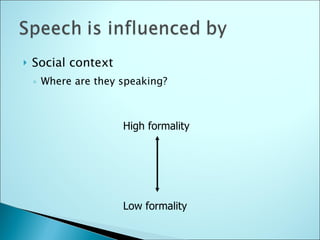
Social context Where are they speaking? High formality   Low formality
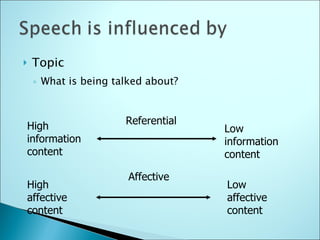
Topic What is being talked about? High information content Low information content   Referential   High affective content   Low affective content   Affective
Function Why are they speaking?
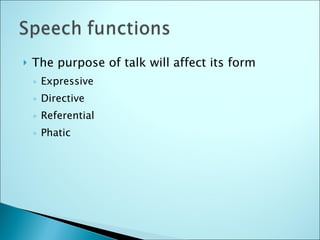
The purpose of talk will affect its form Expressive Directive Referential Phatic
Expresses the speaker’s feelings I’m feeling great today.
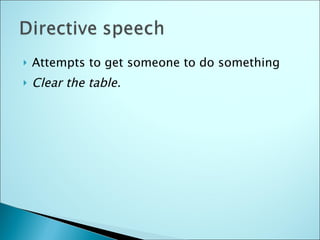
Attempts to get someone to do something Clear the table.
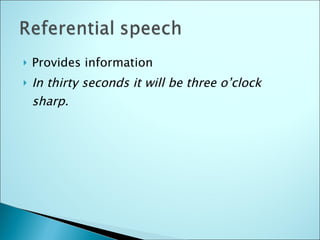
Provides information In thirty seconds it will be three o’clock sharp.
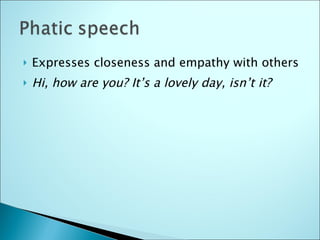
Expresses closeness and empathy with others Hi, how are you? It’s a lovely day, isn’t it?
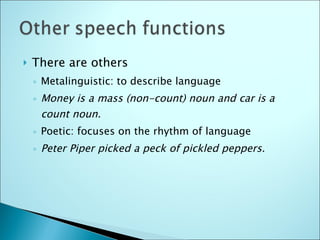
There are others Metalinguistic: to describe language  Money is a mass (non-count) noun and car is a count noun. Poetic: focuses on the rhythm of language Peter Piper picked a peck of pickled peppers.
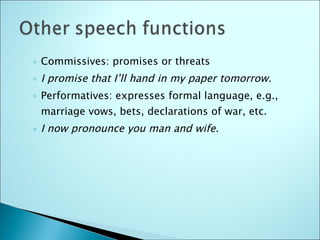
Commissives: promises or threats I promise that I’ll hand in my paper tomorrow. Performatives: expresses formal language, e.g., marriage vows, bets, declarations of war, etc. I now pronounce you man and wife.
Correctness and appropriateness Factors Participants Social context Topic Function Speech functions

Factors that influence speech

  • 1.
  • 2.
    Correctness and appropriatenessFactors Participants Social context Topic Function Speech functions
  • 3.
    Every afternoon myfriend packs her bag and leaves her office at about 5 o’clock. As she leaves, her business partner says Goodbye Margaret , (she replies goodbye Mike), her secretary says goodbye Mrs. Walker (she replies goodbye Jill) and the caretaker says Bye Mrs. Walker (to which she responds goodbye Andy). As she arrives home she is greeted by Hi mum from her daughter, hello dear, have a good day? from her mother and simply you’re late again from her husband. Later in the evening, the president of the local flower club calls to ask if she would like to join. Good evening, is that Mrs. Billington? she asks. No, it’s Ms. Walker, but my husband’s name is David Billington, she answers. What can I do for you? Finally, a friend calls Hello Meg, owz it goin?
  • 4.
    Every afternoon myfriend packs her bag and leaves her office at about 5 o’clock. As she leaves, her business partner says Goodbye Margaret , (she replies goodbye Mike), her secretary says goodbye Mrs. Walker (she replies goodbye Jill) and the caretaker says Bye Mrs. Walker (to which she responds goodbye Andy). As she arrives home she is greeted by Hi mum from her daughter, hello dear , have a good day? from her mother and simply you’re late again from her husband. Later in the evening, the president of the local flower club calls to ask if she would like to join. Good evening, is that Mrs. Billington? she asks. No, it’s Ms. Walker, but my husband’s name is David Billington, she answers. What can I do for you? Finally, a friend calls Hello Meg , owz it goin?
  • 5.
    People can meansomething quite different from what their words mean
  • 6.
    (point to awindow) Open the window. Please open the window. Could you open the window? Would you mind opening the window? I was wondering if you could open the window for me?
  • 7.
    Correctness refers tobeing grammatically correct. Appropriateness refers to saying the right thing at the right time to the right person
  • 8.
  • 9.
    Participants Who isspeaking? Who are they speaking to?
  • 10.
    Intimate High solidarityDistant Low Solidarity
  • 11.
    Superior Highstatus Subordinate Low status
  • 12.
    Social context Whereare they speaking? High formality Low formality
  • 13.
    Topic What isbeing talked about? High information content Low information content Referential High affective content Low affective content Affective
  • 14.
    Function Why arethey speaking?
  • 15.
    The purpose oftalk will affect its form Expressive Directive Referential Phatic
  • 16.
    Expresses the speaker’sfeelings I’m feeling great today.
  • 17.
    Attempts to getsomeone to do something Clear the table.
  • 18.
    Provides information Inthirty seconds it will be three o’clock sharp.
  • 19.
    Expresses closeness andempathy with others Hi, how are you? It’s a lovely day, isn’t it?
  • 20.
    There are othersMetalinguistic: to describe language Money is a mass (non-count) noun and car is a count noun. Poetic: focuses on the rhythm of language Peter Piper picked a peck of pickled peppers.
  • 21.
    Commissives: promises orthreats I promise that I’ll hand in my paper tomorrow. Performatives: expresses formal language, e.g., marriage vows, bets, declarations of war, etc. I now pronounce you man and wife.
  • 22.
    Correctness and appropriatenessFactors Participants Social context Topic Function Speech functions

Editor's Notes

  • #11 Examples 1 & 2
  • #12 Superior / High status: Principal (ex. 2) / Jim (ex. 4) Subordinate / Low status: Ray (ex. 2) / Sam (ex. 4)
  • #13 Speaking in a formal meeting vs. speaking in an informal group.
  • #16 There are others: Metalinguistic = to describe language Poetic = focuses on rhythm of language, e.g. Peter Piper picked a peck of pickled peppers. Commissives = promises and threats Performatives = formal language, e.g. marriage vows, bets, declarations of war
  • #21 There are others: Metalinguistic = to describe language Poetic = focuses on rhythm of language, e.g. Peter Piper picked a peck of pickled peppers. Commissives = promises and threats Performatives = formal language, e.g. marriage vows, bets, declarations of war