Intonation
Intonation is about how we say things,
rather than what we say. Without
intonation, it's impossible to understand
the expressions and thoughts that go with
words.

Listen to somebody speaking without
paying attention to the words: the 'melody'
you hear is the intonation.
WHAT IS INTONATION
1. Intonation is a term used to refer to the
  distinctive use of different patterns of pitch that
  carry meaningful information.

 2. The kinds of pitch modulation which are found
  in whole utterances. Intonation contours can be
  used to highlight certain elements in an
  utterance, to bundle words together into
  information chunks,& to convey speaker’s
  attitude to what he/she is saying.(Philip
  Carr,page#78)
WHAT IS INTONATION


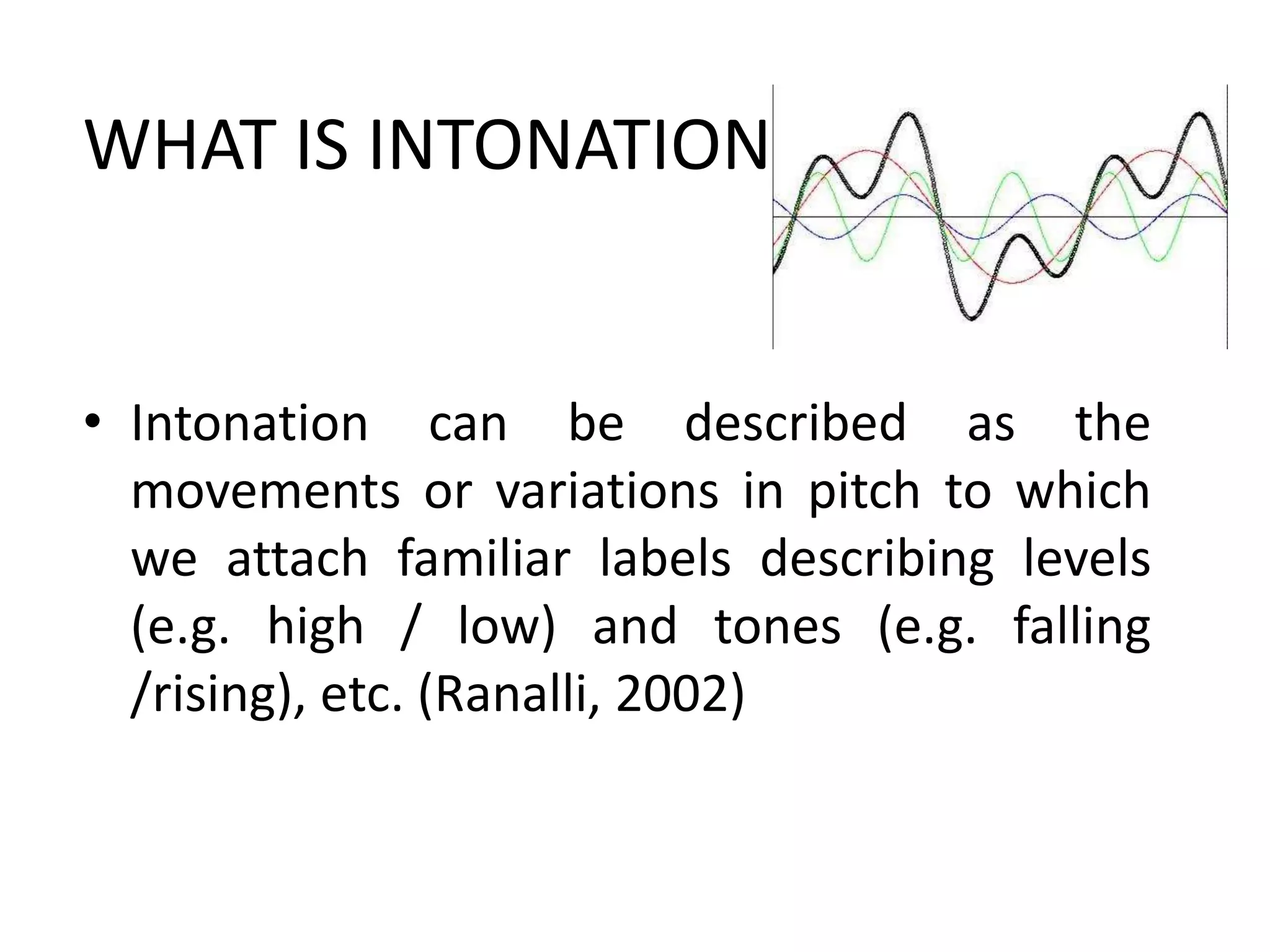
• Intonation can be described as the
  movements or variations in pitch to which
  we attach familiar labels describing levels
  (e.g. high / low) and tones (e.g. falling
  /rising), etc. (Ranalli, 2002)
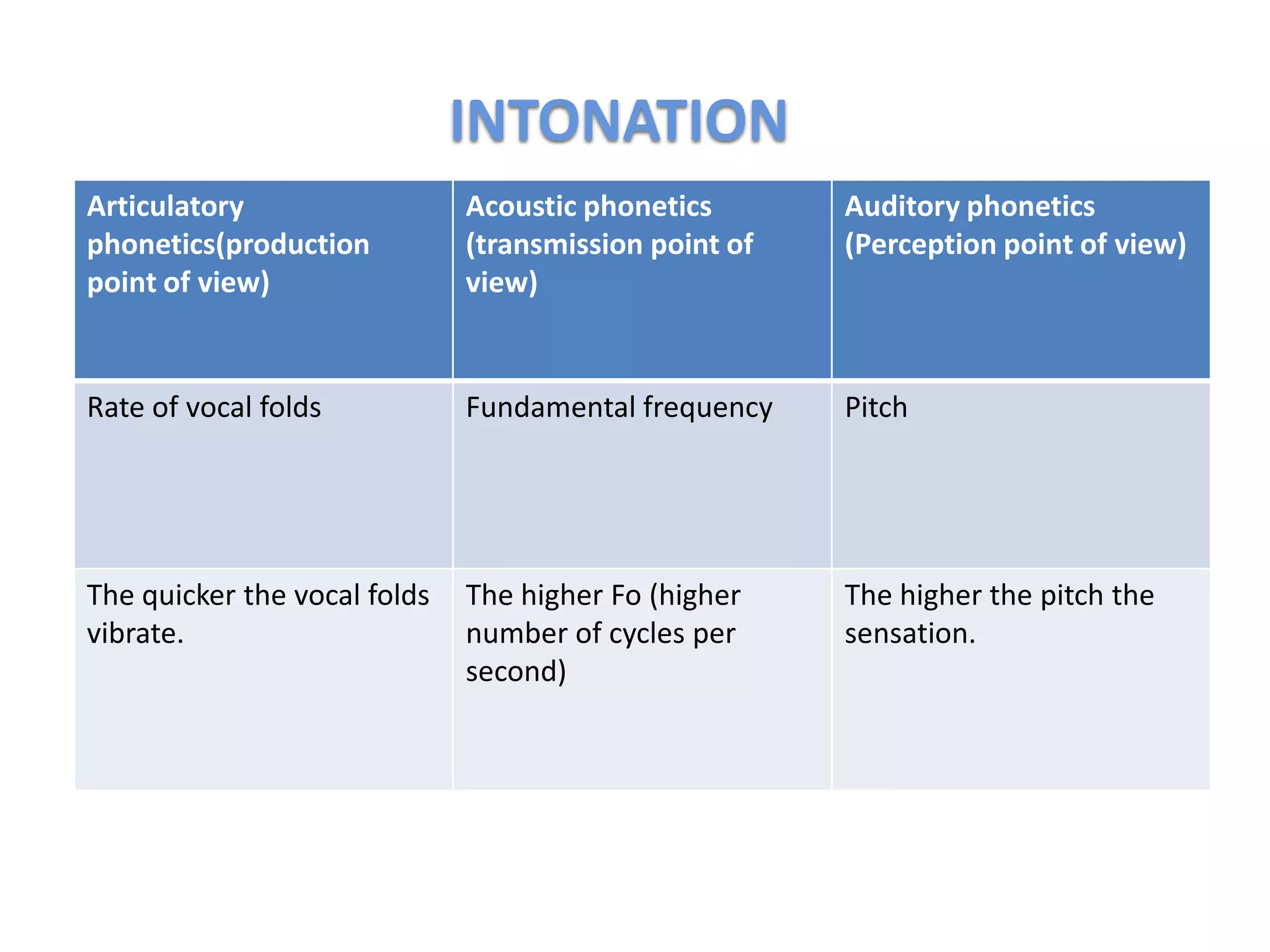
INTONATION
Articulatory                  Acoustic phonetics       Auditory phonetics
phonetics(production          (transmission point of   (Perception point of view)
point of view)                view)


Rate of vocal folds           Fundamental frequency    Pitch


The quicker the vocal folds   The higher Fo (higher    The higher the pitch the
vibrate.                      number of cycles per     sensation.
                              second)
Tone & Intonation languages
• We can divide language into languages which are tone languages
  and those which are not, English falls into second category, that
  is, it is not a tone language.

• All the languages in the world use consonants and vowels to
  build morphemes, which in turn join together to form words.
• Thus the English word ‘me’ is made up of a nasal consonant
  followed by a high vowel.
• If we change the consonant to a/b/ we would get a different
  word, ‘be’, and if we change the vowel to a low vowel, we would
  also get a different words, ‘ma’.
• We may pronounce the word ‘ma’ with various pitch patterns,
  depending on the occasion. We may pronounce it with high
  pitch if we are emphatic, we may say it with a rising pitch in a
  question etc.
Tone languages


• But these different pitch patterns do not alter the word in the
  way that changing a consonant or changing a vowel does.
• These different pitch patterns that do not change but merely
  add to the basic meaning of words are called intonation.
• Yet there are some languages in the world that use pitch
  patterns to build morphemes in the same way consonant and
  vowels are used. The best known such language is Chinese.
Tone languages
• In Chinese, the syllable ‘ma’ when pronounced with a falling
  pitch patterns means, ‘to scold’.
• When pronounced with a rising pattern, the meaning is
  ‘hemp’, when pronounced with a high level pattern, the
  meaning is ‘mother’ as in some dialects of English, and lastly,
  when pronounced with a low dipping pattern, the meaning is
  ‘horse’.
• When pitch patterns are used in this lexical capacity i.e. to
  build word and morphemes much as consonants and vowels
  do, they are called tones.
• And languages that use tones in this way are called tone
  languages.
• English is not tone language because different
  tones make no difference in meanings.
• But chinese is a tone language
• Urdu is stressed lang
• English is not stress language
DEVELOPMENT OF INTONATION

The study of intonation went through many changes in the
 twentieth century.
 British linguistics Daniel Jones & (1926)

The most intensive development began during the 1940.

In United States the theory that evolved was based on ‘pitch
 phonemes’ (Pike. 1945).

It was developed in 1951 and then by Halliday (1967).

Intonation

  Halliday divides intonation into “the three
  T’s”:
1. Tonality (the chunking of speech into
   intonational phrases, or tone-units)
2. 2.Tone (mainly, but not only: fall, rise, and
   fall-rise
3. Tonicity (nucleus placement).
Intonation
Halliday divides intonation into “the three
T’s”:
 Tonality (the chunking of speech into
intonational phrases, or tone-units),
2.Tonicity (nucleus placement), and
3.Tone (mainly, but not only: fall, rise, and
fall-rise
TONE UNIT
a group of words forming a distinctive unit in an
utterance, containing a nucleus and optionally one or
more other syllables before and after the nucleus.
 How do we identify tone units
 • Are there any physical constraints on the
 extent of tone unit?
 • How do we identify tone units in connected
 speech?
 • What communicative function(s) do tone
 units realise in speech?
Constraints on Tone Units.
• We break up spoken language into tone groups
  because we need to breathe, and so there is a
  physical reason.
• There is also the need to think; that is, tone
  groups also have a cognitive basis. While we are
  speaking one tone group, we are planning the
  next one, and so the tone group carries only one
  idea at a time. Thus the pace of the tone groups,
  and the information they convey, matches the
  speaker's thoughts.
Identification of tone unit boundaries
          in connected speech
• Pause

• Pitch

• Speed
Phonetic clues
• A perceivable pitch change immediately
  following the final accented syllable
• Speed – syllables towards the end of a tone
  unit tend to be relatively slow while syllables
  towards the start of a tone unit tend to be
  relatively quick.
  combination of pause, pitch change, and a
  change of pace.
Pause
Some scholars e.g. Brazil (1997) argue that the
  boundaries of a tone unit are marked by a pause.
communicative function of a tone unit
• Halliday (1967) recognised that
• each tone unit realised semantically one
  information unit – in other words we
• use tone units to package our messages into
  bite sized chunks of information e.g.,
• || i THINK || you have made good PROgress
  // THIS year ||
Link between
                       tone-unit and units of grammar
•    Halliday also realised that if a tone unit equals an information unit it is likely to
•    also correspond with a clause. Some statistical evidence for this is found in the
•    Crystal and Davy (1975) corpus approximately where around 50% of all tone
•    units corresponded to clauses.
•    4. || we’re looking forward to BONfire night ||


    Marked and Unmarked Tonality
    = a Clause (Unmarked)
    Tone Unit
    ≠ a Clause (MarkedAt phrase and clause boundaries:
    e.g.
           In France where farms tend to be smaller the
    subsidies are more im portant
Analysis of Utterances to Understand
              Tone – Unit
One syllable utterance
You
This is one tone unit.
Note: Underlined syllable carry tone.
Three Syllable Utterance
Is it you?
This is one tone unit.
Note: the underlined syllable have more prominence.
Division of intonational contour
H.Palmer (1922) was the first one to divide the
intonational contour into three main segments:
• head (all the stressed and the unstressed syllables
before the nucleus),
• nucleus (the most prominent syllable in the
utterance) and
• tail (the unstressed syllables following the nucleus).
• R. Kingdon (1958) suggests a division of the
  intonational contour into five parts: prehead
  (initial unstressed syllables), head (the first
  stressed syllable), body (all the stressed and
  the unstressed syllables in the scale
  preceding the nucleus), nucleus (the most
  prominently stressed syllable) and tail (the
  final unstressed syllables following the
  nucleus). For example:
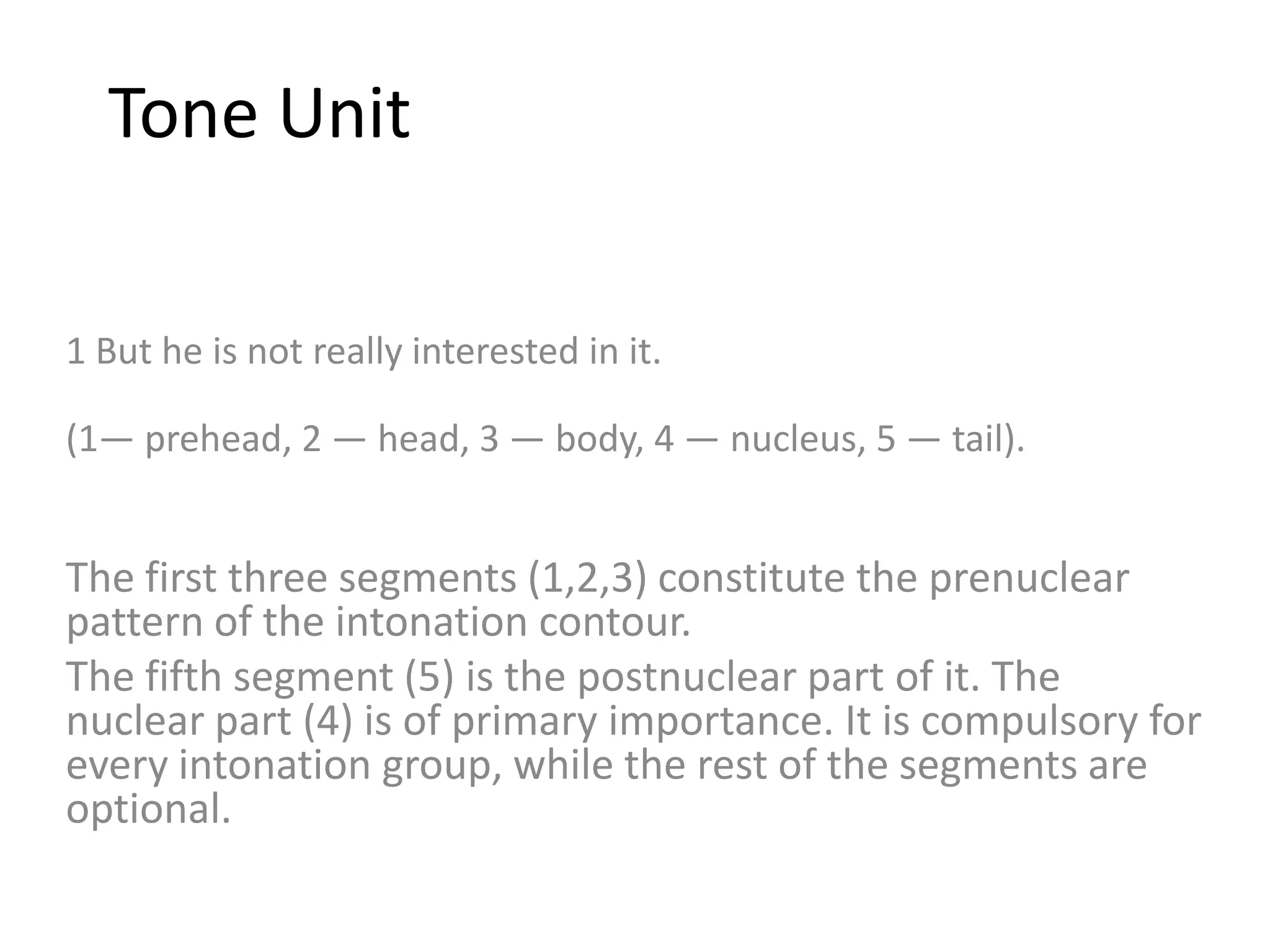
Tone Unit

1 But he is not really interested in it.

(1— prehead, 2 — head, 3 — body, 4 — nucleus, 5 — tail).


The first three segments (1,2,3) constitute the prenuclear
pattern of the intonation contour.
The fifth segment (5) is the postnuclear part of it. The
nuclear part (4) is of primary importance. It is compulsory for
every intonation group, while the rest of the segments are
optional.
Division of the contour

• J. D.O'Connor and G. F.Arnold (1973) stick to
  R. Kingdon's system. However, they suggest a
  four-part division of the contour: prehead,
  head, nucleus and tail, uniting head and
  body into one segment that is head.
(i) Tonic Syllable
• Tonic syllable is an obligatory component of tone unit. The
  centre of the unit, around which everything else is
  constructed, is the tonic syllable, or nucleus.
For example:
  John, is it you?
• In this example, there are two tone units because there are,
  two tonic syllables in it. First is John, one syllable utterance)
  second is it you? (Three syllable utterance).
• It contains a high degree of prominence which is a property of
  stressed syllable, so, tonic syllable contains.
Tone + Stress:
Tonic stress: The stress that tonic syllable is having is called
  tonic stress.
Location of the tonic syllable

• Of great linguistic importance
• The most common position – on the last
  lexical word of the tone-unit
• But, for contrastive purposes any word can
  become the bearer of the tonic syllable
• Thus, the placement of the tonic syllable
  represents the focus of the information
(ii)     The Head:
          The head is all that part of a tone unit that extends from the first stressed
syllable up to the tonic syllable.
For example:
                      Give me,            those?
                       Head                 TS
If there is no stressed syllable proceeding the tonic syllable,
there cannot be any head.
(iii) The Pre-Head:
The unstressed syllable before the head is called pre-head.
For example
              In an          hour
              Pre-head               TS
Pre-head can be found in two situations.
When there is no head.
As in
For example:
              In an          hour
                PH                   TS
b) When the head is after the unstressed syllable.
For example:
In a          little         less than an,           hour
 PH                          H                       TS
(iv) The tail
Any syllable that follows the tonic syllable or any
syllable between tonic syllable and of tone unit is called
the Tail.
For example:
             Look         at     it
              TS           Tail
              I    might         buy it
              H    TS             Tail
Exercises
• Divide the following utterances into tone units
  and decide where the tonic or nucleus might fall
  in each tone unit:
  1. The first student to finish can go early
  2. Sadly, Maurice has gone away
  3. The person who was watching me left a ticket
  behind
  4. Alan couldn't make it so Ken took his place
Answers

1. //The first student to finish// can go early//
2. //Sadly// Maurice has gone away//
3. // The person who was watching me //left a
   ticket behind//
4. //Alan couldn't make it //so Ken took his
   place//
Grammatical function of Tonality
• 22 || my brother who lives in LONdon || got MARried
  ||
• 23 || my BROther || who lives in LONdon || got
  MARried ||
• 24 || the man and the woman dressed in BLACK ||
  STOOD up ||
• 25 || the MAN || and the woman dressed in BLACK ||
  STOOD up ||
• 26 || they sent JOHN || a DOCtor || to HELP him||
• 27 || they sent john a DOCtor || to HELP him ||
Tone – unit and the structure of tone
                  unit:
• Tone: Tone is the overall behaviour of
  pitch.
• Pitch: Pitch is frequency of vibration of
  vocal cords.
• Tone unit:      For the purpose of analyzing
  intonation, a unit greater than syllable one
  syllable. Usually tone – unit is always
  composed of more than one syllable.
Tone unit boundaries
•   Neutral division into tone units:
•    Tone unit boundaries correspond to clause boundaries.
•   Emphatic:
•   A tone unit boundary occurs in the middle of a clause
    (usually at a phrase boundary).

• | On the Saturday we went on the London Eye | (tone unit
  = clause)
• | On the Saturday | we went on the London Eye |
  (marked/emphatic – tone unit boundary between adverbial
  and subject)
Tone
Tone is the major pitch movement within the tone unit. The
overall behavior of pitch is “tone”
Choice of pitch movement
•The meaning component deriving from tone does not attach
to the word level only but to the complete tone unit.
•The prominent words are the sub-classes of the tonic
syllabus.
•The communication value of prominence and tone choice
depends on interaction between listener and speaker.
•When is the meeting?

•On Saturday afterNOON
•On SATurday afternoon
Tone
Tone functions
(i) First possibility of pitch movement and variation in is on “head” of
       the tone-unit .
(ii) Second possibility the movement and variation of pitch for tonic
       syllable, in the form of rise and fall.

In a                     little        less than an, hour
  PH                                 H              TS
 Pitch variations in Head
 “all that part of a tone-unit that extends from the first syllable
 up to tonic syllabus.”
 Pitch possibilities in the head:
 1.High Head
 2.Low head
High Heads

   The stressed syllable which begins the head is
   high in pitch ,usually it is higher than the
   beginning pitch of the tone on the tonic syllable.


The ‘bus was late          is ‘that the end
Low Heads
In the low head the stressed syllable which begins the head is
low in pitch, it is lower than the beginning pitch of the tone on
the tonic syllable


The ,bus was late             is ,that the end
Low Head
Unstressed syllables continue the pitch of the stressed
syllable that precedes them with high and low heads.

We ’asked if it had come.   We ‚asked if it had come.
Pitch movement in tonic syllable
Tones are divided into two classes: static tone & kinetic tone
Static tone - a syllable is pronounced on a level ,no pitch
variation
Kinetic tone-change in pitch on physiological level by tension
of vocal cords
Halliday lists five intonation choices for the falling and rising tone movements.
Tone       symbol tonic movement            terminal pitch
t                                             tendency
1.           `         Falling                low
2.           ‚         Rising                 high

3.            ˆ           falling-rising         high
4.           ˇ          rising-falling        low
5.            -              Level                   low
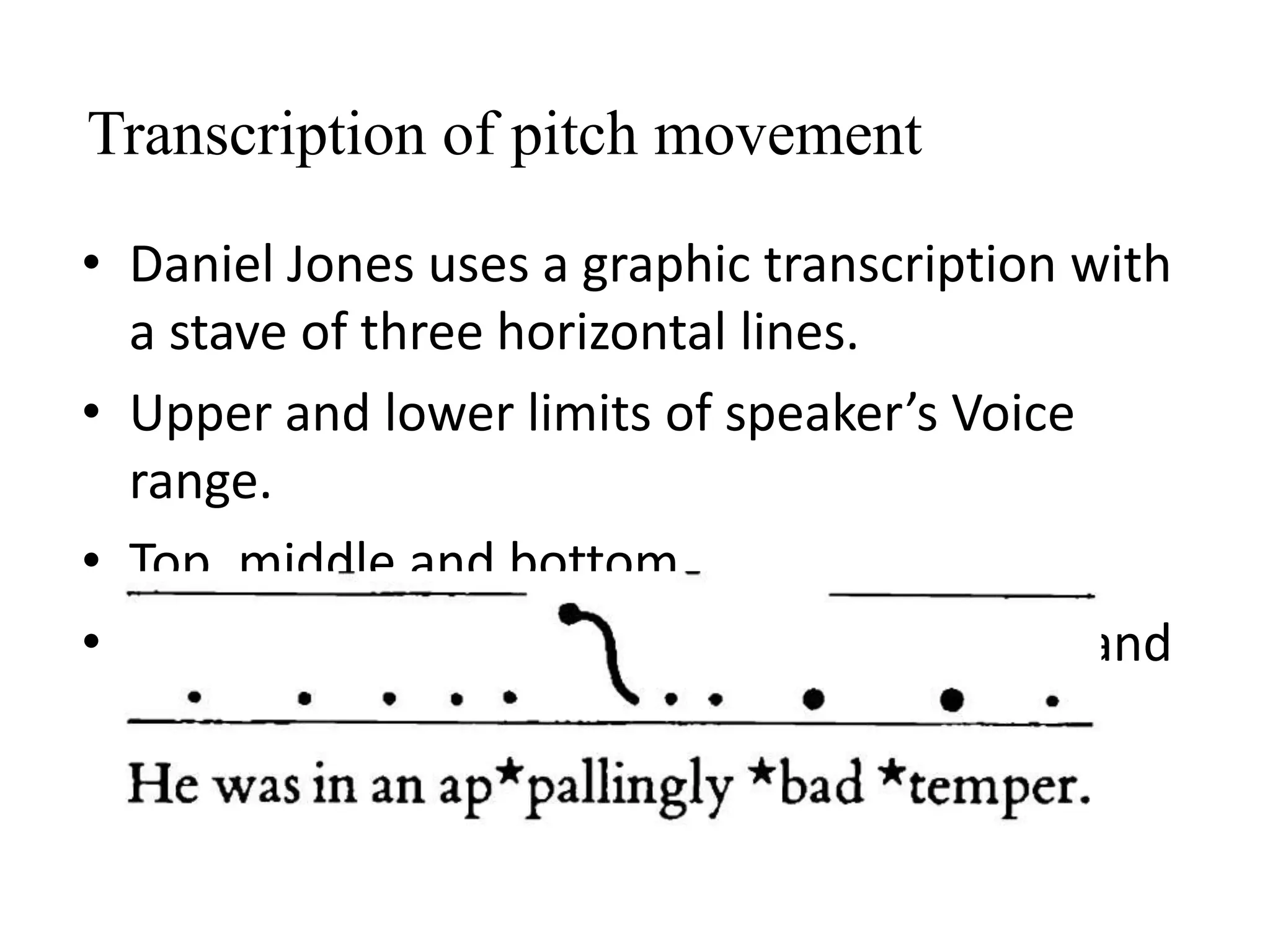
Transcription of pitch movement

• Daniel Jones uses a graphic transcription with
  a stave of three horizontal lines.
• Upper and lower limits of speaker’s Voice
  range.
• Top, middle and bottom
• Stressed & unstressed syllable have small and
  large dots respectively.
1.The Falling tone-(The glide-down)
• Polarity (truth value or validity)is known and
  stated, there is certainty with Yes or No
• A fall in the voice from a fairly high pitch to a very
  low one.
• On a single syllable the voice falls within the
  syllable.
The Falling Tone
• On more than one syllable the voice either falls
  within the stressed syllable or it moves down to the
  next syllable.
• Unstressed syllables at the end are all very low.
The Falling tone-(The glide-down)
Pre- head + tonic syllable
Any unstressed syllable before the tonic syllable have
low pitch.
The Rising-tone (The glide-up )
 Polarity (truth-value) is unknown and information
  is required.
 The tone conveys an impression that something
  more is to follow.
 Frequently accompany polite and friendly feelings
Rising Tone the Glide-Up
The rise in the glide-up either take place on one syllable, before the rise any
stress word is felt to be important but there is no change of pitch
The Rise-Fall Tone (compound tone)

• With the rise-fall tone we find a similar situation: if
  the tonic syllable is followed by a single syllable in
  the tail, the “rise” part of the tone takes place on the
  first (tonic) syllable and the “fall” part is on the
  second.


ˆno        ˆno one     ˆno sir
The Rise-Fall Tone (compound tone)
When there are two or more syllables in the tail, the
syllable immediately following the tonic syllable is
always higher and any following syllables are low.
ˆAll of them went


Thatˆs   a nice way to speak
Fall –Rise tones(compound tone)
• The pitch movement are distorted by the structure of syllables
  they occur on. If there is a tail of two or more syllable the
  normal pitch movement fall on the tonic syllable and to remain
  low until the last stress syllable
 I .Might have .thought of .buying it


   Most of it was for them
The Fall-Rise Tone(compound tone)

• The fall is on the first stress syllable, the fall and
  rise are separated. The rise is on the last stressed
  syllable .
•     Glide down and Glide up tone.
• Pitch movement is for the pitch to fall on the tonic
  syllable and remain low until the last syllable in
  the tail.

Intonation

  • 1.
    Intonation Intonation is abouthow we say things, rather than what we say. Without intonation, it's impossible to understand the expressions and thoughts that go with words. Listen to somebody speaking without paying attention to the words: the 'melody' you hear is the intonation.
  • 2.
    WHAT IS INTONATION 1.Intonation is a term used to refer to the distinctive use of different patterns of pitch that carry meaningful information. 2. The kinds of pitch modulation which are found in whole utterances. Intonation contours can be used to highlight certain elements in an utterance, to bundle words together into information chunks,& to convey speaker’s attitude to what he/she is saying.(Philip Carr,page#78)
  • 3.
    WHAT IS INTONATION •Intonation can be described as the movements or variations in pitch to which we attach familiar labels describing levels (e.g. high / low) and tones (e.g. falling /rising), etc. (Ranalli, 2002)
  • 4.
    INTONATION Articulatory Acoustic phonetics Auditory phonetics phonetics(production (transmission point of (Perception point of view) point of view) view) Rate of vocal folds Fundamental frequency Pitch The quicker the vocal folds The higher Fo (higher The higher the pitch the vibrate. number of cycles per sensation. second)
  • 5.
    Tone & Intonationlanguages • We can divide language into languages which are tone languages and those which are not, English falls into second category, that is, it is not a tone language. • All the languages in the world use consonants and vowels to build morphemes, which in turn join together to form words. • Thus the English word ‘me’ is made up of a nasal consonant followed by a high vowel. • If we change the consonant to a/b/ we would get a different word, ‘be’, and if we change the vowel to a low vowel, we would also get a different words, ‘ma’. • We may pronounce the word ‘ma’ with various pitch patterns, depending on the occasion. We may pronounce it with high pitch if we are emphatic, we may say it with a rising pitch in a question etc.
  • 6.
    Tone languages • Butthese different pitch patterns do not alter the word in the way that changing a consonant or changing a vowel does. • These different pitch patterns that do not change but merely add to the basic meaning of words are called intonation. • Yet there are some languages in the world that use pitch patterns to build morphemes in the same way consonant and vowels are used. The best known such language is Chinese.
  • 7.
    Tone languages • InChinese, the syllable ‘ma’ when pronounced with a falling pitch patterns means, ‘to scold’. • When pronounced with a rising pattern, the meaning is ‘hemp’, when pronounced with a high level pattern, the meaning is ‘mother’ as in some dialects of English, and lastly, when pronounced with a low dipping pattern, the meaning is ‘horse’. • When pitch patterns are used in this lexical capacity i.e. to build word and morphemes much as consonants and vowels do, they are called tones. • And languages that use tones in this way are called tone languages.
  • 8.
    • English isnot tone language because different tones make no difference in meanings. • But chinese is a tone language • Urdu is stressed lang • English is not stress language
  • 9.
    DEVELOPMENT OF INTONATION Thestudy of intonation went through many changes in the twentieth century.  British linguistics Daniel Jones & (1926) The most intensive development began during the 1940. In United States the theory that evolved was based on ‘pitch phonemes’ (Pike. 1945). It was developed in 1951 and then by Halliday (1967). 
  • 10.
    Intonation Hallidaydivides intonation into “the three T’s”: 1. Tonality (the chunking of speech into intonational phrases, or tone-units) 2. 2.Tone (mainly, but not only: fall, rise, and fall-rise 3. Tonicity (nucleus placement).
  • 11.
    Intonation Halliday divides intonationinto “the three T’s”: Tonality (the chunking of speech into intonational phrases, or tone-units), 2.Tonicity (nucleus placement), and 3.Tone (mainly, but not only: fall, rise, and fall-rise
  • 12.
    TONE UNIT a groupof words forming a distinctive unit in an utterance, containing a nucleus and optionally one or more other syllables before and after the nucleus. How do we identify tone units • Are there any physical constraints on the extent of tone unit? • How do we identify tone units in connected speech? • What communicative function(s) do tone units realise in speech?
  • 13.
    Constraints on ToneUnits. • We break up spoken language into tone groups because we need to breathe, and so there is a physical reason. • There is also the need to think; that is, tone groups also have a cognitive basis. While we are speaking one tone group, we are planning the next one, and so the tone group carries only one idea at a time. Thus the pace of the tone groups, and the information they convey, matches the speaker's thoughts.
  • 14.
    Identification of toneunit boundaries in connected speech • Pause • Pitch • Speed
  • 15.
    Phonetic clues • Aperceivable pitch change immediately following the final accented syllable • Speed – syllables towards the end of a tone unit tend to be relatively slow while syllables towards the start of a tone unit tend to be relatively quick. combination of pause, pitch change, and a change of pace.
  • 16.
    Pause Some scholars e.g.Brazil (1997) argue that the boundaries of a tone unit are marked by a pause. communicative function of a tone unit • Halliday (1967) recognised that • each tone unit realised semantically one information unit – in other words we • use tone units to package our messages into bite sized chunks of information e.g., • || i THINK || you have made good PROgress // THIS year ||
  • 17.
    Link between tone-unit and units of grammar • Halliday also realised that if a tone unit equals an information unit it is likely to • also correspond with a clause. Some statistical evidence for this is found in the • Crystal and Davy (1975) corpus approximately where around 50% of all tone • units corresponded to clauses. • 4. || we’re looking forward to BONfire night || Marked and Unmarked Tonality = a Clause (Unmarked) Tone Unit ≠ a Clause (MarkedAt phrase and clause boundaries: e.g. In France where farms tend to be smaller the subsidies are more im portant
  • 18.
    Analysis of Utterancesto Understand Tone – Unit One syllable utterance You This is one tone unit. Note: Underlined syllable carry tone. Three Syllable Utterance Is it you? This is one tone unit. Note: the underlined syllable have more prominence.
  • 19.
    Division of intonationalcontour H.Palmer (1922) was the first one to divide the intonational contour into three main segments: • head (all the stressed and the unstressed syllables before the nucleus), • nucleus (the most prominent syllable in the utterance) and • tail (the unstressed syllables following the nucleus).
  • 20.
    • R. Kingdon(1958) suggests a division of the intonational contour into five parts: prehead (initial unstressed syllables), head (the first stressed syllable), body (all the stressed and the unstressed syllables in the scale preceding the nucleus), nucleus (the most prominently stressed syllable) and tail (the final unstressed syllables following the nucleus). For example:
  • 21.
    Tone Unit 1 Buthe is not really interested in it. (1— prehead, 2 — head, 3 — body, 4 — nucleus, 5 — tail). The first three segments (1,2,3) constitute the prenuclear pattern of the intonation contour. The fifth segment (5) is the postnuclear part of it. The nuclear part (4) is of primary importance. It is compulsory for every intonation group, while the rest of the segments are optional.
  • 22.
    Division of thecontour • J. D.O'Connor and G. F.Arnold (1973) stick to R. Kingdon's system. However, they suggest a four-part division of the contour: prehead, head, nucleus and tail, uniting head and body into one segment that is head.
  • 23.
    (i) Tonic Syllable •Tonic syllable is an obligatory component of tone unit. The centre of the unit, around which everything else is constructed, is the tonic syllable, or nucleus. For example: John, is it you? • In this example, there are two tone units because there are, two tonic syllables in it. First is John, one syllable utterance) second is it you? (Three syllable utterance). • It contains a high degree of prominence which is a property of stressed syllable, so, tonic syllable contains. Tone + Stress: Tonic stress: The stress that tonic syllable is having is called tonic stress.
  • 24.
    Location of thetonic syllable • Of great linguistic importance • The most common position – on the last lexical word of the tone-unit • But, for contrastive purposes any word can become the bearer of the tonic syllable • Thus, the placement of the tonic syllable represents the focus of the information
  • 25.
    (ii) The Head: The head is all that part of a tone unit that extends from the first stressed syllable up to the tonic syllable. For example: Give me, those? Head TS If there is no stressed syllable proceeding the tonic syllable, there cannot be any head.
  • 26.
    (iii) The Pre-Head: Theunstressed syllable before the head is called pre-head. For example In an hour Pre-head TS Pre-head can be found in two situations. When there is no head. As in For example: In an hour PH TS b) When the head is after the unstressed syllable. For example: In a little less than an, hour PH H TS
  • 27.
    (iv) The tail Anysyllable that follows the tonic syllable or any syllable between tonic syllable and of tone unit is called the Tail. For example: Look at it TS Tail I might buy it H TS Tail
  • 28.
    Exercises • Divide thefollowing utterances into tone units and decide where the tonic or nucleus might fall in each tone unit: 1. The first student to finish can go early 2. Sadly, Maurice has gone away 3. The person who was watching me left a ticket behind 4. Alan couldn't make it so Ken took his place
  • 29.
    Answers 1. //The firststudent to finish// can go early// 2. //Sadly// Maurice has gone away// 3. // The person who was watching me //left a ticket behind// 4. //Alan couldn't make it //so Ken took his place//
  • 30.
    Grammatical function ofTonality • 22 || my brother who lives in LONdon || got MARried || • 23 || my BROther || who lives in LONdon || got MARried || • 24 || the man and the woman dressed in BLACK || STOOD up || • 25 || the MAN || and the woman dressed in BLACK || STOOD up || • 26 || they sent JOHN || a DOCtor || to HELP him|| • 27 || they sent john a DOCtor || to HELP him ||
  • 31.
    Tone – unitand the structure of tone unit: • Tone: Tone is the overall behaviour of pitch. • Pitch: Pitch is frequency of vibration of vocal cords. • Tone unit: For the purpose of analyzing intonation, a unit greater than syllable one syllable. Usually tone – unit is always composed of more than one syllable.
  • 32.
    Tone unit boundaries • Neutral division into tone units: • Tone unit boundaries correspond to clause boundaries. • Emphatic: • A tone unit boundary occurs in the middle of a clause (usually at a phrase boundary). • | On the Saturday we went on the London Eye | (tone unit = clause) • | On the Saturday | we went on the London Eye | (marked/emphatic – tone unit boundary between adverbial and subject)
  • 33.
    Tone Tone is themajor pitch movement within the tone unit. The overall behavior of pitch is “tone” Choice of pitch movement •The meaning component deriving from tone does not attach to the word level only but to the complete tone unit. •The prominent words are the sub-classes of the tonic syllabus. •The communication value of prominence and tone choice depends on interaction between listener and speaker. •When is the meeting? •On Saturday afterNOON •On SATurday afternoon
  • 34.
    Tone Tone functions (i) Firstpossibility of pitch movement and variation in is on “head” of the tone-unit . (ii) Second possibility the movement and variation of pitch for tonic syllable, in the form of rise and fall. In a little less than an, hour PH H TS Pitch variations in Head “all that part of a tone-unit that extends from the first syllable up to tonic syllabus.” Pitch possibilities in the head: 1.High Head 2.Low head
  • 35.
    High Heads The stressed syllable which begins the head is high in pitch ,usually it is higher than the beginning pitch of the tone on the tonic syllable. The ‘bus was late is ‘that the end
  • 36.
    Low Heads In thelow head the stressed syllable which begins the head is low in pitch, it is lower than the beginning pitch of the tone on the tonic syllable The ,bus was late is ,that the end
  • 37.
    Low Head Unstressed syllablescontinue the pitch of the stressed syllable that precedes them with high and low heads. We ’asked if it had come. We ‚asked if it had come.
  • 38.
    Pitch movement intonic syllable Tones are divided into two classes: static tone & kinetic tone Static tone - a syllable is pronounced on a level ,no pitch variation Kinetic tone-change in pitch on physiological level by tension of vocal cords Halliday lists five intonation choices for the falling and rising tone movements. Tone symbol tonic movement terminal pitch t tendency 1. ` Falling low 2. ‚ Rising high 3. ˆ falling-rising high 4. ˇ rising-falling low 5. - Level low
  • 39.
    Transcription of pitchmovement • Daniel Jones uses a graphic transcription with a stave of three horizontal lines. • Upper and lower limits of speaker’s Voice range. • Top, middle and bottom • Stressed & unstressed syllable have small and large dots respectively.
  • 40.
    1.The Falling tone-(Theglide-down) • Polarity (truth value or validity)is known and stated, there is certainty with Yes or No • A fall in the voice from a fairly high pitch to a very low one. • On a single syllable the voice falls within the syllable.
  • 41.
    The Falling Tone •On more than one syllable the voice either falls within the stressed syllable or it moves down to the next syllable. • Unstressed syllables at the end are all very low.
  • 42.
    The Falling tone-(Theglide-down) Pre- head + tonic syllable Any unstressed syllable before the tonic syllable have low pitch.
  • 43.
    The Rising-tone (Theglide-up )  Polarity (truth-value) is unknown and information is required.  The tone conveys an impression that something more is to follow.  Frequently accompany polite and friendly feelings
  • 44.
    Rising Tone theGlide-Up The rise in the glide-up either take place on one syllable, before the rise any stress word is felt to be important but there is no change of pitch
  • 45.
    The Rise-Fall Tone(compound tone) • With the rise-fall tone we find a similar situation: if the tonic syllable is followed by a single syllable in the tail, the “rise” part of the tone takes place on the first (tonic) syllable and the “fall” part is on the second. ˆno ˆno one ˆno sir
  • 46.
    The Rise-Fall Tone(compound tone) When there are two or more syllables in the tail, the syllable immediately following the tonic syllable is always higher and any following syllables are low. ˆAll of them went Thatˆs a nice way to speak
  • 47.
    Fall –Rise tones(compoundtone) • The pitch movement are distorted by the structure of syllables they occur on. If there is a tail of two or more syllable the normal pitch movement fall on the tonic syllable and to remain low until the last stress syllable I .Might have .thought of .buying it Most of it was for them
  • 48.
    The Fall-Rise Tone(compoundtone) • The fall is on the first stress syllable, the fall and rise are separated. The rise is on the last stressed syllable . • Glide down and Glide up tone. • Pitch movement is for the pitch to fall on the tonic syllable and remain low until the last syllable in the tail.