Paul Grice:
Theory of Conversational
Implicature
Presented to:Dr. Muhammad Iqbal Butt
Presented by:Muhammad Sajjad Raja
PAUL GRICE
• Grice proposed that many aspects of “speaker’s
meaning” result from the assumption that the participants
in a conversation are cooperating in an attempt to reach
mutual goals – or at least are pretending to do so!
• Grice’s aim was to understand how “speaker’s meaning”
rises from “sentence meaning” ( Speaker meaning =
Sentence meaning + What is implicated)
• Conversation is a cooperative behaviour, and therefore
proceeds by rules of cooperative conduct.
• Grice called this the Cooperative Principle.
The Cooperative Principle.
“Make your conversational
contribution such as is required, at
the stage at which it occurs, by the
accepted purpose or direction of the
talk exchange in which you are
engaged”
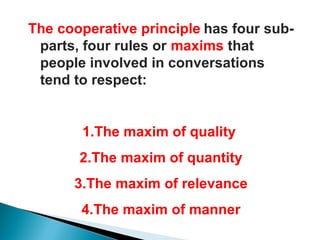
The cooperative principle has four sub-
parts, four rules or maxims that
people involved in conversations
tend to respect:
1.The maxim of quality
2.The maxim of quantity
3.The maxim of relevance
4.The maxim of manner
(1)The maxim of quality (“Tell the truth”)
Do not say what you believe to be false.
Do not say that for which you lack adequate evidence.
(2) The maxim of quantity (“Say just as
much as is necessary”)
Make your contribution as informative as is
required for the current purposes of the
exchange.
Do not make the contribution more informative
than is required.
.
(3) The maxim of relation / relevance
(“Stick to the point”)
Make your contributions relevant.
(4) The maxim of manner (“Be clear”)
Avoid obscurity.
Avoid ambiguity.
Be brief.
Be orderly.
Grice was not acting as a prescriptivist
when he stated these maxims.
He observed the difference between “what
is said” and “what is meant” to show that
people actually do follow these maxims in
conversation.
An example on the maxim of quantity:
Mum: Did you finish your homework?
Pat: I finished my algebra.
Mum: Well, get busy and finish your English, too!
The child did not say that her English homework is not
done, nor did she imply it.
Nevertheless her mother is entitled to draw this
conclusion, based on the combination of what the child
actually said and the cooperative principle.
An example on the maxim of relation/relevance:
The maxim of relevance is behind the implications of
this letter of recommendation (a classic type of
example).
Dear Colleague,
Dr John Jones has asked me to write a letter on his
behalf. Let me say that Dr Jones is unfailingly polite,
is neatly dressed at all times, and is always on time
for his classes.
Yours sincerely,
Prof. H.P. Smith
The person reading this letter assumes that all the
relevant information will be included; so the maxims
of quantity and relevance lead one to suspect that this
is the best that the professor can say.
Maxims may be:
Observed
Ex:
John got into Columbia and won a scholarship.
I went to the supermarket and I bought some
sugar.
“and” means that both linked events occurred,
but implicates also temporal progression due
to the maxim of manner: be orderly.
Maxims may be:
Violated (because of a clash with
another maxim)
A: Where does Dave live?
B: Somewhere in the South of France
This response infringes the first maxim of
quantity, but does so in order to avoid violating
the second maxim of quality.
What is the implicature?
Maxims may be:
Flouted
E.g.:
A: Will you come out on a dinner date with me?
B: Hasn’t the weather been lovely recently?
B flouts the maxims of quantity and relevance.
Entailment is the relationship between two sentences
where the truth of one (A) requires the truth of the other (B).
For example,
The sentence (A) The president was assassinated. entails
(B) The president is dead. Notice also that if (B) is false,
then (A) must necessarily be false. To show entailment, we
must show that (A) being true forces (B) to be true, or,
equivalently, that (B) being false forces (A) to be false.
Entailment and Implicature
The linguistic meaning of what is said
+
The information from the context (shared knowledge)
+
The assumption that the people speaking are
observing the cooperative principle
=
Conversational implicature
Implicature interpretation requires both Speaker and
Hearer to be collaborative
Ex:
A. I got an A on that exam.
B. And I’m Queen Marie of Rumania.
A. Where did you go?
B. Out.
A: Where does Arnold live?
B: Somewhere in southern California.
Types of implicatures
Implicature
conventional conversational
generalized particularized
Conventional implicatures
• encoded in the lexicon or grammar
• not based on cooperative principle or maxims
Ex:
• not dependent on context for their interpretations
George is short but brave. (contrast)
Sue and Bill are divorced (conjunction)
He jumped on his horse and rode away. (sequence)
I dropped the camera and it broke (consequence)
Coversational implicatures
• Inferred via the cooperative principle or maxims
(observed, violated or flouted)
Ex:
A: I am out of petrol.
B: There is a garage around the corner.
Generalized conversational implicatures
• independent of the context
Ex.:
1. Indefinites
A car ran over John’s foot. (not John’s car / not the
speaker’s car)
the speaker is assumed to follow the maxim of quantity, if he
wanted to be more specific he would have said my car or
John’s car
2. Scalar implicatures communicated by choosing a word
expressing a value from a scale (quantity, frequency, etc.)
I’m studying linguistics and I’ve completed some of
the required courses (not all)
If the scale is all, most, many, some, few...., the use of some implicates
that all the higher items in the scale are to be considered negative.
Particularized conversational implicatures
Ex.:
Rick: Hey, coming to the party tonight?
Tom: My parents are visiting. (flouting relevance)
Ann: Where are you going with the dog?
Sam: To the V.E.T. (flouting manner)
• dependent on a specific context
Bert: Do you like ice-cream?
Ernie: Is the the Pope Catholic? (flouting relevance)
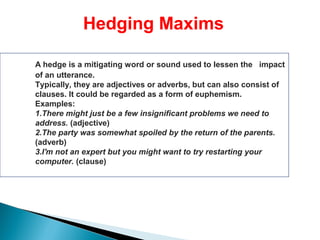
A hedge is a mitigating word or sound used to lessen the impact
of an utterance.
Typically, they are adjectives or adverbs, but can also consist of
clauses. It could be regarded as a form of euphemism.
Examples:
1.There might just be a few insignificant problems we need to
address. (adjective)
2.The party was somewhat spoiled by the return of the parents.
(adverb)
3.I'm not an expert but you might want to try restarting your
computer. (clause)
Hedging Maxims
If the speaker only says that “they are married” and they do not know for
sure if they are married, they may violate the maxim of quality since they
say something that they do not know to be true or false.
Nevertheless, by adding Hedges may intentionally or unintentionally be
employed in both spoken and written language since
they are crucially important in communication.
Hedges help speakers and writers indicate more precisely how Gricean
maxims (expectations of quantity, quality, manner, and relevance)
are observed in assessments.
For example,
1.All I know is smoking is harmful to your health.
In (1), it can be observed that information conveyed by the speaker is
limited by adding all I know.
By so saying, the speaker wants to inform that she is not only making an
assertion but observing the maxim of quantity as well.
they told me that, the speaker wants to confirm that they are
observing the conversational maxim of quality.
1.I am not sure if all of these are clear to you, but this is what
I know.
The above example shows that hedges are good indications
the speakers are not only conscious of the maxim of manner,
1.They told me that they are married.
but they are also trying to observe them.
1.By the way, you like this car?
By using by the way, what has been said by the
speakers is not relevant to the moment in which the
conversation takes place
. Such a hedge can be found in the middle of
speakers’ conversation as the speaker wants to
switch to another topic that is different from the
previous one
. Therefore, by the way functions as a hedge
indicating that the speaker wants to drift into
another topic or to stop the previous topic.
Chap 4  1

Chap 4 1

  • 2.
    Paul Grice: Theory ofConversational Implicature Presented to:Dr. Muhammad Iqbal Butt Presented by:Muhammad Sajjad Raja
  • 3.
    PAUL GRICE • Griceproposed that many aspects of “speaker’s meaning” result from the assumption that the participants in a conversation are cooperating in an attempt to reach mutual goals – or at least are pretending to do so! • Grice’s aim was to understand how “speaker’s meaning” rises from “sentence meaning” ( Speaker meaning = Sentence meaning + What is implicated) • Conversation is a cooperative behaviour, and therefore proceeds by rules of cooperative conduct. • Grice called this the Cooperative Principle.
  • 4.
    The Cooperative Principle. “Makeyour conversational contribution such as is required, at the stage at which it occurs, by the accepted purpose or direction of the talk exchange in which you are engaged”
  • 5.
    The cooperative principlehas four sub- parts, four rules or maxims that people involved in conversations tend to respect: 1.The maxim of quality 2.The maxim of quantity 3.The maxim of relevance 4.The maxim of manner
  • 6.
    (1)The maxim ofquality (“Tell the truth”) Do not say what you believe to be false. Do not say that for which you lack adequate evidence.
  • 7.
    (2) The maximof quantity (“Say just as much as is necessary”) Make your contribution as informative as is required for the current purposes of the exchange. Do not make the contribution more informative than is required.
  • 8.
    . (3) The maximof relation / relevance (“Stick to the point”) Make your contributions relevant.
  • 9.
    (4) The maximof manner (“Be clear”) Avoid obscurity. Avoid ambiguity. Be brief. Be orderly.
  • 10.
    Grice was notacting as a prescriptivist when he stated these maxims. He observed the difference between “what is said” and “what is meant” to show that people actually do follow these maxims in conversation.
  • 11.
    An example onthe maxim of quantity: Mum: Did you finish your homework? Pat: I finished my algebra. Mum: Well, get busy and finish your English, too! The child did not say that her English homework is not done, nor did she imply it. Nevertheless her mother is entitled to draw this conclusion, based on the combination of what the child actually said and the cooperative principle.
  • 12.
    An example onthe maxim of relation/relevance: The maxim of relevance is behind the implications of this letter of recommendation (a classic type of example). Dear Colleague, Dr John Jones has asked me to write a letter on his behalf. Let me say that Dr Jones is unfailingly polite, is neatly dressed at all times, and is always on time for his classes. Yours sincerely, Prof. H.P. Smith The person reading this letter assumes that all the relevant information will be included; so the maxims of quantity and relevance lead one to suspect that this is the best that the professor can say.
  • 13.
    Maxims may be: Observed Ex: Johngot into Columbia and won a scholarship. I went to the supermarket and I bought some sugar. “and” means that both linked events occurred, but implicates also temporal progression due to the maxim of manner: be orderly.
  • 14.
    Maxims may be: Violated(because of a clash with another maxim) A: Where does Dave live? B: Somewhere in the South of France This response infringes the first maxim of quantity, but does so in order to avoid violating the second maxim of quality. What is the implicature?
  • 15.
    Maxims may be: Flouted E.g.: A:Will you come out on a dinner date with me? B: Hasn’t the weather been lovely recently? B flouts the maxims of quantity and relevance.
  • 16.
    Entailment is therelationship between two sentences where the truth of one (A) requires the truth of the other (B). For example, The sentence (A) The president was assassinated. entails (B) The president is dead. Notice also that if (B) is false, then (A) must necessarily be false. To show entailment, we must show that (A) being true forces (B) to be true, or, equivalently, that (B) being false forces (A) to be false. Entailment and Implicature
  • 17.
    The linguistic meaningof what is said + The information from the context (shared knowledge) + The assumption that the people speaking are observing the cooperative principle = Conversational implicature Implicature interpretation requires both Speaker and Hearer to be collaborative Ex: A. I got an A on that exam. B. And I’m Queen Marie of Rumania. A. Where did you go? B. Out. A: Where does Arnold live? B: Somewhere in southern California.
  • 18.
    Types of implicatures Implicature conventionalconversational generalized particularized
  • 19.
    Conventional implicatures • encodedin the lexicon or grammar • not based on cooperative principle or maxims Ex: • not dependent on context for their interpretations George is short but brave. (contrast) Sue and Bill are divorced (conjunction) He jumped on his horse and rode away. (sequence) I dropped the camera and it broke (consequence)
  • 20.
    Coversational implicatures • Inferredvia the cooperative principle or maxims (observed, violated or flouted) Ex: A: I am out of petrol. B: There is a garage around the corner.
  • 21.
    Generalized conversational implicatures •independent of the context Ex.: 1. Indefinites A car ran over John’s foot. (not John’s car / not the speaker’s car) the speaker is assumed to follow the maxim of quantity, if he wanted to be more specific he would have said my car or John’s car 2. Scalar implicatures communicated by choosing a word expressing a value from a scale (quantity, frequency, etc.) I’m studying linguistics and I’ve completed some of the required courses (not all) If the scale is all, most, many, some, few...., the use of some implicates that all the higher items in the scale are to be considered negative.
  • 22.
    Particularized conversational implicatures Ex.: Rick:Hey, coming to the party tonight? Tom: My parents are visiting. (flouting relevance) Ann: Where are you going with the dog? Sam: To the V.E.T. (flouting manner) • dependent on a specific context Bert: Do you like ice-cream? Ernie: Is the the Pope Catholic? (flouting relevance)
  • 23.
    A hedge isa mitigating word or sound used to lessen the impact of an utterance. Typically, they are adjectives or adverbs, but can also consist of clauses. It could be regarded as a form of euphemism. Examples: 1.There might just be a few insignificant problems we need to address. (adjective) 2.The party was somewhat spoiled by the return of the parents. (adverb) 3.I'm not an expert but you might want to try restarting your computer. (clause) Hedging Maxims
  • 24.
    If the speakeronly says that “they are married” and they do not know for sure if they are married, they may violate the maxim of quality since they say something that they do not know to be true or false. Nevertheless, by adding Hedges may intentionally or unintentionally be employed in both spoken and written language since they are crucially important in communication. Hedges help speakers and writers indicate more precisely how Gricean maxims (expectations of quantity, quality, manner, and relevance) are observed in assessments. For example, 1.All I know is smoking is harmful to your health. In (1), it can be observed that information conveyed by the speaker is limited by adding all I know. By so saying, the speaker wants to inform that she is not only making an assertion but observing the maxim of quantity as well.
  • 25.
    they told methat, the speaker wants to confirm that they are observing the conversational maxim of quality. 1.I am not sure if all of these are clear to you, but this is what I know. The above example shows that hedges are good indications the speakers are not only conscious of the maxim of manner, 1.They told me that they are married. but they are also trying to observe them. 1.By the way, you like this car?
  • 26.
    By using bythe way, what has been said by the speakers is not relevant to the moment in which the conversation takes place . Such a hedge can be found in the middle of speakers’ conversation as the speaker wants to switch to another topic that is different from the previous one . Therefore, by the way functions as a hedge indicating that the speaker wants to drift into another topic or to stop the previous topic.