


MODULE II
Valuing Others andTheir
Circumstances
Finding Others’ Greatness
Observing Other’s Circumstances
Feeling for Others
Supporting Others’ Advocacy
Seeking Justice for Others
Overwhelming Indifference
Working with Others
CONTENT STANDARD
•The learner demonstrates understanding of
how Anglo-American literature and other
text types serve as means of valuing other
people; also how to use processing
information strategies, different forms of
adverbs and conditionals for him/her to play
an active part in a ChamberTheatre
presentation.
PERFORMANCE STANDARD
•The learner proficiently plays an active
part in a ChamberTheatre presentation
through employing effective verbal and
non- verbal strategies based on the
following criteria: Focus,Voice, Delivery,
Facial Expressions, Style and Body
Movements or Gestures.
FINDING OTHERS’
GREATNESS
Module 2 | Lesson 2
TASK 2
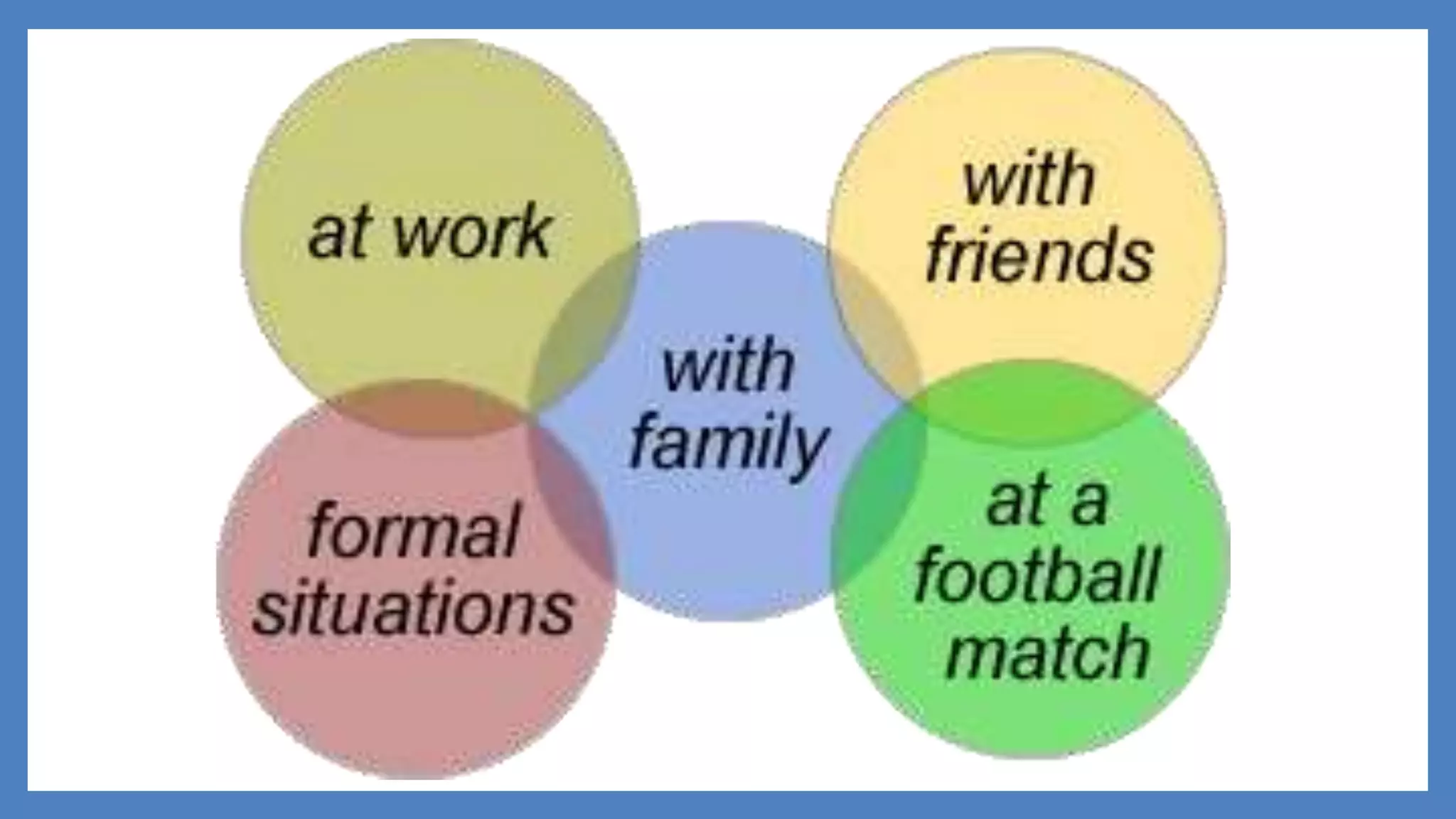
•What is the degree of formality
in each conversation?
•How does our relationship with
others influence the way we
communicate with them?
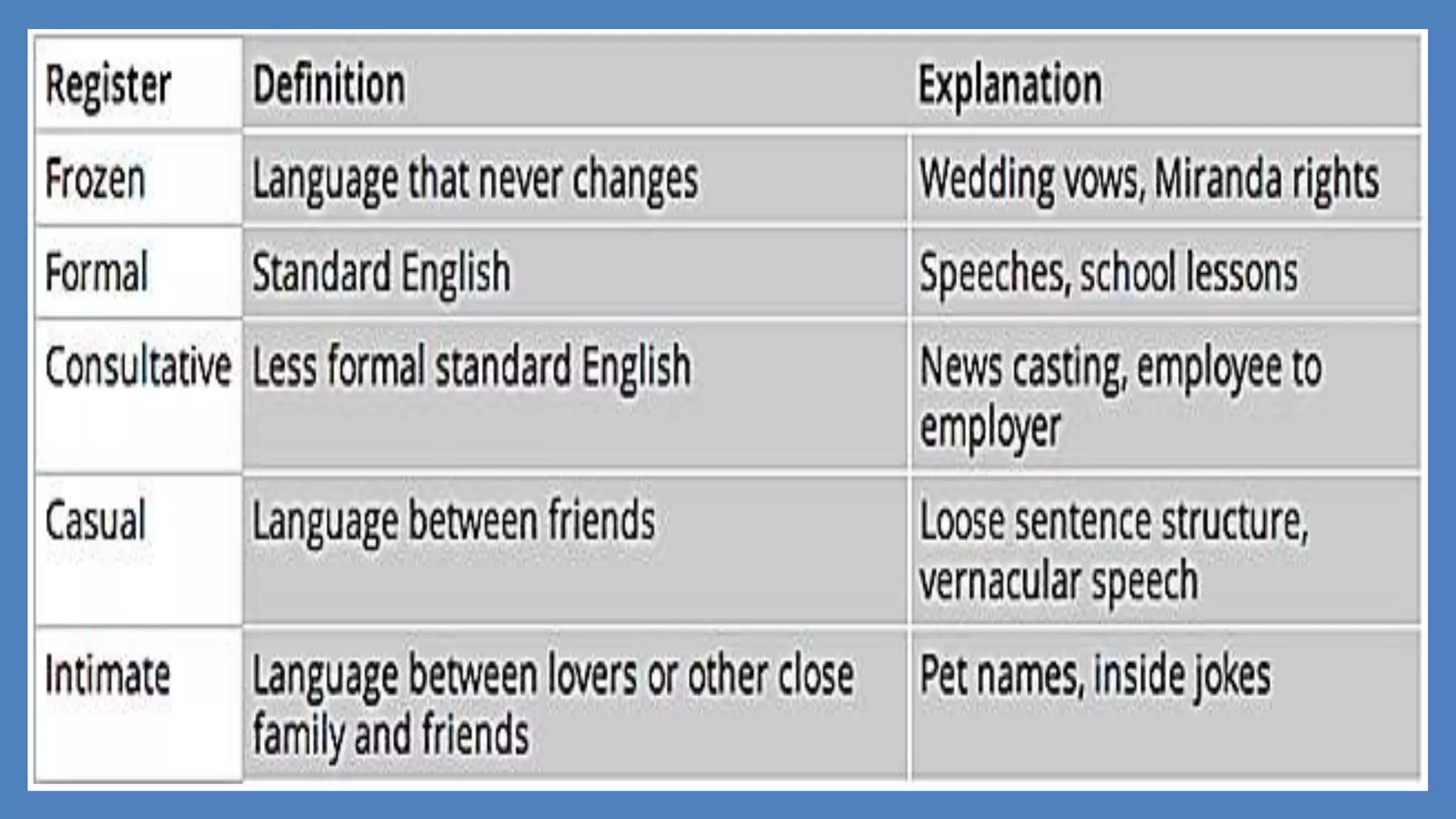
REGISTER
(communicative style)
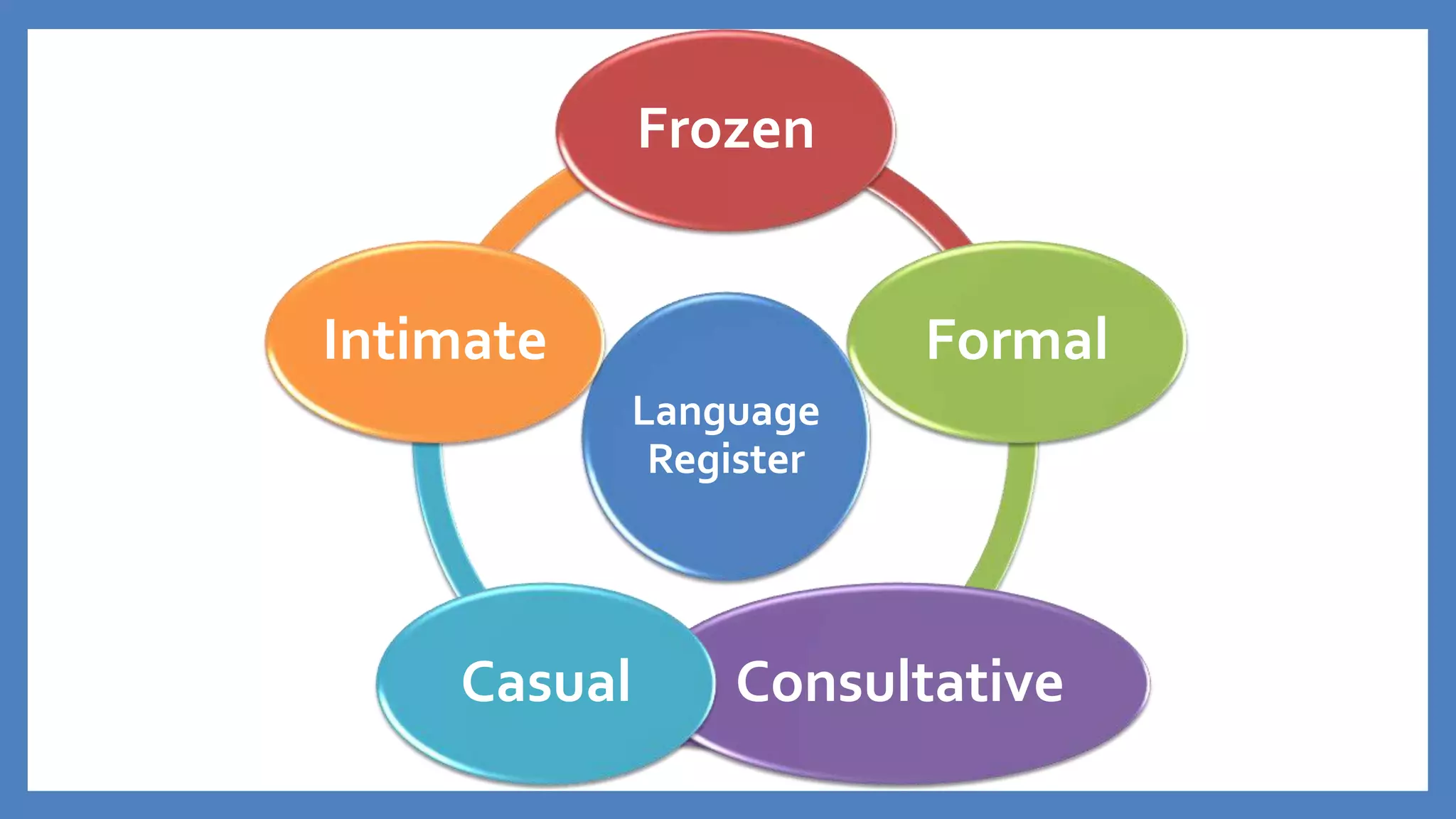
Language
Register
Frozen
Formal
ConsultativeCasual
Intimate
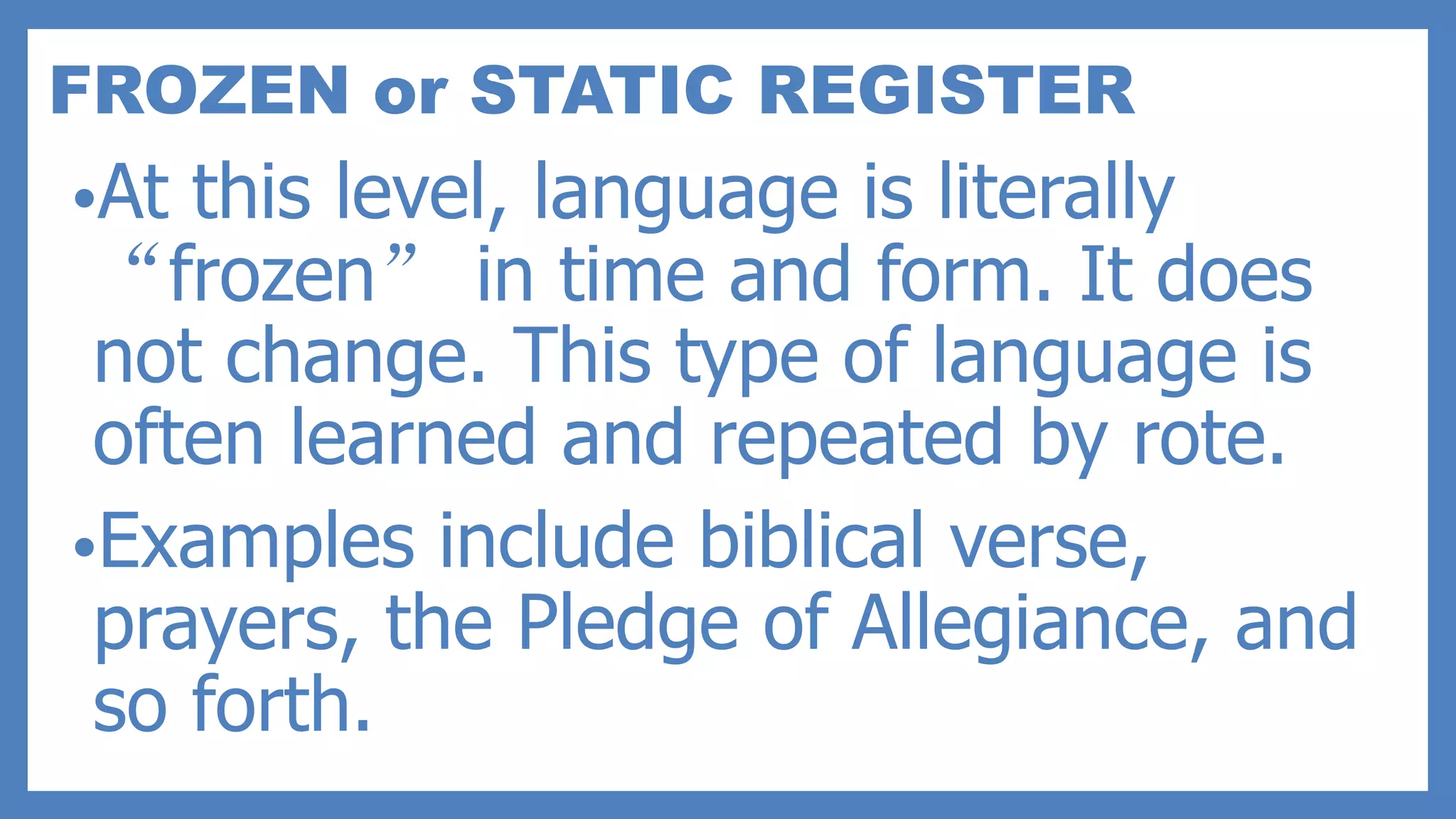
FROZEN or STATIC REGISTER
•At this level, language is literally
“frozen” in time and form. It does
not change. This type of language is
often learned and repeated by rote.
•Examples include biblical verse,
prayers, the Pledge of Allegiance, and
so forth.
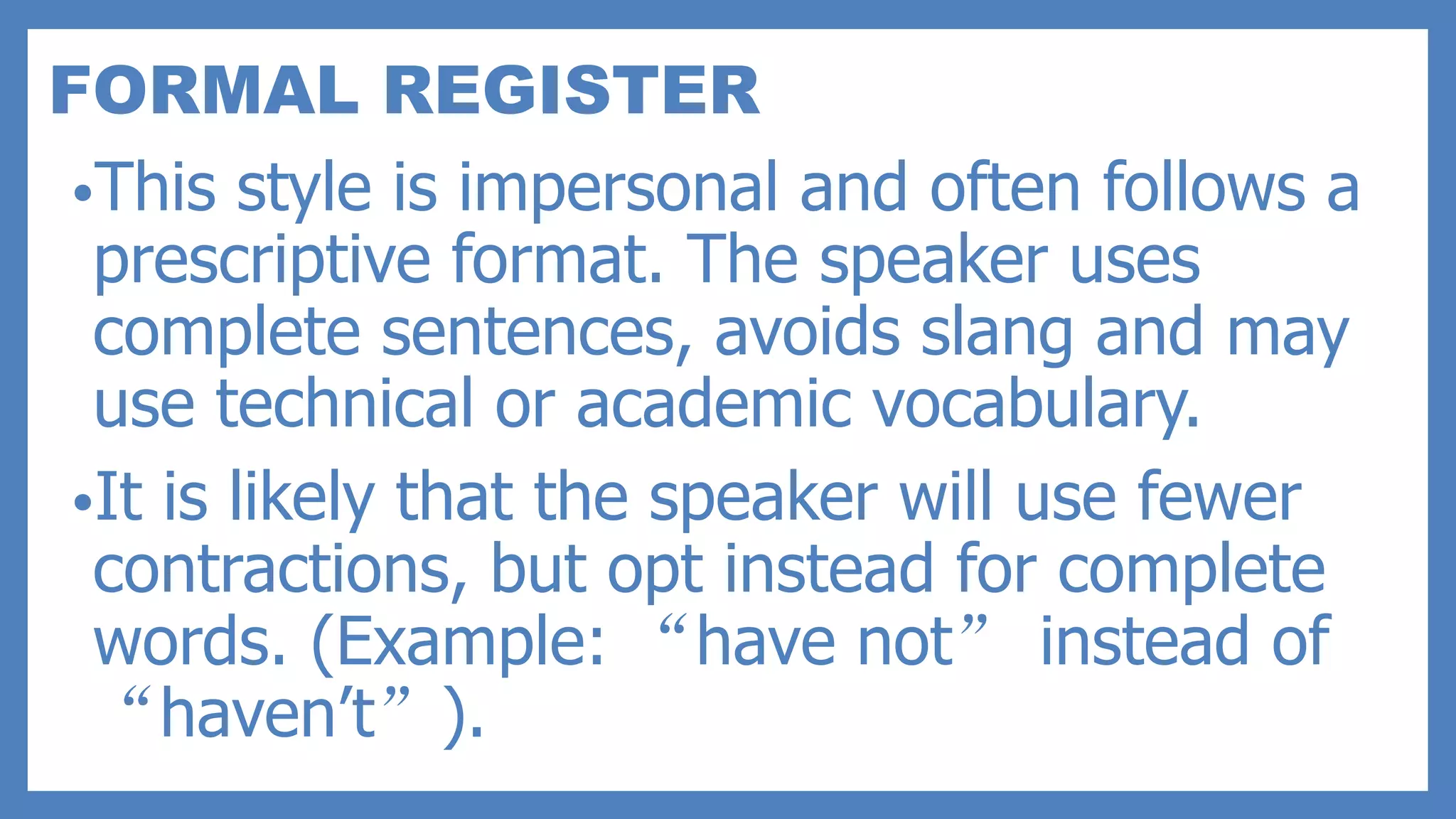
FORMAL REGISTER
•This style is impersonal and often follows a
prescriptive format. The speaker uses
complete sentences, avoids slang and may
use technical or academic vocabulary.
•It is likely that the speaker will use fewer
contractions, but opt instead for complete
words. (Example: “have not” instead of
“haven’t”).
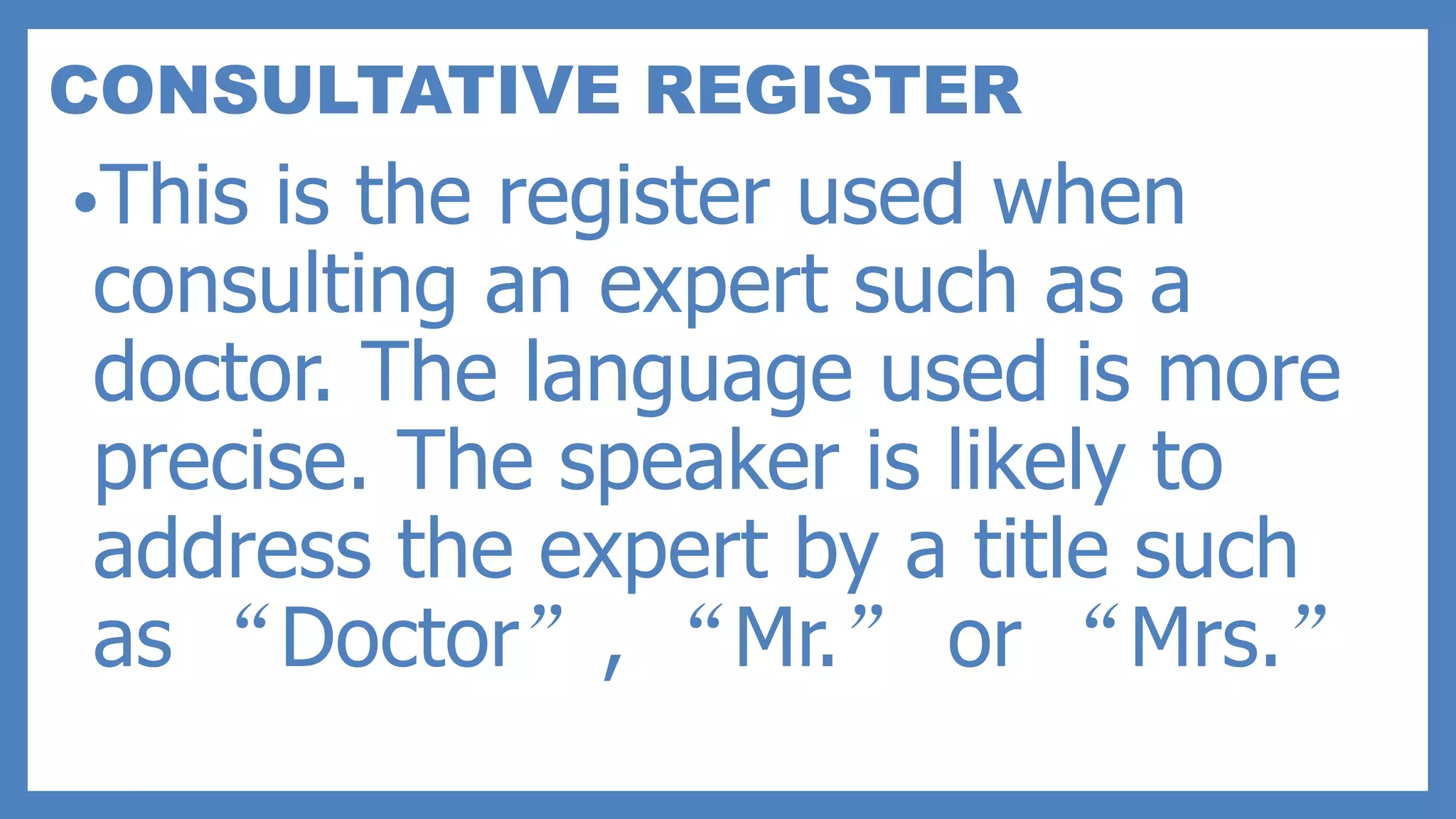
CONSULTATIVE REGISTER
•This is the register used when
consulting an expert such as a
doctor. The language used is more
precise. The speaker is likely to
address the expert by a title such
as “Doctor”, “Mr.” or “Mrs.”
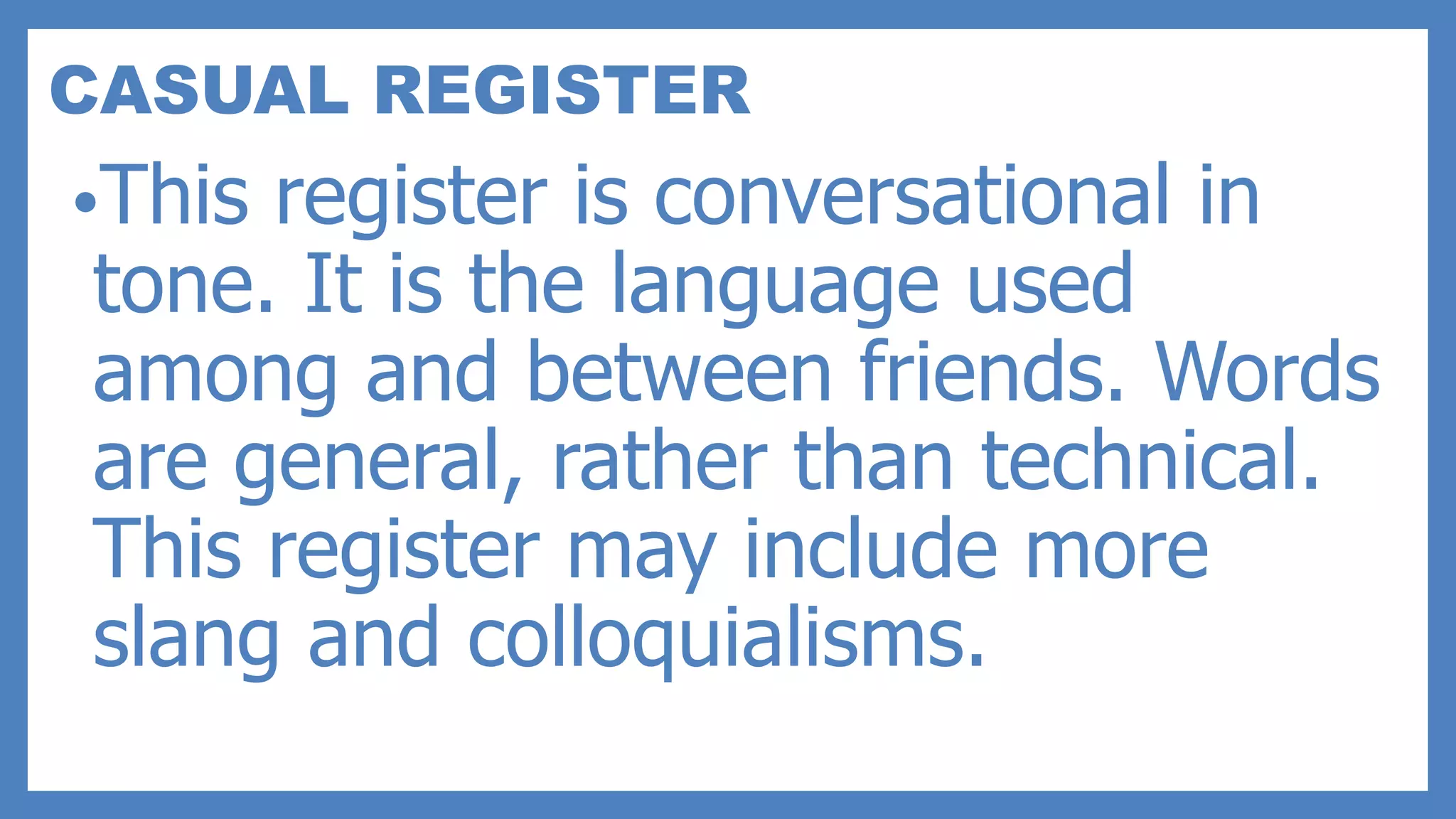
CASUAL REGISTER
•This register is conversational in
tone. It is the language used
among and between friends. Words
are general, rather than technical.
This register may include more
slang and colloquialisms.
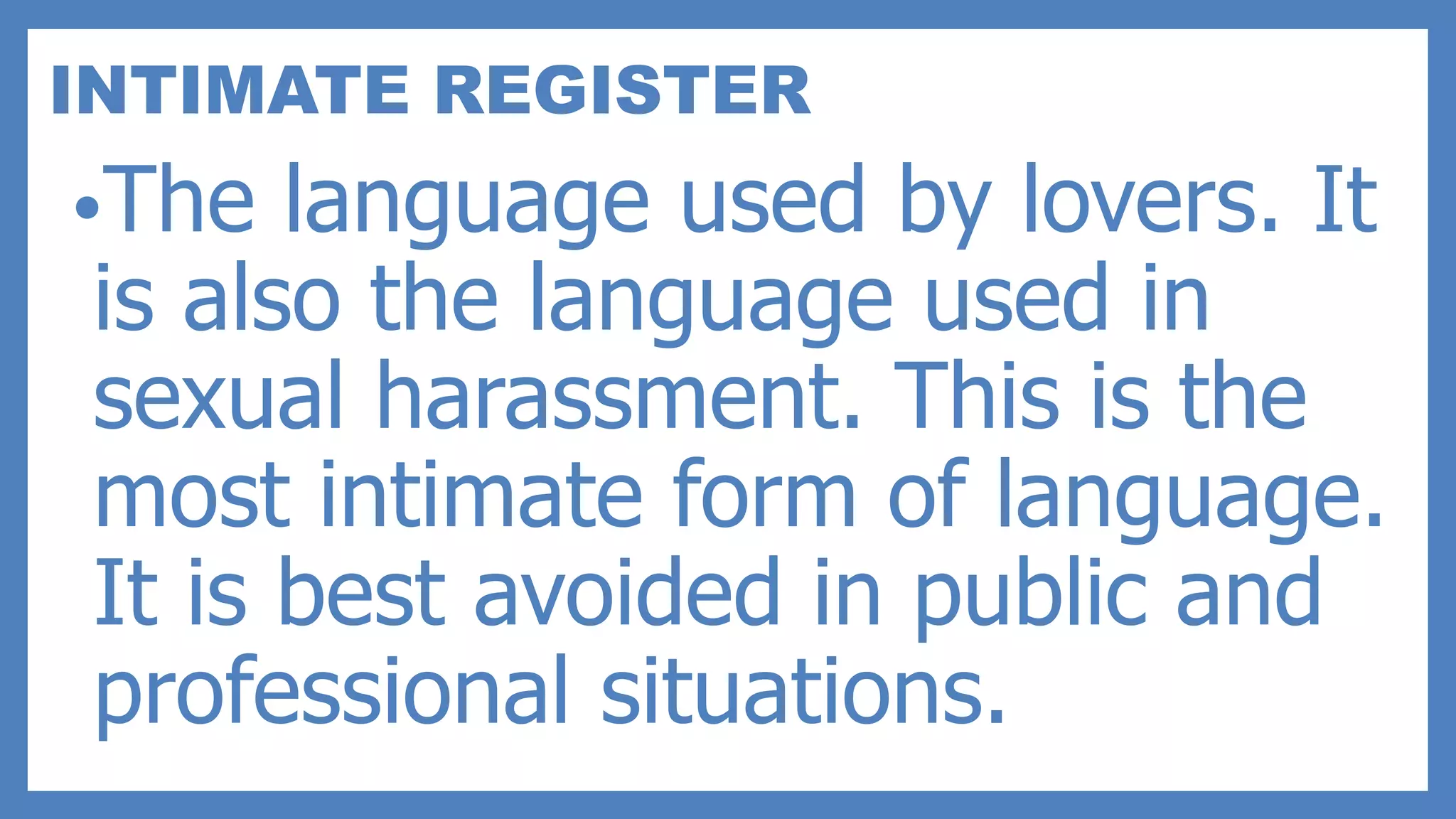
INTIMATE REGISTER
•The language used by lovers. It
is also the language used in
sexual harassment. This is the
most intimate form of language.
It is best avoided in public and
professional situations.
What is the
importance of
changing our
language register in
various situations?
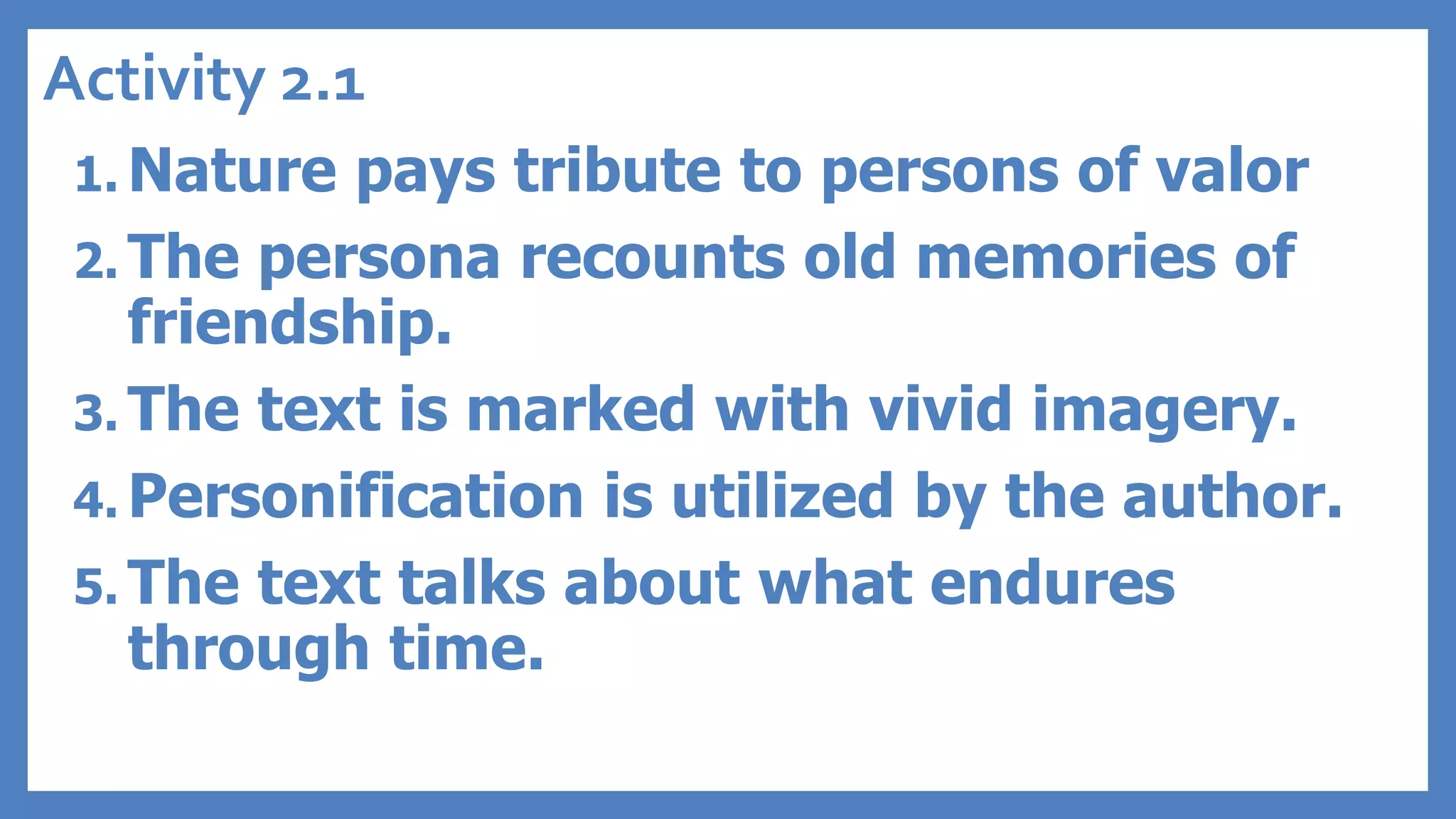
Activity 2.1
1. Nature pays tribute to persons of valor
2. The persona recounts old memories of
friendship.
3. The text is marked with vivid imagery.
4. Personification is utilized by the author.
5. The text talks about what endures
through time.
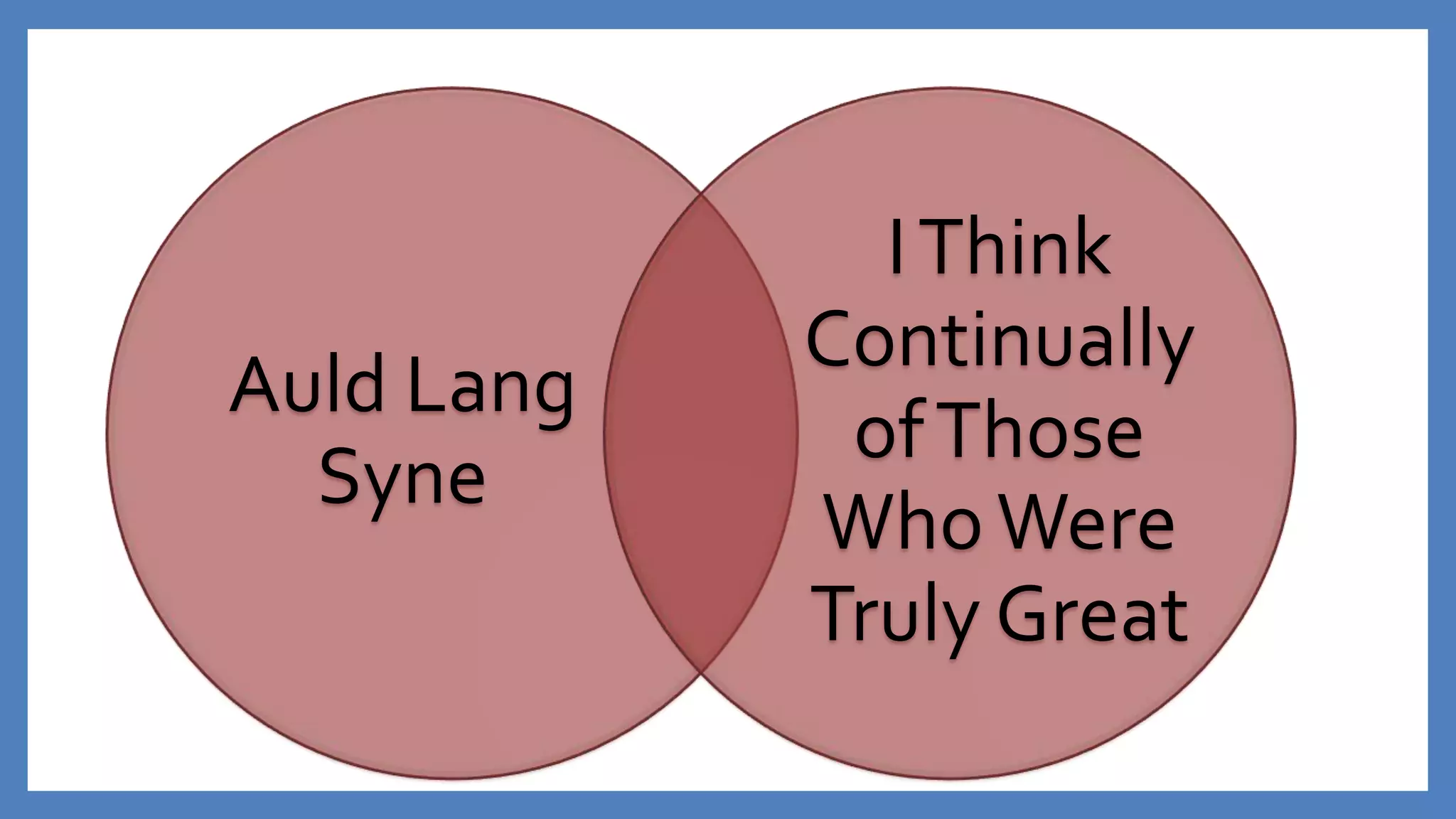
Auld Lang
Syne
IThink
Continually
ofThose
WhoWere
Truly Great
Auld Lang
Syne
IThink
Continually
ofThose
WhoWere
Truly Great
Dramatic Poetry
•Is marked by expression of feelings
or emotions
•this is an emotional piece of
literature which includes a story
which is recited or sung
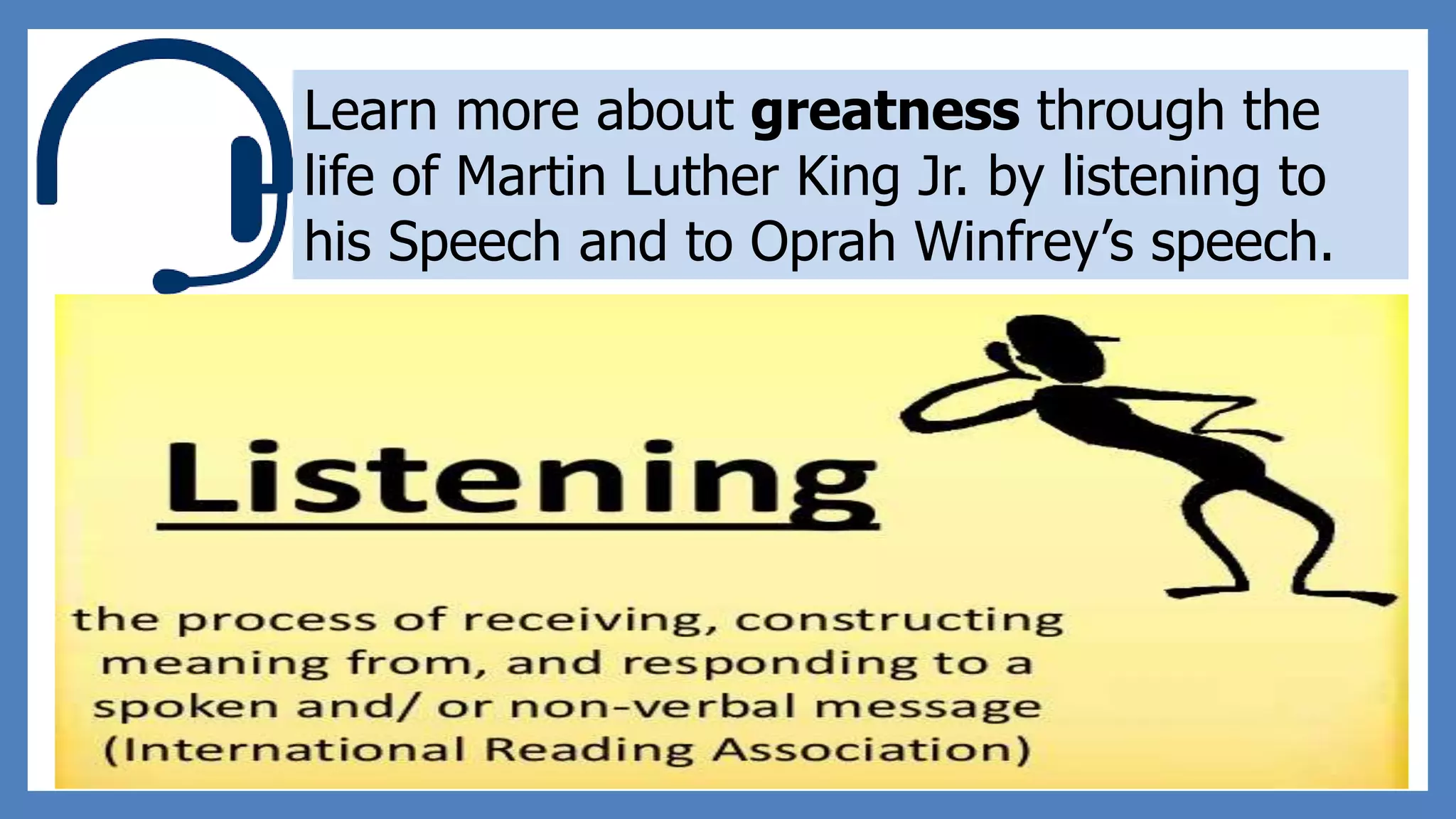
Learn more about greatness through the
life of Martin Luther King Jr. by listening to
his Speech and to Oprah Winfrey’s speech.
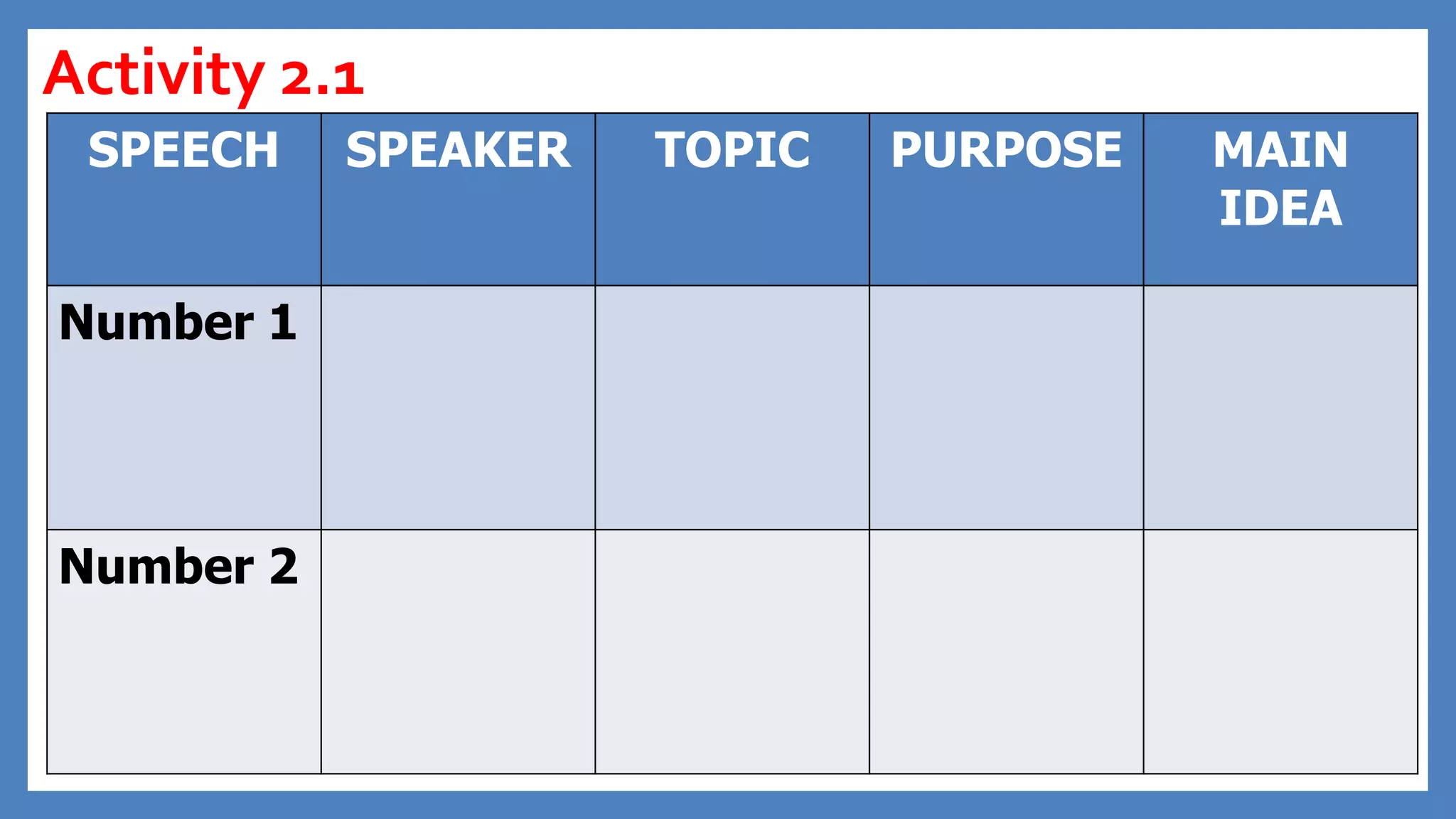
SPEECH SPEAKER TOPIC PURPOSE MAIN
IDEA
Number 1
Number 2
Activity 2.1
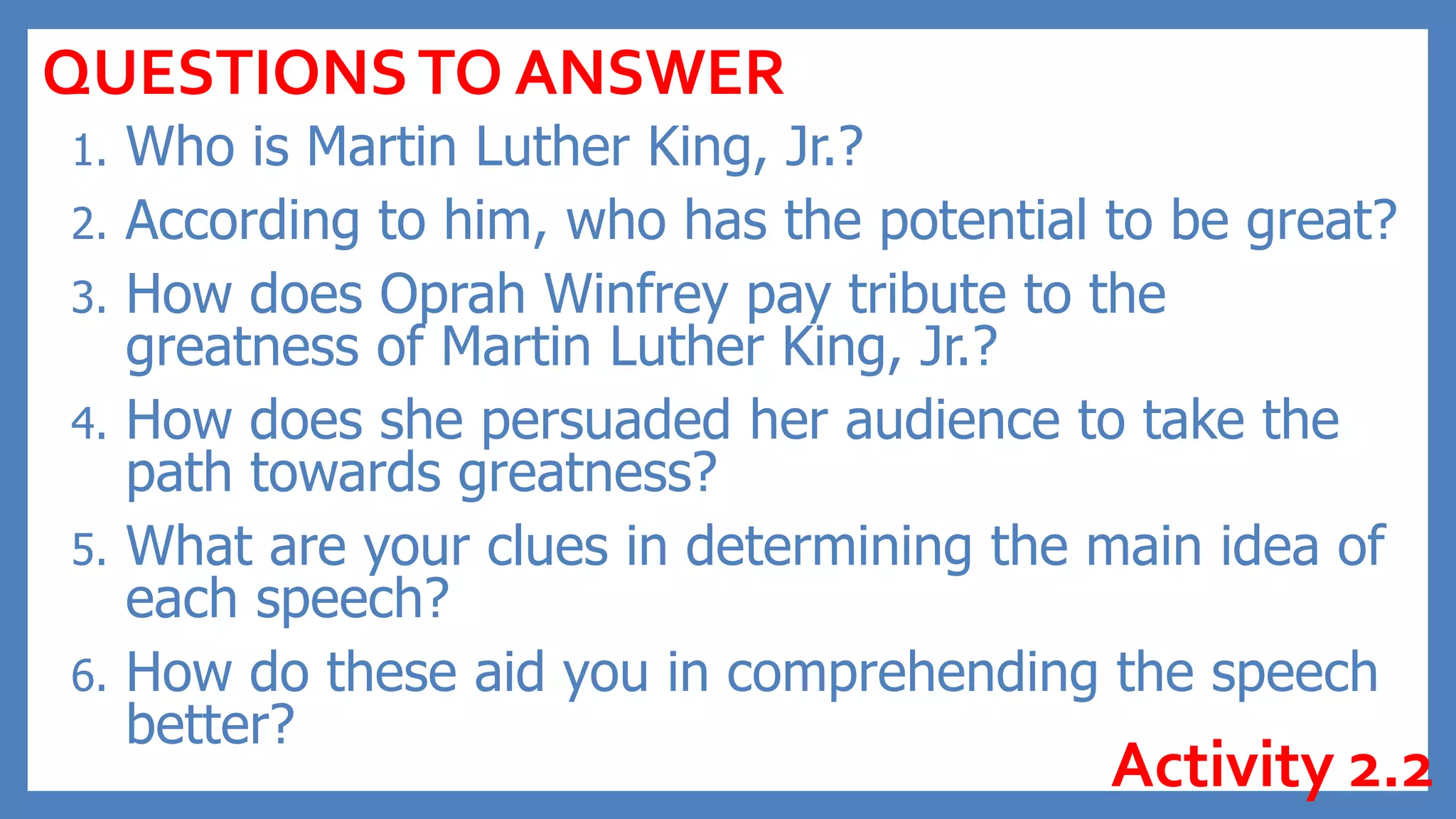
1. Who is Martin Luther King, Jr.?
2. According to him, who has the potential to be great?
3. How does Oprah Winfrey pay tribute to the
greatness of Martin Luther King, Jr.?
4. How does she persuaded her audience to take the
path towards greatness?
5. What are your clues in determining the main idea of
each speech?
6. How do these aid you in comprehending the speech
better?
QUESTIONSTO ANSWER
Activity 2.2
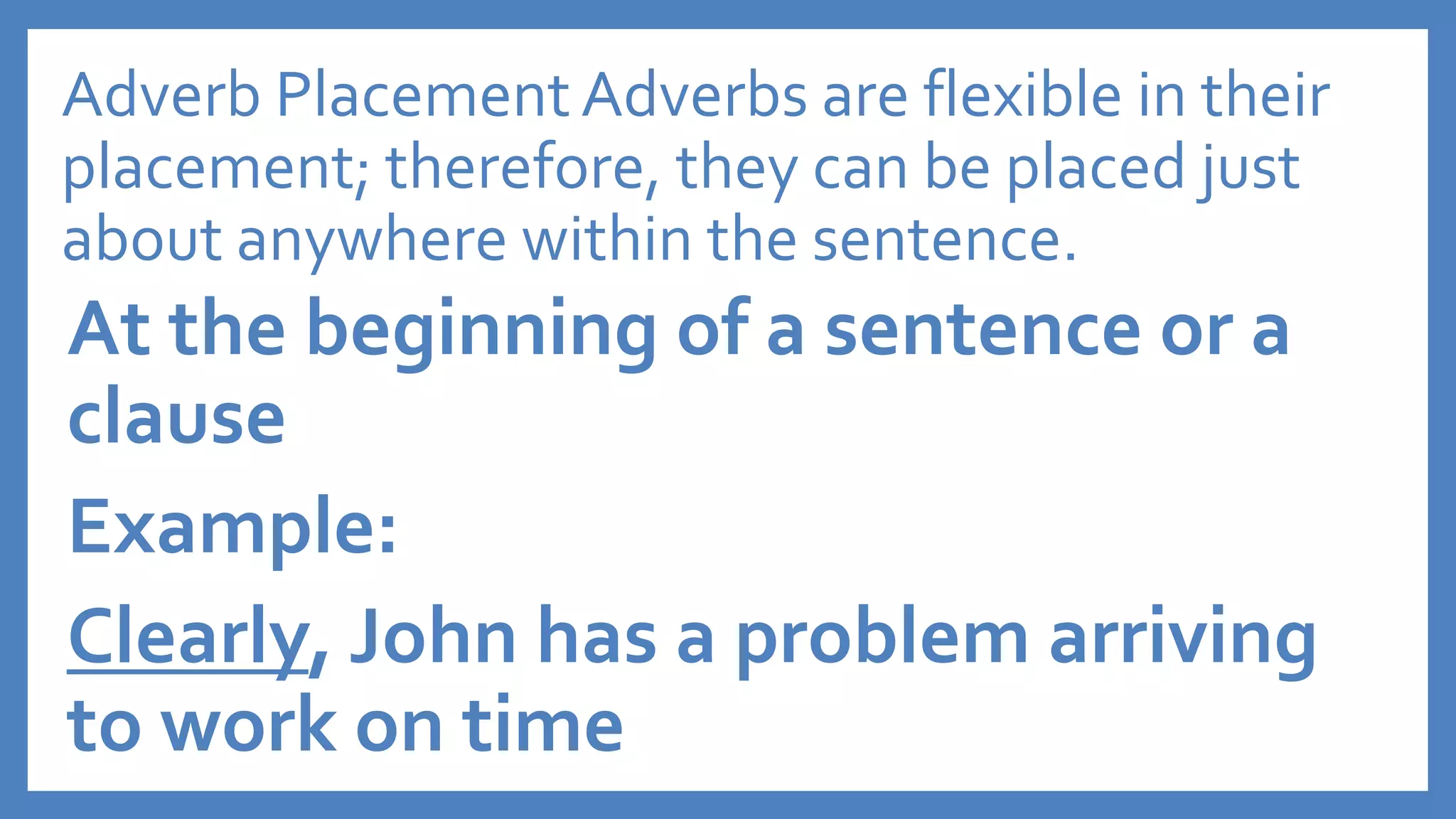
Adverb Placement Adverbs are flexible in their
placement; therefore, they can be placed just
about anywhere within the sentence.
At the beginning of a sentence or a
clause
Example:
Clearly, John has a problem arriving
to work on time
At the end of a sentence or a
clause
Example:
Sarah and John attend the
opera frequently.
After the verb
Example:
Bob and John have always
participated in the soccer
tournament.
Between the subject and the
verb
Example:
Sarah rarely forgets to call
home when she is out late.
1.I went to the market in the morning.
2.The dog sat lazily in the shade of the
tree.
3.The man grumbled loudly while cleaning
the table.
4.I often visit my grandparents.
5.It is extremely hot today.
6.Please wait patiently.
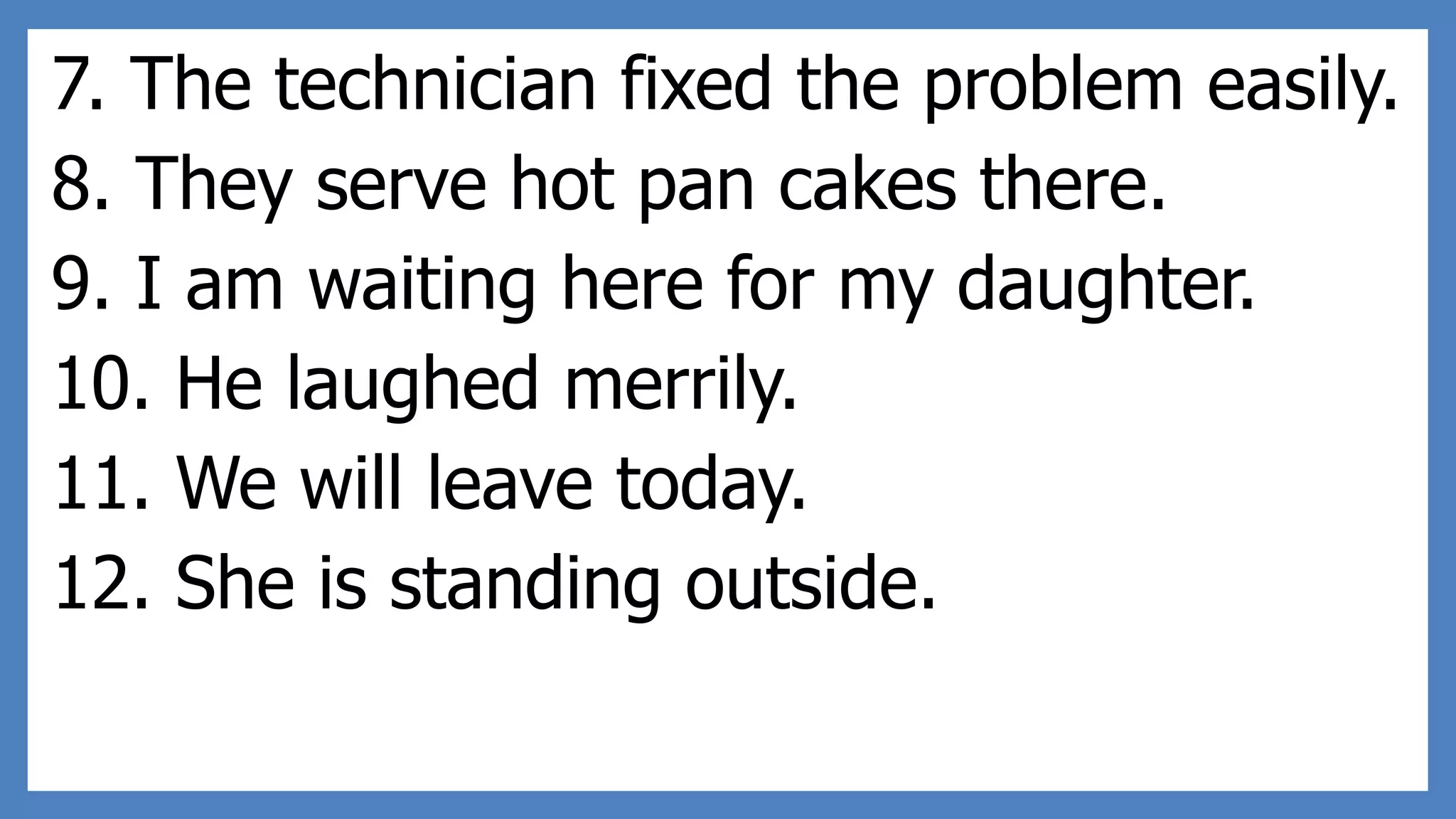
7. The technician fixed the problem easily.
8. They serve hot pan cakes there.
9. I am waiting here for my daughter.
10. He laughed merrily.
11. We will leave today.
12. She is standing outside.
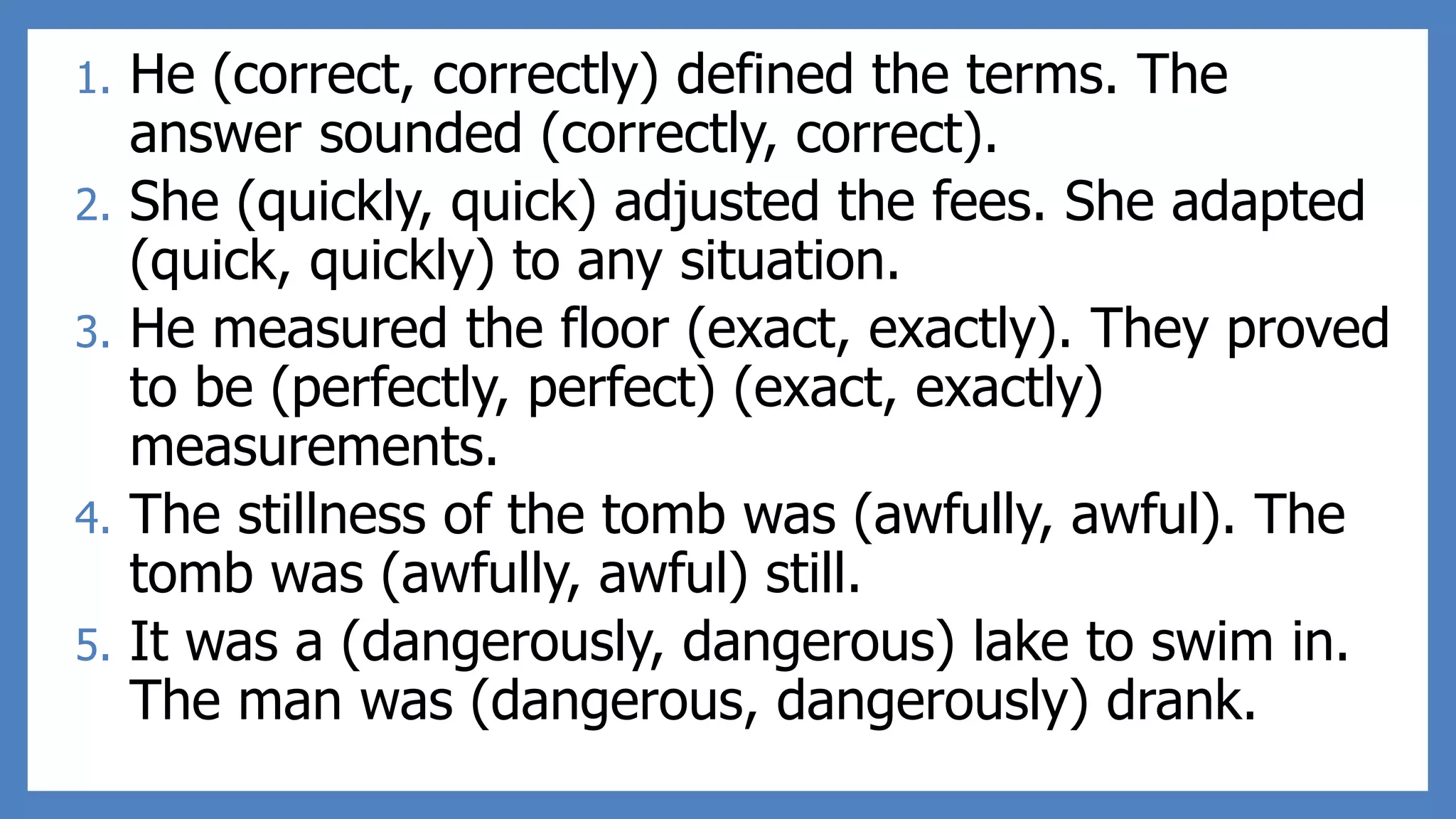
1. He (correct, correctly) defined the terms. The
answer sounded (correctly, correct).
2. She (quickly, quick) adjusted the fees. She adapted
(quick, quickly) to any situation.
3. He measured the floor (exact, exactly). They proved
to be (perfectly, perfect) (exact, exactly)
measurements.
4. The stillness of the tomb was (awfully, awful). The
tomb was (awfully, awful) still.
5. It was a (dangerously, dangerous) lake to swim in.
The man was (dangerous, dangerously) drank.
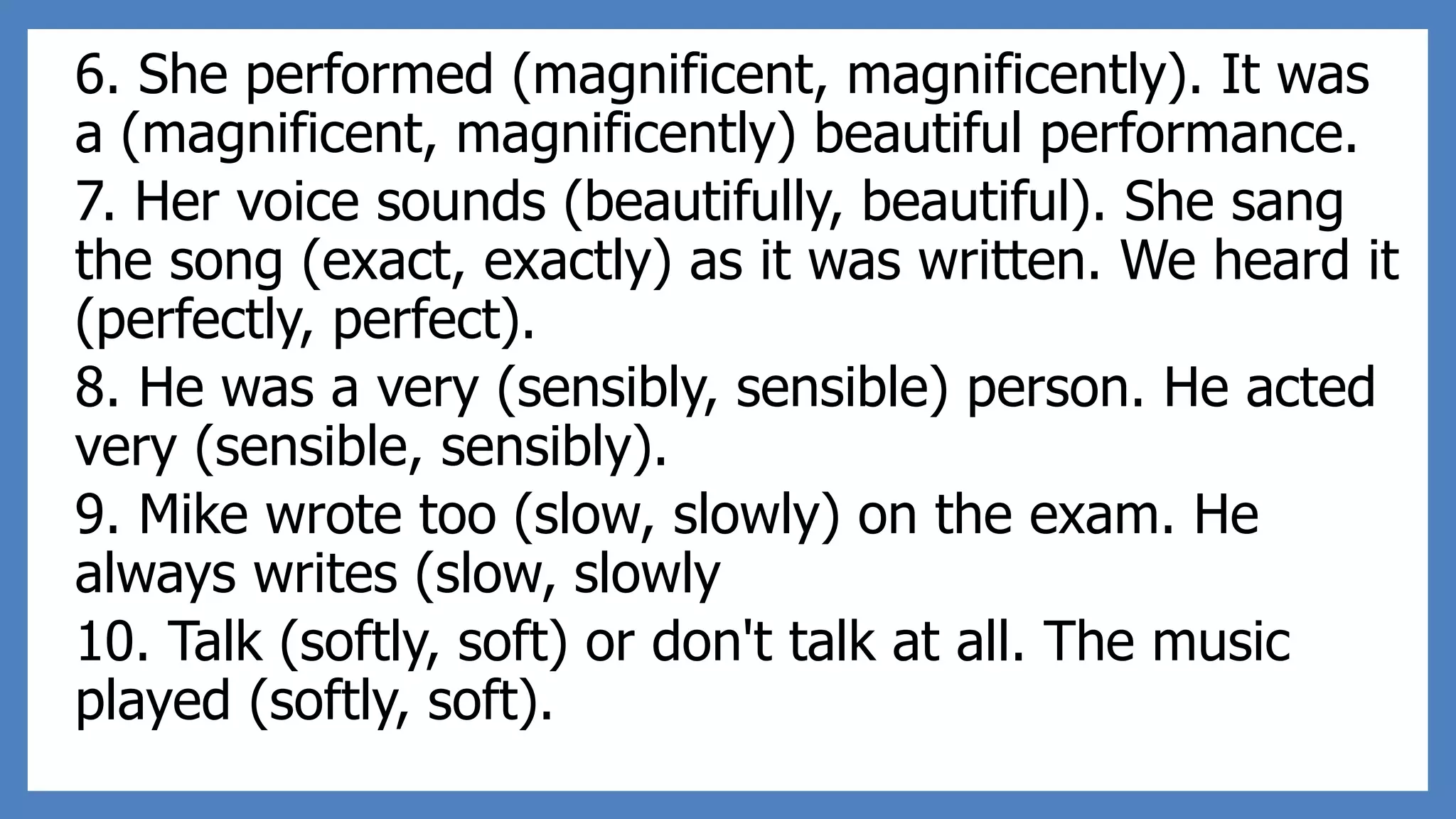
6. She performed (magnificent, magnificently). It was
a (magnificent, magnificently) beautiful performance.
7. Her voice sounds (beautifully, beautiful). She sang
the song (exact, exactly) as it was written. We heard it
(perfectly, perfect).
8. He was a very (sensibly, sensible) person. He acted
very (sensible, sensibly).
9. Mike wrote too (slow, slowly) on the exam. He
always writes (slow, slowly
10. Talk (softly, soft) or don't talk at all. The music
played (softly, soft).
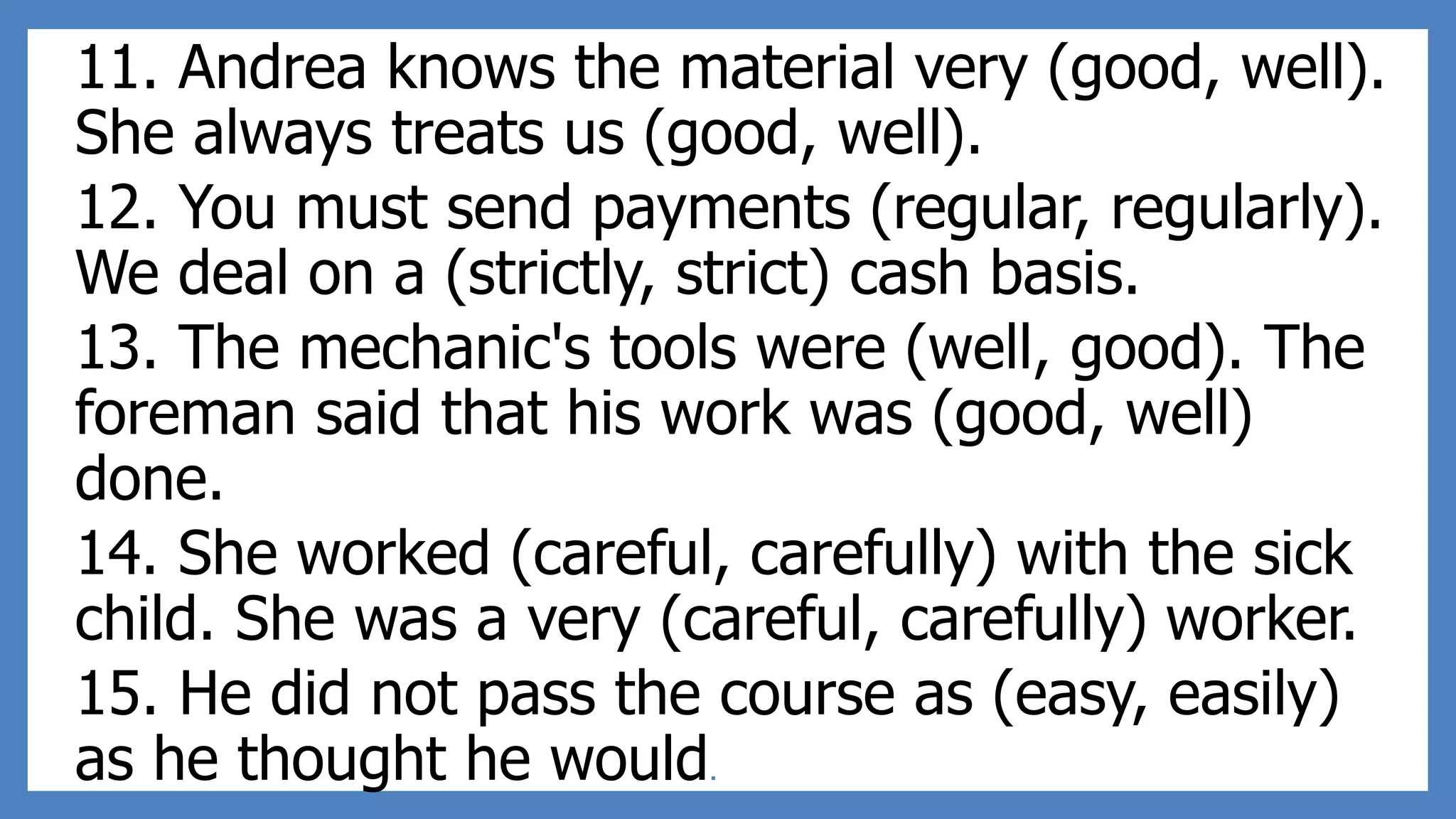
11. Andrea knows the material very (good, well).
She always treats us (good, well).
12. You must send payments (regular, regularly).
We deal on a (strictly, strict) cash basis.
13. The mechanic's tools were (well, good). The
foreman said that his work was (good, well)
done.
14. She worked (careful, carefully) with the sick
child. She was a very (careful, carefully) worker.
15. He did not pass the course as (easy, easily)
as he thought he would.
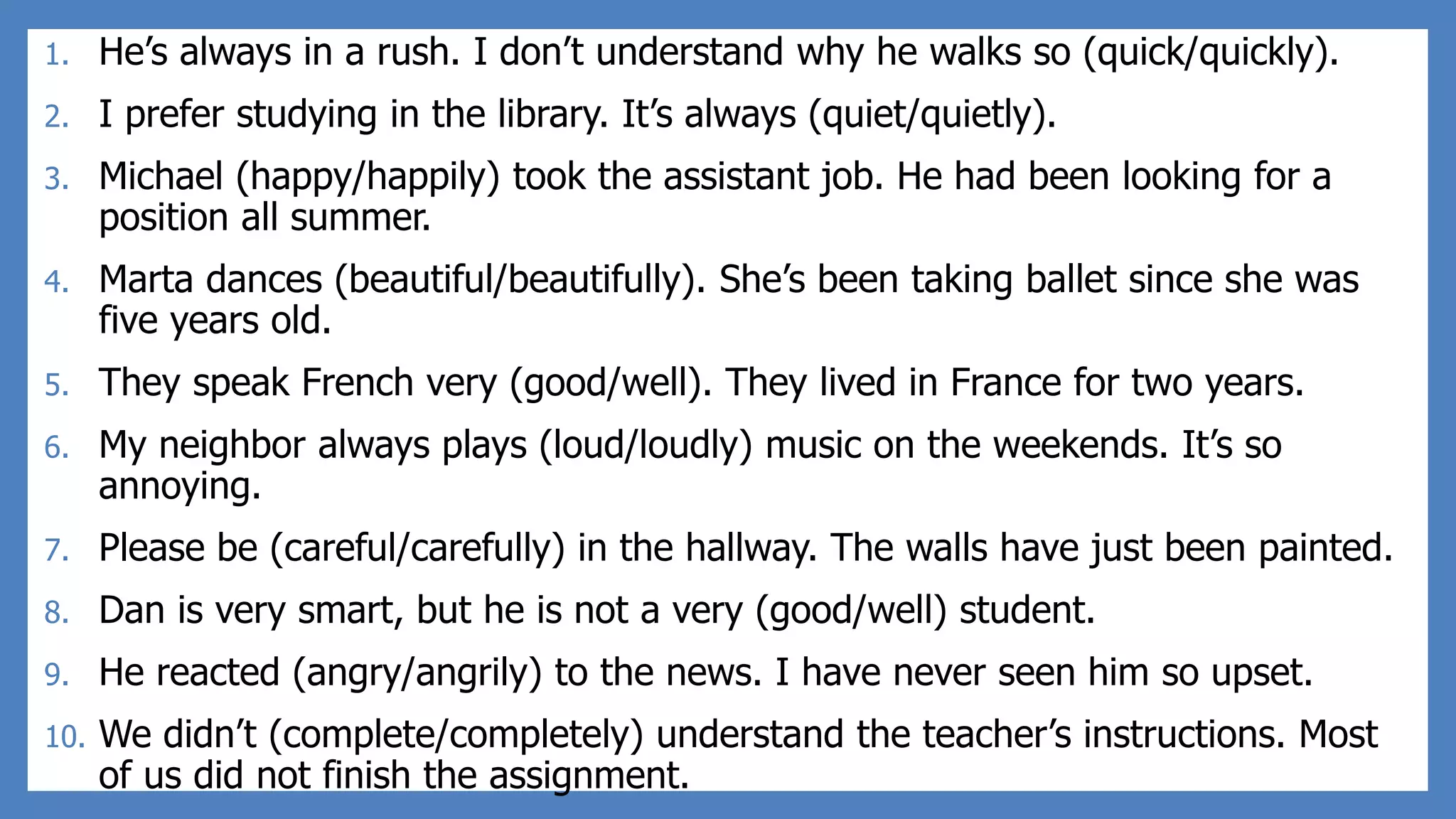
1. He’s always in a rush. I don’t understand why he walks so (quick/quickly).
2. I prefer studying in the library. It’s always (quiet/quietly).
3. Michael (happy/happily) took the assistant job. He had been looking for a
position all summer.
4. Marta dances (beautiful/beautifully). She’s been taking ballet since she was
five years old.
5. They speak French very (good/well). They lived in France for two years.
6. My neighbor always plays (loud/loudly) music on the weekends. It’s so
annoying.
7. Please be (careful/carefully) in the hallway. The walls have just been painted.
8. Dan is very smart, but he is not a very (good/well) student.
9. He reacted (angry/angrily) to the news. I have never seen him so upset.
10. We didn’t (complete/completely) understand the teacher’s instructions. Most
of us did not finish the assignment.
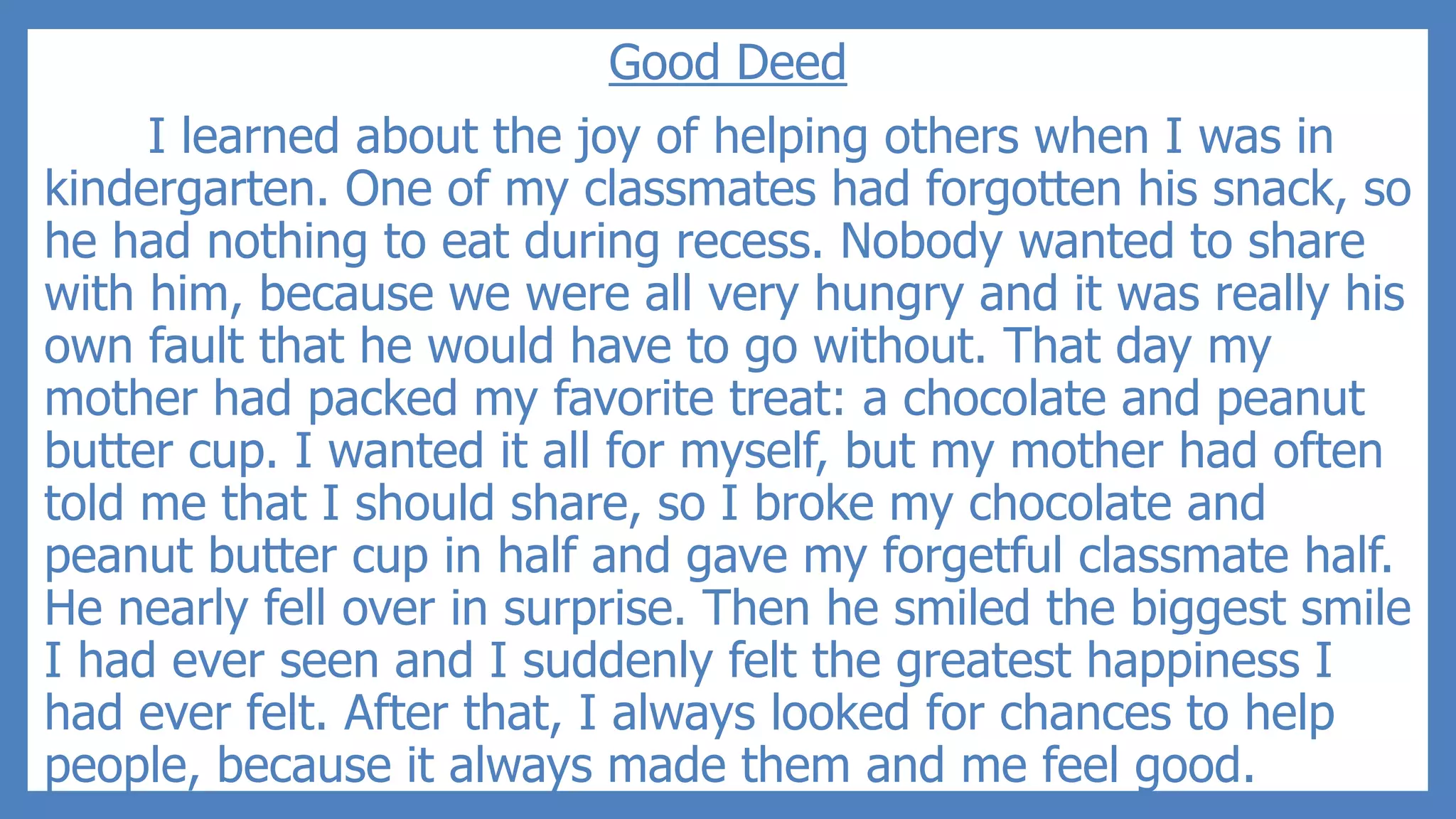
Good Deed
I learned about the joy of helping others when I was in
kindergarten. One of my classmates had forgotten his snack, so
he had nothing to eat during recess. Nobody wanted to share
with him, because we were all very hungry and it was really his
own fault that he would have to go without. That day my
mother had packed my favorite treat: a chocolate and peanut
butter cup. I wanted it all for myself, but my mother had often
told me that I should share, so I broke my chocolate and
peanut butter cup in half and gave my forgetful classmate half.
He nearly fell over in surprise. Then he smiled the biggest smile
I had ever seen and I suddenly felt the greatest happiness I
had ever felt. After that, I always looked for chances to help
people, because it always made them and me feel good.
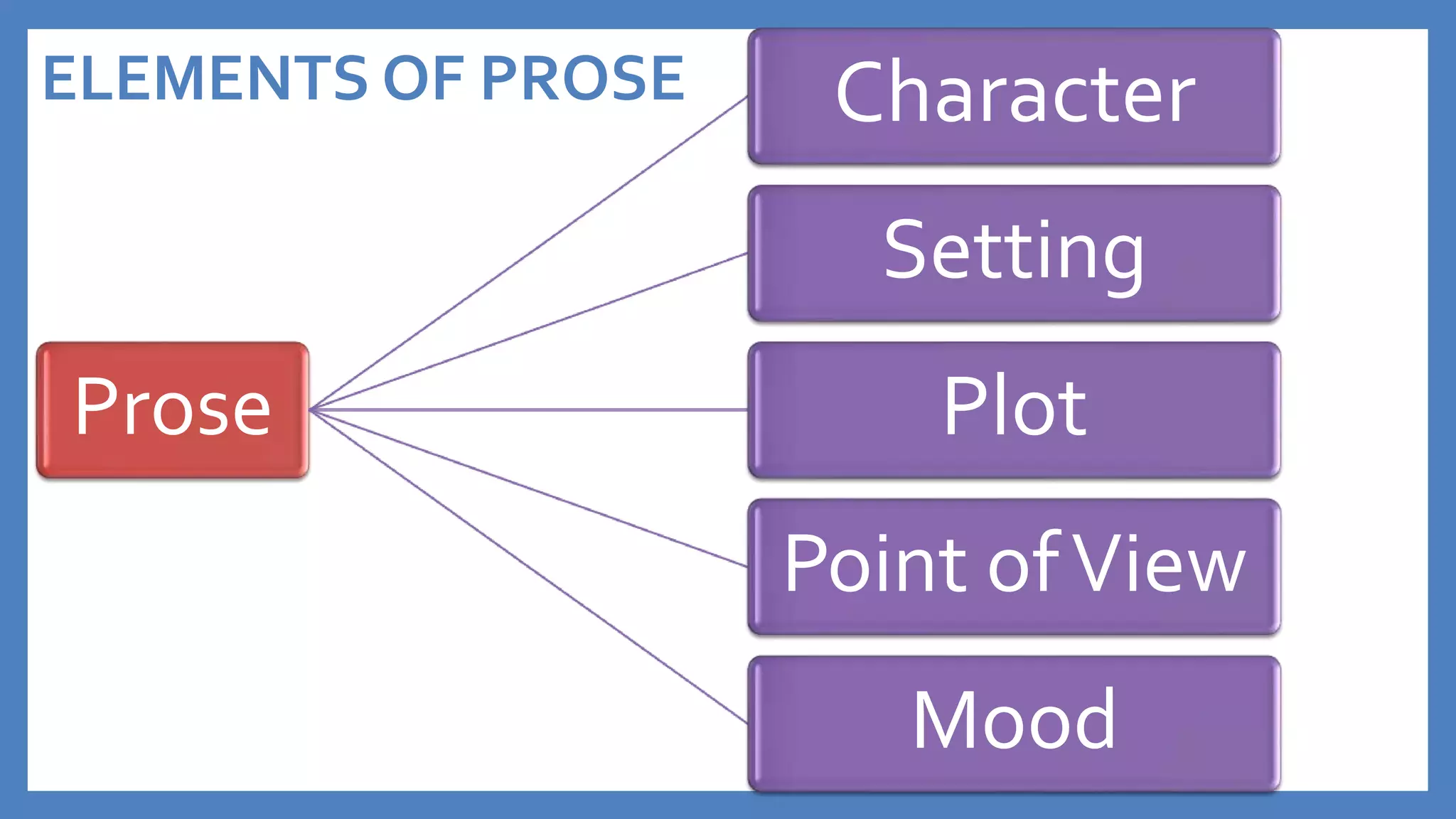
ELEMENTS OF PROSE
Prose
Character
Setting
Plot
Point ofView
Mood
Point ofView
Point of view is the angle of considering things,
which shows us the opinion or feelings of the
individuals involved in a situation. In literature,
point of view is the mode of narration that an
author employs to let the readers “hear” and
“see” what takes place in a story, poem, or essay
Point ofView
 First person point of view involves the use of either of the two
pronouns “I” or “we.”
“I felt like I was getting drowned with shame and disgrace.”
 Second person point of view employs the pronoun “you.”
“Sometimes you cannot clearly discern between anger and
frustration.”
 Third person point of view uses pronouns like “he,” “she,” “it,”
“they,” or a name.
“ Stewart is a principled man. He acts by the book and never lets
you deceive him easily.”
Point ofView
Third Person Limited: Limited means that the POV is
limited to only one character.Which means that the
narrator only knows what that character knows. With
third person limited you can choose to view the action
from right inside the character's head, or from further
away, where the narrator has more access to
information outside the protagonist's viewpoint.
Point ofView
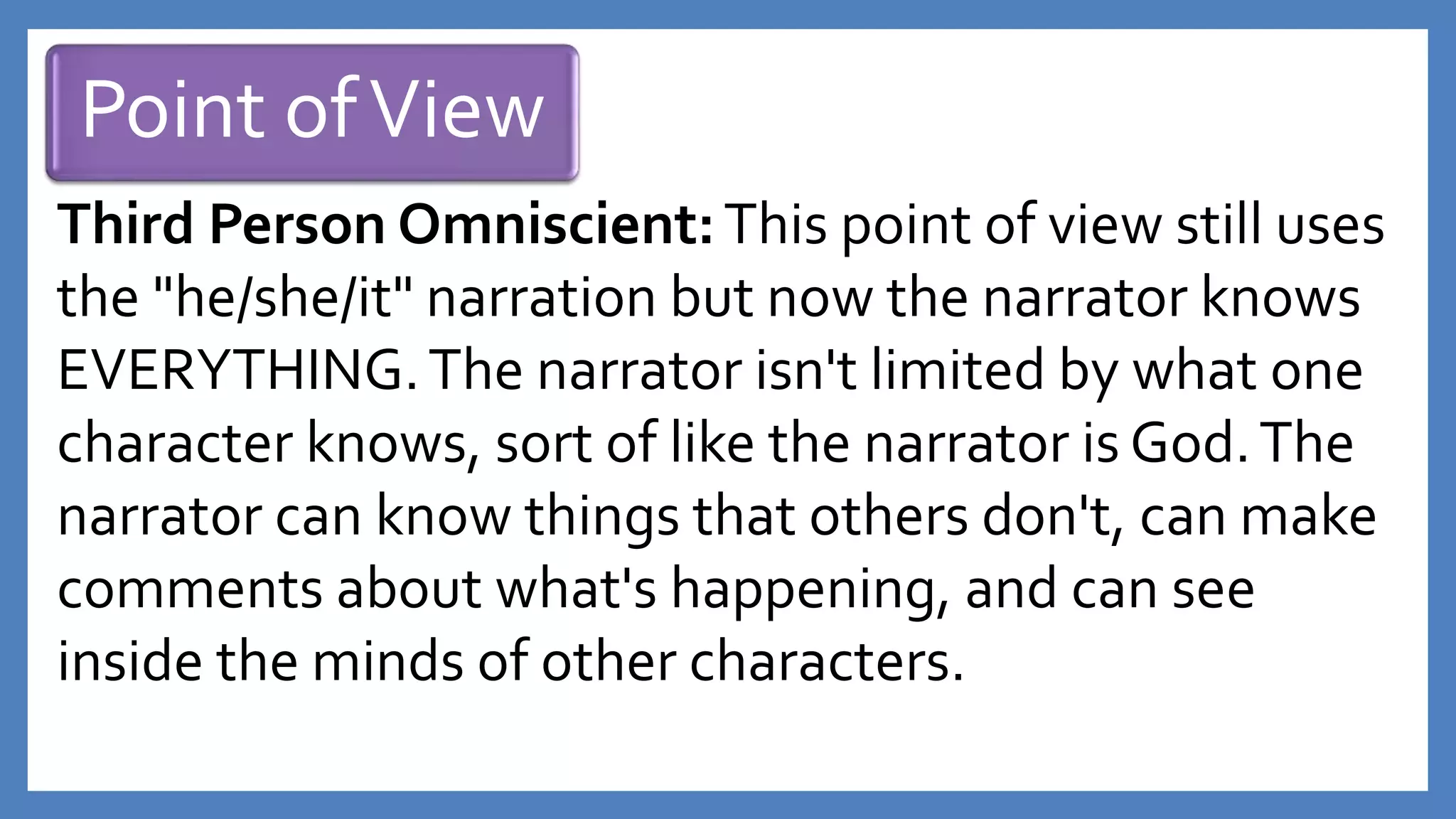
Third Person Omniscient:This point of view still uses
the "he/she/it" narration but now the narrator knows
EVERYTHING.The narrator isn't limited by what one
character knows, sort of like the narrator is God.The
narrator can know things that others don't, can make
comments about what's happening, and can see
inside the minds of other characters.
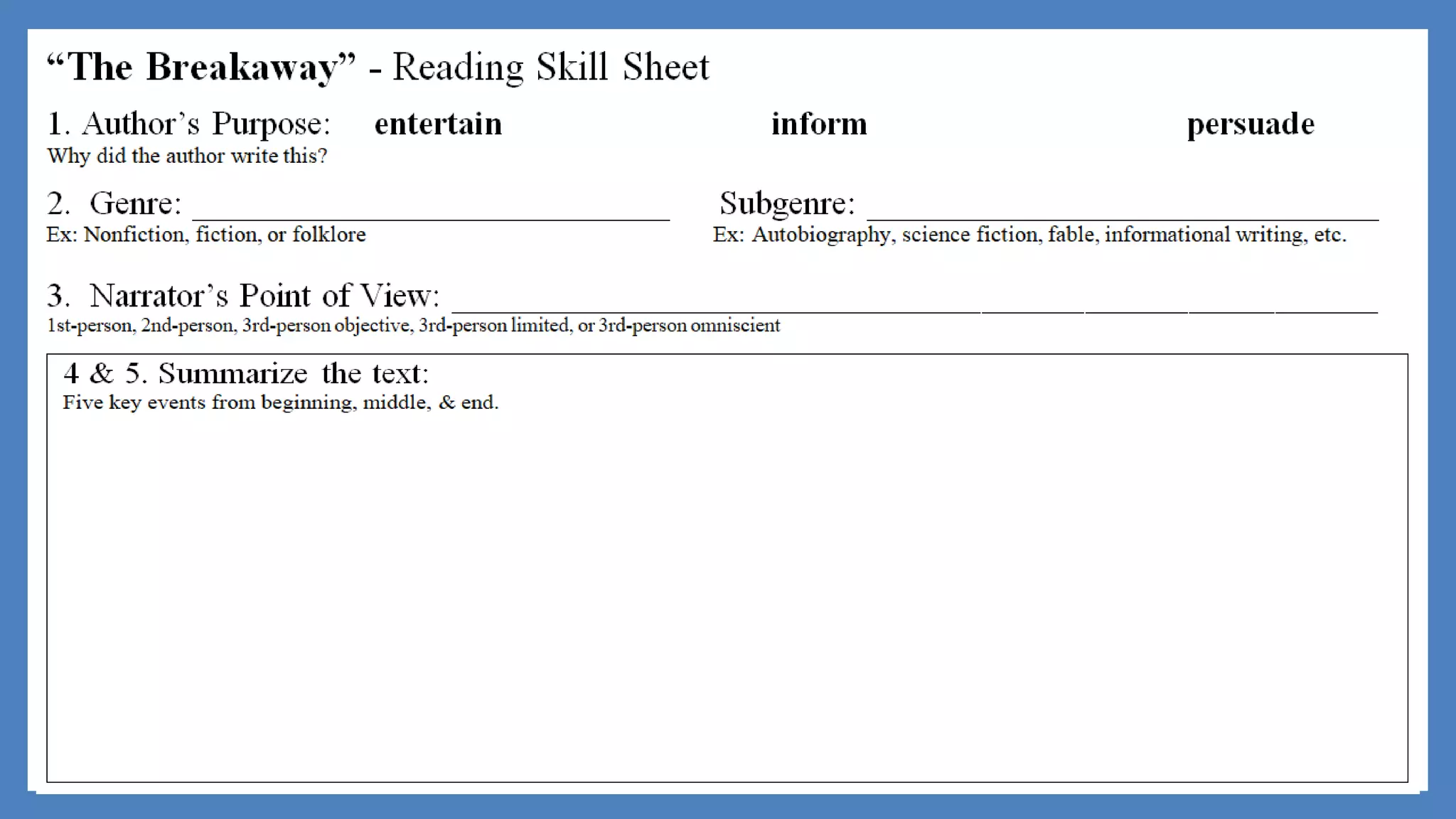
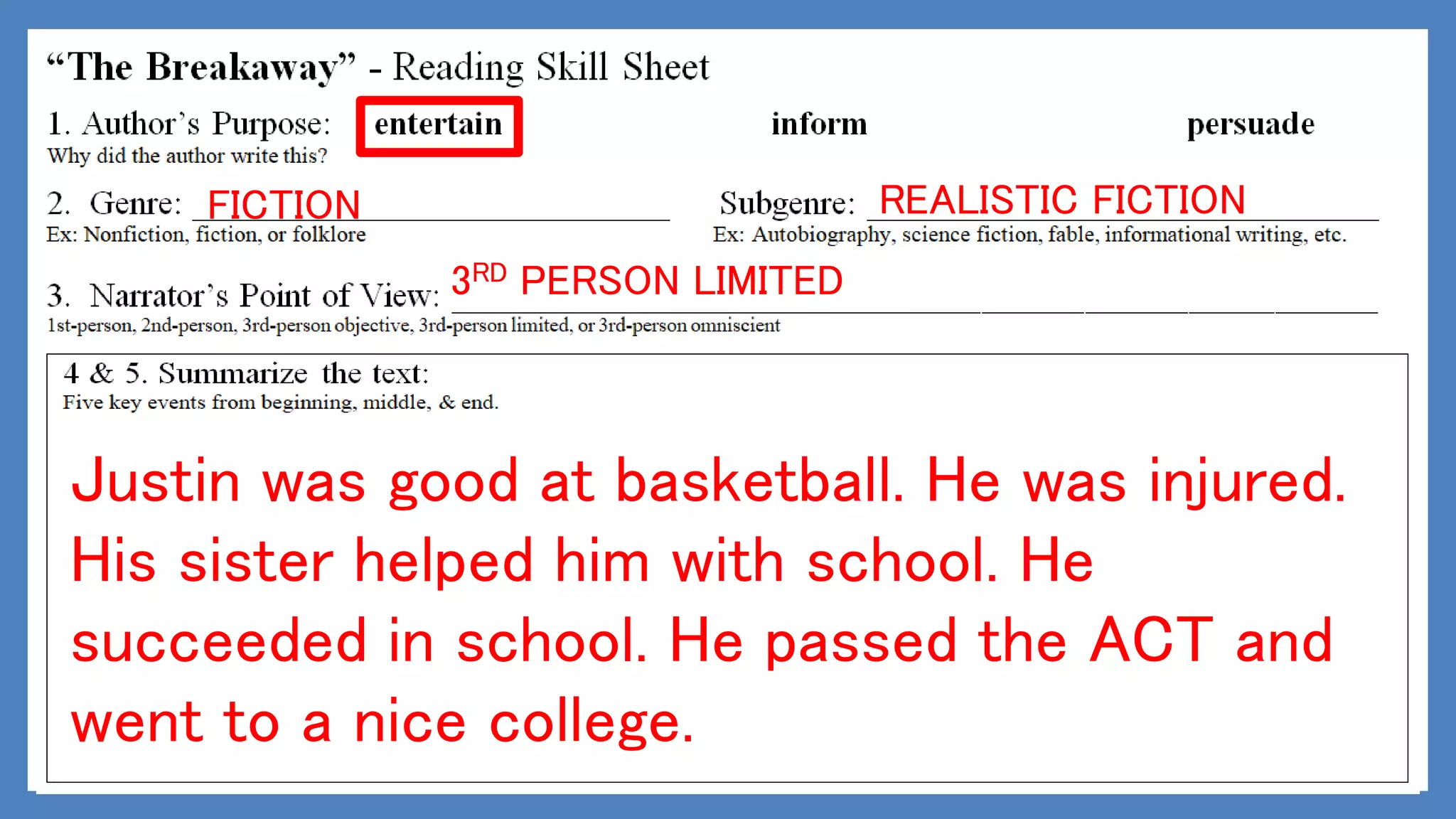
FICTION REALISTIC FICTION
3RD PERSON LIMITED
Justin was good at basketball. He was injured.
His sister helped him with school. He
succeeded in school. He passed the ACT and
went to a nice college.
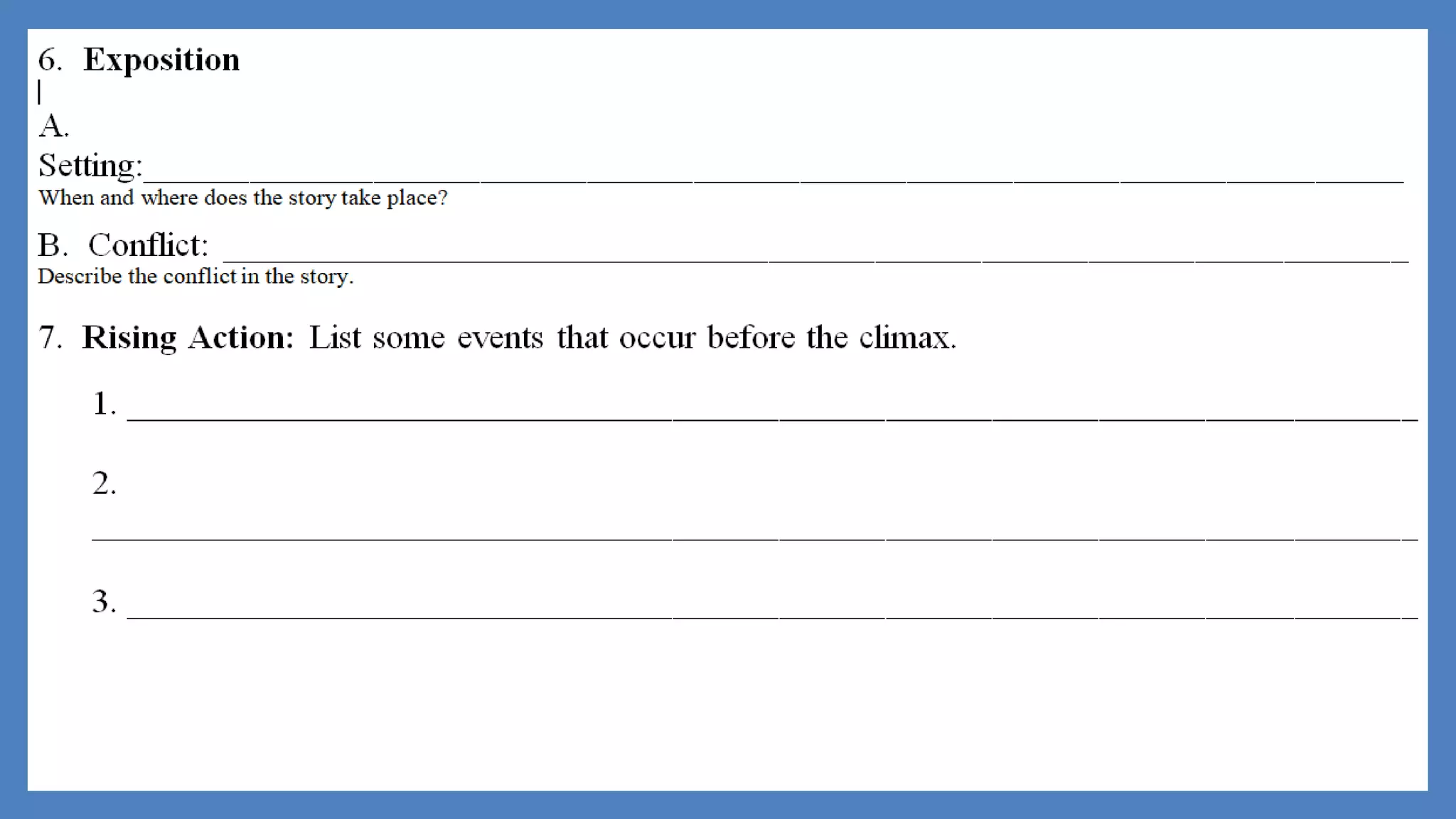
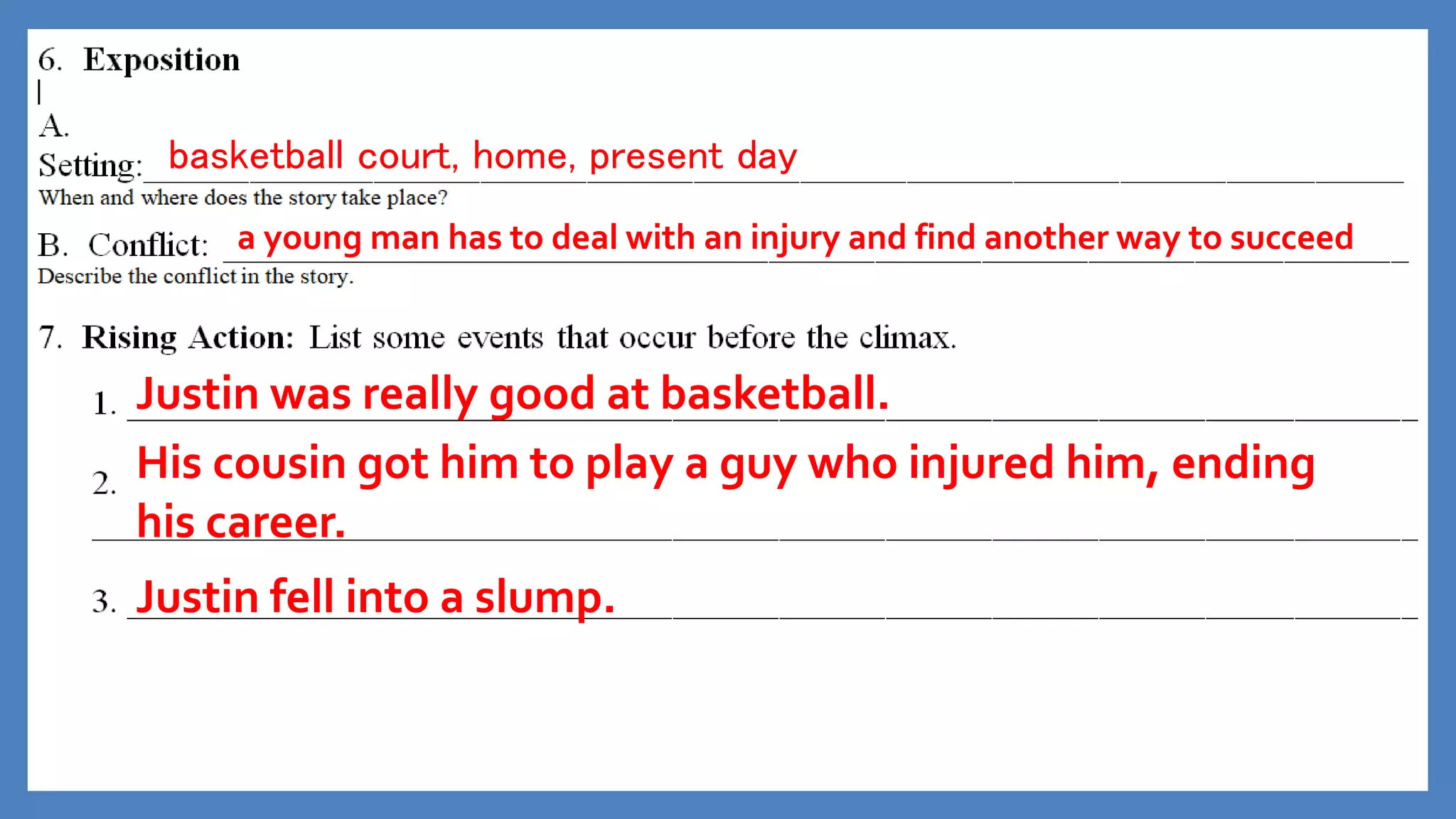
basketball court, home, present day
a young man has to deal with an injury and find another way to succeed
Justin was really good at basketball.
His cousin got him to play a guy who injured him, ending
his career.
Justin fell into a slump.
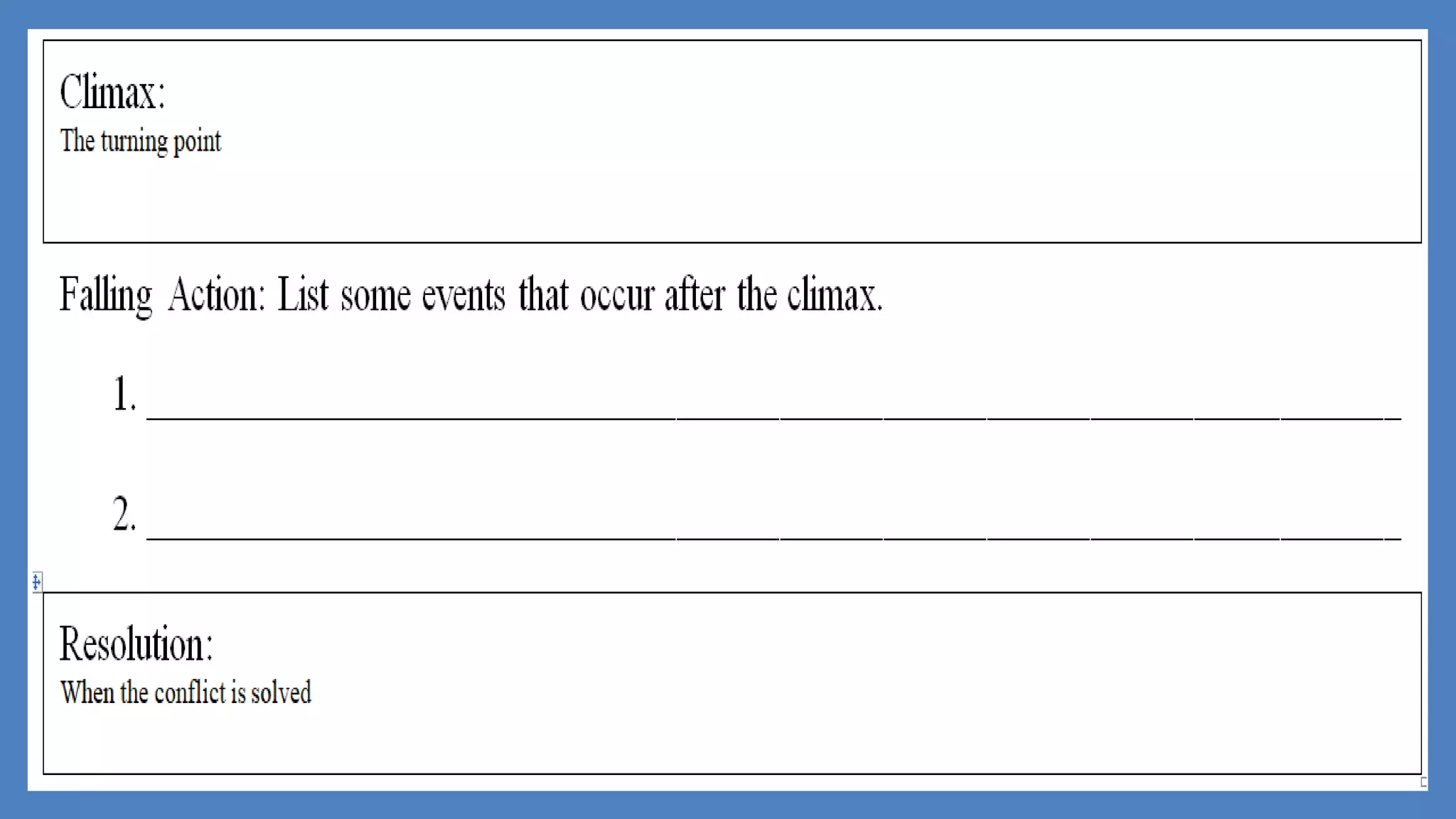
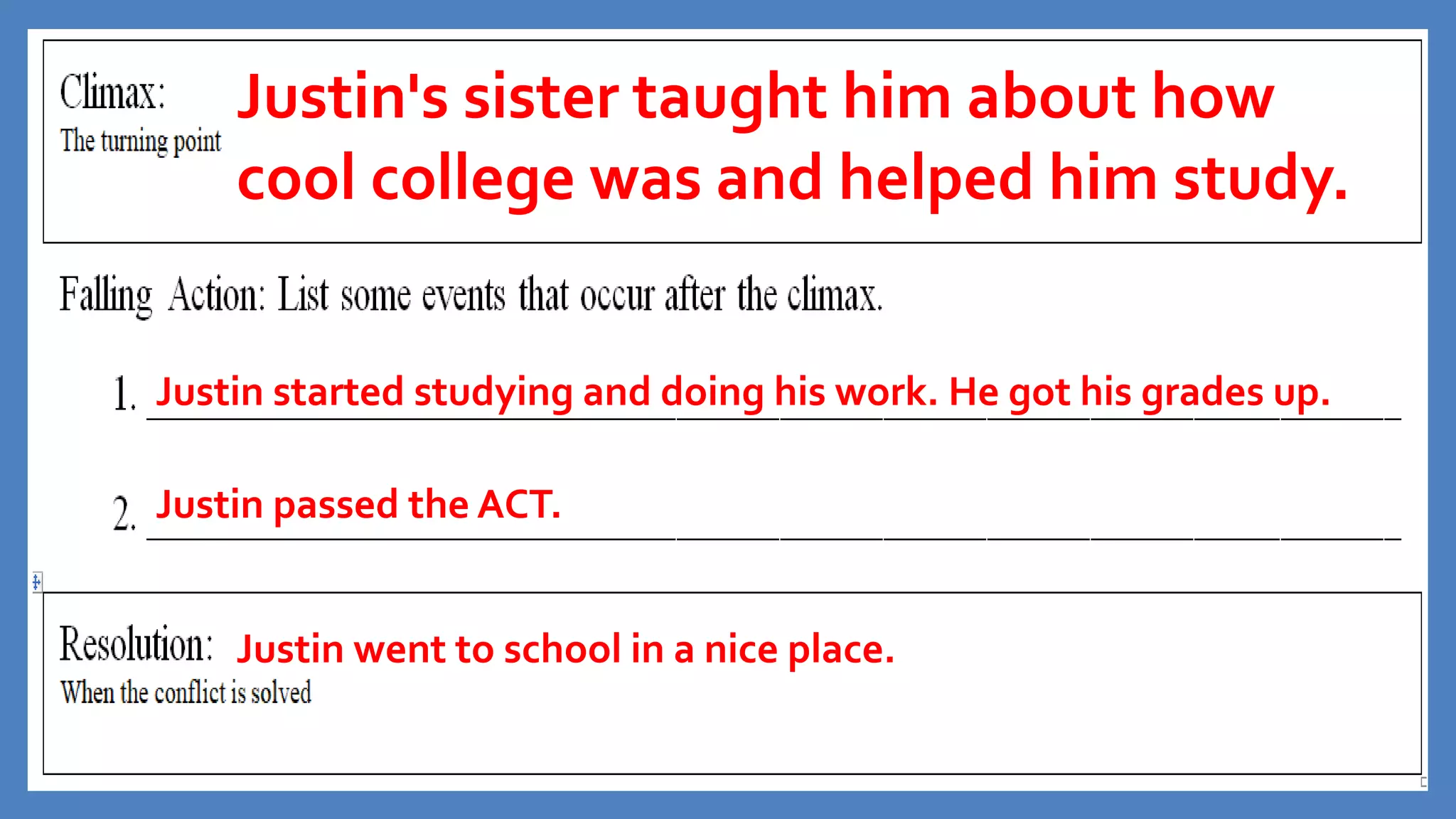
Justin's sister taught him about how
cool college was and helped him study.
Justin started studying and doing his work. He got his grades up.
Justin passed the ACT.
Justin went to school in a nice place.
G9 eng-u2-l1-finding others' greatness

G9 eng-u2-l1-finding others' greatness

  • 1.
    MODULE II Valuing OthersandTheir Circumstances
  • 2.
    Finding Others’ Greatness ObservingOther’s Circumstances Feeling for Others Supporting Others’ Advocacy Seeking Justice for Others Overwhelming Indifference Working with Others
  • 3.
    CONTENT STANDARD •The learnerdemonstrates understanding of how Anglo-American literature and other text types serve as means of valuing other people; also how to use processing information strategies, different forms of adverbs and conditionals for him/her to play an active part in a ChamberTheatre presentation.
  • 4.
    PERFORMANCE STANDARD •The learnerproficiently plays an active part in a ChamberTheatre presentation through employing effective verbal and non- verbal strategies based on the following criteria: Focus,Voice, Delivery, Facial Expressions, Style and Body Movements or Gestures.
  • 5.
  • 7.
    TASK 2 •What isthe degree of formality in each conversation? •How does our relationship with others influence the way we communicate with them?
  • 9.
  • 10.
  • 11.
    FROZEN or STATICREGISTER •At this level, language is literally “frozen” in time and form. It does not change. This type of language is often learned and repeated by rote. •Examples include biblical verse, prayers, the Pledge of Allegiance, and so forth.
  • 12.
    FORMAL REGISTER •This styleis impersonal and often follows a prescriptive format. The speaker uses complete sentences, avoids slang and may use technical or academic vocabulary. •It is likely that the speaker will use fewer contractions, but opt instead for complete words. (Example: “have not” instead of “haven’t”).
  • 13.
    CONSULTATIVE REGISTER •This isthe register used when consulting an expert such as a doctor. The language used is more precise. The speaker is likely to address the expert by a title such as “Doctor”, “Mr.” or “Mrs.”
  • 14.
    CASUAL REGISTER •This registeris conversational in tone. It is the language used among and between friends. Words are general, rather than technical. This register may include more slang and colloquialisms.
  • 15.
    INTIMATE REGISTER •The languageused by lovers. It is also the language used in sexual harassment. This is the most intimate form of language. It is best avoided in public and professional situations.
  • 17.
    What is the importanceof changing our language register in various situations?
  • 18.
    Activity 2.1 1. Naturepays tribute to persons of valor 2. The persona recounts old memories of friendship. 3. The text is marked with vivid imagery. 4. Personification is utilized by the author. 5. The text talks about what endures through time.
  • 19.
  • 20.
  • 21.
    Dramatic Poetry •Is markedby expression of feelings or emotions •this is an emotional piece of literature which includes a story which is recited or sung
  • 25.
    Learn more aboutgreatness through the life of Martin Luther King Jr. by listening to his Speech and to Oprah Winfrey’s speech.
  • 28.
    SPEECH SPEAKER TOPICPURPOSE MAIN IDEA Number 1 Number 2 Activity 2.1
  • 31.
    1. Who isMartin Luther King, Jr.? 2. According to him, who has the potential to be great? 3. How does Oprah Winfrey pay tribute to the greatness of Martin Luther King, Jr.? 4. How does she persuaded her audience to take the path towards greatness? 5. What are your clues in determining the main idea of each speech? 6. How do these aid you in comprehending the speech better? QUESTIONSTO ANSWER Activity 2.2
  • 42.
    Adverb Placement Adverbsare flexible in their placement; therefore, they can be placed just about anywhere within the sentence. At the beginning of a sentence or a clause Example: Clearly, John has a problem arriving to work on time
  • 43.
    At the endof a sentence or a clause Example: Sarah and John attend the opera frequently.
  • 44.
    After the verb Example: Boband John have always participated in the soccer tournament.
  • 45.
    Between the subjectand the verb Example: Sarah rarely forgets to call home when she is out late.
  • 46.
    1.I went tothe market in the morning. 2.The dog sat lazily in the shade of the tree. 3.The man grumbled loudly while cleaning the table. 4.I often visit my grandparents. 5.It is extremely hot today. 6.Please wait patiently.
  • 47.
    7. The technicianfixed the problem easily. 8. They serve hot pan cakes there. 9. I am waiting here for my daughter. 10. He laughed merrily. 11. We will leave today. 12. She is standing outside.
  • 48.
    1. He (correct,correctly) defined the terms. The answer sounded (correctly, correct). 2. She (quickly, quick) adjusted the fees. She adapted (quick, quickly) to any situation. 3. He measured the floor (exact, exactly). They proved to be (perfectly, perfect) (exact, exactly) measurements. 4. The stillness of the tomb was (awfully, awful). The tomb was (awfully, awful) still. 5. It was a (dangerously, dangerous) lake to swim in. The man was (dangerous, dangerously) drank.
  • 49.
    6. She performed(magnificent, magnificently). It was a (magnificent, magnificently) beautiful performance. 7. Her voice sounds (beautifully, beautiful). She sang the song (exact, exactly) as it was written. We heard it (perfectly, perfect). 8. He was a very (sensibly, sensible) person. He acted very (sensible, sensibly). 9. Mike wrote too (slow, slowly) on the exam. He always writes (slow, slowly 10. Talk (softly, soft) or don't talk at all. The music played (softly, soft).
  • 50.
    11. Andrea knowsthe material very (good, well). She always treats us (good, well). 12. You must send payments (regular, regularly). We deal on a (strictly, strict) cash basis. 13. The mechanic's tools were (well, good). The foreman said that his work was (good, well) done. 14. She worked (careful, carefully) with the sick child. She was a very (careful, carefully) worker. 15. He did not pass the course as (easy, easily) as he thought he would.
  • 51.
    1. He’s alwaysin a rush. I don’t understand why he walks so (quick/quickly). 2. I prefer studying in the library. It’s always (quiet/quietly). 3. Michael (happy/happily) took the assistant job. He had been looking for a position all summer. 4. Marta dances (beautiful/beautifully). She’s been taking ballet since she was five years old. 5. They speak French very (good/well). They lived in France for two years. 6. My neighbor always plays (loud/loudly) music on the weekends. It’s so annoying. 7. Please be (careful/carefully) in the hallway. The walls have just been painted. 8. Dan is very smart, but he is not a very (good/well) student. 9. He reacted (angry/angrily) to the news. I have never seen him so upset. 10. We didn’t (complete/completely) understand the teacher’s instructions. Most of us did not finish the assignment.
  • 52.
    Good Deed I learnedabout the joy of helping others when I was in kindergarten. One of my classmates had forgotten his snack, so he had nothing to eat during recess. Nobody wanted to share with him, because we were all very hungry and it was really his own fault that he would have to go without. That day my mother had packed my favorite treat: a chocolate and peanut butter cup. I wanted it all for myself, but my mother had often told me that I should share, so I broke my chocolate and peanut butter cup in half and gave my forgetful classmate half. He nearly fell over in surprise. Then he smiled the biggest smile I had ever seen and I suddenly felt the greatest happiness I had ever felt. After that, I always looked for chances to help people, because it always made them and me feel good.
  • 54.
  • 56.
    Point ofView Point ofview is the angle of considering things, which shows us the opinion or feelings of the individuals involved in a situation. In literature, point of view is the mode of narration that an author employs to let the readers “hear” and “see” what takes place in a story, poem, or essay
  • 57.
    Point ofView  Firstperson point of view involves the use of either of the two pronouns “I” or “we.” “I felt like I was getting drowned with shame and disgrace.”  Second person point of view employs the pronoun “you.” “Sometimes you cannot clearly discern between anger and frustration.”  Third person point of view uses pronouns like “he,” “she,” “it,” “they,” or a name. “ Stewart is a principled man. He acts by the book and never lets you deceive him easily.”
  • 58.
    Point ofView Third PersonLimited: Limited means that the POV is limited to only one character.Which means that the narrator only knows what that character knows. With third person limited you can choose to view the action from right inside the character's head, or from further away, where the narrator has more access to information outside the protagonist's viewpoint.
  • 59.
    Point ofView Third PersonOmniscient:This point of view still uses the "he/she/it" narration but now the narrator knows EVERYTHING.The narrator isn't limited by what one character knows, sort of like the narrator is God.The narrator can know things that others don't, can make comments about what's happening, and can see inside the minds of other characters.
  • 63.
    FICTION REALISTIC FICTION 3RDPERSON LIMITED Justin was good at basketball. He was injured. His sister helped him with school. He succeeded in school. He passed the ACT and went to a nice college.
  • 64.
    basketball court, home,present day a young man has to deal with an injury and find another way to succeed Justin was really good at basketball. His cousin got him to play a guy who injured him, ending his career. Justin fell into a slump.
  • 65.
    Justin's sister taughthim about how cool college was and helped him study. Justin started studying and doing his work. He got his grades up. Justin passed the ACT. Justin went to school in a nice place.

Editor's Notes

  • #6 We forge lasting relationships with others when we recognize their greatness instead of their weaknesses. This is an essential step in becoming connected with them. What is greatness?
  • #7 TASK 1
  • #8 TASK 2
  • #9 Language register is the level of formality with which you speak. Different situations and people call for different registers.
  • #10 Language register is the level of formality with which you speak. Different situations and people call for different registers.
  • #15 Colloquialisms are distinct from slang or jargon. Slang refers to words used only by specific social groups, such as teenagers or soldiers.[5] Colloquial language may include slang, but consists mostly of contractions or other informal words and phrases known to most native speakers of the language.[5] Jargon is terminology that is especially defined in relationship to a specific activity, profession, or group. 
  • #16 Colloquialisms are distinct from slang or jargon. Slang refers to words used only by specific social groups, such as teenagers or soldiers.[5] Colloquial language may include slang, but consists mostly of contractions or other informal words and phrases known to most native speakers of the language.[5] Jargon is terminology that is especially defined in relationship to a specific activity, profession, or group. 
  • #19 2 1 / 2 /
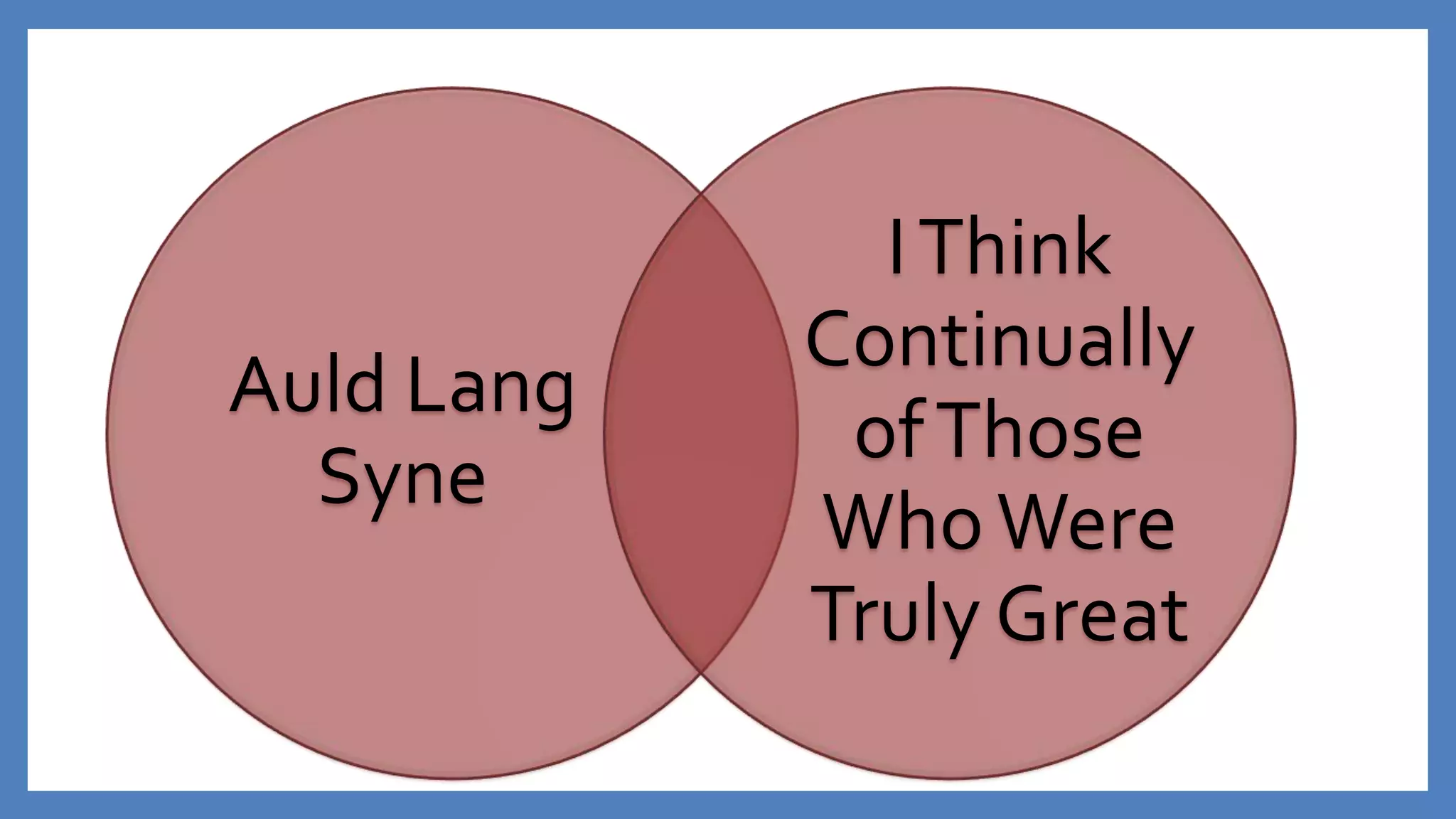
  • #20 Read the poem again. Note the similarities and differences between the two in terms of the use of figurative language and its content. Copy and use the Venn diagram here.
  • #21 Read the poem again. Note the similarities and differences between the two in terms of the use of figurative language and its content. Copy and use the Venn diagram here. Auld Lang Syne (for old times sake) recounts his memory with old friends. Their journey and memories together. I Think Continually of Those Who Were Truly Great from the title itself recounts the great deeds of the heroes in which the persona urge us to value this greatness by remembering what they have done for us
  • #47 Part 1: Underline the adverbs in the following sentences and state their kind.   Answers 1. I went to the market in the morning. (Adverb of time) 2. The dog sat lazily in the shade of the tree. (Adverb of manner) 3. The man grumbled loudly while cleaning the table. (Adverb of manner) 4. I often visit my grandparents. (Adverb of frequency) 5. It is extremely hot today. (Adverb of degree) 6. Please wait patiently. (Adverb of manner) 7. The technician fixed the problem easily. (Adverb of manner) 8. They serve hot pan cakes there. (Adverb of place) 9. I am waiting here for my daughter. (Adverb of place) 10. He laughed merrily. (Adverb of manner) 11. We will leave today. (Adverb of time) 12. She is standing outside. (Adverb of place)
  • #48 Part 1: Underline the adverbs in the following sentences and state their kind.   Answers 1. I went to the market in the morning. (Adverb of time) 2. The dog sat lazily in the shade of the tree. (Adverb of manner) 3. The man grumbled loudly while cleaning the table. (Adverb of manner) 4. I often visit my grandparents. (Adverb of frequency) 5. It is extremely hot today. (Adverb of degree) 6. Please wait patiently. (Adverb of manner) 7. The technician fixed the problem easily. (Adverb of manner) 8. They serve hot pan cakes there. (Adverb of place) 9. I am waiting here for my daughter. (Adverb of place) 10. He laughed merrily. (Adverb of manner) 11. We will leave today. (Adverb of time) 12. She is standing outside. (Adverb of place)
  • #49 Correct answers are in bold. He correctly defined the terms. The answer sounded correct. 2. She quickly adjusted the fees. She adapted quickly to any situation. 3. He measured the floor exactly. They proved to be perfectly exact measurements. 4. The stillness of the tomb was awful. The tomb was awfully still. 5. It was a dangerous lake to swim in. The man was dangerously drunk. The gas smelled dangerous. 6. She performed magnificently. It was a magnificently beautiful performance. 7. Her voice sounds beautiful. She sang the song exactly as it was written. We heard itperfectly. 8. He was a very sensible person. He acted very sensibly. 9. Mike wrote too slowly on the exam. He always writes slowly. 10. Talk softly or don't talk at all. The music played softly. 11. Andrea knows the material very well. She always treats us well. 12. You must send payments regularly. We deal on a strictly cash basis. 13. The mechanic's tools were good. The foreman said that his work was well done. 14. She worked carefully with the sick child. She was a very careful worker. 15. He did not pass the course as easily as he thought he would. 16. I find this novel very interesting. It was interestingly written.
  • #50 Correct answers are in bold. He correctly defined the terms. The answer sounded correct. 2. She quickly adjusted the fees. She adapted quickly to any situation. 3. He measured the floor exactly. They proved to be perfectly exact measurements. 4. The stillness of the tomb was awful. The tomb was awfully still. 5. It was a dangerous lake to swim in. The man was dangerously drunk. The gas smelled dangerous. 6. She performed magnificently. It was a magnificently beautiful performance. 7. Her voice sounds beautiful. She sang the song exactly as it was written. We heard itperfectly. 8. He was a very sensible person. He acted very sensibly. 9. Mike wrote too slowly on the exam. He always writes slowly. 10. Talk softly or don't talk at all. The music played softly. 11. Andrea knows the material very well. She always treats us well. 12. You must send payments regularly. We deal on a strictly cash basis. 13. The mechanic's tools were good. The foreman said that his work was well done. 14. She worked carefully with the sick child. She was a very careful worker. 15. He did not pass the course as easily as he thought he would. 16. I find this novel very interesting. It was interestingly written.
  • #51 Correct answers are in bold. He correctly defined the terms. The answer sounded correct. 2. She quickly adjusted the fees. She adapted quickly to any situation. 3. He measured the floor exactly. They proved to be perfectly exact measurements. 4. The stillness of the tomb was awful. The tomb was awfully still. 5. It was a dangerous lake to swim in. The man was dangerously drunk. The gas smelled dangerous. 6. She performed magnificently. It was a magnificently beautiful performance. 7. Her voice sounds beautiful. She sang the song exactly as it was written. We heard itperfectly. 8. He was a very sensible person. He acted very sensibly. 9. Mike wrote too slowly on the exam. He always writes slowly. 10. Talk softly or don't talk at all. The music played softly. 11. Andrea knows the material very well. She always treats us well. 12. You must send payments regularly. We deal on a strictly cash basis. 13. The mechanic's tools were good. The foreman said that his work was well done. 14. She worked carefully with the sick child. She was a very careful worker. 15. He did not pass the course as easily as he thought he would. 16. I find this novel very interesting. It was interestingly written.
  • #52 Answer Key: 1. quickly, 2. quiet, 3. happily, 4. beautifully, 5. well, 6. loud, 7. careful, 8. good, 9. angrily, 10. completely
  • #53 What does the writer articulate in he first sentence? How does the writer develop this idea in the sentences that follow? How does the paragraph end? What is signified in the last sentences? What are the parts of the paragraph? How does the character in the paragraph manifest greatness? Compare this paragraph paragraph with the poems in YOUR TEXT. What maes it different from the two?