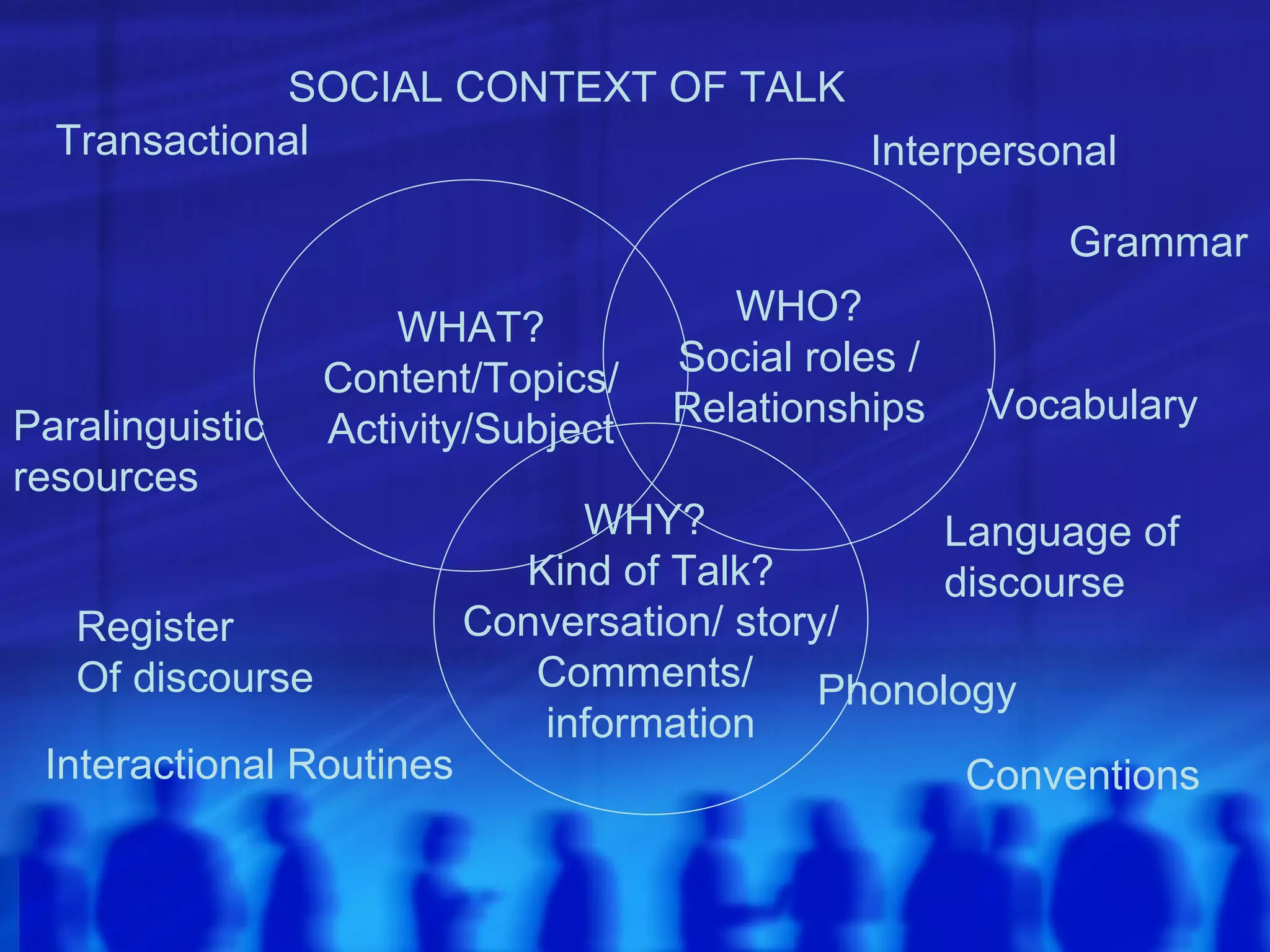
WHO? Social roles / Relationships WHY?  Kind of Talk? Conversation/ story/ Comments/  information WHAT? Content/Topics/ Activity/Subject SOCIAL CONTEXT OF TALK Language of  discourse Register Of discourse Interactional Routines Paralinguistic resources Vocabulary Conventions Interpersonal Transactional Phonology Grammar
Speaking as Skill Linguistic Knowledge: -  Genre  - transactional / interpersonal function - diff types of speech event - interactional / non-interactional - planned / unplanned - Structured differently  Discourse knowledge  -organise / connect - coherence eg  turn-taking structures of interactive talk  ( eg well, oh, and, so, right, or use of synonyms eg cook / make)
Linguistic Knowledge Pragmatic knowledge : communicative purpose of speech acts eg request, asking permission, suggestion Knowing how to do things with language taking into account contexts of use - knowing how to perform and interpret speech acts Politeness  - avoid threats to face - use of politeness markers eg please or modal verbs to soften requests or commands
Linguistic Knowledge Register  - sensitivity to context esp relationships eg status difference between people or familiarity FIELD - what is being talked about / topic eg lecture on nutrition, conversation about food TENOR - WHO - relationship b/w interactants  MODE - HOW - CHANNEL of communication eg face-to-face, real-time, pre-recorded Influences - formality, use of jargon/specialised language, colloquial language Knowing what language CHOICES appropriate
Linguistic Knowledge VOCABULARY - discourse markers, words and expression expressing STANCE eg really, actually, maybe, APPRAISAL eg nice, good , DEITIC lang - points to place, time and participants eg now, this , it, that, me, you CHUNKS : lexical phrases, formulaic language collocations  - eg rich and famous, densely populated Phrasal verbs  - eg get up, log on Idioms, catchphrases and sayings  eg part and parcel, speak of the devil Sentence frames  - fixed components of sentences eg would you like..? Social formulas - eg see you later, have a nice day Dicourse markers eg if you ask me, I take your point, to cut a long story short
Linguistic Knowledge PHONOLOGY - pronunication , intonation, pace, pitch, stress  SPEECH CONDITION eg cognitive factors - familiarity with topic, with genre, with interlocutors and processing demands eg complex mental processing like giving complicated instructions, more difficult  Affective factors - feelings towards participants / topic , self-consciousness Performance factors eg face-to-face easier - can monitor responses, use gestures, eye-contact etc, degree of collaboration - on your own or with peers, planning and rehearsal time, time pressure
Speaking as Skill Extralinguistic Knowledge  -topic / context knowledge ,  context knowledge eg people involved and  sociocultural knowledge ( social norms and values)
Features of Spoken Language takes place in real time and space usually involves face-to-face communication involves speakers and listeners adjusting to context – for example, who, when, where.
Speakers give shape and structure when they talk: explicitly signpost things  for the listener using words such as ‘now’ and ‘so’ to indicate a change of topic. What is said can be meaningful even if it’s  half-finished or seems incomplete . Speakers often  avoid over-elaborating  and rely on  mutual understanding of the context . •  Single words or phrases such as ‘anyway’, ‘alright’ or ‘really’ can be highly meaningful.
Speaking takes place in real time and place mostly unplanned because it usually happens with little opportunity for advance planning or editing. Because they are unplanned, spoken exchanges tend to  be open and fluid . Speakers can change direction and topic, return to things they’d forgotten, insert anecdotes and so on. Spoken language is  varied in style . Speakers can adapt and switch from one level of formality to another as the situation demands.
Communicating face to face a  collaborative and interactive process - an exchange  - finish each other’s comments, interrupt, disagree with or extend what is said. Speakers  get and give feedback  as they talk and listen using comments like ‘Exactly’, ‘Right’, ‘Good’, ‘Oh I see’ and simple vocalisations such as ‘Mmmm’, ‘Uh’, ‘Oh’. use more than words : pitch and tone of voice, volume, silence, eye contact, gestures and body movements all convey meaning.  Listeners give  non-verbal feedback  such as nodding the head.
Conventions of Spoken language Heads  - occur at the beginning of clauses. Heads help orientate listeners by establishing a topic. Eg  The white house on the corner , is that where she lives? Tails - occur at the end of clauses, usually reinforcing an antecedent pronoun. Eg She’s a very good swimmer,  Jenny is .
Ellipsis  - subjects and/or verbs are omitted, because the speaker assumes the listener knows what is meant. Eg Sounds good to me. (It/that). Discourse markers  - words or phrases denote moving from one topic or stage of a conversation to another. They act as ‘spoken punctuation’. Eg  Anyway , give Jean a ring and see what she says.
Modal expressions  - Help to soften what is said and to communicate more indirectly. Eg I don’t know, I think, perhaps, possibly and probably. Chains of clauses  - Speakers often do not have time to construct patterns of main and sub clauses. Clauses are therefore often  added incrementally to each other . Eg I was driving along talking to Jill and we like stopped at some traffic lights and then – bang – there was this terrible crash and we got pushed forwards.
Speaking and Listening Integrated In  whole-class work , shared reading and writing provide opportunities: for discussion when working in detail on texts, looking at meaning and considering the use of literary techniques to achieve particular effects. In  group and paired work  encourage participation and sharing ideas During independent work  have opportunities to share ideas, helping them to reflect on and refine their learning and to extend their thinking. Plenaries  can involve oral evaluation and consolidation of what has been learned
Questions teachers should ask: when is speaking and listening the focus of an activity ? eg contributing to group discussion, asking questions at an interview, listening actively to a speaker? when is speaking and listening the outcome ? eg taking on a specific role during discussion, a prepared talk or report, a performance, or a reading? where does discussion and group work result in action ? eg agreement on a course of action, the solving of a problem or the production of a leaflet?
Questions teachers should ask: how do different student undertake different tasks and  when do they need to collaborate and negotiate  to achieve an overall aim? where and when do children have the opportunity to rehearse, practise and apply  newly acquired speaking and listening skills? how and where do children reflect on their use of talk  and its impact on their learning?
Metacognitive Talk or Talk about Talk During the teaching of speaking and listening, remember to: give  linguistic prompts to support  their talk, especially in more formal presentations; discuss and  MODEL how to go about a task , for example the language useful to take turns, summarise or conduct an interview; extend vocabulary  through activities which focus on words, alternative choices and different ways of saying the ‘same’ thing in English
Metacognitive Talk or Talk about Talk introduce and teach  appropriate terminology for discussing speaking and listening , for example, audience, context, pace, discuss, emphasis, expression, formal, gesture, informal, stress, negotiate, open and closed questions, standard and non-standard  English, turn-taking, intonation teach and use language to reflect  on spoken language activities, for example reflecting on working in role and performance in drama activities.

Teaching speaking

  • 1.
    WHO? Social roles/ Relationships WHY? Kind of Talk? Conversation/ story/ Comments/ information WHAT? Content/Topics/ Activity/Subject SOCIAL CONTEXT OF TALK Language of discourse Register Of discourse Interactional Routines Paralinguistic resources Vocabulary Conventions Interpersonal Transactional Phonology Grammar
  • 2.
    Speaking as SkillLinguistic Knowledge: - Genre - transactional / interpersonal function - diff types of speech event - interactional / non-interactional - planned / unplanned - Structured differently Discourse knowledge -organise / connect - coherence eg turn-taking structures of interactive talk ( eg well, oh, and, so, right, or use of synonyms eg cook / make)
  • 3.
    Linguistic Knowledge Pragmaticknowledge : communicative purpose of speech acts eg request, asking permission, suggestion Knowing how to do things with language taking into account contexts of use - knowing how to perform and interpret speech acts Politeness - avoid threats to face - use of politeness markers eg please or modal verbs to soften requests or commands
  • 4.
    Linguistic Knowledge Register - sensitivity to context esp relationships eg status difference between people or familiarity FIELD - what is being talked about / topic eg lecture on nutrition, conversation about food TENOR - WHO - relationship b/w interactants MODE - HOW - CHANNEL of communication eg face-to-face, real-time, pre-recorded Influences - formality, use of jargon/specialised language, colloquial language Knowing what language CHOICES appropriate
  • 5.
    Linguistic Knowledge VOCABULARY- discourse markers, words and expression expressing STANCE eg really, actually, maybe, APPRAISAL eg nice, good , DEITIC lang - points to place, time and participants eg now, this , it, that, me, you CHUNKS : lexical phrases, formulaic language collocations - eg rich and famous, densely populated Phrasal verbs - eg get up, log on Idioms, catchphrases and sayings eg part and parcel, speak of the devil Sentence frames - fixed components of sentences eg would you like..? Social formulas - eg see you later, have a nice day Dicourse markers eg if you ask me, I take your point, to cut a long story short
  • 6.
    Linguistic Knowledge PHONOLOGY- pronunication , intonation, pace, pitch, stress SPEECH CONDITION eg cognitive factors - familiarity with topic, with genre, with interlocutors and processing demands eg complex mental processing like giving complicated instructions, more difficult Affective factors - feelings towards participants / topic , self-consciousness Performance factors eg face-to-face easier - can monitor responses, use gestures, eye-contact etc, degree of collaboration - on your own or with peers, planning and rehearsal time, time pressure
  • 7.
    Speaking as SkillExtralinguistic Knowledge -topic / context knowledge , context knowledge eg people involved and sociocultural knowledge ( social norms and values)
  • 8.
    Features of SpokenLanguage takes place in real time and space usually involves face-to-face communication involves speakers and listeners adjusting to context – for example, who, when, where.
  • 9.
    Speakers give shapeand structure when they talk: explicitly signpost things for the listener using words such as ‘now’ and ‘so’ to indicate a change of topic. What is said can be meaningful even if it’s half-finished or seems incomplete . Speakers often avoid over-elaborating and rely on mutual understanding of the context . • Single words or phrases such as ‘anyway’, ‘alright’ or ‘really’ can be highly meaningful.
  • 10.
    Speaking takes placein real time and place mostly unplanned because it usually happens with little opportunity for advance planning or editing. Because they are unplanned, spoken exchanges tend to be open and fluid . Speakers can change direction and topic, return to things they’d forgotten, insert anecdotes and so on. Spoken language is varied in style . Speakers can adapt and switch from one level of formality to another as the situation demands.
  • 11.
    Communicating face toface a collaborative and interactive process - an exchange - finish each other’s comments, interrupt, disagree with or extend what is said. Speakers get and give feedback as they talk and listen using comments like ‘Exactly’, ‘Right’, ‘Good’, ‘Oh I see’ and simple vocalisations such as ‘Mmmm’, ‘Uh’, ‘Oh’. use more than words : pitch and tone of voice, volume, silence, eye contact, gestures and body movements all convey meaning. Listeners give non-verbal feedback such as nodding the head.
  • 12.
    Conventions of Spokenlanguage Heads - occur at the beginning of clauses. Heads help orientate listeners by establishing a topic. Eg The white house on the corner , is that where she lives? Tails - occur at the end of clauses, usually reinforcing an antecedent pronoun. Eg She’s a very good swimmer, Jenny is .
  • 13.
    Ellipsis -subjects and/or verbs are omitted, because the speaker assumes the listener knows what is meant. Eg Sounds good to me. (It/that). Discourse markers - words or phrases denote moving from one topic or stage of a conversation to another. They act as ‘spoken punctuation’. Eg Anyway , give Jean a ring and see what she says.
  • 14.
    Modal expressions - Help to soften what is said and to communicate more indirectly. Eg I don’t know, I think, perhaps, possibly and probably. Chains of clauses - Speakers often do not have time to construct patterns of main and sub clauses. Clauses are therefore often added incrementally to each other . Eg I was driving along talking to Jill and we like stopped at some traffic lights and then – bang – there was this terrible crash and we got pushed forwards.
  • 15.
    Speaking and ListeningIntegrated In whole-class work , shared reading and writing provide opportunities: for discussion when working in detail on texts, looking at meaning and considering the use of literary techniques to achieve particular effects. In group and paired work encourage participation and sharing ideas During independent work have opportunities to share ideas, helping them to reflect on and refine their learning and to extend their thinking. Plenaries can involve oral evaluation and consolidation of what has been learned
  • 16.
    Questions teachers shouldask: when is speaking and listening the focus of an activity ? eg contributing to group discussion, asking questions at an interview, listening actively to a speaker? when is speaking and listening the outcome ? eg taking on a specific role during discussion, a prepared talk or report, a performance, or a reading? where does discussion and group work result in action ? eg agreement on a course of action, the solving of a problem or the production of a leaflet?
  • 17.
    Questions teachers shouldask: how do different student undertake different tasks and when do they need to collaborate and negotiate to achieve an overall aim? where and when do children have the opportunity to rehearse, practise and apply newly acquired speaking and listening skills? how and where do children reflect on their use of talk and its impact on their learning?
  • 18.
    Metacognitive Talk orTalk about Talk During the teaching of speaking and listening, remember to: give linguistic prompts to support their talk, especially in more formal presentations; discuss and MODEL how to go about a task , for example the language useful to take turns, summarise or conduct an interview; extend vocabulary through activities which focus on words, alternative choices and different ways of saying the ‘same’ thing in English
  • 19.
    Metacognitive Talk orTalk about Talk introduce and teach appropriate terminology for discussing speaking and listening , for example, audience, context, pace, discuss, emphasis, expression, formal, gesture, informal, stress, negotiate, open and closed questions, standard and non-standard English, turn-taking, intonation teach and use language to reflect on spoken language activities, for example reflecting on working in role and performance in drama activities.