Chapter 3 - Resistance

  Introductory Circuit Analysis
       Robert L. Boylestad
3.1 – Introduction
 The resistance of any material with a uniform
 cross-sectional area is determined by the following
 factors:
    Material
    Length
    Cross-sectional Area
    Temperature
Introduction
 Material and its unique molecular structure will
 react differently to pressures to establish current
 through its core.
    Conductors – Permit generous flow of charge
    Insulators – Have high resistance
Introduction

 As the temperature of most conductors
 increases, the increased motion of particles within
 the molecular structure makes it increasingly
 difficult for the “free” carriers to pass through, and
 the resistance level increases.
3.2 Resistance: Circular Wires
The higher the resistivity of a conductor, the
 higher its resistance.
The longer the length of a conductor, the higher
 its resistance.
The lower the cross-sectional area of a
 conductor, the higher its resistance.
The higher the temperature of a conductor, the
 higher its resistance.
Resistance: Circular Wires
Area of a conductor is measured in circular mils (CM).
The mil is a unit of measurement for length and is
 related to the inch by
                                1
                      1 mil =      in.
                              1000
A wire with a diameter of 1 mil has an area of 1 circular
 mil (CM).
Resistance: Circular Wires
 Resistivity is not the only factor used in determining
 the best conductor. Other factors are:
    Malleability – ability of a material to be shaped
    Ductility – ability of a material to be drawn into long,
                 thin wires
    Temperature sensitivity
    Resistance to abuse
    Cost
Resistance: Circular Wires
 Copper is the most widely used material because it is quite
 malleable, ductile and available.
 Aluminum was tried for general wiring but because of its
 thermal characteristics created difficulties.
 Silver and gold are used but because of cost, they have been
 limited to places that justify the cost.
 Tungsten has a resistivity three times that of copper but there
 are occasions when its physical characteristics (durability and
 hardness) are the overriding considerations.
3.3 Wire Tables
 Designed to standardize the size of wire produced by
 manufacturers, it contains the following information:
   Cross-sectional area in circular mils
   Diameter in mils
   Ohms per 1000 feet at 20°C
   Weight per 1000 feet
   Maximum allowable current in amperes, as determined by
   the National Fire Protection Association
 The American Wire Gage (AWG) indicates cable
 size
3.4 Resistance: Metric Units
 Metric units are used in the design of resistive
 elements including thin-film resistors and integrated
 circuits.
 Generally the meter is too large of a unit of measure
 for most applications, so the centimeter is usually
 employed.
 The resistivity of material is actually the resistance of
 a sample block.
3.5 Temperature Effects
 Temperature has a significant effect on the
 resistance of conductors, semiconductors and
 insulators.
   For good conductors, an increase in temperature will result in an
   increase in the resistance level. Consequently, conductors have
   positive temperature coefficients.
   For semiconductor materials, an increase in temperature will result
   in a decrease in the resistance level. Consequently, semiconductors
   have negative temperature coefficients.
   As with semiconductors, an increase in temperature will result in a
   decrease in the resistance of an insulator. The result is a negative
   temperature coefficient.
Temperature Effects
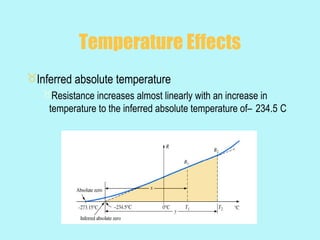
Inferred absolute temperature
   Resistance increases almost linearly with an increase in
    temperature to the inferred absolute temperature of ̶ 234.5 C
Temperature Effects
 Temperature coefficient of resistance


    The higher the temperature coefficient of resistance
    for a material, the more sensitive the resistance level
    to changes in temperature.
    When we use the temperature coefficient equation
    we see that copper is more sensitive to temperature
    variations than is silver, gold, or aluminum.
Temperature Effects
 PPM/°C
   The specification Parts Per Million Per Degree
    Celsius (PPM/°C) provides an immediate
    indication of the sensitivity level of a resistor to
    temperature.
   
3.6 Superconductors
 Superconductors are conductors of electric
 charge that, for all practical purposes, have zero
 resistance.
 The relatively low speed of electrons through
 conventional conductors is due to collisions with
 atoms and repulsive forces from other electrons.
 Cooper effect: Electrons travel in pairs and help
 each other maintain a significantly higher velocity
 through the medium.
Superconductors
 The goal of superconductivity at room temperature
   Before 1986:
        Superconductivity could only be established at temperatures
        colder than 23 K
    After 1986:
       Physicists Alex Muller and George Bednorz of the IBM Zurich
        Research Center found a ceramic material, lanthanum barium
        copper oxide that exhibited superconductivity at 30 K.
       Professors Paul Chu and Man Kven Wu raised the temperature
        to 95 K using a superconductor of yttrium barium copper oxide,
        enabling liquid nitrogen (boiling point 77 K) to be used for cooling.
3.7 Types of Resistors
 Resistors are made in many forms but all belong in
 either of two groups:
    Fixed resistors – are made of metal films, high-resistance
    wire or carbon composition
    Variable resistors – have a terminal resistance that can be
    varied by turning a dial, knob, screw, or anything else
    appropriate for the application
Types of Resistors
 Variable resistors can have two or three
 terminals. Most have three.
Variable resistors are classified as a rheostat or a
 potentiometer, depending upon the application.
    Rheostat: Two- or three-terminal device used as a
    variable resistor
    Potentiometer: Three-terminal device used for
    controlling potential levels
Types of Resistors
 Most potentiometers have three
 terminals as shown.
The knob, dial or screw in the center   Figure 3.24
 of the housing controls the motion of
 a contact that can move along the
 resistive element connected between
 the outer terminals.
The contact is connected to the
 center terminal, establishing a
 resistance from a movable contact to
 each outer terminal.
Types of Resistors
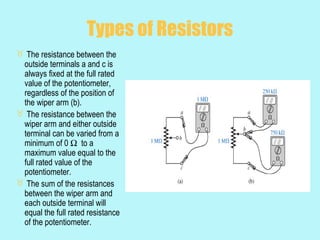
 The resistance between the
 outside terminals a and c is
 always fixed at the full rated
 value of the potentiometer,
 regardless of the position of
 the wiper arm (b).
 The resistance between the
 wiper arm and either outside
 terminal can be varied from a
 minimum of 0 Ω to a
 maximum value equal to the
 full rated value of the
 potentiometer.
 The sum of the resistances
 between the wiper arm and
 each outside terminal will
 equal the full rated resistance
 of the potentiometer.
3.8 Color Coding and Standard
         Resistor Values
 Color coding was developed to identify
 resistors that were too small for their resistance
 value to be printed on them.
    Color bands are always read from the end that has
    the bands closest to it.
    1st and 2nd band represent the first two digits
    3rd band determines the power-of-ten multiplier (the
    number of zeros following the second digit)
    4th band is the manufacturer’s tolerance (precision
    of the resistor)
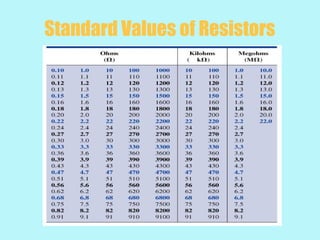
Standard Values of Resistors
3.9 Conductance
The reciprocal of resistance is conductance (G),
 measured in siemens (S)

               G = 1/R      (siemens, S)

A resistance of 1 MΩ is equivalent to a conductance
 of 10-6 S and a resistance of 10 Ω is equivalent to a
 conductance of 10-1 S.
3.10 - Ohmmeters
 An Ohmmeter is used to perform the following
 tasks:
    Measure the resistance of individual or combined elements
    Detect open-circuit (high-resistance) and short-circuit (low-
    resistance) situations
    Check continuity of network connections and identify wires of
    a multilead cable
    Test some semiconductor (electronic) devices
Resistance is measured by simply connecting
 the two leads of the meter across the resistor. It
 doesn’t matter which lead goes on which end.
Ohmmeters
 When measuring the resistance of a single
 resistor in a network, it is usually best to remove
 the resistor from the network before making the
 measurement.
 Important notes about the use of any ohmmeter:
   Never hook up an ohmmeter to a live circuit.
   Never store a VOM or a DMM in the resistance
    mode.
3.11 - Thermistors
 A thermistor is a two-terminal semiconductor device
 whose resistance is temperature sensitive.
    Increase in current through the device will raise its
    temperature, causing a drop in its terminal resistance
    Materials employed in the manufacture of thermistors
    include oxides of cobalt, nickel, strontium and
    manganese.
3.12 – Photoconductive Cell

 A photoconductive cell is a two-terminal
 semiconductor whose terminal resistance is
 determined by the intensity of the incident light
 on its exposed surface.
 As illumination increases in intensity, the energy
 state of the surface electrons and atoms
 increases resulting in an increase in the number
 of “free carriers”, and a corresponding drop in
 resistance.
3.13 - Varistors
 Varistors are voltage-dependent, nonlinear
 resistors used to suppress high-voltage transients.
 Varistors can be used to limit the voltage that can
 appear across the terminals of a sensitive device
 or system.
3.14 - Applications
 Electric baseboard heating element
   Heat is generated by passing current through a resistive
   element.
 Dimmer controls in an automobile
   A two-point rheostat can be used to control light intensity
   on the dashboard and accessories of an automobile.
 Strain gauges
   Change in the shape of a structure can be detected using
   strain gauges whose resistance will change with applied
   stress or flex.

My Presentation on Rc-Circuit

  • 1.
    Chapter 3 -Resistance Introductory Circuit Analysis Robert L. Boylestad
  • 2.
    3.1 – Introduction The resistance of any material with a uniform cross-sectional area is determined by the following factors:  Material  Length  Cross-sectional Area  Temperature
  • 3.
    Introduction  Material andits unique molecular structure will react differently to pressures to establish current through its core.  Conductors – Permit generous flow of charge  Insulators – Have high resistance
  • 4.
    Introduction  As thetemperature of most conductors increases, the increased motion of particles within the molecular structure makes it increasingly difficult for the “free” carriers to pass through, and the resistance level increases.
  • 5.
    3.2 Resistance: CircularWires The higher the resistivity of a conductor, the higher its resistance. The longer the length of a conductor, the higher its resistance. The lower the cross-sectional area of a conductor, the higher its resistance. The higher the temperature of a conductor, the higher its resistance.
  • 6.
    Resistance: Circular Wires Areaof a conductor is measured in circular mils (CM). The mil is a unit of measurement for length and is related to the inch by 1 1 mil = in. 1000 A wire with a diameter of 1 mil has an area of 1 circular mil (CM).
  • 7.
    Resistance: Circular Wires Resistivity is not the only factor used in determining the best conductor. Other factors are:  Malleability – ability of a material to be shaped  Ductility – ability of a material to be drawn into long,  thin wires  Temperature sensitivity  Resistance to abuse  Cost
  • 8.
    Resistance: Circular Wires Copper is the most widely used material because it is quite malleable, ductile and available.  Aluminum was tried for general wiring but because of its thermal characteristics created difficulties.  Silver and gold are used but because of cost, they have been limited to places that justify the cost.  Tungsten has a resistivity three times that of copper but there are occasions when its physical characteristics (durability and hardness) are the overriding considerations.
  • 9.
    3.3 Wire Tables Designed to standardize the size of wire produced by manufacturers, it contains the following information:  Cross-sectional area in circular mils  Diameter in mils  Ohms per 1000 feet at 20°C  Weight per 1000 feet  Maximum allowable current in amperes, as determined by the National Fire Protection Association  The American Wire Gage (AWG) indicates cable size
  • 10.
    3.4 Resistance: MetricUnits  Metric units are used in the design of resistive elements including thin-film resistors and integrated circuits.  Generally the meter is too large of a unit of measure for most applications, so the centimeter is usually employed.  The resistivity of material is actually the resistance of a sample block.
  • 11.
    3.5 Temperature Effects Temperature has a significant effect on the resistance of conductors, semiconductors and insulators.  For good conductors, an increase in temperature will result in an increase in the resistance level. Consequently, conductors have positive temperature coefficients.  For semiconductor materials, an increase in temperature will result in a decrease in the resistance level. Consequently, semiconductors have negative temperature coefficients.  As with semiconductors, an increase in temperature will result in a decrease in the resistance of an insulator. The result is a negative temperature coefficient.
  • 12.
    Temperature Effects Inferred absolutetemperature Resistance increases almost linearly with an increase in temperature to the inferred absolute temperature of ̶ 234.5 C
  • 13.
    Temperature Effects  Temperaturecoefficient of resistance  The higher the temperature coefficient of resistance for a material, the more sensitive the resistance level to changes in temperature.  When we use the temperature coefficient equation we see that copper is more sensitive to temperature variations than is silver, gold, or aluminum.
  • 14.
    Temperature Effects  PPM/°C  The specification Parts Per Million Per Degree Celsius (PPM/°C) provides an immediate indication of the sensitivity level of a resistor to temperature. 
  • 15.
    3.6 Superconductors  Superconductorsare conductors of electric charge that, for all practical purposes, have zero resistance.  The relatively low speed of electrons through conventional conductors is due to collisions with atoms and repulsive forces from other electrons.  Cooper effect: Electrons travel in pairs and help each other maintain a significantly higher velocity through the medium.
  • 16.
    Superconductors  The goalof superconductivity at room temperature Before 1986:  Superconductivity could only be established at temperatures colder than 23 K  After 1986:  Physicists Alex Muller and George Bednorz of the IBM Zurich Research Center found a ceramic material, lanthanum barium copper oxide that exhibited superconductivity at 30 K.  Professors Paul Chu and Man Kven Wu raised the temperature to 95 K using a superconductor of yttrium barium copper oxide, enabling liquid nitrogen (boiling point 77 K) to be used for cooling.
  • 17.
    3.7 Types ofResistors  Resistors are made in many forms but all belong in either of two groups:  Fixed resistors – are made of metal films, high-resistance wire or carbon composition  Variable resistors – have a terminal resistance that can be varied by turning a dial, knob, screw, or anything else appropriate for the application
  • 18.
    Types of Resistors Variable resistors can have two or three terminals. Most have three. Variable resistors are classified as a rheostat or a potentiometer, depending upon the application.  Rheostat: Two- or three-terminal device used as a variable resistor  Potentiometer: Three-terminal device used for controlling potential levels
  • 19.
    Types of Resistors Most potentiometers have three terminals as shown. The knob, dial or screw in the center Figure 3.24 of the housing controls the motion of a contact that can move along the resistive element connected between the outer terminals. The contact is connected to the center terminal, establishing a resistance from a movable contact to each outer terminal.
  • 20.
    Types of Resistors The resistance between the outside terminals a and c is always fixed at the full rated value of the potentiometer, regardless of the position of the wiper arm (b).  The resistance between the wiper arm and either outside terminal can be varied from a minimum of 0 Ω to a maximum value equal to the full rated value of the potentiometer.  The sum of the resistances between the wiper arm and each outside terminal will equal the full rated resistance of the potentiometer.
  • 21.
    3.8 Color Codingand Standard Resistor Values  Color coding was developed to identify resistors that were too small for their resistance value to be printed on them.  Color bands are always read from the end that has the bands closest to it.  1st and 2nd band represent the first two digits  3rd band determines the power-of-ten multiplier (the number of zeros following the second digit)  4th band is the manufacturer’s tolerance (precision of the resistor)
  • 22.
  • 23.
    3.9 Conductance The reciprocalof resistance is conductance (G), measured in siemens (S) G = 1/R (siemens, S) A resistance of 1 MΩ is equivalent to a conductance of 10-6 S and a resistance of 10 Ω is equivalent to a conductance of 10-1 S.
  • 24.
    3.10 - Ohmmeters An Ohmmeter is used to perform the following tasks:  Measure the resistance of individual or combined elements  Detect open-circuit (high-resistance) and short-circuit (low- resistance) situations  Check continuity of network connections and identify wires of a multilead cable  Test some semiconductor (electronic) devices Resistance is measured by simply connecting the two leads of the meter across the resistor. It doesn’t matter which lead goes on which end.
  • 25.
    Ohmmeters  When measuringthe resistance of a single resistor in a network, it is usually best to remove the resistor from the network before making the measurement.  Important notes about the use of any ohmmeter: Never hook up an ohmmeter to a live circuit. Never store a VOM or a DMM in the resistance mode.
  • 26.
    3.11 - Thermistors A thermistor is a two-terminal semiconductor device whose resistance is temperature sensitive.  Increase in current through the device will raise its temperature, causing a drop in its terminal resistance  Materials employed in the manufacture of thermistors include oxides of cobalt, nickel, strontium and manganese.
  • 27.
    3.12 – PhotoconductiveCell  A photoconductive cell is a two-terminal semiconductor whose terminal resistance is determined by the intensity of the incident light on its exposed surface.  As illumination increases in intensity, the energy state of the surface electrons and atoms increases resulting in an increase in the number of “free carriers”, and a corresponding drop in resistance.
  • 28.
    3.13 - Varistors Varistors are voltage-dependent, nonlinear resistors used to suppress high-voltage transients.  Varistors can be used to limit the voltage that can appear across the terminals of a sensitive device or system.
  • 29.
    3.14 - Applications Electric baseboard heating element  Heat is generated by passing current through a resistive element.  Dimmer controls in an automobile  A two-point rheostat can be used to control light intensity on the dashboard and accessories of an automobile.  Strain gauges  Change in the shape of a structure can be detected using strain gauges whose resistance will change with applied stress or flex.