




Factorial Analysis of Variance
How did we get here?
First we begin with a research question
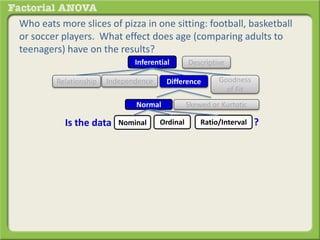
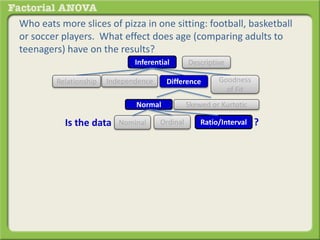
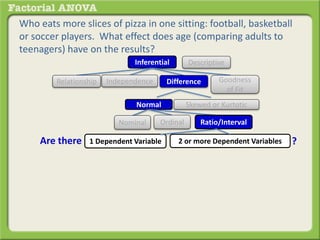
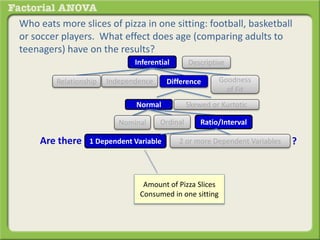
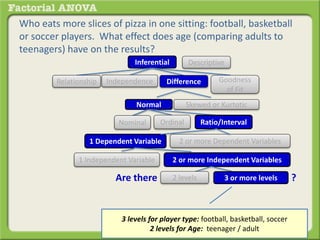
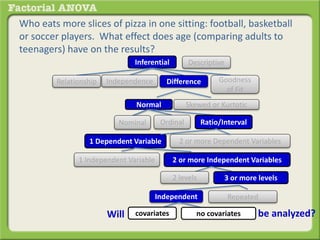
Who eats more slices of pizza in one sitting:
football, basketball or soccer players. What
effect does age (comparing adults to teenagers)
have on the results?
First we begin with a research question
Who eats more slices of pizza in one sitting: football, basketball
or soccer players. What effect does age (comparing adults to
teenagers) have on the results?
Who eats more slices of pizza in one sitting: football, basketball
or soccer players. What effect does age (comparing adults to
teenagers) have on the results?
Inferential DescriptiveIs this an / question?
Who eats more slices of pizza in one sitting: football, basketball
or soccer players. What effect does age (comparing adults to
teenagers) have on the results?
Inferential DescriptiveIs this an / question?
Who eats more slices of pizza in one sitting: football, basketball
or soccer players. What effect does age (comparing adults to
teenagers) have on the results?
Inferential DescriptiveIs this an / question?
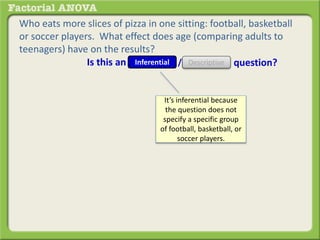
It’s inferential because
the question does not
specify a specific group
of football, basketball, or
soccer players.
Who eats more slices of pizza in one sitting: football, basketball
or soccer players. What effect does age (comparing adults to
teenagers) have on the results?
Inferential Descriptive
Is this a question?DifferenceRelationship Goodness of
Fit
Independence
Who eats more slices of pizza in one sitting: football, basketball
or soccer players. What effect does age (comparing adults to
teenagers) have on the results?
Inferential Descriptive
Is this a DifferenceRelationship Goodness
of Fit
Independence question?
Who eats more slices of pizza in one sitting: football, basketball
or soccer players. What effect does age (comparing adults to
teenagers) have on the results?
Inferential Descriptive
Is this a DifferenceRelationship Goodness
of Fit
Independence question?
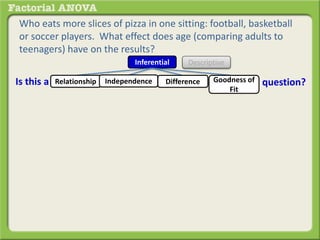
It’s difference in terms of
amount of pizza
consumed across player
types and age.
Who eats more slices of pizza in one sitting: football, basketball
or soccer players. What effect does age (comparing adults to
teenagers) have on the results?
Inferential Descriptive
Is this data set
DifferenceRelationship Goodness
of Fit
Independence
?Normal Skewed or Kurtotic
Who eats more slices of pizza in one sitting: football, basketball
or soccer players. What effect does age (comparing adults to
teenagers) have on the results?
Inferential Descriptive
Is this data set
DifferenceRelationship Goodness
of Fit
Independence
?Normal Skewed or Kurtotic
Who eats more slices of pizza in one sitting: football, basketball
or soccer players. What effect does age (comparing adults to
teenagers) have on the results?
Inferential Descriptive
Is the data set
DifferenceRelationship Goodness
of Fit
Independence
?
Normal Skewed or Kurtotic
Ratio/IntervalOrdinalNominal
Who eats more slices of pizza in one sitting: football, basketball
or soccer players. What effect does age (comparing adults to
teenagers) have on the results?
Inferential Descriptive
Is the data set
DifferenceRelationship Goodness
of Fit
Independence
?
Normal Skewed or Kurtotic
Ratio/IntervalOrdinalNominal
Who eats more slices of pizza in one sitting: football, basketball
or soccer players. What effect does age (comparing adults to
teenagers) have on the results?
Inferential Descriptive
Are there
DifferenceRelationship Goodness
of Fit
Independence
?
Normal Skewed or Kurtotic
1 Dependent Variable 2 or more Dependent Variables
Ratio/IntervalOrdinalNominal
Who eats more slices of pizza in one sitting: football, basketball
or soccer players. What effect does age (comparing adults to
teenagers) have on the results?
Inferential Descriptive
Are there
DifferenceRelationship Goodness
of Fit
Independence
?
Normal Skewed or Kurtotic
1 Dependent Variable 2 or more Dependent Variables
Ratio/IntervalOrdinalNominal
Amount of Pizza Slices
Consumed in one sitting
Who eats more slices of pizza in one sitting: football, basketball
or soccer players. What effect does age (comparing adults to
teenagers) have on the results?
Inferential Descriptive
Are there
DifferenceRelationship Goodness
of Fit
Independence
Normal Skewed or Kurtotic
1 Dependent Variable 2 or more Dependent Variables
Ratio/IntervalOrdinalNominal
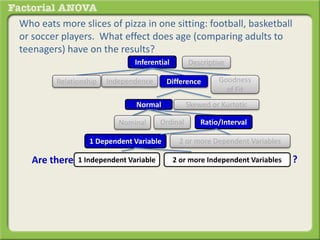
1 Independent Variable 2 or more Independent Variables ?
Who eats more slices of pizza in one sitting: football, basketball
or soccer players. What effect does age (comparing adults to
teenagers) have on the results?
Inferential Descriptive
Are there
DifferenceRelationship Goodness
of Fit
Independence
Normal Skewed or Kurtotic
1 Dependent Variable 2 or more Dependent Variables
Ratio/IntervalOrdinalNominal
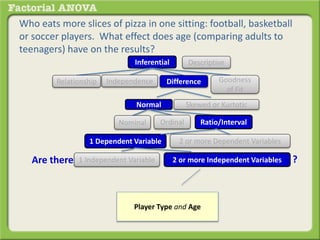
1 Independent Variable 2 or more Independent Variables ?
Player Type and Age
Who eats more slices of pizza in one sitting: football, basketball
or soccer players. What effect does age (comparing adults to
teenagers) have on the results?
Inferential Descriptive
Are there
DifferenceRelationship Goodness
of Fit
Independence
Normal Skewed or Kurtotic
1 Dependent Variable 2 or more Dependent Variables
Ratio/IntervalOrdinalNominal
1 Independent Variable 2 or more Independent Variables
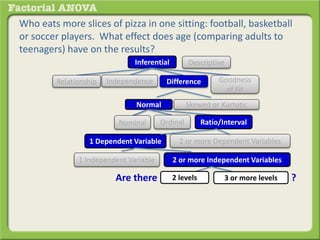
?2 levels 3 or more levels
Who eats more slices of pizza in one sitting: football, basketball
or soccer players. What effect does age (comparing adults to
teenagers) have on the results?
Inferential Descriptive
Are there
DifferenceRelationship Goodness
of Fit
Independence
Normal Skewed or Kurtotic
1 Dependent Variable 2 or more Dependent Variables
Ratio/IntervalOrdinalNominal
1 Independent Variable 2 or more Independent Variables
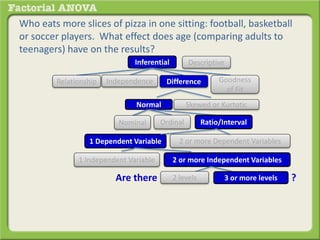
?3 or more levels2 levels
Who eats more slices of pizza in one sitting: football, basketball
or soccer players. What effect does age (comparing adults to
teenagers) have on the results?
Inferential Descriptive
Are there
DifferenceRelationship Goodness
of Fit
Independence
Normal Skewed or Kurtotic
1 Dependent Variable 2 or more Dependent Variables
Ratio/IntervalOrdinalNominal
1 Independent Variable 2 or more Independent Variables
?3 or more levels
3 levels for player type: football, basketball, soccer
2 levels for Age: teenager / adult
2 levels
Who eats more slices of pizza in one sitting: football, basketball
or soccer players. What effect does age (comparing adults to
teenagers) have on the results?
Inferential Descriptive
DifferenceRelationship Goodness
of Fit
Independence
Normal Skewed or Kurtotic
1 Dependent Variable 2 or more Dependent Variables
Ratio/IntervalOrdinalNominal
1 Independent Variable 2 or more Independent Variables
2 levels 3 or more levels
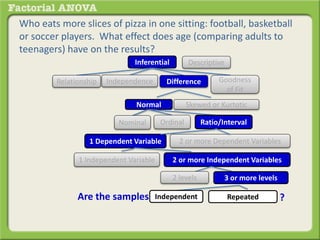
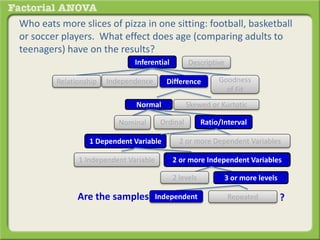
Are the samples ?Independent Repeated
Who eats more slices of pizza in one sitting: football, basketball
or soccer players. What effect does age (comparing adults to
teenagers) have on the results?
Inferential Descriptive
DifferenceRelationship Goodness
of Fit
Independence
Normal Skewed or Kurtotic
1 Dependent Variable 2 or more Dependent Variables
Ratio/IntervalOrdinalNominal
1 Independent Variable 2 or more Independent Variables
2 levels 3 or more levels
Are the samples ?Independent Repeated
Who eats more slices of pizza in one sitting: football, basketball
or soccer players. What effect does age (comparing adults to
teenagers) have on the results?
Inferential Descriptive
DifferenceRelationship Goodness
of Fit
Independence
Normal Skewed or Kurtotic
1 Dependent Variable 2 or more Dependent Variables
Ratio/IntervalOrdinalNominal
1 Independent Variable 2 or more Independent Variables
2 levels 3 or more levels
Are the samples ?Independent Repeated
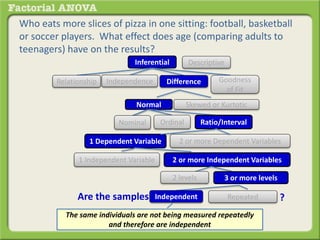
The same individuals are not being measured repeatedly
and therefore are independent
Who eats more slices of pizza in one sitting: football, basketball
or soccer players. What effect does age (comparing adults to
teenagers) have on the results?
Inferential Descriptive
DifferenceRelationship Goodness
of Fit
Independence
Normal Skewed or Kurtotic
1 Dependent Variable 2 or more Dependent Variables
Ratio/IntervalOrdinalNominal
1 Independent Variable 2 or more Independent Variables
2 levels 3 or more levels
Independent Repeated
Will covariates no covariates be analyzed?
Who eats more slices of pizza in one sitting: football, basketball
or soccer players. What effect does age (comparing adults to
teenagers) have on the results?
Inferential Descriptive
DifferenceRelationship Goodness
of Fit
Independence
Normal Skewed or Kurtotic
1 Dependent Variable 2 or more Dependent Variables
Ratio/IntervalOrdinalNominal
1 Independent Variable 2 or more Independent Variables
2 levels 3 or more levels
Independent Repeated
Will covariates no covariates be analyzed?
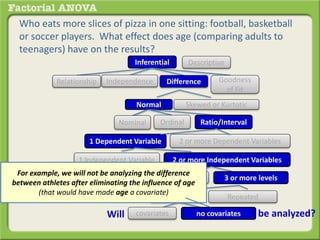
For example, we will not be analyzing the difference
between athletes after eliminating the influence of age
(that would have made age a covariate)
Who eats more slices of pizza in one sitting: football, basketball
or soccer players. What effect does age (comparing adults to
teenagers) have on the results?
Inferential Descriptive
DifferenceRelationship Goodness
of Fit
Independence
Normal Skewed or Kurtotic
1 Dependent Variable 2 or more Dependent Variables
Ratio/IntervalOrdinalNominal
1 Independent Variable 2 or more Independent Variables
2 levels 3 or more levels
Independent Repeated
covariates no covariates
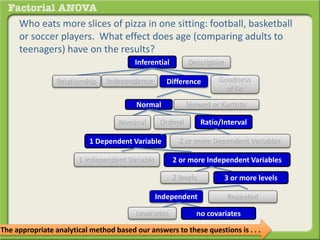
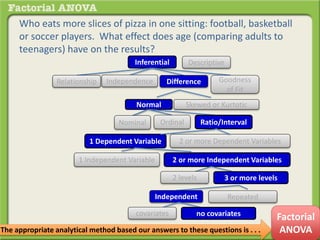
The appropriate analytical method based our answers to these questions is . . .
Who eats more slices of pizza in one sitting: football, basketball
or soccer players. What effect does age (comparing adults to
teenagers) have on the results?
Inferential Descriptive
DifferenceRelationship Goodness
of Fit
Independence
Normal Skewed or Kurtotic
1 Dependent Variable 2 or more Dependent Variables
Ratio/IntervalOrdinalNominal
1 Independent Variable 2 or more Independent Variables
2 levels 3 or more levels
Independent Repeated
covariates no covariates
The appropriate analytical method based our answers to these questions is . . .
Factorial
ANOVA
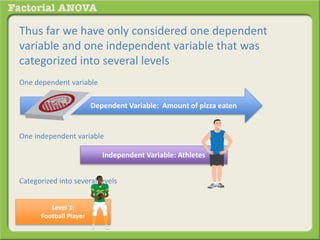
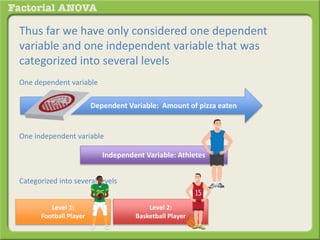
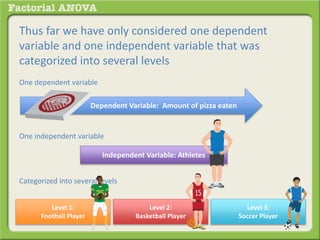
Thus far we have only considered one dependent
variable and one independent variable that was
categorized into several levels
One dependent variable
Dependent Variable: Amount of pizza eaten
Thus far we have only considered one dependent
variable and one independent variable that was
categorized into several levels
One dependent variable
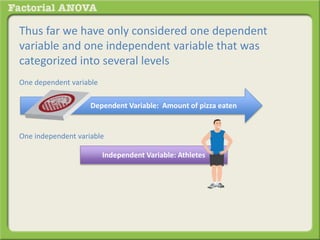
One independent variable
Dependent Variable: Amount of pizza eaten
Thus far we have only considered one dependent
variable and one independent variable that was
categorized into several levels
One dependent variable
One independent variable
Dependent Variable: Amount of pizza eaten
Independent Variable: Athletes
Thus far we have only considered one dependent
variable and one independent variable that was
categorized into several levels
One dependent variable
One independent variable
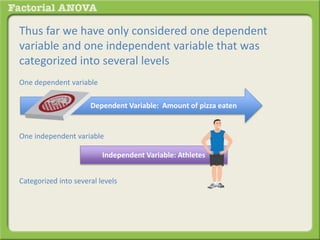
Categorized into several levels
Dependent Variable: Amount of pizza eaten
Independent Variable: Athletes
Thus far we have only considered one dependent
variable and one independent variable that was
categorized into several levels
One dependent variable
One independent variable
Categorized into several levels
Dependent Variable: Amount of pizza eaten
Independent Variable: Athletes
Level 1:
Football Player
Thus far we have only considered one dependent
variable and one independent variable that was
categorized into several levels
One dependent variable
One independent variable
Categorized into several levels
Dependent Variable: Amount of pizza eaten
Independent Variable: Athletes
Level 1:
Football Player
Level 2:
Basketball Player
Thus far we have only considered one dependent
variable and one independent variable that was
categorized into several levels
One dependent variable
One independent variable
Categorized into several levels
Dependent Variable: Amount of pizza eaten
Independent Variable: Athletes
Level 1:
Football Player
Level 2:
Basketball Player
Level 3:
Soccer Player
We can consider the effect of multiple independent
variables on a single dependent variable.
We can consider the effect of multiple independent
variables on a single dependent variable.
For example:
We can consider the effect of multiple independent
variables on a single dependent variable.
For example:
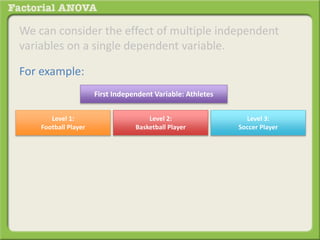
First Independent Variable: Athletes
Level 1:
Football Player
Level 2:
Basketball Player
Level 3:
Soccer Player
We can consider the effect of multiple independent
variables on a single dependent variable.
For example:
First Independent Variable: Athletes
Level 1:
Football Player
Level 2:
Basketball Player
Level 3:
Soccer Player
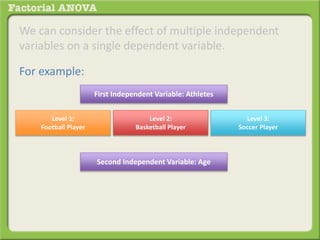
Second Independent Variable: Age
We can consider the effect of multiple independent
variables on a single dependent variable.
For example:
First Independent Variable: Athletes
Level 1:
Football Player
Level 2:
Basketball Player
Level 3:
Soccer Player
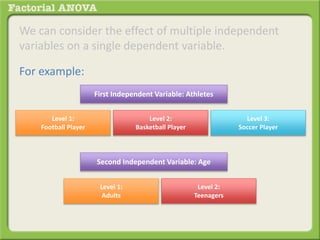
Second Independent Variable: Age
Level 1:
Adults
Level 2:
Teenagers
We can consider the effect of multiple independent
variables on a single dependent variable.
For example: the differences in number of slices of
pizza consumed (this is the single independent variable)
among 3 different athlete groups (Football, Basketball,
& Soccer) at two different age levels (Adults &
Teenagers).
We can consider the effect of multiple independent
variables on a single dependent variable.
For example: the differences in number of slices of
pizza consumed (this is the single independent variable)
among 3 different athlete groups (Football, Basketball,
& Soccer) at two different age levels (Adults &
Teenagers). Now, rather than comparing only 3 groups,
we will be comparing 6 groups (3 levels of athlete x 2
levels of age groups).
We can consider the effect of multiple independent
variables on a single dependent variable.
For example: the differences in number of slices of
pizza consumed (this is the single independent variable)
among 3 different athlete groups (Football, Basketball,
& Soccer) at two different age levels (Adults &
Teenagers). Now, rather than comparing only 3 groups,
we will be comparing 6 groups (3 levels of athlete x 2
levels of age groups).
Let’s see what this data set might look like.
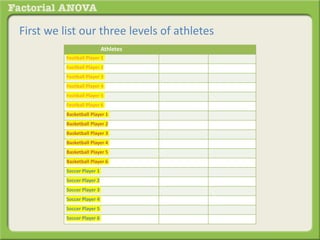
First we list our three levels of athletes
Athletes
Football Player 1
Football Player 2
Football Player 3
Football Player 4
Football Player 5
Football Player 6
Basketball Player 1
Basketball Player 2
Basketball Player 3
Basketball Player 4
Basketball Player 5
Basketball Player 6
Soccer Player 1
Soccer Player 2
Soccer Player 3
Soccer Player 4
Soccer Player 5
Soccer Player 6
Then our two age groups
Athletes
Football Player 1
Football Player 2
Football Player 3
Football Player 4
Football Player 5
Football Player 6
Basketball Player 1
Basketball Player 2
Basketball Player 3
Basketball Player 4
Basketball Player 5
Basketball Player 6
Soccer Player 1
Soccer Player 2
Soccer Player 3
Soccer Player 4
Soccer Player 5
Soccer Player 6
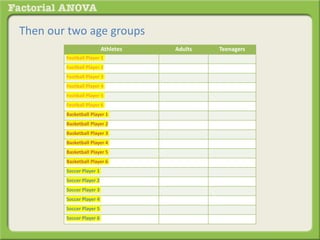
Then our two age groups
Athletes Adults Teenagers
Football Player 1
Football Player 2
Football Player 3
Football Player 4
Football Player 5
Football Player 6
Basketball Player 1
Basketball Player 2
Basketball Player 3
Basketball Player 4
Basketball Player 5
Basketball Player 6
Soccer Player 1
Soccer Player 2
Soccer Player 3
Soccer Player 4
Soccer Player 5
Soccer Player 6
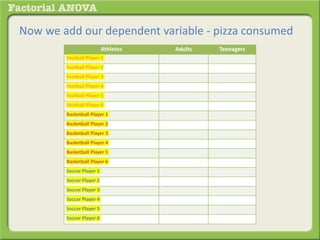
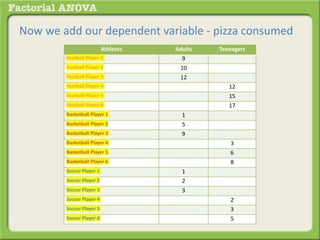
Now we add our dependent variable - pizza consumed
Athletes Adults Teenagers
Football Player 1
Football Player 2
Football Player 3
Football Player 4
Football Player 5
Football Player 6
Basketball Player 1
Basketball Player 2
Basketball Player 3
Basketball Player 4
Basketball Player 5
Basketball Player 6
Soccer Player 1
Soccer Player 2
Soccer Player 3
Soccer Player 4
Soccer Player 5
Soccer Player 6
Now we add our dependent variable - pizza consumed
Athletes Adults Teenagers
Football Player 1 9
Football Player 2 10
Football Player 3 12
Football Player 4 12
Football Player 5 15
Football Player 6 17
Basketball Player 1 1
Basketball Player 2 5
Basketball Player 3 9
Basketball Player 4 3
Basketball Player 5 6
Basketball Player 6 8
Soccer Player 1 1
Soccer Player 2 2
Soccer Player 3 3
Soccer Player 4 2
Soccer Player 5 3
Soccer Player 6 5
The procedure by which we analyze the sums of
squares among the 6 groups based on 2 independent
variables (Age Group and Athlete Category) is called
Factorial ANOVA.
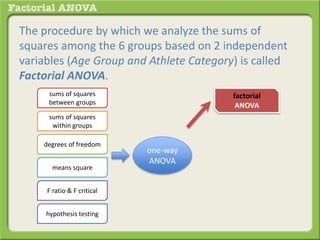
The procedure by which we analyze the sums of
squares among the 6 groups based on 2 independent
variables (Age Group and Athlete Category) is called
Factorial ANOVA.
sums of squares
between groups
sums of squares
within groups
degrees of freedom
means square
F ratio & F critical
hypothesis testing
one-way
ANOVA
factorial
ANOVA
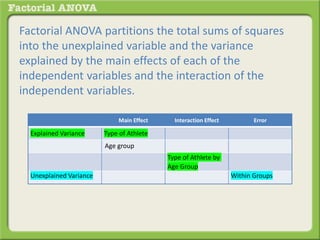
Factorial ANOVA partitions the total sums of squares
into the unexplained variable and the variance
explained by the main effects of each of the
independent variables and the interaction of the
independent variables.
Factorial ANOVA partitions the total sums of squares
into the unexplained variable and the variance
explained by the main effects of each of the
independent variables and the interaction of the
independent variables.
Main Effect Interaction Effect Error
Explained Variance Type of Athlete
Age group
Type of Athlete by
Age Group
Unexplained Variance Within Groups
Continuing our example:
• The type of athlete may have an effect on the
number of slices of pizza eaten.
Continuing our example:
• The type of athlete may have an effect on the
number of slices of pizza eaten.
• But also the age group might as well have an effect
on the number of slices eaten.
Continuing our example:
• The type of athlete may have an effect on the
number of slices of pizza eaten.
• But also the age group might as well have an effect
on the number of slices eaten.
• And the interaction of type of athlete and age group
may have an effect on slices eaten as well
Continuing our example:
• The type of athlete may have an effect on the
number of slices of pizza eaten.
• But also the age group might as well have an effect
on the number of slices eaten.
• And the interaction of type of athlete and age group
may have an effect on slices eaten as well
In other words, some age groups within different athlete
categories may consume different amounts of pizza. For
example, maybe football and basketball adults eat much
more than football and basketball teenagers, while adult
soccer players eat much less than teenage soccer players.
In that case, the soccer players did not follow the trend
of the football and basketball players. This would be
considered an interaction effect between age group
and type of athlete.
In that case, the soccer players did not follow the trend
of the football and basketball players. This would be
considered an interaction effect between age group
and type of athlete.
Of course, there are 6 (3 x 2) possible combinations of
age groups and types of athletes any one of which may
not follow the direct main effect trend of age group or
type of athlete.
In that case, the soccer players did not follow the trend
of the football and basketball players. This would be
considered an interaction effect between age group
and type of athlete.
Of course, there are 6 (3 x 2) possible combinations of
age groups and types of athletes any one of which may
not follow the direct main effect trend of age group or
type of athlete.
• Adult Football Player
• Teenage Football Player
• Adult Basketball Player
• Teenage Basketball Player
• Adult Soccer Player
• Teenage Soccer Player
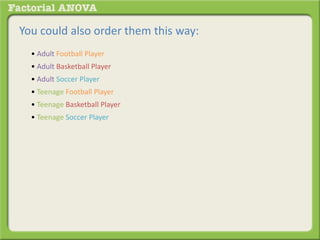
You could also order them this way:
• Adult Football Player
• Teenage Football Player
• Adult Basketball Player
• Teenage Basketball Player
• Adult Soccer Player
• Teenage Soccer Player
You could also order them this way:
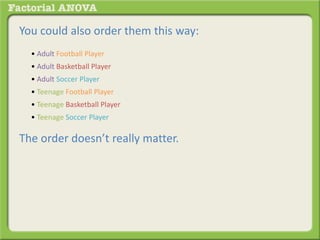
The order doesn’t really matter.
• Adult Football Player
• Teenage Football Player
• Adult Basketball Player
• Teenage Basketball Player
• Adult Soccer Player
• Teenage Soccer Player
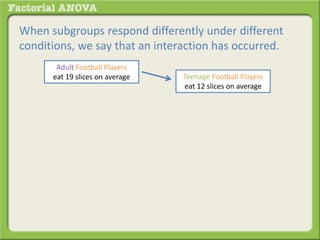
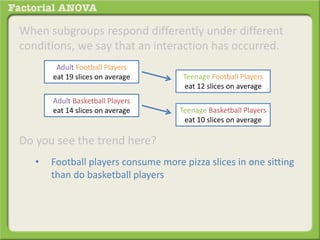
When subgroups respond differently under different
conditions, we say that an interaction has occurred.
When subgroups respond differently under different
conditions, we say that an interaction has occurred.
Adult Football Players
eat 19 slices on average Teenage Football Players
eat 12 slices on average
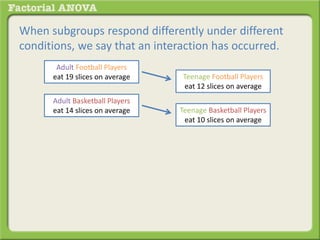
When subgroups respond differently under different
conditions, we say that an interaction has occurred.
Adult Football Players
eat 19 slices on average
Adult Basketball Players
eat 14 slices on average
Teenage Football Players
eat 12 slices on average
Teenage Basketball Players
eat 10 slices on average
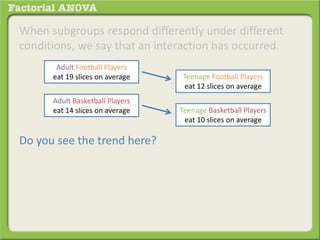
When subgroups respond differently under different
conditions, we say that an interaction has occurred.
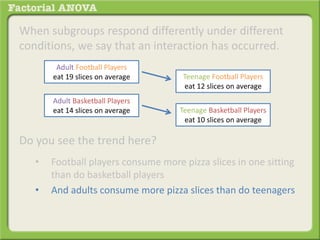
Do you see the trend here?
Adult Football Players
eat 19 slices on average
Adult Basketball Players
eat 14 slices on average
Teenage Football Players
eat 12 slices on average
Teenage Basketball Players
eat 10 slices on average
When subgroups respond differently under different
conditions, we say that an interaction has occurred.
Do you see the trend here?
• Football players consume more pizza slices in one sitting
than do basketball players
Adult Football Players
eat 19 slices on average
Adult Basketball Players
eat 14 slices on average
Teenage Football Players
eat 12 slices on average
Teenage Basketball Players
eat 10 slices on average
When subgroups respond differently under different
conditions, we say that an interaction has occurred.
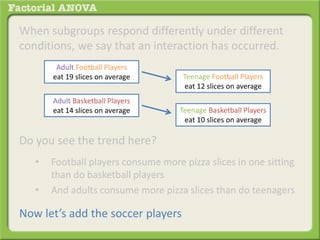
Do you see the trend here?
• Football players consume more pizza slices in one sitting
than do basketball players
• And adults consume more pizza slices than do teenagers
Adult Football Players
eat 19 slices on average
Adult Basketball Players
eat 14 slices on average
Teenage Football Players
eat 12 slices on average
Teenage Basketball Players
eat 10 slices on average
When subgroups respond differently under different
conditions, we say that an interaction has occurred.
Do you see the trend here?
• Football players consume more pizza slices in one sitting
than do basketball players
• And adults consume more pizza slices than do teenagers
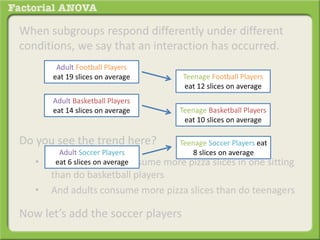
Now let’s add the soccer players
Adult Football Players
eat 19 slices on average
Adult Basketball Players
eat 14 slices on average
Teenage Football Players
eat 12 slices on average
Teenage Basketball Players
eat 10 slices on average
When subgroups respond differently under different
conditions, we say that an interaction has occurred.
Do you see the trend here?
• Football players consume more pizza slices in one sitting
than do basketball players
• And adults consume more pizza slices than do teenagers
Now let’s add the soccer players
Adult Football Players
eat 19 slices on average
Adult Basketball Players
eat 14 slices on average
Teenage Football Players
eat 12 slices on average
Teenage Basketball Players
eat 10 slices on average
Adult Soccer Players
eat 6 slices on average
Teenage Soccer Players eat
8 slices on average
Because the soccer players do not follow the trend of
the other two groups, this is called an interaction effect
between type of athlete and age group.
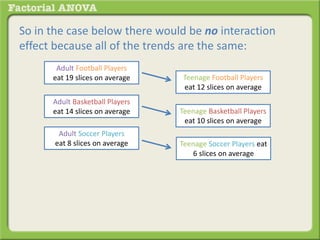
So in the case below there would be no interaction
effect because all of the trends are the same:
So in the case below there would be no interaction
effect because all of the trends are the same:
Adult Football Players
eat 19 slices on average
Adult Basketball Players
eat 14 slices on average
Teenage Football Players
eat 12 slices on average
Teenage Basketball Players
eat 10 slices on average
Adult Soccer Players
eat 8 slices on average Teenage Soccer Players eat
6 slices on average
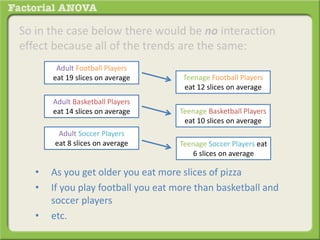
So in the case below there would be no interaction
effect because all of the trends are the same:
• As you get older you eat more slices of pizza
• If you play football you eat more than basketball and
soccer players
• etc.
Adult Football Players
eat 19 slices on average
Adult Basketball Players
eat 14 slices on average
Teenage Football Players
eat 12 slices on average
Teenage Basketball Players
eat 10 slices on average
Adult Soccer Players
eat 8 slices on average Teenage Soccer Players eat
6 slices on average
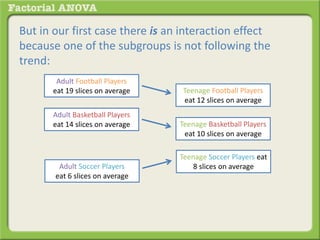
But in our first case there is an interaction effect
because one of the subgroups is not following the
trend:
But in our first case there is an interaction effect
because one of the subgroups is not following the
trend:
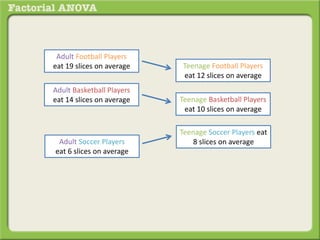
Adult Football Players
eat 19 slices on average
Adult Basketball Players
eat 14 slices on average
Teenage Football Players
eat 12 slices on average
Teenage Basketball Players
eat 10 slices on average
Adult Soccer Players
eat 6 slices on average
Teenage Soccer Players eat
8 slices on average
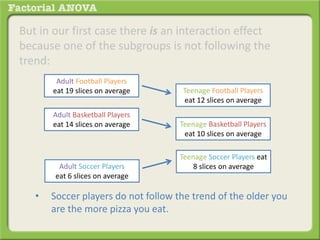
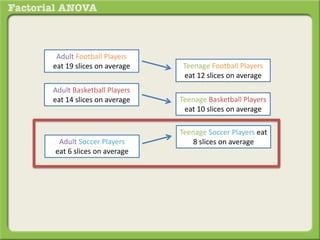
But in our first case there is an interaction effect
because one of the subgroups is not following the
trend:
• Soccer players do not follow the trend of the older you
are the more pizza you eat.
Adult Football Players
eat 19 slices on average
Adult Basketball Players
eat 14 slices on average
Teenage Football Players
eat 12 slices on average
Teenage Basketball Players
eat 10 slices on average
Adult Soccer Players
eat 6 slices on average
Teenage Soccer Players eat
8 slices on average
A factorial ANOVA will have at the very least three null
hypotheses. In the simplest case of two independent
variables, there will be three.
A factorial ANOVA will have at the very least three null
hypotheses. In the simplest case of two independent
variables, there will be three.
Here they are:
A factorial ANOVA will have at the very least three null
hypotheses. In the simplest case of two independent
variables, there will be three.
Here they are:
• Main Effect for Age Group: There is no significant
difference between the amount of pizza slices eaten by
adults and teenagers in one sitting.
A factorial ANOVA will have at the very least three null
hypotheses. In the simplest case of two independent
variables, there will be three.
Here they are:
• Main Effect for Age Group: There is no significant
difference between the amount of pizza slices eaten by
adults and teenagers in one sitting.
• Main Effect for Type of Athlete: There is no significant
difference between the amount of pizza slices eaten by
football, basketball, and soccer players in one sitting.
A factorial ANOVA will have at the very least three null
hypotheses. In the simplest case of two independent
variables, there will be three.
Here they are:
• Main Effect for Age Group: There is no significant
difference between the amount of pizza slices eaten by
adults and teenagers in one sitting.
• Main Effect for Type of Athlete: There is no significant
difference between the amount of pizza slices eaten by
football, basketball, and soccer players in one sitting.
• Interaction Effect Between Age Group and Type of
Athlete: There is no significant interaction between the
amount of pizza eaten by football, basketball and soccer
players in one sitting.
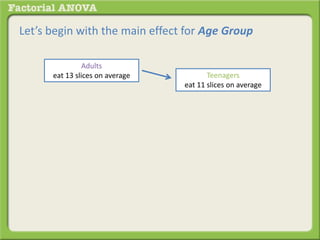
Let’s begin with the main effect for Age Group
Adults
eat 13 slices on average Teenagers
eat 11 slices on average
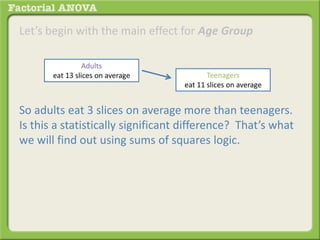
Let’s begin with the main effect for Age Group
So adults eat 3 slices on average more than teenagers.
Is this a statistically significant difference? That’s what
we will find out using sums of squares logic.
Adults
eat 13 slices on average Teenagers
eat 11 slices on average
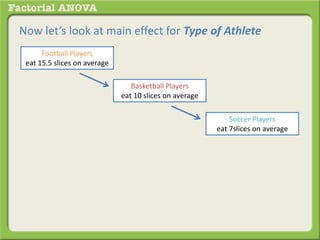
Now let’s look at main effect for Type of Athlete
Football Players
eat 15.5 slices on average
Basketball Players
eat 10 slices on average
Soccer Players
eat 7slices on average
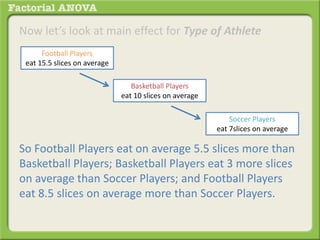
Now let’s look at main effect for Type of Athlete
So Football Players eat on average 5.5 slices more than
Basketball Players; Basketball Players eat 3 more slices
on average than Soccer Players; and Football Players
eat 8.5 slices on average more than Soccer Players.
Football Players
eat 15.5 slices on average
Basketball Players
eat 10 slices on average
Soccer Players
eat 7slices on average
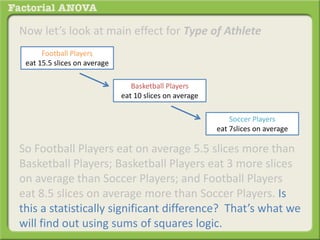
Now let’s look at main effect for Type of Athlete
So Football Players eat on average 5.5 slices more than
Basketball Players; Basketball Players eat 3 more slices
on average than Soccer Players; and Football Players
eat 8.5 slices on average more than Soccer Players. Is
this a statistically significant difference? That’s what we
will find out using sums of squares logic.
Football Players
eat 15.5 slices on average
Basketball Players
eat 10 slices on average
Soccer Players
eat 7slices on average
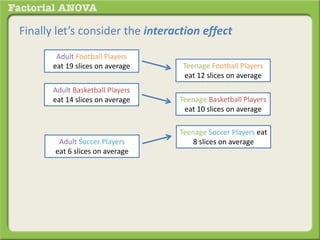
Finally let’s consider the interaction effect
Adult Football Players
eat 19 slices on average
Adult Basketball Players
eat 14 slices on average
Teenage Football Players
eat 12 slices on average
Teenage Basketball Players
eat 10 slices on average
Adult Soccer Players
eat 6 slices on average
Teenage Soccer Players eat
8 slices on average
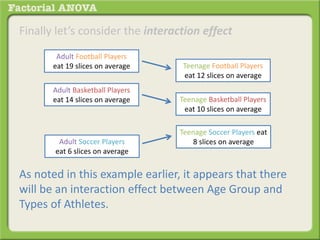
Finally let’s consider the interaction effect
As noted in this example earlier, it appears that there
will be an interaction effect between Age Group and
Types of Athletes.
Adult Football Players
eat 19 slices on average
Adult Basketball Players
eat 14 slices on average
Teenage Football Players
eat 12 slices on average
Teenage Basketball Players
eat 10 slices on average
Adult Soccer Players
eat 6 slices on average
Teenage Soccer Players eat
8 slices on average
So how do we test these possibilities statistically?
Factorial ANOVA will produce an F-ratio for each main
effect and for each interaction.
So how do we test these possibilities statistically?
Factorial ANOVA will produce an F-ratio for each main
effect and for each interaction.
• Main effect: Age Group
So how do we test these possibilities statistically?
Factorial ANOVA will produce an F-ratio for each main
effect and for each interaction.
• Main effect: Age Group – F ratio.
So how do we test these possibilities statistically?
Factorial ANOVA will produce an F-ratio for each main
effect and for each interaction.
• Main effect: Age Group – F ratio.
• Main effect: Type of Athlete
So how do we test these possibilities statistically?
Factorial ANOVA will produce an F-ratio for each main
effect and for each interaction.
• Main effect: Age Group – F ratio.
• Main effect: Type of Athlete – F ratio.
So how do we test these possibilities statistically?
Factorial ANOVA will produce an F-ratio for each main
effect and for each interaction.
• Main effect: Age Group – F ratio.
• Main effect: Type of Athlete – F ratio.
• Interaction effect: Age Group by Type of Athlete
So how do we test these possibilities statistically?
Factorial ANOVA will produce an F-ratio for each main
effect and for each interaction.
• Main effect: Age Group – F ratio.
• Main effect: Type of Athlete – F ratio.
• Interaction effect: Age Group by Type of Athlete – F ratio
So how do we test these possibilities statistically?
Factorial ANOVA will produce an F-ratio for each main
effect and for each interaction.
• Main effect: Age Group – F ratio.
• Main effect: Type of Athlete – F ratio.
• Interaction effect: Age Group by Type of Athlete – F ratio
Each of these F ratios will be compared with their
individual F-critical values on the F distribution table to
determine if the null hypothesis will be retained or
rejected.
Always interpret the F-ratio for the interactions effect
first, before considering the F-ratio for the main effects.
Always interpret the F-ratio for the interactions effect
first, before considering the F-ratio for the main effects.
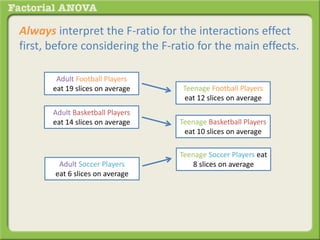
Adult Football Players
eat 19 slices on average
Adult Basketball Players
eat 14 slices on average
Teenage Football Players
eat 12 slices on average
Teenage Basketball Players
eat 10 slices on average
Adult Soccer Players
eat 6 slices on average
Teenage Soccer Players eat
8 slices on average
Always interpret the F-ratio for the interactions effect
first, before considering the F-ratio for the main effects.
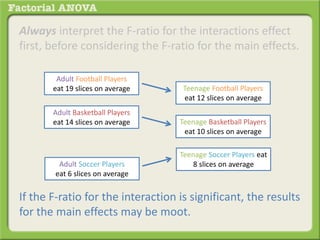
If the F-ratio for the interaction is significant, the results
for the main effects may be moot.
Adult Football Players
eat 19 slices on average
Adult Basketball Players
eat 14 slices on average
Teenage Football Players
eat 12 slices on average
Teenage Basketball Players
eat 10 slices on average
Adult Soccer Players
eat 6 slices on average
Teenage Soccer Players eat
8 slices on average
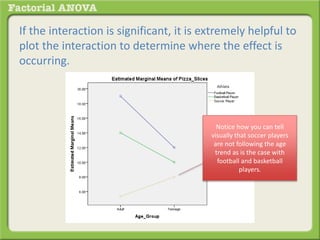
If the interaction is significant, it is extremely helpful to
plot the interaction to determine where the effect is
occurring.
If the interaction is significant, it is extremely helpful to
plot the interaction to determine where the effect is
occurring.
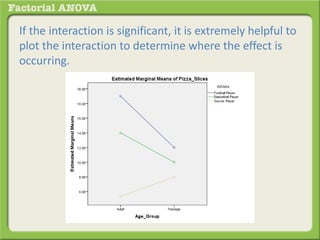
If the interaction is significant, it is extremely helpful to
plot the interaction to determine where the effect is
occurring.
Notice how you can tell
visually that soccer players
are not following the age
trend as is the case with
football and basketball
players.
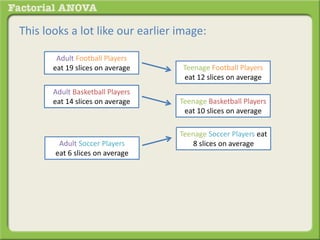
This looks a lot like our earlier image:
Adult Football Players
eat 19 slices on average
Adult Basketball Players
eat 14 slices on average
Teenage Football Players
eat 12 slices on average
Teenage Basketball Players
eat 10 slices on average
Adult Soccer Players
eat 6 slices on average
Teenage Soccer Players eat
8 slices on average
There are many possible combinations of effects that
can render a significant F-ratio for the interaction. In
our example, one of the 6 groups might respond very
differently than the others …
There are many possible combinations of effects that
can render a significant F-ratio for the interaction. In
our example, one of the 6 groups might respond very
differently than the others … or 2, or 3, or … it can be
very complex.
If the interaction is significant, it is the primary focus of
interpretation.
If the interaction is significant, it is the primary focus of
interpretation.
However, sometimes the main effects may be
significant and meaningful; even the presence of the
significant interaction. The plot will help you decide if it
is meaningful.
If the interaction is significant, it is the primary focus of
interpretation.
However, sometimes the main effects may be
significant and meaningful; even the presence of the
significant interaction. The plot will help you decide if it
is meaningful.
For example, if all players increase in pizza consumption
as they age but some increase much faster in than
others, both the interaction and the main effect for age
may be important.
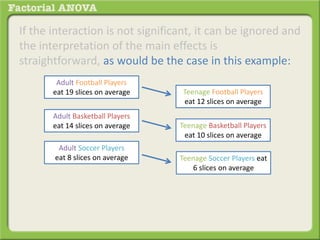
If the interaction is not significant, it can be ignored and
the interpretation of the main effects is
straightforward,
If the interaction is not significant, it can be ignored and
the interpretation of the main effects is
straightforward, as would be the case in this example:
If the interaction is not significant, it can be ignored and
the interpretation of the main effects is
straightforward, as would be the case in this example:
Adult Football Players
eat 19 slices on average
Adult Basketball Players
eat 14 slices on average
Teenage Football Players
eat 12 slices on average
Teenage Basketball Players
eat 10 slices on average
Adult Soccer Players
eat 8 slices on average Teenage Soccer Players eat
6 slices on average
You will now see how to calculate a Factorial ANOVA by
hand. Normally you will use a statistical software
package to do this calculation. That being said, it is
important to see what is going on behind the scenes.
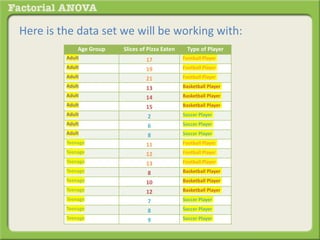
Here is the data set we will be working with:
Age Group Slices of Pizza Eaten Type of Player
Adult 17 Football Player
Adult 19 Football Player
Adult 21 Football Player
Adult 13 Basketball Player
Adult 14 Basketball Player
Adult 15 Basketball Player
Adult 2 Soccer Player
Adult 6 Soccer Player
Adult 8 Soccer Player
Teenage 11 Football Player
Teenage 12 Football Player
Teenage 13 Football Player
Teenage 8 Basketball Player
Teenage 10 Basketball Player
Teenage 12 Basketball Player
Teenage 7 Soccer Player
Teenage 8 Soccer Player
Teenage 9 Soccer Player
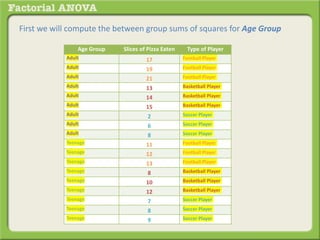
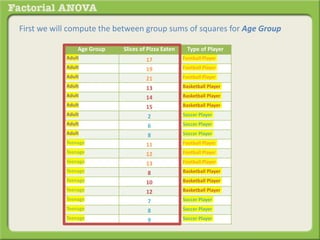
First we will compute the between group sums of squares for Age Group
Age Group Slices of Pizza Eaten Type of Player
Adult 17 Football Player
Adult 19 Football Player
Adult 21 Football Player
Adult 13 Basketball Player
Adult 14 Basketball Player
Adult 15 Basketball Player
Adult 2 Soccer Player
Adult 6 Soccer Player
Adult 8 Soccer Player
Teenage 11 Football Player
Teenage 12 Football Player
Teenage 13 Football Player
Teenage 8 Basketball Player
Teenage 10 Basketball Player
Teenage 12 Basketball Player
Teenage 7 Soccer Player
Teenage 8 Soccer Player
Teenage 9 Soccer Player
First we will compute the between group sums of squares for Age Group
Age Group Slices of Pizza Eaten Type of Player
Adult 17 Football Player
Adult 19 Football Player
Adult 21 Football Player
Adult 13 Basketball Player
Adult 14 Basketball Player
Adult 15 Basketball Player
Adult 2 Soccer Player
Adult 6 Soccer Player
Adult 8 Soccer Player
Teenage 11 Football Player
Teenage 12 Football Player
Teenage 13 Football Player
Teenage 8 Basketball Player
Teenage 10 Basketball Player
Teenage 12 Basketball Player
Teenage 7 Soccer Player
Teenage 8 Soccer Player
Teenage 9 Soccer Player
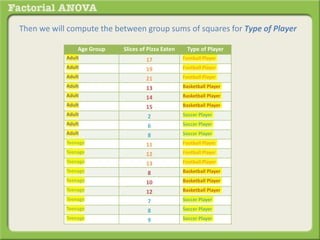
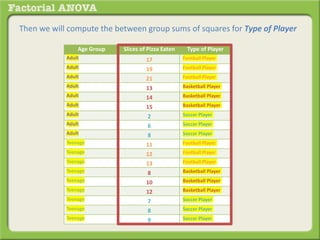
Then we will compute the between group sums of squares for Type of Player
Age Group Slices of Pizza Eaten Type of Player
Adult 17 Football Player
Adult 19 Football Player
Adult 21 Football Player
Adult 13 Basketball Player
Adult 14 Basketball Player
Adult 15 Basketball Player
Adult 2 Soccer Player
Adult 6 Soccer Player
Adult 8 Soccer Player
Teenage 11 Football Player
Teenage 12 Football Player
Teenage 13 Football Player
Teenage 8 Basketball Player
Teenage 10 Basketball Player
Teenage 12 Basketball Player
Teenage 7 Soccer Player
Teenage 8 Soccer Player
Teenage 9 Soccer Player
Then we will compute the between group sums of squares for Type of Player
Age Group Slices of Pizza Eaten Type of Player
Adult 17 Football Player
Adult 19 Football Player
Adult 21 Football Player
Adult 13 Basketball Player
Adult 14 Basketball Player
Adult 15 Basketball Player
Adult 2 Soccer Player
Adult 6 Soccer Player
Adult 8 Soccer Player
Teenage 11 Football Player
Teenage 12 Football Player
Teenage 13 Football Player
Teenage 8 Basketball Player
Teenage 10 Basketball Player
Teenage 12 Basketball Player
Teenage 7 Soccer Player
Teenage 8 Soccer Player
Teenage 9 Soccer Player
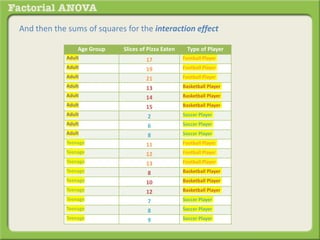
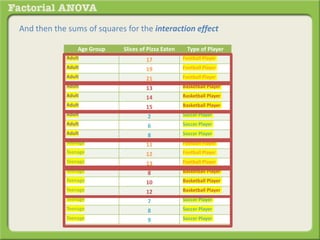
And then the sums of squares for the interaction effect
Age Group Slices of Pizza Eaten Type of Player
Adult 17 Football Player
Adult 19 Football Player
Adult 21 Football Player
Adult 13 Basketball Player
Adult 14 Basketball Player
Adult 15 Basketball Player
Adult 2 Soccer Player
Adult 6 Soccer Player
Adult 8 Soccer Player
Teenage 11 Football Player
Teenage 12 Football Player
Teenage 13 Football Player
Teenage 8 Basketball Player
Teenage 10 Basketball Player
Teenage 12 Basketball Player
Teenage 7 Soccer Player
Teenage 8 Soccer Player
Teenage 9 Soccer Player
And then the sums of squares for the interaction effect
Age Group Slices of Pizza Eaten Type of Player
Adult 17 Football Player
Adult 19 Football Player
Adult 21 Football Player
Adult 13 Basketball Player
Adult 14 Basketball Player
Adult 15 Basketball Player
Adult 2 Soccer Player
Adult 6 Soccer Player
Adult 8 Soccer Player
Teenage 11 Football Player
Teenage 12 Football Player
Teenage 13 Football Player
Teenage 8 Basketball Player
Teenage 10 Basketball Player
Teenage 12 Basketball Player
Teenage 7 Soccer Player
Teenage 8 Soccer Player
Teenage 9 Soccer Player
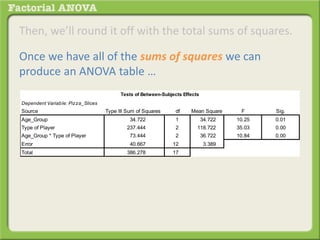
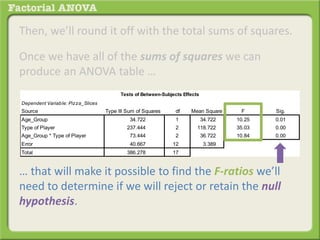
Then, we’ll round it off with the total sums of squares.
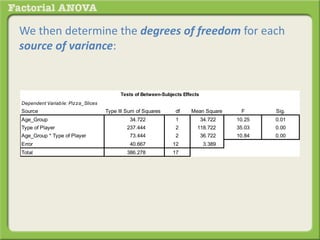
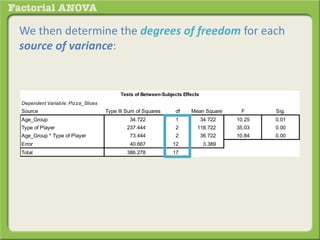
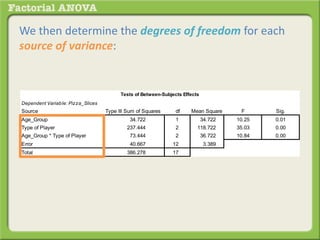
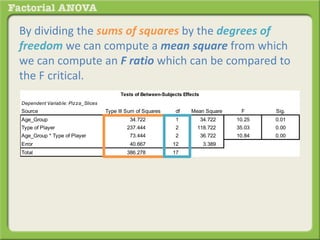
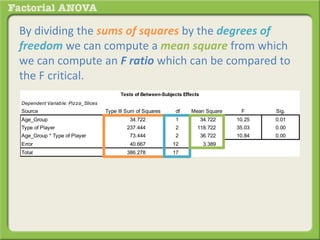
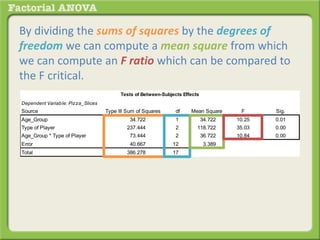
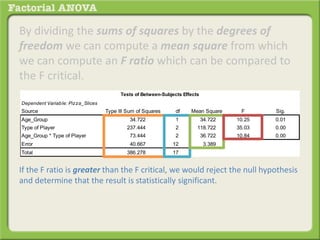
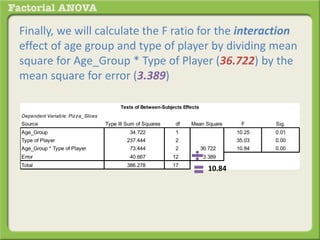
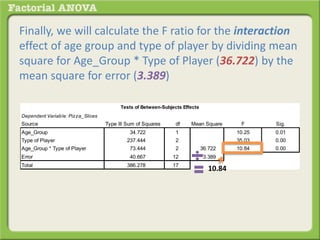
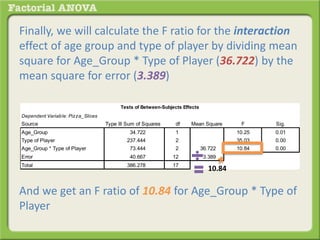
Once we have all of the sums of squares we can
produce an ANOVA table …
Then, we’ll round it off with the total sums of squares.
Once we have all of the sums of squares we can
produce an ANOVA table …
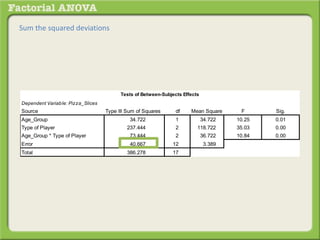
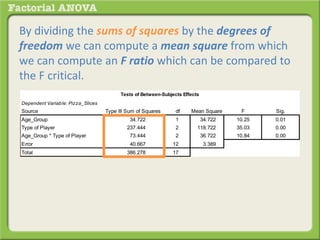
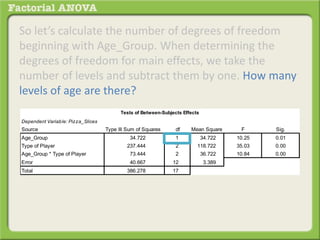
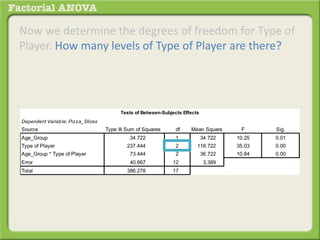
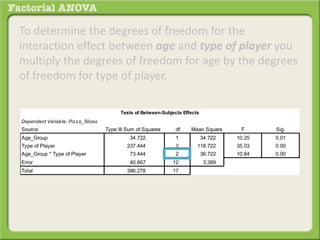
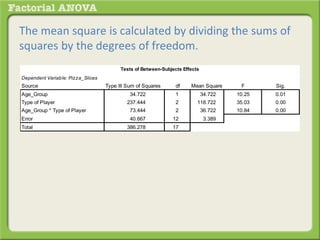
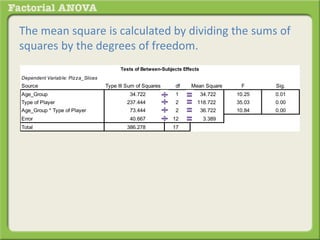
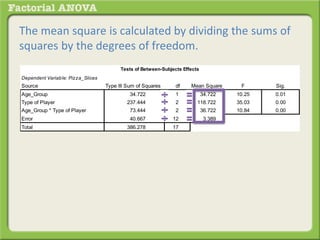
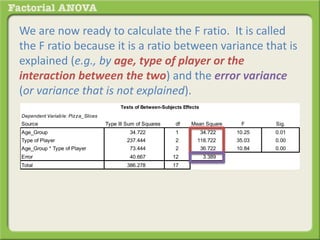
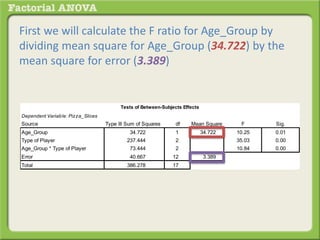
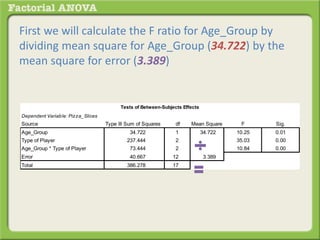
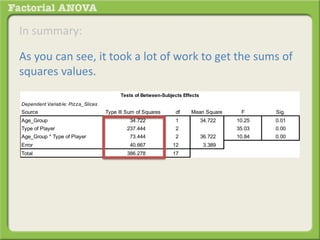
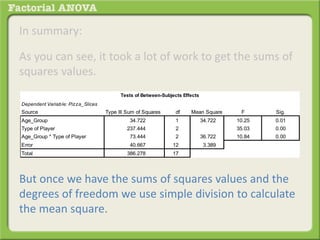
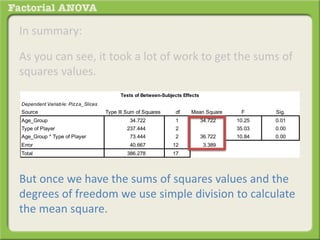
Dependent Variable: Pizza_Slices
Source Type III Sum of Squares df Mean Square F Sig.
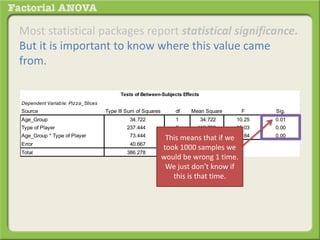
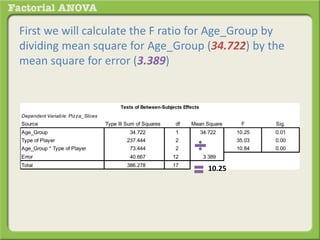
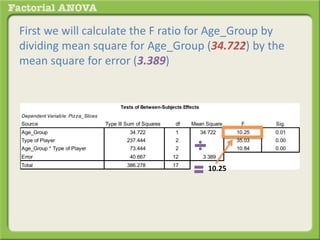
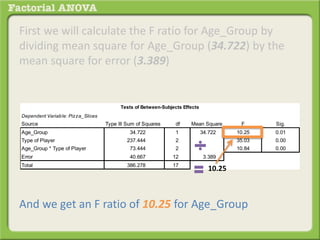
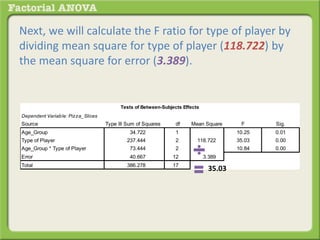
Age_Group 34.722 1 34.722 10.25 0.01
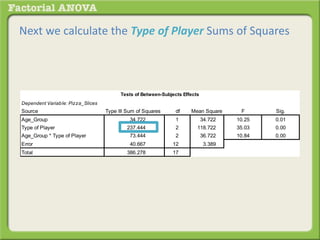
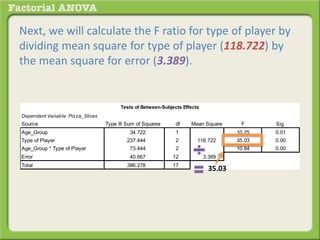
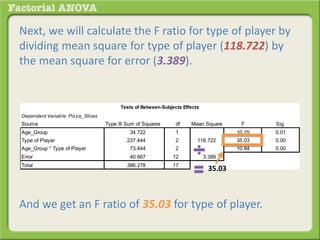
Type of Player 237.444 2 118.722 35.03 0.00
Age_Group * Type of Player 73.444 2 36.722 10.84 0.00
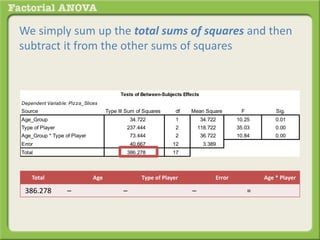
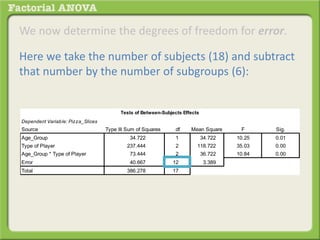
Error 40.667 12 3.389
Total 386.278 17
Tests of Between-Subjects Effects
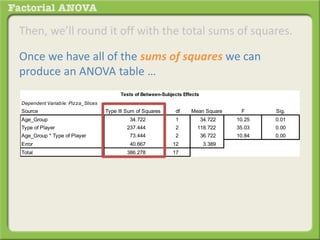
Then, we’ll round it off with the total sums of squares.
Once we have all of the sums of squares we can
produce an ANOVA table …
Dependent Variable: Pizza_Slices
Source Type III Sum of Squares df Mean Square F Sig.
Age_Group 34.722 1 34.722 10.25 0.01
Type of Player 237.444 2 118.722 35.03 0.00
Age_Group * Type of Player 73.444 2 36.722 10.84 0.00
Error 40.667 12 3.389
Total 386.278 17
Tests of Between-Subjects Effects
Then, we’ll round it off with the total sums of squares.
Once we have all of the sums of squares we can
produce an ANOVA table …
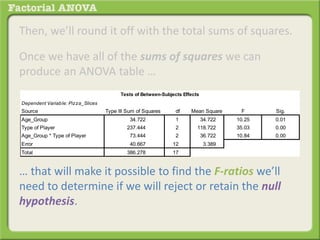
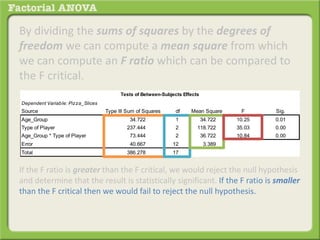
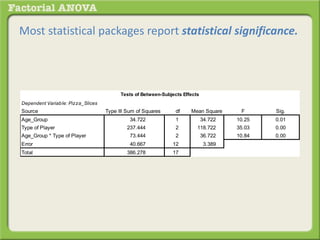
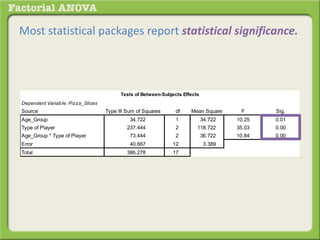
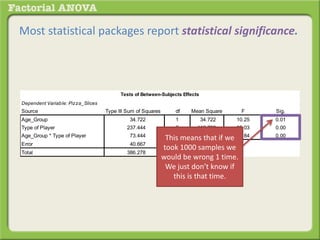
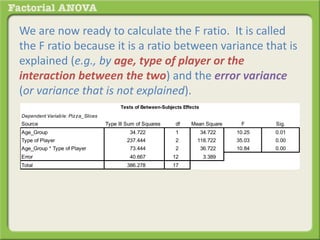
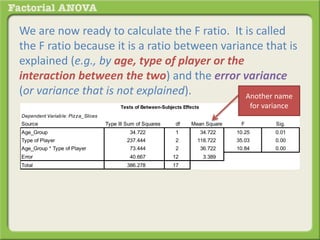
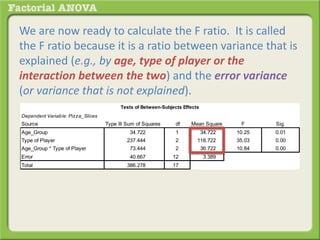
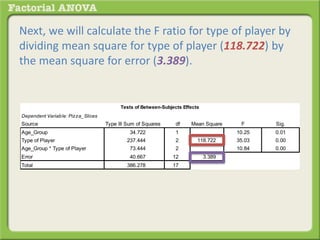
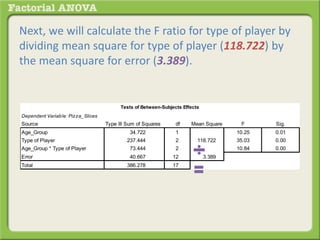
… that will make it possible to find the F-ratios we’ll
need to determine if we will reject or retain the null
hypothesis.
Dependent Variable: Pizza_Slices
Source Type III Sum of Squares df Mean Square F Sig.
Age_Group 34.722 1 34.722 10.25 0.01
Type of Player 237.444 2 118.722 35.03 0.00
Age_Group * Type of Player 73.444 2 36.722 10.84 0.00
Error 40.667 12 3.389
Total 386.278 17
Tests of Between-Subjects Effects
Then, we’ll round it off with the total sums of squares.
Once we have all of the sums of squares we can
produce an ANOVA table …
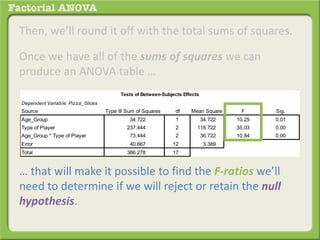
… that will make it possible to find the F-ratios we’ll
need to determine if we will reject or retain the null
hypothesis.
Dependent Variable: Pizza_Slices
Source Type III Sum of Squares df Mean Square F Sig.
Age_Group 34.722 1 34.722 10.25 0.01
Type of Player 237.444 2 118.722 35.03 0.00
Age_Group * Type of Player 73.444 2 36.722 10.84 0.00
Error 40.667 12 3.389
Total 386.278 17
Tests of Between-Subjects Effects
Then, we’ll round it off with the total sums of squares.
Once we have all of the sums of squares we can
produce an ANOVA table …
… that will make it possible to find the F-ratios we’ll
need to determine if we will reject or retain the null
hypothesis.
Dependent Variable: Pizza_Slices
Source Type III Sum of Squares df Mean Square F Sig.
Age_Group 34.722 1 34.722 10.25 0.01
Type of Player 237.444 2 118.722 35.03 0.00
Age_Group * Type of Player 73.444 2 36.722 10.84 0.00
Error 40.667 12 3.389
Total 386.278 17
Tests of Between-Subjects Effects
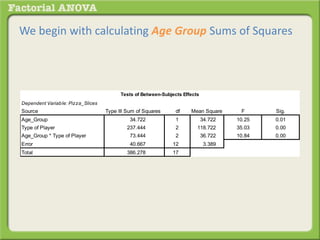
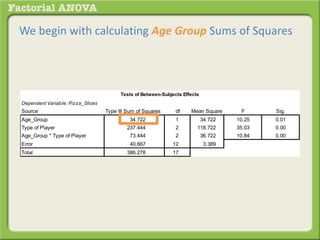
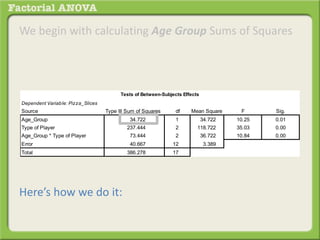
We begin with calculating Age Group Sums of Squares
Dependent Variable: Pizza_Slices
Source Type III Sum of Squares df Mean Square F Sig.
Age_Group 34.722 1 34.722 10.25 0.01
Type of Player 237.444 2 118.722 35.03 0.00
Age_Group * Type of Player 73.444 2 36.722 10.84 0.00
Error 40.667 12 3.389
Total 386.278 17
Tests of Between-Subjects Effects
We begin with calculating Age Group Sums of Squares
Dependent Variable: Pizza_Slices
Source Type III Sum of Squares df Mean Square F Sig.
Age_Group 34.722 1 34.722 10.25 0.01
Type of Player 237.444 2 118.722 35.03 0.00
Age_Group * Type of Player 73.444 2 36.722 10.84 0.00
Error 40.667 12 3.389
Total 386.278 17
Tests of Between-Subjects Effects
We begin with calculating Age Group Sums of Squares
Here’s how we do it:
Dependent Variable: Pizza_Slices
Source Type III Sum of Squares df Mean Square F Sig.
Age_Group 34.722 1 34.722 10.25 0.01
Type of Player 237.444 2 118.722 35.03 0.00
Age_Group * Type of Player 73.444 2 36.722 10.84 0.00
Error 40.667 12 3.389
Total 386.278 17
Tests of Between-Subjects Effects
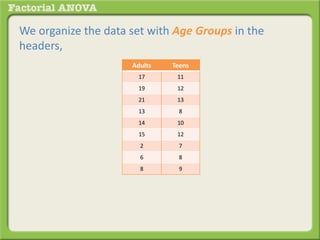
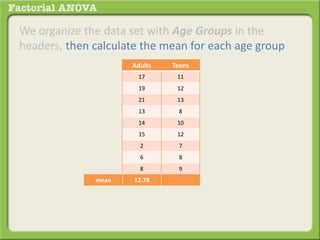
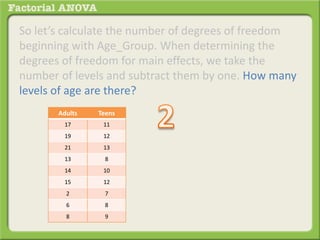
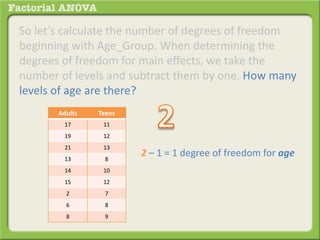
We organize the data set with Age Groups in the
headers,
We organize the data set with Age Groups in the
headers,
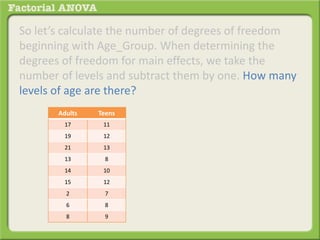
Adults Teens
17 11
19 12
21 13
13 8
14 10
15 12
2 7
6 8
8 9
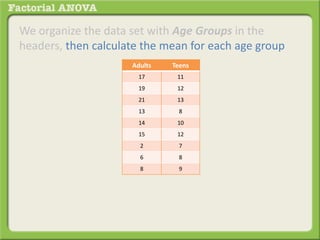
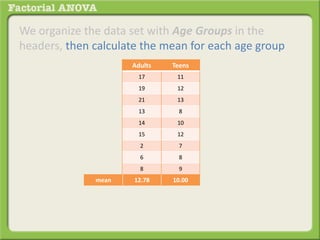
We organize the data set with Age Groups in the
headers, then calculate the mean for each age group
Adults Teens
17 11
19 12
21 13
13 8
14 10
15 12
2 7
6 8
8 9
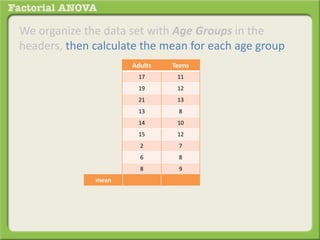
We organize the data set with Age Groups in the
headers, then calculate the mean for each age group
Adults Teens
17 11
19 12
21 13
13 8
14 10
15 12
2 7
6 8
8 9
mean
We organize the data set with Age Groups in the
headers, then calculate the mean for each age group
Adults Teens
17 11
19 12
21 13
13 8
14 10
15 12
2 7
6 8
8 9
mean 12.78
We organize the data set with Age Groups in the
headers, then calculate the mean for each age group
Adults Teens
17 11
19 12
21 13
13 8
14 10
15 12
2 7
6 8
8 9
mean 12.78 10.00
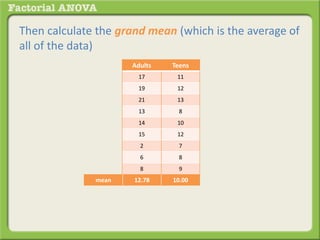
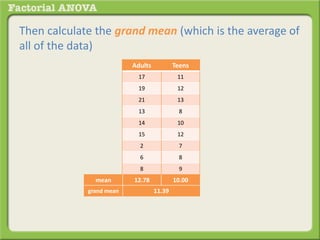
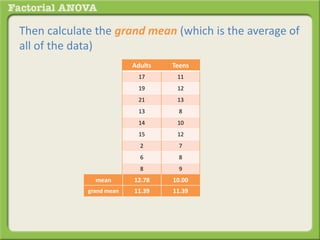
Then calculate the grand mean (which is the average of
all of the data)
Adults Teens
17 11
19 12
21 13
13 8
14 10
15 12
2 7
6 8
8 9
mean 12.78 10.00
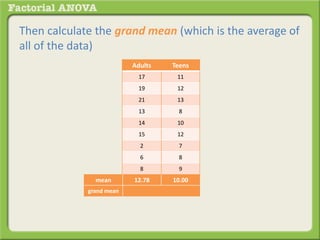
Then calculate the grand mean (which is the average of
all of the data)
Adults Teens
17 11
19 12
21 13
13 8
14 10
15 12
2 7
6 8
8 9
mean 12.78 10.00
grand mean
Then calculate the grand mean (which is the average of
all of the data)
Adults Teens
17 11
19 12
21 13
13 8
14 10
15 12
2 7
6 8
8 9
mean 12.78 10.00
grand mean 11.39
Then calculate the grand mean (which is the average of
all of the data)
Adults Teens
17 11
19 12
21 13
13 8
14 10
15 12
2 7
6 8
8 9
mean 12.78 10.00
grand mean 11.39 11.39
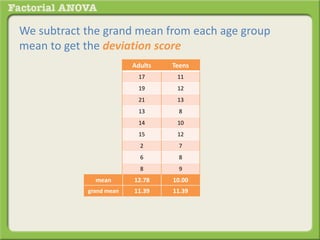
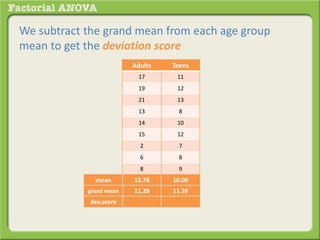
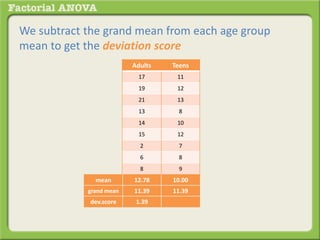
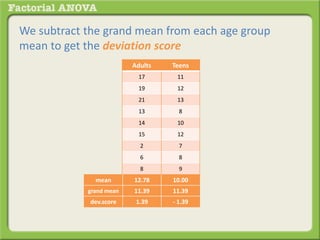
We subtract the grand mean from each age group
mean to get the deviation score
Adults Teens
17 11
19 12
21 13
13 8
14 10
15 12
2 7
6 8
8 9
mean 12.78 10.00
grand mean 11.39 11.39
We subtract the grand mean from each age group
mean to get the deviation score
Adults Teens
17 11
19 12
21 13
13 8
14 10
15 12
2 7
6 8
8 9
mean 12.78 10.00
grand mean 11.39 11.39
dev.score
We subtract the grand mean from each age group
mean to get the deviation score
Adults Teens
17 11
19 12
21 13
13 8
14 10
15 12
2 7
6 8
8 9
mean 12.78 10.00
grand mean 11.39 11.39
dev.score 1.39
We subtract the grand mean from each age group
mean to get the deviation score
Adults Teens
17 11
19 12
21 13
13 8
14 10
15 12
2 7
6 8
8 9
mean 12.78 10.00
grand mean 11.39 11.39
dev.score 1.39 - 1.39
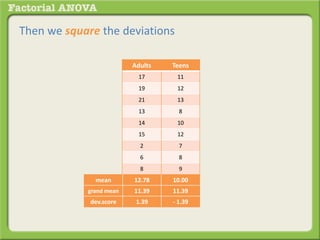
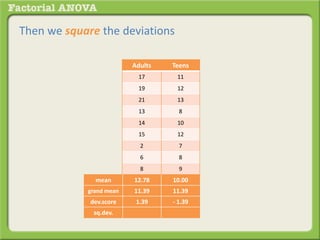
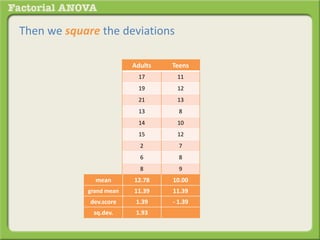
Then we square the deviations
Adults Teens
17 11
19 12
21 13
13 8
14 10
15 12
2 7
6 8
8 9
mean 12.78 10.00
grand mean 11.39 11.39
dev.score 1.39 - 1.39
Then we square the deviations
Adults Teens
17 11
19 12
21 13
13 8
14 10
15 12
2 7
6 8
8 9
mean 12.78 10.00
grand mean 11.39 11.39
dev.score 1.39 - 1.39
sq.dev.
Then we square the deviations
Adults Teens
17 11
19 12
21 13
13 8
14 10
15 12
2 7
6 8
8 9
mean 12.78 10.00
grand mean 11.39 11.39
dev.score 1.39 - 1.39
sq.dev. 1.93
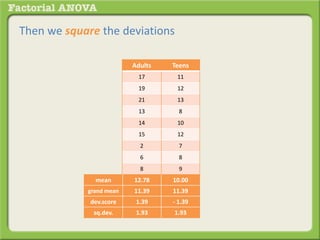
Then we square the deviations
Adults Teens
17 11
19 12
21 13
13 8
14 10
15 12
2 7
6 8
8 9
mean 12.78 10.00
grand mean 11.39 11.39
dev.score 1.39 - 1.39
sq.dev. 1.93 1.93
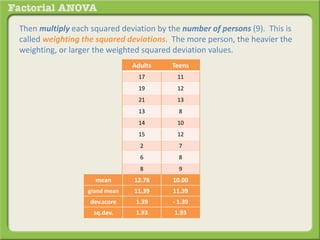
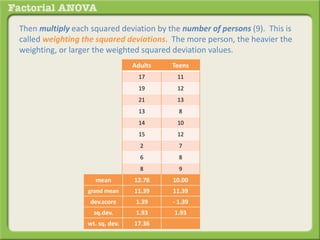
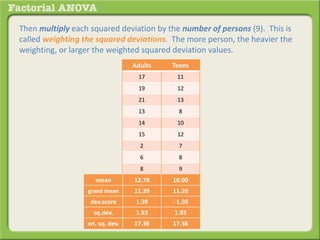
Then multiply each squared deviation by the number of persons (9). This is
called weighting the squared deviations. The more person, the heavier the
weighting, or larger the weighted squared deviation values.
Adults Teens
17 11
19 12
21 13
13 8
14 10
15 12
2 7
6 8
8 9
mean 12.78 10.00
grand mean 11.39 11.39
dev.score 1.39 - 1.39
sq.dev. 1.93 1.93
Then multiply each squared deviation by the number of persons (9). This is
called weighting the squared deviations. The more person, the heavier the
weighting, or larger the weighted squared deviation values.
Adults Teens
17 11
19 12
21 13
13 8
14 10
15 12
2 7
6 8
8 9
mean 12.78 10.00
grand mean 11.39 11.39
dev.score 1.39 - 1.39
sq.dev. 1.93 1.93
wt. sq. dev.
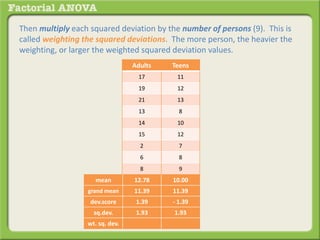
Then multiply each squared deviation by the number of persons (9). This is
called weighting the squared deviations. The more person, the heavier the
weighting, or larger the weighted squared deviation values.
Adults Teens
17 11
19 12
21 13
13 8
14 10
15 12
2 7
6 8
8 9
mean 12.78 10.00
grand mean 11.39 11.39
dev.score 1.39 - 1.39
sq.dev. 1.93 1.93
wt. sq. dev. 17.36
Then multiply each squared deviation by the number of persons (9). This is
called weighting the squared deviations. The more person, the heavier the
weighting, or larger the weighted squared deviation values.
Adults Teens
17 11
19 12
21 13
13 8
14 10
15 12
2 7
6 8
8 9
mean 12.78 10.00
grand mean 11.39 11.39
dev.score 1.39 - 1.39
sq.dev. 1.93 1.93
wt. sq. dev. 17.36 17.36
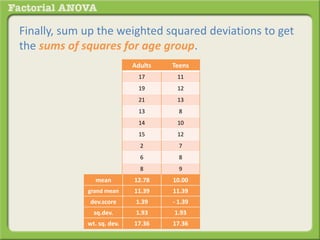
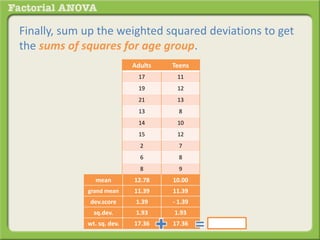
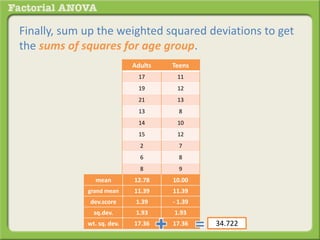
Finally, sum up the weighted squared deviations to get
the sums of squares for age group.
Adults Teens
17 11
19 12
21 13
13 8
14 10
15 12
2 7
6 8
8 9
mean 12.78 10.00
grand mean 11.39 11.39
dev.score 1.39 - 1.39
sq.dev. 1.93 1.93
wt. sq. dev. 17.36 17.36
Finally, sum up the weighted squared deviations to get
the sums of squares for age group.
Adults Teens
17 11
19 12
21 13
13 8
14 10
15 12
2 7
6 8
8 9
mean 12.78 10.00
grand mean 11.39 11.39
dev.score 1.39 - 1.39
sq.dev. 1.93 1.93
wt. sq. dev. 17.36 17.36
Finally, sum up the weighted squared deviations to get
the sums of squares for age group.
Adults Teens
17 11
19 12
21 13
13 8
14 10
15 12
2 7
6 8
8 9
mean 12.78 10.00
grand mean 11.39 11.39
dev.score 1.39 - 1.39
sq.dev. 1.93 1.93
wt. sq. dev. 17.36 17.36 34.722
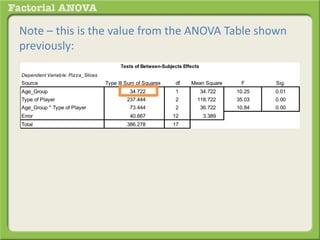
Note – this is the value from the ANOVA Table shown
previously:
Note – this is the value from the ANOVA Table shown
previously:
Dependent Variable: Pizza_Slices
Source Type III Sum of Squares df Mean Square F Sig.
Age_Group 34.722 1 34.722 10.25 0.01
Type of Player 237.444 2 118.722 35.03 0.00
Age_Group * Type of Player 73.444 2 36.722 10.84 0.00
Error 40.667 12 3.389
Total 386.278 17
Tests of Between-Subjects Effects
Next we calculate the Type of Player Sums of Squares
Dependent Variable: Pizza_Slices
Source Type III Sum of Squares df Mean Square F Sig.
Age_Group 34.722 1 34.722 10.25 0.01
Type of Player 237.444 2 118.722 35.03 0.00
Age_Group * Type of Player 73.444 2 36.722 10.84 0.00
Error 40.667 12 3.389
Total 386.278 17
Tests of Between-Subjects Effects
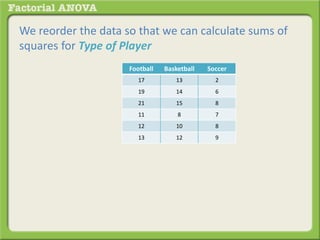
We reorder the data so that we can calculate sums of
squares for Type of Player
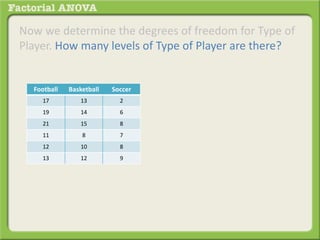
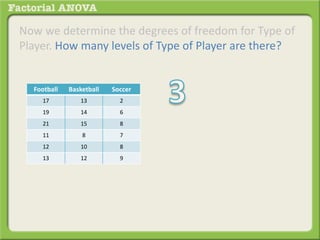
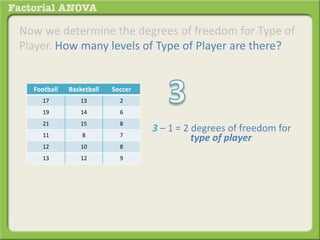
We reorder the data so that we can calculate sums of
squares for Type of Player
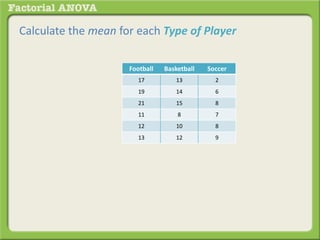
Football Basketball Soccer
17 13 2
19 14 6
21 15 8
11 8 7
12 10 8
13 12 9
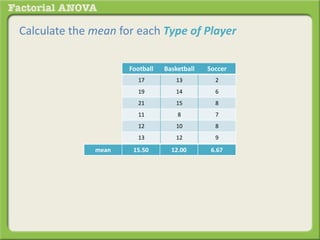
Calculate the mean for each Type of Player
Football Basketball Soccer
17 13 2
19 14 6
21 15 8
11 8 7
12 10 8
13 12 9
Calculate the mean for each Type of Player
Football Basketball Soccer
17 13 2
19 14 6
21 15 8
11 8 7
12 10 8
13 12 9
mean 15.50 12.00 6.67
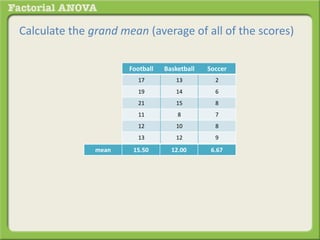
Calculate the grand mean (average of all of the scores)
Football Basketball Soccer
17 13 2
19 14 6
21 15 8
11 8 7
12 10 8
13 12 9
mean 15.50 12.00 6.67
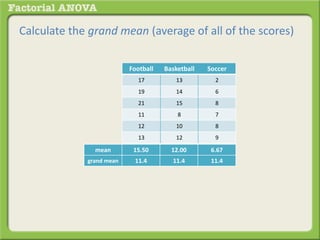
Calculate the grand mean (average of all of the scores)
Football Basketball Soccer
17 13 2
19 14 6
21 15 8
11 8 7
12 10 8
13 12 9
mean 15.50 12.00 6.67
grand mean 11.4 11.4 11.4
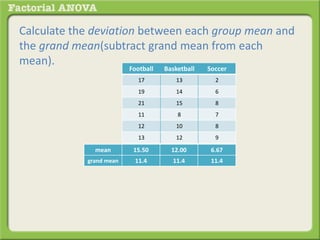
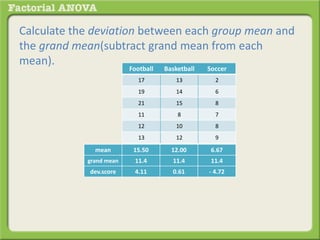
Calculate the deviation between each group mean and
the grand mean(subtract grand mean from each
mean).
Football Basketball Soccer
17 13 2
19 14 6
21 15 8
11 8 7
12 10 8
13 12 9
mean 15.50 12.00 6.67
grand mean 11.4 11.4 11.4
Calculate the deviation between each group mean and
the grand mean(subtract grand mean from each
mean).
Football Basketball Soccer
17 13 2
19 14 6
21 15 8
11 8 7
12 10 8
13 12 9
mean 15.50 12.00 6.67
grand mean 11.4 11.4 11.4
dev.score 4.11 0.61 - 4.72
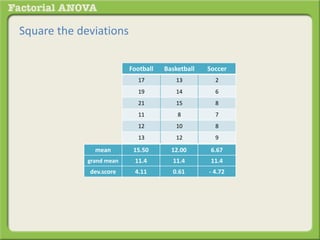
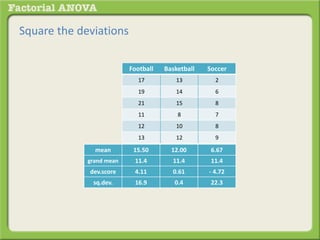
Square the deviations
Football Basketball Soccer
17 13 2
19 14 6
21 15 8
11 8 7
12 10 8
13 12 9
mean 15.50 12.00 6.67
grand mean 11.4 11.4 11.4
dev.score 4.11 0.61 - 4.72
Square the deviations
Football Basketball Soccer
17 13 2
19 14 6
21 15 8
11 8 7
12 10 8
13 12 9
mean 15.50 12.00 6.67
grand mean 11.4 11.4 11.4
dev.score 4.11 0.61 - 4.72
sq.dev. 16.9 0.4 22.3
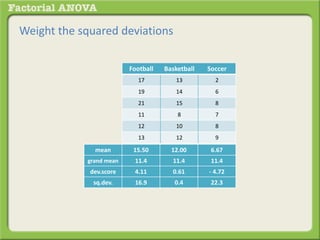
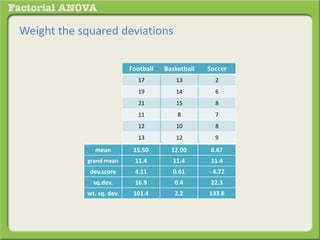
Weight the squared deviations
Football Basketball Soccer
17 13 2
19 14 6
21 15 8
11 8 7
12 10 8
13 12 9
mean 15.50 12.00 6.67
grand mean 11.4 11.4 11.4
dev.score 4.11 0.61 - 4.72
sq.dev. 16.9 0.4 22.3
Weight the squared deviations
Football Basketball Soccer
17 13 2
19 14 6
21 15 8
11 8 7
12 10 8
13 12 9
mean 15.50 12.00 6.67
grand mean 11.4 11.4 11.4
dev.score 4.11 0.61 - 4.72
sq.dev. 16.9 0.4 22.3
wt. sq. dev. 101.4 2.2 133.8
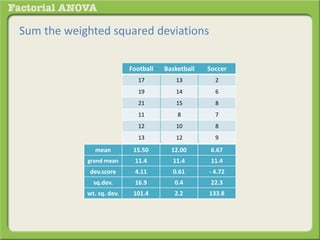
Sum the weighted squared deviations
Football Basketball Soccer
17 13 2
19 14 6
21 15 8
11 8 7
12 10 8
13 12 9
mean 15.50 12.00 6.67
grand mean 11.4 11.4 11.4
dev.score 4.11 0.61 - 4.72
sq.dev. 16.9 0.4 22.3
wt. sq. dev. 101.4 2.2 133.8
Sum the weighted squared deviations
Football Basketball Soccer
17 13 2
19 14 6
21 15 8
11 8 7
12 10 8
13 12 9
mean 15.50 12.00 6.67
grand mean 11.4 11.4 11.4
dev.score 4.11 0.61 - 4.72
sq.dev. 16.9 0.4 22.3
wt. sq. dev. 101.4 2.2 133.8
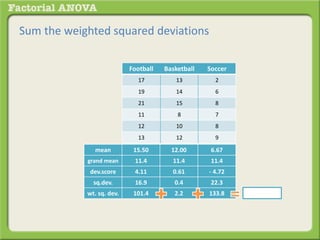
Sum the weighted squared deviations
Football Basketball Soccer
17 13 2
19 14 6
21 15 8
11 8 7
12 10 8
13 12 9
mean 15.50 12.00 6.67
grand mean 11.4 11.4 11.4
dev.score 4.11 0.61 - 4.72
sq.dev. 16.9 0.4 22.3
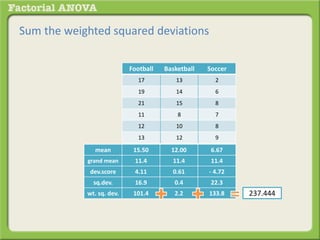
wt. sq. dev. 101.4 2.2 133.8 237.444
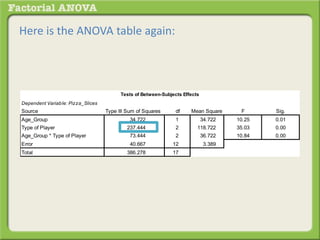
Here is the ANOVA table again:
Dependent Variable: Pizza_Slices
Source Type III Sum of Squares df Mean Square F Sig.
Age_Group 34.722 1 34.722 10.25 0.01
Type of Player 237.444 2 118.722 35.03 0.00
Age_Group * Type of Player 73.444 2 36.722 10.84 0.00
Error 40.667 12 3.389
Total 386.278 17
Tests of Between-Subjects Effects
Here is how we reorder the data to calculate the within
groups sums of squares
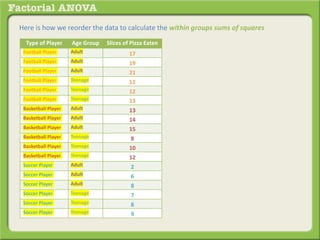
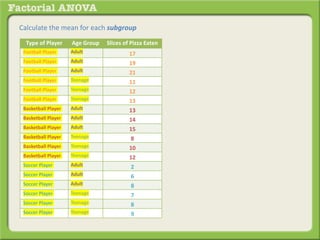
Here is how we reorder the data to calculate the within groups sums of squares
Type of Player Age Group Slices of Pizza Eaten
Football Player Adult 17
Football Player Adult 19
Football Player Adult 21
Football Player Teenage 11
Football Player Teenage 12
Football Player Teenage 13
Basketball Player Adult 13
Basketball Player Adult 14
Basketball Player Adult 15
Basketball Player Teenage 8
Basketball Player Teenage 10
Basketball Player Teenage 12
Soccer Player Adult 2
Soccer Player Adult 6
Soccer Player Adult 8
Soccer Player Teenage 7
Soccer Player Teenage 8
Soccer Player Teenage 9
Calculate the mean for each subgroup
Type of Player Age Group Slices of Pizza Eaten
Football Player Adult 17
Football Player Adult 19
Football Player Adult 21
Football Player Teenage 11
Football Player Teenage 12
Football Player Teenage 13
Basketball Player Adult 13
Basketball Player Adult 14
Basketball Player Adult 15
Basketball Player Teenage 8
Basketball Player Teenage 10
Basketball Player Teenage 12
Soccer Player Adult 2
Soccer Player Adult 6
Soccer Player Adult 8
Soccer Player Teenage 7
Soccer Player Teenage 8
Soccer Player Teenage 9
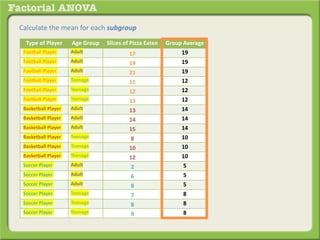
Calculate the mean for each subgroup
Type of Player Age Group Slices of Pizza Eaten Group Average
Football Player Adult 17 19
Football Player Adult 19 19
Football Player Adult 21 19
Football Player Teenage 11 12
Football Player Teenage 12 12
Football Player Teenage 13 12
Basketball Player Adult 13 14
Basketball Player Adult 14 14
Basketball Player Adult 15 14
Basketball Player Teenage 8 10
Basketball Player Teenage 10 10
Basketball Player Teenage 12 10
Soccer Player Adult 2 5
Soccer Player Adult 6 5
Soccer Player Adult 8 5
Soccer Player Teenage 7 8
Soccer Player Teenage 8 8
Soccer Player Teenage 9 8
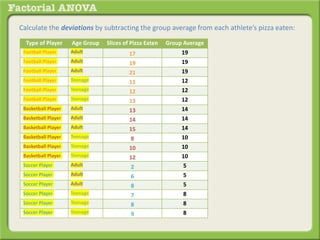
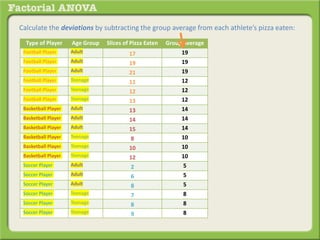
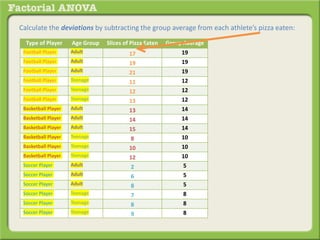
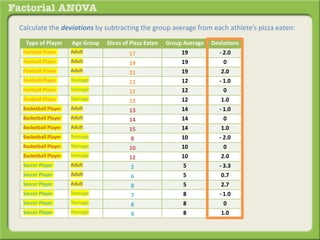
Calculate the deviations by subtracting the group average from each athlete’s pizza eaten:
Type of Player Age Group Slices of Pizza Eaten Group Average
Football Player Adult 17 19
Football Player Adult 19 19
Football Player Adult 21 19
Football Player Teenage 11 12
Football Player Teenage 12 12
Football Player Teenage 13 12
Basketball Player Adult 13 14
Basketball Player Adult 14 14
Basketball Player Adult 15 14
Basketball Player Teenage 8 10
Basketball Player Teenage 10 10
Basketball Player Teenage 12 10
Soccer Player Adult 2 5
Soccer Player Adult 6 5
Soccer Player Adult 8 5
Soccer Player Teenage 7 8
Soccer Player Teenage 8 8
Soccer Player Teenage 9 8
Calculate the deviations by subtracting the group average from each athlete’s pizza eaten:
Type of Player Age Group Slices of Pizza Eaten Group Average
Football Player Adult 17 19
Football Player Adult 19 19
Football Player Adult 21 19
Football Player Teenage 11 12
Football Player Teenage 12 12
Football Player Teenage 13 12
Basketball Player Adult 13 14
Basketball Player Adult 14 14
Basketball Player Adult 15 14
Basketball Player Teenage 8 10
Basketball Player Teenage 10 10
Basketball Player Teenage 12 10
Soccer Player Adult 2 5
Soccer Player Adult 6 5
Soccer Player Adult 8 5
Soccer Player Teenage 7 8
Soccer Player Teenage 8 8
Soccer Player Teenage 9 8
Calculate the deviations by subtracting the group average from each athlete’s pizza eaten:
Type of Player Age Group Slices of Pizza Eaten Group Average
Football Player Adult 17 19
Football Player Adult 19 19
Football Player Adult 21 19
Football Player Teenage 11 12
Football Player Teenage 12 12
Football Player Teenage 13 12
Basketball Player Adult 13 14
Basketball Player Adult 14 14
Basketball Player Adult 15 14
Basketball Player Teenage 8 10
Basketball Player Teenage 10 10
Basketball Player Teenage 12 10
Soccer Player Adult 2 5
Soccer Player Adult 6 5
Soccer Player Adult 8 5
Soccer Player Teenage 7 8
Soccer Player Teenage 8 8
Soccer Player Teenage 9 8
Calculate the deviations by subtracting the group average from each athlete’s pizza eaten:
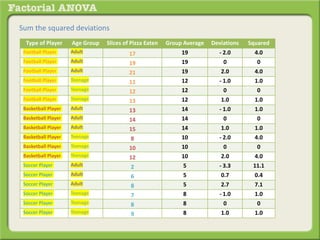
Type of Player Age Group Slices of Pizza Eaten Group Average Deviations
Football Player Adult 17 19 - 2.0
Football Player Adult 19 19 0
Football Player Adult 21 19 2.0
Football Player Teenage 11 12 - 1.0
Football Player Teenage 12 12 0
Football Player Teenage 13 12 1.0
Basketball Player Adult 13 14 - 1.0
Basketball Player Adult 14 14 0
Basketball Player Adult 15 14 1.0
Basketball Player Teenage 8 10 - 2.0
Basketball Player Teenage 10 10 0
Basketball Player Teenage 12 10 2.0
Soccer Player Adult 2 5 - 3.3
Soccer Player Adult 6 5 0.7
Soccer Player Adult 8 5 2.7
Soccer Player Teenage 7 8 - 1.0
Soccer Player Teenage 8 8 0
Soccer Player Teenage 9 8 1.0
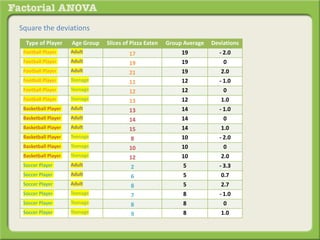
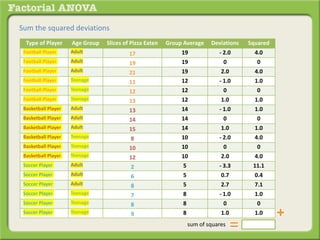
Square the deviations
Type of Player Age Group Slices of Pizza Eaten Group Average Deviations
Football Player Adult 17 19 - 2.0
Football Player Adult 19 19 0
Football Player Adult 21 19 2.0
Football Player Teenage 11 12 - 1.0
Football Player Teenage 12 12 0
Football Player Teenage 13 12 1.0
Basketball Player Adult 13 14 - 1.0
Basketball Player Adult 14 14 0
Basketball Player Adult 15 14 1.0
Basketball Player Teenage 8 10 - 2.0
Basketball Player Teenage 10 10 0
Basketball Player Teenage 12 10 2.0
Soccer Player Adult 2 5 - 3.3
Soccer Player Adult 6 5 0.7
Soccer Player Adult 8 5 2.7
Soccer Player Teenage 7 8 - 1.0
Soccer Player Teenage 8 8 0
Soccer Player Teenage 9 8 1.0
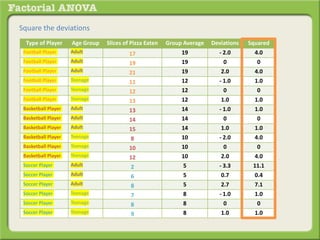
Square the deviations
Type of Player Age Group Slices of Pizza Eaten Group Average Deviations Squared
Football Player Adult 17 19 - 2.0 4.0
Football Player Adult 19 19 0 0
Football Player Adult 21 19 2.0 4.0
Football Player Teenage 11 12 - 1.0 1.0
Football Player Teenage 12 12 0 0
Football Player Teenage 13 12 1.0 1.0
Basketball Player Adult 13 14 - 1.0 1.0
Basketball Player Adult 14 14 0 0
Basketball Player Adult 15 14 1.0 1.0
Basketball Player Teenage 8 10 - 2.0 4.0
Basketball Player Teenage 10 10 0 0
Basketball Player Teenage 12 10 2.0 4.0
Soccer Player Adult 2 5 - 3.3 11.1
Soccer Player Adult 6 5 0.7 0.4
Soccer Player Adult 8 5 2.7 7.1
Soccer Player Teenage 7 8 - 1.0 1.0
Soccer Player Teenage 8 8 0 0
Soccer Player Teenage 9 8 1.0 1.0
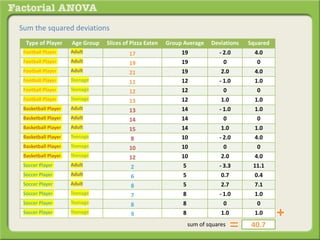
Sum the squared deviations
Type of Player Age Group Slices of Pizza Eaten Group Average Deviations Squared
Football Player Adult 17 19 - 2.0 4.0
Football Player Adult 19 19 0 0
Football Player Adult 21 19 2.0 4.0
Football Player Teenage 11 12 - 1.0 1.0
Football Player Teenage 12 12 0 0
Football Player Teenage 13 12 1.0 1.0
Basketball Player Adult 13 14 - 1.0 1.0
Basketball Player Adult 14 14 0 0
Basketball Player Adult 15 14 1.0 1.0
Basketball Player Teenage 8 10 - 2.0 4.0
Basketball Player Teenage 10 10 0 0
Basketball Player Teenage 12 10 2.0 4.0
Soccer Player Adult 2 5 - 3.3 11.1
Soccer Player Adult 6 5 0.7 0.4
Soccer Player Adult 8 5 2.7 7.1
Soccer Player Teenage 7 8 - 1.0 1.0
Soccer Player Teenage 8 8 0 0
Soccer Player Teenage 9 8 1.0 1.0
Sum the squared deviations
Type of Player Age Group Slices of Pizza Eaten Group Average Deviations Squared
Football Player Adult 17 19 - 2.0 4.0
Football Player Adult 19 19 0 0
Football Player Adult 21 19 2.0 4.0
Football Player Teenage 11 12 - 1.0 1.0
Football Player Teenage 12 12 0 0
Football Player Teenage 13 12 1.0 1.0
Basketball Player Adult 13 14 - 1.0 1.0
Basketball Player Adult 14 14 0 0
Basketball Player Adult 15 14 1.0 1.0
Basketball Player Teenage 8 10 - 2.0 4.0
Basketball Player Teenage 10 10 0 0
Basketball Player Teenage 12 10 2.0 4.0
Soccer Player Adult 2 5 - 3.3 11.1
Soccer Player Adult 6 5 0.7 0.4
Soccer Player Adult 8 5 2.7 7.1
Soccer Player Teenage 7 8 - 1.0 1.0
Soccer Player Teenage 8 8 0 0
Soccer Player Teenage 9 8 1.0 1.0
sum of squares
Sum the squared deviations
Type of Player Age Group Slices of Pizza Eaten Group Average Deviations Squared
Football Player Adult 17 19 - 2.0 4.0
Football Player Adult 19 19 0 0
Football Player Adult 21 19 2.0 4.0
Football Player Teenage 11 12 - 1.0 1.0
Football Player Teenage 12 12 0 0
Football Player Teenage 13 12 1.0 1.0
Basketball Player Adult 13 14 - 1.0 1.0
Basketball Player Adult 14 14 0 0
Basketball Player Adult 15 14 1.0 1.0
Basketball Player Teenage 8 10 - 2.0 4.0
Basketball Player Teenage 10 10 0 0
Basketball Player Teenage 12 10 2.0 4.0
Soccer Player Adult 2 5 - 3.3 11.1
Soccer Player Adult 6 5 0.7 0.4
Soccer Player Adult 8 5 2.7 7.1
Soccer Player Teenage 7 8 - 1.0 1.0
Soccer Player Teenage 8 8 0 0
Soccer Player Teenage 9 8 1.0 1.0
40.7sum of squares
Sum the squared deviations
Dependent Variable: Pizza_Slices
Source Type III Sum of Squares df Mean Square F Sig.
Age_Group 34.722 1 34.722 10.25 0.01
Type of Player 237.444 2 118.722 35.03 0.00
Age_Group * Type of Player 73.444 2 36.722 10.84 0.00
Error 40.667 12 3.389
Total 386.278 17
Tests of Between-Subjects Effects
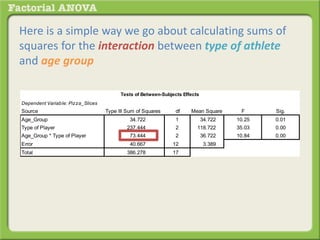
Here is a simple way we go about calculating sums of
squares for the interaction between type of athlete
and age group
Here is a simple way we go about calculating sums of
squares for the interaction between type of athlete
and age group
Dependent Variable: Pizza_Slices
Source Type III Sum of Squares df Mean Square F Sig.
Age_Group 34.722 1 34.722 10.25 0.01
Type of Player 237.444 2 118.722 35.03 0.00
Age_Group * Type of Player 73.444 2 36.722 10.84 0.00
Error 40.667 12 3.389
Total 386.278 17
Tests of Between-Subjects Effects
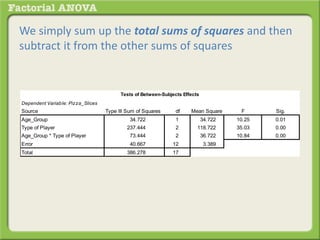
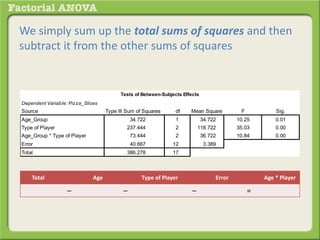
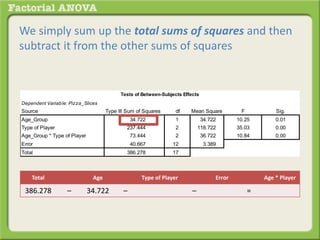
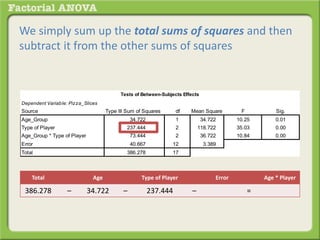
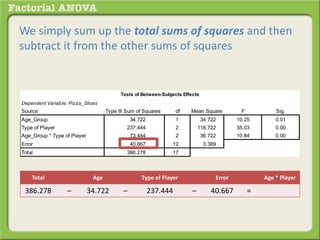
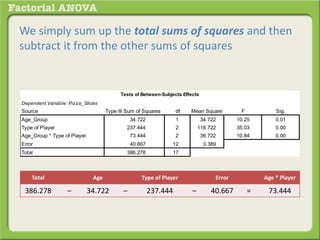
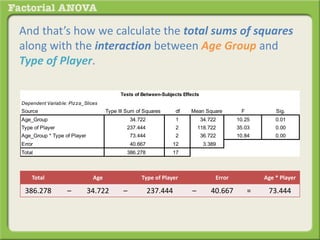
We simply sum up the total sums of squares and then
subtract it from the other sums of squares
Dependent Variable: Pizza_Slices
Source Type III Sum of Squares df Mean Square F Sig.
Age_Group 34.722 1 34.722 10.25 0.01
Type of Player 237.444 2 118.722 35.03 0.00
Age_Group * Type of Player 73.444 2 36.722 10.84 0.00
Error 40.667 12 3.389
Total 386.278 17
Tests of Between-Subjects Effects
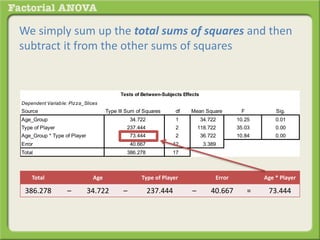
We simply sum up the total sums of squares and then
subtract it from the other sums of squares
Dependent Variable: Pizza_Slices
Source Type III Sum of Squares df Mean Square F Sig.
Age_Group 34.722 1 34.722 10.25 0.01
Type of Player 237.444 2 118.722 35.03 0.00
Age_Group * Type of Player 73.444 2 36.722 10.84 0.00
Error 40.667 12 3.389
Total 386.278 17
Tests of Between-Subjects Effects
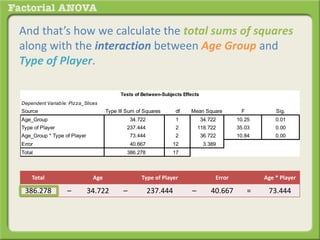
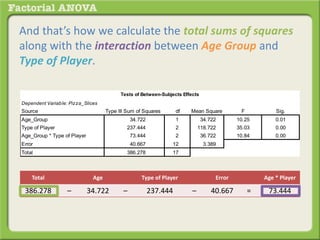
Total Age Type of Player Error Age * Player
– – – =
We simply sum up the total sums of squares and then
subtract it from the other sums of squares
Dependent Variable: Pizza_Slices
Source Type III Sum of Squares df Mean Square F Sig.
Age_Group 34.722 1 34.722 10.25 0.01
Type of Player 237.444 2 118.722 35.03 0.00
Age_Group * Type of Player 73.444 2 36.722 10.84 0.00
Error 40.667 12 3.389
Total 386.278 17
Tests of Between-Subjects Effects
Total Age Type of Player Error Age * Player
386.278 – – – =
We simply sum up the total sums of squares and then
subtract it from the other sums of squares
Dependent Variable: Pizza_Slices
Source Type III Sum of Squares df Mean Square F Sig.
Age_Group 34.722 1 34.722 10.25 0.01
Type of Player 237.444 2 118.722 35.03 0.00
Age_Group * Type of Player 73.444 2 36.722 10.84 0.00
Error 40.667 12 3.389
Total 386.278 17
Tests of Between-Subjects Effects
Total Age Type of Player Error Age * Player
386.278 – 34.722 – – =
We simply sum up the total sums of squares and then
subtract it from the other sums of squares
Dependent Variable: Pizza_Slices
Source Type III Sum of Squares df Mean Square F Sig.
Age_Group 34.722 1 34.722 10.25 0.01
Type of Player 237.444 2 118.722 35.03 0.00
Age_Group * Type of Player 73.444 2 36.722 10.84 0.00
Error 40.667 12 3.389
Total 386.278 17
Tests of Between-Subjects Effects
Total Age Type of Player Error Age * Player
386.278 – 34.722 – 237.444 – =
We simply sum up the total sums of squares and then
subtract it from the other sums of squares
Dependent Variable: Pizza_Slices
Source Type III Sum of Squares df Mean Square F Sig.
Age_Group 34.722 1 34.722 10.25 0.01
Type of Player 237.444 2 118.722 35.03 0.00
Age_Group * Type of Player 73.444 2 36.722 10.84 0.00
Error 40.667 12 3.389
Total 386.278 17
Tests of Between-Subjects Effects
Total Age Type of Player Error Age * Player
386.278 – 34.722 – 237.444 – 40.667 =
We simply sum up the total sums of squares and then
subtract it from the other sums of squares
Dependent Variable: Pizza_Slices
Source Type III Sum of Squares df Mean Square F Sig.
Age_Group 34.722 1 34.722 10.25 0.01
Type of Player 237.444 2 118.722 35.03 0.00
Age_Group * Type of Player 73.444 2 36.722 10.84 0.00
Error 40.667 12 3.389
Total 386.278 17
Tests of Between-Subjects Effects
Total Age Type of Player Error Age * Player
386.278 – 34.722 – 237.444 – 40.667 = 73.444
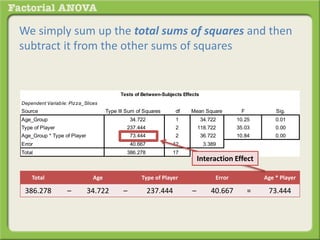
We simply sum up the total sums of squares and then
subtract it from the other sums of squares
Dependent Variable: Pizza_Slices
Source Type III Sum of Squares df Mean Square F Sig.
Age_Group 34.722 1 34.722 10.25 0.01
Type of Player 237.444 2 118.722 35.03 0.00
Age_Group * Type of Player 73.444 2 36.722 10.84 0.00
Error 40.667 12 3.389
Total 386.278 17
Tests of Between-Subjects Effects
Total Age Type of Player Error Age * Player
386.278 – 34.722 – 237.444 – 40.667 = 73.444
We simply sum up the total sums of squares and then
subtract it from the other sums of squares
Dependent Variable: Pizza_Slices
Source Type III Sum of Squares df Mean Square F Sig.
Age_Group 34.722 1 34.722 10.25 0.01
Type of Player 237.444 2 118.722 35.03 0.00
Age_Group * Type of Player 73.444 2 36.722 10.84 0.00
Error 40.667 12 3.389
Total 386.278 17
Tests of Between-Subjects Effects
Total Age Type of Player Error Age * Player
386.278 – 34.722 – 237.444 – 40.667 = 73.444
Interaction Effect
So here is how we calculate sums of squares:
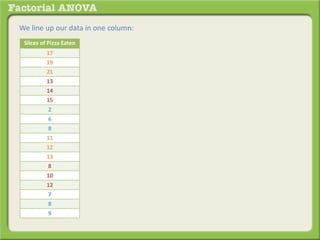
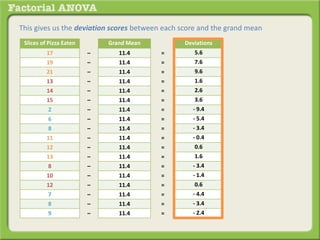
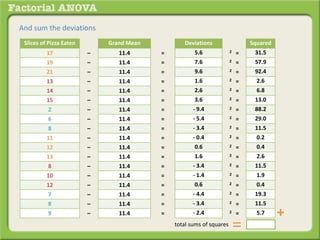
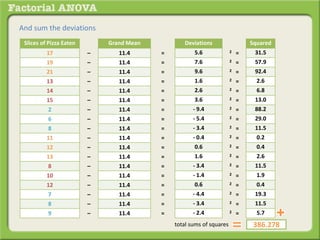
We line up our data in one column:
Slices of Pizza Eaten
17
19
21
13
14
15
2
6
8
11
12
13
8
10
12
7
8
9
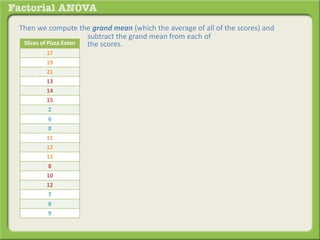
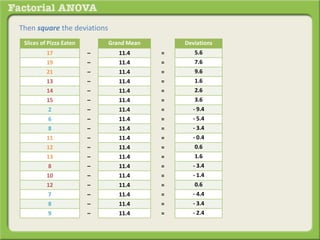
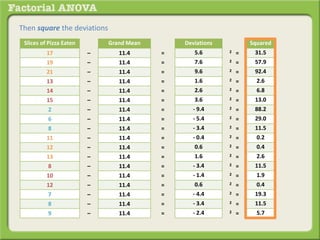
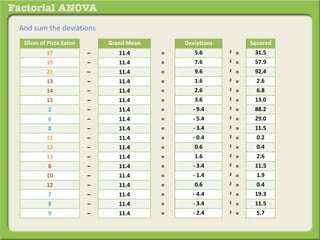
Then we compute the grand mean (which the average of all of the scores) and
subtract the grand mean from each of
the scores.Slices of Pizza Eaten
17
19
21
13
14
15
2
6
8
11
12
13
8
10
12
7
8
9
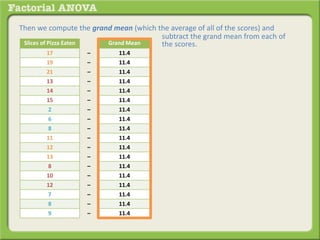
Then we compute the grand mean (which the average of all of the scores) and
subtract the grand mean from each of
the scores.Slices of Pizza Eaten Grand Mean
17 – 11.4
19 – 11.4
21 – 11.4
13 – 11.4
14 – 11.4
15 – 11.4
2 – 11.4
6 – 11.4
8 – 11.4
11 – 11.4
12 – 11.4
13 – 11.4
8 – 11.4
10 – 11.4
12 – 11.4
7 – 11.4
8 – 11.4
9 – 11.4
This gives us the deviation scores between each score and the grand mean
Slices of Pizza Eaten Grand Mean
17 – 11.4
19 – 11.4
21 – 11.4
13 – 11.4
14 – 11.4
15 – 11.4
2 – 11.4
6 – 11.4
8 – 11.4
11 – 11.4
12 – 11.4
13 – 11.4
8 – 11.4
10 – 11.4
12 – 11.4
7 – 11.4
8 – 11.4
9 – 11.4
This gives us the deviation scores between each score and the grand mean
Slices of Pizza Eaten Grand Mean Deviations
17 – 11.4 = 5.6
19 – 11.4 = 7.6
21 – 11.4 = 9.6
13 – 11.4 = 1.6
14 – 11.4 = 2.6
15 – 11.4 = 3.6
2 – 11.4 = - 9.4
6 – 11.4 = - 5.4
8 – 11.4 = - 3.4
11 – 11.4 = - 0.4
12 – 11.4 = 0.6
13 – 11.4 = 1.6
8 – 11.4 = - 3.4
10 – 11.4 = - 1.4
12 – 11.4 = 0.6
7 – 11.4 = - 4.4
8 – 11.4 = - 3.4
9 – 11.4 = - 2.4
Then square the deviations
Slices of Pizza Eaten Grand Mean Deviations
17 – 11.4 = 5.6
19 – 11.4 = 7.6
21 – 11.4 = 9.6
13 – 11.4 = 1.6
14 – 11.4 = 2.6
15 – 11.4 = 3.6
2 – 11.4 = - 9.4
6 – 11.4 = - 5.4
8 – 11.4 = - 3.4
11 – 11.4 = - 0.4
12 – 11.4 = 0.6
13 – 11.4 = 1.6
8 – 11.4 = - 3.4
10 – 11.4 = - 1.4
12 – 11.4 = 0.6
7 – 11.4 = - 4.4
8 – 11.4 = - 3.4
9 – 11.4 = - 2.4
Then square the deviations
Slices of Pizza Eaten Grand Mean Deviations Squared
17 – 11.4 = 5.6 2 = 31.5
19 – 11.4 = 7.6 2 = 57.9
21 – 11.4 = 9.6 2 = 92.4
13 – 11.4 = 1.6 2 = 2.6
14 – 11.4 = 2.6 2 = 6.8
15 – 11.4 = 3.6 2 = 13.0
2 – 11.4 = - 9.4 2 = 88.2
6 – 11.4 = - 5.4 2 = 29.0
8 – 11.4 = - 3.4 2 = 11.5
11 – 11.4 = - 0.4 2 = 0.2
12 – 11.4 = 0.6 2 = 0.4
13 – 11.4 = 1.6 2 = 2.6
8 – 11.4 = - 3.4 2 = 11.5
10 – 11.4 = - 1.4 2 = 1.9
12 – 11.4 = 0.6 2 = 0.4
7 – 11.4 = - 4.4 2 = 19.3
8 – 11.4 = - 3.4 2 = 11.5
9 – 11.4 = - 2.4 2 = 5.7
And sum the deviations
Slices of Pizza Eaten Grand Mean Deviations Squared
17 – 11.4 = 5.6 2 = 31.5
19 – 11.4 = 7.6 2 = 57.9
21 – 11.4 = 9.6 2 = 92.4
13 – 11.4 = 1.6 2 = 2.6
14 – 11.4 = 2.6 2 = 6.8
15 – 11.4 = 3.6 2 = 13.0
2 – 11.4 = - 9.4 2 = 88.2
6 – 11.4 = - 5.4 2 = 29.0
8 – 11.4 = - 3.4 2 = 11.5
11 – 11.4 = - 0.4 2 = 0.2
12 – 11.4 = 0.6 2 = 0.4
13 – 11.4 = 1.6 2 = 2.6
8 – 11.4 = - 3.4 2 = 11.5
10 – 11.4 = - 1.4 2 = 1.9
12 – 11.4 = 0.6 2 = 0.4
7 – 11.4 = - 4.4 2 = 19.3
8 – 11.4 = - 3.4 2 = 11.5
9 – 11.4 = - 2.4 2 = 5.7
And sum the deviations
Slices of Pizza Eaten Grand Mean Deviations Squared
17 – 11.4 = 5.6 2 = 31.5
19 – 11.4 = 7.6 2 = 57.9
21 – 11.4 = 9.6 2 = 92.4
13 – 11.4 = 1.6 2 = 2.6
14 – 11.4 = 2.6 2 = 6.8
15 – 11.4 = 3.6 2 = 13.0
2 – 11.4 = - 9.4 2 = 88.2
6 – 11.4 = - 5.4 2 = 29.0
8 – 11.4 = - 3.4 2 = 11.5
11 – 11.4 = - 0.4 2 = 0.2
12 – 11.4 = 0.6 2 = 0.4
13 – 11.4 = 1.6 2 = 2.6
8 – 11.4 = - 3.4 2 = 11.5
10 – 11.4 = - 1.4 2 = 1.9
12 – 11.4 = 0.6 2 = 0.4
7 – 11.4 = - 4.4 2 = 19.3
8 – 11.4 = - 3.4 2 = 11.5
9 – 11.4 = - 2.4 2 = 5.7
total sums of squares
And sum the deviations
Slices of Pizza Eaten Grand Mean Deviations Squared
17 – 11.4 = 5.6 2 = 31.5
19 – 11.4 = 7.6 2 = 57.9
21 – 11.4 = 9.6 2 = 92.4
13 – 11.4 = 1.6 2 = 2.6
14 – 11.4 = 2.6 2 = 6.8
15 – 11.4 = 3.6 2 = 13.0
2 – 11.4 = - 9.4 2 = 88.2
6 – 11.4 = - 5.4 2 = 29.0
8 – 11.4 = - 3.4 2 = 11.5
11 – 11.4 = - 0.4 2 = 0.2
12 – 11.4 = 0.6 2 = 0.4
13 – 11.4 = 1.6 2 = 2.6
8 – 11.4 = - 3.4 2 = 11.5
10 – 11.4 = - 1.4 2 = 1.9
12 – 11.4 = 0.6 2 = 0.4
7 – 11.4 = - 4.4 2 = 19.3
8 – 11.4 = - 3.4 2 = 11.5
9 – 11.4 = - 2.4 2 = 5.7
386.278total sums of squares
And that’s how we calculate the total sums of squares
along with the interaction between Age Group and
Type of Player.
And that’s how we calculate the total sums of squares
along with the interaction between Age Group and
Type of Player.
Dependent Variable: Pizza_Slices
Source Type III Sum of Squares df Mean Square F Sig.
Age_Group 34.722 1 34.722 10.25 0.01
Type of Player 237.444 2 118.722 35.03 0.00
Age_Group * Type of Player 73.444 2 36.722 10.84 0.00
Error 40.667 12 3.389
Total 386.278 17
Tests of Between-Subjects Effects
Total Age Type of Player Error Age * Player
386.278 – 34.722 – 237.444 – 40.667 = 73.444
And that’s how we calculate the total sums of squares
along with the interaction between Age Group and
Type of Player.
Dependent Variable: Pizza_Slices
Source Type III Sum of Squares df Mean Square F Sig.
Age_Group 34.722 1 34.722 10.25 0.01
Type of Player 237.444 2 118.722 35.03 0.00
Age_Group * Type of Player 73.444 2 36.722 10.84 0.00
Error 40.667 12 3.389
Total 386.278 17
Tests of Between-Subjects Effects
Total Age Type of Player Error Age * Player
386.278 – 34.722 – 237.444 – 40.667 = 73.444
And that’s how we calculate the total sums of squares
along with the interaction between Age Group and
Type of Player.
Dependent Variable: Pizza_Slices
Source Type III Sum of Squares df Mean Square F Sig.
Age_Group 34.722 1 34.722 10.25 0.01
Type of Player 237.444 2 118.722 35.03 0.00
Age_Group * Type of Player 73.444 2 36.722 10.84 0.00
Error 40.667 12 3.389
Total 386.278 17
Tests of Between-Subjects Effects
Total Age Type of Player Error Age * Player
386.278 – 34.722 – 237.444 – 40.667 = 73.444
We then determine the degrees of freedom for each
source of variance:
Dependent Variable: Pizza_Slices
Source Type III Sum of Squares df Mean Square F Sig.
Age_Group 34.722 1 34.722 10.25 0.01
Type of Player 237.444 2 118.722 35.03 0.00
Age_Group * Type of Player 73.444 2 36.722 10.84 0.00
Error 40.667 12 3.389
Total 386.278 17
Tests of Between-Subjects Effects
We then determine the degrees of freedom for each
source of variance:
Dependent Variable: Pizza_Slices
Source Type III Sum of Squares df Mean Square F Sig.
Age_Group 34.722 1 34.722 10.25 0.01
Type of Player 237.444 2 118.722 35.03 0.00
Age_Group * Type of Player 73.444 2 36.722 10.84 0.00
Error 40.667 12 3.389
Total 386.278 17
Tests of Between-Subjects Effects
We then determine the degrees of freedom for each
source of variance:
Dependent Variable: Pizza_Slices
Source Type III Sum of Squares df Mean Square F Sig.
Age_Group 34.722 1 34.722 10.25 0.01
Type of Player 237.444 2 118.722 35.03 0.00
Age_Group * Type of Player 73.444 2 36.722 10.84 0.00
Error 40.667 12 3.389
Total 386.278 17
Tests of Between-Subjects Effects
Why do we need to determine the degrees of
freedom?
Why do we need to determine the degrees of
freedom? Because this will make it possible to test our
three null hypotheses:
Why do we need to determine the degrees of
freedom? Because this will make it possible to test our
three null hypotheses:
• Main effect for Age Group: There is NO significant difference
between the amount of pizza slices eaten by adults and
teenagers in one sitting.
Why do we need to determine the degrees of
freedom? Because this will make it possible to test our
three null hypotheses:
• Main effect for Age Group: There is NO significant difference
between the amount of pizza slices eaten by adults and
teenagers in one sitting.
• Main effect for Type of Player: There is NO significant
difference between the amount of pizza slices eaten by
football, basketball, and soccer players in one sitting.
Why do we need to determine the degrees of
freedom? Because this will make it possible to test our
three null hypotheses:
• Main effect for Age Group: There is NO significant difference
between the amount of pizza slices eaten by adults and
teenagers in one sitting.
• Main effect for Type of Player: There is NO significant
difference between the amount of pizza slices eaten by
football, basketball, and soccer players in one sitting.
• Interaction effect between Age Group and Type of Athlete:
There is NO significant interaction between the amount of
pizza slices eaten by football, basketball, and soccer players
in one sitting.
By dividing the sums of squares by the degrees of
freedom we can compute a mean square from which
we can compute an F ratio which can be compared to
the F critical.
By dividing the sums of squares by the degrees of
freedom we can compute a mean square from which
we can compute an F ratio which can be compared to
the F critical.
Dependent Variable: Pizza_Slices
Source Type III Sum of Squares df Mean Square F Sig.
Age_Group 34.722 1 34.722 10.25 0.01
Type of Player 237.444 2 118.722 35.03 0.00
Age_Group * Type of Player 73.444 2 36.722 10.84 0.00
Error 40.667 12 3.389
Total 386.278 17
Tests of Between-Subjects Effects
By dividing the sums of squares by the degrees of
freedom we can compute a mean square from which
we can compute an F ratio which can be compared to
the F critical.
Dependent Variable: Pizza_Slices
Source Type III Sum of Squares df Mean Square F Sig.
Age_Group 34.722 1 34.722 10.25 0.01
Type of Player 237.444 2 118.722 35.03 0.00
Age_Group * Type of Player 73.444 2 36.722 10.84 0.00
Error 40.667 12 3.389
Total 386.278 17
Tests of Between-Subjects Effects
By dividing the sums of squares by the degrees of
freedom we can compute a mean square from which
we can compute an F ratio which can be compared to
the F critical.
Dependent Variable: Pizza_Slices
Source Type III Sum of Squares df Mean Square F Sig.
Age_Group 34.722 1 34.722 10.25 0.01
Type of Player 237.444 2 118.722 35.03 0.00
Age_Group * Type of Player 73.444 2 36.722 10.84 0.00
Error 40.667 12 3.389
Total 386.278 17
Tests of Between-Subjects Effects
By dividing the sums of squares by the degrees of
freedom we can compute a mean square from which
we can compute an F ratio which can be compared to
the F critical.
Dependent Variable: Pizza_Slices
Source Type III Sum of Squares df Mean Square F Sig.
Age_Group 34.722 1 34.722 10.25 0.01
Type of Player 237.444 2 118.722 35.03 0.00
Age_Group * Type of Player 73.444 2 36.722 10.84 0.00
Error 40.667 12 3.389
Total 386.278 17
Tests of Between-Subjects Effects
By dividing the sums of squares by the degrees of
freedom we can compute a mean square from which
we can compute an F ratio which can be compared to
the F critical.
If the F ratio is greater than the F critical, we would reject the null hypothesis
and determine that the result is statistically significant.
Dependent Variable: Pizza_Slices
Source Type III Sum of Squares df Mean Square F Sig.
Age_Group 34.722 1 34.722 10.25 0.01
Type of Player 237.444 2 118.722 35.03 0.00
Age_Group * Type of Player 73.444 2 36.722 10.84 0.00
Error 40.667 12 3.389
Total 386.278 17
Tests of Between-Subjects Effects
By dividing the sums of squares by the degrees of
freedom we can compute a mean square from which
we can compute an F ratio which can be compared to
the F critical.
If the F ratio is greater than the F critical, we would reject the null hypothesis
and determine that the result is statistically significant. If the F ratio is smaller
than the F critical then we would fail to reject the null hypothesis.
Dependent Variable: Pizza_Slices
Source Type III Sum of Squares df Mean Square F Sig.
Age_Group 34.722 1 34.722 10.25 0.01
Type of Player 237.444 2 118.722 35.03 0.00
Age_Group * Type of Player 73.444 2 36.722 10.84 0.00
Error 40.667 12 3.389
Total 386.278 17
Tests of Between-Subjects Effects
Most statistical packages report statistical significance.
Dependent Variable: Pizza_Slices
Source Type III Sum of Squares df Mean Square F Sig.
Age_Group 34.722 1 34.722 10.25 0.01
Type of Player 237.444 2 118.722 35.03 0.00
Age_Group * Type of Player 73.444 2 36.722 10.84 0.00
Error 40.667 12 3.389
Total 386.278 17
Tests of Between-Subjects Effects
Most statistical packages report statistical significance.
Dependent Variable: Pizza_Slices
Source Type III Sum of Squares df Mean Square F Sig.
Age_Group 34.722 1 34.722 10.25 0.01
Type of Player 237.444 2 118.722 35.03 0.00
Age_Group * Type of Player 73.444 2 36.722 10.84 0.00
Error 40.667 12 3.389
Total 386.278 17
Tests of Between-Subjects Effects
Most statistical packages report statistical significance.
Dependent Variable: Pizza_Slices
Source Type III Sum of Squares df Mean Square F Sig.
Age_Group 34.722 1 34.722 10.25 0.01
Type of Player 237.444 2 118.722 35.03 0.00
Age_Group * Type of Player 73.444 2 36.722 10.84 0.00
Error 40.667 12 3.389
Total 386.278 17
Tests of Between-Subjects Effects
This means that if we
took 1000 samples we
would be wrong 1 time.
We just don’t know if
this is that time.
Most statistical packages report statistical significance.
But it is important to know where this value came
from.
Dependent Variable: Pizza_Slices
Source Type III Sum of Squares df Mean Square F Sig.
Age_Group 34.722 1 34.722 10.25 0.01
Type of Player 237.444 2 118.722 35.03 0.00
Age_Group * Type of Player 73.444 2 36.722 10.84 0.00
Error 40.667 12 3.389
Total 386.278 17
Tests of Between-Subjects Effects
This means that if we
took 1000 samples we
would be wrong 1 time.
We just don’t know if
this is that time.
So let’s calculate the number of degrees of freedom
beginning with Age_Group.
So let’s calculate the number of degrees of freedom
beginning with Age_Group. When determining the
degrees of freedom for main effects, we take the
number of levels and subtract them by one.
So let’s calculate the number of degrees of freedom
beginning with Age_Group. When determining the
degrees of freedom for main effects, we take the
number of levels and subtract them by one. How many
levels of age are there?
So let’s calculate the number of degrees of freedom
beginning with Age_Group. When determining the
degrees of freedom for main effects, we take the
number of levels and subtract them by one. How many
levels of age are there?
Adults Teens
17 11
19 12
21 13
13 8
14 10
15 12
2 7
6 8
8 9
So let’s calculate the number of degrees of freedom
beginning with Age_Group. When determining the
degrees of freedom for main effects, we take the
number of levels and subtract them by one. How many
levels of age are there?
Adults Teens
17 11
19 12
21 13
13 8
14 10
15 12
2 7
6 8
8 9
So let’s calculate the number of degrees of freedom
beginning with Age_Group. When determining the
degrees of freedom for main effects, we take the
number of levels and subtract them by one. How many
levels of age are there?
Adults Teens
17 11
19 12
21 13
13 8
14 10
15 12
2 7
6 8
8 9
2 – 1 = 1 degree of freedom for age
So let’s calculate the number of degrees of freedom
beginning with Age_Group. When determining the
degrees of freedom for main effects, we take the
number of levels and subtract them by one. How many
levels of age are there?
Dependent Variable: Pizza_Slices
Source Type III Sum of Squares df Mean Square F Sig.
Age_Group 34.722 1 34.722 10.25 0.01
Type of Player 237.444 2 118.722 35.03 0.00
Age_Group * Type of Player 73.444 2 36.722 10.84 0.00
Error 40.667 12 3.389
Total 386.278 17
Tests of Between-Subjects Effects
Now we determine the degrees of freedom for Type of
Player.
Now we determine the degrees of freedom for Type of
Player. How many levels of Type of Player are there?
Now we determine the degrees of freedom for Type of
Player. How many levels of Type of Player are there?
Football Basketball Soccer
17 13 2
19 14 6
21 15 8
11 8 7
12 10 8
13 12 9
Now we determine the degrees of freedom for Type of
Player. How many levels of Type of Player are there?
Football Basketball Soccer
17 13 2
19 14 6
21 15 8
11 8 7
12 10 8
13 12 9
Now we determine the degrees of freedom for Type of
Player. How many levels of Type of Player are there?
Football Basketball Soccer
17 13 2
19 14 6
21 15 8
11 8 7
12 10 8
13 12 9
3 – 1 = 2 degrees of freedom for
type of player
Now we determine the degrees of freedom for Type of
Player. How many levels of Type of Player are there?
Dependent Variable: Pizza_Slices
Source Type III Sum of Squares df Mean Square F Sig.
Age_Group 34.722 1 34.722 10.25 0.01
Type of Player 237.444 2 118.722 35.03 0.00
Age_Group * Type of Player 73.444 2 36.722 10.84 0.00
Error 40.667 12 3.389
Total 386.278 17
Tests of Between-Subjects Effects
To determine the degrees of freedom for the
interaction effect between age and type of player you
multiply the degrees of freedom for age by the degrees
of freedom for type of player.
To determine the degrees of freedom for the
interaction effect between age and type of player you
multiply the degrees of freedom for age by the degrees
of freedom for type of player.
1 * 2 = 2 degrees of freedom for
interaction effect
To determine the degrees of freedom for the
interaction effect between age and type of player you
multiply the degrees of freedom for age by the degrees
of freedom for type of player.
Dependent Variable: Pizza_Slices
Source Type III Sum of Squares df Mean Square F Sig.
Age_Group 34.722 1 34.722 10.25 0.01
Type of Player 237.444 2 118.722 35.03 0.00
Age_Group * Type of Player 73.444 2 36.722 10.84 0.00
Error 40.667 12 3.389
Total 386.278 17
Tests of Between-Subjects Effects
We now determine the degrees of freedom for error.
Here we take the number of subjects (18) and subtract
that number by the number of subgroups (6):
We now determine the degrees of freedom for error.
Here we take the number of subjects (18) and subtract
that number by the number of subgroups (6):
• Adult Football Player
• Teenage Football Player
• Adult Basketball Player
• Teenage Basketball Player
• Adult Soccer Player
• Teenage Soccer Player
We now determine the degrees of freedom for error.
Here we take the number of subjects (18) and subtract
that number by the number of subgroups (6):
• Adult Football Player
• Teenage Football Player
• Adult Basketball Player
• Teenage Basketball Player
• Adult Soccer Player
• Teenage Soccer Player
18 – 6 = 12 degrees of freedom for error
We now determine the degrees of freedom for error.
Here we take the number of subjects (18) and subtract
that number by the number of subgroups (6):
Dependent Variable: Pizza_Slices
Source Type III Sum of Squares df Mean Square F Sig.
Age_Group 34.722 1 34.722 10.25 0.01
Type of Player 237.444 2 118.722 35.03 0.00
Age_Group * Type of Player 73.444 2 36.722 10.84 0.00
Error 40.667 12 3.389
Total 386.278 17
Tests of Between-Subjects Effects
To determine the total degrees of freedom we simply
add up all of the other degrees of freedom
To determine the total degrees of freedom we simply
add up all of the other degrees of freedom
Dependent Variable: Pizza_Slices
Source Type III Sum of Squares df Mean Square F Sig.
Age_Group 34.722 1 34.722 10.25 0.01
Type of Player 237.444 2 118.722 35.03 0.00
Age_Group * Type of Player 73.444 2 36.722 10.84 0.00
Error 40.667 12 3.389
Total 386.278 17
Tests of Between-Subjects Effects
To determine the total degrees of freedom we simply
add up all of the other degrees of freedom
Dependent Variable: Pizza_Slices
Source Type III Sum of Squares df Mean Square F Sig.
Age_Group 34.722 1 34.722 10.25 0.01
Type of Player 237.444 2 118.722 35.03 0.00
Age_Group * Type of Player 73.444 2 36.722 10.84 0.00
Error 40.667 12 3.389
Total 386.278 17
Tests of Between-Subjects Effects
We now calculate the mean square.
We now calculate the mean square. The reason this
value is called mean square because it represents the
average squared deviation of scores from the mean.
We now calculate the mean square. The reason this
value is called mean square because it represents the
average squared deviation of scores from the mean.
You will notice that this is actually the definition for
variance.
So the mean square is a variance.
• The mean square for Age_Group is the variance between the two ages
(adult and teenager) and the grand mean. (This is explained variance or
variance explained by whether you are an adult or a teenager)
So the mean square is a variance.
• The mean square for Age_Group is the variance between the two ages
(adult and teenager) and the grand mean. (This is explained variance or
variance explained by whether you are an adult or a teenager)
• The mean square for Type of Player is the variance between the three
types of player (football, basketball, and soccer) and the grand mean.
(This is explained variance or variance explained by whether you are a
football, basketball, or soccer player)
So the mean square is a variance.
• The mean square for Age_Group is the variance between the two ages
(adult and teenager) and the grand mean. (This is explained variance or
variance explained by whether you are an adult or a teenager)
• The mean square for Type of Player is the variance between the three
types of player (football, basketball, and soccer) and the grand mean.
(This is explained variance or variance explained by whether you are a
football, basketball, or soccer player)
• The mean square for the interaction effect represents the variance
between each subgroup and the grand mean. (This is explained variance
or variance explained by the interaction between Age and Type of Player
effects)
So the mean square is a variance.
• The mean square for Age_Group is the variance between the two ages
(adult and teenager) and the grand mean. (This is explained variance or
variance explained by whether you are an adult or a teenager)
• The mean square for Type of Player is the variance between the three
types of player (football, basketball, and soccer) and the grand mean.
(This is explained variance or variance explained by whether you are a
football, basketball, or soccer player)
• The mean square for the interaction effect represents the variance
between each subgroup and the grand mean. (This is explained variance
or variance explained by the interaction between Age and Type of Player
effects)
• The mean square for the error or within groups scores represents the
variance between each individual and the grand mean. (This is
unexplained variance or variance that is not explained by what group
subjects are in or how they interact)
The mean square is calculated by dividing the sums of
squares by the degrees of freedom.
The mean square is calculated by dividing the sums of
squares by the degrees of freedom.
Dependent Variable: Pizza_Slices
Source Type III Sum of Squares df Mean Square F Sig.
Age_Group 34.722 1 34.722 10.25 0.01
Type of Player 237.444 2 118.722 35.03 0.00
Age_Group * Type of Player 73.444 2 36.722 10.84 0.00
Error 40.667 12 3.389
Total 386.278 17
Tests of Between-Subjects Effects
The mean square is calculated by dividing the sums of
squares by the degrees of freedom.
Dependent Variable: Pizza_Slices
Source Type III Sum of Squares df Mean Square F Sig.
Age_Group 34.722 1 34.722 10.25 0.01
Type of Player 237.444 2 118.722 35.03 0.00
Age_Group * Type of Player 73.444 2 36.722 10.84 0.00
Error 40.667 12 3.389
Total 386.278 17
Tests of Between-Subjects Effects
The mean square is calculated by dividing the sums of
squares by the degrees of freedom.
Dependent Variable: Pizza_Slices
Source Type III Sum of Squares df Mean Square F Sig.
Age_Group 34.722 1 34.722 10.25 0.01
Type of Player 237.444 2 118.722 35.03 0.00
Age_Group * Type of Player 73.444 2 36.722 10.84 0.00
Error 40.667 12 3.389
Total 386.278 17
Tests of Between-Subjects Effects
We are now ready to calculate the F ratio. It is called
the F ratio because it is a ratio between variance that is
explained (e.g., by age, type of player or the
interaction between the two) and the error variance
(or variance that is not explained).
We are now ready to calculate the F ratio. It is called
the F ratio because it is a ratio between variance that is
explained (e.g., by age, type of player or the
interaction between the two) and the error variance
(or variance that is not explained).
Dependent Variable: Pizza_Slices
Source Type III Sum of Squares df Mean Square F Sig.
Age_Group 34.722 1 34.722 10.25 0.01
Type of Player 237.444 2 118.722 35.03 0.00
Age_Group * Type of Player 73.444 2 36.722 10.84 0.00
Error 40.667 12 3.389
Total 386.278 17
Tests of Between-Subjects Effects
We are now ready to calculate the F ratio. It is called
the F ratio because it is a ratio between variance that is
explained (e.g., by age, type of player or the
interaction between the two) and the error variance
(or variance that is not explained).
Dependent Variable: Pizza_Slices
Source Type III Sum of Squares df Mean Square F Sig.
Age_Group 34.722 1 34.722 10.25 0.01
Type of Player 237.444 2 118.722 35.03 0.00
Age_Group * Type of Player 73.444 2 36.722 10.84 0.00
Error 40.667 12 3.389
Total 386.278 17
Tests of Between-Subjects Effects
Another name
for variance
We are now ready to calculate the F ratio. It is called
the F ratio because it is a ratio between variance that is
explained (e.g., by age, type of player or the
interaction between the two) and the error variance
(or variance that is not explained).
Dependent Variable: Pizza_Slices
Source Type III Sum of Squares df Mean Square F Sig.
Age_Group 34.722 1 34.722 10.25 0.01
Type of Player 237.444 2 118.722 35.03 0.00
Age_Group * Type of Player 73.444 2 36.722 10.84 0.00
Error 40.667 12 3.389
Total 386.278 17
Tests of Between-Subjects Effects
We are now ready to calculate the F ratio. It is called
the F ratio because it is a ratio between variance that is
explained (e.g., by age, type of player or the
interaction between the two) and the error variance
(or variance that is not explained).
Dependent Variable: Pizza_Slices
Source Type III Sum of Squares df Mean Square F Sig.
Age_Group 34.722 1 34.722 10.25 0.01
Type of Player 237.444 2 118.722 35.03 0.00
Age_Group * Type of Player 73.444 2 36.722 10.84 0.00
Error 40.667 12 3.389
Total 386.278 17
Tests of Between-Subjects Effects
First we will calculate the F ratio for Age_Group by
dividing mean square for Age_Group (34.722) by the
mean square for error (3.389)
First we will calculate the F ratio for Age_Group by
dividing mean square for Age_Group (34.722) by the
mean square for error (3.389)
Dependent Variable: Pizza_Slices
Source Type III Sum of Squares df Mean Square F Sig.
Age_Group 34.722 1 34.722 10.25 0.01
Type of Player 237.444 2 118.722 35.03 0.00
Age_Group * Type of Player 73.444 2 36.722 10.84 0.00
Error 40.667 12 3.389
Total 386.278 17
Tests of Between-Subjects Effects
First we will calculate the F ratio for Age_Group by
dividing mean square for Age_Group (34.722) by the
mean square for error (3.389)
Dependent Variable: Pizza_Slices
Source Type III Sum of Squares df Mean Square F Sig.
Age_Group 34.722 1 34.722 10.25 0.01
Type of Player 237.444 2 118.722 35.03 0.00
Age_Group * Type of Player 73.444 2 36.722 10.84 0.00
Error 40.667 12 3.389
Total 386.278 17
Tests of Between-Subjects Effects
First we will calculate the F ratio for Age_Group by
dividing mean square for Age_Group (34.722) by the
mean square for error (3.389)
Dependent Variable: Pizza_Slices
Source Type III Sum of Squares df Mean Square F Sig.
Age_Group 34.722 1 34.722 10.25 0.01
Type of Player 237.444 2 118.722 35.03 0.00
Age_Group * Type of Player 73.444 2 36.722 10.84 0.00
Error 40.667 12 3.389
Total 386.278 17
Tests of Between-Subjects Effects
10.25
First we will calculate the F ratio for Age_Group by
dividing mean square for Age_Group (34.722) by the
mean square for error (3.389)
Dependent Variable: Pizza_Slices
Source Type III Sum of Squares df Mean Square F Sig.
Age_Group 34.722 1 34.722 10.25 0.01
Type of Player 237.444 2 118.722 35.03 0.00
Age_Group * Type of Player 73.444 2 36.722 10.84 0.00
Error 40.667 12 3.389
Total 386.278 17
Tests of Between-Subjects Effects
10.25
First we will calculate the F ratio for Age_Group by
dividing mean square for Age_Group (34.722) by the
mean square for error (3.389)
And we get an F ratio of 10.25 for Age_Group
Dependent Variable: Pizza_Slices
Source Type III Sum of Squares df Mean Square F Sig.
Age_Group 34.722 1 34.722 10.25 0.01
Type of Player 237.444 2 118.722 35.03 0.00
Age_Group * Type of Player 73.444 2 36.722 10.84 0.00
Error 40.667 12 3.389
Total 386.278 17
Tests of Between-Subjects Effects
10.25
The significance value of 0.01 means that if we were to
take 100 samples with the same Factorial Design and
analyze the results we would be wrong to reject the
null hypothesis 1 time.
The significance value of 0.01 means that if we were to
take 100 samples with the same Factorial Design and
analyze the results we would be wrong to reject the
null hypothesis 1 time. Because we are probably
comfortable with those odds, we will reject the null
hypothesis that age group has no effect on pizza
consumption.
Next, we will calculate the F ratio for type of player by
dividing mean square for type of player (118.722) by
the mean square for error (3.389).
Next, we will calculate the F ratio for type of player by
dividing mean square for type of player (118.722) by
the mean square for error (3.389).
Dependent Variable: Pizza_Slices
Source Type III Sum of Squares df Mean Square F Sig.
Age_Group 34.722 1 34.722 10.25 0.01
Type of Player 237.444 2 118.722 35.03 0.00
Age_Group * Type of Player 73.444 2 36.722 10.84 0.00
Error 40.667 12 3.389
Total 386.278 17
Tests of Between-Subjects Effects
Next, we will calculate the F ratio for type of player by
dividing mean square for type of player (118.722) by
the mean square for error (3.389).
Dependent Variable: Pizza_Slices
Source Type III Sum of Squares df Mean Square F Sig.
Age_Group 34.722 1 34.722 10.25 0.01
Type of Player 237.444 2 118.722 35.03 0.00
Age_Group * Type of Player 73.444 2 36.722 10.84 0.00
Error 40.667 12 3.389
Total 386.278 17
Tests of Between-Subjects Effects
Next, we will calculate the F ratio for type of player by
dividing mean square for type of player (118.722) by
the mean square for error (3.389).
Dependent Variable: Pizza_Slices
Source Type III Sum of Squares df Mean Square F Sig.
Age_Group 34.722 1 34.722 10.25 0.01
Type of Player 237.444 2 118.722 35.03 0.00
Age_Group * Type of Player 73.444 2 36.722 10.84 0.00
Error 40.667 12 3.389
Total 386.278 17
Tests of Between-Subjects Effects
35.03
Next, we will calculate the F ratio for type of player by
dividing mean square for type of player (118.722) by
the mean square for error (3.389).
Dependent Variable: Pizza_Slices
Source Type III Sum of Squares df Mean Square F Sig.
Age_Group 34.722 1 34.722 10.25 0.01
Type of Player 237.444 2 118.722 35.03 0.00
Age_Group * Type of Player 73.444 2 36.722 10.84 0.00
Error 40.667 12 3.389
Total 386.278 17
Tests of Between-Subjects Effects
35.03
Next, we will calculate the F ratio for type of player by
dividing mean square for type of player (118.722) by
the mean square for error (3.389).
And we get an F ratio of 35.03 for type of player.
Dependent Variable: Pizza_Slices
Source Type III Sum of Squares df Mean Square F Sig.
Age_Group 34.722 1 34.722 10.25 0.01
Type of Player 237.444 2 118.722 35.03 0.00
Age_Group * Type of Player 73.444 2 36.722 10.84 0.00
Error 40.667 12 3.389
Total 386.278 17
Tests of Between-Subjects Effects
35.03
The significance value of 0.00 (which, let’s say, is 0.002)
means that if we were to take 1000 samples with the
same factorial design and analyze the results we would
be wrong to reject the null hypothesis 2 times.
The significance value of 0.00 (which, let’s say, is 0.002)
means that if we were to take 1000 samples with the
same factorial design and analyze the results we would
be wrong to reject the null hypothesis 2 times. Because
we are probably comfortable with those odds, we will
reject the null hypothesis that type of player has no
effect on pizza consumption.
Finally, we will calculate the F ratio for the interaction
effect of age group and type of player by dividing mean
square for Age_Group * Type of Player (36.722) by the
mean square for error (3.389)
Finally, we will calculate the F ratio for the interaction
effect of age group and type of player by dividing mean
square for Age_Group * Type of Player (36.722) by the
mean square for error (3.389)
Dependent Variable: Pizza_Slices
Source Type III Sum of Squares df Mean Square F Sig.
Age_Group 34.722 1 34.722 10.25 0.01
Type of Player 237.444 2 118.722 35.03 0.00
Age_Group * Type of Player 73.444 2 36.722 10.84 0.00
Error 40.667 12 3.389
Total 386.278 17
Tests of Between-Subjects Effects
Finally, we will calculate the F ratio for the interaction
effect of age group and type of player by dividing mean
square for Age_Group * Type of Player (36.722) by the
mean square for error (3.389)
Dependent Variable: Pizza_Slices
Source Type III Sum of Squares df Mean Square F Sig.
Age_Group 34.722 1 34.722 10.25 0.01
Type of Player 237.444 2 118.722 35.03 0.00
Age_Group * Type of Player 73.444 2 36.722 10.84 0.00
Error 40.667 12 3.389
Total 386.278 17
Tests of Between-Subjects Effects
Finally, we will calculate the F ratio for the interaction
effect of age group and type of player by dividing mean
square for Age_Group * Type of Player (36.722) by the
mean square for error (3.389)
Dependent Variable: Pizza_Slices
Source Type III Sum of Squares df Mean Square F Sig.
Age_Group 34.722 1 34.722 10.25 0.01
Type of Player 237.444 2 118.722 35.03 0.00
Age_Group * Type of Player 73.444 2 36.722 10.84 0.00
Error 40.667 12 3.389
Total 386.278 17
Tests of Between-Subjects Effects
10.84
Finally, we will calculate the F ratio for the interaction
effect of age group and type of player by dividing mean
square for Age_Group * Type of Player (36.722) by the
mean square for error (3.389)
Dependent Variable: Pizza_Slices
Source Type III Sum of Squares df Mean Square F Sig.
Age_Group 34.722 1 34.722 10.25 0.01
Type of Player 237.444 2 118.722 35.03 0.00
Age_Group * Type of Player 73.444 2 36.722 10.84 0.00
Error 40.667 12 3.389
Total 386.278 17
Tests of Between-Subjects Effects
10.84
Finally, we will calculate the F ratio for the interaction
effect of age group and type of player by dividing mean
square for Age_Group * Type of Player (36.722) by the
mean square for error (3.389)
And we get an F ratio of 10.84 for Age_Group * Type of
Player
Dependent Variable: Pizza_Slices
Source Type III Sum of Squares df Mean Square F Sig.
Age_Group 34.722 1 34.722 10.25 0.01
Type of Player 237.444 2 118.722 35.03 0.00
Age_Group * Type of Player 73.444 2 36.722 10.84 0.00
Error 40.667 12 3.389
Total 386.278 17
Tests of Between-Subjects Effects
10.84
The significance value of 0.00 (which, let’s say, is .003)
means that if we were to take 1000 samples with the
same factorial design and analyze the results we would
be wrong to reject the null hypothesis 3 times.
The significance value of 0.00 (which, let’s say, is .003)
means that if we were to take 1000 samples with the
same factorial design and analyze the results we would
be wrong to reject the null hypothesis 3 times. Because
we are probably comfortable with those odds, we will
reject the null hypothesis that Age_Group * Type of
Player has no interaction effect on pizza consumption.
The significance value of 0.00 (which, let’s say, is .003)
means that if we were to take 1000 samples with the
same factorial design and analyze the results we would
be wrong to reject the null hypothesis 3 times. Because
we are probably comfortable with those odds, we will
reject the null hypothesis that Age_Group * Type of
Player has no interaction effect on pizza consumption.
Once again, this means that one of the subgroups is not
acting like one or more other subgroups.
means
Adult Football Players
eat 19 slices on average
Adult Basketball Players
eat 14 slices on average
Teenage Football Players
eat 12 slices on average
Teenage Basketball Players
eat 10 slices on average
Adult Soccer Players
eat 6 slices on average
Teenage Soccer Players eat
8 slices on average
means
Adult Football Players
eat 19 slices on average
Adult Basketball Players
eat 14 slices on average
Teenage Football Players
eat 12 slices on average
Teenage Basketball Players
eat 10 slices on average
Adult Soccer Players
eat 6 slices on average
Teenage Soccer Players eat
8 slices on average
In summary:
In summary:
As you can see, it took a lot of work to get the sums of
squares values.
In summary:
As you can see, it took a lot of work to get the sums of
squares values.
Dependent Variable: Pizza_Slices
Source Type III Sum of Squares df Mean Square F Sig.
Age_Group 34.722 1 34.722 10.25 0.01
Type of Player 237.444 2 118.722 35.03 0.00
Age_Group * Type of Player 73.444 2 36.722 10.84 0.00
Error 40.667 12 3.389
Total 386.278 17
Tests of Between-Subjects Effects
In summary:
As you can see, it took a lot of work to get the sums of
squares values.
But once we have the sums of squares values and the
degrees of freedom we use simple division to calculate
the mean square.
Dependent Variable: Pizza_Slices
Source Type III Sum of Squares df Mean Square F Sig.
Age_Group 34.722 1 34.722 10.25 0.01
Type of Player 237.444 2 118.722 35.03 0.00
Age_Group * Type of Player 73.444 2 36.722 10.84 0.00
Error 40.667 12 3.389
Total 386.278 17
Tests of Between-Subjects Effects
In summary:
As you can see, it took a lot of work to get the sums of
squares values.
But once we have the sums of squares values and the
degrees of freedom we use simple division to calculate
the mean square.
Dependent Variable: Pizza_Slices
Source Type III Sum of Squares df Mean Square F Sig.
Age_Group 34.722 1 34.722 10.25 0.01
Type of Player 237.444 2 118.722 35.03 0.00
Age_Group * Type of Player 73.444 2 36.722 10.84 0.00
Error 40.667 12 3.389
Total 386.278 17
Tests of Between-Subjects Effects
End of Presentation

Factorial ANOVA

  • 1.
  • 2.
    How did weget here?
  • 3.
    First we beginwith a research question
  • 4.
    Who eats moreslices of pizza in one sitting: football, basketball or soccer players. What effect does age (comparing adults to teenagers) have on the results? First we begin with a research question
  • 5.
    Who eats moreslices of pizza in one sitting: football, basketball or soccer players. What effect does age (comparing adults to teenagers) have on the results?
  • 6.
    Who eats moreslices of pizza in one sitting: football, basketball or soccer players. What effect does age (comparing adults to teenagers) have on the results? Inferential DescriptiveIs this an / question?
  • 7.
    Who eats moreslices of pizza in one sitting: football, basketball or soccer players. What effect does age (comparing adults to teenagers) have on the results? Inferential DescriptiveIs this an / question?
  • 8.
    Who eats moreslices of pizza in one sitting: football, basketball or soccer players. What effect does age (comparing adults to teenagers) have on the results? Inferential DescriptiveIs this an / question? It’s inferential because the question does not specify a specific group of football, basketball, or soccer players.
  • 9.
    Who eats moreslices of pizza in one sitting: football, basketball or soccer players. What effect does age (comparing adults to teenagers) have on the results? Inferential Descriptive Is this a question?DifferenceRelationship Goodness of Fit Independence
  • 10.
    Who eats moreslices of pizza in one sitting: football, basketball or soccer players. What effect does age (comparing adults to teenagers) have on the results? Inferential Descriptive Is this a DifferenceRelationship Goodness of Fit Independence question?
  • 11.
    Who eats moreslices of pizza in one sitting: football, basketball or soccer players. What effect does age (comparing adults to teenagers) have on the results? Inferential Descriptive Is this a DifferenceRelationship Goodness of Fit Independence question? It’s difference in terms of amount of pizza consumed across player types and age.
  • 12.
    Who eats moreslices of pizza in one sitting: football, basketball or soccer players. What effect does age (comparing adults to teenagers) have on the results? Inferential Descriptive Is this data set DifferenceRelationship Goodness of Fit Independence ?Normal Skewed or Kurtotic
  • 13.
    Who eats moreslices of pizza in one sitting: football, basketball or soccer players. What effect does age (comparing adults to teenagers) have on the results? Inferential Descriptive Is this data set DifferenceRelationship Goodness of Fit Independence ?Normal Skewed or Kurtotic
  • 14.
    Who eats moreslices of pizza in one sitting: football, basketball or soccer players. What effect does age (comparing adults to teenagers) have on the results? Inferential Descriptive Is the data set DifferenceRelationship Goodness of Fit Independence ? Normal Skewed or Kurtotic Ratio/IntervalOrdinalNominal
  • 15.
    Who eats moreslices of pizza in one sitting: football, basketball or soccer players. What effect does age (comparing adults to teenagers) have on the results? Inferential Descriptive Is the data set DifferenceRelationship Goodness of Fit Independence ? Normal Skewed or Kurtotic Ratio/IntervalOrdinalNominal
  • 16.
    Who eats moreslices of pizza in one sitting: football, basketball or soccer players. What effect does age (comparing adults to teenagers) have on the results? Inferential Descriptive Are there DifferenceRelationship Goodness of Fit Independence ? Normal Skewed or Kurtotic 1 Dependent Variable 2 or more Dependent Variables Ratio/IntervalOrdinalNominal
  • 17.
    Who eats moreslices of pizza in one sitting: football, basketball or soccer players. What effect does age (comparing adults to teenagers) have on the results? Inferential Descriptive Are there DifferenceRelationship Goodness of Fit Independence ? Normal Skewed or Kurtotic 1 Dependent Variable 2 or more Dependent Variables Ratio/IntervalOrdinalNominal Amount of Pizza Slices Consumed in one sitting
  • 18.
    Who eats moreslices of pizza in one sitting: football, basketball or soccer players. What effect does age (comparing adults to teenagers) have on the results? Inferential Descriptive Are there DifferenceRelationship Goodness of Fit Independence Normal Skewed or Kurtotic 1 Dependent Variable 2 or more Dependent Variables Ratio/IntervalOrdinalNominal 1 Independent Variable 2 or more Independent Variables ?
  • 19.
    Who eats moreslices of pizza in one sitting: football, basketball or soccer players. What effect does age (comparing adults to teenagers) have on the results? Inferential Descriptive Are there DifferenceRelationship Goodness of Fit Independence Normal Skewed or Kurtotic 1 Dependent Variable 2 or more Dependent Variables Ratio/IntervalOrdinalNominal 1 Independent Variable 2 or more Independent Variables ? Player Type and Age
  • 20.
    Who eats moreslices of pizza in one sitting: football, basketball or soccer players. What effect does age (comparing adults to teenagers) have on the results? Inferential Descriptive Are there DifferenceRelationship Goodness of Fit Independence Normal Skewed or Kurtotic 1 Dependent Variable 2 or more Dependent Variables Ratio/IntervalOrdinalNominal 1 Independent Variable 2 or more Independent Variables ?2 levels 3 or more levels
  • 21.
    Who eats moreslices of pizza in one sitting: football, basketball or soccer players. What effect does age (comparing adults to teenagers) have on the results? Inferential Descriptive Are there DifferenceRelationship Goodness of Fit Independence Normal Skewed or Kurtotic 1 Dependent Variable 2 or more Dependent Variables Ratio/IntervalOrdinalNominal 1 Independent Variable 2 or more Independent Variables ?3 or more levels2 levels
  • 22.
    Who eats moreslices of pizza in one sitting: football, basketball or soccer players. What effect does age (comparing adults to teenagers) have on the results? Inferential Descriptive Are there DifferenceRelationship Goodness of Fit Independence Normal Skewed or Kurtotic 1 Dependent Variable 2 or more Dependent Variables Ratio/IntervalOrdinalNominal 1 Independent Variable 2 or more Independent Variables ?3 or more levels 3 levels for player type: football, basketball, soccer 2 levels for Age: teenager / adult 2 levels
  • 23.
    Who eats moreslices of pizza in one sitting: football, basketball or soccer players. What effect does age (comparing adults to teenagers) have on the results? Inferential Descriptive DifferenceRelationship Goodness of Fit Independence Normal Skewed or Kurtotic 1 Dependent Variable 2 or more Dependent Variables Ratio/IntervalOrdinalNominal 1 Independent Variable 2 or more Independent Variables 2 levels 3 or more levels Are the samples ?Independent Repeated
  • 24.
    Who eats moreslices of pizza in one sitting: football, basketball or soccer players. What effect does age (comparing adults to teenagers) have on the results? Inferential Descriptive DifferenceRelationship Goodness of Fit Independence Normal Skewed or Kurtotic 1 Dependent Variable 2 or more Dependent Variables Ratio/IntervalOrdinalNominal 1 Independent Variable 2 or more Independent Variables 2 levels 3 or more levels Are the samples ?Independent Repeated
  • 25.
    Who eats moreslices of pizza in one sitting: football, basketball or soccer players. What effect does age (comparing adults to teenagers) have on the results? Inferential Descriptive DifferenceRelationship Goodness of Fit Independence Normal Skewed or Kurtotic 1 Dependent Variable 2 or more Dependent Variables Ratio/IntervalOrdinalNominal 1 Independent Variable 2 or more Independent Variables 2 levels 3 or more levels Are the samples ?Independent Repeated The same individuals are not being measured repeatedly and therefore are independent
  • 26.
    Who eats moreslices of pizza in one sitting: football, basketball or soccer players. What effect does age (comparing adults to teenagers) have on the results? Inferential Descriptive DifferenceRelationship Goodness of Fit Independence Normal Skewed or Kurtotic 1 Dependent Variable 2 or more Dependent Variables Ratio/IntervalOrdinalNominal 1 Independent Variable 2 or more Independent Variables 2 levels 3 or more levels Independent Repeated Will covariates no covariates be analyzed?
  • 27.
    Who eats moreslices of pizza in one sitting: football, basketball or soccer players. What effect does age (comparing adults to teenagers) have on the results? Inferential Descriptive DifferenceRelationship Goodness of Fit Independence Normal Skewed or Kurtotic 1 Dependent Variable 2 or more Dependent Variables Ratio/IntervalOrdinalNominal 1 Independent Variable 2 or more Independent Variables 2 levels 3 or more levels Independent Repeated Will covariates no covariates be analyzed? For example, we will not be analyzing the difference between athletes after eliminating the influence of age (that would have made age a covariate)
  • 28.
    Who eats moreslices of pizza in one sitting: football, basketball or soccer players. What effect does age (comparing adults to teenagers) have on the results? Inferential Descriptive DifferenceRelationship Goodness of Fit Independence Normal Skewed or Kurtotic 1 Dependent Variable 2 or more Dependent Variables Ratio/IntervalOrdinalNominal 1 Independent Variable 2 or more Independent Variables 2 levels 3 or more levels Independent Repeated covariates no covariates The appropriate analytical method based our answers to these questions is . . .
  • 29.
    Who eats moreslices of pizza in one sitting: football, basketball or soccer players. What effect does age (comparing adults to teenagers) have on the results? Inferential Descriptive DifferenceRelationship Goodness of Fit Independence Normal Skewed or Kurtotic 1 Dependent Variable 2 or more Dependent Variables Ratio/IntervalOrdinalNominal 1 Independent Variable 2 or more Independent Variables 2 levels 3 or more levels Independent Repeated covariates no covariates The appropriate analytical method based our answers to these questions is . . . Factorial ANOVA
  • 30.
    Thus far wehave only considered one dependent variable and one independent variable that was categorized into several levels One dependent variable Dependent Variable: Amount of pizza eaten
  • 31.
    Thus far wehave only considered one dependent variable and one independent variable that was categorized into several levels One dependent variable One independent variable Dependent Variable: Amount of pizza eaten
  • 32.
    Thus far wehave only considered one dependent variable and one independent variable that was categorized into several levels One dependent variable One independent variable Dependent Variable: Amount of pizza eaten Independent Variable: Athletes
  • 33.
    Thus far wehave only considered one dependent variable and one independent variable that was categorized into several levels One dependent variable One independent variable Categorized into several levels Dependent Variable: Amount of pizza eaten Independent Variable: Athletes
  • 34.
    Thus far wehave only considered one dependent variable and one independent variable that was categorized into several levels One dependent variable One independent variable Categorized into several levels Dependent Variable: Amount of pizza eaten Independent Variable: Athletes Level 1: Football Player
  • 35.
    Thus far wehave only considered one dependent variable and one independent variable that was categorized into several levels One dependent variable One independent variable Categorized into several levels Dependent Variable: Amount of pizza eaten Independent Variable: Athletes Level 1: Football Player Level 2: Basketball Player
  • 36.
    Thus far wehave only considered one dependent variable and one independent variable that was categorized into several levels One dependent variable One independent variable Categorized into several levels Dependent Variable: Amount of pizza eaten Independent Variable: Athletes Level 1: Football Player Level 2: Basketball Player Level 3: Soccer Player
  • 37.
    We can considerthe effect of multiple independent variables on a single dependent variable.
  • 38.
    We can considerthe effect of multiple independent variables on a single dependent variable. For example:
  • 39.
    We can considerthe effect of multiple independent variables on a single dependent variable. For example: First Independent Variable: Athletes Level 1: Football Player Level 2: Basketball Player Level 3: Soccer Player
  • 40.
    We can considerthe effect of multiple independent variables on a single dependent variable. For example: First Independent Variable: Athletes Level 1: Football Player Level 2: Basketball Player Level 3: Soccer Player Second Independent Variable: Age
  • 41.
    We can considerthe effect of multiple independent variables on a single dependent variable. For example: First Independent Variable: Athletes Level 1: Football Player Level 2: Basketball Player Level 3: Soccer Player Second Independent Variable: Age Level 1: Adults Level 2: Teenagers
  • 42.
    We can considerthe effect of multiple independent variables on a single dependent variable. For example: the differences in number of slices of pizza consumed (this is the single independent variable) among 3 different athlete groups (Football, Basketball, & Soccer) at two different age levels (Adults & Teenagers).
  • 43.
    We can considerthe effect of multiple independent variables on a single dependent variable. For example: the differences in number of slices of pizza consumed (this is the single independent variable) among 3 different athlete groups (Football, Basketball, & Soccer) at two different age levels (Adults & Teenagers). Now, rather than comparing only 3 groups, we will be comparing 6 groups (3 levels of athlete x 2 levels of age groups).
  • 44.
    We can considerthe effect of multiple independent variables on a single dependent variable. For example: the differences in number of slices of pizza consumed (this is the single independent variable) among 3 different athlete groups (Football, Basketball, & Soccer) at two different age levels (Adults & Teenagers). Now, rather than comparing only 3 groups, we will be comparing 6 groups (3 levels of athlete x 2 levels of age groups). Let’s see what this data set might look like.
  • 45.
    First we listour three levels of athletes
  • 46.
    First we listour three levels of athletes Athletes Football Player 1 Football Player 2 Football Player 3 Football Player 4 Football Player 5 Football Player 6 Basketball Player 1 Basketball Player 2 Basketball Player 3 Basketball Player 4 Basketball Player 5 Basketball Player 6 Soccer Player 1 Soccer Player 2 Soccer Player 3 Soccer Player 4 Soccer Player 5 Soccer Player 6
  • 47.
    Then our twoage groups Athletes Football Player 1 Football Player 2 Football Player 3 Football Player 4 Football Player 5 Football Player 6 Basketball Player 1 Basketball Player 2 Basketball Player 3 Basketball Player 4 Basketball Player 5 Basketball Player 6 Soccer Player 1 Soccer Player 2 Soccer Player 3 Soccer Player 4 Soccer Player 5 Soccer Player 6
  • 48.
    Then our twoage groups Athletes Adults Teenagers Football Player 1 Football Player 2 Football Player 3 Football Player 4 Football Player 5 Football Player 6 Basketball Player 1 Basketball Player 2 Basketball Player 3 Basketball Player 4 Basketball Player 5 Basketball Player 6 Soccer Player 1 Soccer Player 2 Soccer Player 3 Soccer Player 4 Soccer Player 5 Soccer Player 6
  • 49.
    Now we addour dependent variable - pizza consumed Athletes Adults Teenagers Football Player 1 Football Player 2 Football Player 3 Football Player 4 Football Player 5 Football Player 6 Basketball Player 1 Basketball Player 2 Basketball Player 3 Basketball Player 4 Basketball Player 5 Basketball Player 6 Soccer Player 1 Soccer Player 2 Soccer Player 3 Soccer Player 4 Soccer Player 5 Soccer Player 6
  • 50.
    Now we addour dependent variable - pizza consumed Athletes Adults Teenagers Football Player 1 9 Football Player 2 10 Football Player 3 12 Football Player 4 12 Football Player 5 15 Football Player 6 17 Basketball Player 1 1 Basketball Player 2 5 Basketball Player 3 9 Basketball Player 4 3 Basketball Player 5 6 Basketball Player 6 8 Soccer Player 1 1 Soccer Player 2 2 Soccer Player 3 3 Soccer Player 4 2 Soccer Player 5 3 Soccer Player 6 5
  • 51.
    The procedure bywhich we analyze the sums of squares among the 6 groups based on 2 independent variables (Age Group and Athlete Category) is called Factorial ANOVA.
  • 52.
    The procedure bywhich we analyze the sums of squares among the 6 groups based on 2 independent variables (Age Group and Athlete Category) is called Factorial ANOVA. sums of squares between groups sums of squares within groups degrees of freedom means square F ratio & F critical hypothesis testing one-way ANOVA factorial ANOVA
  • 53.
    Factorial ANOVA partitionsthe total sums of squares into the unexplained variable and the variance explained by the main effects of each of the independent variables and the interaction of the independent variables.
  • 54.
    Factorial ANOVA partitionsthe total sums of squares into the unexplained variable and the variance explained by the main effects of each of the independent variables and the interaction of the independent variables. Main Effect Interaction Effect Error Explained Variance Type of Athlete Age group Type of Athlete by Age Group Unexplained Variance Within Groups
  • 55.
  • 56.
    Continuing our example: •The type of athlete may have an effect on the number of slices of pizza eaten.
  • 57.
    Continuing our example: •The type of athlete may have an effect on the number of slices of pizza eaten. • But also the age group might as well have an effect on the number of slices eaten.
  • 58.
    Continuing our example: •The type of athlete may have an effect on the number of slices of pizza eaten. • But also the age group might as well have an effect on the number of slices eaten. • And the interaction of type of athlete and age group may have an effect on slices eaten as well
  • 59.
    Continuing our example: •The type of athlete may have an effect on the number of slices of pizza eaten. • But also the age group might as well have an effect on the number of slices eaten. • And the interaction of type of athlete and age group may have an effect on slices eaten as well In other words, some age groups within different athlete categories may consume different amounts of pizza. For example, maybe football and basketball adults eat much more than football and basketball teenagers, while adult soccer players eat much less than teenage soccer players.
  • 60.
    In that case,the soccer players did not follow the trend of the football and basketball players. This would be considered an interaction effect between age group and type of athlete.
  • 61.
    In that case,the soccer players did not follow the trend of the football and basketball players. This would be considered an interaction effect between age group and type of athlete. Of course, there are 6 (3 x 2) possible combinations of age groups and types of athletes any one of which may not follow the direct main effect trend of age group or type of athlete.
  • 62.
    In that case,the soccer players did not follow the trend of the football and basketball players. This would be considered an interaction effect between age group and type of athlete. Of course, there are 6 (3 x 2) possible combinations of age groups and types of athletes any one of which may not follow the direct main effect trend of age group or type of athlete. • Adult Football Player • Teenage Football Player • Adult Basketball Player • Teenage Basketball Player • Adult Soccer Player • Teenage Soccer Player
  • 63.
    You could alsoorder them this way:
  • 64.
    You could alsoorder them this way: • Adult Football Player • Teenage Football Player • Adult Basketball Player • Teenage Basketball Player • Adult Soccer Player • Teenage Soccer Player
  • 65.
    You could alsoorder them this way: The order doesn’t really matter. • Adult Football Player • Teenage Football Player • Adult Basketball Player • Teenage Basketball Player • Adult Soccer Player • Teenage Soccer Player
  • 66.
    When subgroups responddifferently under different conditions, we say that an interaction has occurred.
  • 67.
    When subgroups responddifferently under different conditions, we say that an interaction has occurred. Adult Football Players eat 19 slices on average Teenage Football Players eat 12 slices on average
  • 68.
    When subgroups responddifferently under different conditions, we say that an interaction has occurred. Adult Football Players eat 19 slices on average Adult Basketball Players eat 14 slices on average Teenage Football Players eat 12 slices on average Teenage Basketball Players eat 10 slices on average
  • 69.
    When subgroups responddifferently under different conditions, we say that an interaction has occurred. Do you see the trend here? Adult Football Players eat 19 slices on average Adult Basketball Players eat 14 slices on average Teenage Football Players eat 12 slices on average Teenage Basketball Players eat 10 slices on average
  • 70.
    When subgroups responddifferently under different conditions, we say that an interaction has occurred. Do you see the trend here? • Football players consume more pizza slices in one sitting than do basketball players Adult Football Players eat 19 slices on average Adult Basketball Players eat 14 slices on average Teenage Football Players eat 12 slices on average Teenage Basketball Players eat 10 slices on average
  • 71.
    When subgroups responddifferently under different conditions, we say that an interaction has occurred. Do you see the trend here? • Football players consume more pizza slices in one sitting than do basketball players • And adults consume more pizza slices than do teenagers Adult Football Players eat 19 slices on average Adult Basketball Players eat 14 slices on average Teenage Football Players eat 12 slices on average Teenage Basketball Players eat 10 slices on average
  • 72.
    When subgroups responddifferently under different conditions, we say that an interaction has occurred. Do you see the trend here? • Football players consume more pizza slices in one sitting than do basketball players • And adults consume more pizza slices than do teenagers Now let’s add the soccer players Adult Football Players eat 19 slices on average Adult Basketball Players eat 14 slices on average Teenage Football Players eat 12 slices on average Teenage Basketball Players eat 10 slices on average
  • 73.
    When subgroups responddifferently under different conditions, we say that an interaction has occurred. Do you see the trend here? • Football players consume more pizza slices in one sitting than do basketball players • And adults consume more pizza slices than do teenagers Now let’s add the soccer players Adult Football Players eat 19 slices on average Adult Basketball Players eat 14 slices on average Teenage Football Players eat 12 slices on average Teenage Basketball Players eat 10 slices on average Adult Soccer Players eat 6 slices on average Teenage Soccer Players eat 8 slices on average
  • 74.
    Because the soccerplayers do not follow the trend of the other two groups, this is called an interaction effect between type of athlete and age group.
  • 75.
    So in thecase below there would be no interaction effect because all of the trends are the same:
  • 76.
    So in thecase below there would be no interaction effect because all of the trends are the same: Adult Football Players eat 19 slices on average Adult Basketball Players eat 14 slices on average Teenage Football Players eat 12 slices on average Teenage Basketball Players eat 10 slices on average Adult Soccer Players eat 8 slices on average Teenage Soccer Players eat 6 slices on average
  • 77.
    So in thecase below there would be no interaction effect because all of the trends are the same: • As you get older you eat more slices of pizza • If you play football you eat more than basketball and soccer players • etc. Adult Football Players eat 19 slices on average Adult Basketball Players eat 14 slices on average Teenage Football Players eat 12 slices on average Teenage Basketball Players eat 10 slices on average Adult Soccer Players eat 8 slices on average Teenage Soccer Players eat 6 slices on average
  • 78.
    But in ourfirst case there is an interaction effect because one of the subgroups is not following the trend:
  • 79.
    But in ourfirst case there is an interaction effect because one of the subgroups is not following the trend: Adult Football Players eat 19 slices on average Adult Basketball Players eat 14 slices on average Teenage Football Players eat 12 slices on average Teenage Basketball Players eat 10 slices on average Adult Soccer Players eat 6 slices on average Teenage Soccer Players eat 8 slices on average
  • 80.
    But in ourfirst case there is an interaction effect because one of the subgroups is not following the trend: • Soccer players do not follow the trend of the older you are the more pizza you eat. Adult Football Players eat 19 slices on average Adult Basketball Players eat 14 slices on average Teenage Football Players eat 12 slices on average Teenage Basketball Players eat 10 slices on average Adult Soccer Players eat 6 slices on average Teenage Soccer Players eat 8 slices on average
  • 81.
    A factorial ANOVAwill have at the very least three null hypotheses. In the simplest case of two independent variables, there will be three.
  • 82.
    A factorial ANOVAwill have at the very least three null hypotheses. In the simplest case of two independent variables, there will be three. Here they are:
  • 83.
    A factorial ANOVAwill have at the very least three null hypotheses. In the simplest case of two independent variables, there will be three. Here they are: • Main Effect for Age Group: There is no significant difference between the amount of pizza slices eaten by adults and teenagers in one sitting.
  • 84.
    A factorial ANOVAwill have at the very least three null hypotheses. In the simplest case of two independent variables, there will be three. Here they are: • Main Effect for Age Group: There is no significant difference between the amount of pizza slices eaten by adults and teenagers in one sitting. • Main Effect for Type of Athlete: There is no significant difference between the amount of pizza slices eaten by football, basketball, and soccer players in one sitting.
  • 85.
    A factorial ANOVAwill have at the very least three null hypotheses. In the simplest case of two independent variables, there will be three. Here they are: • Main Effect for Age Group: There is no significant difference between the amount of pizza slices eaten by adults and teenagers in one sitting. • Main Effect for Type of Athlete: There is no significant difference between the amount of pizza slices eaten by football, basketball, and soccer players in one sitting. • Interaction Effect Between Age Group and Type of Athlete: There is no significant interaction between the amount of pizza eaten by football, basketball and soccer players in one sitting.
  • 86.
    Let’s begin withthe main effect for Age Group
  • 87.
    Let’s begin withthe main effect for Age Group Adults eat 13 slices on average Teenagers eat 11 slices on average
  • 88.
    Let’s begin withthe main effect for Age Group So adults eat 3 slices on average more than teenagers. Is this a statistically significant difference? That’s what we will find out using sums of squares logic. Adults eat 13 slices on average Teenagers eat 11 slices on average
  • 89.
    Now let’s lookat main effect for Type of Athlete
  • 90.
    Now let’s lookat main effect for Type of Athlete Football Players eat 15.5 slices on average Basketball Players eat 10 slices on average Soccer Players eat 7slices on average
  • 91.
    Now let’s lookat main effect for Type of Athlete So Football Players eat on average 5.5 slices more than Basketball Players; Basketball Players eat 3 more slices on average than Soccer Players; and Football Players eat 8.5 slices on average more than Soccer Players. Football Players eat 15.5 slices on average Basketball Players eat 10 slices on average Soccer Players eat 7slices on average
  • 92.
    Now let’s lookat main effect for Type of Athlete So Football Players eat on average 5.5 slices more than Basketball Players; Basketball Players eat 3 more slices on average than Soccer Players; and Football Players eat 8.5 slices on average more than Soccer Players. Is this a statistically significant difference? That’s what we will find out using sums of squares logic. Football Players eat 15.5 slices on average Basketball Players eat 10 slices on average Soccer Players eat 7slices on average
  • 93.
    Finally let’s considerthe interaction effect
  • 94.
    Finally let’s considerthe interaction effect Adult Football Players eat 19 slices on average Adult Basketball Players eat 14 slices on average Teenage Football Players eat 12 slices on average Teenage Basketball Players eat 10 slices on average Adult Soccer Players eat 6 slices on average Teenage Soccer Players eat 8 slices on average
  • 95.
    Finally let’s considerthe interaction effect As noted in this example earlier, it appears that there will be an interaction effect between Age Group and Types of Athletes. Adult Football Players eat 19 slices on average Adult Basketball Players eat 14 slices on average Teenage Football Players eat 12 slices on average Teenage Basketball Players eat 10 slices on average Adult Soccer Players eat 6 slices on average Teenage Soccer Players eat 8 slices on average
  • 96.
    So how dowe test these possibilities statistically?
  • 97.
    So how dowe test these possibilities statistically? Factorial ANOVA will produce an F-ratio for each main effect and for each interaction.
  • 98.
    So how dowe test these possibilities statistically? Factorial ANOVA will produce an F-ratio for each main effect and for each interaction. • Main effect: Age Group
  • 99.
    So how dowe test these possibilities statistically? Factorial ANOVA will produce an F-ratio for each main effect and for each interaction. • Main effect: Age Group – F ratio.
  • 100.
    So how dowe test these possibilities statistically? Factorial ANOVA will produce an F-ratio for each main effect and for each interaction. • Main effect: Age Group – F ratio. • Main effect: Type of Athlete
  • 101.
    So how dowe test these possibilities statistically? Factorial ANOVA will produce an F-ratio for each main effect and for each interaction. • Main effect: Age Group – F ratio. • Main effect: Type of Athlete – F ratio.
  • 102.
    So how dowe test these possibilities statistically? Factorial ANOVA will produce an F-ratio for each main effect and for each interaction. • Main effect: Age Group – F ratio. • Main effect: Type of Athlete – F ratio. • Interaction effect: Age Group by Type of Athlete
  • 103.
    So how dowe test these possibilities statistically? Factorial ANOVA will produce an F-ratio for each main effect and for each interaction. • Main effect: Age Group – F ratio. • Main effect: Type of Athlete – F ratio. • Interaction effect: Age Group by Type of Athlete – F ratio
  • 104.
    So how dowe test these possibilities statistically? Factorial ANOVA will produce an F-ratio for each main effect and for each interaction. • Main effect: Age Group – F ratio. • Main effect: Type of Athlete – F ratio. • Interaction effect: Age Group by Type of Athlete – F ratio Each of these F ratios will be compared with their individual F-critical values on the F distribution table to determine if the null hypothesis will be retained or rejected.
  • 105.
    Always interpret theF-ratio for the interactions effect first, before considering the F-ratio for the main effects.
  • 106.
    Always interpret theF-ratio for the interactions effect first, before considering the F-ratio for the main effects. Adult Football Players eat 19 slices on average Adult Basketball Players eat 14 slices on average Teenage Football Players eat 12 slices on average Teenage Basketball Players eat 10 slices on average Adult Soccer Players eat 6 slices on average Teenage Soccer Players eat 8 slices on average
  • 107.
    Always interpret theF-ratio for the interactions effect first, before considering the F-ratio for the main effects. If the F-ratio for the interaction is significant, the results for the main effects may be moot. Adult Football Players eat 19 slices on average Adult Basketball Players eat 14 slices on average Teenage Football Players eat 12 slices on average Teenage Basketball Players eat 10 slices on average Adult Soccer Players eat 6 slices on average Teenage Soccer Players eat 8 slices on average
  • 108.
    If the interactionis significant, it is extremely helpful to plot the interaction to determine where the effect is occurring.
  • 109.
    If the interactionis significant, it is extremely helpful to plot the interaction to determine where the effect is occurring.
  • 110.
    If the interactionis significant, it is extremely helpful to plot the interaction to determine where the effect is occurring. Notice how you can tell visually that soccer players are not following the age trend as is the case with football and basketball players.
  • 111.
    This looks alot like our earlier image:
  • 112.
    This looks alot like our earlier image: Adult Football Players eat 19 slices on average Adult Basketball Players eat 14 slices on average Teenage Football Players eat 12 slices on average Teenage Basketball Players eat 10 slices on average Adult Soccer Players eat 6 slices on average Teenage Soccer Players eat 8 slices on average
  • 113.
    There are manypossible combinations of effects that can render a significant F-ratio for the interaction. In our example, one of the 6 groups might respond very differently than the others …
  • 114.
    There are manypossible combinations of effects that can render a significant F-ratio for the interaction. In our example, one of the 6 groups might respond very differently than the others … or 2, or 3, or … it can be very complex.
  • 115.
    If the interactionis significant, it is the primary focus of interpretation.
  • 116.
    If the interactionis significant, it is the primary focus of interpretation. However, sometimes the main effects may be significant and meaningful; even the presence of the significant interaction. The plot will help you decide if it is meaningful.
  • 117.
    If the interactionis significant, it is the primary focus of interpretation. However, sometimes the main effects may be significant and meaningful; even the presence of the significant interaction. The plot will help you decide if it is meaningful. For example, if all players increase in pizza consumption as they age but some increase much faster in than others, both the interaction and the main effect for age may be important.
  • 118.
    If the interactionis not significant, it can be ignored and the interpretation of the main effects is straightforward,
  • 119.
    If the interactionis not significant, it can be ignored and the interpretation of the main effects is straightforward, as would be the case in this example:
  • 120.
    If the interactionis not significant, it can be ignored and the interpretation of the main effects is straightforward, as would be the case in this example: Adult Football Players eat 19 slices on average Adult Basketball Players eat 14 slices on average Teenage Football Players eat 12 slices on average Teenage Basketball Players eat 10 slices on average Adult Soccer Players eat 8 slices on average Teenage Soccer Players eat 6 slices on average
  • 121.
    You will nowsee how to calculate a Factorial ANOVA by hand. Normally you will use a statistical software package to do this calculation. That being said, it is important to see what is going on behind the scenes.
  • 122.
    Here is thedata set we will be working with:
  • 123.
    Here is thedata set we will be working with: Age Group Slices of Pizza Eaten Type of Player Adult 17 Football Player Adult 19 Football Player Adult 21 Football Player Adult 13 Basketball Player Adult 14 Basketball Player Adult 15 Basketball Player Adult 2 Soccer Player Adult 6 Soccer Player Adult 8 Soccer Player Teenage 11 Football Player Teenage 12 Football Player Teenage 13 Football Player Teenage 8 Basketball Player Teenage 10 Basketball Player Teenage 12 Basketball Player Teenage 7 Soccer Player Teenage 8 Soccer Player Teenage 9 Soccer Player
  • 124.
    First we willcompute the between group sums of squares for Age Group Age Group Slices of Pizza Eaten Type of Player Adult 17 Football Player Adult 19 Football Player Adult 21 Football Player Adult 13 Basketball Player Adult 14 Basketball Player Adult 15 Basketball Player Adult 2 Soccer Player Adult 6 Soccer Player Adult 8 Soccer Player Teenage 11 Football Player Teenage 12 Football Player Teenage 13 Football Player Teenage 8 Basketball Player Teenage 10 Basketball Player Teenage 12 Basketball Player Teenage 7 Soccer Player Teenage 8 Soccer Player Teenage 9 Soccer Player
  • 125.
    First we willcompute the between group sums of squares for Age Group Age Group Slices of Pizza Eaten Type of Player Adult 17 Football Player Adult 19 Football Player Adult 21 Football Player Adult 13 Basketball Player Adult 14 Basketball Player Adult 15 Basketball Player Adult 2 Soccer Player Adult 6 Soccer Player Adult 8 Soccer Player Teenage 11 Football Player Teenage 12 Football Player Teenage 13 Football Player Teenage 8 Basketball Player Teenage 10 Basketball Player Teenage 12 Basketball Player Teenage 7 Soccer Player Teenage 8 Soccer Player Teenage 9 Soccer Player
  • 126.
    Then we willcompute the between group sums of squares for Type of Player Age Group Slices of Pizza Eaten Type of Player Adult 17 Football Player Adult 19 Football Player Adult 21 Football Player Adult 13 Basketball Player Adult 14 Basketball Player Adult 15 Basketball Player Adult 2 Soccer Player Adult 6 Soccer Player Adult 8 Soccer Player Teenage 11 Football Player Teenage 12 Football Player Teenage 13 Football Player Teenage 8 Basketball Player Teenage 10 Basketball Player Teenage 12 Basketball Player Teenage 7 Soccer Player Teenage 8 Soccer Player Teenage 9 Soccer Player
  • 127.
    Then we willcompute the between group sums of squares for Type of Player Age Group Slices of Pizza Eaten Type of Player Adult 17 Football Player Adult 19 Football Player Adult 21 Football Player Adult 13 Basketball Player Adult 14 Basketball Player Adult 15 Basketball Player Adult 2 Soccer Player Adult 6 Soccer Player Adult 8 Soccer Player Teenage 11 Football Player Teenage 12 Football Player Teenage 13 Football Player Teenage 8 Basketball Player Teenage 10 Basketball Player Teenage 12 Basketball Player Teenage 7 Soccer Player Teenage 8 Soccer Player Teenage 9 Soccer Player
  • 128.
    And then thesums of squares for the interaction effect Age Group Slices of Pizza Eaten Type of Player Adult 17 Football Player Adult 19 Football Player Adult 21 Football Player Adult 13 Basketball Player Adult 14 Basketball Player Adult 15 Basketball Player Adult 2 Soccer Player Adult 6 Soccer Player Adult 8 Soccer Player Teenage 11 Football Player Teenage 12 Football Player Teenage 13 Football Player Teenage 8 Basketball Player Teenage 10 Basketball Player Teenage 12 Basketball Player Teenage 7 Soccer Player Teenage 8 Soccer Player Teenage 9 Soccer Player
  • 129.
    And then thesums of squares for the interaction effect Age Group Slices of Pizza Eaten Type of Player Adult 17 Football Player Adult 19 Football Player Adult 21 Football Player Adult 13 Basketball Player Adult 14 Basketball Player Adult 15 Basketball Player Adult 2 Soccer Player Adult 6 Soccer Player Adult 8 Soccer Player Teenage 11 Football Player Teenage 12 Football Player Teenage 13 Football Player Teenage 8 Basketball Player Teenage 10 Basketball Player Teenage 12 Basketball Player Teenage 7 Soccer Player Teenage 8 Soccer Player Teenage 9 Soccer Player
  • 130.
    Then, we’ll roundit off with the total sums of squares.
  • 131.
    Then, we’ll roundit off with the total sums of squares. Once we have all of the sums of squares we can produce an ANOVA table …
  • 132.
    Then, we’ll roundit off with the total sums of squares. Once we have all of the sums of squares we can produce an ANOVA table … Dependent Variable: Pizza_Slices Source Type III Sum of Squares df Mean Square F Sig. Age_Group 34.722 1 34.722 10.25 0.01 Type of Player 237.444 2 118.722 35.03 0.00 Age_Group * Type of Player 73.444 2 36.722 10.84 0.00 Error 40.667 12 3.389 Total 386.278 17 Tests of Between-Subjects Effects
  • 133.
    Then, we’ll roundit off with the total sums of squares. Once we have all of the sums of squares we can produce an ANOVA table … Dependent Variable: Pizza_Slices Source Type III Sum of Squares df Mean Square F Sig. Age_Group 34.722 1 34.722 10.25 0.01 Type of Player 237.444 2 118.722 35.03 0.00 Age_Group * Type of Player 73.444 2 36.722 10.84 0.00 Error 40.667 12 3.389 Total 386.278 17 Tests of Between-Subjects Effects
  • 134.
    Then, we’ll roundit off with the total sums of squares. Once we have all of the sums of squares we can produce an ANOVA table … … that will make it possible to find the F-ratios we’ll need to determine if we will reject or retain the null hypothesis. Dependent Variable: Pizza_Slices Source Type III Sum of Squares df Mean Square F Sig. Age_Group 34.722 1 34.722 10.25 0.01 Type of Player 237.444 2 118.722 35.03 0.00 Age_Group * Type of Player 73.444 2 36.722 10.84 0.00 Error 40.667 12 3.389 Total 386.278 17 Tests of Between-Subjects Effects
  • 135.
    Then, we’ll roundit off with the total sums of squares. Once we have all of the sums of squares we can produce an ANOVA table … … that will make it possible to find the F-ratios we’ll need to determine if we will reject or retain the null hypothesis. Dependent Variable: Pizza_Slices Source Type III Sum of Squares df Mean Square F Sig. Age_Group 34.722 1 34.722 10.25 0.01 Type of Player 237.444 2 118.722 35.03 0.00 Age_Group * Type of Player 73.444 2 36.722 10.84 0.00 Error 40.667 12 3.389 Total 386.278 17 Tests of Between-Subjects Effects
  • 136.
    Then, we’ll roundit off with the total sums of squares. Once we have all of the sums of squares we can produce an ANOVA table … … that will make it possible to find the F-ratios we’ll need to determine if we will reject or retain the null hypothesis. Dependent Variable: Pizza_Slices Source Type III Sum of Squares df Mean Square F Sig. Age_Group 34.722 1 34.722 10.25 0.01 Type of Player 237.444 2 118.722 35.03 0.00 Age_Group * Type of Player 73.444 2 36.722 10.84 0.00 Error 40.667 12 3.389 Total 386.278 17 Tests of Between-Subjects Effects
  • 137.
    We begin withcalculating Age Group Sums of Squares Dependent Variable: Pizza_Slices Source Type III Sum of Squares df Mean Square F Sig. Age_Group 34.722 1 34.722 10.25 0.01 Type of Player 237.444 2 118.722 35.03 0.00 Age_Group * Type of Player 73.444 2 36.722 10.84 0.00 Error 40.667 12 3.389 Total 386.278 17 Tests of Between-Subjects Effects
  • 138.
    We begin withcalculating Age Group Sums of Squares Dependent Variable: Pizza_Slices Source Type III Sum of Squares df Mean Square F Sig. Age_Group 34.722 1 34.722 10.25 0.01 Type of Player 237.444 2 118.722 35.03 0.00 Age_Group * Type of Player 73.444 2 36.722 10.84 0.00 Error 40.667 12 3.389 Total 386.278 17 Tests of Between-Subjects Effects
  • 139.
    We begin withcalculating Age Group Sums of Squares Here’s how we do it: Dependent Variable: Pizza_Slices Source Type III Sum of Squares df Mean Square F Sig. Age_Group 34.722 1 34.722 10.25 0.01 Type of Player 237.444 2 118.722 35.03 0.00 Age_Group * Type of Player 73.444 2 36.722 10.84 0.00 Error 40.667 12 3.389 Total 386.278 17 Tests of Between-Subjects Effects
  • 140.
    We organize thedata set with Age Groups in the headers,
  • 141.
    We organize thedata set with Age Groups in the headers, Adults Teens 17 11 19 12 21 13 13 8 14 10 15 12 2 7 6 8 8 9
  • 142.
    We organize thedata set with Age Groups in the headers, then calculate the mean for each age group Adults Teens 17 11 19 12 21 13 13 8 14 10 15 12 2 7 6 8 8 9
  • 143.
    We organize thedata set with Age Groups in the headers, then calculate the mean for each age group Adults Teens 17 11 19 12 21 13 13 8 14 10 15 12 2 7 6 8 8 9 mean
  • 144.
    We organize thedata set with Age Groups in the headers, then calculate the mean for each age group Adults Teens 17 11 19 12 21 13 13 8 14 10 15 12 2 7 6 8 8 9 mean 12.78
  • 145.
    We organize thedata set with Age Groups in the headers, then calculate the mean for each age group Adults Teens 17 11 19 12 21 13 13 8 14 10 15 12 2 7 6 8 8 9 mean 12.78 10.00
  • 146.
    Then calculate thegrand mean (which is the average of all of the data) Adults Teens 17 11 19 12 21 13 13 8 14 10 15 12 2 7 6 8 8 9 mean 12.78 10.00
  • 147.
    Then calculate thegrand mean (which is the average of all of the data) Adults Teens 17 11 19 12 21 13 13 8 14 10 15 12 2 7 6 8 8 9 mean 12.78 10.00 grand mean
  • 148.
    Then calculate thegrand mean (which is the average of all of the data) Adults Teens 17 11 19 12 21 13 13 8 14 10 15 12 2 7 6 8 8 9 mean 12.78 10.00 grand mean 11.39
  • 149.
    Then calculate thegrand mean (which is the average of all of the data) Adults Teens 17 11 19 12 21 13 13 8 14 10 15 12 2 7 6 8 8 9 mean 12.78 10.00 grand mean 11.39 11.39
  • 150.
    We subtract thegrand mean from each age group mean to get the deviation score Adults Teens 17 11 19 12 21 13 13 8 14 10 15 12 2 7 6 8 8 9 mean 12.78 10.00 grand mean 11.39 11.39
  • 151.
    We subtract thegrand mean from each age group mean to get the deviation score Adults Teens 17 11 19 12 21 13 13 8 14 10 15 12 2 7 6 8 8 9 mean 12.78 10.00 grand mean 11.39 11.39 dev.score
  • 152.
    We subtract thegrand mean from each age group mean to get the deviation score Adults Teens 17 11 19 12 21 13 13 8 14 10 15 12 2 7 6 8 8 9 mean 12.78 10.00 grand mean 11.39 11.39 dev.score 1.39
  • 153.
    We subtract thegrand mean from each age group mean to get the deviation score Adults Teens 17 11 19 12 21 13 13 8 14 10 15 12 2 7 6 8 8 9 mean 12.78 10.00 grand mean 11.39 11.39 dev.score 1.39 - 1.39
  • 154.
    Then we squarethe deviations Adults Teens 17 11 19 12 21 13 13 8 14 10 15 12 2 7 6 8 8 9 mean 12.78 10.00 grand mean 11.39 11.39 dev.score 1.39 - 1.39
  • 155.
    Then we squarethe deviations Adults Teens 17 11 19 12 21 13 13 8 14 10 15 12 2 7 6 8 8 9 mean 12.78 10.00 grand mean 11.39 11.39 dev.score 1.39 - 1.39 sq.dev.
  • 156.
    Then we squarethe deviations Adults Teens 17 11 19 12 21 13 13 8 14 10 15 12 2 7 6 8 8 9 mean 12.78 10.00 grand mean 11.39 11.39 dev.score 1.39 - 1.39 sq.dev. 1.93
  • 157.
    Then we squarethe deviations Adults Teens 17 11 19 12 21 13 13 8 14 10 15 12 2 7 6 8 8 9 mean 12.78 10.00 grand mean 11.39 11.39 dev.score 1.39 - 1.39 sq.dev. 1.93 1.93
  • 158.
    Then multiply eachsquared deviation by the number of persons (9). This is called weighting the squared deviations. The more person, the heavier the weighting, or larger the weighted squared deviation values. Adults Teens 17 11 19 12 21 13 13 8 14 10 15 12 2 7 6 8 8 9 mean 12.78 10.00 grand mean 11.39 11.39 dev.score 1.39 - 1.39 sq.dev. 1.93 1.93
  • 159.
    Then multiply eachsquared deviation by the number of persons (9). This is called weighting the squared deviations. The more person, the heavier the weighting, or larger the weighted squared deviation values. Adults Teens 17 11 19 12 21 13 13 8 14 10 15 12 2 7 6 8 8 9 mean 12.78 10.00 grand mean 11.39 11.39 dev.score 1.39 - 1.39 sq.dev. 1.93 1.93 wt. sq. dev.
  • 160.
    Then multiply eachsquared deviation by the number of persons (9). This is called weighting the squared deviations. The more person, the heavier the weighting, or larger the weighted squared deviation values. Adults Teens 17 11 19 12 21 13 13 8 14 10 15 12 2 7 6 8 8 9 mean 12.78 10.00 grand mean 11.39 11.39 dev.score 1.39 - 1.39 sq.dev. 1.93 1.93 wt. sq. dev. 17.36
  • 161.
    Then multiply eachsquared deviation by the number of persons (9). This is called weighting the squared deviations. The more person, the heavier the weighting, or larger the weighted squared deviation values. Adults Teens 17 11 19 12 21 13 13 8 14 10 15 12 2 7 6 8 8 9 mean 12.78 10.00 grand mean 11.39 11.39 dev.score 1.39 - 1.39 sq.dev. 1.93 1.93 wt. sq. dev. 17.36 17.36
  • 162.
    Finally, sum upthe weighted squared deviations to get the sums of squares for age group. Adults Teens 17 11 19 12 21 13 13 8 14 10 15 12 2 7 6 8 8 9 mean 12.78 10.00 grand mean 11.39 11.39 dev.score 1.39 - 1.39 sq.dev. 1.93 1.93 wt. sq. dev. 17.36 17.36
  • 163.
    Finally, sum upthe weighted squared deviations to get the sums of squares for age group. Adults Teens 17 11 19 12 21 13 13 8 14 10 15 12 2 7 6 8 8 9 mean 12.78 10.00 grand mean 11.39 11.39 dev.score 1.39 - 1.39 sq.dev. 1.93 1.93 wt. sq. dev. 17.36 17.36
  • 164.
    Finally, sum upthe weighted squared deviations to get the sums of squares for age group. Adults Teens 17 11 19 12 21 13 13 8 14 10 15 12 2 7 6 8 8 9 mean 12.78 10.00 grand mean 11.39 11.39 dev.score 1.39 - 1.39 sq.dev. 1.93 1.93 wt. sq. dev. 17.36 17.36 34.722
  • 165.
    Note – thisis the value from the ANOVA Table shown previously:
  • 166.
    Note – thisis the value from the ANOVA Table shown previously: Dependent Variable: Pizza_Slices Source Type III Sum of Squares df Mean Square F Sig. Age_Group 34.722 1 34.722 10.25 0.01 Type of Player 237.444 2 118.722 35.03 0.00 Age_Group * Type of Player 73.444 2 36.722 10.84 0.00 Error 40.667 12 3.389 Total 386.278 17 Tests of Between-Subjects Effects
  • 167.
    Next we calculatethe Type of Player Sums of Squares
  • 168.
    Next we calculatethe Type of Player Sums of Squares Dependent Variable: Pizza_Slices Source Type III Sum of Squares df Mean Square F Sig. Age_Group 34.722 1 34.722 10.25 0.01 Type of Player 237.444 2 118.722 35.03 0.00 Age_Group * Type of Player 73.444 2 36.722 10.84 0.00 Error 40.667 12 3.389 Total 386.278 17 Tests of Between-Subjects Effects
  • 169.
    We reorder thedata so that we can calculate sums of squares for Type of Player
  • 170.
    We reorder thedata so that we can calculate sums of squares for Type of Player Football Basketball Soccer 17 13 2 19 14 6 21 15 8 11 8 7 12 10 8 13 12 9
  • 171.
    Calculate the meanfor each Type of Player Football Basketball Soccer 17 13 2 19 14 6 21 15 8 11 8 7 12 10 8 13 12 9
  • 172.
    Calculate the meanfor each Type of Player Football Basketball Soccer 17 13 2 19 14 6 21 15 8 11 8 7 12 10 8 13 12 9 mean 15.50 12.00 6.67
  • 173.
    Calculate the grandmean (average of all of the scores) Football Basketball Soccer 17 13 2 19 14 6 21 15 8 11 8 7 12 10 8 13 12 9 mean 15.50 12.00 6.67
  • 174.
    Calculate the grandmean (average of all of the scores) Football Basketball Soccer 17 13 2 19 14 6 21 15 8 11 8 7 12 10 8 13 12 9 mean 15.50 12.00 6.67 grand mean 11.4 11.4 11.4
  • 175.
    Calculate the deviationbetween each group mean and the grand mean(subtract grand mean from each mean). Football Basketball Soccer 17 13 2 19 14 6 21 15 8 11 8 7 12 10 8 13 12 9 mean 15.50 12.00 6.67 grand mean 11.4 11.4 11.4
  • 176.
    Calculate the deviationbetween each group mean and the grand mean(subtract grand mean from each mean). Football Basketball Soccer 17 13 2 19 14 6 21 15 8 11 8 7 12 10 8 13 12 9 mean 15.50 12.00 6.67 grand mean 11.4 11.4 11.4 dev.score 4.11 0.61 - 4.72
  • 177.
    Square the deviations FootballBasketball Soccer 17 13 2 19 14 6 21 15 8 11 8 7 12 10 8 13 12 9 mean 15.50 12.00 6.67 grand mean 11.4 11.4 11.4 dev.score 4.11 0.61 - 4.72
  • 178.
    Square the deviations FootballBasketball Soccer 17 13 2 19 14 6 21 15 8 11 8 7 12 10 8 13 12 9 mean 15.50 12.00 6.67 grand mean 11.4 11.4 11.4 dev.score 4.11 0.61 - 4.72 sq.dev. 16.9 0.4 22.3
  • 179.
    Weight the squareddeviations Football Basketball Soccer 17 13 2 19 14 6 21 15 8 11 8 7 12 10 8 13 12 9 mean 15.50 12.00 6.67 grand mean 11.4 11.4 11.4 dev.score 4.11 0.61 - 4.72 sq.dev. 16.9 0.4 22.3
  • 180.
    Weight the squareddeviations Football Basketball Soccer 17 13 2 19 14 6 21 15 8 11 8 7 12 10 8 13 12 9 mean 15.50 12.00 6.67 grand mean 11.4 11.4 11.4 dev.score 4.11 0.61 - 4.72 sq.dev. 16.9 0.4 22.3 wt. sq. dev. 101.4 2.2 133.8
  • 181.
    Sum the weightedsquared deviations Football Basketball Soccer 17 13 2 19 14 6 21 15 8 11 8 7 12 10 8 13 12 9 mean 15.50 12.00 6.67 grand mean 11.4 11.4 11.4 dev.score 4.11 0.61 - 4.72 sq.dev. 16.9 0.4 22.3 wt. sq. dev. 101.4 2.2 133.8
  • 182.
    Sum the weightedsquared deviations Football Basketball Soccer 17 13 2 19 14 6 21 15 8 11 8 7 12 10 8 13 12 9 mean 15.50 12.00 6.67 grand mean 11.4 11.4 11.4 dev.score 4.11 0.61 - 4.72 sq.dev. 16.9 0.4 22.3 wt. sq. dev. 101.4 2.2 133.8
  • 183.
    Sum the weightedsquared deviations Football Basketball Soccer 17 13 2 19 14 6 21 15 8 11 8 7 12 10 8 13 12 9 mean 15.50 12.00 6.67 grand mean 11.4 11.4 11.4 dev.score 4.11 0.61 - 4.72 sq.dev. 16.9 0.4 22.3 wt. sq. dev. 101.4 2.2 133.8 237.444
  • 184.
    Here is theANOVA table again:
  • 185.
    Here is theANOVA table again: Dependent Variable: Pizza_Slices Source Type III Sum of Squares df Mean Square F Sig. Age_Group 34.722 1 34.722 10.25 0.01 Type of Player 237.444 2 118.722 35.03 0.00 Age_Group * Type of Player 73.444 2 36.722 10.84 0.00 Error 40.667 12 3.389 Total 386.278 17 Tests of Between-Subjects Effects
  • 186.
    Here is howwe reorder the data to calculate the within groups sums of squares
  • 187.
    Here is howwe reorder the data to calculate the within groups sums of squares Type of Player Age Group Slices of Pizza Eaten Football Player Adult 17 Football Player Adult 19 Football Player Adult 21 Football Player Teenage 11 Football Player Teenage 12 Football Player Teenage 13 Basketball Player Adult 13 Basketball Player Adult 14 Basketball Player Adult 15 Basketball Player Teenage 8 Basketball Player Teenage 10 Basketball Player Teenage 12 Soccer Player Adult 2 Soccer Player Adult 6 Soccer Player Adult 8 Soccer Player Teenage 7 Soccer Player Teenage 8 Soccer Player Teenage 9
  • 188.
    Calculate the meanfor each subgroup Type of Player Age Group Slices of Pizza Eaten Football Player Adult 17 Football Player Adult 19 Football Player Adult 21 Football Player Teenage 11 Football Player Teenage 12 Football Player Teenage 13 Basketball Player Adult 13 Basketball Player Adult 14 Basketball Player Adult 15 Basketball Player Teenage 8 Basketball Player Teenage 10 Basketball Player Teenage 12 Soccer Player Adult 2 Soccer Player Adult 6 Soccer Player Adult 8 Soccer Player Teenage 7 Soccer Player Teenage 8 Soccer Player Teenage 9
  • 189.
    Calculate the meanfor each subgroup Type of Player Age Group Slices of Pizza Eaten Group Average Football Player Adult 17 19 Football Player Adult 19 19 Football Player Adult 21 19 Football Player Teenage 11 12 Football Player Teenage 12 12 Football Player Teenage 13 12 Basketball Player Adult 13 14 Basketball Player Adult 14 14 Basketball Player Adult 15 14 Basketball Player Teenage 8 10 Basketball Player Teenage 10 10 Basketball Player Teenage 12 10 Soccer Player Adult 2 5 Soccer Player Adult 6 5 Soccer Player Adult 8 5 Soccer Player Teenage 7 8 Soccer Player Teenage 8 8 Soccer Player Teenage 9 8
  • 190.
    Calculate the deviationsby subtracting the group average from each athlete’s pizza eaten: Type of Player Age Group Slices of Pizza Eaten Group Average Football Player Adult 17 19 Football Player Adult 19 19 Football Player Adult 21 19 Football Player Teenage 11 12 Football Player Teenage 12 12 Football Player Teenage 13 12 Basketball Player Adult 13 14 Basketball Player Adult 14 14 Basketball Player Adult 15 14 Basketball Player Teenage 8 10 Basketball Player Teenage 10 10 Basketball Player Teenage 12 10 Soccer Player Adult 2 5 Soccer Player Adult 6 5 Soccer Player Adult 8 5 Soccer Player Teenage 7 8 Soccer Player Teenage 8 8 Soccer Player Teenage 9 8
  • 191.
    Calculate the deviationsby subtracting the group average from each athlete’s pizza eaten: Type of Player Age Group Slices of Pizza Eaten Group Average Football Player Adult 17 19 Football Player Adult 19 19 Football Player Adult 21 19 Football Player Teenage 11 12 Football Player Teenage 12 12 Football Player Teenage 13 12 Basketball Player Adult 13 14 Basketball Player Adult 14 14 Basketball Player Adult 15 14 Basketball Player Teenage 8 10 Basketball Player Teenage 10 10 Basketball Player Teenage 12 10 Soccer Player Adult 2 5 Soccer Player Adult 6 5 Soccer Player Adult 8 5 Soccer Player Teenage 7 8 Soccer Player Teenage 8 8 Soccer Player Teenage 9 8
  • 192.
    Calculate the deviationsby subtracting the group average from each athlete’s pizza eaten: Type of Player Age Group Slices of Pizza Eaten Group Average Football Player Adult 17 19 Football Player Adult 19 19 Football Player Adult 21 19 Football Player Teenage 11 12 Football Player Teenage 12 12 Football Player Teenage 13 12 Basketball Player Adult 13 14 Basketball Player Adult 14 14 Basketball Player Adult 15 14 Basketball Player Teenage 8 10 Basketball Player Teenage 10 10 Basketball Player Teenage 12 10 Soccer Player Adult 2 5 Soccer Player Adult 6 5 Soccer Player Adult 8 5 Soccer Player Teenage 7 8 Soccer Player Teenage 8 8 Soccer Player Teenage 9 8
  • 193.
    Calculate the deviationsby subtracting the group average from each athlete’s pizza eaten: Type of Player Age Group Slices of Pizza Eaten Group Average Deviations Football Player Adult 17 19 - 2.0 Football Player Adult 19 19 0 Football Player Adult 21 19 2.0 Football Player Teenage 11 12 - 1.0 Football Player Teenage 12 12 0 Football Player Teenage 13 12 1.0 Basketball Player Adult 13 14 - 1.0 Basketball Player Adult 14 14 0 Basketball Player Adult 15 14 1.0 Basketball Player Teenage 8 10 - 2.0 Basketball Player Teenage 10 10 0 Basketball Player Teenage 12 10 2.0 Soccer Player Adult 2 5 - 3.3 Soccer Player Adult 6 5 0.7 Soccer Player Adult 8 5 2.7 Soccer Player Teenage 7 8 - 1.0 Soccer Player Teenage 8 8 0 Soccer Player Teenage 9 8 1.0
  • 194.
    Square the deviations Typeof Player Age Group Slices of Pizza Eaten Group Average Deviations Football Player Adult 17 19 - 2.0 Football Player Adult 19 19 0 Football Player Adult 21 19 2.0 Football Player Teenage 11 12 - 1.0 Football Player Teenage 12 12 0 Football Player Teenage 13 12 1.0 Basketball Player Adult 13 14 - 1.0 Basketball Player Adult 14 14 0 Basketball Player Adult 15 14 1.0 Basketball Player Teenage 8 10 - 2.0 Basketball Player Teenage 10 10 0 Basketball Player Teenage 12 10 2.0 Soccer Player Adult 2 5 - 3.3 Soccer Player Adult 6 5 0.7 Soccer Player Adult 8 5 2.7 Soccer Player Teenage 7 8 - 1.0 Soccer Player Teenage 8 8 0 Soccer Player Teenage 9 8 1.0
  • 195.
    Square the deviations Typeof Player Age Group Slices of Pizza Eaten Group Average Deviations Squared Football Player Adult 17 19 - 2.0 4.0 Football Player Adult 19 19 0 0 Football Player Adult 21 19 2.0 4.0 Football Player Teenage 11 12 - 1.0 1.0 Football Player Teenage 12 12 0 0 Football Player Teenage 13 12 1.0 1.0 Basketball Player Adult 13 14 - 1.0 1.0 Basketball Player Adult 14 14 0 0 Basketball Player Adult 15 14 1.0 1.0 Basketball Player Teenage 8 10 - 2.0 4.0 Basketball Player Teenage 10 10 0 0 Basketball Player Teenage 12 10 2.0 4.0 Soccer Player Adult 2 5 - 3.3 11.1 Soccer Player Adult 6 5 0.7 0.4 Soccer Player Adult 8 5 2.7 7.1 Soccer Player Teenage 7 8 - 1.0 1.0 Soccer Player Teenage 8 8 0 0 Soccer Player Teenage 9 8 1.0 1.0
  • 196.
    Sum the squareddeviations Type of Player Age Group Slices of Pizza Eaten Group Average Deviations Squared Football Player Adult 17 19 - 2.0 4.0 Football Player Adult 19 19 0 0 Football Player Adult 21 19 2.0 4.0 Football Player Teenage 11 12 - 1.0 1.0 Football Player Teenage 12 12 0 0 Football Player Teenage 13 12 1.0 1.0 Basketball Player Adult 13 14 - 1.0 1.0 Basketball Player Adult 14 14 0 0 Basketball Player Adult 15 14 1.0 1.0 Basketball Player Teenage 8 10 - 2.0 4.0 Basketball Player Teenage 10 10 0 0 Basketball Player Teenage 12 10 2.0 4.0 Soccer Player Adult 2 5 - 3.3 11.1 Soccer Player Adult 6 5 0.7 0.4 Soccer Player Adult 8 5 2.7 7.1 Soccer Player Teenage 7 8 - 1.0 1.0 Soccer Player Teenage 8 8 0 0 Soccer Player Teenage 9 8 1.0 1.0
  • 197.
    Sum the squareddeviations Type of Player Age Group Slices of Pizza Eaten Group Average Deviations Squared Football Player Adult 17 19 - 2.0 4.0 Football Player Adult 19 19 0 0 Football Player Adult 21 19 2.0 4.0 Football Player Teenage 11 12 - 1.0 1.0 Football Player Teenage 12 12 0 0 Football Player Teenage 13 12 1.0 1.0 Basketball Player Adult 13 14 - 1.0 1.0 Basketball Player Adult 14 14 0 0 Basketball Player Adult 15 14 1.0 1.0 Basketball Player Teenage 8 10 - 2.0 4.0 Basketball Player Teenage 10 10 0 0 Basketball Player Teenage 12 10 2.0 4.0 Soccer Player Adult 2 5 - 3.3 11.1 Soccer Player Adult 6 5 0.7 0.4 Soccer Player Adult 8 5 2.7 7.1 Soccer Player Teenage 7 8 - 1.0 1.0 Soccer Player Teenage 8 8 0 0 Soccer Player Teenage 9 8 1.0 1.0 sum of squares
  • 198.
    Sum the squareddeviations Type of Player Age Group Slices of Pizza Eaten Group Average Deviations Squared Football Player Adult 17 19 - 2.0 4.0 Football Player Adult 19 19 0 0 Football Player Adult 21 19 2.0 4.0 Football Player Teenage 11 12 - 1.0 1.0 Football Player Teenage 12 12 0 0 Football Player Teenage 13 12 1.0 1.0 Basketball Player Adult 13 14 - 1.0 1.0 Basketball Player Adult 14 14 0 0 Basketball Player Adult 15 14 1.0 1.0 Basketball Player Teenage 8 10 - 2.0 4.0 Basketball Player Teenage 10 10 0 0 Basketball Player Teenage 12 10 2.0 4.0 Soccer Player Adult 2 5 - 3.3 11.1 Soccer Player Adult 6 5 0.7 0.4 Soccer Player Adult 8 5 2.7 7.1 Soccer Player Teenage 7 8 - 1.0 1.0 Soccer Player Teenage 8 8 0 0 Soccer Player Teenage 9 8 1.0 1.0 40.7sum of squares
  • 199.
    Sum the squareddeviations Dependent Variable: Pizza_Slices Source Type III Sum of Squares df Mean Square F Sig. Age_Group 34.722 1 34.722 10.25 0.01 Type of Player 237.444 2 118.722 35.03 0.00 Age_Group * Type of Player 73.444 2 36.722 10.84 0.00 Error 40.667 12 3.389 Total 386.278 17 Tests of Between-Subjects Effects
  • 200.
    Here is asimple way we go about calculating sums of squares for the interaction between type of athlete and age group
  • 201.
    Here is asimple way we go about calculating sums of squares for the interaction between type of athlete and age group Dependent Variable: Pizza_Slices Source Type III Sum of Squares df Mean Square F Sig. Age_Group 34.722 1 34.722 10.25 0.01 Type of Player 237.444 2 118.722 35.03 0.00 Age_Group * Type of Player 73.444 2 36.722 10.84 0.00 Error 40.667 12 3.389 Total 386.278 17 Tests of Between-Subjects Effects
  • 202.
    We simply sumup the total sums of squares and then subtract it from the other sums of squares Dependent Variable: Pizza_Slices Source Type III Sum of Squares df Mean Square F Sig. Age_Group 34.722 1 34.722 10.25 0.01 Type of Player 237.444 2 118.722 35.03 0.00 Age_Group * Type of Player 73.444 2 36.722 10.84 0.00 Error 40.667 12 3.389 Total 386.278 17 Tests of Between-Subjects Effects
  • 203.
    We simply sumup the total sums of squares and then subtract it from the other sums of squares Dependent Variable: Pizza_Slices Source Type III Sum of Squares df Mean Square F Sig. Age_Group 34.722 1 34.722 10.25 0.01 Type of Player 237.444 2 118.722 35.03 0.00 Age_Group * Type of Player 73.444 2 36.722 10.84 0.00 Error 40.667 12 3.389 Total 386.278 17 Tests of Between-Subjects Effects Total Age Type of Player Error Age * Player – – – =
  • 204.
    We simply sumup the total sums of squares and then subtract it from the other sums of squares Dependent Variable: Pizza_Slices Source Type III Sum of Squares df Mean Square F Sig. Age_Group 34.722 1 34.722 10.25 0.01 Type of Player 237.444 2 118.722 35.03 0.00 Age_Group * Type of Player 73.444 2 36.722 10.84 0.00 Error 40.667 12 3.389 Total 386.278 17 Tests of Between-Subjects Effects Total Age Type of Player Error Age * Player 386.278 – – – =
  • 205.
    We simply sumup the total sums of squares and then subtract it from the other sums of squares Dependent Variable: Pizza_Slices Source Type III Sum of Squares df Mean Square F Sig. Age_Group 34.722 1 34.722 10.25 0.01 Type of Player 237.444 2 118.722 35.03 0.00 Age_Group * Type of Player 73.444 2 36.722 10.84 0.00 Error 40.667 12 3.389 Total 386.278 17 Tests of Between-Subjects Effects Total Age Type of Player Error Age * Player 386.278 – 34.722 – – =
  • 206.
    We simply sumup the total sums of squares and then subtract it from the other sums of squares Dependent Variable: Pizza_Slices Source Type III Sum of Squares df Mean Square F Sig. Age_Group 34.722 1 34.722 10.25 0.01 Type of Player 237.444 2 118.722 35.03 0.00 Age_Group * Type of Player 73.444 2 36.722 10.84 0.00 Error 40.667 12 3.389 Total 386.278 17 Tests of Between-Subjects Effects Total Age Type of Player Error Age * Player 386.278 – 34.722 – 237.444 – =
  • 207.
    We simply sumup the total sums of squares and then subtract it from the other sums of squares Dependent Variable: Pizza_Slices Source Type III Sum of Squares df Mean Square F Sig. Age_Group 34.722 1 34.722 10.25 0.01 Type of Player 237.444 2 118.722 35.03 0.00 Age_Group * Type of Player 73.444 2 36.722 10.84 0.00 Error 40.667 12 3.389 Total 386.278 17 Tests of Between-Subjects Effects Total Age Type of Player Error Age * Player 386.278 – 34.722 – 237.444 – 40.667 =
  • 208.
    We simply sumup the total sums of squares and then subtract it from the other sums of squares Dependent Variable: Pizza_Slices Source Type III Sum of Squares df Mean Square F Sig. Age_Group 34.722 1 34.722 10.25 0.01 Type of Player 237.444 2 118.722 35.03 0.00 Age_Group * Type of Player 73.444 2 36.722 10.84 0.00 Error 40.667 12 3.389 Total 386.278 17 Tests of Between-Subjects Effects Total Age Type of Player Error Age * Player 386.278 – 34.722 – 237.444 – 40.667 = 73.444
  • 209.
    We simply sumup the total sums of squares and then subtract it from the other sums of squares Dependent Variable: Pizza_Slices Source Type III Sum of Squares df Mean Square F Sig. Age_Group 34.722 1 34.722 10.25 0.01 Type of Player 237.444 2 118.722 35.03 0.00 Age_Group * Type of Player 73.444 2 36.722 10.84 0.00 Error 40.667 12 3.389 Total 386.278 17 Tests of Between-Subjects Effects Total Age Type of Player Error Age * Player 386.278 – 34.722 – 237.444 – 40.667 = 73.444
  • 210.
    We simply sumup the total sums of squares and then subtract it from the other sums of squares Dependent Variable: Pizza_Slices Source Type III Sum of Squares df Mean Square F Sig. Age_Group 34.722 1 34.722 10.25 0.01 Type of Player 237.444 2 118.722 35.03 0.00 Age_Group * Type of Player 73.444 2 36.722 10.84 0.00 Error 40.667 12 3.389 Total 386.278 17 Tests of Between-Subjects Effects Total Age Type of Player Error Age * Player 386.278 – 34.722 – 237.444 – 40.667 = 73.444 Interaction Effect
  • 211.
    So here ishow we calculate sums of squares:
  • 212.
    We line upour data in one column: Slices of Pizza Eaten 17 19 21 13 14 15 2 6 8 11 12 13 8 10 12 7 8 9
  • 213.
    Then we computethe grand mean (which the average of all of the scores) and subtract the grand mean from each of the scores.Slices of Pizza Eaten 17 19 21 13 14 15 2 6 8 11 12 13 8 10 12 7 8 9
  • 214.
    Then we computethe grand mean (which the average of all of the scores) and subtract the grand mean from each of the scores.Slices of Pizza Eaten Grand Mean 17 – 11.4 19 – 11.4 21 – 11.4 13 – 11.4 14 – 11.4 15 – 11.4 2 – 11.4 6 – 11.4 8 – 11.4 11 – 11.4 12 – 11.4 13 – 11.4 8 – 11.4 10 – 11.4 12 – 11.4 7 – 11.4 8 – 11.4 9 – 11.4
  • 215.
    This gives usthe deviation scores between each score and the grand mean Slices of Pizza Eaten Grand Mean 17 – 11.4 19 – 11.4 21 – 11.4 13 – 11.4 14 – 11.4 15 – 11.4 2 – 11.4 6 – 11.4 8 – 11.4 11 – 11.4 12 – 11.4 13 – 11.4 8 – 11.4 10 – 11.4 12 – 11.4 7 – 11.4 8 – 11.4 9 – 11.4
  • 216.
    This gives usthe deviation scores between each score and the grand mean Slices of Pizza Eaten Grand Mean Deviations 17 – 11.4 = 5.6 19 – 11.4 = 7.6 21 – 11.4 = 9.6 13 – 11.4 = 1.6 14 – 11.4 = 2.6 15 – 11.4 = 3.6 2 – 11.4 = - 9.4 6 – 11.4 = - 5.4 8 – 11.4 = - 3.4 11 – 11.4 = - 0.4 12 – 11.4 = 0.6 13 – 11.4 = 1.6 8 – 11.4 = - 3.4 10 – 11.4 = - 1.4 12 – 11.4 = 0.6 7 – 11.4 = - 4.4 8 – 11.4 = - 3.4 9 – 11.4 = - 2.4
  • 217.
    Then square thedeviations Slices of Pizza Eaten Grand Mean Deviations 17 – 11.4 = 5.6 19 – 11.4 = 7.6 21 – 11.4 = 9.6 13 – 11.4 = 1.6 14 – 11.4 = 2.6 15 – 11.4 = 3.6 2 – 11.4 = - 9.4 6 – 11.4 = - 5.4 8 – 11.4 = - 3.4 11 – 11.4 = - 0.4 12 – 11.4 = 0.6 13 – 11.4 = 1.6 8 – 11.4 = - 3.4 10 – 11.4 = - 1.4 12 – 11.4 = 0.6 7 – 11.4 = - 4.4 8 – 11.4 = - 3.4 9 – 11.4 = - 2.4
  • 218.
    Then square thedeviations Slices of Pizza Eaten Grand Mean Deviations Squared 17 – 11.4 = 5.6 2 = 31.5 19 – 11.4 = 7.6 2 = 57.9 21 – 11.4 = 9.6 2 = 92.4 13 – 11.4 = 1.6 2 = 2.6 14 – 11.4 = 2.6 2 = 6.8 15 – 11.4 = 3.6 2 = 13.0 2 – 11.4 = - 9.4 2 = 88.2 6 – 11.4 = - 5.4 2 = 29.0 8 – 11.4 = - 3.4 2 = 11.5 11 – 11.4 = - 0.4 2 = 0.2 12 – 11.4 = 0.6 2 = 0.4 13 – 11.4 = 1.6 2 = 2.6 8 – 11.4 = - 3.4 2 = 11.5 10 – 11.4 = - 1.4 2 = 1.9 12 – 11.4 = 0.6 2 = 0.4 7 – 11.4 = - 4.4 2 = 19.3 8 – 11.4 = - 3.4 2 = 11.5 9 – 11.4 = - 2.4 2 = 5.7
  • 219.
    And sum thedeviations Slices of Pizza Eaten Grand Mean Deviations Squared 17 – 11.4 = 5.6 2 = 31.5 19 – 11.4 = 7.6 2 = 57.9 21 – 11.4 = 9.6 2 = 92.4 13 – 11.4 = 1.6 2 = 2.6 14 – 11.4 = 2.6 2 = 6.8 15 – 11.4 = 3.6 2 = 13.0 2 – 11.4 = - 9.4 2 = 88.2 6 – 11.4 = - 5.4 2 = 29.0 8 – 11.4 = - 3.4 2 = 11.5 11 – 11.4 = - 0.4 2 = 0.2 12 – 11.4 = 0.6 2 = 0.4 13 – 11.4 = 1.6 2 = 2.6 8 – 11.4 = - 3.4 2 = 11.5 10 – 11.4 = - 1.4 2 = 1.9 12 – 11.4 = 0.6 2 = 0.4 7 – 11.4 = - 4.4 2 = 19.3 8 – 11.4 = - 3.4 2 = 11.5 9 – 11.4 = - 2.4 2 = 5.7
  • 220.
    And sum thedeviations Slices of Pizza Eaten Grand Mean Deviations Squared 17 – 11.4 = 5.6 2 = 31.5 19 – 11.4 = 7.6 2 = 57.9 21 – 11.4 = 9.6 2 = 92.4 13 – 11.4 = 1.6 2 = 2.6 14 – 11.4 = 2.6 2 = 6.8 15 – 11.4 = 3.6 2 = 13.0 2 – 11.4 = - 9.4 2 = 88.2 6 – 11.4 = - 5.4 2 = 29.0 8 – 11.4 = - 3.4 2 = 11.5 11 – 11.4 = - 0.4 2 = 0.2 12 – 11.4 = 0.6 2 = 0.4 13 – 11.4 = 1.6 2 = 2.6 8 – 11.4 = - 3.4 2 = 11.5 10 – 11.4 = - 1.4 2 = 1.9 12 – 11.4 = 0.6 2 = 0.4 7 – 11.4 = - 4.4 2 = 19.3 8 – 11.4 = - 3.4 2 = 11.5 9 – 11.4 = - 2.4 2 = 5.7 total sums of squares
  • 221.
    And sum thedeviations Slices of Pizza Eaten Grand Mean Deviations Squared 17 – 11.4 = 5.6 2 = 31.5 19 – 11.4 = 7.6 2 = 57.9 21 – 11.4 = 9.6 2 = 92.4 13 – 11.4 = 1.6 2 = 2.6 14 – 11.4 = 2.6 2 = 6.8 15 – 11.4 = 3.6 2 = 13.0 2 – 11.4 = - 9.4 2 = 88.2 6 – 11.4 = - 5.4 2 = 29.0 8 – 11.4 = - 3.4 2 = 11.5 11 – 11.4 = - 0.4 2 = 0.2 12 – 11.4 = 0.6 2 = 0.4 13 – 11.4 = 1.6 2 = 2.6 8 – 11.4 = - 3.4 2 = 11.5 10 – 11.4 = - 1.4 2 = 1.9 12 – 11.4 = 0.6 2 = 0.4 7 – 11.4 = - 4.4 2 = 19.3 8 – 11.4 = - 3.4 2 = 11.5 9 – 11.4 = - 2.4 2 = 5.7 386.278total sums of squares
  • 222.
    And that’s howwe calculate the total sums of squares along with the interaction between Age Group and Type of Player.
  • 223.
    And that’s howwe calculate the total sums of squares along with the interaction between Age Group and Type of Player. Dependent Variable: Pizza_Slices Source Type III Sum of Squares df Mean Square F Sig. Age_Group 34.722 1 34.722 10.25 0.01 Type of Player 237.444 2 118.722 35.03 0.00 Age_Group * Type of Player 73.444 2 36.722 10.84 0.00 Error 40.667 12 3.389 Total 386.278 17 Tests of Between-Subjects Effects Total Age Type of Player Error Age * Player 386.278 – 34.722 – 237.444 – 40.667 = 73.444
  • 224.
    And that’s howwe calculate the total sums of squares along with the interaction between Age Group and Type of Player. Dependent Variable: Pizza_Slices Source Type III Sum of Squares df Mean Square F Sig. Age_Group 34.722 1 34.722 10.25 0.01 Type of Player 237.444 2 118.722 35.03 0.00 Age_Group * Type of Player 73.444 2 36.722 10.84 0.00 Error 40.667 12 3.389 Total 386.278 17 Tests of Between-Subjects Effects Total Age Type of Player Error Age * Player 386.278 – 34.722 – 237.444 – 40.667 = 73.444
  • 225.
    And that’s howwe calculate the total sums of squares along with the interaction between Age Group and Type of Player. Dependent Variable: Pizza_Slices Source Type III Sum of Squares df Mean Square F Sig. Age_Group 34.722 1 34.722 10.25 0.01 Type of Player 237.444 2 118.722 35.03 0.00 Age_Group * Type of Player 73.444 2 36.722 10.84 0.00 Error 40.667 12 3.389 Total 386.278 17 Tests of Between-Subjects Effects Total Age Type of Player Error Age * Player 386.278 – 34.722 – 237.444 – 40.667 = 73.444
  • 226.
    We then determinethe degrees of freedom for each source of variance: Dependent Variable: Pizza_Slices Source Type III Sum of Squares df Mean Square F Sig. Age_Group 34.722 1 34.722 10.25 0.01 Type of Player 237.444 2 118.722 35.03 0.00 Age_Group * Type of Player 73.444 2 36.722 10.84 0.00 Error 40.667 12 3.389 Total 386.278 17 Tests of Between-Subjects Effects
  • 227.
    We then determinethe degrees of freedom for each source of variance: Dependent Variable: Pizza_Slices Source Type III Sum of Squares df Mean Square F Sig. Age_Group 34.722 1 34.722 10.25 0.01 Type of Player 237.444 2 118.722 35.03 0.00 Age_Group * Type of Player 73.444 2 36.722 10.84 0.00 Error 40.667 12 3.389 Total 386.278 17 Tests of Between-Subjects Effects
  • 228.
    We then determinethe degrees of freedom for each source of variance: Dependent Variable: Pizza_Slices Source Type III Sum of Squares df Mean Square F Sig. Age_Group 34.722 1 34.722 10.25 0.01 Type of Player 237.444 2 118.722 35.03 0.00 Age_Group * Type of Player 73.444 2 36.722 10.84 0.00 Error 40.667 12 3.389 Total 386.278 17 Tests of Between-Subjects Effects
  • 229.
    Why do weneed to determine the degrees of freedom?
  • 230.
    Why do weneed to determine the degrees of freedom? Because this will make it possible to test our three null hypotheses:
  • 231.
    Why do weneed to determine the degrees of freedom? Because this will make it possible to test our three null hypotheses: • Main effect for Age Group: There is NO significant difference between the amount of pizza slices eaten by adults and teenagers in one sitting.
  • 232.
    Why do weneed to determine the degrees of freedom? Because this will make it possible to test our three null hypotheses: • Main effect for Age Group: There is NO significant difference between the amount of pizza slices eaten by adults and teenagers in one sitting. • Main effect for Type of Player: There is NO significant difference between the amount of pizza slices eaten by football, basketball, and soccer players in one sitting.
  • 233.
    Why do weneed to determine the degrees of freedom? Because this will make it possible to test our three null hypotheses: • Main effect for Age Group: There is NO significant difference between the amount of pizza slices eaten by adults and teenagers in one sitting. • Main effect for Type of Player: There is NO significant difference between the amount of pizza slices eaten by football, basketball, and soccer players in one sitting. • Interaction effect between Age Group and Type of Athlete: There is NO significant interaction between the amount of pizza slices eaten by football, basketball, and soccer players in one sitting.
  • 234.
    By dividing thesums of squares by the degrees of freedom we can compute a mean square from which we can compute an F ratio which can be compared to the F critical.
  • 235.
    By dividing thesums of squares by the degrees of freedom we can compute a mean square from which we can compute an F ratio which can be compared to the F critical. Dependent Variable: Pizza_Slices Source Type III Sum of Squares df Mean Square F Sig. Age_Group 34.722 1 34.722 10.25 0.01 Type of Player 237.444 2 118.722 35.03 0.00 Age_Group * Type of Player 73.444 2 36.722 10.84 0.00 Error 40.667 12 3.389 Total 386.278 17 Tests of Between-Subjects Effects
  • 236.
    By dividing thesums of squares by the degrees of freedom we can compute a mean square from which we can compute an F ratio which can be compared to the F critical. Dependent Variable: Pizza_Slices Source Type III Sum of Squares df Mean Square F Sig. Age_Group 34.722 1 34.722 10.25 0.01 Type of Player 237.444 2 118.722 35.03 0.00 Age_Group * Type of Player 73.444 2 36.722 10.84 0.00 Error 40.667 12 3.389 Total 386.278 17 Tests of Between-Subjects Effects
  • 237.
    By dividing thesums of squares by the degrees of freedom we can compute a mean square from which we can compute an F ratio which can be compared to the F critical. Dependent Variable: Pizza_Slices Source Type III Sum of Squares df Mean Square F Sig. Age_Group 34.722 1 34.722 10.25 0.01 Type of Player 237.444 2 118.722 35.03 0.00 Age_Group * Type of Player 73.444 2 36.722 10.84 0.00 Error 40.667 12 3.389 Total 386.278 17 Tests of Between-Subjects Effects
  • 238.
    By dividing thesums of squares by the degrees of freedom we can compute a mean square from which we can compute an F ratio which can be compared to the F critical. Dependent Variable: Pizza_Slices Source Type III Sum of Squares df Mean Square F Sig. Age_Group 34.722 1 34.722 10.25 0.01 Type of Player 237.444 2 118.722 35.03 0.00 Age_Group * Type of Player 73.444 2 36.722 10.84 0.00 Error 40.667 12 3.389 Total 386.278 17 Tests of Between-Subjects Effects
  • 239.
    By dividing thesums of squares by the degrees of freedom we can compute a mean square from which we can compute an F ratio which can be compared to the F critical. If the F ratio is greater than the F critical, we would reject the null hypothesis and determine that the result is statistically significant. Dependent Variable: Pizza_Slices Source Type III Sum of Squares df Mean Square F Sig. Age_Group 34.722 1 34.722 10.25 0.01 Type of Player 237.444 2 118.722 35.03 0.00 Age_Group * Type of Player 73.444 2 36.722 10.84 0.00 Error 40.667 12 3.389 Total 386.278 17 Tests of Between-Subjects Effects
  • 240.
    By dividing thesums of squares by the degrees of freedom we can compute a mean square from which we can compute an F ratio which can be compared to the F critical. If the F ratio is greater than the F critical, we would reject the null hypothesis and determine that the result is statistically significant. If the F ratio is smaller than the F critical then we would fail to reject the null hypothesis. Dependent Variable: Pizza_Slices Source Type III Sum of Squares df Mean Square F Sig. Age_Group 34.722 1 34.722 10.25 0.01 Type of Player 237.444 2 118.722 35.03 0.00 Age_Group * Type of Player 73.444 2 36.722 10.84 0.00 Error 40.667 12 3.389 Total 386.278 17 Tests of Between-Subjects Effects
  • 241.
    Most statistical packagesreport statistical significance. Dependent Variable: Pizza_Slices Source Type III Sum of Squares df Mean Square F Sig. Age_Group 34.722 1 34.722 10.25 0.01 Type of Player 237.444 2 118.722 35.03 0.00 Age_Group * Type of Player 73.444 2 36.722 10.84 0.00 Error 40.667 12 3.389 Total 386.278 17 Tests of Between-Subjects Effects
  • 242.
    Most statistical packagesreport statistical significance. Dependent Variable: Pizza_Slices Source Type III Sum of Squares df Mean Square F Sig. Age_Group 34.722 1 34.722 10.25 0.01 Type of Player 237.444 2 118.722 35.03 0.00 Age_Group * Type of Player 73.444 2 36.722 10.84 0.00 Error 40.667 12 3.389 Total 386.278 17 Tests of Between-Subjects Effects
  • 243.
    Most statistical packagesreport statistical significance. Dependent Variable: Pizza_Slices Source Type III Sum of Squares df Mean Square F Sig. Age_Group 34.722 1 34.722 10.25 0.01 Type of Player 237.444 2 118.722 35.03 0.00 Age_Group * Type of Player 73.444 2 36.722 10.84 0.00 Error 40.667 12 3.389 Total 386.278 17 Tests of Between-Subjects Effects This means that if we took 1000 samples we would be wrong 1 time. We just don’t know if this is that time.
  • 244.
    Most statistical packagesreport statistical significance. But it is important to know where this value came from. Dependent Variable: Pizza_Slices Source Type III Sum of Squares df Mean Square F Sig. Age_Group 34.722 1 34.722 10.25 0.01 Type of Player 237.444 2 118.722 35.03 0.00 Age_Group * Type of Player 73.444 2 36.722 10.84 0.00 Error 40.667 12 3.389 Total 386.278 17 Tests of Between-Subjects Effects This means that if we took 1000 samples we would be wrong 1 time. We just don’t know if this is that time.
  • 245.
    So let’s calculatethe number of degrees of freedom beginning with Age_Group.
  • 246.
    So let’s calculatethe number of degrees of freedom beginning with Age_Group. When determining the degrees of freedom for main effects, we take the number of levels and subtract them by one.
  • 247.
    So let’s calculatethe number of degrees of freedom beginning with Age_Group. When determining the degrees of freedom for main effects, we take the number of levels and subtract them by one. How many levels of age are there?
  • 248.
    So let’s calculatethe number of degrees of freedom beginning with Age_Group. When determining the degrees of freedom for main effects, we take the number of levels and subtract them by one. How many levels of age are there? Adults Teens 17 11 19 12 21 13 13 8 14 10 15 12 2 7 6 8 8 9
  • 249.
    So let’s calculatethe number of degrees of freedom beginning with Age_Group. When determining the degrees of freedom for main effects, we take the number of levels and subtract them by one. How many levels of age are there? Adults Teens 17 11 19 12 21 13 13 8 14 10 15 12 2 7 6 8 8 9
  • 250.
    So let’s calculatethe number of degrees of freedom beginning with Age_Group. When determining the degrees of freedom for main effects, we take the number of levels and subtract them by one. How many levels of age are there? Adults Teens 17 11 19 12 21 13 13 8 14 10 15 12 2 7 6 8 8 9 2 – 1 = 1 degree of freedom for age
  • 251.
    So let’s calculatethe number of degrees of freedom beginning with Age_Group. When determining the degrees of freedom for main effects, we take the number of levels and subtract them by one. How many levels of age are there? Dependent Variable: Pizza_Slices Source Type III Sum of Squares df Mean Square F Sig. Age_Group 34.722 1 34.722 10.25 0.01 Type of Player 237.444 2 118.722 35.03 0.00 Age_Group * Type of Player 73.444 2 36.722 10.84 0.00 Error 40.667 12 3.389 Total 386.278 17 Tests of Between-Subjects Effects
  • 252.
    Now we determinethe degrees of freedom for Type of Player.
  • 253.
    Now we determinethe degrees of freedom for Type of Player. How many levels of Type of Player are there?
  • 254.
    Now we determinethe degrees of freedom for Type of Player. How many levels of Type of Player are there? Football Basketball Soccer 17 13 2 19 14 6 21 15 8 11 8 7 12 10 8 13 12 9
  • 255.
    Now we determinethe degrees of freedom for Type of Player. How many levels of Type of Player are there? Football Basketball Soccer 17 13 2 19 14 6 21 15 8 11 8 7 12 10 8 13 12 9
  • 256.
    Now we determinethe degrees of freedom for Type of Player. How many levels of Type of Player are there? Football Basketball Soccer 17 13 2 19 14 6 21 15 8 11 8 7 12 10 8 13 12 9 3 – 1 = 2 degrees of freedom for type of player
  • 257.
    Now we determinethe degrees of freedom for Type of Player. How many levels of Type of Player are there? Dependent Variable: Pizza_Slices Source Type III Sum of Squares df Mean Square F Sig. Age_Group 34.722 1 34.722 10.25 0.01 Type of Player 237.444 2 118.722 35.03 0.00 Age_Group * Type of Player 73.444 2 36.722 10.84 0.00 Error 40.667 12 3.389 Total 386.278 17 Tests of Between-Subjects Effects
  • 258.
    To determine thedegrees of freedom for the interaction effect between age and type of player you multiply the degrees of freedom for age by the degrees of freedom for type of player.
  • 259.
    To determine thedegrees of freedom for the interaction effect between age and type of player you multiply the degrees of freedom for age by the degrees of freedom for type of player. 1 * 2 = 2 degrees of freedom for interaction effect
  • 260.
    To determine thedegrees of freedom for the interaction effect between age and type of player you multiply the degrees of freedom for age by the degrees of freedom for type of player. Dependent Variable: Pizza_Slices Source Type III Sum of Squares df Mean Square F Sig. Age_Group 34.722 1 34.722 10.25 0.01 Type of Player 237.444 2 118.722 35.03 0.00 Age_Group * Type of Player 73.444 2 36.722 10.84 0.00 Error 40.667 12 3.389 Total 386.278 17 Tests of Between-Subjects Effects
  • 261.
    We now determinethe degrees of freedom for error.
  • 262.
    We now determinethe degrees of freedom for error. Here we take the number of subjects (18) and subtract that number by the number of subgroups (6):
  • 263.
    We now determinethe degrees of freedom for error. Here we take the number of subjects (18) and subtract that number by the number of subgroups (6): • Adult Football Player • Teenage Football Player • Adult Basketball Player • Teenage Basketball Player • Adult Soccer Player • Teenage Soccer Player
  • 264.
    We now determinethe degrees of freedom for error. Here we take the number of subjects (18) and subtract that number by the number of subgroups (6): • Adult Football Player • Teenage Football Player • Adult Basketball Player • Teenage Basketball Player • Adult Soccer Player • Teenage Soccer Player 18 – 6 = 12 degrees of freedom for error
  • 265.
    We now determinethe degrees of freedom for error. Here we take the number of subjects (18) and subtract that number by the number of subgroups (6): Dependent Variable: Pizza_Slices Source Type III Sum of Squares df Mean Square F Sig. Age_Group 34.722 1 34.722 10.25 0.01 Type of Player 237.444 2 118.722 35.03 0.00 Age_Group * Type of Player 73.444 2 36.722 10.84 0.00 Error 40.667 12 3.389 Total 386.278 17 Tests of Between-Subjects Effects
  • 266.
    To determine thetotal degrees of freedom we simply add up all of the other degrees of freedom
  • 267.
    To determine thetotal degrees of freedom we simply add up all of the other degrees of freedom Dependent Variable: Pizza_Slices Source Type III Sum of Squares df Mean Square F Sig. Age_Group 34.722 1 34.722 10.25 0.01 Type of Player 237.444 2 118.722 35.03 0.00 Age_Group * Type of Player 73.444 2 36.722 10.84 0.00 Error 40.667 12 3.389 Total 386.278 17 Tests of Between-Subjects Effects
  • 268.
    To determine thetotal degrees of freedom we simply add up all of the other degrees of freedom Dependent Variable: Pizza_Slices Source Type III Sum of Squares df Mean Square F Sig. Age_Group 34.722 1 34.722 10.25 0.01 Type of Player 237.444 2 118.722 35.03 0.00 Age_Group * Type of Player 73.444 2 36.722 10.84 0.00 Error 40.667 12 3.389 Total 386.278 17 Tests of Between-Subjects Effects
  • 269.
    We now calculatethe mean square.
  • 270.
    We now calculatethe mean square. The reason this value is called mean square because it represents the average squared deviation of scores from the mean.
  • 271.
    We now calculatethe mean square. The reason this value is called mean square because it represents the average squared deviation of scores from the mean. You will notice that this is actually the definition for variance.
  • 272.
    So the meansquare is a variance.
  • 273.
    So the meansquare is a variance. • The mean square for Age_Group is the variance between the two ages (adult and teenager) and the grand mean. (This is explained variance or variance explained by whether you are an adult or a teenager)
  • 274.
    So the meansquare is a variance. • The mean square for Age_Group is the variance between the two ages (adult and teenager) and the grand mean. (This is explained variance or variance explained by whether you are an adult or a teenager) • The mean square for Type of Player is the variance between the three types of player (football, basketball, and soccer) and the grand mean. (This is explained variance or variance explained by whether you are a football, basketball, or soccer player)
  • 275.
    So the meansquare is a variance. • The mean square for Age_Group is the variance between the two ages (adult and teenager) and the grand mean. (This is explained variance or variance explained by whether you are an adult or a teenager) • The mean square for Type of Player is the variance between the three types of player (football, basketball, and soccer) and the grand mean. (This is explained variance or variance explained by whether you are a football, basketball, or soccer player) • The mean square for the interaction effect represents the variance between each subgroup and the grand mean. (This is explained variance or variance explained by the interaction between Age and Type of Player effects)
  • 276.
    So the meansquare is a variance. • The mean square for Age_Group is the variance between the two ages (adult and teenager) and the grand mean. (This is explained variance or variance explained by whether you are an adult or a teenager) • The mean square for Type of Player is the variance between the three types of player (football, basketball, and soccer) and the grand mean. (This is explained variance or variance explained by whether you are a football, basketball, or soccer player) • The mean square for the interaction effect represents the variance between each subgroup and the grand mean. (This is explained variance or variance explained by the interaction between Age and Type of Player effects) • The mean square for the error or within groups scores represents the variance between each individual and the grand mean. (This is unexplained variance or variance that is not explained by what group subjects are in or how they interact)
  • 277.
    The mean squareis calculated by dividing the sums of squares by the degrees of freedom.
  • 278.
    The mean squareis calculated by dividing the sums of squares by the degrees of freedom. Dependent Variable: Pizza_Slices Source Type III Sum of Squares df Mean Square F Sig. Age_Group 34.722 1 34.722 10.25 0.01 Type of Player 237.444 2 118.722 35.03 0.00 Age_Group * Type of Player 73.444 2 36.722 10.84 0.00 Error 40.667 12 3.389 Total 386.278 17 Tests of Between-Subjects Effects
  • 279.
    The mean squareis calculated by dividing the sums of squares by the degrees of freedom. Dependent Variable: Pizza_Slices Source Type III Sum of Squares df Mean Square F Sig. Age_Group 34.722 1 34.722 10.25 0.01 Type of Player 237.444 2 118.722 35.03 0.00 Age_Group * Type of Player 73.444 2 36.722 10.84 0.00 Error 40.667 12 3.389 Total 386.278 17 Tests of Between-Subjects Effects
  • 280.
    The mean squareis calculated by dividing the sums of squares by the degrees of freedom. Dependent Variable: Pizza_Slices Source Type III Sum of Squares df Mean Square F Sig. Age_Group 34.722 1 34.722 10.25 0.01 Type of Player 237.444 2 118.722 35.03 0.00 Age_Group * Type of Player 73.444 2 36.722 10.84 0.00 Error 40.667 12 3.389 Total 386.278 17 Tests of Between-Subjects Effects
  • 281.
    We are nowready to calculate the F ratio. It is called the F ratio because it is a ratio between variance that is explained (e.g., by age, type of player or the interaction between the two) and the error variance (or variance that is not explained).
  • 282.
    We are nowready to calculate the F ratio. It is called the F ratio because it is a ratio between variance that is explained (e.g., by age, type of player or the interaction between the two) and the error variance (or variance that is not explained). Dependent Variable: Pizza_Slices Source Type III Sum of Squares df Mean Square F Sig. Age_Group 34.722 1 34.722 10.25 0.01 Type of Player 237.444 2 118.722 35.03 0.00 Age_Group * Type of Player 73.444 2 36.722 10.84 0.00 Error 40.667 12 3.389 Total 386.278 17 Tests of Between-Subjects Effects
  • 283.
    We are nowready to calculate the F ratio. It is called the F ratio because it is a ratio between variance that is explained (e.g., by age, type of player or the interaction between the two) and the error variance (or variance that is not explained). Dependent Variable: Pizza_Slices Source Type III Sum of Squares df Mean Square F Sig. Age_Group 34.722 1 34.722 10.25 0.01 Type of Player 237.444 2 118.722 35.03 0.00 Age_Group * Type of Player 73.444 2 36.722 10.84 0.00 Error 40.667 12 3.389 Total 386.278 17 Tests of Between-Subjects Effects Another name for variance
  • 284.
    We are nowready to calculate the F ratio. It is called the F ratio because it is a ratio between variance that is explained (e.g., by age, type of player or the interaction between the two) and the error variance (or variance that is not explained). Dependent Variable: Pizza_Slices Source Type III Sum of Squares df Mean Square F Sig. Age_Group 34.722 1 34.722 10.25 0.01 Type of Player 237.444 2 118.722 35.03 0.00 Age_Group * Type of Player 73.444 2 36.722 10.84 0.00 Error 40.667 12 3.389 Total 386.278 17 Tests of Between-Subjects Effects
  • 285.
    We are nowready to calculate the F ratio. It is called the F ratio because it is a ratio between variance that is explained (e.g., by age, type of player or the interaction between the two) and the error variance (or variance that is not explained). Dependent Variable: Pizza_Slices Source Type III Sum of Squares df Mean Square F Sig. Age_Group 34.722 1 34.722 10.25 0.01 Type of Player 237.444 2 118.722 35.03 0.00 Age_Group * Type of Player 73.444 2 36.722 10.84 0.00 Error 40.667 12 3.389 Total 386.278 17 Tests of Between-Subjects Effects
  • 286.
    First we willcalculate the F ratio for Age_Group by dividing mean square for Age_Group (34.722) by the mean square for error (3.389)
  • 287.
    First we willcalculate the F ratio for Age_Group by dividing mean square for Age_Group (34.722) by the mean square for error (3.389) Dependent Variable: Pizza_Slices Source Type III Sum of Squares df Mean Square F Sig. Age_Group 34.722 1 34.722 10.25 0.01 Type of Player 237.444 2 118.722 35.03 0.00 Age_Group * Type of Player 73.444 2 36.722 10.84 0.00 Error 40.667 12 3.389 Total 386.278 17 Tests of Between-Subjects Effects
  • 288.
    First we willcalculate the F ratio for Age_Group by dividing mean square for Age_Group (34.722) by the mean square for error (3.389) Dependent Variable: Pizza_Slices Source Type III Sum of Squares df Mean Square F Sig. Age_Group 34.722 1 34.722 10.25 0.01 Type of Player 237.444 2 118.722 35.03 0.00 Age_Group * Type of Player 73.444 2 36.722 10.84 0.00 Error 40.667 12 3.389 Total 386.278 17 Tests of Between-Subjects Effects
  • 289.
    First we willcalculate the F ratio for Age_Group by dividing mean square for Age_Group (34.722) by the mean square for error (3.389) Dependent Variable: Pizza_Slices Source Type III Sum of Squares df Mean Square F Sig. Age_Group 34.722 1 34.722 10.25 0.01 Type of Player 237.444 2 118.722 35.03 0.00 Age_Group * Type of Player 73.444 2 36.722 10.84 0.00 Error 40.667 12 3.389 Total 386.278 17 Tests of Between-Subjects Effects 10.25
  • 290.
    First we willcalculate the F ratio for Age_Group by dividing mean square for Age_Group (34.722) by the mean square for error (3.389) Dependent Variable: Pizza_Slices Source Type III Sum of Squares df Mean Square F Sig. Age_Group 34.722 1 34.722 10.25 0.01 Type of Player 237.444 2 118.722 35.03 0.00 Age_Group * Type of Player 73.444 2 36.722 10.84 0.00 Error 40.667 12 3.389 Total 386.278 17 Tests of Between-Subjects Effects 10.25
  • 291.
    First we willcalculate the F ratio for Age_Group by dividing mean square for Age_Group (34.722) by the mean square for error (3.389) And we get an F ratio of 10.25 for Age_Group Dependent Variable: Pizza_Slices Source Type III Sum of Squares df Mean Square F Sig. Age_Group 34.722 1 34.722 10.25 0.01 Type of Player 237.444 2 118.722 35.03 0.00 Age_Group * Type of Player 73.444 2 36.722 10.84 0.00 Error 40.667 12 3.389 Total 386.278 17 Tests of Between-Subjects Effects 10.25
  • 292.
    The significance valueof 0.01 means that if we were to take 100 samples with the same Factorial Design and analyze the results we would be wrong to reject the null hypothesis 1 time.
  • 293.
    The significance valueof 0.01 means that if we were to take 100 samples with the same Factorial Design and analyze the results we would be wrong to reject the null hypothesis 1 time. Because we are probably comfortable with those odds, we will reject the null hypothesis that age group has no effect on pizza consumption.
  • 294.
    Next, we willcalculate the F ratio for type of player by dividing mean square for type of player (118.722) by the mean square for error (3.389).
  • 295.
    Next, we willcalculate the F ratio for type of player by dividing mean square for type of player (118.722) by the mean square for error (3.389). Dependent Variable: Pizza_Slices Source Type III Sum of Squares df Mean Square F Sig. Age_Group 34.722 1 34.722 10.25 0.01 Type of Player 237.444 2 118.722 35.03 0.00 Age_Group * Type of Player 73.444 2 36.722 10.84 0.00 Error 40.667 12 3.389 Total 386.278 17 Tests of Between-Subjects Effects
  • 296.
    Next, we willcalculate the F ratio for type of player by dividing mean square for type of player (118.722) by the mean square for error (3.389). Dependent Variable: Pizza_Slices Source Type III Sum of Squares df Mean Square F Sig. Age_Group 34.722 1 34.722 10.25 0.01 Type of Player 237.444 2 118.722 35.03 0.00 Age_Group * Type of Player 73.444 2 36.722 10.84 0.00 Error 40.667 12 3.389 Total 386.278 17 Tests of Between-Subjects Effects
  • 297.
    Next, we willcalculate the F ratio for type of player by dividing mean square for type of player (118.722) by the mean square for error (3.389). Dependent Variable: Pizza_Slices Source Type III Sum of Squares df Mean Square F Sig. Age_Group 34.722 1 34.722 10.25 0.01 Type of Player 237.444 2 118.722 35.03 0.00 Age_Group * Type of Player 73.444 2 36.722 10.84 0.00 Error 40.667 12 3.389 Total 386.278 17 Tests of Between-Subjects Effects 35.03
  • 298.
    Next, we willcalculate the F ratio for type of player by dividing mean square for type of player (118.722) by the mean square for error (3.389). Dependent Variable: Pizza_Slices Source Type III Sum of Squares df Mean Square F Sig. Age_Group 34.722 1 34.722 10.25 0.01 Type of Player 237.444 2 118.722 35.03 0.00 Age_Group * Type of Player 73.444 2 36.722 10.84 0.00 Error 40.667 12 3.389 Total 386.278 17 Tests of Between-Subjects Effects 35.03
  • 299.
    Next, we willcalculate the F ratio for type of player by dividing mean square for type of player (118.722) by the mean square for error (3.389). And we get an F ratio of 35.03 for type of player. Dependent Variable: Pizza_Slices Source Type III Sum of Squares df Mean Square F Sig. Age_Group 34.722 1 34.722 10.25 0.01 Type of Player 237.444 2 118.722 35.03 0.00 Age_Group * Type of Player 73.444 2 36.722 10.84 0.00 Error 40.667 12 3.389 Total 386.278 17 Tests of Between-Subjects Effects 35.03
  • 300.
    The significance valueof 0.00 (which, let’s say, is 0.002) means that if we were to take 1000 samples with the same factorial design and analyze the results we would be wrong to reject the null hypothesis 2 times.
  • 301.
    The significance valueof 0.00 (which, let’s say, is 0.002) means that if we were to take 1000 samples with the same factorial design and analyze the results we would be wrong to reject the null hypothesis 2 times. Because we are probably comfortable with those odds, we will reject the null hypothesis that type of player has no effect on pizza consumption.
  • 302.
    Finally, we willcalculate the F ratio for the interaction effect of age group and type of player by dividing mean square for Age_Group * Type of Player (36.722) by the mean square for error (3.389)
  • 303.
    Finally, we willcalculate the F ratio for the interaction effect of age group and type of player by dividing mean square for Age_Group * Type of Player (36.722) by the mean square for error (3.389) Dependent Variable: Pizza_Slices Source Type III Sum of Squares df Mean Square F Sig. Age_Group 34.722 1 34.722 10.25 0.01 Type of Player 237.444 2 118.722 35.03 0.00 Age_Group * Type of Player 73.444 2 36.722 10.84 0.00 Error 40.667 12 3.389 Total 386.278 17 Tests of Between-Subjects Effects
  • 304.
    Finally, we willcalculate the F ratio for the interaction effect of age group and type of player by dividing mean square for Age_Group * Type of Player (36.722) by the mean square for error (3.389) Dependent Variable: Pizza_Slices Source Type III Sum of Squares df Mean Square F Sig. Age_Group 34.722 1 34.722 10.25 0.01 Type of Player 237.444 2 118.722 35.03 0.00 Age_Group * Type of Player 73.444 2 36.722 10.84 0.00 Error 40.667 12 3.389 Total 386.278 17 Tests of Between-Subjects Effects
  • 305.
    Finally, we willcalculate the F ratio for the interaction effect of age group and type of player by dividing mean square for Age_Group * Type of Player (36.722) by the mean square for error (3.389) Dependent Variable: Pizza_Slices Source Type III Sum of Squares df Mean Square F Sig. Age_Group 34.722 1 34.722 10.25 0.01 Type of Player 237.444 2 118.722 35.03 0.00 Age_Group * Type of Player 73.444 2 36.722 10.84 0.00 Error 40.667 12 3.389 Total 386.278 17 Tests of Between-Subjects Effects 10.84
  • 306.
    Finally, we willcalculate the F ratio for the interaction effect of age group and type of player by dividing mean square for Age_Group * Type of Player (36.722) by the mean square for error (3.389) Dependent Variable: Pizza_Slices Source Type III Sum of Squares df Mean Square F Sig. Age_Group 34.722 1 34.722 10.25 0.01 Type of Player 237.444 2 118.722 35.03 0.00 Age_Group * Type of Player 73.444 2 36.722 10.84 0.00 Error 40.667 12 3.389 Total 386.278 17 Tests of Between-Subjects Effects 10.84
  • 307.
    Finally, we willcalculate the F ratio for the interaction effect of age group and type of player by dividing mean square for Age_Group * Type of Player (36.722) by the mean square for error (3.389) And we get an F ratio of 10.84 for Age_Group * Type of Player Dependent Variable: Pizza_Slices Source Type III Sum of Squares df Mean Square F Sig. Age_Group 34.722 1 34.722 10.25 0.01 Type of Player 237.444 2 118.722 35.03 0.00 Age_Group * Type of Player 73.444 2 36.722 10.84 0.00 Error 40.667 12 3.389 Total 386.278 17 Tests of Between-Subjects Effects 10.84
  • 308.
    The significance valueof 0.00 (which, let’s say, is .003) means that if we were to take 1000 samples with the same factorial design and analyze the results we would be wrong to reject the null hypothesis 3 times.
  • 309.
    The significance valueof 0.00 (which, let’s say, is .003) means that if we were to take 1000 samples with the same factorial design and analyze the results we would be wrong to reject the null hypothesis 3 times. Because we are probably comfortable with those odds, we will reject the null hypothesis that Age_Group * Type of Player has no interaction effect on pizza consumption.
  • 310.
    The significance valueof 0.00 (which, let’s say, is .003) means that if we were to take 1000 samples with the same factorial design and analyze the results we would be wrong to reject the null hypothesis 3 times. Because we are probably comfortable with those odds, we will reject the null hypothesis that Age_Group * Type of Player has no interaction effect on pizza consumption. Once again, this means that one of the subgroups is not acting like one or more other subgroups.
  • 311.
    means Adult Football Players eat19 slices on average Adult Basketball Players eat 14 slices on average Teenage Football Players eat 12 slices on average Teenage Basketball Players eat 10 slices on average Adult Soccer Players eat 6 slices on average Teenage Soccer Players eat 8 slices on average
  • 312.
    means Adult Football Players eat19 slices on average Adult Basketball Players eat 14 slices on average Teenage Football Players eat 12 slices on average Teenage Basketball Players eat 10 slices on average Adult Soccer Players eat 6 slices on average Teenage Soccer Players eat 8 slices on average
  • 313.
  • 314.
    In summary: As youcan see, it took a lot of work to get the sums of squares values.
  • 315.
    In summary: As youcan see, it took a lot of work to get the sums of squares values. Dependent Variable: Pizza_Slices Source Type III Sum of Squares df Mean Square F Sig. Age_Group 34.722 1 34.722 10.25 0.01 Type of Player 237.444 2 118.722 35.03 0.00 Age_Group * Type of Player 73.444 2 36.722 10.84 0.00 Error 40.667 12 3.389 Total 386.278 17 Tests of Between-Subjects Effects
  • 316.
    In summary: As youcan see, it took a lot of work to get the sums of squares values. But once we have the sums of squares values and the degrees of freedom we use simple division to calculate the mean square. Dependent Variable: Pizza_Slices Source Type III Sum of Squares df Mean Square F Sig. Age_Group 34.722 1 34.722 10.25 0.01 Type of Player 237.444 2 118.722 35.03 0.00 Age_Group * Type of Player 73.444 2 36.722 10.84 0.00 Error 40.667 12 3.389 Total 386.278 17 Tests of Between-Subjects Effects
  • 317.
    In summary: As youcan see, it took a lot of work to get the sums of squares values. But once we have the sums of squares values and the degrees of freedom we use simple division to calculate the mean square. Dependent Variable: Pizza_Slices Source Type III Sum of Squares df Mean Square F Sig. Age_Group 34.722 1 34.722 10.25 0.01 Type of Player 237.444 2 118.722 35.03 0.00 Age_Group * Type of Player 73.444 2 36.722 10.84 0.00 Error 40.667 12 3.389 Total 386.278 17 Tests of Between-Subjects Effects
  • 318.