Facies and
Stratigraphy
 Facies
 All the properties of a body of rock that allow us to differentiate
it from those above, below or laterally adjacent to it
 Properties include
 Lithology – rock type, including color, etc.
 Composition – mineral content
 Texture – grain size, sorting, roundness
 Sedimentary structures
 Fossils
 Facies means aspect – same Latin root as “face”
 Overall appearance of a rock body
 Facies are the products of depositional environments
 Examples:
 Planar laminated fine quartz arenite facies
 Bioturbated, poorly sorted muddy skeletal limestone facies
 Cross-stratified arkosic conglomerate facies
 Stromatoporoid-tabulate coral reef facies
• Facies:
• Can be genetic (fluvial facies) or descriptive
(sandstone facies)
• Lithofacies – a constant lithological character
within a formation E.G an evaporate
 An idealized description of a facies
 Constructed from modern environments and
ancient rocks
 Serves as a
 Norm for comparison
 Framework for observation
 Predictor of patterns
 Groups of facies commonly show patterns
 Proximal Facies (near the source) tend to be
coarse grained
 Distal Facies (far from source) tend to be
finer grained
 This pattern is displayed upstream and down
in rivers and onshore to offshore in coastal
areas
 Facies are arranged according to distribution
of depositional environments
 Facies migrate through space and time
 Migration is in response to environmental
factors
 Sediment supply
 Sea level change
 Subsidence
 Facies become stacked during migration
 A single facies is likely to be different ages in
different locations
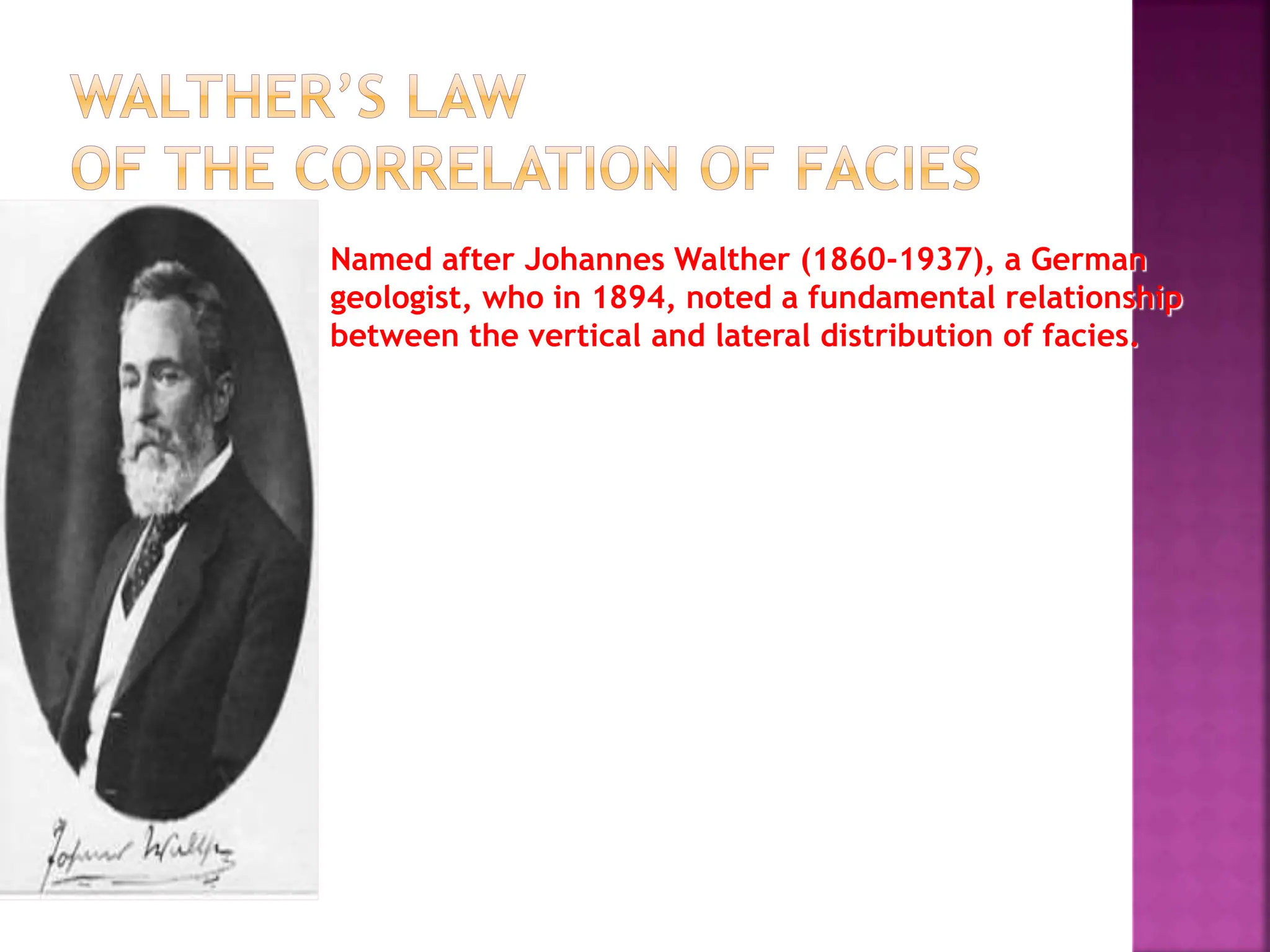
Named after Johannes Walther (1860-1937), a German
geologist, who in 1894, noted a fundamental relationship
between the vertical and lateral distribution of facies.
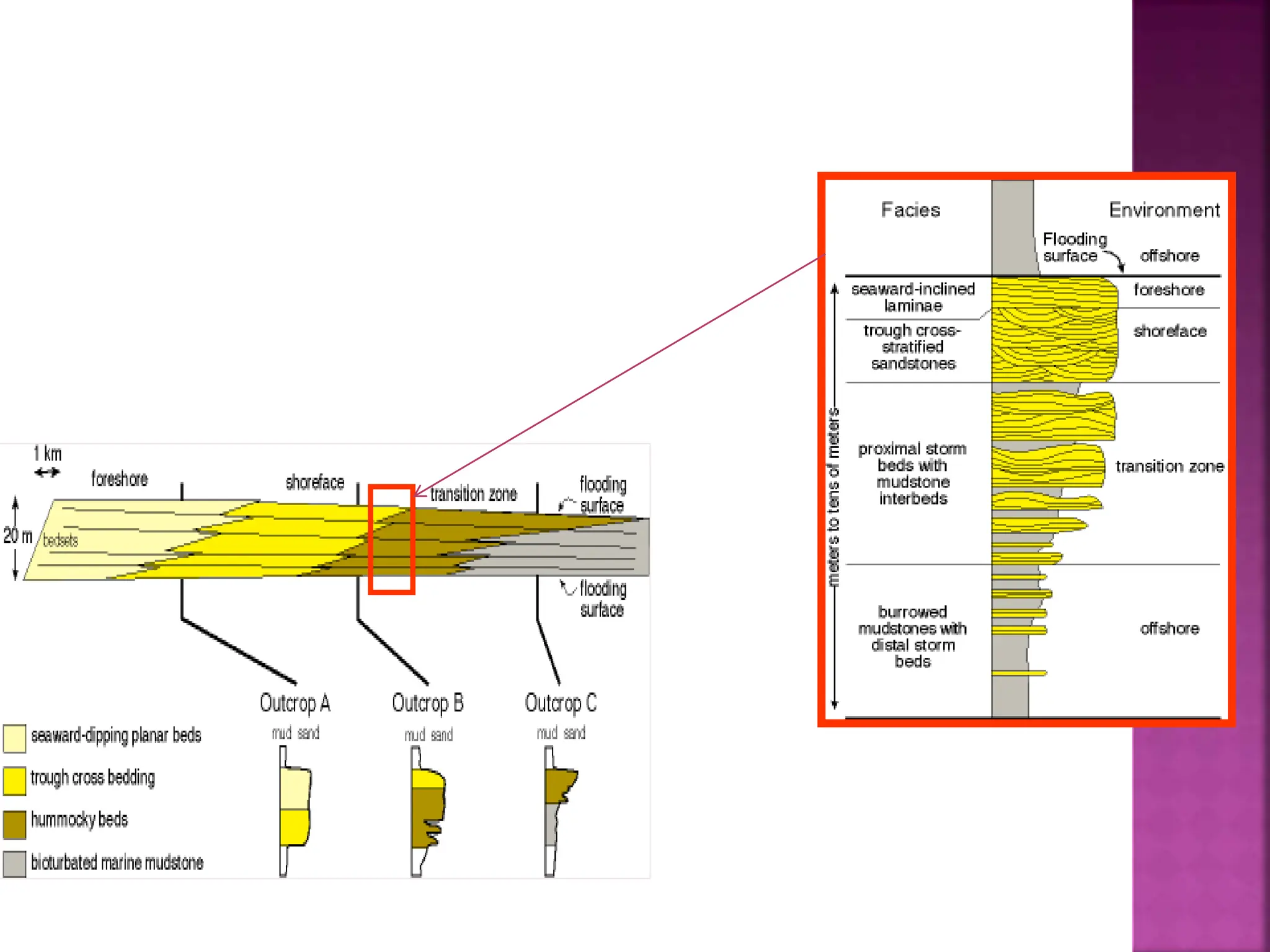
 Sedimentary environments that started out
side-by-side will end up overlapping one
another over time due to transgressions and
regressions. The result is a vertical sequence
of beds. The vertical sequence of facies
mirrors the original lateral distribution of
sedimentary environments.
 But…
Walther's Law can only apply to sections
without unconformities.
 Only works where there are no unconformities
 Only facies that were laterally adjacent during
deposition (result of laterally adjacent environments)
can be stacked vertically
 Vertical arrangement of facies gives us information on
 Distribution of environments
 How environments migrated through space and time
 Used as a basis to build facies maps or
paleogeographic maps
 Accurate time correlation of facies is essential
 Time lines provide framework for correlation
 Bio-events
 Volcanic ashes
 Other thin, unique lithologies or marker beds
 Only those lithofacies which are a product of
sedimentary environments found adjacent to
one another in the modern can occur
superimposed in continuous, uninterrupted
stratigraphic succession.”
• Transgression
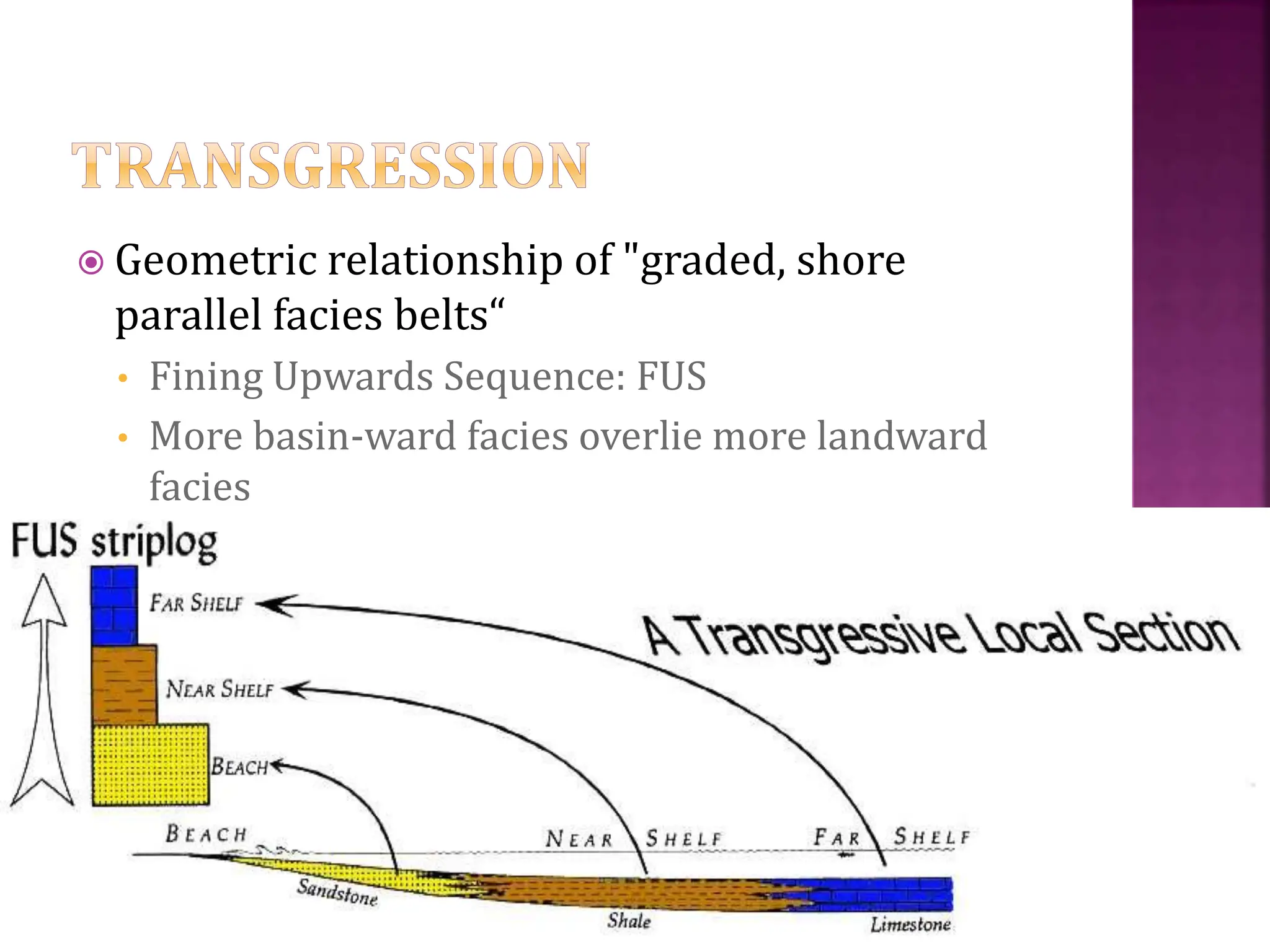
 Landward movement of shoreline (progressive
deepening)
 Stand on beach
 Over time, you would be under water as shoreline moved
landward
• Regression
 Seaward movement of shoreline
 (progressive shallowing)
• Results in lateral and vertical changes
 Geometric relationship of "graded, shore
parallel facies belts“
• Fining Upwards Sequence: FUS
• More basin-ward facies overlie more landward
facies
 Compared to depositional systems models
 Geometric relationship of "graded, shore
parallel facies belts“
• Coarsening Upwards Sequence: CUS
• More landward facies overlie more basin-ward
facies
 Compared to depositional systems models
• Shallowing upwards, shoreline moves basin ward through
time--> Regression
• Sea level drop +/- uplift +/- sediment supply
 Progradation
 excess sediment supply relative to accommodation space
 Forced Regression
• Relative sea level drop and formation of erosion surfaces: Unconformity
(surface of subaerial exposure)
• Soils; kaolinitized, clay-rich layers
• Angular discordance with underlying units (disconformity)
• Plant remains, rooted zones
• Non-genetic stratal relationships: basinward shift in sedimentary facies
• Strata across lithologic boundaries NOT in accordance with Walther’s law
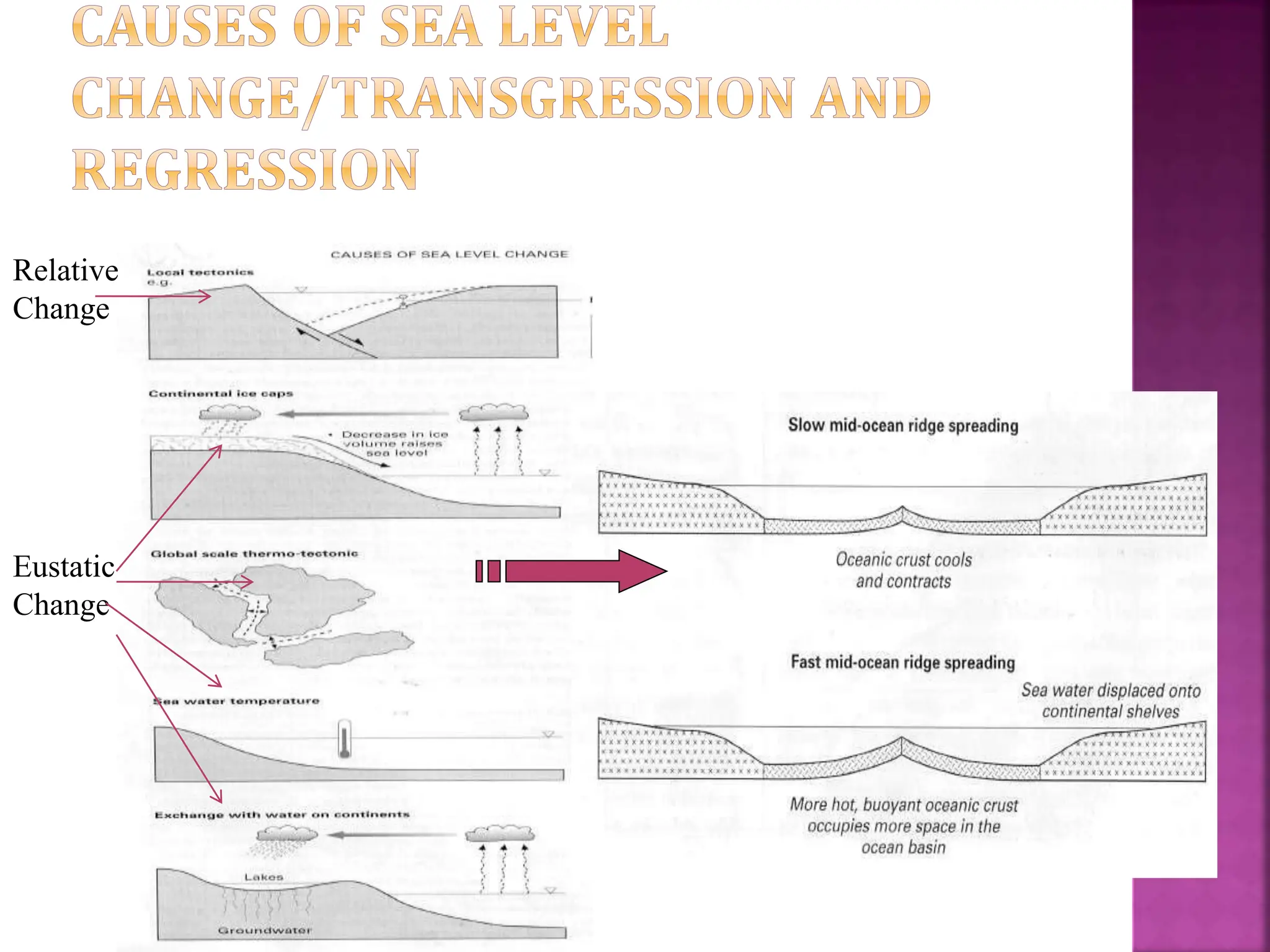
Relative
Change
Eustatic
Change
 The study of strata (layers) of rocks with an eye
toward interpreting the geologic history of the
region
 Types of stratigraphy
 Lithostratigraphy
 Biostratigraphy
 CHRONOSTRATIGRAPHY

 Supergroup
 Group
 Formation – a mappable unit with distinctive
lithic characteristics
 Member
 Bed
Evolution
 Variations exist within a population
 Result from mutations and other genetic accidents
 Some variations are advantageous but others are not
 Some are neutral
 Natural Selection works on these variations
 Characteristics of population shift through time =
evolution
Bio-Events
 First appearances of new species
 First appearances of new higher taxa
 Extinctions of species
 Mass extinctions of multiple taxa
 Bio-events are unique points in geologic time
 Index Fossils
 Some fossils are more useful than others for
relative age determinations
 Fossils that are most useful are called INDEX
FOSSILS
 What factors would maximize a fossil’s
usefulness? (i.e., What makes a good index
fossil?)
 Characteristics of a good index fossil:
 Distinctive appearance/easy to recognize
 Short duration between first appearance and
extinction.
 Widespread geographic distribution (makes
correlation possible across a wide
area/multiple continents
 Limited Stratigraphic Range
 Commonly Pelagic
 Or tolerant of a wide variety of environments
(found in many facies)
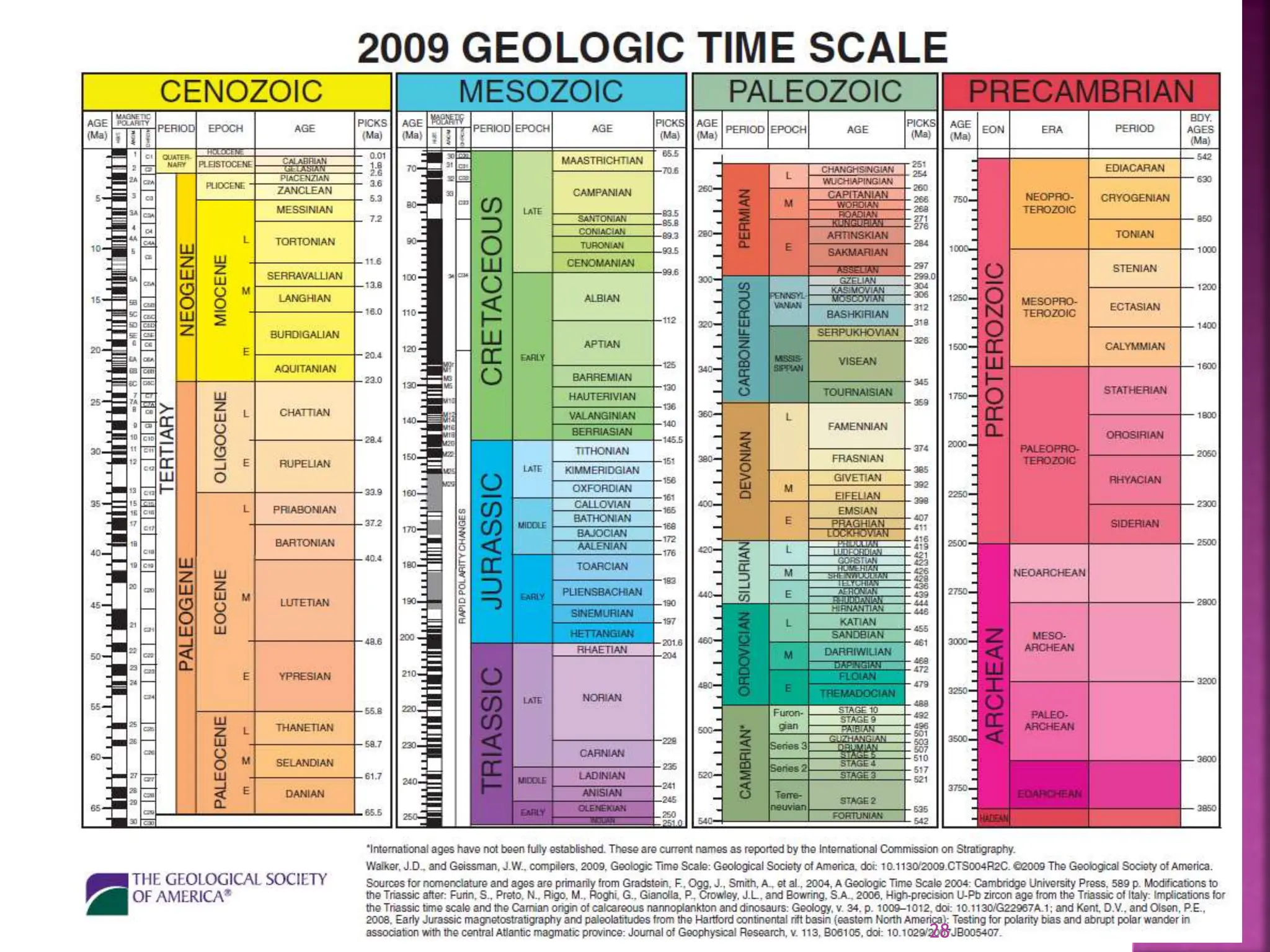
CHRONOSTRATIGRAPHY
Geochronological units
27
28
 Contacts
• Plane or irregular surfaces between different types
of rocks
• Separate units
 Conformable
 Unconformable
• Conformable boundaries
• Conformable strata form unbroken depositional
sequences
 Layers are deposited by ~ uninterrupted deposition
• Abrupt or gradational
 Abrupt : Sudden distinctive changes in lithology
 Often, local change
• Gradational
 Gradual change in depositional conditions with time
progressive gradual contact
 One lithology grades into another
 e.g., ss becomes finer upsection until it becomes a siltstone
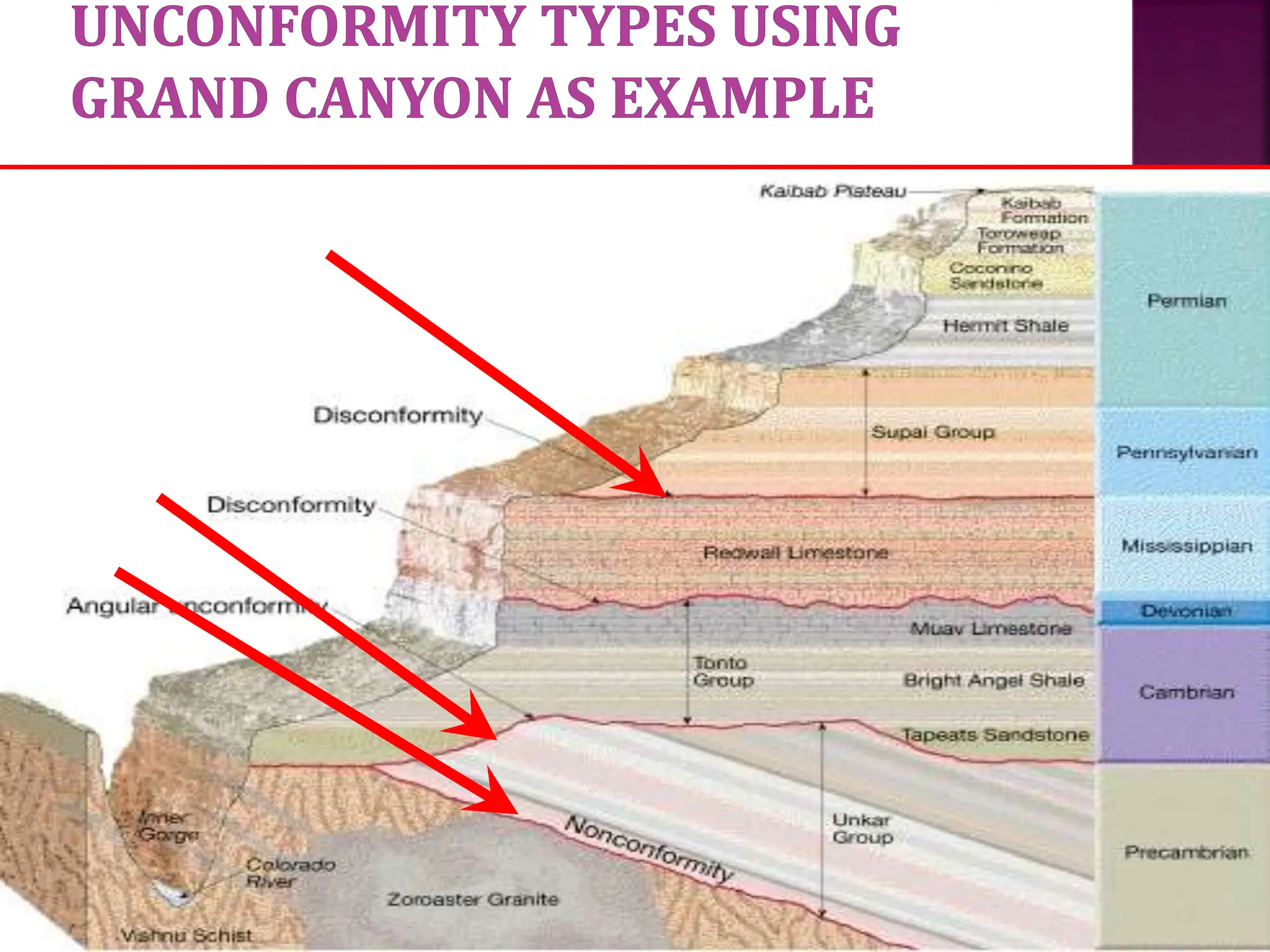
Unconformities
Unconformities are surfaces in rock that represent
periods of erosion or non-deposition. In other words,
time has been left out of the physical geologic rock
record.
There are three (3) principal types of unconformities:
 Angular Unconformity
Rocks above and below unconformity have different
orientations.
Shows that there was a period of deformation,
followed by erosion, and then renewed deposition.
Easiest of the three types to recognize because the
units are at an angle truncated with the units above
them.
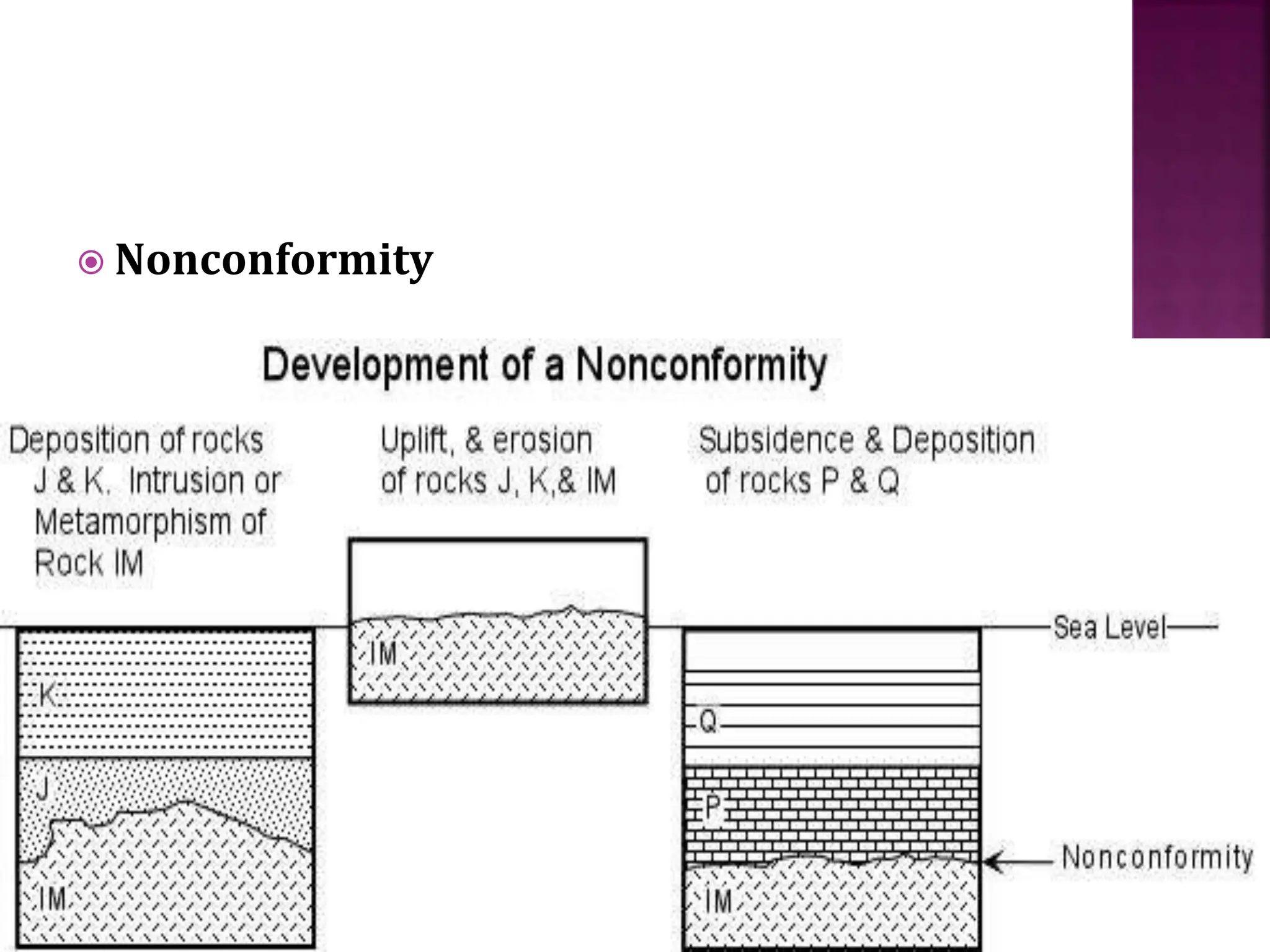
 Nonconformity
Rocks in a horizontal fashion were eroded down to
igneous bedrock material at which time subsequent
deposition of sedimentary layers commenced. Shows
that there was a period of deformation, followed by
erosion, and then renewed deposition. Represents the
greatest amount of time left out of the geologic rock
record.
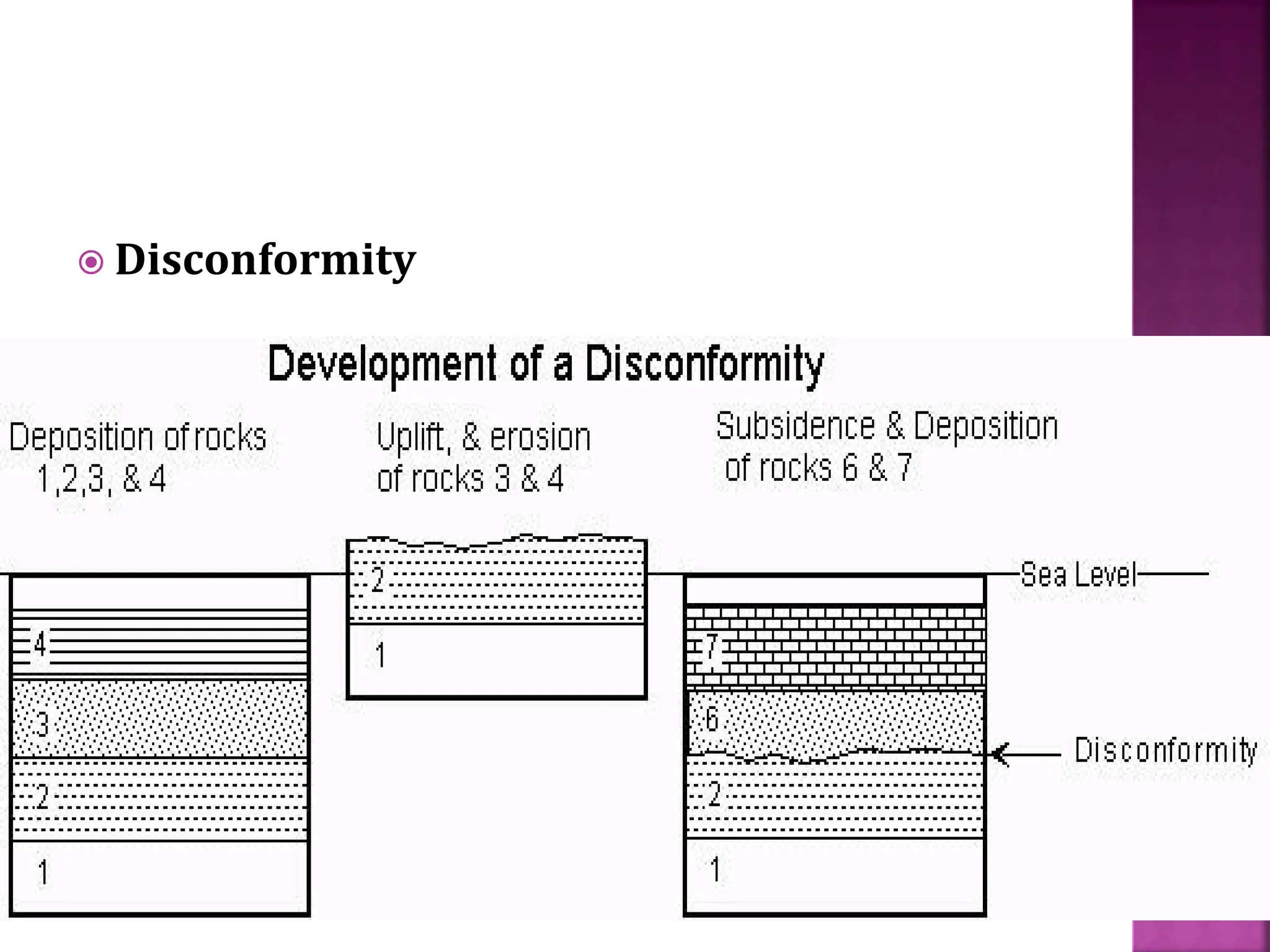
 Disconformity
Rocks in a nearly horizontal fashion were eroded and
an erosional profile remains covered by subsequent
sedimentary deposition. Shows that there was a
period of erosion and then renewed deposition in
nearly horizontal layers. Most difficult to recognize
because the units are nearly horizontal and only a
small discontinuous layer can be observed (rubble
zone or soil profile).
Angular
Unconformity
 Disconformity
 Nonconformity
…

Facies and Stratigraphy sedimentary rocks.pptx

  • 1.
  • 2.
     Facies  Allthe properties of a body of rock that allow us to differentiate it from those above, below or laterally adjacent to it  Properties include  Lithology – rock type, including color, etc.  Composition – mineral content  Texture – grain size, sorting, roundness  Sedimentary structures  Fossils  Facies means aspect – same Latin root as “face”  Overall appearance of a rock body  Facies are the products of depositional environments  Examples:  Planar laminated fine quartz arenite facies  Bioturbated, poorly sorted muddy skeletal limestone facies  Cross-stratified arkosic conglomerate facies  Stromatoporoid-tabulate coral reef facies
  • 3.
    • Facies: • Canbe genetic (fluvial facies) or descriptive (sandstone facies) • Lithofacies – a constant lithological character within a formation E.G an evaporate
  • 4.
     An idealizeddescription of a facies  Constructed from modern environments and ancient rocks  Serves as a  Norm for comparison  Framework for observation  Predictor of patterns
  • 5.
     Groups offacies commonly show patterns  Proximal Facies (near the source) tend to be coarse grained  Distal Facies (far from source) tend to be finer grained  This pattern is displayed upstream and down in rivers and onshore to offshore in coastal areas  Facies are arranged according to distribution of depositional environments
  • 6.
     Facies migratethrough space and time  Migration is in response to environmental factors  Sediment supply  Sea level change  Subsidence  Facies become stacked during migration  A single facies is likely to be different ages in different locations
  • 7.
    Named after JohannesWalther (1860-1937), a German geologist, who in 1894, noted a fundamental relationship between the vertical and lateral distribution of facies.
  • 8.
     Sedimentary environmentsthat started out side-by-side will end up overlapping one another over time due to transgressions and regressions. The result is a vertical sequence of beds. The vertical sequence of facies mirrors the original lateral distribution of sedimentary environments.
  • 11.
     But… Walther's Lawcan only apply to sections without unconformities.
  • 12.
     Only workswhere there are no unconformities  Only facies that were laterally adjacent during deposition (result of laterally adjacent environments) can be stacked vertically  Vertical arrangement of facies gives us information on  Distribution of environments  How environments migrated through space and time  Used as a basis to build facies maps or paleogeographic maps  Accurate time correlation of facies is essential  Time lines provide framework for correlation  Bio-events  Volcanic ashes  Other thin, unique lithologies or marker beds
  • 13.
     Only thoselithofacies which are a product of sedimentary environments found adjacent to one another in the modern can occur superimposed in continuous, uninterrupted stratigraphic succession.”
  • 15.
    • Transgression  Landwardmovement of shoreline (progressive deepening)  Stand on beach  Over time, you would be under water as shoreline moved landward • Regression  Seaward movement of shoreline  (progressive shallowing) • Results in lateral and vertical changes
  • 16.
     Geometric relationshipof "graded, shore parallel facies belts“ • Fining Upwards Sequence: FUS • More basin-ward facies overlie more landward facies  Compared to depositional systems models
  • 17.
     Geometric relationshipof "graded, shore parallel facies belts“ • Coarsening Upwards Sequence: CUS • More landward facies overlie more basin-ward facies  Compared to depositional systems models
  • 18.
    • Shallowing upwards,shoreline moves basin ward through time--> Regression • Sea level drop +/- uplift +/- sediment supply  Progradation  excess sediment supply relative to accommodation space  Forced Regression • Relative sea level drop and formation of erosion surfaces: Unconformity (surface of subaerial exposure) • Soils; kaolinitized, clay-rich layers • Angular discordance with underlying units (disconformity) • Plant remains, rooted zones • Non-genetic stratal relationships: basinward shift in sedimentary facies • Strata across lithologic boundaries NOT in accordance with Walther’s law
  • 19.
  • 20.
     The studyof strata (layers) of rocks with an eye toward interpreting the geologic history of the region  Types of stratigraphy  Lithostratigraphy  Biostratigraphy  CHRONOSTRATIGRAPHY 
  • 21.
     Supergroup  Group Formation – a mappable unit with distinctive lithic characteristics  Member  Bed
  • 22.
    Evolution  Variations existwithin a population  Result from mutations and other genetic accidents  Some variations are advantageous but others are not  Some are neutral  Natural Selection works on these variations  Characteristics of population shift through time = evolution
  • 23.
    Bio-Events  First appearancesof new species  First appearances of new higher taxa  Extinctions of species  Mass extinctions of multiple taxa  Bio-events are unique points in geologic time
  • 24.
     Index Fossils Some fossils are more useful than others for relative age determinations  Fossils that are most useful are called INDEX FOSSILS  What factors would maximize a fossil’s usefulness? (i.e., What makes a good index fossil?)
  • 25.
     Characteristics ofa good index fossil:  Distinctive appearance/easy to recognize  Short duration between first appearance and extinction.  Widespread geographic distribution (makes correlation possible across a wide area/multiple continents
  • 26.
     Limited StratigraphicRange  Commonly Pelagic  Or tolerant of a wide variety of environments (found in many facies)
  • 27.
  • 28.
  • 29.
     Contacts • Planeor irregular surfaces between different types of rocks • Separate units
  • 30.
  • 31.
    • Conformable boundaries •Conformable strata form unbroken depositional sequences  Layers are deposited by ~ uninterrupted deposition • Abrupt or gradational  Abrupt : Sudden distinctive changes in lithology  Often, local change • Gradational  Gradual change in depositional conditions with time progressive gradual contact  One lithology grades into another  e.g., ss becomes finer upsection until it becomes a siltstone
  • 32.
    Unconformities Unconformities are surfacesin rock that represent periods of erosion or non-deposition. In other words, time has been left out of the physical geologic rock record. There are three (3) principal types of unconformities:  Angular Unconformity Rocks above and below unconformity have different orientations. Shows that there was a period of deformation, followed by erosion, and then renewed deposition. Easiest of the three types to recognize because the units are at an angle truncated with the units above them.
  • 33.
     Nonconformity Rocks ina horizontal fashion were eroded down to igneous bedrock material at which time subsequent deposition of sedimentary layers commenced. Shows that there was a period of deformation, followed by erosion, and then renewed deposition. Represents the greatest amount of time left out of the geologic rock record.  Disconformity Rocks in a nearly horizontal fashion were eroded and an erosional profile remains covered by subsequent sedimentary deposition. Shows that there was a period of erosion and then renewed deposition in nearly horizontal layers. Most difficult to recognize because the units are nearly horizontal and only a small discontinuous layer can be observed (rubble zone or soil profile).
  • 34.
  • 35.
  • 36.
  • 39.