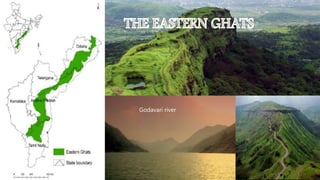
Godavari river
 The mountain ranges extend in the NE-SW direction along the
eastern coast of Orissa to Tamil Nadu.
 The rocks exposure is the Archean rocks that are 50-80 Km in
width.
 The chief rocks are: metamorphosed gneisses, Charnockites,
Khondalites & Kodurites.
 Charnockites shows intrusive relationship with Khondalites.
 In these rocks garnet and sillimanite occur in abundance.
 They shows intrusive relation with the country rock, and also shows foliated structure.
 They are acidic in nature and are characterized by the presence of bluish gray of quartz.
 Usually occur in most of mountain ranges of Eastern Ghats like Sheveroy hills, Nilgiri
hills, and palni hills
 they are the Garnet-Silimanite-Schist
 They are named after the ‘Khond’ tribe of Andhra
Pradesh.
 They are often banded and contain quartz, feldspar,
and graphite.
 Khondalites are believed to have formed by
plutonic metamorphism of argillaceous sediments.
 The felspathic Khondalites are thought to have
originated by Granitization. On weathering these
rocks give rise to laterite and bauxite
 Khondalites often contain graphite deposits of
commercial importance.
Argillaceous: of rocks or sediment) consisting of or containing clay
 They are manganese rich gneisses.
 Composed of potash feldspar, manganese garnet, manganese pyroxene,
quartz and Apatite.
 The Kodurite are the hybrid rocks by the assimilation of metamorphosed
manganiferous sediment and acid igneous rocks.
 On weathering they give rise to Manganese ore diposits.
Apatite:
a widely occurring pale green to purple mineral, consisting
of calcium phosphate with some fluorine, chlorine, and
other elements. It is used in the manufacture of fertilizers.
 it is a manganese bearing high grade metamorphic rock.
 It composed of quartz, spessartite, Rhodonite, and small
percentage of Apatite.
 They are formed by the plutonic metamorphism of sediments
rich in Manganese oxide.
 Commonly found in Archean succession of Balaghat-chinwara
area of Madhya Pradesh
Spessartine:
sometimes mistakenly referred to as spessartite,is
a nesosilicate, manganese aluminium garnet species, Mn2+
3Al2(SiO4)3.
The mineral spessartine should not be confused with a type of igneous
rock (a lamprophyre) called spessartite.
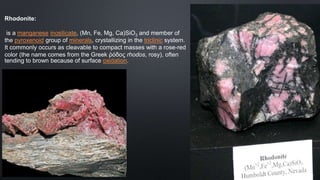
Rhodonite:
is a manganese inosilicate, (Mn, Fe, Mg, Ca)SiO3 and member of
the pyroxenoid group of minerals, crystallizing in the triclinic system.
It commonly occurs as cleavable to compact masses with a rose-red
color (the name comes from the Greek ῥόδος rhodos, rosy), often
tending to brown because of surface oxidation.
Eastern ghats

Eastern ghats

  • 1.
  • 2.
     The mountainranges extend in the NE-SW direction along the eastern coast of Orissa to Tamil Nadu.  The rocks exposure is the Archean rocks that are 50-80 Km in width.  The chief rocks are: metamorphosed gneisses, Charnockites, Khondalites & Kodurites.  Charnockites shows intrusive relationship with Khondalites.  In these rocks garnet and sillimanite occur in abundance.
  • 3.
     They showsintrusive relation with the country rock, and also shows foliated structure.  They are acidic in nature and are characterized by the presence of bluish gray of quartz.  Usually occur in most of mountain ranges of Eastern Ghats like Sheveroy hills, Nilgiri hills, and palni hills
  • 4.
     they arethe Garnet-Silimanite-Schist  They are named after the ‘Khond’ tribe of Andhra Pradesh.  They are often banded and contain quartz, feldspar, and graphite.  Khondalites are believed to have formed by plutonic metamorphism of argillaceous sediments.  The felspathic Khondalites are thought to have originated by Granitization. On weathering these rocks give rise to laterite and bauxite  Khondalites often contain graphite deposits of commercial importance. Argillaceous: of rocks or sediment) consisting of or containing clay
  • 5.
     They aremanganese rich gneisses.  Composed of potash feldspar, manganese garnet, manganese pyroxene, quartz and Apatite.  The Kodurite are the hybrid rocks by the assimilation of metamorphosed manganiferous sediment and acid igneous rocks.  On weathering they give rise to Manganese ore diposits. Apatite: a widely occurring pale green to purple mineral, consisting of calcium phosphate with some fluorine, chlorine, and other elements. It is used in the manufacture of fertilizers.
  • 6.
     it isa manganese bearing high grade metamorphic rock.  It composed of quartz, spessartite, Rhodonite, and small percentage of Apatite.  They are formed by the plutonic metamorphism of sediments rich in Manganese oxide.  Commonly found in Archean succession of Balaghat-chinwara area of Madhya Pradesh Spessartine: sometimes mistakenly referred to as spessartite,is a nesosilicate, manganese aluminium garnet species, Mn2+ 3Al2(SiO4)3. The mineral spessartine should not be confused with a type of igneous rock (a lamprophyre) called spessartite.
  • 7.
    Rhodonite: is a manganeseinosilicate, (Mn, Fe, Mg, Ca)SiO3 and member of the pyroxenoid group of minerals, crystallizing in the triclinic system. It commonly occurs as cleavable to compact masses with a rose-red color (the name comes from the Greek ῥόδος rhodos, rosy), often tending to brown because of surface oxidation.