1. Introduction
2. Generalised Stratigraphic Succession Map of Singhbhum
3. Singhbhum Composition
4. Succession of Singhbhum
a) Older Metamorphic Group
b) Iron Ore Group
c) Singhbhum Granite
d) Singhbhum Group
e) Dhanjori Group
f) Gangpur Group
5. Evolution Of Singhbhum Craton Lithology In The Archean
6. Conclusion
7. Reference
Content:
1. Introduction :
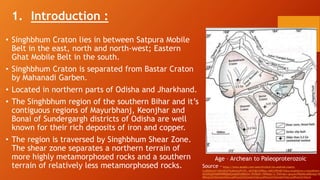
• Singhbhum Craton lies in between Satpura Mobile
Belt in the east, north and north-west; Eastern
Ghat Mobile Belt in the south.
• Singhbhum Craton is separated from Bastar Craton
by Mahanadi Garben.
• Located in northern parts of Odisha and Jharkhand.
• The Singhbhum region of the southern Bihar and it’s
contiguous regions of Mayurbhanj, Keonjhar and
Bonai of Sundergargh districts of Odisha are well
known for their rich deposits of iron and copper.
• The region is traversed by Singhbhum Shear Zone.
The shear zone separates a northern terrain of
more highly metamorphosed rocks and a southern
terrain of relatively less metamorphosed rocks. Source –https://www.google.com/search?client=ms-android-xiaomi-
rvo2b&sxsrf=APwXEdfTky8tAUyPf1E9_rj8JFQOvOPBog:1682249548732&q=singhbhum+craton&tbm=
AhXz9zgGHeMPDR8Q0pQJegQIIhAB&biw=393&bih=784&dpr=2.75#imgrc=gLpyecPBe6NLoM&lnspr=W
dWxsLG51bGwsbnVsbCxudWxsLG51bGwsbnVsbCxudWxsLG51bGwsbnVsbCxudWxsLG51bGxd
Age – Archean to Paleoproterozoic
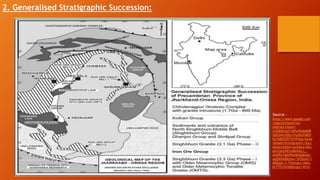
2. Generalised Stratigraphic Succession:
Source –
https://www.google.com
/search?client=ms-
android-xiaomi-
rvo2b&sxsrf=APwXEdebDB
XdU34vxf0ScvrfqE8oIfMED
Q:1682250710191&q=Gene
ralised+Stratigraphic+Succ
ession:&tbm=isch&sa=X&v
ed=2ahUKEwi864Og-L_-
AhXRwTgGHReABfgQ0pQJ
egQIKRAB&biw=393&bih=7
84&dpr=2.75#imgrc=bBhx
BrT7fX3VmM&lnspr=W10=
3. Singhbhum Composition
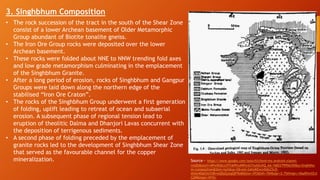
• The rock succession of the tract in the south of the Shear Zone
consist of a lower Archean basement of Older Metamorphic
Group abundant of Biotite tonalite gneiss.
• The Iron Ore Group rocks were deposited over the lower
Archean basement.
• These rocks were folded about NNE to NNW trending fold axes
and low grade metamorphism culminating in the emplacement
of the Singhbhum Granite.
• After a long period of erosion, rocks of Singhbhum and Gangpur
Groups were laid down along the northern edge of the
stabilised “Iron Ore Craton”.
• The rocks of the Singhbhum Group underwent a first generation
of folding, uplift leading to retreat of ocean and subaerial
erosion. A subsequent phase of regional tension lead to
eruption of theolitic Dalma and Dhanjori Lavas concurrent with
the deposition of terrigenous sediments.
• A second phase of folding preceded by the emplacement of
granite rocks led to the development of Singhbhum Shear Zone
that served as the favourable channel for the copper
mineralization. Source - https://www.google.com/search?client=ms-android-xiaomi-
rvo2b&sxsrf=APwXEdcxj7ITs69Vu4NPynG7nybGsXQ_AA:1682279956250&q=Singhbhu
m+composition&tbm=isch&sa=X&ved=2ahUKEwjv0dGZ5cD-
AhXe4DgGHcfUBvwQ0pQJegQIFRAB&biw=393&bih=784&dpr=2.75#imgrc=X6aRfimS5JI
C2M&lnspr=W10=
4. Succession:
Source-
https://www.google.com/search?q=
Singhbhum+succession&tbm=isch&v
ed=2ahUKEwj2pLub5cD-
AhXyALcAHZ_EBkgQ2-
cCegQIABAC&oq=Singhbhum+success
ion&gs_lcp=ChJtb2JpbGUtZ3dzLXdp
ei1pbWcQAzIGCAAQCBAeMgYIABAIEB
4yBwgAEBgQgAQyBQgAEKIEMgUIABCi
BDoECCMQJzoFCAAQgARQwwpYyUp
gnU1oAHAAeACAAYQCiAHpIpIBBzAu
MTEuMTGYAQCgAQHAAQE&sclient=
mobile-gws-wiz-
img&ei=GI5FZPa4BPKB3LUPn4mbwA
Q&bih=784&biw=393&client=ms-
android-xiaomi-
rvo2b#imgrc=JxU9CWWKsZXPAM
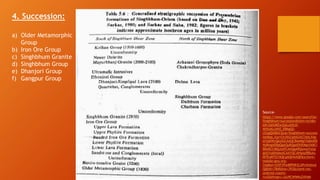
a) Older Metamorphic
Group
b) Iron Ore Group
c) Singhbhum Granite
d) Singhbhum Group
e) Dhanjori Group
f) Gangpur Group
a) Older metamorphic group :
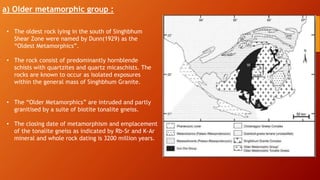
• The oldest rock lying in the south of Singhbhum
Shear Zone were named by Dunn(1929) as the
“Oldest Metamorphics”.
• The rock consist of predominantly hornblende
schists with quartzites and quartz micaschists. The
rocks are known to occur as isolated exposures
within the general mass of Singhbhum Granite.
• The “Older Metamorphics” are intruded and partly
granitised by a suite of biotite tonalite gneiss.
• The closing date of metamorphism and emplacement
of the tonalite gneiss as indicated by Rb-Sr and K-Ar
mineral and whole rock dating is 3200 million years.
b) Iron Ore Group :
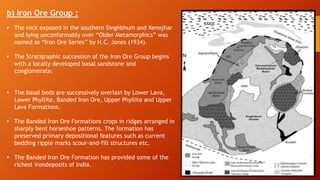
• The rock exposed in the southern Singhbhum and Kenojhar
and lying unconformably over “Older Metamorphics” was
named as “Iron Ore Series” by H.C. Jones (1934).
• The Stratigraphic succession of the Iron Ore Group begins
with a locally developed basal sandstone and
conglomerate.
• The basal beds are successively overlain by Lower Lava,
Lower Phyllite, Banded Iron Ore, Upper Phyllite and Upper
Lava Formations.
• The Banded Iron Ore Formations crops in ridges arranged in
sharply bent horseshoe patterns. The formation has
preserved primary depositional features such as current
bedding ripple marks scour-and-fill structures etc.
• The Banded Iron Ore Formation has provided some of the
richest irondeposits of India.
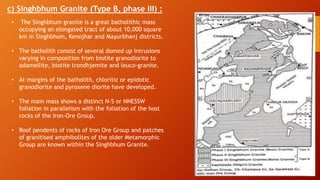
c) Singhbhum Granite (Type B, phase III) :
• The Singhbhum granite is a great batholithic mass
occupying an elongated tract of about 10,000 square
km in Singhbhum, Kenojhar and Mayurbhanj districts.
• The batholith consist of several domed up intrusions
varying in composition from biotite granodiorite to
adamellite, biotite trondhjemite and leuco-granite.
• At margins of the batholith, chloritic or epidotic
granodiorite and pyroxene diorite have developed.
• The main mass shows a distinct N-S or NNESSW
foliation in parallelism with the foliation of the host
rocks of the Iron-Ore Group.
• Roof pendents of rocks of Iron Ore Group and patches
of granitised amphibolites of the older Metamorphic
Group are known within the Singhbhum Granite.
d) Singhbhum Group:
The rock succession lying to the north of the Singhbhum Shear Zone extends in a
series of east-west folds for 200km.
This succession has been divided into a lower Chaibasa Formation and an upper Dalbhum Formation.
Chaibasa Formation -
• The Chaibasa Formation nearest outcrops are exposed some 20km north.
• The formation consist of high grade mica-schists, hornblende-schists and quartz granulites. The rock were
considered as more metamorphosed equivalents of rocks exposed at Chaibasa which was later group into a
much younger Kolhan Group of Middle to Late Proterozoic age.
• The term “Chaibasa Formation” has been retained in Indian Geology for its usage for a very long time and
for want of any other proper stratigraphical name for the formation.
Dalbhum Formation -
• The Dalbhum formation consists of phyllites and banded quarzites which show a lower grade
metamorphism than the underlying rocks of the Chaibasa Formation.
• Some of phyllites are considered to represent tuffs and volcanic flows.
• The phyllites contain ferruginous beds and sometimes manganese mineral also.
e) Dhanjori Group
• The group consists of a basal conglomerate, arkose, quarzite and extensive lava flows.
• The succession was unconformably deposited over the Singhbhum Granite and the rocks of
Iron Ore Group.
• Equivalent volcanic rocks exposed in the Dalma hills in the north of the Singhbhum Shear
Zone are known as “Dalma Lava”.
• Southern extensions of the volcanic flows are observed in Simlipal of Kenojhar district and
Bonai of Sundergarh district in Odisha.
• Basal sediments of the Dhanjhori Group are regarded as non-marine facies of piedmont or
alluvial fan types.
• The Dalma Lava probably once covering an area of over 2000 square km.
f) Gangpur Group :
• Archean rocks of the Sundergarh district in Odisha were grouped into a “Gangpur Series”. These
rocks were regarded to be older than the rocks of the Iron Ore Group.
• The Gangpur rocks were shown to occupy the core of anticlinorium.
• The Gangpur Group has been divided into five formation; On the basis of their lithological
similarities, the succession has been corelated with the Chilpi Ghat Group exposed at about
120km to the west of Gangpur area.
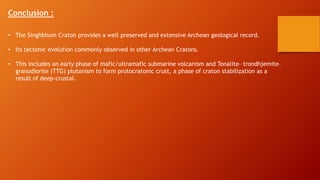
Conclusion :
• The Singhbhum Craton provides a well preserved and extensive Archean geological record.
• Its tectonic evolution commonly observed in other Archean Cratons.
• This includes an early phase of mafic/ultramafic submarine volcanism and Tonalite– trondhjemite–
granodiorite (TTG) plutonism to form protocratonic crust, a phase of craton stabilization as a
result of deep-crustal.
Bibliography :
• Kumar, R. (1985). Fundamentals of historical geology and stratigraphy of India.
Wiley.
• Bangar, K. M. (2001). Principles of engineering geology. Rise of Himalaya, 312-313.
Thank You
By Anshuman Dash

Singhbhum Craton by AD.pptx

  • 2.
    1. Introduction 2. GeneralisedStratigraphic Succession Map of Singhbhum 3. Singhbhum Composition 4. Succession of Singhbhum a) Older Metamorphic Group b) Iron Ore Group c) Singhbhum Granite d) Singhbhum Group e) Dhanjori Group f) Gangpur Group 5. Evolution Of Singhbhum Craton Lithology In The Archean 6. Conclusion 7. Reference Content:
  • 3.
    1. Introduction : •Singhbhum Craton lies in between Satpura Mobile Belt in the east, north and north-west; Eastern Ghat Mobile Belt in the south. • Singhbhum Craton is separated from Bastar Craton by Mahanadi Garben. • Located in northern parts of Odisha and Jharkhand. • The Singhbhum region of the southern Bihar and it’s contiguous regions of Mayurbhanj, Keonjhar and Bonai of Sundergargh districts of Odisha are well known for their rich deposits of iron and copper. • The region is traversed by Singhbhum Shear Zone. The shear zone separates a northern terrain of more highly metamorphosed rocks and a southern terrain of relatively less metamorphosed rocks. Source –https://www.google.com/search?client=ms-android-xiaomi- rvo2b&sxsrf=APwXEdfTky8tAUyPf1E9_rj8JFQOvOPBog:1682249548732&q=singhbhum+craton&tbm= AhXz9zgGHeMPDR8Q0pQJegQIIhAB&biw=393&bih=784&dpr=2.75#imgrc=gLpyecPBe6NLoM&lnspr=W dWxsLG51bGwsbnVsbCxudWxsLG51bGwsbnVsbCxudWxsLG51bGwsbnVsbCxudWxsLG51bGxd Age – Archean to Paleoproterozoic
  • 4.
    2. Generalised StratigraphicSuccession: Source – https://www.google.com /search?client=ms- android-xiaomi- rvo2b&sxsrf=APwXEdebDB XdU34vxf0ScvrfqE8oIfMED Q:1682250710191&q=Gene ralised+Stratigraphic+Succ ession:&tbm=isch&sa=X&v ed=2ahUKEwi864Og-L_- AhXRwTgGHReABfgQ0pQJ egQIKRAB&biw=393&bih=7 84&dpr=2.75#imgrc=bBhx BrT7fX3VmM&lnspr=W10=
  • 5.
    3. Singhbhum Composition •The rock succession of the tract in the south of the Shear Zone consist of a lower Archean basement of Older Metamorphic Group abundant of Biotite tonalite gneiss. • The Iron Ore Group rocks were deposited over the lower Archean basement. • These rocks were folded about NNE to NNW trending fold axes and low grade metamorphism culminating in the emplacement of the Singhbhum Granite. • After a long period of erosion, rocks of Singhbhum and Gangpur Groups were laid down along the northern edge of the stabilised “Iron Ore Craton”. • The rocks of the Singhbhum Group underwent a first generation of folding, uplift leading to retreat of ocean and subaerial erosion. A subsequent phase of regional tension lead to eruption of theolitic Dalma and Dhanjori Lavas concurrent with the deposition of terrigenous sediments. • A second phase of folding preceded by the emplacement of granite rocks led to the development of Singhbhum Shear Zone that served as the favourable channel for the copper mineralization. Source - https://www.google.com/search?client=ms-android-xiaomi- rvo2b&sxsrf=APwXEdcxj7ITs69Vu4NPynG7nybGsXQ_AA:1682279956250&q=Singhbhu m+composition&tbm=isch&sa=X&ved=2ahUKEwjv0dGZ5cD- AhXe4DgGHcfUBvwQ0pQJegQIFRAB&biw=393&bih=784&dpr=2.75#imgrc=X6aRfimS5JI C2M&lnspr=W10=
  • 6.
  • 7.
    a) Older metamorphicgroup : • The oldest rock lying in the south of Singhbhum Shear Zone were named by Dunn(1929) as the “Oldest Metamorphics”. • The rock consist of predominantly hornblende schists with quartzites and quartz micaschists. The rocks are known to occur as isolated exposures within the general mass of Singhbhum Granite. • The “Older Metamorphics” are intruded and partly granitised by a suite of biotite tonalite gneiss. • The closing date of metamorphism and emplacement of the tonalite gneiss as indicated by Rb-Sr and K-Ar mineral and whole rock dating is 3200 million years.
  • 8.
    b) Iron OreGroup : • The rock exposed in the southern Singhbhum and Kenojhar and lying unconformably over “Older Metamorphics” was named as “Iron Ore Series” by H.C. Jones (1934). • The Stratigraphic succession of the Iron Ore Group begins with a locally developed basal sandstone and conglomerate. • The basal beds are successively overlain by Lower Lava, Lower Phyllite, Banded Iron Ore, Upper Phyllite and Upper Lava Formations. • The Banded Iron Ore Formations crops in ridges arranged in sharply bent horseshoe patterns. The formation has preserved primary depositional features such as current bedding ripple marks scour-and-fill structures etc. • The Banded Iron Ore Formation has provided some of the richest irondeposits of India.
  • 9.
    c) Singhbhum Granite(Type B, phase III) : • The Singhbhum granite is a great batholithic mass occupying an elongated tract of about 10,000 square km in Singhbhum, Kenojhar and Mayurbhanj districts. • The batholith consist of several domed up intrusions varying in composition from biotite granodiorite to adamellite, biotite trondhjemite and leuco-granite. • At margins of the batholith, chloritic or epidotic granodiorite and pyroxene diorite have developed. • The main mass shows a distinct N-S or NNESSW foliation in parallelism with the foliation of the host rocks of the Iron-Ore Group. • Roof pendents of rocks of Iron Ore Group and patches of granitised amphibolites of the older Metamorphic Group are known within the Singhbhum Granite.
  • 10.
    d) Singhbhum Group: Therock succession lying to the north of the Singhbhum Shear Zone extends in a series of east-west folds for 200km. This succession has been divided into a lower Chaibasa Formation and an upper Dalbhum Formation. Chaibasa Formation - • The Chaibasa Formation nearest outcrops are exposed some 20km north. • The formation consist of high grade mica-schists, hornblende-schists and quartz granulites. The rock were considered as more metamorphosed equivalents of rocks exposed at Chaibasa which was later group into a much younger Kolhan Group of Middle to Late Proterozoic age. • The term “Chaibasa Formation” has been retained in Indian Geology for its usage for a very long time and for want of any other proper stratigraphical name for the formation. Dalbhum Formation - • The Dalbhum formation consists of phyllites and banded quarzites which show a lower grade metamorphism than the underlying rocks of the Chaibasa Formation. • Some of phyllites are considered to represent tuffs and volcanic flows. • The phyllites contain ferruginous beds and sometimes manganese mineral also.
  • 11.
    e) Dhanjori Group •The group consists of a basal conglomerate, arkose, quarzite and extensive lava flows. • The succession was unconformably deposited over the Singhbhum Granite and the rocks of Iron Ore Group. • Equivalent volcanic rocks exposed in the Dalma hills in the north of the Singhbhum Shear Zone are known as “Dalma Lava”. • Southern extensions of the volcanic flows are observed in Simlipal of Kenojhar district and Bonai of Sundergarh district in Odisha. • Basal sediments of the Dhanjhori Group are regarded as non-marine facies of piedmont or alluvial fan types. • The Dalma Lava probably once covering an area of over 2000 square km.
  • 12.
    f) Gangpur Group: • Archean rocks of the Sundergarh district in Odisha were grouped into a “Gangpur Series”. These rocks were regarded to be older than the rocks of the Iron Ore Group. • The Gangpur rocks were shown to occupy the core of anticlinorium. • The Gangpur Group has been divided into five formation; On the basis of their lithological similarities, the succession has been corelated with the Chilpi Ghat Group exposed at about 120km to the west of Gangpur area.
  • 13.
    Conclusion : • TheSinghbhum Craton provides a well preserved and extensive Archean geological record. • Its tectonic evolution commonly observed in other Archean Cratons. • This includes an early phase of mafic/ultramafic submarine volcanism and Tonalite– trondhjemite– granodiorite (TTG) plutonism to form protocratonic crust, a phase of craton stabilization as a result of deep-crustal.
  • 14.
    Bibliography : • Kumar,R. (1985). Fundamentals of historical geology and stratigraphy of India. Wiley. • Bangar, K. M. (2001). Principles of engineering geology. Rise of Himalaya, 312-313.
  • 15.