STRATIGRAPHY
By
Dr. Rajiv Kumar Jaiswal
Assistant Professor
AIHC & Archaeology
Vasanta College for Women,
KFI, Rajghat Fort,
Banaras Hindu University
Understanding the Principles of Relative Dating
INTRODUCTION
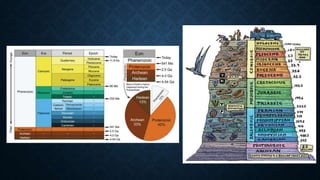
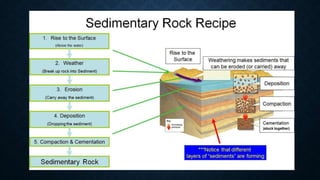
• Stratigraphy is a branch of geology that deals with the study of rock
layers (strata)
• Stratigraphy is a term used by archaeologists, geologists, and the like
to refer to the layers of the earth that have built up over time.
Stratification is defined by the depositing of strata or layers, one on
top of the other, creating the ground we walk on today.
• It involves observing the vertical arrangement of different layers,
their composition, and any associated artifacts or fossils.
CONT….
• The Study of cultural depositional sequences and understanding their
vertical and horizontal interrelationships in a chronological-cultural
frame work could be considered as an Archaeological Stratigraphy.
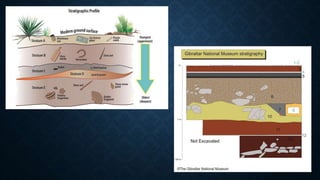
• In archaeological studies, the accurate construction of stratigraphy is
crucial to understand the past human behavioural activities in
sequential order.
• Therefore, understanding the stratigraphic sequence and their
periodization are the most important task for any archaeologist.
PROCESS OF FORMATION
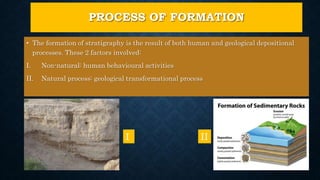
• The formation of stratigraphy is the result of both human and geological depositional
processes. These 2 factors involved:
I. Non-natural: human behavioural activities
II. Natural process: geological transformational process
I II
ROLE OF STRATIGRAPHY
 Stratigraphy is a relative dating system, as there are no exact dates to be located
within the ground, and areas can build up at different rates depending on climate,
habitation, and weather.
 It is the finds within these strata that help us date these slices of human activity,
what we’re really after when we want to date something anyways. This is why
context and association are so important when excavating.
 If multiple objects are found in association with each other, it is a good indication
that they were buried at the same time. As long as the layers haven’t been
disturbed, and has been sealed, we can say these objects are no later or no more
recent that the deposit itself.
CONCEPT OF STRATIGRAPHY
• The concept of stratigraphy in geology was introduced by Sir Charles
Lyell in 1830 with the publication of his book “Principles of Geology”.
• Geological stratification is formed by a cyclic process of deposition or
denudation, the evolution of land or submergence beneath sea.
GEOLOGICAL STRATIGRAPHY
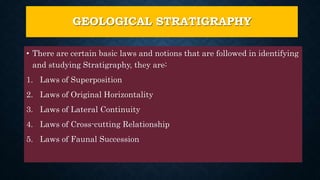
• There are certain basic laws and notions that are followed in identifying
and studying Stratigraphy, they are:
1. Laws of Superposition
2. Laws of Original Horizontality
3. Laws of Lateral Continuity
4. Laws of Cross-cutting Relationship
5. Laws of Faunal Succession
THE LAW OF SUPERPOSITION
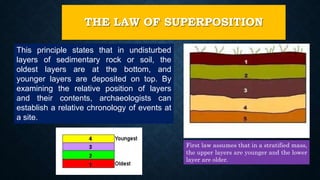
First law assumes that in a stratified mass,
the upper layers are younger and the lower
layer are older.
This principle states that in undisturbed
layers of sedimentary rock or soil, the
oldest layers are at the bottom, and
younger layers are deposited on top. By
examining the relative position of layers
and their contents, archaeologists can
establish a relative chronology of events at
a site.
THE LAW OF ORIGINAL HORIZONTALITY
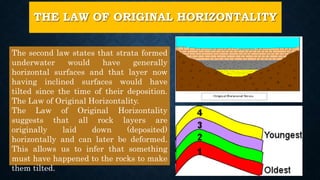
The second law states that strata formed
underwater would have generally
horizontal surfaces and that layer now
having inclined surfaces would have
tilted since the time of their deposition.
The Law of Original Horizontality.
The Law of Original Horizontality
suggests that all rock layers are
originally laid down (deposited)
horizontally and can later be deformed.
This allows us to infer that something
must have happened to the rocks to make
them tilted.
LAWS OF LATERAL CONTINUITY
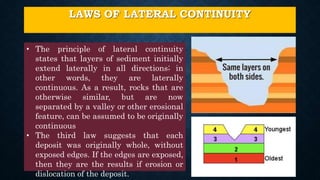
• The principle of lateral continuity
states that layers of sediment initially
extend laterally in all directions; in
other words, they are laterally
continuous. As a result, rocks that are
otherwise similar, but are now
separated by a valley or other erosional
feature, can be assumed to be originally
continuous
• The third law suggests that each
deposit was originally whole, without
exposed edges. If the edges are exposed,
then they are the results if erosion or
dislocation of the deposit.
LAWS OF CROSS-CUTTING RELATIONSHIP
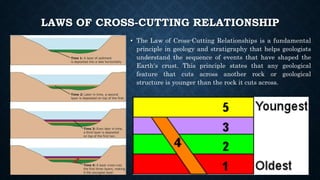
• The Law of Cross-Cutting Relationships is a fundamental
principle in geology and stratigraphy that helps geologists
understand the sequence of events that have shaped the
Earth's crust. This principle states that any geological
feature that cuts across another rock or geological
structure is younger than the rock it cuts across.
LAWS OF FAUNAL SUCCESSION
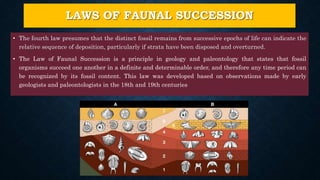
• The fourth law presumes that the distinct fossil remains from successive epochs of life can indicate the
relative sequence of deposition, particularly if strata have been disposed and overturned.
• The Law of Faunal Succession is a principle in geology and paleontology that states that fossil
organisms succeed one another in a definite and determinable order, and therefore any time period can
be recognized by its fossil content. This law was developed based on observations made by early
geologists and paleontologists in the 18th and 19th centuries
IMPORTANCE IN ARCHAEOLOGY
• Chronological Sequencing: Stratigraphy helps archaeologists establish a relative chronology
of events at a site by determining the sequence in which layers were deposited. This allows
them to understand the order of human occupation or natural processes over time.
• Interpretation of Site Formation Processes: Different layers within a site represent different
periods of activity or depositional events. By analyzing these layers, archaeologists can infer
how the site was formed, including factors such as natural sedimentation, human
occupation, erosion, or geological disturbances.
• Artifact Context: Artifacts found within specific layers provide valuable information about
the activities and cultures associated with those periods. By understanding the spatial and
temporal distribution of artifacts within the stratigraphic sequence, archaeologists can
reconstruct past human behaviors and cultural developments.
• Dating Techniques: While stratigraphy itself provides relative dating (i.e., determining the
age of one layer relative to another), it also serves as a framework for applying absolute
dating techniques, such as radiocarbon dating, luminescence dating, or dendrochronology.
Stratigraphy Relative Dating Method.pptx

Stratigraphy Relative Dating Method.pptx

  • 1.
    STRATIGRAPHY By Dr. Rajiv KumarJaiswal Assistant Professor AIHC & Archaeology Vasanta College for Women, KFI, Rajghat Fort, Banaras Hindu University Understanding the Principles of Relative Dating
  • 2.
    INTRODUCTION • Stratigraphy isa branch of geology that deals with the study of rock layers (strata) • Stratigraphy is a term used by archaeologists, geologists, and the like to refer to the layers of the earth that have built up over time. Stratification is defined by the depositing of strata or layers, one on top of the other, creating the ground we walk on today. • It involves observing the vertical arrangement of different layers, their composition, and any associated artifacts or fossils.
  • 4.
    CONT…. • The Studyof cultural depositional sequences and understanding their vertical and horizontal interrelationships in a chronological-cultural frame work could be considered as an Archaeological Stratigraphy. • In archaeological studies, the accurate construction of stratigraphy is crucial to understand the past human behavioural activities in sequential order. • Therefore, understanding the stratigraphic sequence and their periodization are the most important task for any archaeologist.
  • 5.
    PROCESS OF FORMATION •The formation of stratigraphy is the result of both human and geological depositional processes. These 2 factors involved: I. Non-natural: human behavioural activities II. Natural process: geological transformational process I II
  • 6.
    ROLE OF STRATIGRAPHY Stratigraphy is a relative dating system, as there are no exact dates to be located within the ground, and areas can build up at different rates depending on climate, habitation, and weather.  It is the finds within these strata that help us date these slices of human activity, what we’re really after when we want to date something anyways. This is why context and association are so important when excavating.  If multiple objects are found in association with each other, it is a good indication that they were buried at the same time. As long as the layers haven’t been disturbed, and has been sealed, we can say these objects are no later or no more recent that the deposit itself.
  • 8.
    CONCEPT OF STRATIGRAPHY •The concept of stratigraphy in geology was introduced by Sir Charles Lyell in 1830 with the publication of his book “Principles of Geology”. • Geological stratification is formed by a cyclic process of deposition or denudation, the evolution of land or submergence beneath sea.
  • 9.
    GEOLOGICAL STRATIGRAPHY • Thereare certain basic laws and notions that are followed in identifying and studying Stratigraphy, they are: 1. Laws of Superposition 2. Laws of Original Horizontality 3. Laws of Lateral Continuity 4. Laws of Cross-cutting Relationship 5. Laws of Faunal Succession
  • 10.
    THE LAW OFSUPERPOSITION First law assumes that in a stratified mass, the upper layers are younger and the lower layer are older. This principle states that in undisturbed layers of sedimentary rock or soil, the oldest layers are at the bottom, and younger layers are deposited on top. By examining the relative position of layers and their contents, archaeologists can establish a relative chronology of events at a site.
  • 11.
    THE LAW OFORIGINAL HORIZONTALITY The second law states that strata formed underwater would have generally horizontal surfaces and that layer now having inclined surfaces would have tilted since the time of their deposition. The Law of Original Horizontality. The Law of Original Horizontality suggests that all rock layers are originally laid down (deposited) horizontally and can later be deformed. This allows us to infer that something must have happened to the rocks to make them tilted.
  • 12.
    LAWS OF LATERALCONTINUITY • The principle of lateral continuity states that layers of sediment initially extend laterally in all directions; in other words, they are laterally continuous. As a result, rocks that are otherwise similar, but are now separated by a valley or other erosional feature, can be assumed to be originally continuous • The third law suggests that each deposit was originally whole, without exposed edges. If the edges are exposed, then they are the results if erosion or dislocation of the deposit.
  • 13.
    LAWS OF CROSS-CUTTINGRELATIONSHIP • The Law of Cross-Cutting Relationships is a fundamental principle in geology and stratigraphy that helps geologists understand the sequence of events that have shaped the Earth's crust. This principle states that any geological feature that cuts across another rock or geological structure is younger than the rock it cuts across.
  • 14.
    LAWS OF FAUNALSUCCESSION • The fourth law presumes that the distinct fossil remains from successive epochs of life can indicate the relative sequence of deposition, particularly if strata have been disposed and overturned. • The Law of Faunal Succession is a principle in geology and paleontology that states that fossil organisms succeed one another in a definite and determinable order, and therefore any time period can be recognized by its fossil content. This law was developed based on observations made by early geologists and paleontologists in the 18th and 19th centuries
  • 16.
    IMPORTANCE IN ARCHAEOLOGY •Chronological Sequencing: Stratigraphy helps archaeologists establish a relative chronology of events at a site by determining the sequence in which layers were deposited. This allows them to understand the order of human occupation or natural processes over time. • Interpretation of Site Formation Processes: Different layers within a site represent different periods of activity or depositional events. By analyzing these layers, archaeologists can infer how the site was formed, including factors such as natural sedimentation, human occupation, erosion, or geological disturbances. • Artifact Context: Artifacts found within specific layers provide valuable information about the activities and cultures associated with those periods. By understanding the spatial and temporal distribution of artifacts within the stratigraphic sequence, archaeologists can reconstruct past human behaviors and cultural developments. • Dating Techniques: While stratigraphy itself provides relative dating (i.e., determining the age of one layer relative to another), it also serves as a framework for applying absolute dating techniques, such as radiocarbon dating, luminescence dating, or dendrochronology.