MAGMA DIVERSITY
Partial Melting And
Magmatic Differentiation
Shankar Lamani
223104024
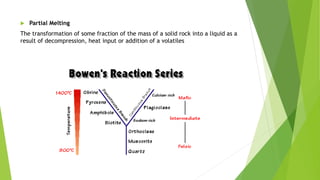
 Partial Melting
The transformation of some fraction of the mass of a solid rock into a liquid as a
result of decompression, heat input or addition of a volatiles
Magmatic Differentiation
 The process of evolution of different types of igneous
rocks from a single originally uniform magma is called as
magmatic differentiation.
1. Fractional Crystallization
2. Flowage differentiation
3. Crystal Zoning
4. Filter Pressing
5. Liquid Immiscibility
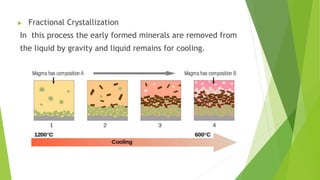
 Fractional Crystallization
In this process the early formed minerals are removed from
the liquid by gravity and liquid remains for cooling.
Flowage differentiation
When a magma moves along a pipe or a narrow channel, its
flowage changes away from the contacts. The suspended
crystals under such conditions get concentrated along the
axis (centre) of such channels where the flow velocity is
higher
 Crystal Zoning
when minerals belonging to solid solution series
crystallize, for e.g. plagioclase feldspar, the early formed
crystals are rich in calcic composition and the crystallization
proceeds. The early formed crystals react continuously with
the melt to form plagioclase of uniform composition.
However, if equilibrium is disturbed the successive liquid will
have a different composition. This mechanism when very
extensive can affect the composition of the residual liquid
and thus different rock types are formed.
 Filter Pressing
It involves mechanical separation of coexisting magma from the
crystal-liquid mixture. When crystallization of magma is far
advanced, the crystal builds a continuous mesh, in the interstices
of which lies the melt. If this crystal-liquid mixture is now
subjected to any stress or the magma chamber collapses, the
residual liquid is forced out and thus tends to move towards the
region of lower pressure to form rocks having different
composition
 Liquid Immiscibility:
some magmas break up into immiscible liquid fractions
through fall of temperature. These may separate as droplets,
bubbles of the sub-ordinate phase suspended in the bulk of
liquid. Thus, with falling temperature, the homogeneity in
magma is lost and different phases try to separate.
Gaseous Transfer
Gases like H2O, CO2, P2O5, S, etc. migrate upwards from
the magma chamber establishing a compositional gradient
THANK YOU

MAGMA DIVERSITY.pptx

  • 1.
    MAGMA DIVERSITY Partial MeltingAnd Magmatic Differentiation Shankar Lamani 223104024
  • 2.
     Partial Melting Thetransformation of some fraction of the mass of a solid rock into a liquid as a result of decompression, heat input or addition of a volatiles
  • 3.
    Magmatic Differentiation  Theprocess of evolution of different types of igneous rocks from a single originally uniform magma is called as magmatic differentiation. 1. Fractional Crystallization 2. Flowage differentiation 3. Crystal Zoning 4. Filter Pressing 5. Liquid Immiscibility
  • 4.
     Fractional Crystallization Inthis process the early formed minerals are removed from the liquid by gravity and liquid remains for cooling.
  • 5.
    Flowage differentiation When amagma moves along a pipe or a narrow channel, its flowage changes away from the contacts. The suspended crystals under such conditions get concentrated along the axis (centre) of such channels where the flow velocity is higher
  • 6.
     Crystal Zoning whenminerals belonging to solid solution series crystallize, for e.g. plagioclase feldspar, the early formed crystals are rich in calcic composition and the crystallization proceeds. The early formed crystals react continuously with the melt to form plagioclase of uniform composition. However, if equilibrium is disturbed the successive liquid will have a different composition. This mechanism when very extensive can affect the composition of the residual liquid and thus different rock types are formed.
  • 7.
     Filter Pressing Itinvolves mechanical separation of coexisting magma from the crystal-liquid mixture. When crystallization of magma is far advanced, the crystal builds a continuous mesh, in the interstices of which lies the melt. If this crystal-liquid mixture is now subjected to any stress or the magma chamber collapses, the residual liquid is forced out and thus tends to move towards the region of lower pressure to form rocks having different composition
  • 8.
     Liquid Immiscibility: somemagmas break up into immiscible liquid fractions through fall of temperature. These may separate as droplets, bubbles of the sub-ordinate phase suspended in the bulk of liquid. Thus, with falling temperature, the homogeneity in magma is lost and different phases try to separate.
  • 9.
    Gaseous Transfer Gases likeH2O, CO2, P2O5, S, etc. migrate upwards from the magma chamber establishing a compositional gradient
  • 10.

Editor's Notes

  • #4 . When a magma of uniform composition starts cooling and crystallization, the early formed crystals can be separated by many means from the magma. The remaining liquid, depleted of the crystallized minerals, has a composition different from that of the original or parent magma and is called as daughter magma
  • #5  Fractional Crystallization: the early crystallized minerals in a magma chamber usually have densities different from that of the corresponding liquid phase. Therefore, they either sink or float in the magma under the influence of gravity and are physically removed from the melt. They are of two types; gravitational differentiation and crystal floatation. Thus their separation affects the composition of the residual magma. This phenomenon is well exhibited by layered igneous intrusions where early formed minerals like olivine, chromite, pyroxene, etc. undergo gravity settling in an originally basaltic magma resulting in formation of various rock types like dunites, pyroxenites, gabbro, etc. gravity differentiation is the most effective mechanism in bringing about magmatic differentiation. Other factors which control gravity differentiation are viscosity of the magma and convection currents within the magma chamber.