Walther’s law of correlation of facies
The principle that facies
that occur in conformable
vertical successions of
strata also occur in laterally
adjacent environments.
[A vertical progression of
facies can be found
corresponding lateral facies
changes]
Walther’s Principle
           < vertical and horizontal facies match >

The various deposits of the same facies-area and
similarly the sum of the rocks of different facies-
areas are formed beside each other in space,
though in a cross section we see them lying on top
of each other.
As with biotypes, it is a basic statement of far
reaching significance that only those facies and
facies-areas can be superimposed primarily which
can be observed beside each other at the present
time.
Walther’s Law
• Sedimentary rock types record the environment
  of their deposition.
• Depositional environments can shift laterally as
  conditions change.
• When so, laterally related environments become
  superimposed.
• Time-transgressive sedimentary formations, are
  the result.
• The vertical succession and lateral sequence of
  facies will be the same.
Walther’s Law
• Certain facies associations are common in the
  rock record.
• For example, most clastic shoreline show a
  series of depositional environments that are
  progressively finer-grained in the offshore
  direction.
• There are facies belts of coarses sands, and
  silts and clays. If the relative sea level changes,
  deposits of these facies belts accumulate.
• Three facies pattern are possible.
Walther’s Law
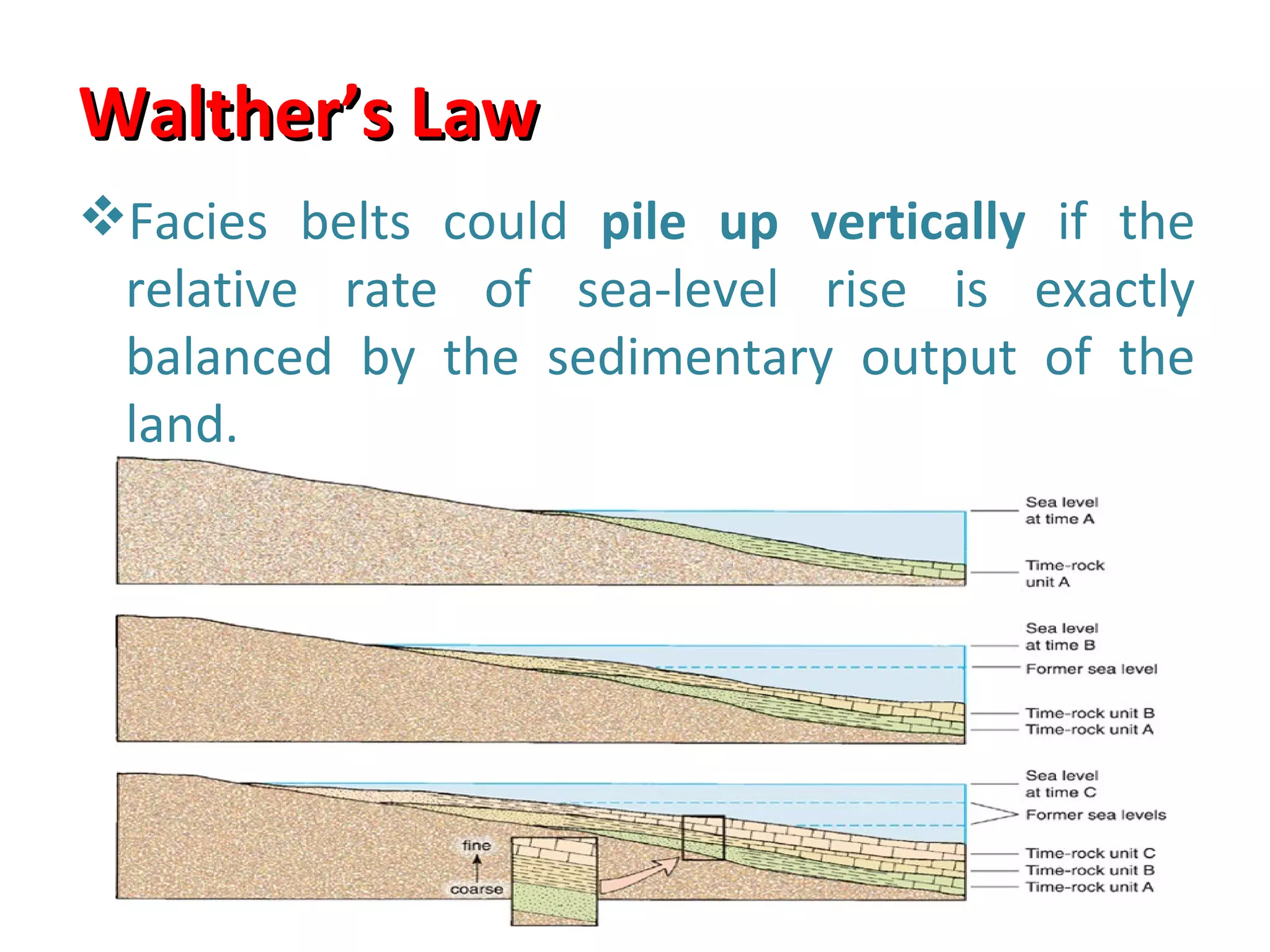
Facies belts could pile up vertically if the
 relative rate of sea-level rise is exactly
 balanced by the sedimentary output of the
 land.
Walther’s Law
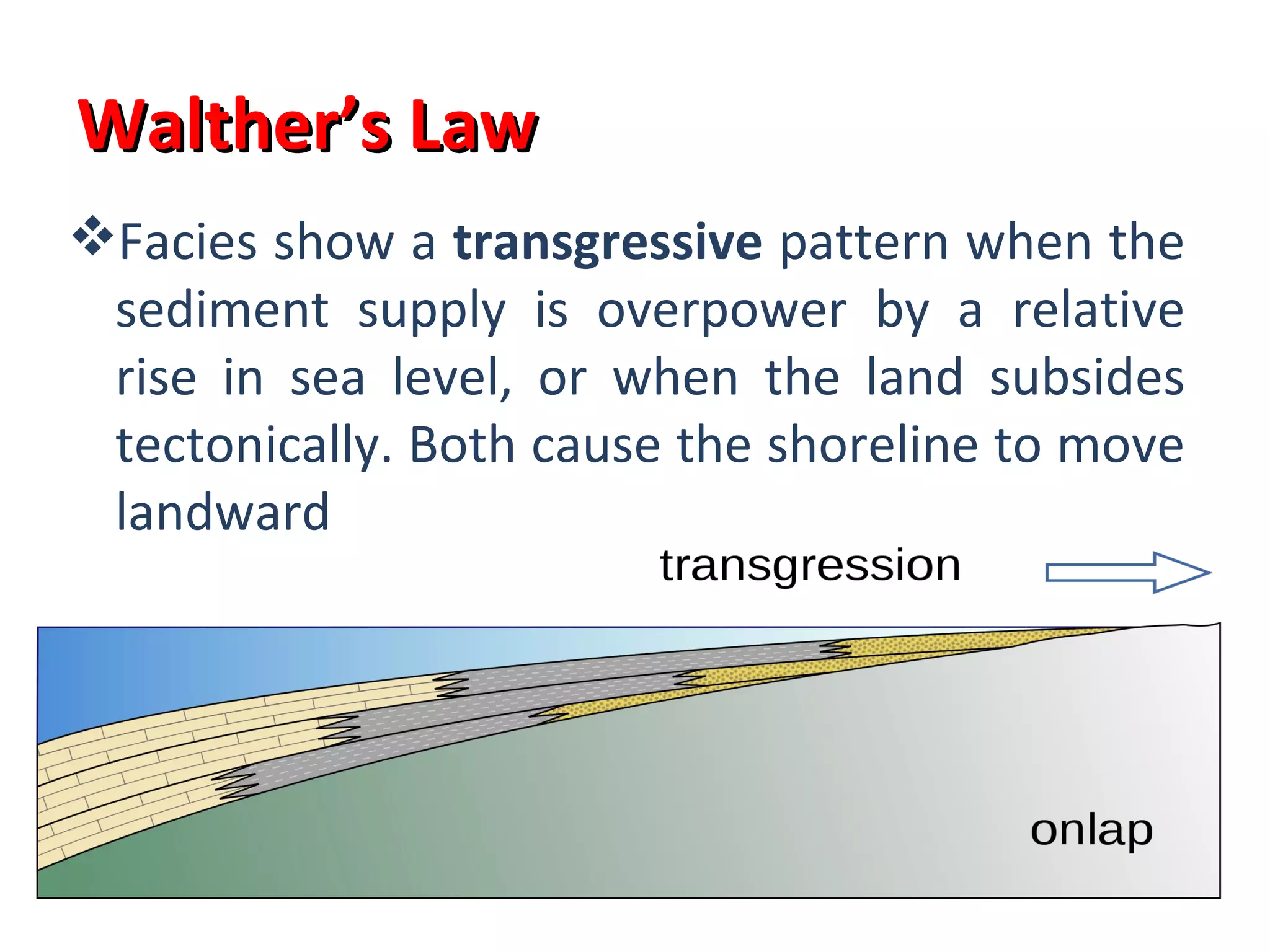
Facies show a transgressive pattern when the
 sediment supply is overpower by a relative
 rise in sea level, or when the land subsides
 tectonically. Both cause the shoreline to move
 landward
Walther’s Law
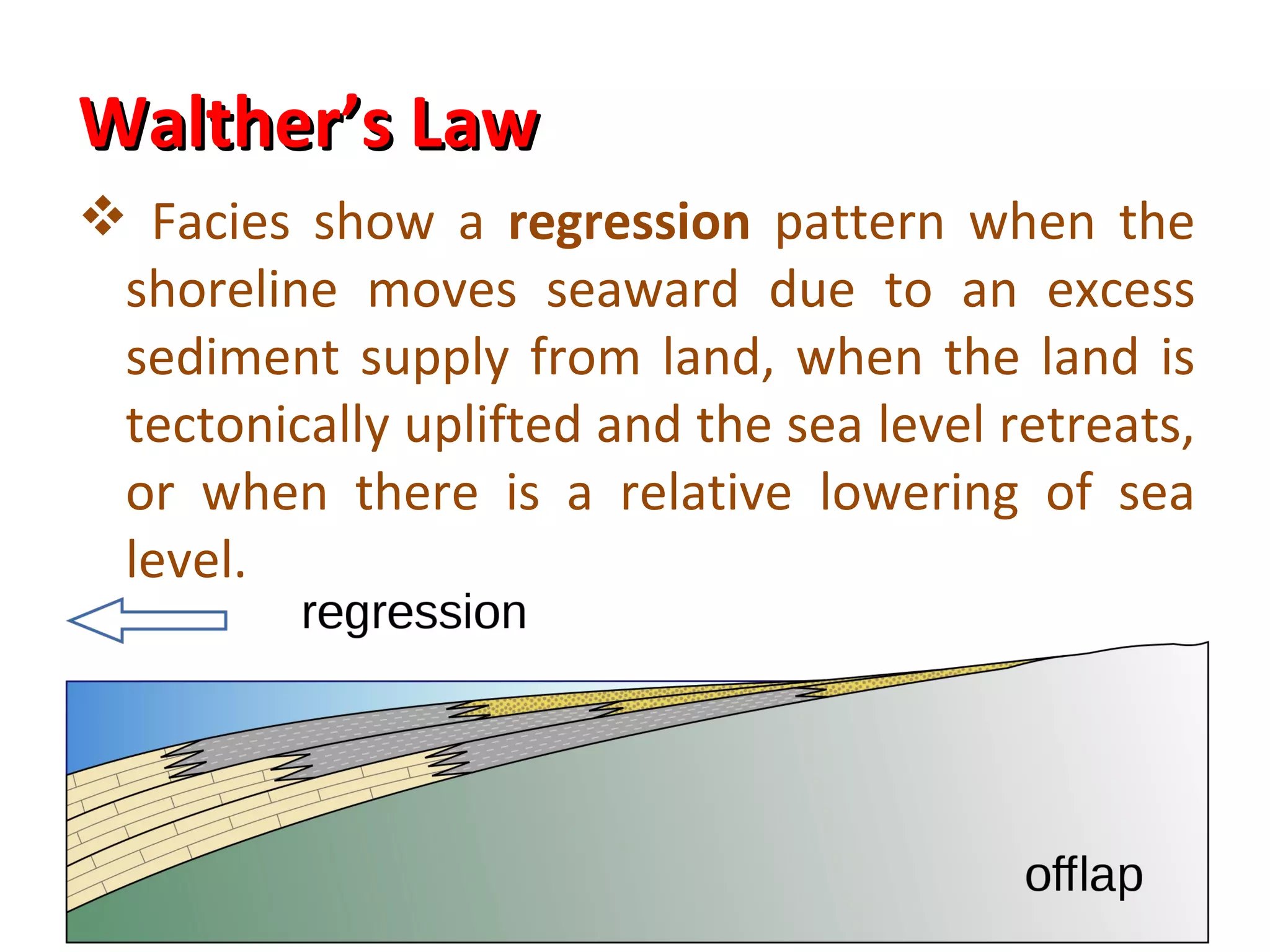
 Facies show a regression pattern when the
 shoreline moves seaward due to an excess
 sediment supply from land, when the land is
 tectonically uplifted and the sea level retreats,
 or when there is a relative lowering of sea
 level.
Walther’s Law
                Exceptions


• The law is invalid where the contact between
  different lithologies is non-conformable (due to
  lack of deposition), or during cases of rapid
  environmental change when non-adjacent
  environments may replace one another.

Walther’s law of correlation of facies

  • 1.
    Walther’s law ofcorrelation of facies The principle that facies that occur in conformable vertical successions of strata also occur in laterally adjacent environments. [A vertical progression of facies can be found corresponding lateral facies changes]
  • 2.
    Walther’s Principle < vertical and horizontal facies match > The various deposits of the same facies-area and similarly the sum of the rocks of different facies- areas are formed beside each other in space, though in a cross section we see them lying on top of each other. As with biotypes, it is a basic statement of far reaching significance that only those facies and facies-areas can be superimposed primarily which can be observed beside each other at the present time.
  • 3.
    Walther’s Law • Sedimentaryrock types record the environment of their deposition. • Depositional environments can shift laterally as conditions change. • When so, laterally related environments become superimposed. • Time-transgressive sedimentary formations, are the result. • The vertical succession and lateral sequence of facies will be the same.
  • 5.
    Walther’s Law • Certainfacies associations are common in the rock record. • For example, most clastic shoreline show a series of depositional environments that are progressively finer-grained in the offshore direction. • There are facies belts of coarses sands, and silts and clays. If the relative sea level changes, deposits of these facies belts accumulate. • Three facies pattern are possible.
  • 6.
    Walther’s Law Facies beltscould pile up vertically if the relative rate of sea-level rise is exactly balanced by the sedimentary output of the land.
  • 7.
    Walther’s Law Facies showa transgressive pattern when the sediment supply is overpower by a relative rise in sea level, or when the land subsides tectonically. Both cause the shoreline to move landward
  • 8.
    Walther’s Law  Faciesshow a regression pattern when the shoreline moves seaward due to an excess sediment supply from land, when the land is tectonically uplifted and the sea level retreats, or when there is a relative lowering of sea level.
  • 9.
    Walther’s Law Exceptions • The law is invalid where the contact between different lithologies is non-conformable (due to lack of deposition), or during cases of rapid environmental change when non-adjacent environments may replace one another.