
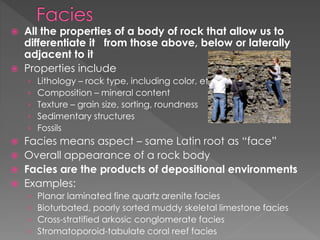
 All the properties of a body of rock that allow us to
differentiate it from those above, below or laterally
adjacent to it
 Properties include
› Lithology – rock type, including color, etc.
› Composition – mineral content
› Texture – grain size, sorting, roundness
› Sedimentary structures
› Fossils
 Facies means aspect – same Latin root as “face”
 Overall appearance of a rock body
 Facies are the products of depositional environments
 Examples:
› Planar laminated fine quartz arenite facies
› Bioturbated, poorly sorted muddy skeletal limestone facies
› Cross-stratified arkosic conglomerate facies
› Stromatoporoid-tabulate coral reef facies
 Facies migrate through space and time
 Migration is in response to environmental
factors
› Sediment supply
› Sea level change
› Subsidence
 Facies become stacked during migration
 A single facies is likely to be different
ages in different locations
 Groups of facies commonly show patterns
 Proximal Facies (near the source) tend to
be coarse grained
 Distal Facies (far from source) tend to be
finer grained
 This pattern is displayed upstream and
down in rivers and onshore to offshore in
coastal areas
 Facies are arranged according to
distribution of depositional environments
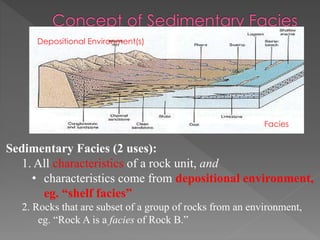
Sedimentary Facies (2 uses):
1. All characteristics of a rock unit, and
• characteristics come from depositional environment,
eg. “shelf facies”
2. Rocks that are subset of a group of rocks from an environment,
eg. “Rock A is a facies of Rock B.”
Facies
Depositional Environment(s)
QuickTime™ and a
TIFF(Uncompressed) decompressor
are needed to see this picture.
A = Sandstone facies (beach environment)
B = Shale facies (offshore marine environment)
C = Limestone facies (far from sources of terrigenous input)
Facies Change
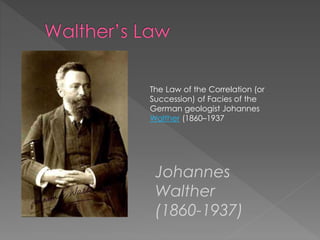
Johannes
Walther
(1860-1937)
The Law of the Correlation (or
Succession) of Facies of the
German geologist Johannes
Walther (1860–1937
 Walther's Law of Facies,
named after the geologist
Johannes Walther, states that
the vertical succession of
facies reflects lateral changes
in environment. Conversely, it
states that when a
depositional environment
"migrates" laterally, sediments
of one depositional
environment come to lie on
top of another.[3] A classic
example of this law is the
vertical stratigraphic
succession that typifies marine
trangressions and regressions.
However, the law is not
applicable where the contact
between different lithologies is
non-conformable (i.e.
sedimentation was not
continuous), or in instances of
rapid environmental change
where non-adjacent
environments may replace
one another.
http://faculty.weber.edu/bdattilo//fossils/notes/facies.html
 Recognition of lateral variation
› Because rocks are not constant through space,
you get a variation in lithology within one unit.
 Initially people didn’t recognize this-
› Thought Noah’s flood left layer cake layers of
strata that extended to ends of Earth without
change in lithology or thickness
 Began to trace beds
 walked them
 looked at how the rocks between the boundaries
changed
 realized fallacy of idea
› We retain layer cake to describe stacking
pattern; not infinite nature
 “Only those lithofacies which are a product of
sedimentary environments found adjacent to one
another in the modern can be occur superimposed in
continuous, uninterrupted stratigraphic succession.”
 Relationship between vertical and lateral
variations
 The fact that there is lateral variation in facies
leads to vertical variation in facies
 Walther’s Law of Correlation of Facies
 Lateral variations are expressed in the
vertical due to the succession of facies
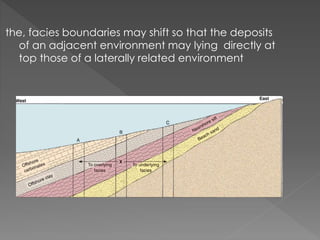
the, facies boundaries may shift so that the deposits
of an adjacent environment may lying directly at
top those of a laterally related environment
 Certain facies associations are common in
the rock record.• For example, most clastic
shoreline show a series of depositional
environments that are progressively finer-
grained in the offshore direction.
 • There are facies belts of coarses sands,
and silts and clays. If the relative sea level
changes, deposits of these facies belts
accumulate.• Three facies pattern are
possible.
 In the other word the same section that is
present vertically also present horizontal
unless there is break in sedimentation.
 A vertical change’s of facie’s with in a
relatively conformable succession of
genetically related strata.
 Facies show a transgressive pattern6.
Walther’s Law when the sediment supply is
overpower by a relative rise in sea level, or
when the land subsides tectonically. Both
cause the shoreline to move landward
 Facies show a regression pattern7.
Walther’s Law when the shoreline moves
seaward due to an excess sediment supply
from land, when the land is tectonically
uplifted and the sea level retreats, or when
there is a relative lowering of sea level.
 Only works where there are no unconformities
 Only facies that were laterally adjacent during
deposition (result of laterally adjacent
environments) can be stacked vertically
 Vertical arrangement of facies gives us
information on
› Distribution of environments
› How environments migrated through space and
time
 Used as a basis to build facies maps or
paleogeographic maps
 Accurate time correlation of facies is essential
 Time lines provide framework for correlation
› Bio-events
› Volcanic ashes
› Other thin, unique lithologies or marker beds
The Law of the Correlation (or
Succession) of Facies of the German
geologist Johannes Walther (1860–
1937used widely in the interpretation of
sedimentary sections
Walther's Law is used to interpret the
depositional setting of these parcels of
sediment.
the application of Walther's Law have
made this law a very POWERFUL tool and
all sedimentary stratigraphers use it
An example of the application of Walther's
Law can be seen in Coe et al's (2003)
interpretation of the depositional setting of
high frequency clastic parasequences from
sections measured in the Book Cliff
escarpment
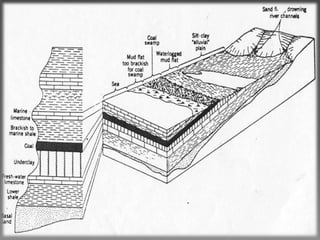
Using this principle, a vertical succession, encountered say as drill core is
retrieved, of sandstone over shale over limestone, can be read as regression
(offlap), and a vertical succession of limestone over shale over sand, can be
read as transgression (onlap) of an epeiric (continental shelf and interior,
shallow) sea (Figure c15.1). Walther had originally applied his principle
for the correlation of facies to arguefor the deepening of a
transgressive
 THANKS

facies, walther's law by Junaid

  • 3.
     All theproperties of a body of rock that allow us to differentiate it from those above, below or laterally adjacent to it  Properties include › Lithology – rock type, including color, etc. › Composition – mineral content › Texture – grain size, sorting, roundness › Sedimentary structures › Fossils  Facies means aspect – same Latin root as “face”  Overall appearance of a rock body  Facies are the products of depositional environments  Examples: › Planar laminated fine quartz arenite facies › Bioturbated, poorly sorted muddy skeletal limestone facies › Cross-stratified arkosic conglomerate facies › Stromatoporoid-tabulate coral reef facies
  • 4.
     Facies migratethrough space and time  Migration is in response to environmental factors › Sediment supply › Sea level change › Subsidence  Facies become stacked during migration  A single facies is likely to be different ages in different locations
  • 5.
     Groups offacies commonly show patterns  Proximal Facies (near the source) tend to be coarse grained  Distal Facies (far from source) tend to be finer grained  This pattern is displayed upstream and down in rivers and onshore to offshore in coastal areas  Facies are arranged according to distribution of depositional environments
  • 6.
    Sedimentary Facies (2uses): 1. All characteristics of a rock unit, and • characteristics come from depositional environment, eg. “shelf facies” 2. Rocks that are subset of a group of rocks from an environment, eg. “Rock A is a facies of Rock B.” Facies Depositional Environment(s)
  • 7.
    QuickTime™ and a TIFF(Uncompressed)decompressor are needed to see this picture. A = Sandstone facies (beach environment) B = Shale facies (offshore marine environment) C = Limestone facies (far from sources of terrigenous input) Facies Change
  • 8.
    Johannes Walther (1860-1937) The Law ofthe Correlation (or Succession) of Facies of the German geologist Johannes Walther (1860–1937
  • 9.
     Walther's Lawof Facies, named after the geologist Johannes Walther, states that the vertical succession of facies reflects lateral changes in environment. Conversely, it states that when a depositional environment "migrates" laterally, sediments of one depositional environment come to lie on top of another.[3] A classic example of this law is the vertical stratigraphic succession that typifies marine trangressions and regressions. However, the law is not applicable where the contact between different lithologies is non-conformable (i.e. sedimentation was not continuous), or in instances of rapid environmental change where non-adjacent environments may replace one another. http://faculty.weber.edu/bdattilo//fossils/notes/facies.html
  • 10.
     Recognition oflateral variation › Because rocks are not constant through space, you get a variation in lithology within one unit.  Initially people didn’t recognize this- › Thought Noah’s flood left layer cake layers of strata that extended to ends of Earth without change in lithology or thickness  Began to trace beds  walked them  looked at how the rocks between the boundaries changed  realized fallacy of idea › We retain layer cake to describe stacking pattern; not infinite nature
  • 11.
     “Only thoselithofacies which are a product of sedimentary environments found adjacent to one another in the modern can be occur superimposed in continuous, uninterrupted stratigraphic succession.”
  • 12.
     Relationship betweenvertical and lateral variations  The fact that there is lateral variation in facies leads to vertical variation in facies  Walther’s Law of Correlation of Facies  Lateral variations are expressed in the vertical due to the succession of facies
  • 13.
    the, facies boundariesmay shift so that the deposits of an adjacent environment may lying directly at top those of a laterally related environment
  • 14.
     Certain faciesassociations are common in the rock record.• For example, most clastic shoreline show a series of depositional environments that are progressively finer- grained in the offshore direction.  • There are facies belts of coarses sands, and silts and clays. If the relative sea level changes, deposits of these facies belts accumulate.• Three facies pattern are possible.
  • 15.
     In theother word the same section that is present vertically also present horizontal unless there is break in sedimentation.  A vertical change’s of facie’s with in a relatively conformable succession of genetically related strata.
  • 16.
     Facies showa transgressive pattern6. Walther’s Law when the sediment supply is overpower by a relative rise in sea level, or when the land subsides tectonically. Both cause the shoreline to move landward  Facies show a regression pattern7. Walther’s Law when the shoreline moves seaward due to an excess sediment supply from land, when the land is tectonically uplifted and the sea level retreats, or when there is a relative lowering of sea level.
  • 18.
     Only workswhere there are no unconformities  Only facies that were laterally adjacent during deposition (result of laterally adjacent environments) can be stacked vertically  Vertical arrangement of facies gives us information on › Distribution of environments › How environments migrated through space and time  Used as a basis to build facies maps or paleogeographic maps  Accurate time correlation of facies is essential  Time lines provide framework for correlation › Bio-events › Volcanic ashes › Other thin, unique lithologies or marker beds
  • 19.
    The Law ofthe Correlation (or Succession) of Facies of the German geologist Johannes Walther (1860– 1937used widely in the interpretation of sedimentary sections Walther's Law is used to interpret the depositional setting of these parcels of sediment. the application of Walther's Law have made this law a very POWERFUL tool and all sedimentary stratigraphers use it An example of the application of Walther's Law can be seen in Coe et al's (2003) interpretation of the depositional setting of high frequency clastic parasequences from sections measured in the Book Cliff escarpment
  • 20.
    Using this principle,a vertical succession, encountered say as drill core is retrieved, of sandstone over shale over limestone, can be read as regression (offlap), and a vertical succession of limestone over shale over sand, can be read as transgression (onlap) of an epeiric (continental shelf and interior, shallow) sea (Figure c15.1). Walther had originally applied his principle for the correlation of facies to arguefor the deepening of a transgressive
  • 21.