


PATTERN RECOGNITION
Recognize pattern and face
Presented by : Anup, Randhir and Shailesh
1
Intro
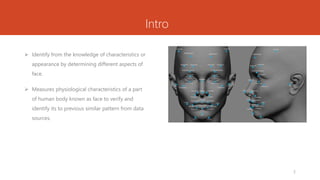
 Identify from the knowledge of characteristics or
appearance by determining different aspects of
face.
 Measures physiological characteristics of a part
of human body known as face to verify and
identify its to previous similar pattern from data
sources.
2
Abstract
Humans detect and identify faces in a scene with little or no effort. We present a system for recognizing human
faces from single images out of a large database containing one image per person. However, building an
automated system that accomplishes this task is very difficult. There are several related sub-problems:
 detection of a pattern as a face,
 identification of the face,
 analysis of facial expressions, and
 classification based on physical features of the face.
3
Importance
A system that performs these operations will find many applications,
 Facebook includes facial recognition system.
 criminal identification,
 authentication in secure systems, etc.
4
Process
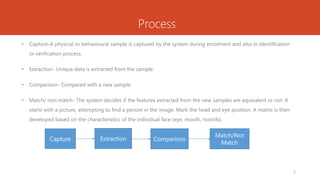
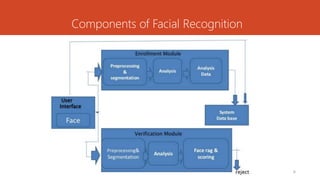
• Capture-A physical or behavioural sample is captured by the system during enrolment and also in identification
or verification process.
• Extraction- Unique data is extracted from the sample.
• Comparison- Compared with a new sample.
• Match/ non match- The system decides if the features extracted from the new samples are equivalent or not. It
starts with a picture, attempting to find a person in the image. Mark the head and eye position. A matrix is then
developed based on the characteristics of the individual face (eye, mouth, nostrils).
Capture Extraction Comparison
Match/Not
Match
5
Components of Facial Recognition
6
Implementation of Face Recognition System
 Face Image Data acquisition and Database Creation
 Input Processing
 Face image classification and decision making
7
Face Image Data Acquisition and
Database Creation
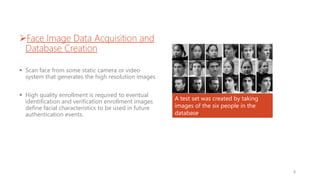
 Scan face from some static camera or video
system that generates the high resolution images
 High quality enrollment is required to eventual
identification and verification enrollment images
define facial characteristics to be used in future
authentication events.
A test set was created by taking
images of the six people in the
database.
8
Input Processing
A pre-processing module marks the eye position and also looks after the surrounding lighting condition
and colour variance. After the face is detection, localization and normalization are carried out. The
appearance of the face can change considerably during speech and due to facial expressions. Some
facial recognition approaches use the whole face while others concentrate on facial components and/
or regions such as:
• distance between eyes and depth of it
• lips
• nose
• cheeks
• jaw line
• chin
9
Face Image Classification and Decision Making
Synergetic computer are used to classify optical and audio features, respectively. A synergetic
computer is a set of algorithm that simulate synergetic phenomena. In training phase the BIOID
creates a prototype called face print for each person. A newly recorded pattern is pre-processed and
compared with each face print stored in the database. As comparisons are made, the system assigns
a value to the comparison using a scale of one to ten. If a score is above a predetermined threshold,
a match is declared.
10
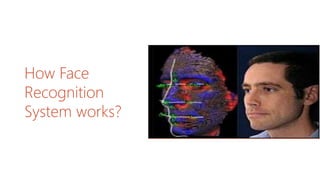
How Face
Recognition
System works?
Intuitively design beautiful presentations,
easily share and work together with others
and give a professional performance with
advanced presenting tools.
Face recognition system work by a particular software. There are about 80 nodal points on a human face. Here
are few nodal points that are measured by the software:
 Distance between the eyes
 Width of the nose
 Depth of the eye socket
 Cheekbones
 Jaw line
 Chin
These nodal points are measured to create a numerical code, a string of numbers that represent a face in the
database. This code is called face print. Only 14 to 22 nodal points are needed for detecting face and complete
the recognition process.
 Nodal Point
 Alignment
 Normalization
 Representation
 Matching
12
Elastic Bunch Graph Matching
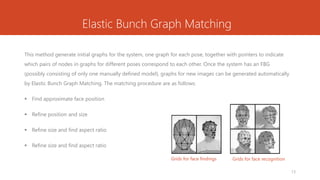
This method generate initial graphs for the system, one graph for each pose, together with pointers to indicate
which pairs of nodes in graphs for different poses correspond to each other. Once the system has an FBG
(possibly consisting of only one manually defined model), graphs for new images can be generated automatically
by Elastic Bunch Graph Matching. The matching procedure are as follows:
 Find approximate face position
 Refine position and size
 Refine size and find aspect ratio
13
Grids for face findings Grids for face recognition
ADVANTAGES AND DISADVANTAGES
Advantages
• There are many benefits to face recognition systems such as its convenience and Social acceptability. all you
need is your picture taken for it to work.
• Face recognition is easy to use and in many cases it can be performed without a Person even knowing.
• Face recognition is also one of the most inexpensive biometric in the market and Its price should continue
to go down.
Disadvantages
• Face recognition systems can’t tell the difference between identical twins.
14
Conclusion
Face recognition methods have been related
with very expensive secure applications. Some
applications of face recognition technology
are economical, reliable and highly accurate.
So there is no technological or financial
obstacle to move to widespread deployment.
16

Pattern recognition

  • 1.
    PATTERN RECOGNITION Recognize patternand face Presented by : Anup, Randhir and Shailesh 1
  • 2.
    Intro  Identify fromthe knowledge of characteristics or appearance by determining different aspects of face.  Measures physiological characteristics of a part of human body known as face to verify and identify its to previous similar pattern from data sources. 2
  • 3.
    Abstract Humans detect andidentify faces in a scene with little or no effort. We present a system for recognizing human faces from single images out of a large database containing one image per person. However, building an automated system that accomplishes this task is very difficult. There are several related sub-problems:  detection of a pattern as a face,  identification of the face,  analysis of facial expressions, and  classification based on physical features of the face. 3
  • 4.
    Importance A system thatperforms these operations will find many applications,  Facebook includes facial recognition system.  criminal identification,  authentication in secure systems, etc. 4
  • 5.
    Process • Capture-A physicalor behavioural sample is captured by the system during enrolment and also in identification or verification process. • Extraction- Unique data is extracted from the sample. • Comparison- Compared with a new sample. • Match/ non match- The system decides if the features extracted from the new samples are equivalent or not. It starts with a picture, attempting to find a person in the image. Mark the head and eye position. A matrix is then developed based on the characteristics of the individual face (eye, mouth, nostrils). Capture Extraction Comparison Match/Not Match 5
  • 6.
    Components of FacialRecognition 6
  • 7.
    Implementation of FaceRecognition System  Face Image Data acquisition and Database Creation  Input Processing  Face image classification and decision making 7
  • 8.
    Face Image DataAcquisition and Database Creation  Scan face from some static camera or video system that generates the high resolution images  High quality enrollment is required to eventual identification and verification enrollment images define facial characteristics to be used in future authentication events. A test set was created by taking images of the six people in the database. 8
  • 9.
    Input Processing A pre-processingmodule marks the eye position and also looks after the surrounding lighting condition and colour variance. After the face is detection, localization and normalization are carried out. The appearance of the face can change considerably during speech and due to facial expressions. Some facial recognition approaches use the whole face while others concentrate on facial components and/ or regions such as: • distance between eyes and depth of it • lips • nose • cheeks • jaw line • chin 9
  • 10.
    Face Image Classificationand Decision Making Synergetic computer are used to classify optical and audio features, respectively. A synergetic computer is a set of algorithm that simulate synergetic phenomena. In training phase the BIOID creates a prototype called face print for each person. A newly recorded pattern is pre-processed and compared with each face print stored in the database. As comparisons are made, the system assigns a value to the comparison using a scale of one to ten. If a score is above a predetermined threshold, a match is declared. 10
  • 11.
    How Face Recognition System works? Intuitivelydesign beautiful presentations, easily share and work together with others and give a professional performance with advanced presenting tools.
  • 12.
    Face recognition systemwork by a particular software. There are about 80 nodal points on a human face. Here are few nodal points that are measured by the software:  Distance between the eyes  Width of the nose  Depth of the eye socket  Cheekbones  Jaw line  Chin These nodal points are measured to create a numerical code, a string of numbers that represent a face in the database. This code is called face print. Only 14 to 22 nodal points are needed for detecting face and complete the recognition process.  Nodal Point  Alignment  Normalization  Representation  Matching 12
  • 13.
    Elastic Bunch GraphMatching This method generate initial graphs for the system, one graph for each pose, together with pointers to indicate which pairs of nodes in graphs for different poses correspond to each other. Once the system has an FBG (possibly consisting of only one manually defined model), graphs for new images can be generated automatically by Elastic Bunch Graph Matching. The matching procedure are as follows:  Find approximate face position  Refine position and size  Refine size and find aspect ratio  Refine size and find aspect ratio 13 Grids for face findings Grids for face recognition
  • 14.
    ADVANTAGES AND DISADVANTAGES Advantages •There are many benefits to face recognition systems such as its convenience and Social acceptability. all you need is your picture taken for it to work. • Face recognition is easy to use and in many cases it can be performed without a Person even knowing. • Face recognition is also one of the most inexpensive biometric in the market and Its price should continue to go down. Disadvantages • Face recognition systems can’t tell the difference between identical twins. 14
  • 15.
    Conclusion Face recognition methodshave been related with very expensive secure applications. Some applications of face recognition technology are economical, reliable and highly accurate. So there is no technological or financial obstacle to move to widespread deployment.
  • 16.

Editor's Notes

  • #12 In Slide Show mode, click the arrow to enter the PowerPoint Getting Started Center.
  • #16 In Slide Show mode, click the arrow to enter the PowerPoint Getting Started Center.