F: Conclusions
Let’s Predict the Future!
A half-day workshop
at the SAOIM 2014
conference held on
Tuesday 3 June
2014 facilitated by
Brian Kelly, Cetis
Slides available
under a Creative
Commons licence
(CC-BY)
1
F1: Let’s Predict the Future:
Conclusions
Conclusions
To conclude:
• Technological developments will continue
• User expectations will continue to grow
• Organisations will need to be able to respond to
such change
• Temptations to assume changes will be
managed and beneficial to organisation
Need for:
• Evidence-based mechanisms for detecting
changes
• Open approaches for interpretting trends and
planning for implications of developments
• Ability to be able to respond to the unexpected
2
Methodology
Summary of methodology:
• Monitor signals of developments and trends:
 Quantative: e.g. numerical analyses
 Qualitative: e.g. literature surveys
• Document mechanisms used for observing
trends
• Provide interpretations of trends & implications
e.g. see OUseful and UK Web Focus blogs
• Use systematic processes within organisation /
sector:
 Delphi process
 Scenario planning
 Open feedback
3
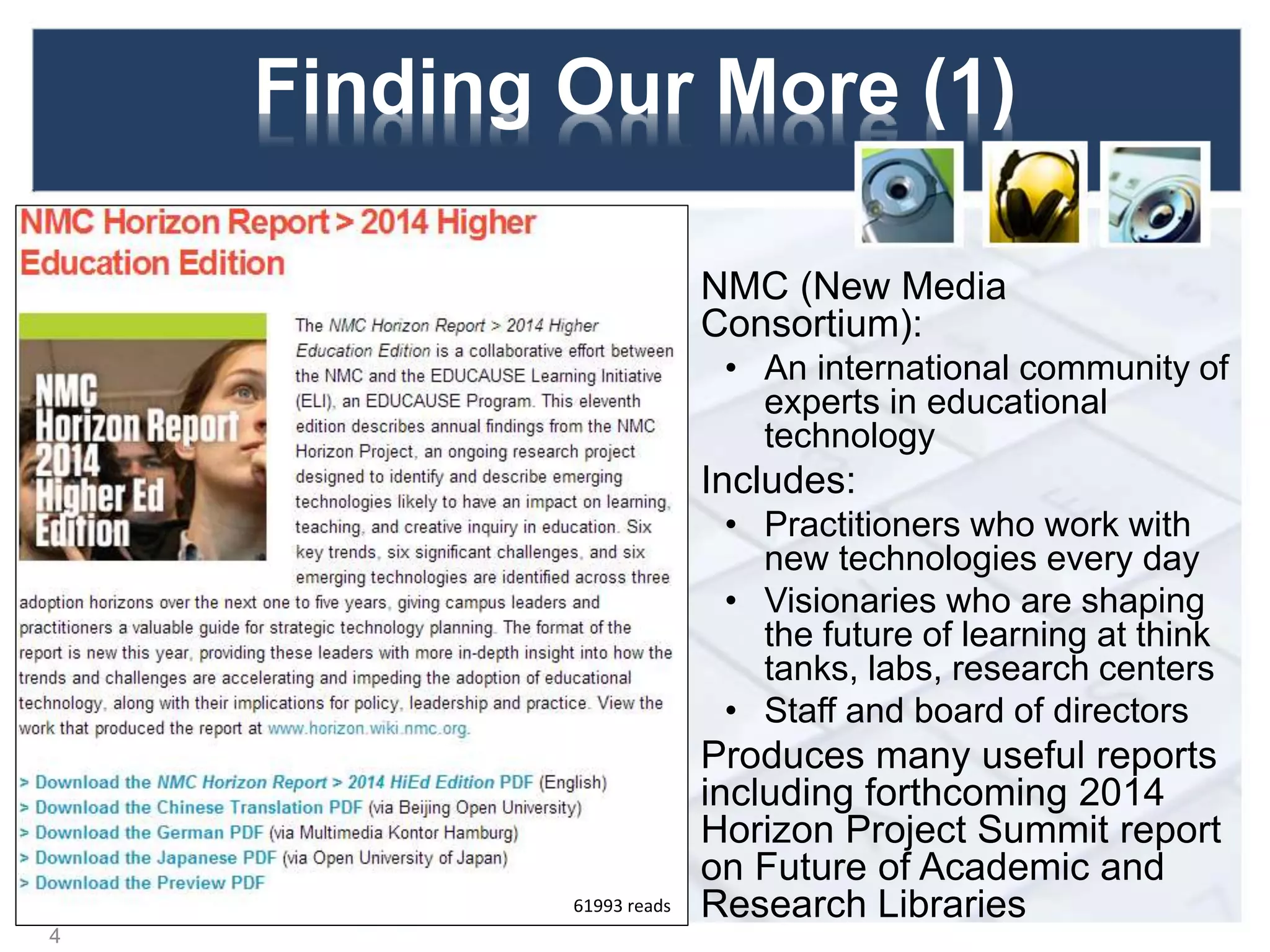
Finding Our More (1)
NMC (New Media
Consortium):
• An international community of
experts in educational
technology
Includes:
• Practitioners who work with
new technologies every day
• Visionaries who are shaping
the future of learning at think
tanks, labs, research centers
• Staff and board of directors
Produces many useful reports
including forthcoming 2014
Horizon Project Summit report
on Future of Academic and
Research Libraries
4
61993 reads
The 2012 Horizon Project Retreat
Top 10 trends:
1. The world of work is increasingly global and
increasingly collaborative.
2. People expect to work, learn, socialise, and play
whenever and wherever they want to.
3. The Internet is becoming a global mobile network
— and already is at its edges.
4. The technologies we use are increasingly cloud-
based and delivered over utility networks,
facilitating the rapid growth of online videos and
rich media.
5. Openness — concepts like open content, open
data, and open resources, along with notions of
transparency and easy access to data and
information — is moving from a trend to a value for
much of the world.
5
In bed?!
The 2012 Horizon Project Retreat
Top 10 trends:
6. Legal notions of ownership and privacy lag behind
the practices common in society.
7. Real challenges of access, efficiency, and scale
are redefining what we mean by quality and
success.
8. The Internet is constantly challenging us to rethink
learning and education, while refining our notion of
literacy.
9. There is a rise in informal learning as individual
needs are redefining schools, universities, and
training.
10. Business models across the education ecosystem
are changing.
6
Leaving the
institution
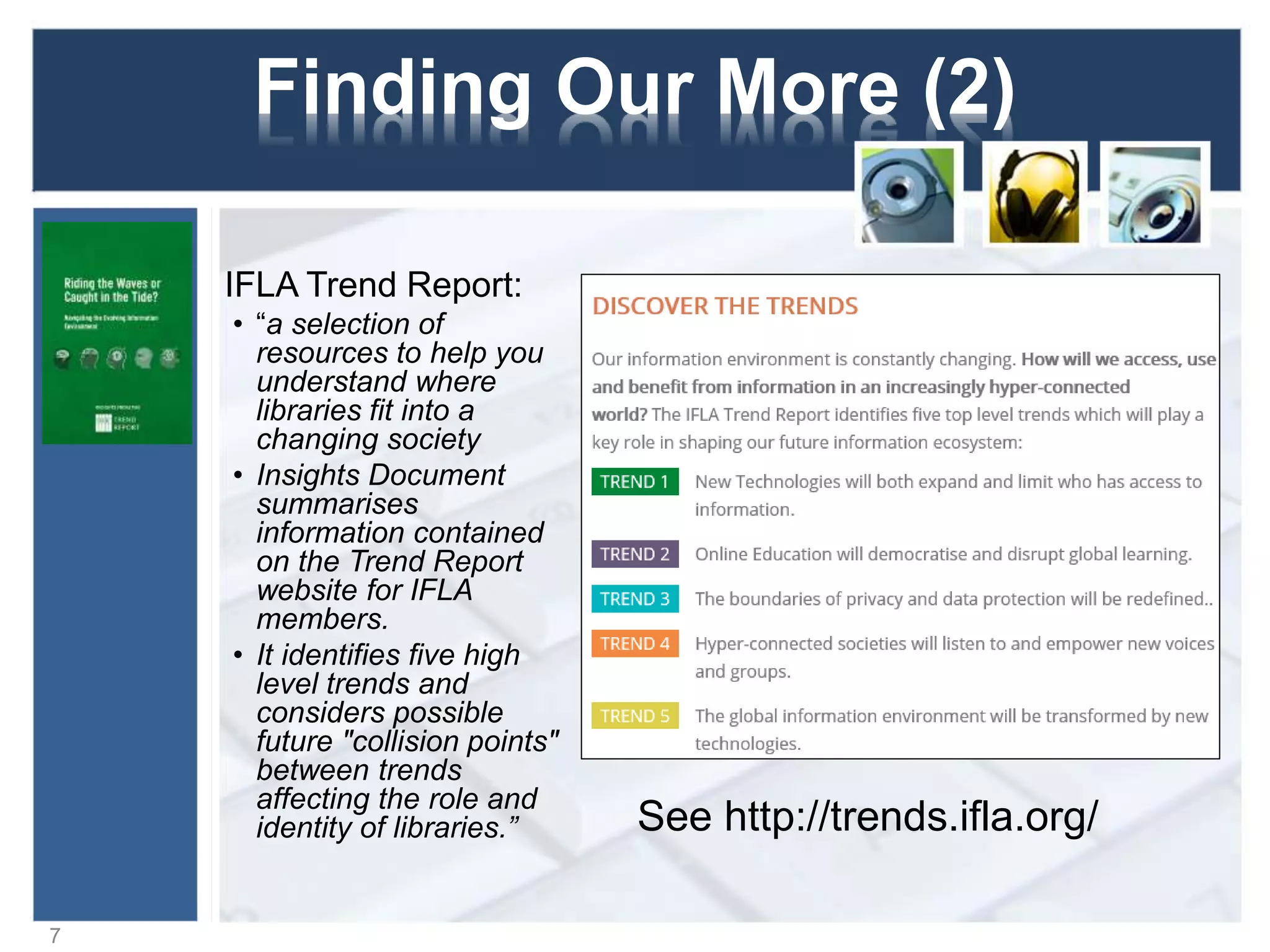
Finding Our More (2)
IFLA Trend Report:
• “a selection of
resources to help you
understand where
libraries fit into a
changing society
• Insights Document
summarises
information contained
on the Trend Report
website for IFLA
members.
• It identifies five high
level trends and
considers possible
future "collision points"
between trends
affecting the role and
identity of libraries.”
7
See http://trends.ifla.org/
IFLA Trends
8
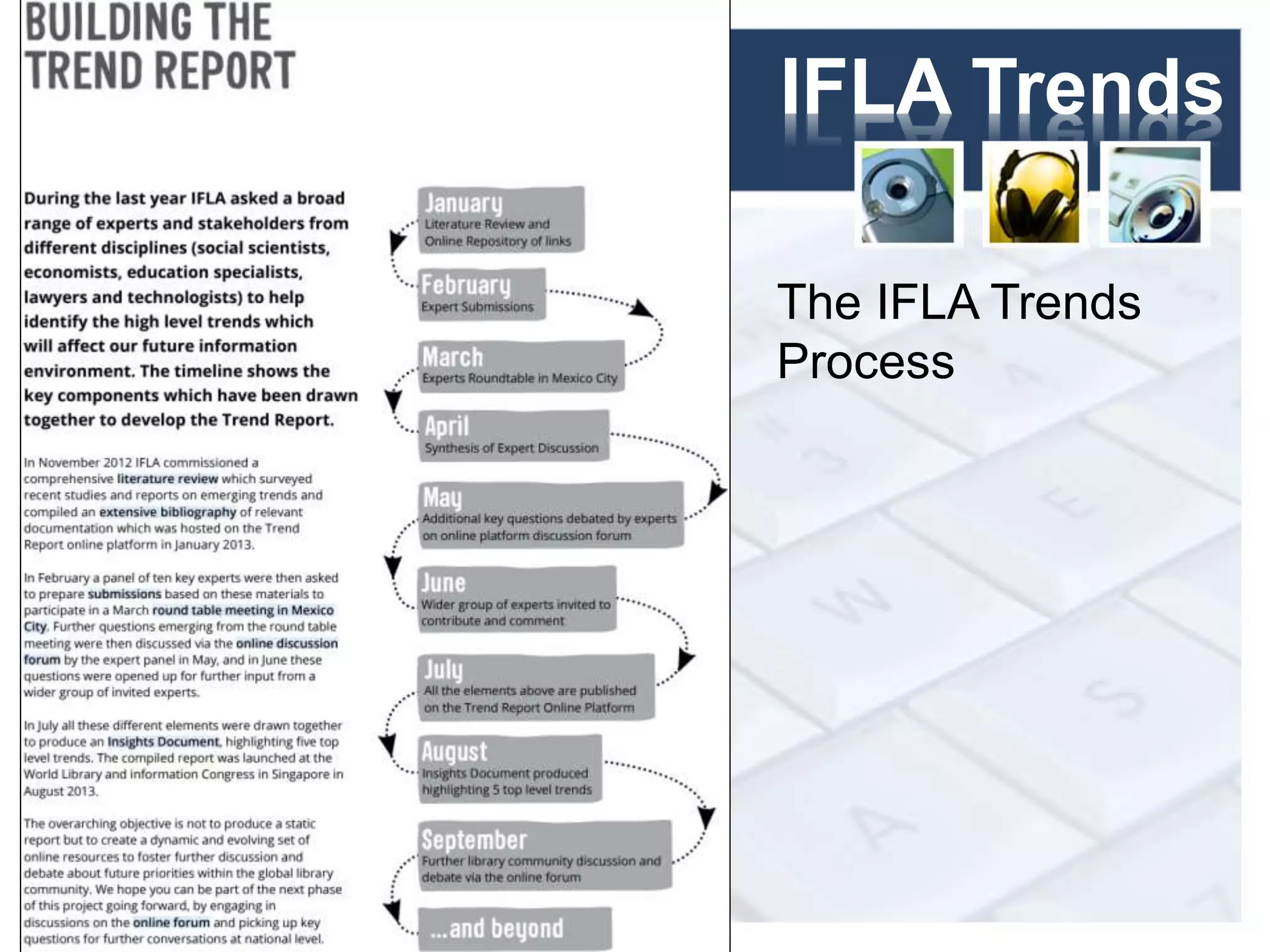
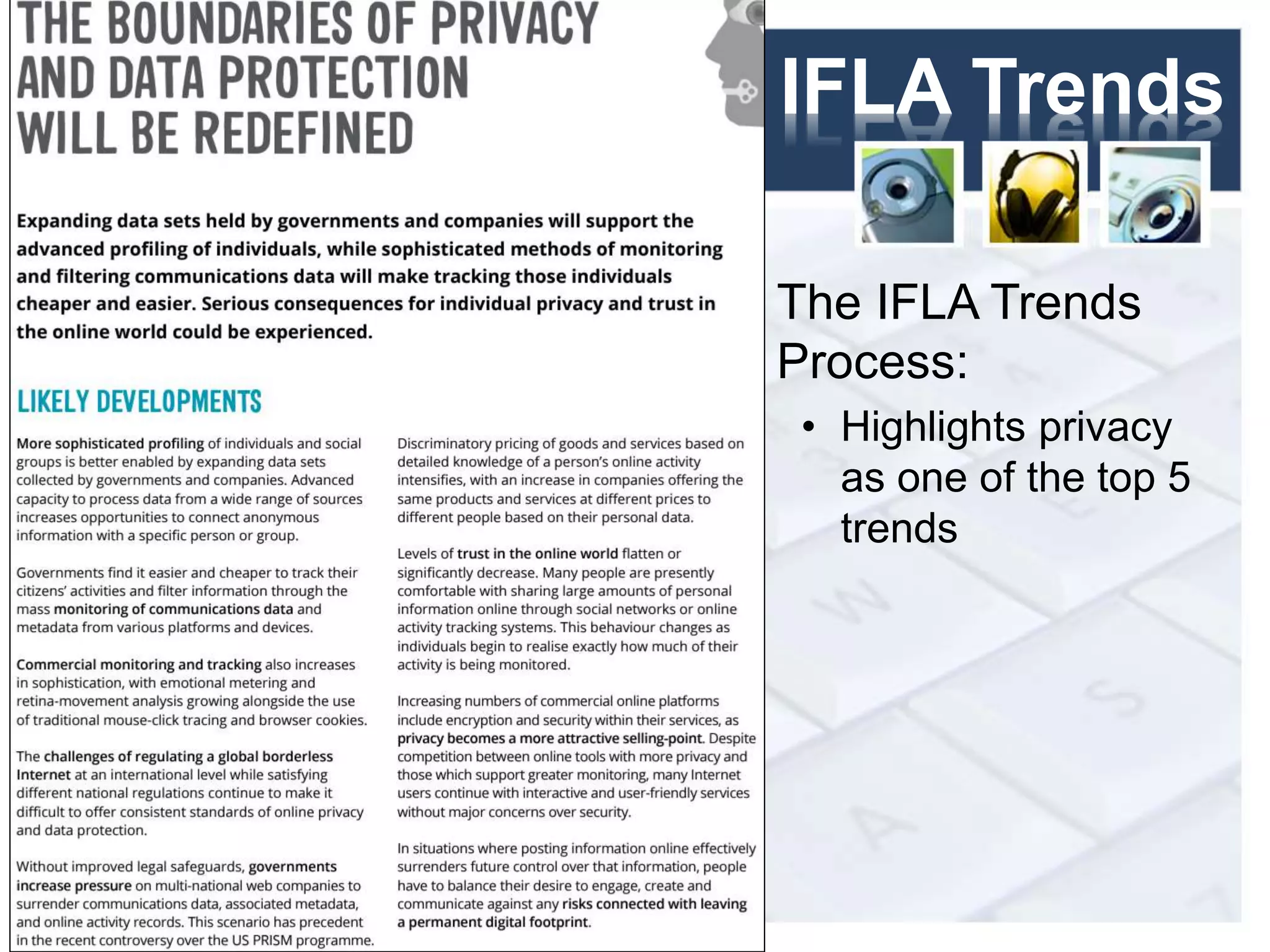
The IFLA Trends
Process
IFLA Trends
The IFLA Trends
Process:
• Highlights privacy
as one of the top 5
trends
9
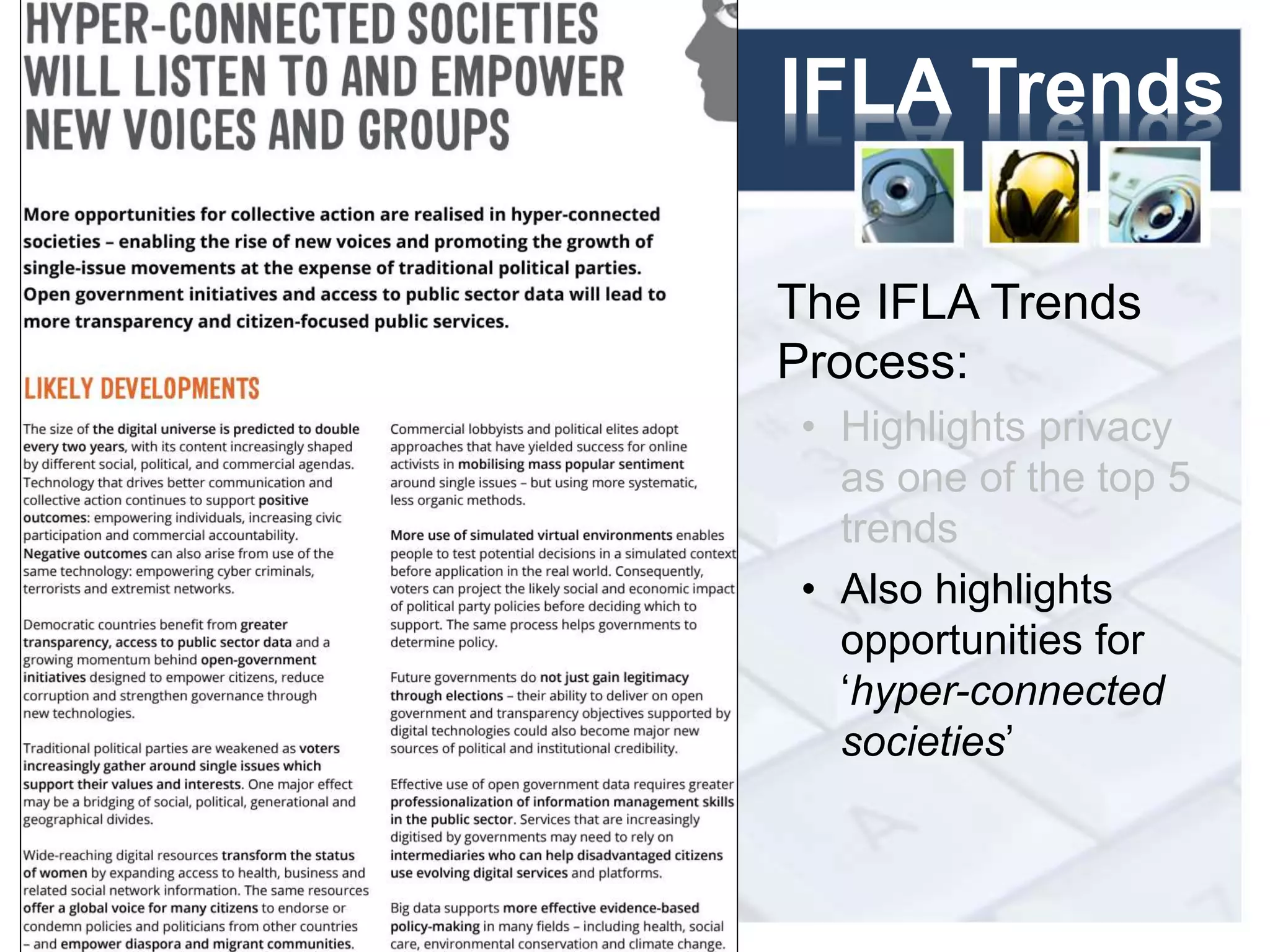
IFLA Trends
The IFLA Trends
Process:
• Highlights privacy
as one of the top 5
trends
• Also highlights
opportunities for
‘hyper-connected
societies’
10
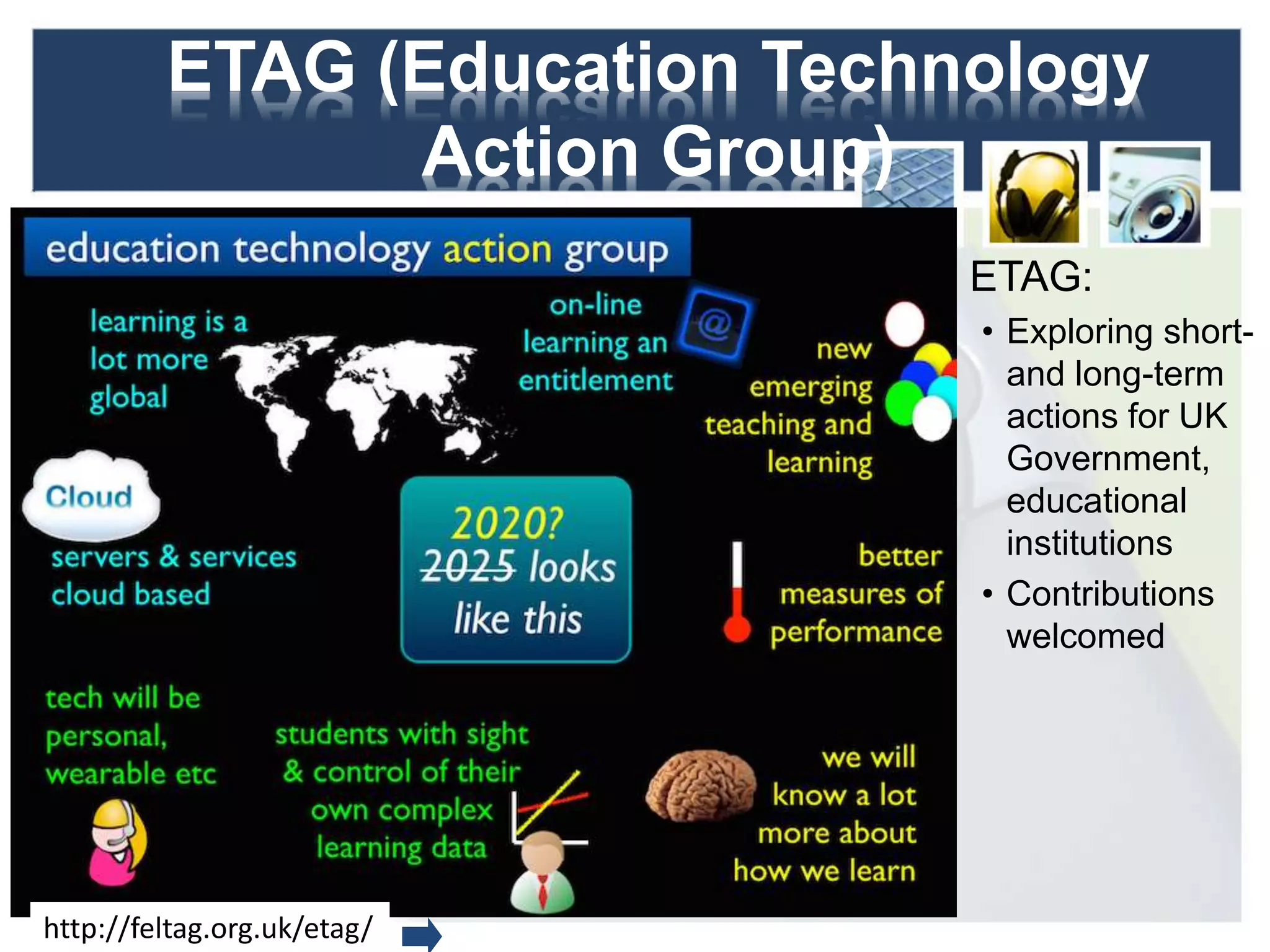
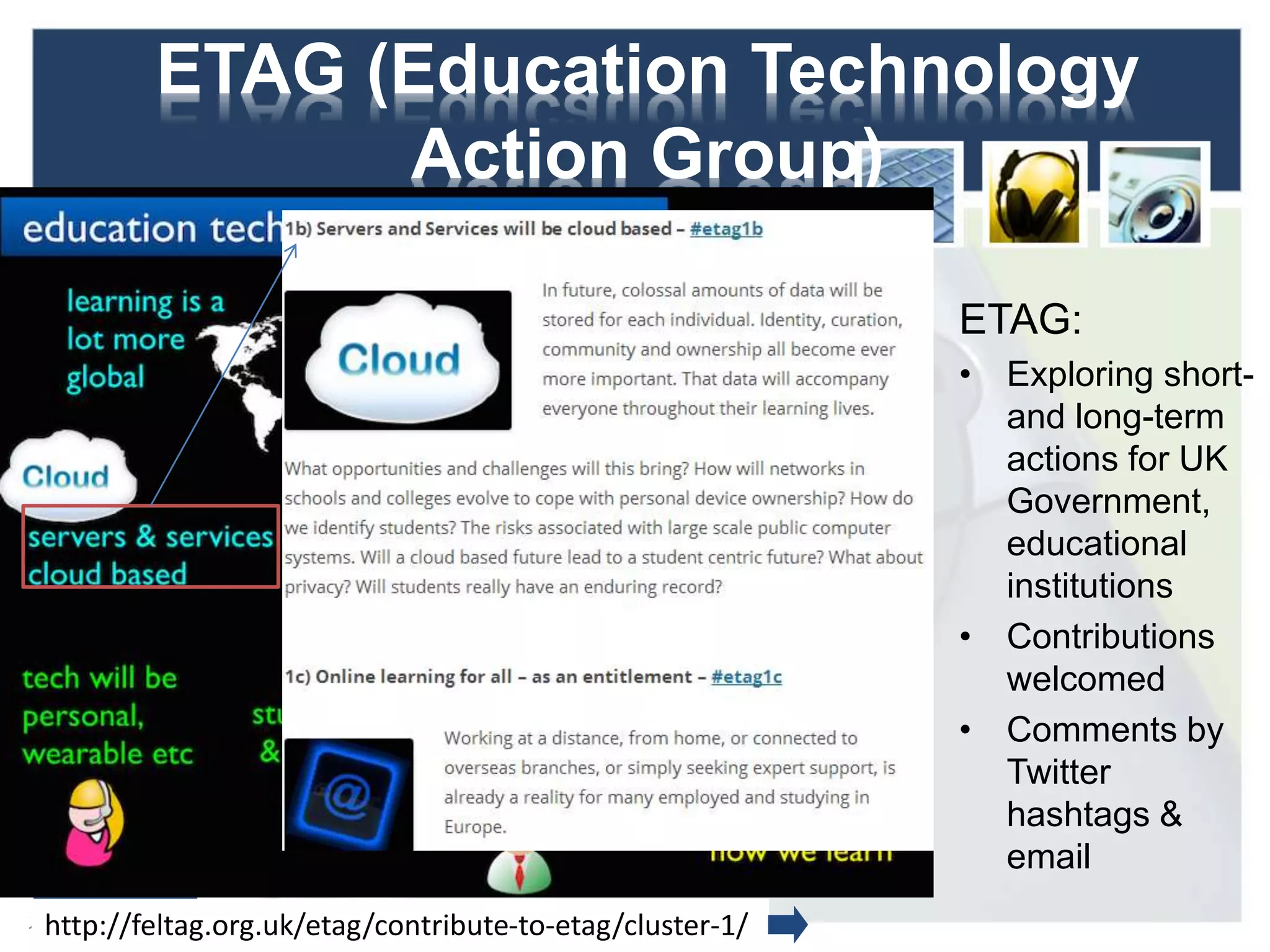
ETAG (Education Technology
Action Group)
ETAG:
• Exploring short-
and long-term
actions for UK
Government,
educational
institutions
• Contributions
welcomed
11http://feltag.org.uk/etag/
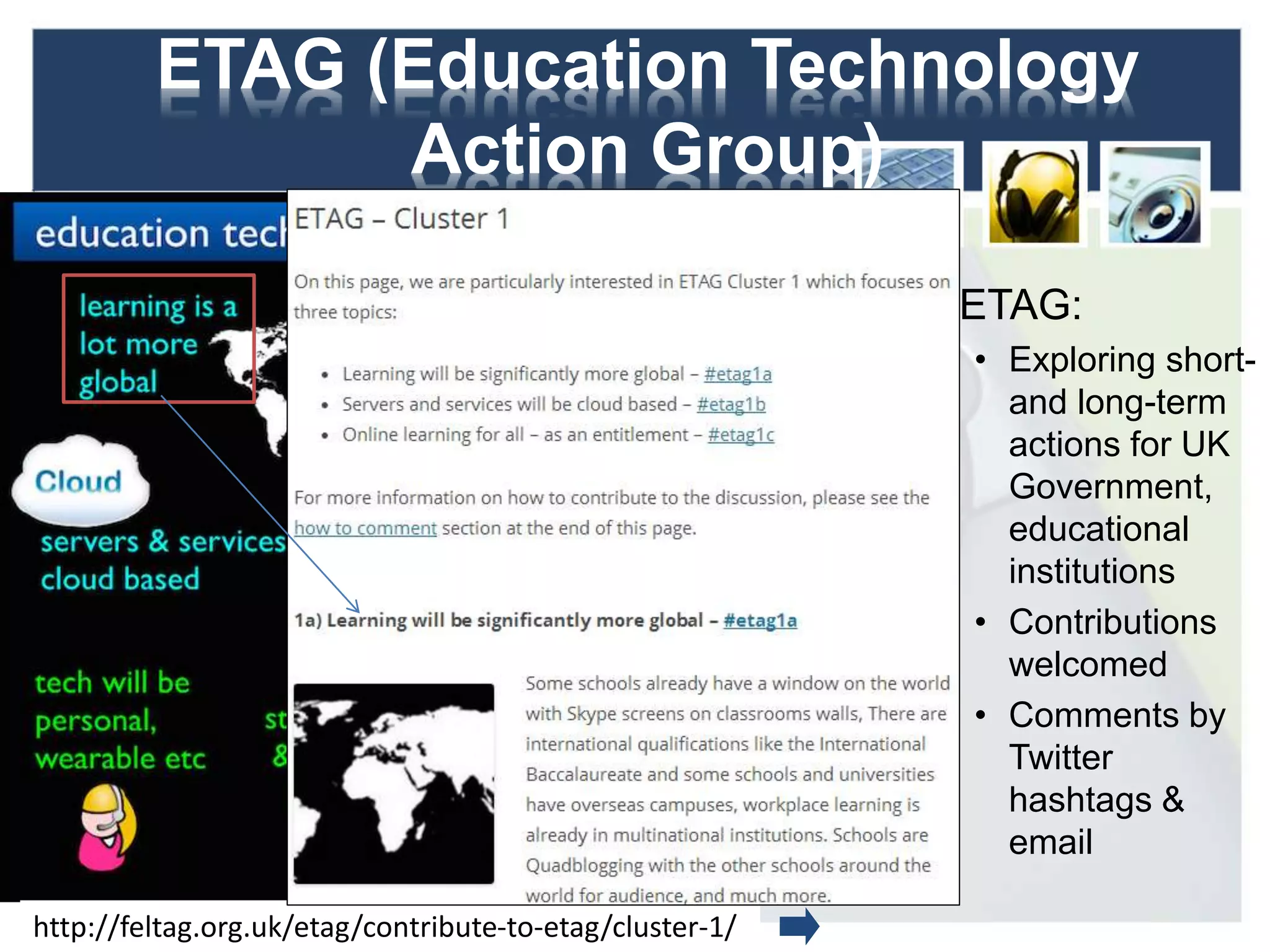
ETAG (Education Technology
Action Group)
ETAG:
• Exploring short-
and long-term
actions for UK
Government,
educational
institutions
• Contributions
welcomed
• Comments by
Twitter
hashtags &
email
12http://feltag.org.uk/etag/contribute-to-etag/cluster-1/
ETAG (Education Technology
Action Group)
ETAG:
• Exploring short-
and long-term
actions for UK
Government,
educational
institutions
• Contributions
welcomed
• Comments by
Twitter
hashtags &
email
13http://feltag.org.uk/etag/contribute-to-etag/cluster-1/
Thoughts
Some final thoughts:
• How do the NMC, IFLA Trends and
related predictions relate to ours?
• Would you like to use the scenario
planning exercise based on the NMC
and IFLA Trends predictions in your
orgaisation?
14
Next Steps
For you to consider:
• What action plans do you intend to
implement when you return to work?
• What recommendations do you intend
to make to your colleagues?
15
Questions
Any final questions or comments?
16

Let’s Predict the Future: F1 Conclusions

  • 1.
    F: Conclusions Let’s Predictthe Future! A half-day workshop at the SAOIM 2014 conference held on Tuesday 3 June 2014 facilitated by Brian Kelly, Cetis Slides available under a Creative Commons licence (CC-BY) 1 F1: Let’s Predict the Future: Conclusions
  • 2.
    Conclusions To conclude: • Technologicaldevelopments will continue • User expectations will continue to grow • Organisations will need to be able to respond to such change • Temptations to assume changes will be managed and beneficial to organisation Need for: • Evidence-based mechanisms for detecting changes • Open approaches for interpretting trends and planning for implications of developments • Ability to be able to respond to the unexpected 2
  • 3.
    Methodology Summary of methodology: •Monitor signals of developments and trends:  Quantative: e.g. numerical analyses  Qualitative: e.g. literature surveys • Document mechanisms used for observing trends • Provide interpretations of trends & implications e.g. see OUseful and UK Web Focus blogs • Use systematic processes within organisation / sector:  Delphi process  Scenario planning  Open feedback 3
  • 4.
    Finding Our More(1) NMC (New Media Consortium): • An international community of experts in educational technology Includes: • Practitioners who work with new technologies every day • Visionaries who are shaping the future of learning at think tanks, labs, research centers • Staff and board of directors Produces many useful reports including forthcoming 2014 Horizon Project Summit report on Future of Academic and Research Libraries 4 61993 reads
  • 5.
    The 2012 HorizonProject Retreat Top 10 trends: 1. The world of work is increasingly global and increasingly collaborative. 2. People expect to work, learn, socialise, and play whenever and wherever they want to. 3. The Internet is becoming a global mobile network — and already is at its edges. 4. The technologies we use are increasingly cloud- based and delivered over utility networks, facilitating the rapid growth of online videos and rich media. 5. Openness — concepts like open content, open data, and open resources, along with notions of transparency and easy access to data and information — is moving from a trend to a value for much of the world. 5 In bed?!
  • 6.
    The 2012 HorizonProject Retreat Top 10 trends: 6. Legal notions of ownership and privacy lag behind the practices common in society. 7. Real challenges of access, efficiency, and scale are redefining what we mean by quality and success. 8. The Internet is constantly challenging us to rethink learning and education, while refining our notion of literacy. 9. There is a rise in informal learning as individual needs are redefining schools, universities, and training. 10. Business models across the education ecosystem are changing. 6 Leaving the institution
  • 7.
    Finding Our More(2) IFLA Trend Report: • “a selection of resources to help you understand where libraries fit into a changing society • Insights Document summarises information contained on the Trend Report website for IFLA members. • It identifies five high level trends and considers possible future "collision points" between trends affecting the role and identity of libraries.” 7 See http://trends.ifla.org/
  • 8.
    IFLA Trends 8 The IFLATrends Process
  • 9.
    IFLA Trends The IFLATrends Process: • Highlights privacy as one of the top 5 trends 9
  • 10.
    IFLA Trends The IFLATrends Process: • Highlights privacy as one of the top 5 trends • Also highlights opportunities for ‘hyper-connected societies’ 10
  • 11.
    ETAG (Education Technology ActionGroup) ETAG: • Exploring short- and long-term actions for UK Government, educational institutions • Contributions welcomed 11http://feltag.org.uk/etag/
  • 12.
    ETAG (Education Technology ActionGroup) ETAG: • Exploring short- and long-term actions for UK Government, educational institutions • Contributions welcomed • Comments by Twitter hashtags & email 12http://feltag.org.uk/etag/contribute-to-etag/cluster-1/
  • 13.
    ETAG (Education Technology ActionGroup) ETAG: • Exploring short- and long-term actions for UK Government, educational institutions • Contributions welcomed • Comments by Twitter hashtags & email 13http://feltag.org.uk/etag/contribute-to-etag/cluster-1/
  • 14.
    Thoughts Some final thoughts: •How do the NMC, IFLA Trends and related predictions relate to ours? • Would you like to use the scenario planning exercise based on the NMC and IFLA Trends predictions in your orgaisation? 14
  • 15.
    Next Steps For youto consider: • What action plans do you intend to implement when you return to work? • What recommendations do you intend to make to your colleagues? 15
  • 16.