The Global Transformation of Libraries, LIS
Education, and LIS professionals
Dr. Sandra Hirsh, Professor and Director
Library 2.013
October 18, 2013
“The secret to high performance and
satisfaction – at work, at school, and
at home – is the deeply human need
to direct our lives, to learn and create
new things, and to do better by
ourselves and our world.”
(Daniel H. Pink, 2011)

2
Global Trends
Impacting
Libraries

3
“The amount of digital content
created in 2011 amounts to several
million times that contained in all
books ever written.”
(IFLA, 2013)

IFLA. (2013). Riding the Waves or Caught in the tide? Navigating the Evolving Information Environment. Insights
from the IFLA Trend Report. Retrieved from: http://trends.ifla.org/

4
“Internet traffic has risen by
13,000% in the last decade, with
more digital information created in
2008-2011 than in all of previous
recorded history.”
(IFLA, 2013)

IFLA. (2013). Riding the Waves or Caught in the tide? Navigating the Evolving Information Environment. Insights
from the IFLA Trend Report. Retrieved from: http://trends.ifla.org/

5
5 Key Trends
•  Technologies will expand and limit who has
access
•  Online learning will democratize global
learning
•  The boundaries of privacy and data protection
will be redefined
•  Hyper-connected societies will listen to and
empower new voices
•  The global information environment will be
transformed with new technologies

IFLA. (2013). Riding the Waves or Caught in the tide? Navigating the Evolving Information Environment. Insights
from the IFLA Trend Report. Retrieved from: http://trends.ifla.org/

6
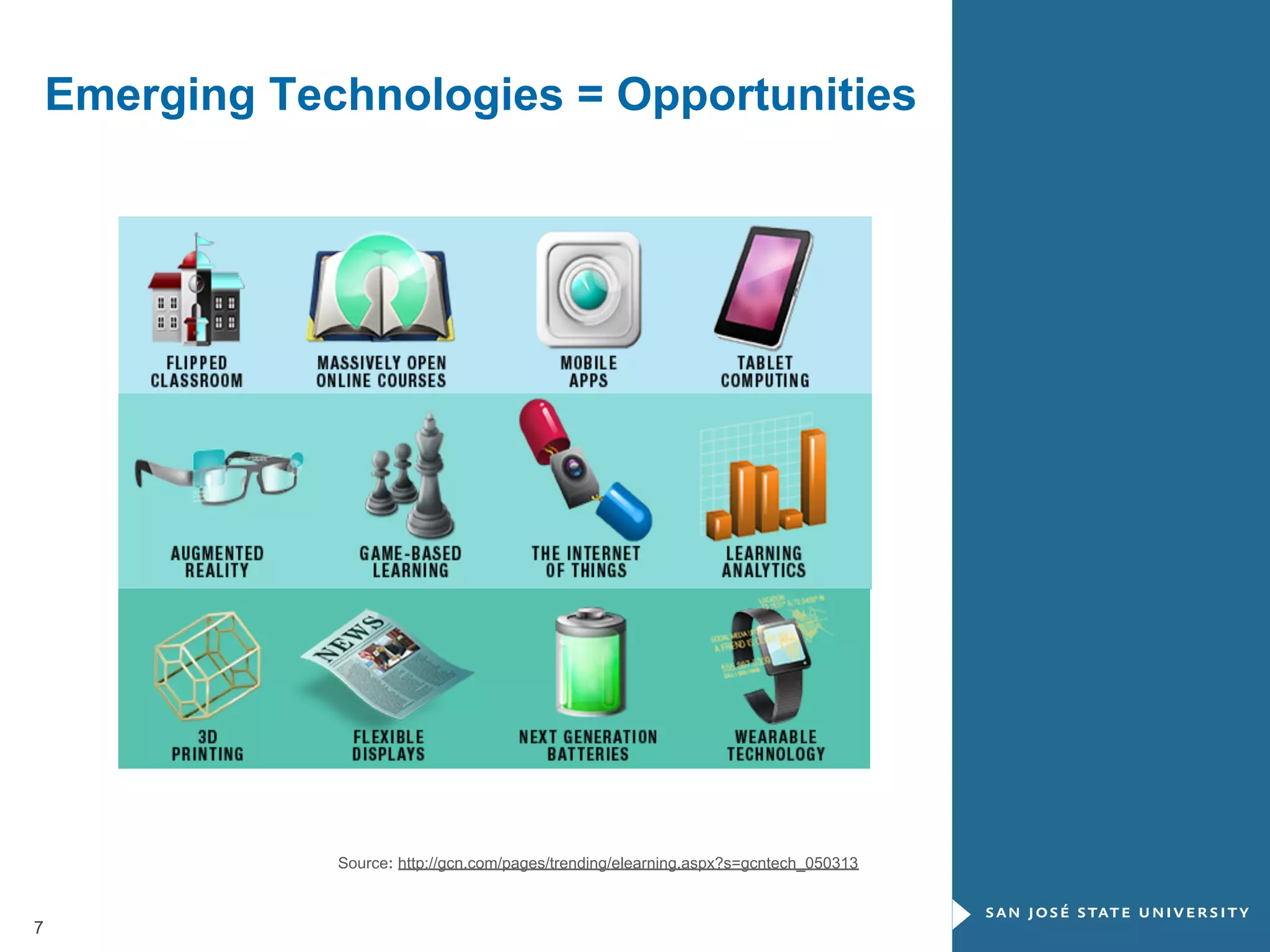
Emerging Technologies = Opportunities


Source: http://gcn.com/pages/trending/elearning.aspx?s=gcntech_050313

7
These innovations are “not
technologies looking for an
application in formal education.
They are new ways of teaching,
learning, and assessment.”
(Sharples, et. al, 2013)

8
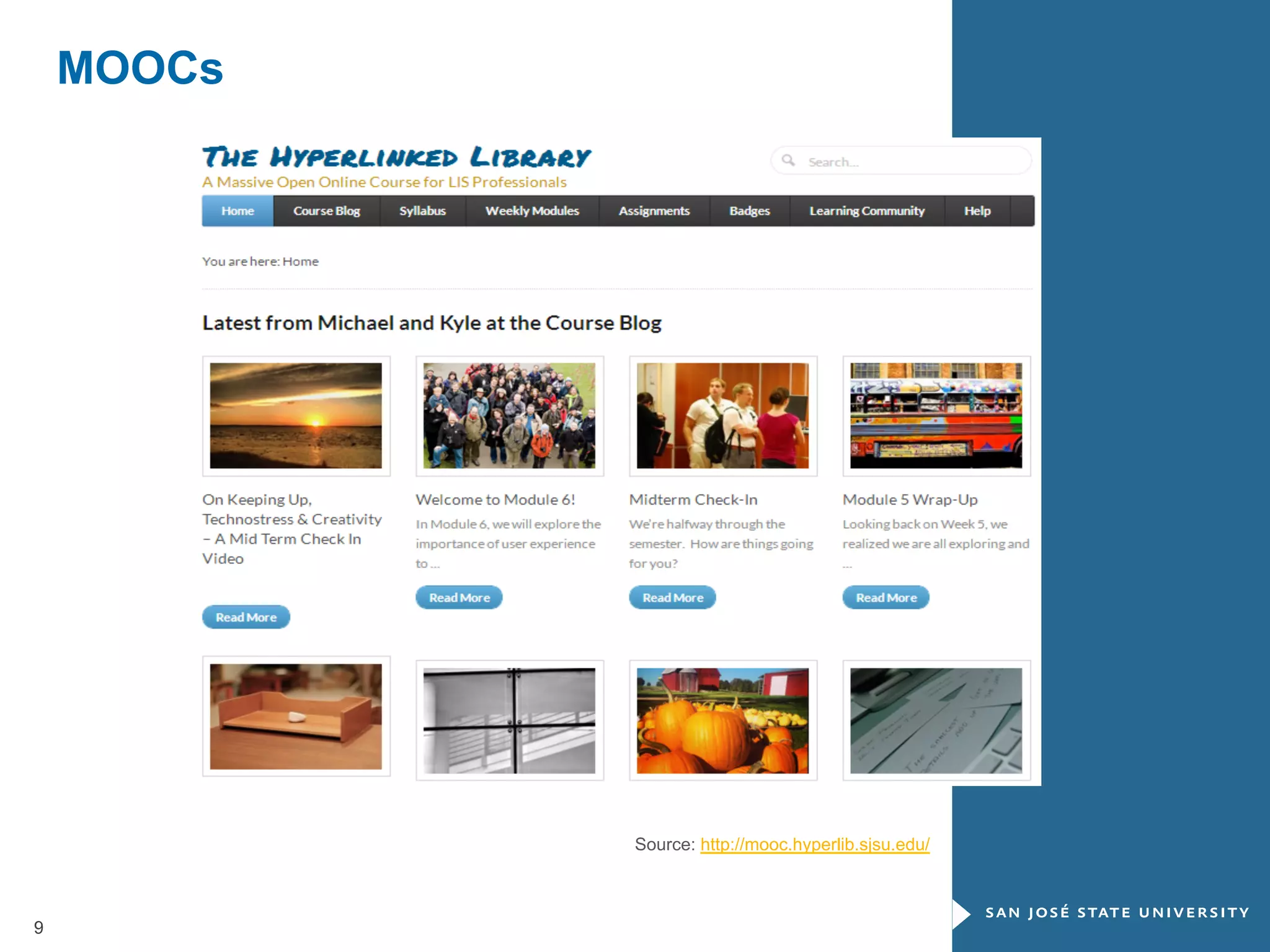
MOOCs

Source: http://mooc.hyperlib.sjsu.edu/

9
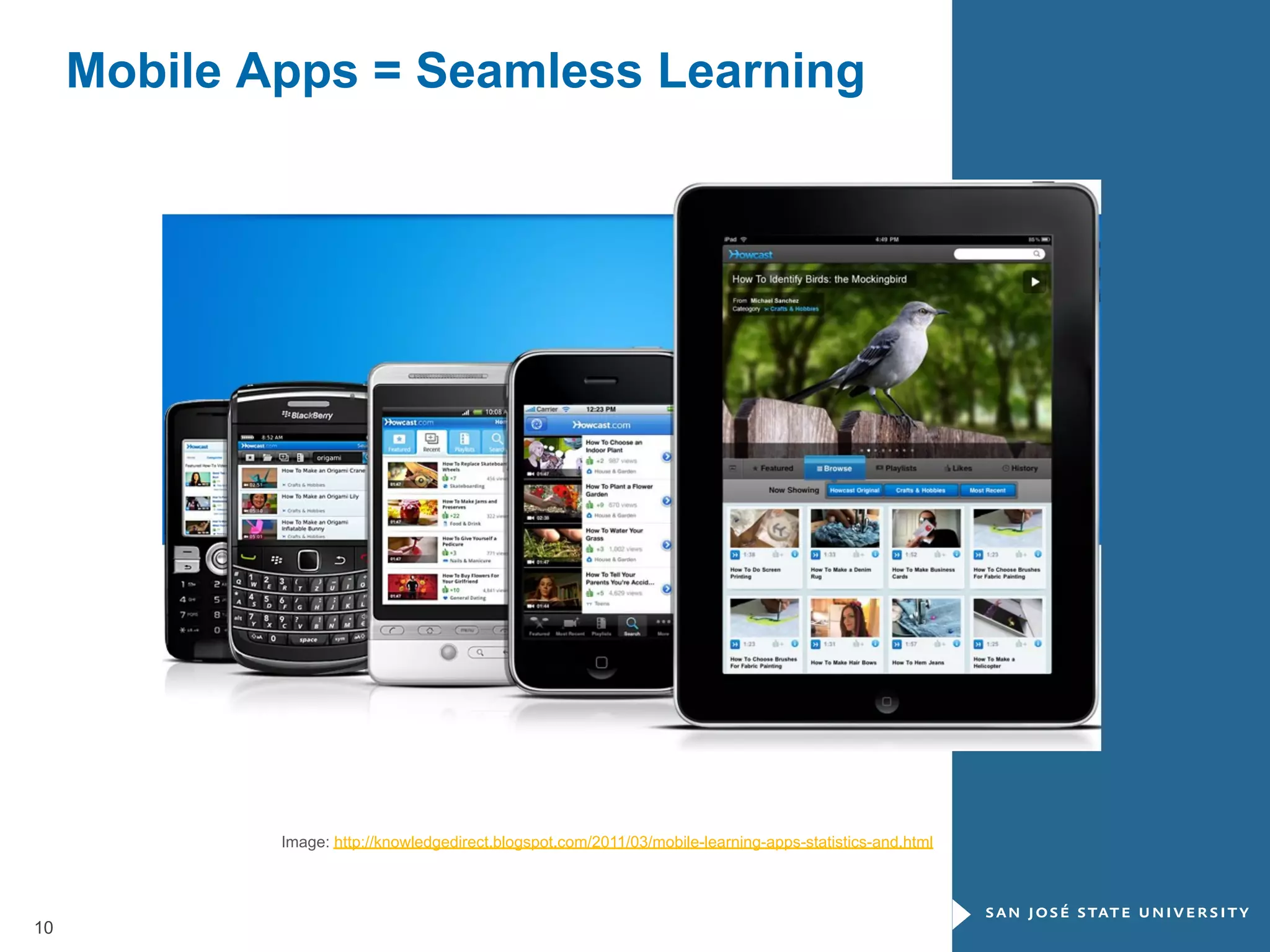
Mobile Apps = Seamless Learning

Image: http://knowledgedirect.blogspot.com/2011/03/mobile-learning-apps-statistics-and.html

10
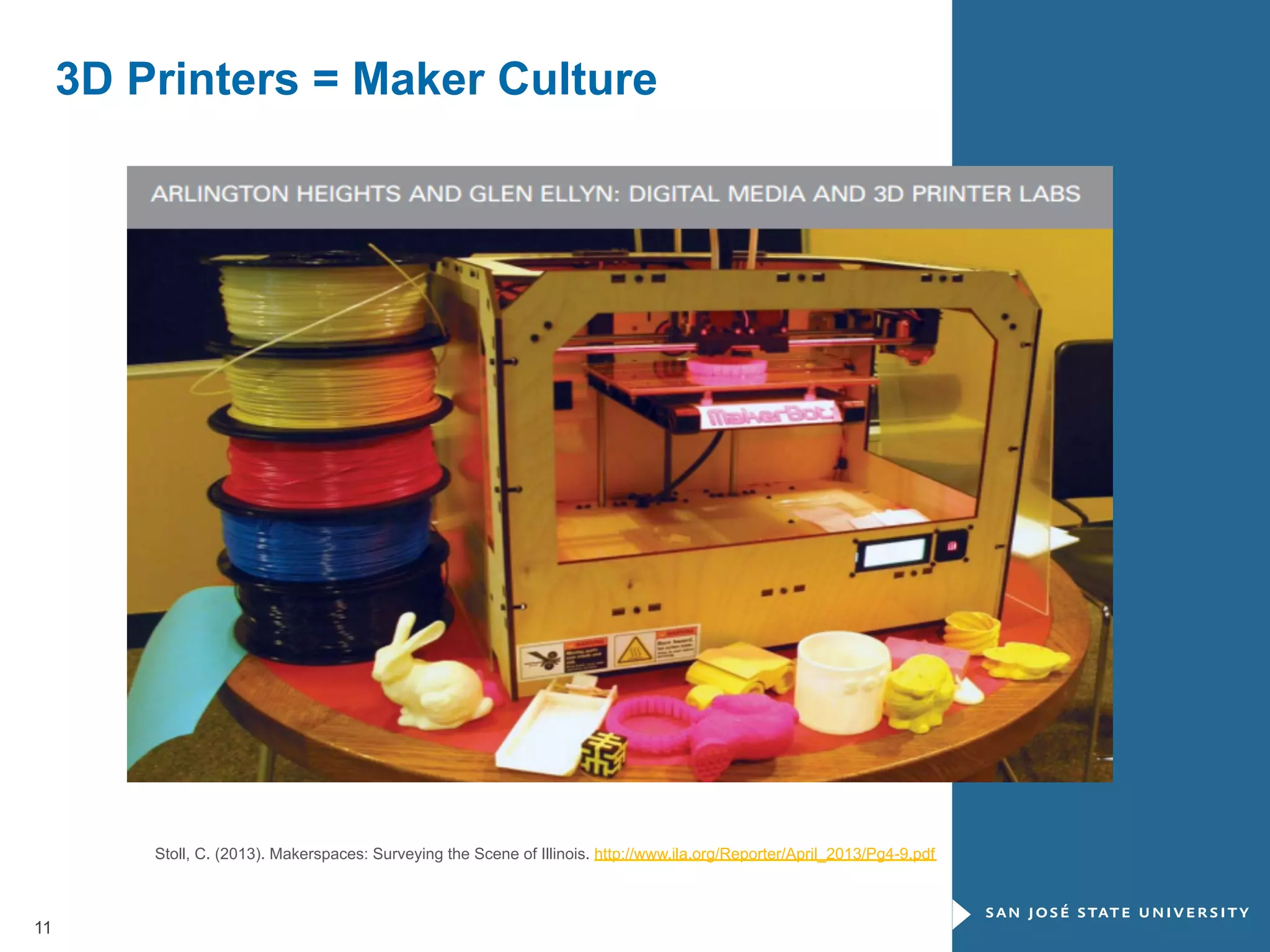
3D Printers = Maker Culture

Stoll, C. (2013). Makerspaces: Surveying the Scene of Illinois. http://www.ila.org/Reporter/April_2013/Pg4-9.pdf

11
The Internet of Things

Image source: http://www.internet-of-things.eu/

Image source:
http://www.x-v-x.de/blog/?
p=2408

12
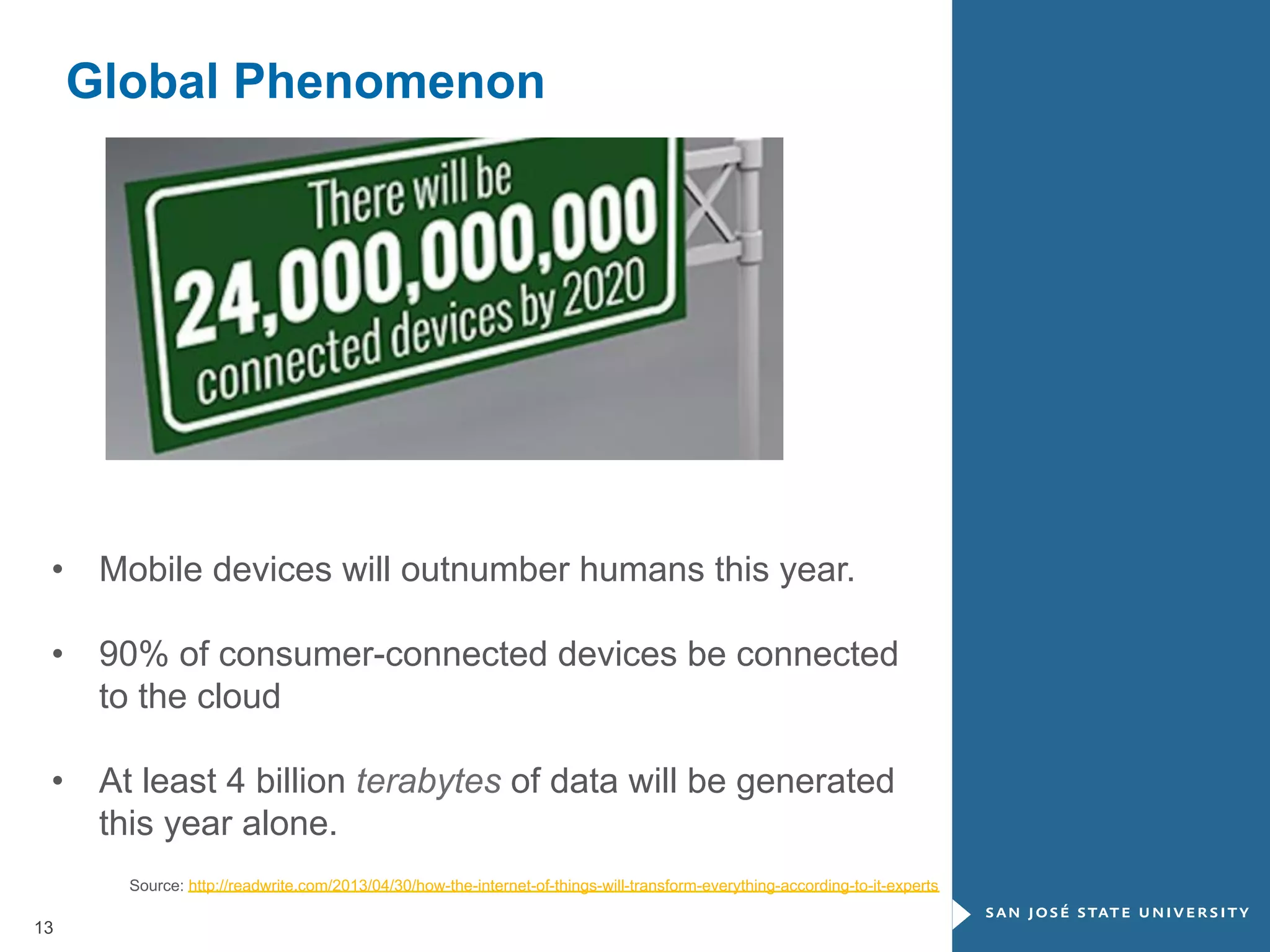
Global Phenomenon

•  Mobile devices will outnumber humans this year.
•  90% of consumer-connected devices be connected
to the cloud
•  At least 4 billion terabytes of data will be generated
this year alone.
Source: http://readwrite.com/2013/04/30/how-the-internet-of-things-will-transform-everything-according-to-it-experts

13
New Roles for
the Library

14
“Libraries are more than just a
repository - they are communities
where information flows back and
forth.”
Anthony Andora, SJSU SLIS Alumni

15
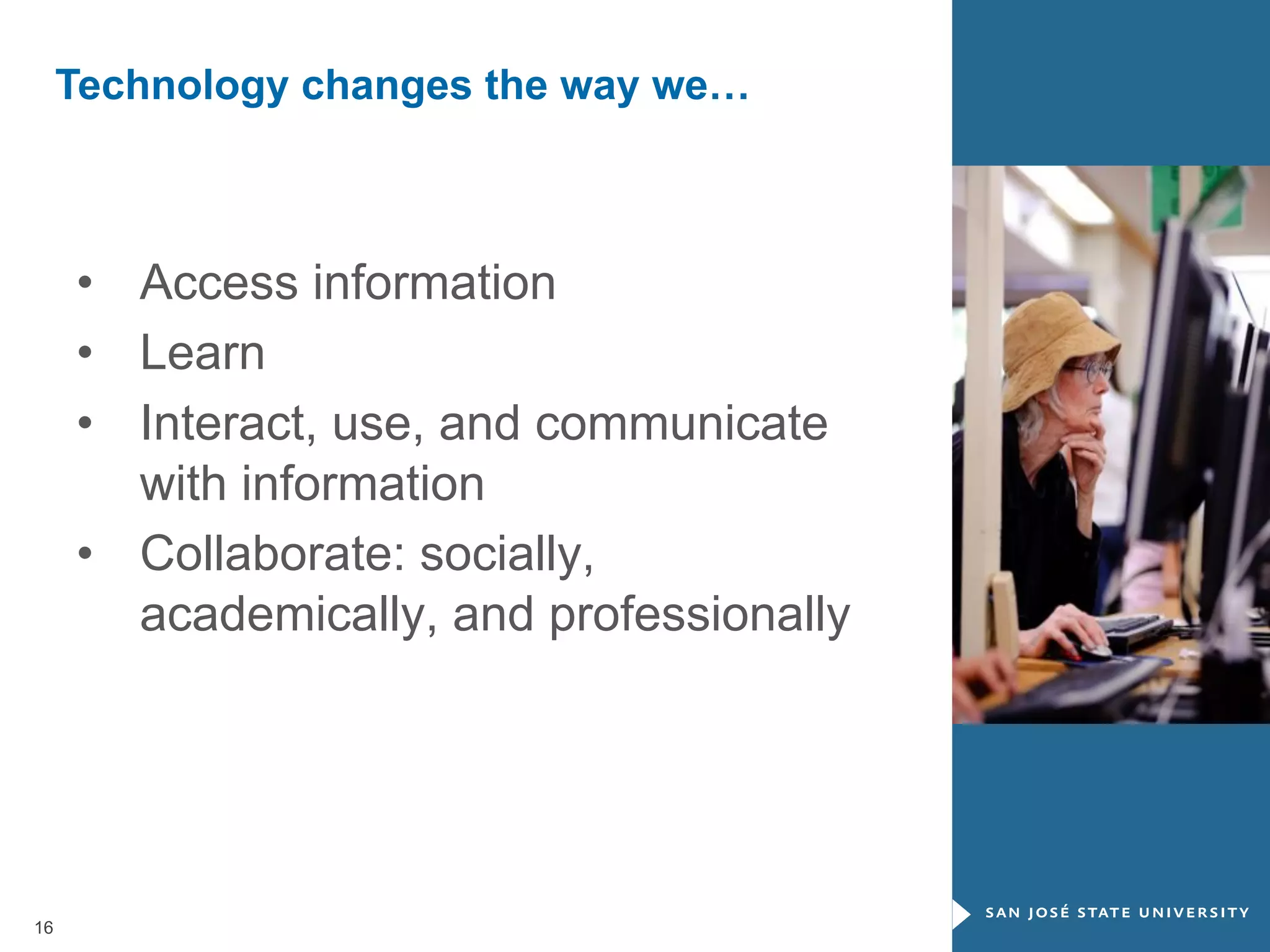
Technology changes the way we…

•  Access information
•  Learn
•  Interact, use, and communicate
with information
•  Collaborate: socially,
academically, and professionally

16
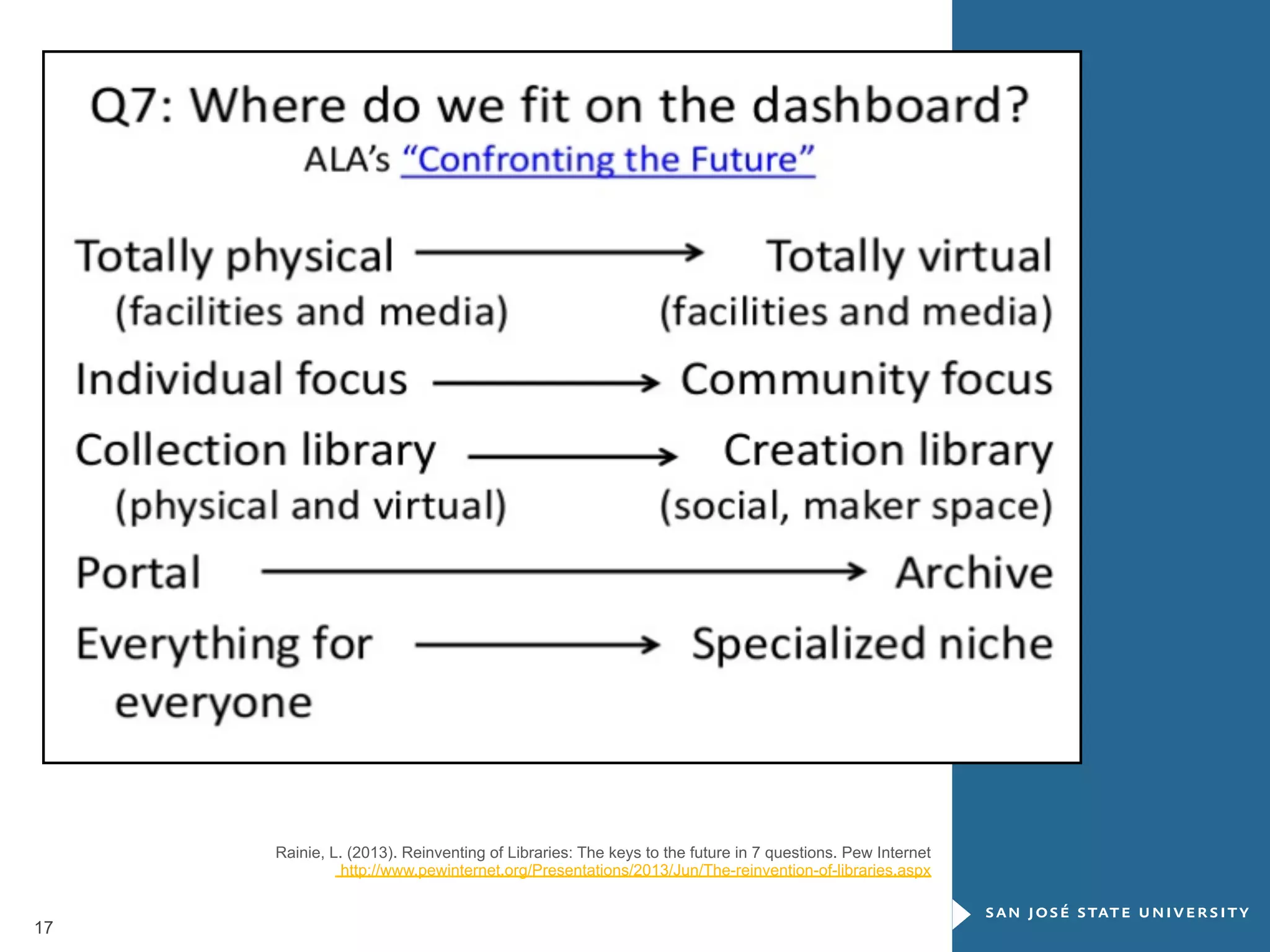
Rainie, L. (2013). Reinventing of Libraries: The keys to the future in 7 questions. Pew Internet
http://www.pewinternet.org/Presentations/2013/Jun/The-reinvention-of-libraries.aspx

17
Rainie, L. (2013). Reinventing of Libraries: The keys to the future in 7 questions. Pew Internet
http://www.pewinternet.org/Presentations/2013/Jun/The-reinvention-of-libraries.aspx

18
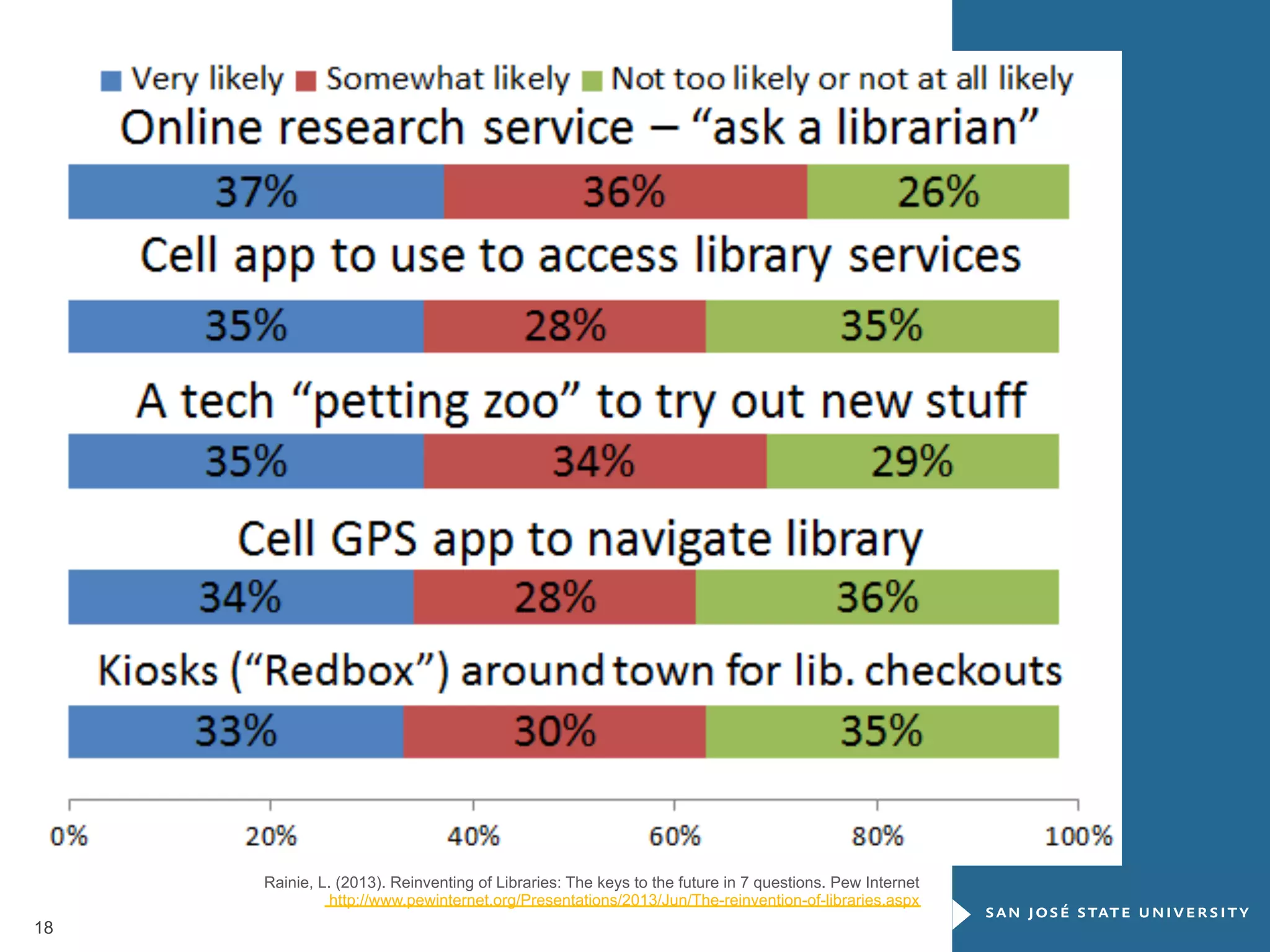
Rainie, L. (2013). Reinventing of Libraries: The keys to the future in 7 questions. Pew Internet
http://www.pewinternet.org/Presentations/2013/Jun/The-reinvention-of-libraries.aspx

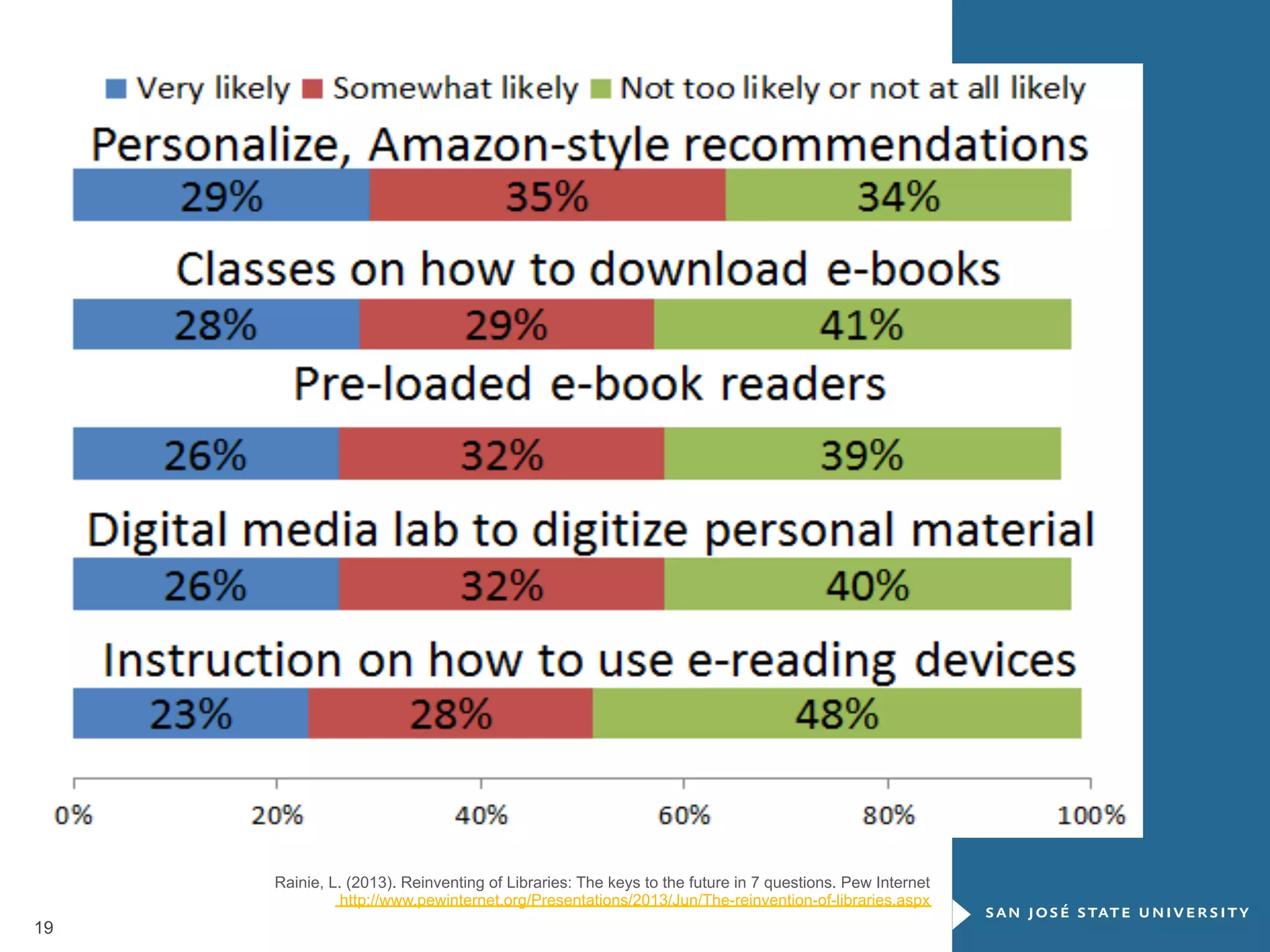
19
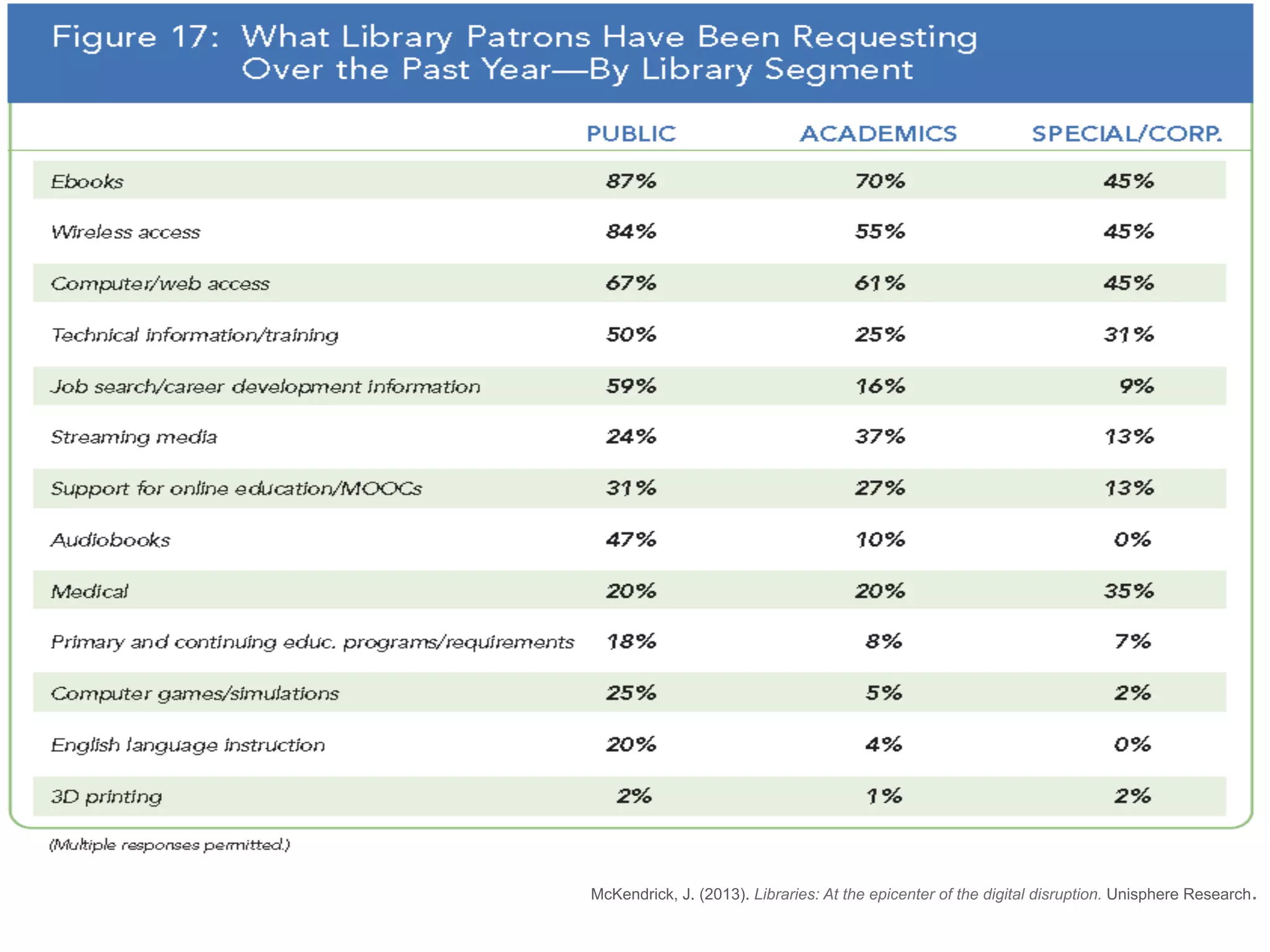
McKendrick, J. (2013). Libraries: At the epicenter of the digital disruption. Unisphere Research.
“When asked what I see for the
future of libraries – all kinds of
libraries - I imagine a space
where users will connect,
collaborate, create, and care.”
(Stephens, 2011)

That future is now…

21
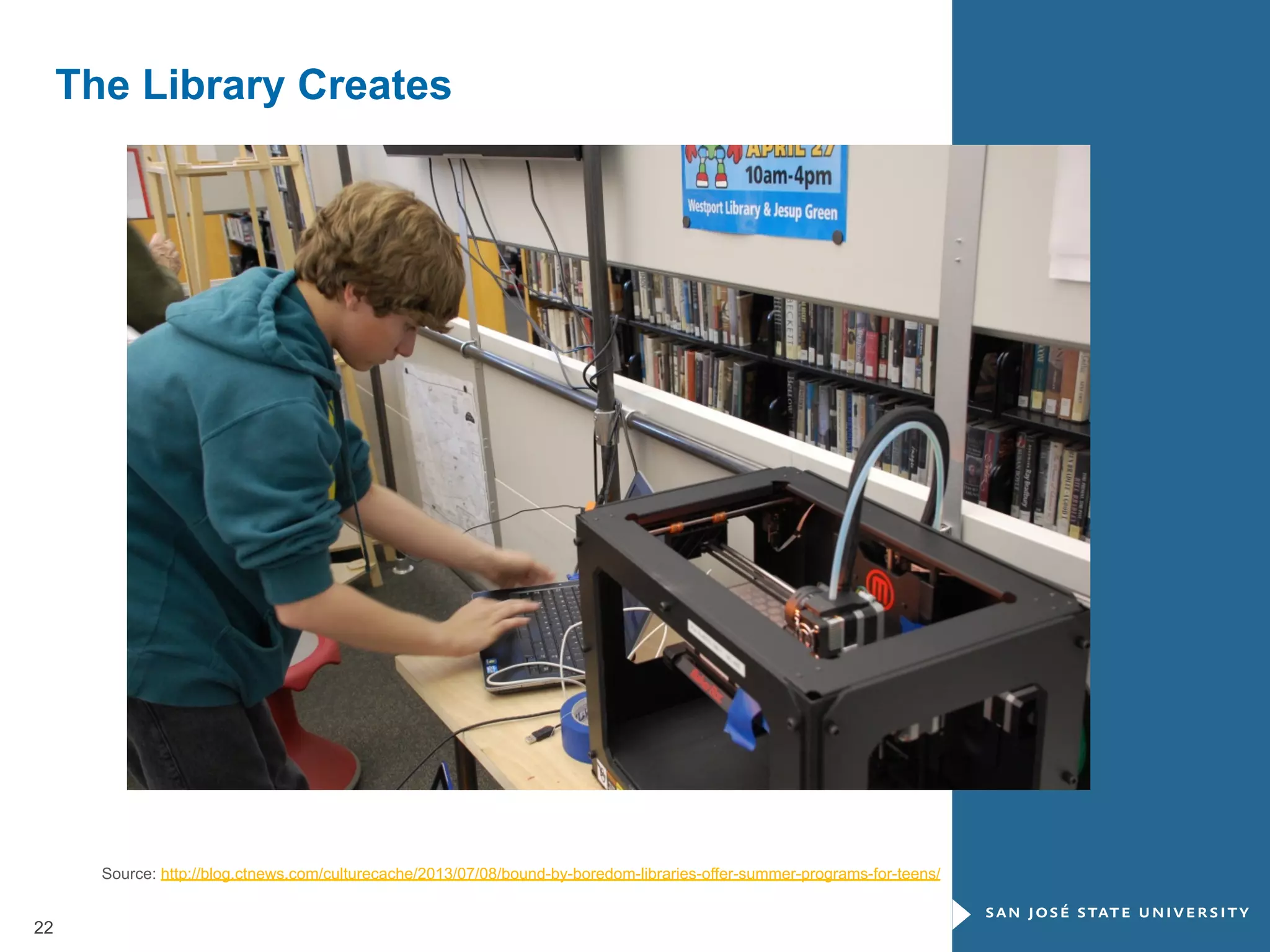
The Library Creates

Source: http://blog.ctnews.com/culturecache/2013/07/08/bound-by-boredom-libraries-offer-summer-programs-for-teens/

22
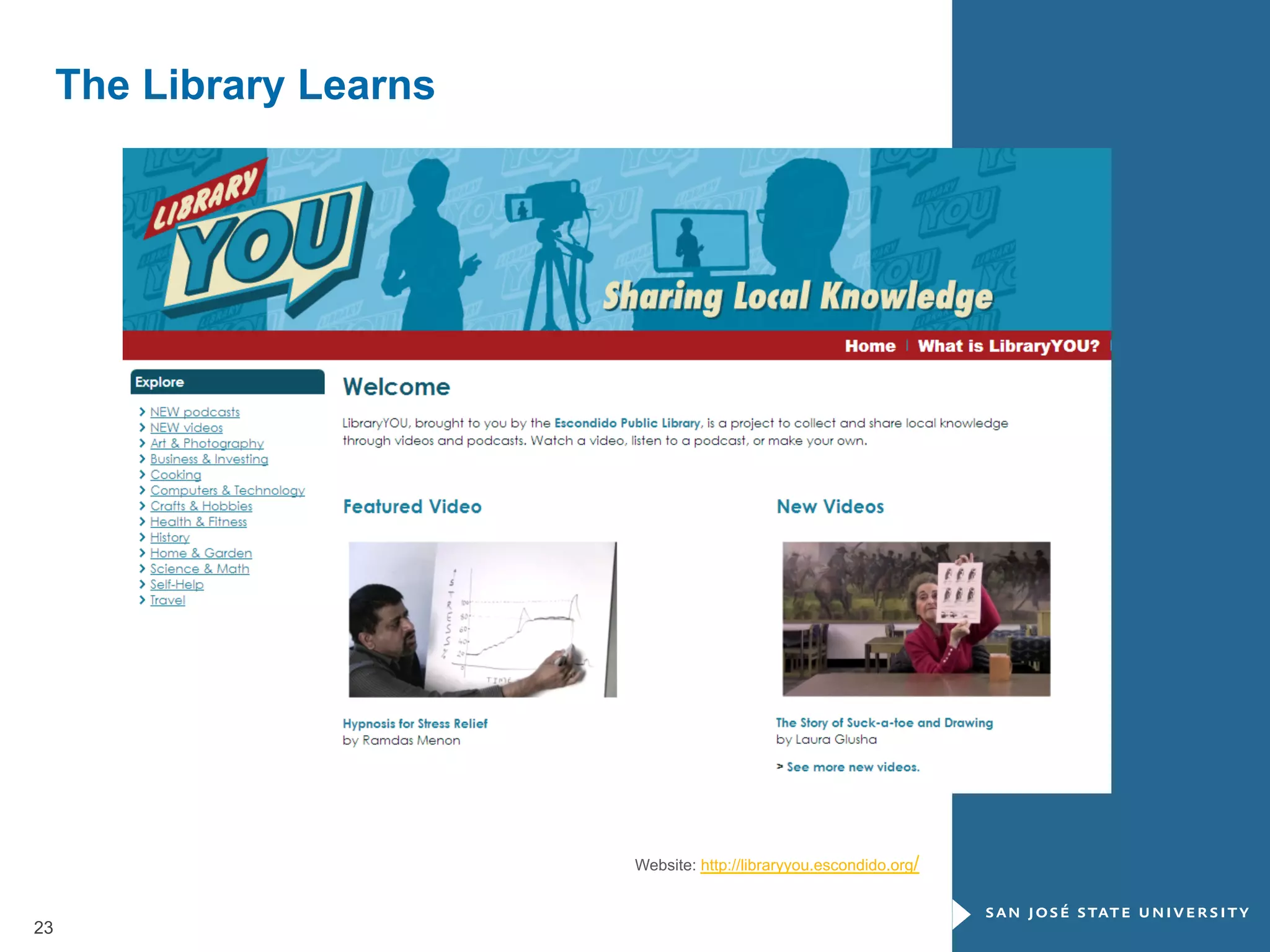
The Library Learns

Website: http://libraryyou.escondido.org/

23
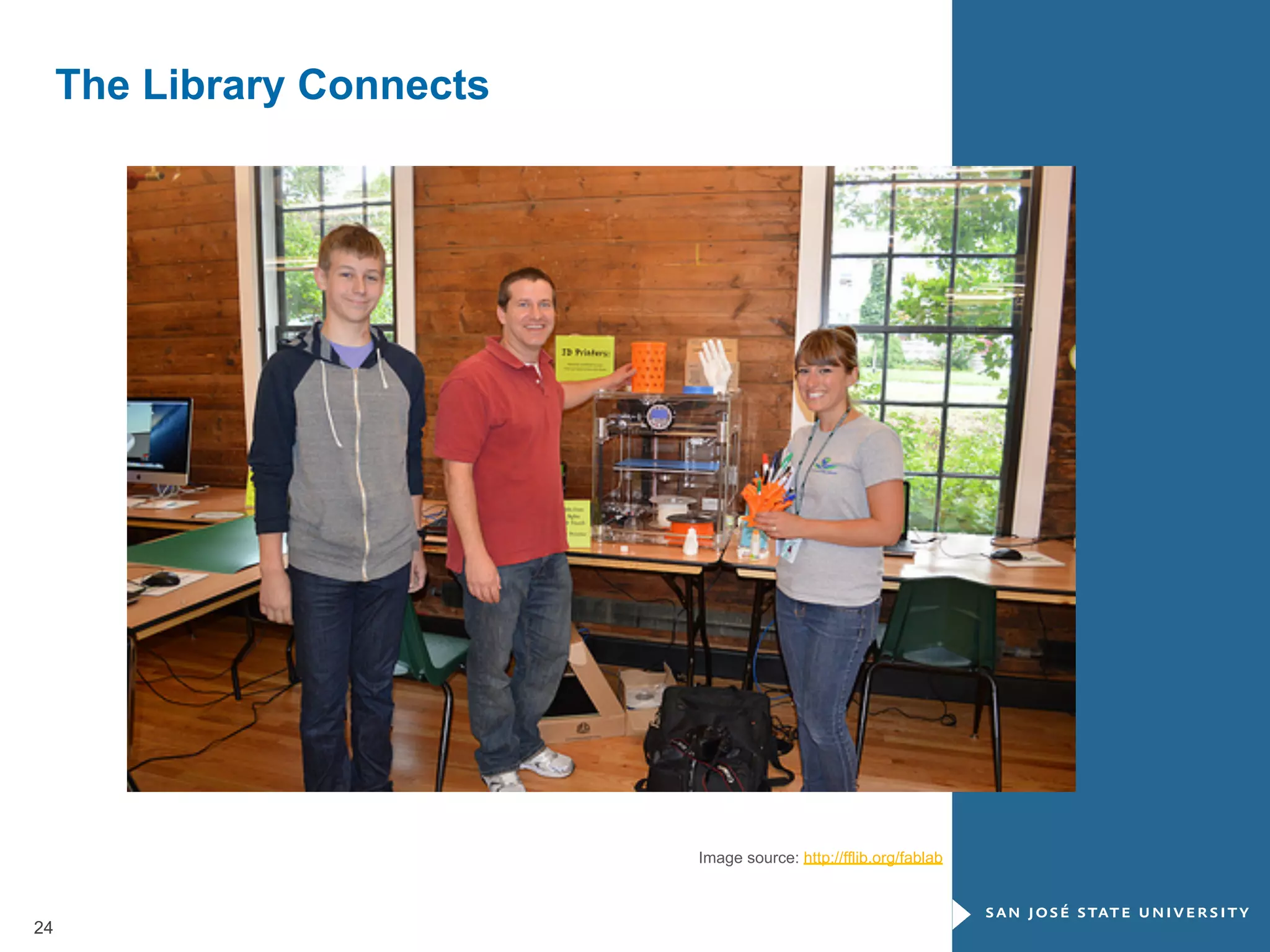
FFL Fab Lab
The Library Connects

Image source: http://fflib.org/fablab

24
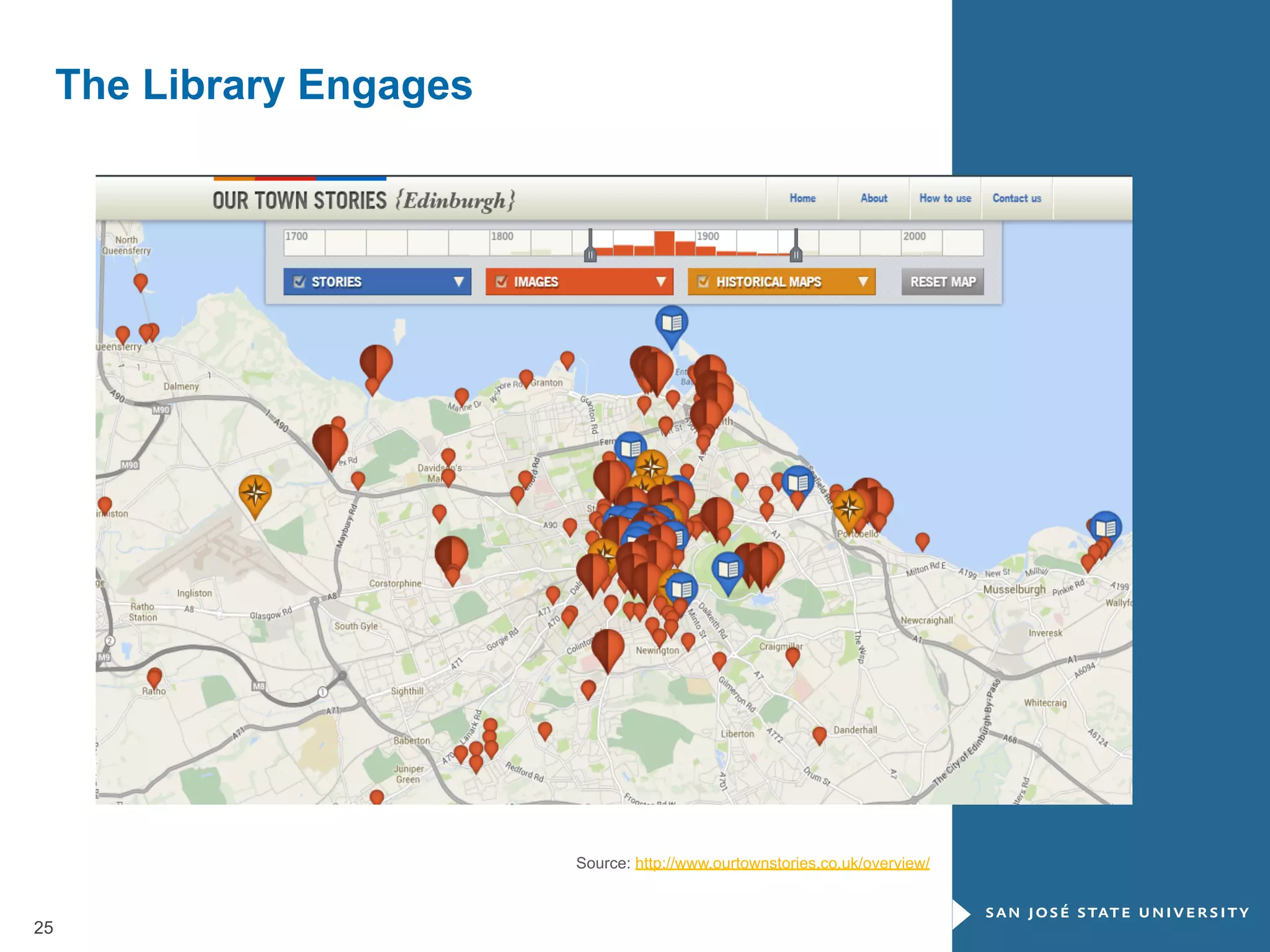
The Library Engages

Source: http://www.ourtownstories.co.uk/overview/

25
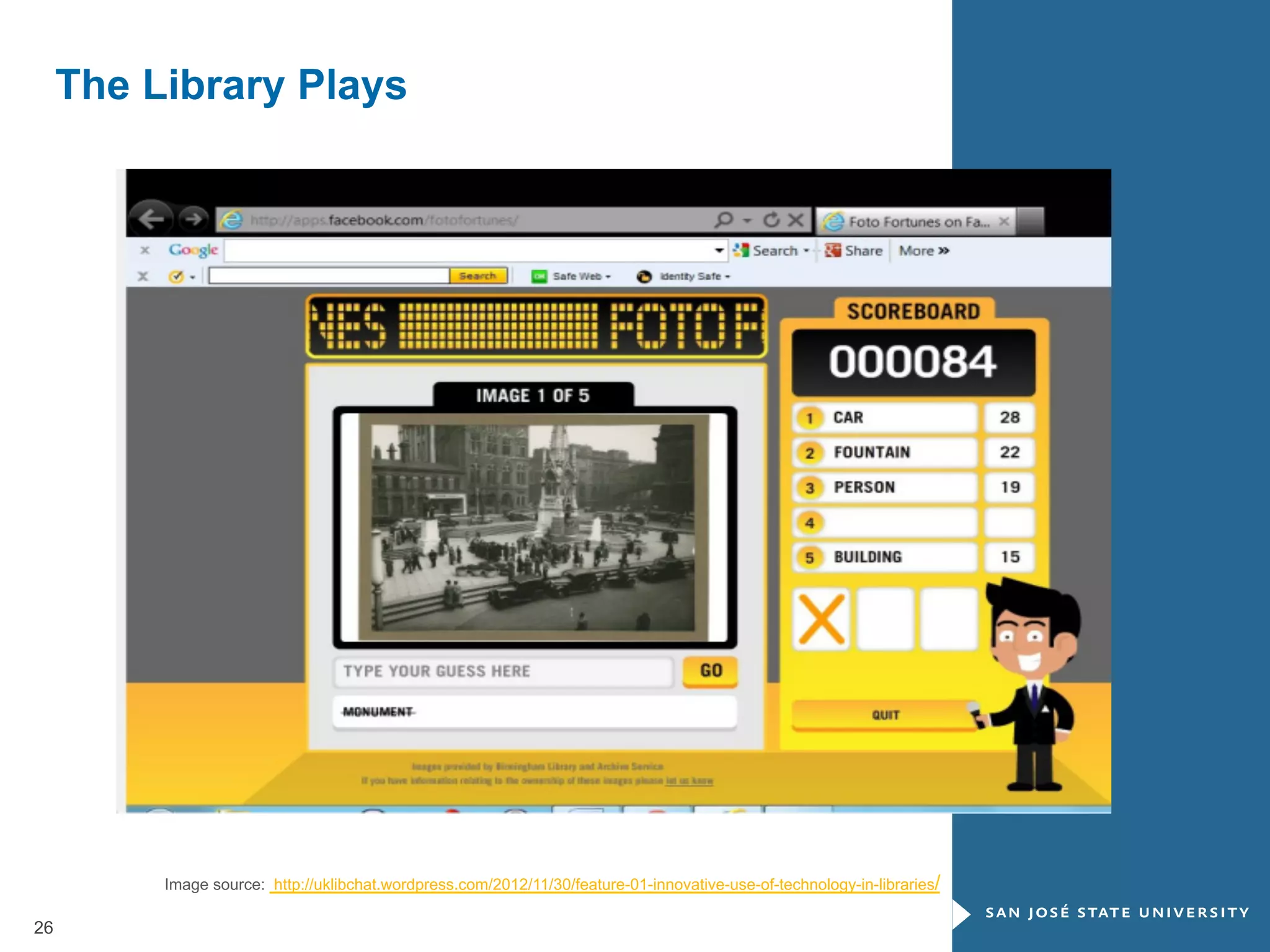
The Library Plays

Image source: http://uklibchat.wordpress.com/2012/11/30/feature-01-innovative-use-of-technology-in-libraries/

26
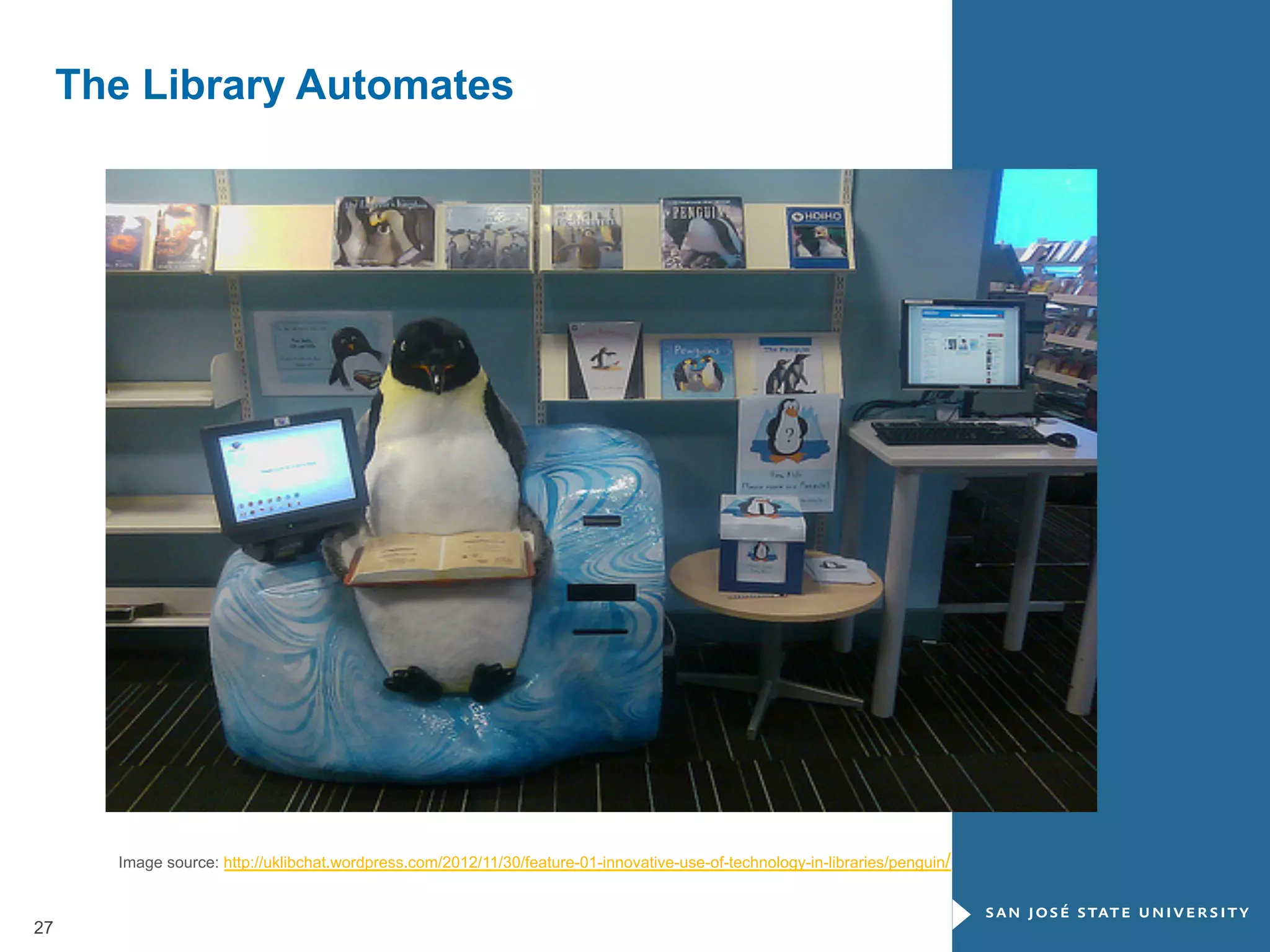
The Library Automates

Image source: http://uklibchat.wordpress.com/2012/11/30/feature-01-innovative-use-of-technology-in-libraries/penguin/

27
New Roles for
Library
Professionals

28
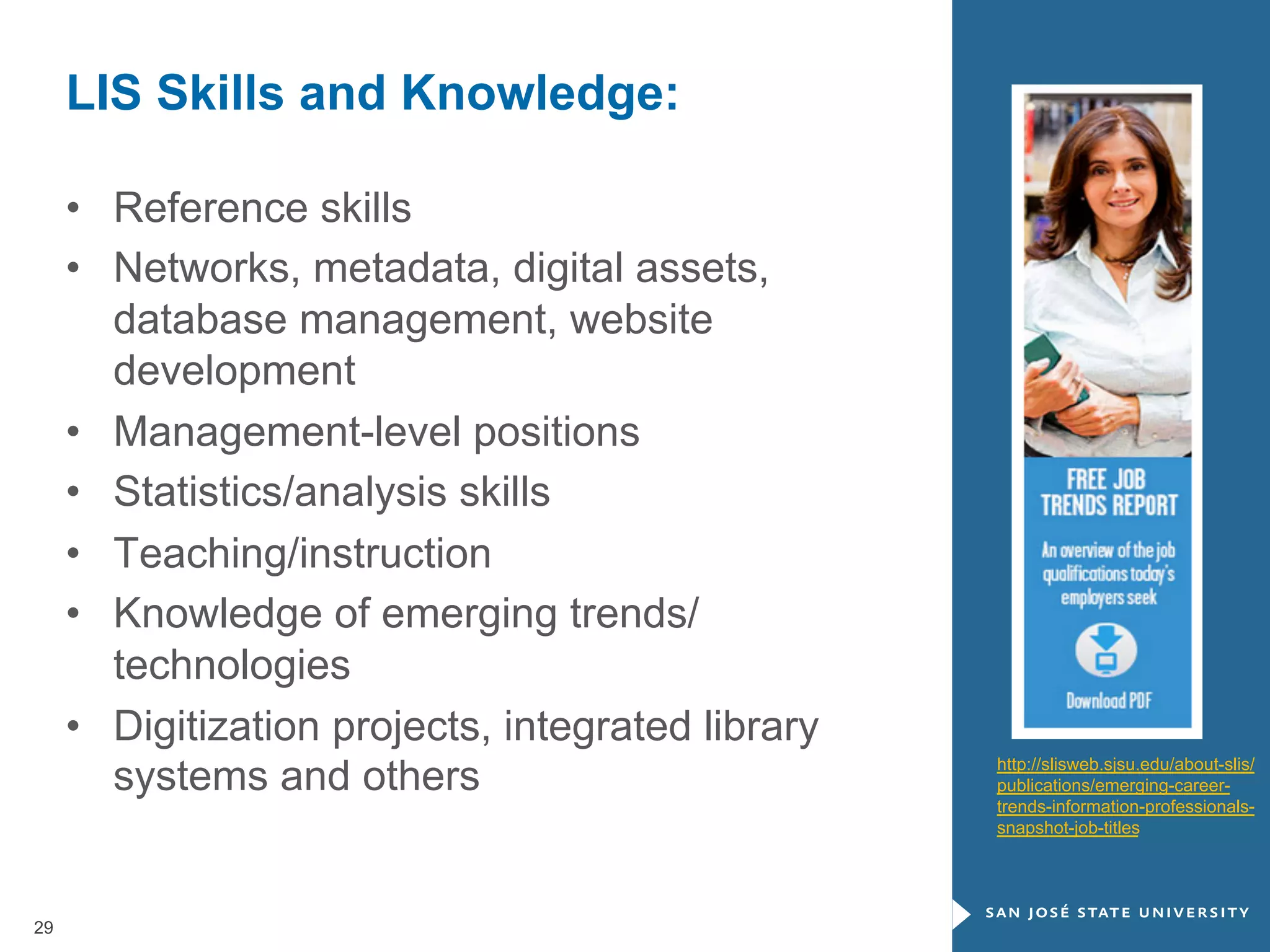
LIS Skills and Knowledge:
•  Reference skills
•  Networks, metadata, digital assets,
database management, website
development
•  Management-level positions
•  Statistics/analysis skills
•  Teaching/instruction
•  Knowledge of emerging trends/
technologies
•  Digitization projects, integrated library
systems and others

29

http://slisweb.sjsu.edu/about-slis/
publications/emerging-careertrends-information-professionalssnapshot-job-titles
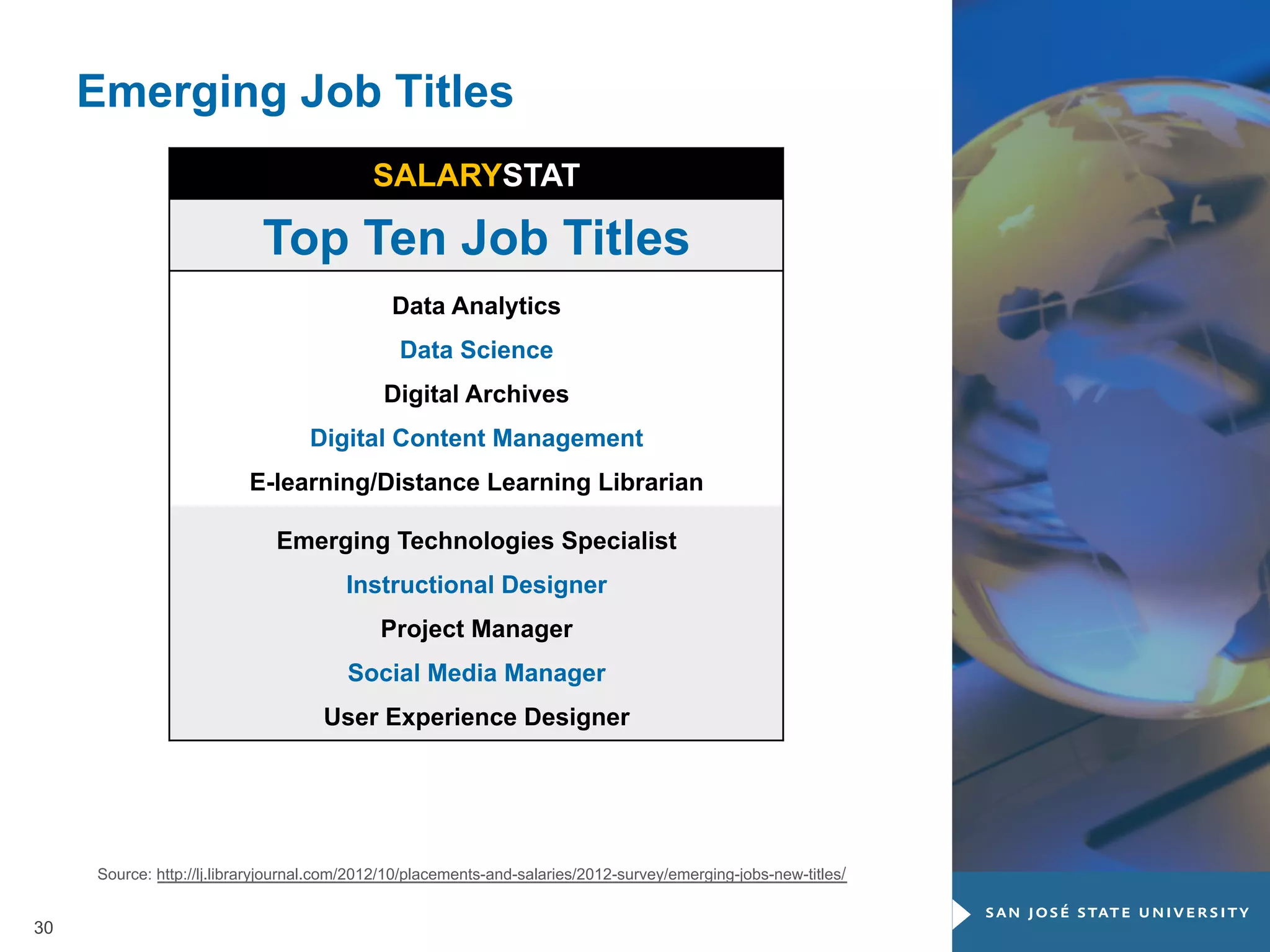
Emerging Job Titles
SALARYSTAT

Top Ten Job Titles
Data Analytics
Data Science
Digital Archives
Digital Content Management
E-learning/Distance Learning Librarian
Emerging Technologies Specialist
Instructional Designer
Project Manager
Social Media Manager
User Experience Designer

Source: http://lj.libraryjournal.com/2012/10/placements-and-salaries/2012-survey/emerging-jobs-new-titles/

30
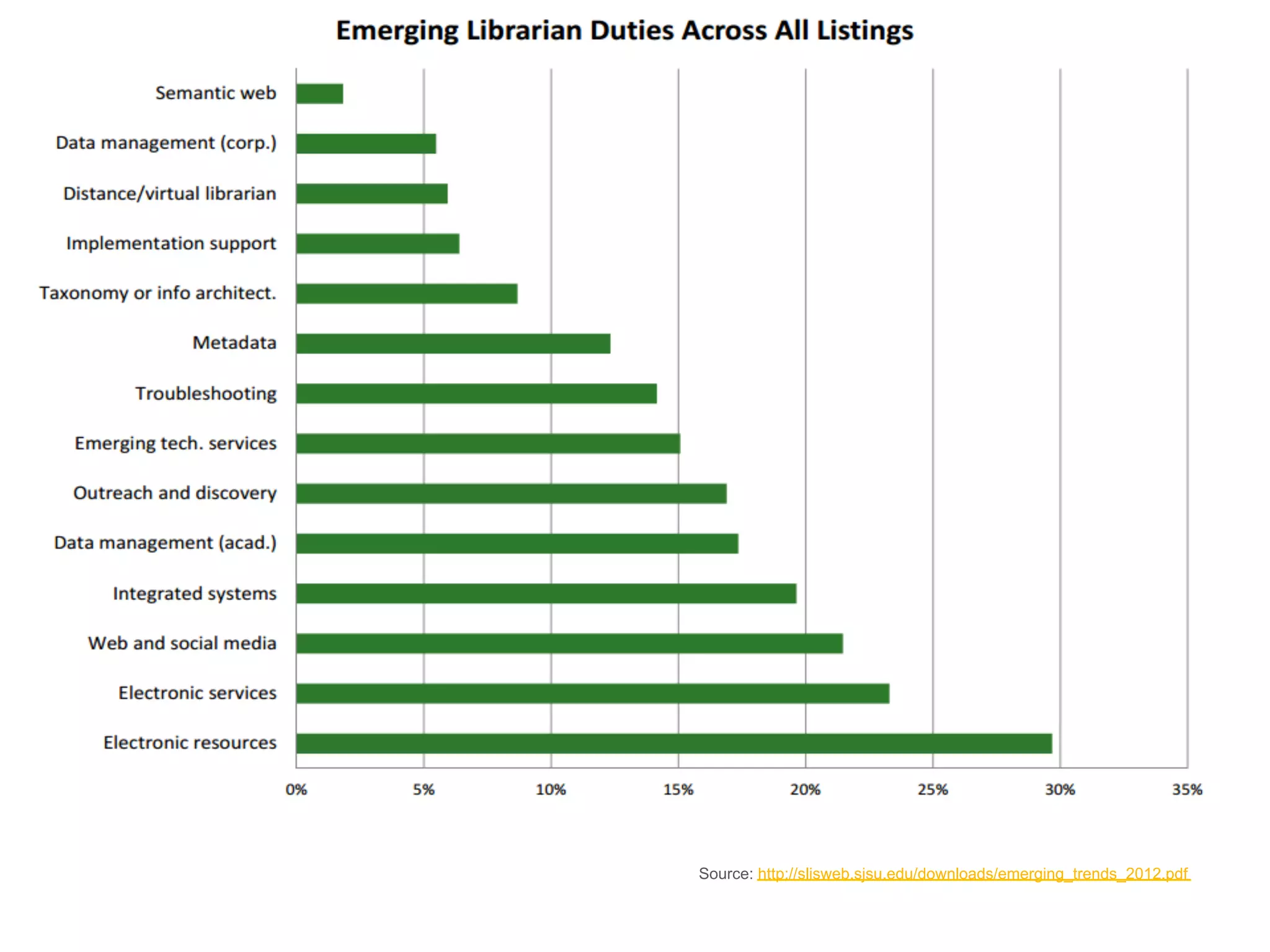
Source: http://slisweb.sjsu.edu/downloads/emerging_trends_2012.pdf
“A result of a Kuwait University selfstudy on the competencies needed by
new LIS professionals, new tracks of
specialization were developed to
address the needs of librarianship
which included information
management, IT applications, and
knowledge management.“
(Rehman, 2010, p. 303)

32
Global Perspective

Norwegian and Thai LIS educators found
that the
“principal areas of disciplinary
knowledge required included an
understanding of metadata, database
development, database management
systems, and user needs.”
(Nonthacumjane, 2011)

33
Forecasts for Jobs
Requiring a MLIS Degree
• 
• 
• 
• 
• 
• 

34

71% explicitly required a MLS or MLIS
43% of listings require reference skills
33% of listings are management-level jobs
32% of listings are tech-centered jobs
25% of listings require teaching/instruction
21% of listings require statistics/analysis
skills
LIS Education –
Providing the Path
for Vibrant Library
Futures

35
Top 3 Skills Requested

•  Effective written and verbal
communication skills,
•  A passion for continuous learning and
adaptability to new technology, and
•  Proficient use of current and emerging
information technologies.

Hirsh, S. (2012). Preparing future professionals through broad competency planning. Information Outlook, 16(1), p. 9-11.
Retrieved from: https://slisweb.sjsu.edu/downloads/future_professionals.pdf

36
LIS Technological Pathways

•  Digital Libraries – 42%
•  Information Architecture,
Design, and Programming – 32%
•  Information Technology – 7%
•  Social Technical – 7%
•  Data Curation – 4%
•  Other - 8%

37
“In today’s environment of rapid
technological changes, competitive
job markets and evolving job roles,
it’s critical to examine the
competencies needed to succeed as
an information professional.”
(Hirsh, 2012)

38
LIS Required Competencies

Students will “demonstrate proficiency
in the use of current information and
communication technologies, and
other related technologies, as they
affect the resources and uses of
libraries and other types of information
providing entities.”
(San Jose State University, 2013)

39
LIS Required Competencies

Students will “Be cognizant of the
impact of technology on the social
and economic structure and the
library’s mission to the community.”
(University of Mississippi, 2013)

40
LIS Required Competencies

Students will “employ current and
emerging technologies effectively
for communication, and to search
for, identify, repackage, and deliver
information resources.”
(Emporia State, 2013)

41
“Graduates of accredited LIS
programs have the ability to engage
and evolve with technology, impart
technology to cross-generational
communities, and possess a
willingness to share, teach, and
participate.”
(Stephens, 2011)

42
43
44
“Providing technology-based access is
now libraries’ top priority as they
redefine their roles as digital
knowledge centers.”
(McKendrick, 2013)

45
Thank you for attending!
Dr. Sandy Hirsh, Professor and Director
sandy.hirsh@sjsu.edu
Facebook:
Twitter:
Pinterest:
YouTube:

facebook.com/sjsuslis
twitter.com/sjsuslis
pinterest.com/sjsuslis/
youtube.com/user/sjsuslis

slisweb.sjsu.edu

46

The Global Transformation of Libraries, LIS Education, and LIS Profession

  • 1.
    The Global Transformationof Libraries, LIS Education, and LIS professionals Dr. Sandra Hirsh, Professor and Director Library 2.013 October 18, 2013
  • 2.
    “The secret tohigh performance and satisfaction – at work, at school, and at home – is the deeply human need to direct our lives, to learn and create new things, and to do better by ourselves and our world.” (Daniel H. Pink, 2011) 2
  • 3.
  • 4.
    “The amount ofdigital content created in 2011 amounts to several million times that contained in all books ever written.” (IFLA, 2013) IFLA. (2013). Riding the Waves or Caught in the tide? Navigating the Evolving Information Environment. Insights from the IFLA Trend Report. Retrieved from: http://trends.ifla.org/ 4
  • 5.
    “Internet traffic hasrisen by 13,000% in the last decade, with more digital information created in 2008-2011 than in all of previous recorded history.” (IFLA, 2013) IFLA. (2013). Riding the Waves or Caught in the tide? Navigating the Evolving Information Environment. Insights from the IFLA Trend Report. Retrieved from: http://trends.ifla.org/ 5
  • 6.
    5 Key Trends • Technologies will expand and limit who has access •  Online learning will democratize global learning •  The boundaries of privacy and data protection will be redefined •  Hyper-connected societies will listen to and empower new voices •  The global information environment will be transformed with new technologies IFLA. (2013). Riding the Waves or Caught in the tide? Navigating the Evolving Information Environment. Insights from the IFLA Trend Report. Retrieved from: http://trends.ifla.org/ 6
  • 7.
    Emerging Technologies =Opportunities     Source: http://gcn.com/pages/trending/elearning.aspx?s=gcntech_050313 7
  • 8.
    These innovations are“not technologies looking for an application in formal education. They are new ways of teaching, learning, and assessment.” (Sharples, et. al, 2013) 8
  • 9.
  • 10.
    Mobile Apps =Seamless Learning Image: http://knowledgedirect.blogspot.com/2011/03/mobile-learning-apps-statistics-and.html 10
  • 11.
    3D Printers =Maker Culture Stoll, C. (2013). Makerspaces: Surveying the Scene of Illinois. http://www.ila.org/Reporter/April_2013/Pg4-9.pdf 11
  • 12.
    The Internet ofThings Image source: http://www.internet-of-things.eu/ Image source: http://www.x-v-x.de/blog/? p=2408 12
  • 13.
    Global Phenomenon •  Mobiledevices will outnumber humans this year. •  90% of consumer-connected devices be connected to the cloud •  At least 4 billion terabytes of data will be generated this year alone. Source: http://readwrite.com/2013/04/30/how-the-internet-of-things-will-transform-everything-according-to-it-experts 13
  • 14.
  • 15.
    “Libraries are morethan just a repository - they are communities where information flows back and forth.” Anthony Andora, SJSU SLIS Alumni 15
  • 16.
    Technology changes theway we… •  Access information •  Learn •  Interact, use, and communicate with information •  Collaborate: socially, academically, and professionally 16
  • 17.
    Rainie, L. (2013).Reinventing of Libraries: The keys to the future in 7 questions. Pew Internet http://www.pewinternet.org/Presentations/2013/Jun/The-reinvention-of-libraries.aspx 17
  • 18.
    Rainie, L. (2013).Reinventing of Libraries: The keys to the future in 7 questions. Pew Internet http://www.pewinternet.org/Presentations/2013/Jun/The-reinvention-of-libraries.aspx 18
  • 19.
    Rainie, L. (2013).Reinventing of Libraries: The keys to the future in 7 questions. Pew Internet http://www.pewinternet.org/Presentations/2013/Jun/The-reinvention-of-libraries.aspx 19
  • 20.
    McKendrick, J. (2013).Libraries: At the epicenter of the digital disruption. Unisphere Research.
  • 21.
    “When asked whatI see for the future of libraries – all kinds of libraries - I imagine a space where users will connect, collaborate, create, and care.” (Stephens, 2011) That future is now… 21
  • 22.
    The Library Creates Source:http://blog.ctnews.com/culturecache/2013/07/08/bound-by-boredom-libraries-offer-summer-programs-for-teens/ 22
  • 23.
    The Library Learns Website:http://libraryyou.escondido.org/ 23
  • 24.
    FFL Fab Lab TheLibrary Connects Image source: http://fflib.org/fablab 24
  • 25.
    The Library Engages Source:http://www.ourtownstories.co.uk/overview/ 25
  • 26.
    The Library Plays Imagesource: http://uklibchat.wordpress.com/2012/11/30/feature-01-innovative-use-of-technology-in-libraries/ 26
  • 27.
    The Library Automates Imagesource: http://uklibchat.wordpress.com/2012/11/30/feature-01-innovative-use-of-technology-in-libraries/penguin/ 27
  • 28.
  • 29.
    LIS Skills andKnowledge: •  Reference skills •  Networks, metadata, digital assets, database management, website development •  Management-level positions •  Statistics/analysis skills •  Teaching/instruction •  Knowledge of emerging trends/ technologies •  Digitization projects, integrated library systems and others 29 http://slisweb.sjsu.edu/about-slis/ publications/emerging-careertrends-information-professionalssnapshot-job-titles
  • 30.
    Emerging Job Titles SALARYSTAT TopTen Job Titles Data Analytics Data Science Digital Archives Digital Content Management E-learning/Distance Learning Librarian Emerging Technologies Specialist Instructional Designer Project Manager Social Media Manager User Experience Designer Source: http://lj.libraryjournal.com/2012/10/placements-and-salaries/2012-survey/emerging-jobs-new-titles/ 30
  • 31.
  • 32.
    “A result ofa Kuwait University selfstudy on the competencies needed by new LIS professionals, new tracks of specialization were developed to address the needs of librarianship which included information management, IT applications, and knowledge management.“ (Rehman, 2010, p. 303) 32
  • 33.
    Global Perspective Norwegian andThai LIS educators found that the “principal areas of disciplinary knowledge required included an understanding of metadata, database development, database management systems, and user needs.” (Nonthacumjane, 2011) 33
  • 34.
    Forecasts for Jobs Requiringa MLIS Degree •  •  •  •  •  •  34 71% explicitly required a MLS or MLIS 43% of listings require reference skills 33% of listings are management-level jobs 32% of listings are tech-centered jobs 25% of listings require teaching/instruction 21% of listings require statistics/analysis skills
  • 35.
    LIS Education – Providingthe Path for Vibrant Library Futures 35
  • 36.
    Top 3 SkillsRequested •  Effective written and verbal communication skills, •  A passion for continuous learning and adaptability to new technology, and •  Proficient use of current and emerging information technologies. Hirsh, S. (2012). Preparing future professionals through broad competency planning. Information Outlook, 16(1), p. 9-11. Retrieved from: https://slisweb.sjsu.edu/downloads/future_professionals.pdf 36
  • 37.
    LIS Technological Pathways • Digital Libraries – 42% •  Information Architecture, Design, and Programming – 32% •  Information Technology – 7% •  Social Technical – 7% •  Data Curation – 4% •  Other - 8% 37
  • 38.
    “In today’s environmentof rapid technological changes, competitive job markets and evolving job roles, it’s critical to examine the competencies needed to succeed as an information professional.” (Hirsh, 2012) 38
  • 39.
    LIS Required Competencies Studentswill “demonstrate proficiency in the use of current information and communication technologies, and other related technologies, as they affect the resources and uses of libraries and other types of information providing entities.” (San Jose State University, 2013) 39
  • 40.
    LIS Required Competencies Studentswill “Be cognizant of the impact of technology on the social and economic structure and the library’s mission to the community.” (University of Mississippi, 2013) 40
  • 41.
    LIS Required Competencies Studentswill “employ current and emerging technologies effectively for communication, and to search for, identify, repackage, and deliver information resources.” (Emporia State, 2013) 41
  • 42.
    “Graduates of accreditedLIS programs have the ability to engage and evolve with technology, impart technology to cross-generational communities, and possess a willingness to share, teach, and participate.” (Stephens, 2011) 42
  • 43.
  • 44.
  • 45.
    “Providing technology-based accessis now libraries’ top priority as they redefine their roles as digital knowledge centers.” (McKendrick, 2013) 45
  • 46.
    Thank you forattending! Dr. Sandy Hirsh, Professor and Director sandy.hirsh@sjsu.edu Facebook: Twitter: Pinterest: YouTube: facebook.com/sjsuslis twitter.com/sjsuslis pinterest.com/sjsuslis/ youtube.com/user/sjsuslis slisweb.sjsu.edu 46