Exploiting the Potential of Blogs and Social Networks  Brian Kelly UKOLN University of Bath Bath, UK [email_address] UKOLN is supported by: http://www.ukoln.ac.uk/web-focus/events/seminars/museum-heritage-show-2008/ This work is licensed under a Attribution-NonCommercial-ShareAlike 2.0 licence (but note caveat) Resources bookmarked using ‘ museum-heritage-show-2008 ' tag  by-nc-sa Acceptable Use Policy Recording/broadcasting of this talk, taking photographs, discussing the content using email, instant messaging, blogs, SMS, etc. is permitted providing distractions to others is minimised.
Contents Introduction About Me • About the Talk About You What’s It All About? Overview  • Example of Museum Blogs We Should Be Doing This! Reasons For Having a Blog • Policies & QA Technical Infrastructure • Sharing Best Practices Where Do Social Networks Fit In? What are Social Networks? Using Social Networks Conclusions What Next? Questions  Introduction
About Me Brian Kelly: UK Web Focus: a national advisory post Long-standing Web evangelist (since Jan 1993) Based at UKOLN, University of Bath, with remit to advise HE/FE and cultural heritage sectors Interests include Web 2.0, standards, accessibility and overcoming institutional inertia Blogger since November 2006 Awarded the IWR Information Professional of the Year in December 2007 Facilitated half day workshops on  Using Blogs Effectively Within Your Organisation  at Museum & Web 2008 and  Using Blogs Effectively Within Your Library  at ILI 2007 conferences Introduction
About The Talk By the end of the talk you should: Be aware of key blogging concepts and tool Have learnt about ways in which blogs can be used within a library environment  Have identified potential barriers to the deployment of blogs within an institution  Have heard about and discussed strategies for overcoming barriers Have learnt about tools and techniques for measuring a blog’s impact and success.  Have heard about and discussed best practices for developing a sustainable blogging service Have had the opportunity to make plans for launching or enhancing your blog service Introduction And have a set of materials & resources which you can use for in-house training purposes  
About You In brief: Do you have a work-related blog? Do you have a social blog?  Do you use social networks (e.g. Facebook, MySpace, …) for work-related purposes or for social purposes? Is your organisation intending to set up a blog? What you hope to gain from this talk? Introduction
Key Blog Concepts (1 of 5) What Is A Blog? A blog (a portmanteau of web log) is a website where entries are written in chronological order and commonly displayed in reverse chronological order.  Blogs provide commentary or news on a particular subject such as food, politics, or local news; some function as more personal online diaries. A typical blog combines text, images, and links to other blogs, web pages, and other media related to its topic. The ability for readers to leave comments in an interactive format is an important part of many blogs. Blog Concepts Wikipedia definition Note that blog software can be used for other purposes (including building conventional Web sites). We will focus on conventional understanding of a blog. See also handout
Key Blog Concepts (2 of 5) Providing a Blog Blogs can be provided by: Installing software locally (open source or licensed) Using an externally hosted service (Blogger.com and Wordpress.com are popular) Using existing systems (e.g. a VLE, a CMS, etc.) which has blog functionality provided Using social networking services (e.g. Facebook, MySpace) which providing blogging or similar functionality  Blogging
Key Blog Concepts (3 of 5) Reading Blogs Blog readers can: Visit a blog site (conventional approach) Use an RSS reader, which can be web-based (e.g. Bloglines, Google Reader, etc.) or a desktop RSS reader (e.g. Blogbridge) Via a blog aggregator – view posts from lots of blogs Use a mobile device (e.g. PDA, mobile phone, etc.) Have blog posts delivered using email Blog Concepts
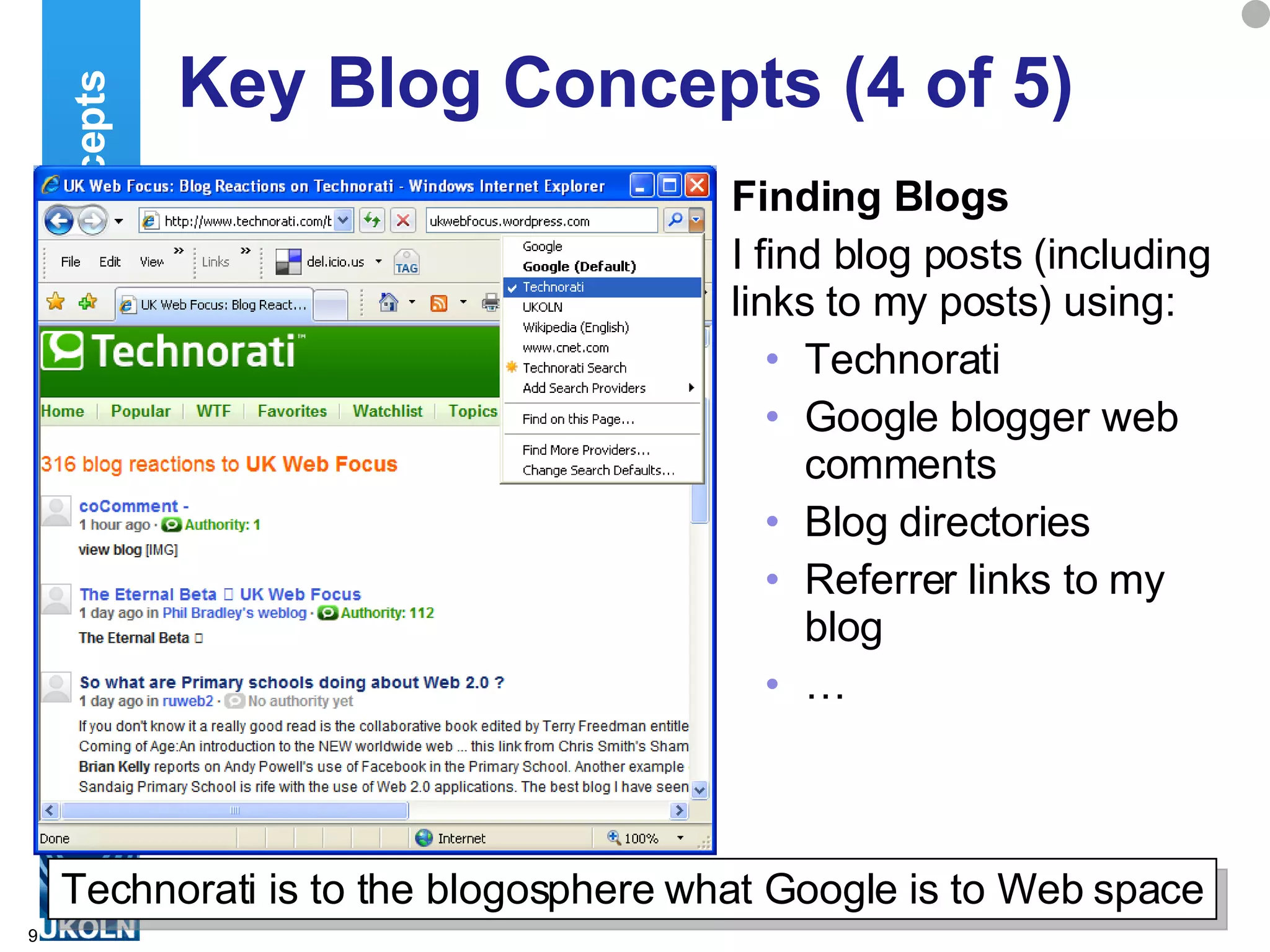
Key Blog Concepts (4 of 5) Finding Blogs I find blog posts (including links to my posts) using: Technorati  Google blogger web comments Blog directories Referrer links to my blog … Blog Concepts Technorati is to the blogosphere what Google is to Web space
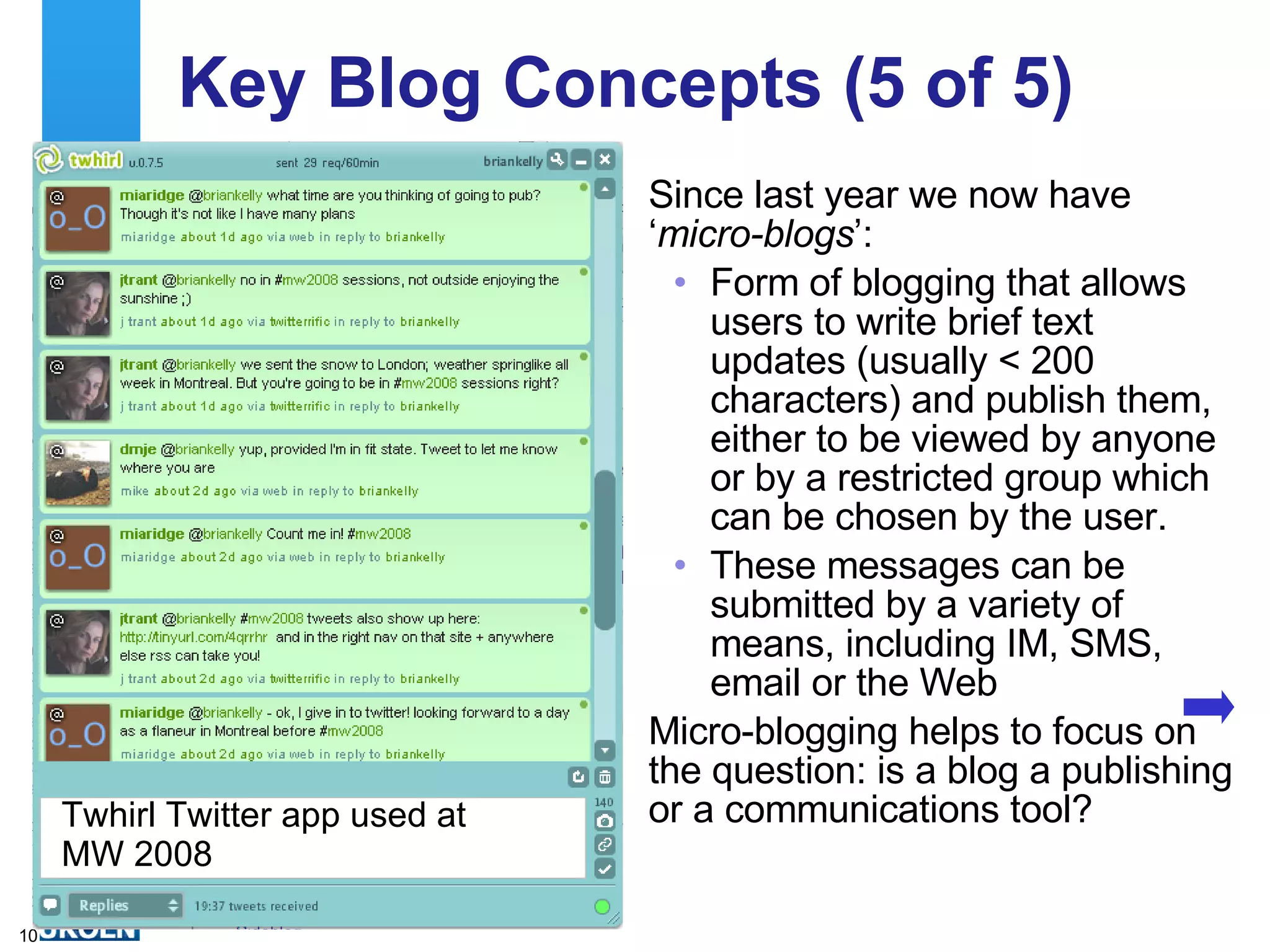
Key Blog Concepts (5 of 5) Since last year we now have ‘ micro-blogs ’: Form of blogging that allows users to write brief text updates (usually < 200 characters) and publish them, either to be viewed by anyone or by a restricted group which can be chosen by the user.  These messages can be submitted by a variety of means, including IM, SMS, email or the Web Micro-blogging helps to focus on the question: is a blog a publishing or a communications tool?  Twhirl Twitter app used at MW 2008
Museum Blogs Typically “the museum Web site” is: “ official” formal marketing-driven and branded impersonal Whereas typically, “the blog” is: “ un-official” informal away from brand pressures personal Museum Blogs Acknowledgment to Mike Ellis, Eduserv Note see MuseumBlogs.org for a directory of over 270  museum blogs, an aggregation of 90,000+ posts and a search across the blogs
Why Have A Blog? Reasons individuals & organisations have blogs: We want to communicate We have something to say Reasons museums might use blogs: Blogs are great at the  niche  or  long tail Museums are great at the  niche  or  long tail ... There is a  compelling mystique  about museums: “ why do they collect that and not this?” “ what made them choose that exhibition?” “ why is this particular object special?” “ how do they make their money?” Museums want to connect with audiences … …  and blogs allow you to communicate with your most  loyal  and  enthusiastic  visitors Museum Blogs Acknowledgment to Mike Ellis, Eduserv
What Makes A Good Blog? Want to be a successful blogger? Blog with  passion  and because you want to! Have a  personality , a defined tone of voice Find a  niche  (or at least well-defined) area of interest Build  your community: two-way engagement  Create well written,  intelligent  posts Don’t just  regurgitate , but find a new angle (be a thinker not a linker) Link  a lot, and  read  the links you link to   Museum Blogs Like all simple rules, these can be broken – but may be a useful guide for your planning Acknowledgment to Mike Ellis, Eduserv
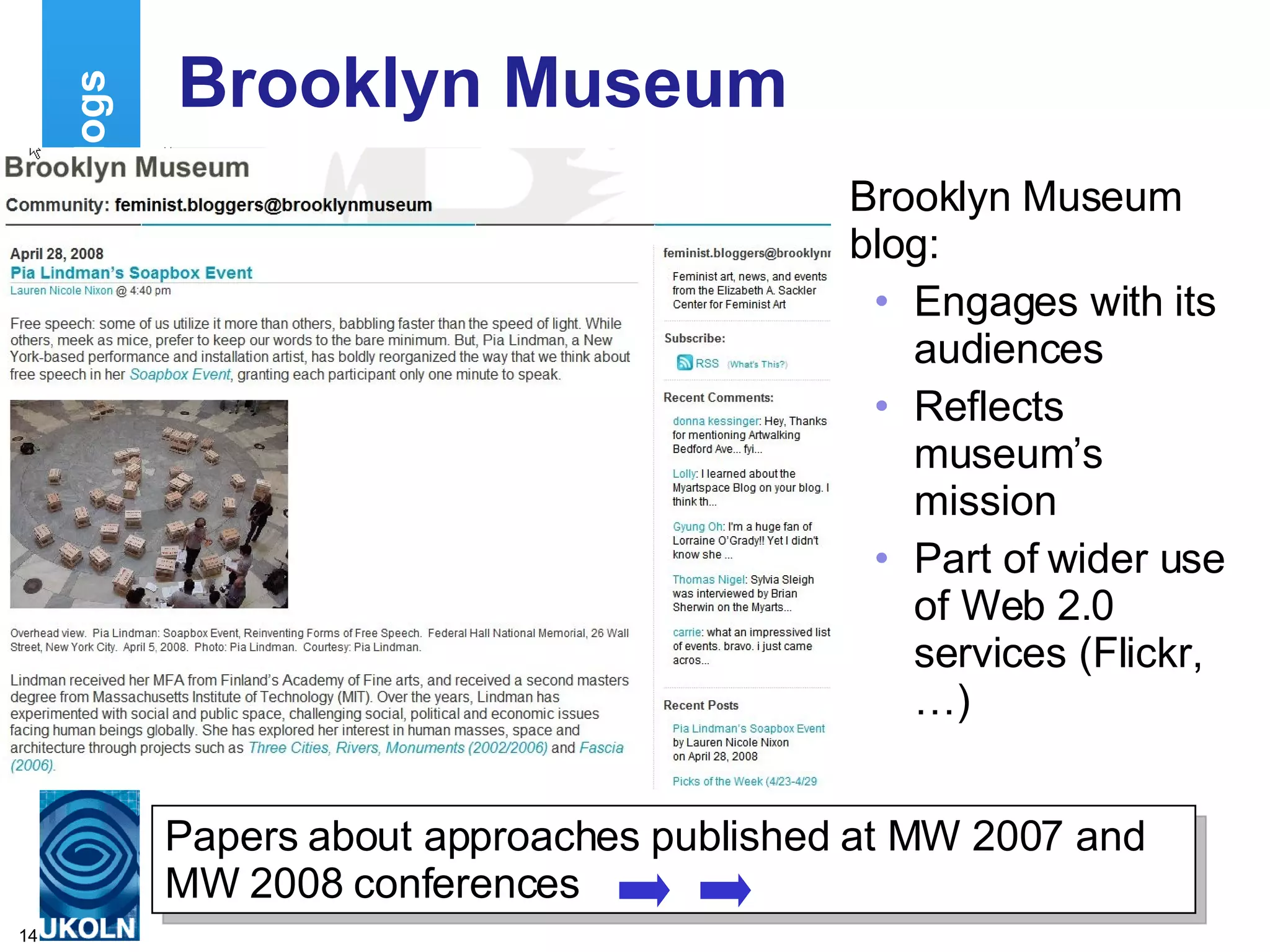
Brooklyn Museum Brooklyn Museum blog: Engages with its audiences Reflects museum’s mission Part of wider use of Web 2.0 services (Flickr, …) Examples of Museum Blogs Papers about approaches published at MW 2007 and MW 2008 conferences
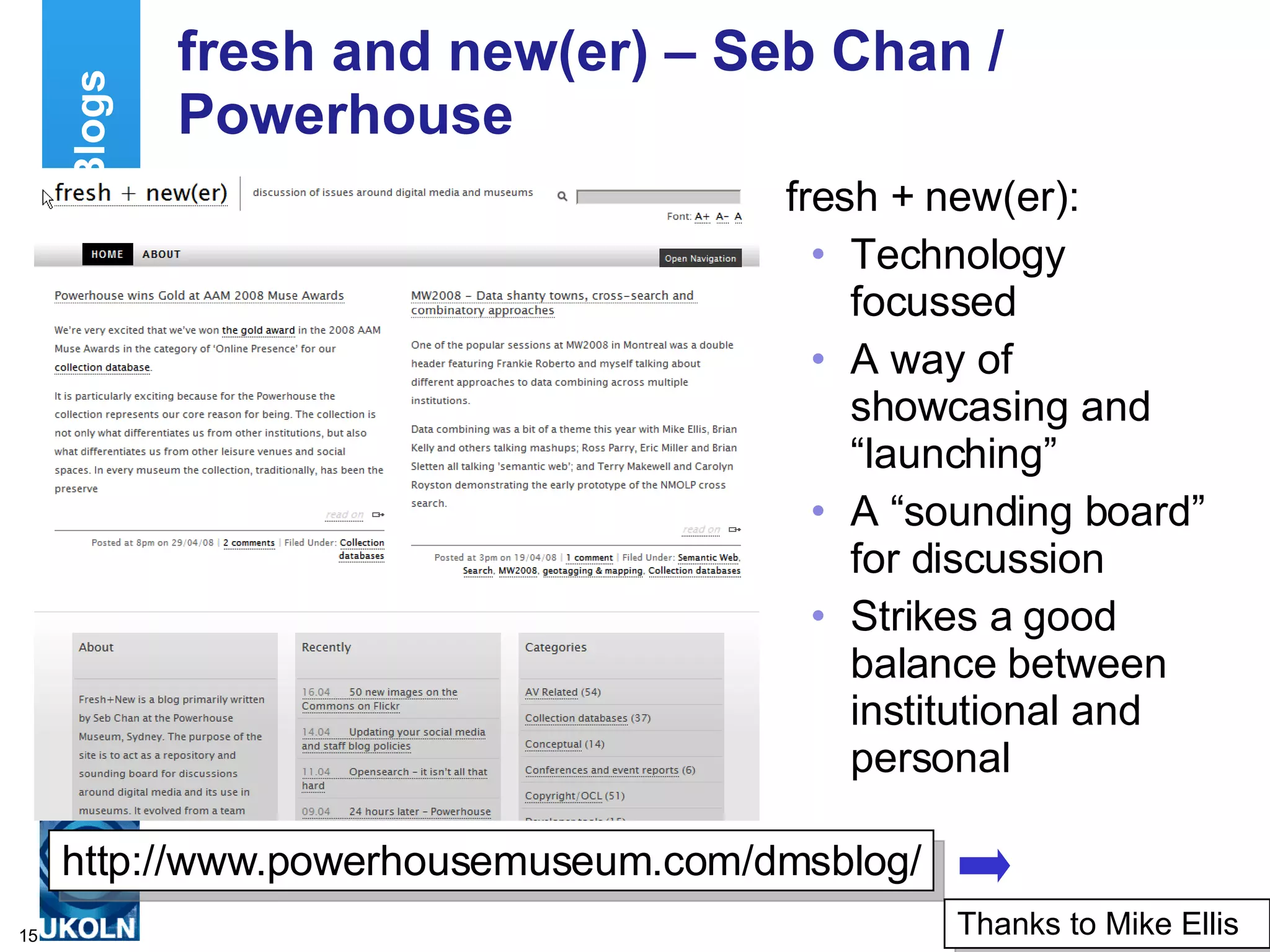
fresh and new(er) – Seb Chan / Powerhouse fresh + new(er): Technology focussed A way of showcasing and “launching” A “sounding board” for discussion Strikes a good balance between institutional and personal Examples of Museum Blogs http://www.powerhousemuseum.com/dmsblog/ Thanks to Mike Ellis
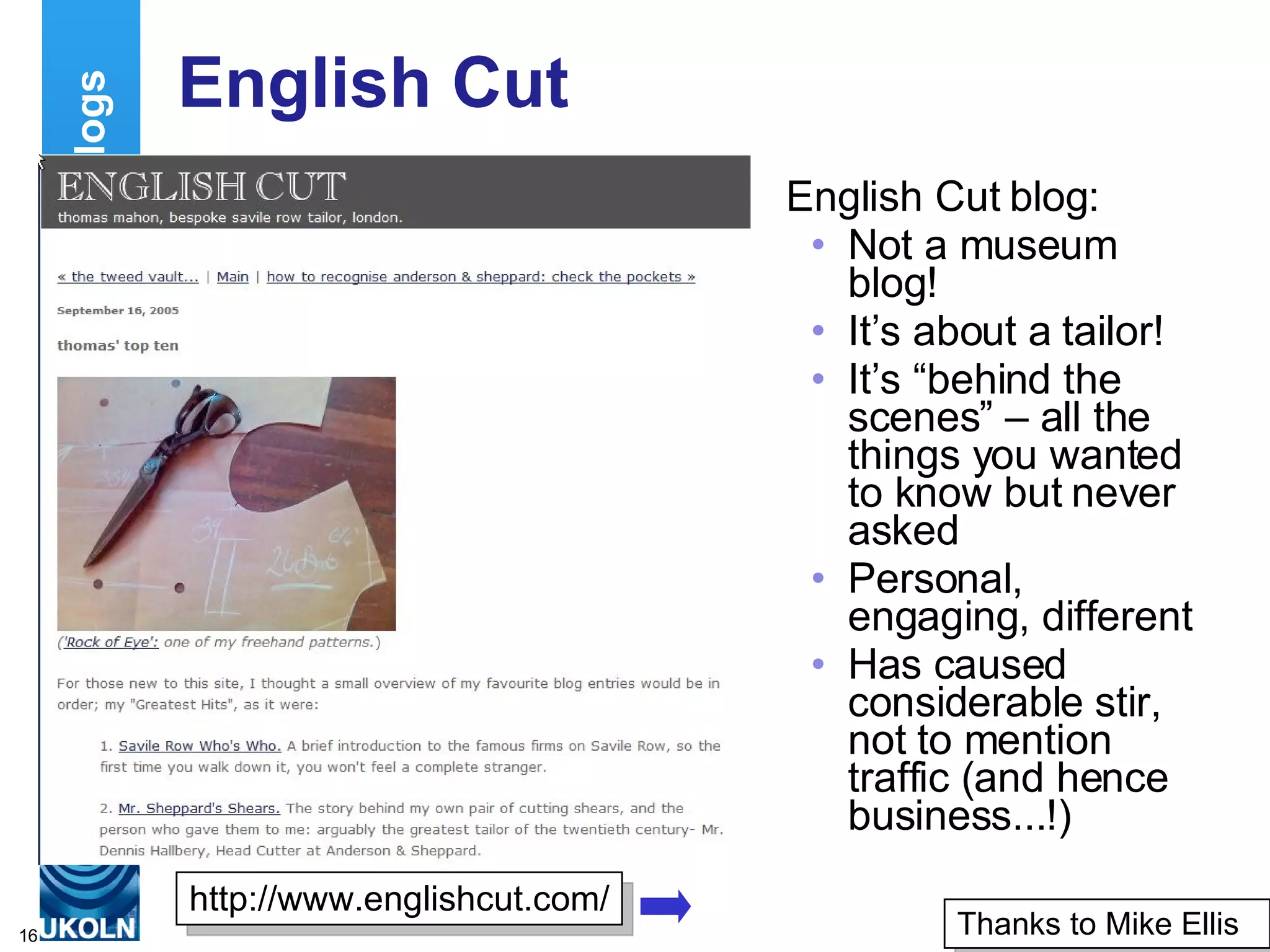
English Cut English Cut blog: Not a museum blog! It’s about a tailor! It’s “behind the scenes” – all the things you wanted to know but never asked Personal, engaging, different Has caused considerable stir, not to mention traffic (and hence business...!) Examples of Museum Blogs http://www.englishcut.com/ Thanks to Mike Ellis
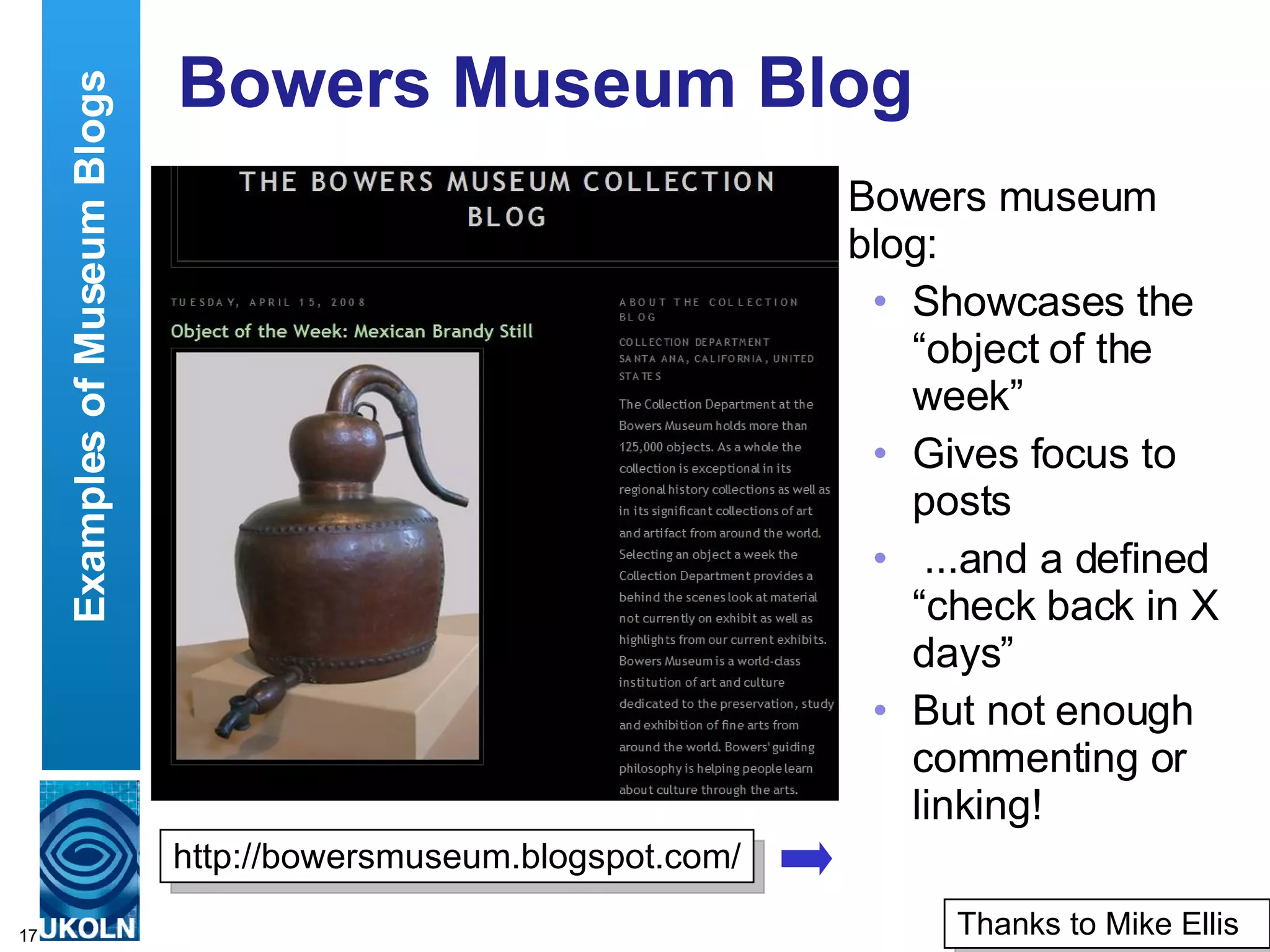
Bowers Museum Blog Bowers museum blog: Showcases the “object of the week” Gives focus to posts ...and a defined “check back in X days” But not enough commenting or linking! Examples of Museum Blogs http://bowersmuseum.blogspot.com/ Thanks to Mike Ellis
Reflections Thoughts on these examples: Varieties of different approaches Personal  aspect is what makes these tick .. finding out about the people behind the formality Perhaps that is what people want from museums?! Examples of Museum Blogs Do you now what to set up your own blogging service?
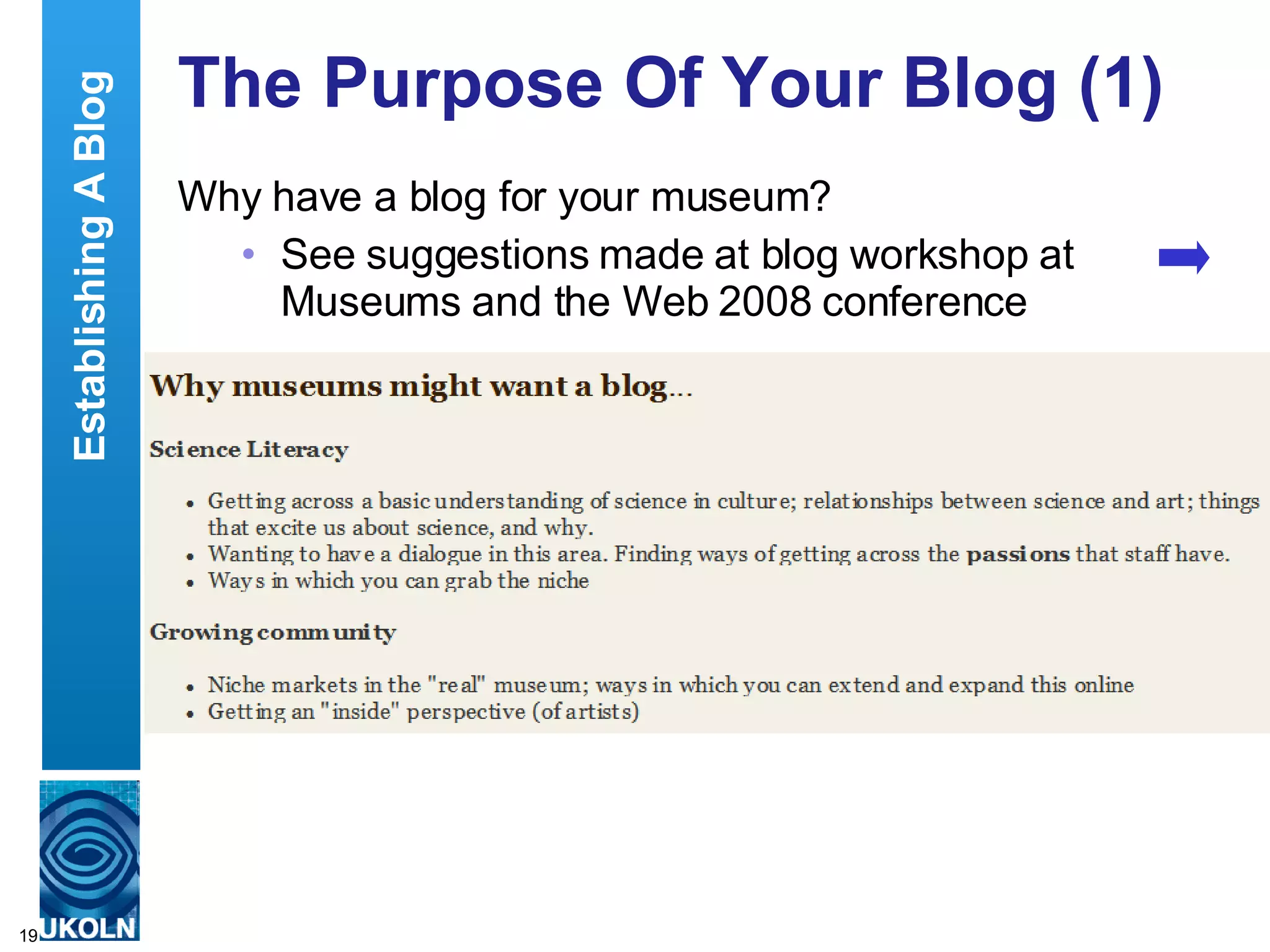
The Purpose Of Your Blog (1) Why have a blog for your museum? See suggestions made at blog workshop at Museums and the Web 2008 conference  Establishing A Blog
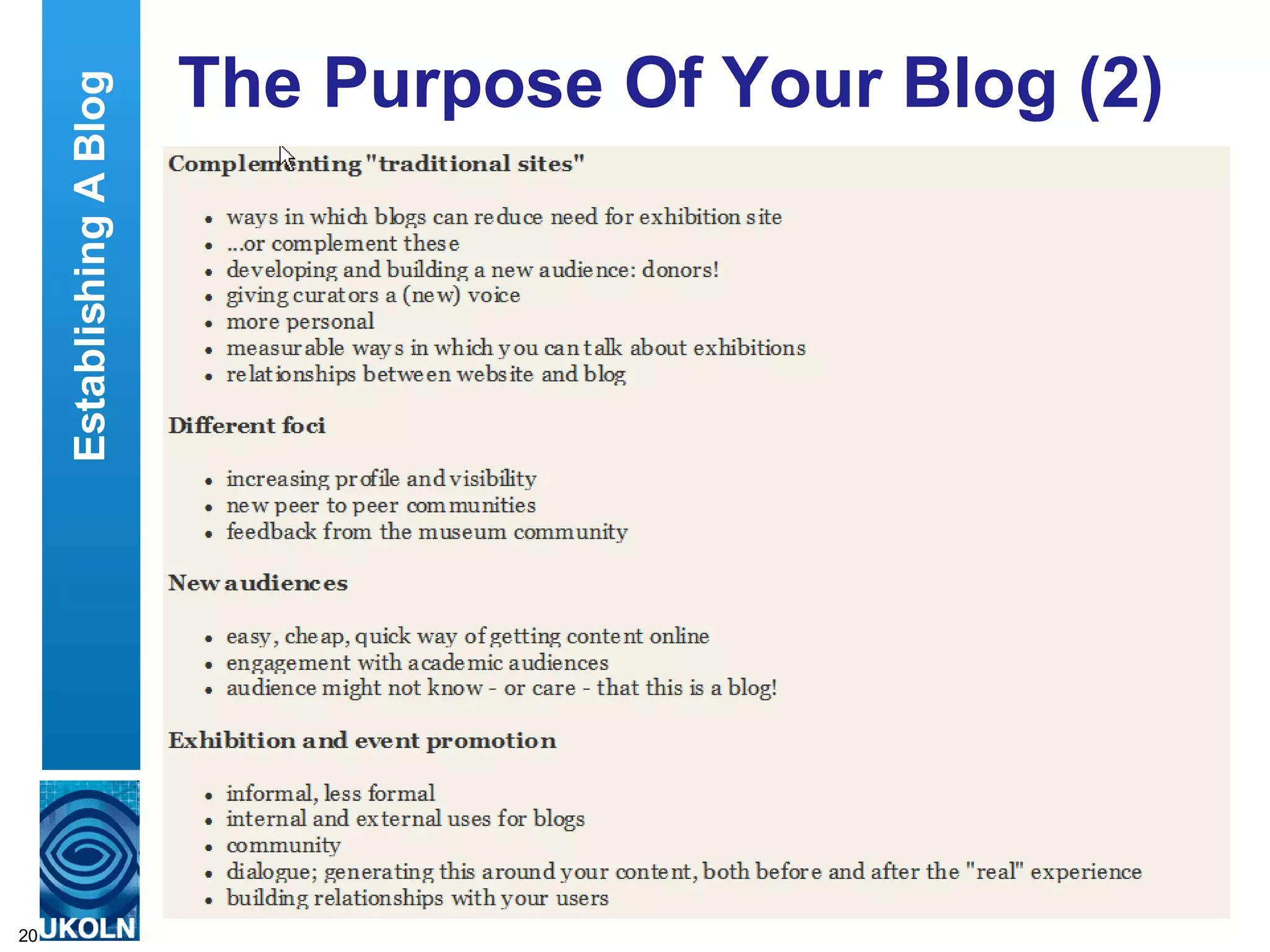
The Purpose Of Your Blog (2) Establishing A Blog
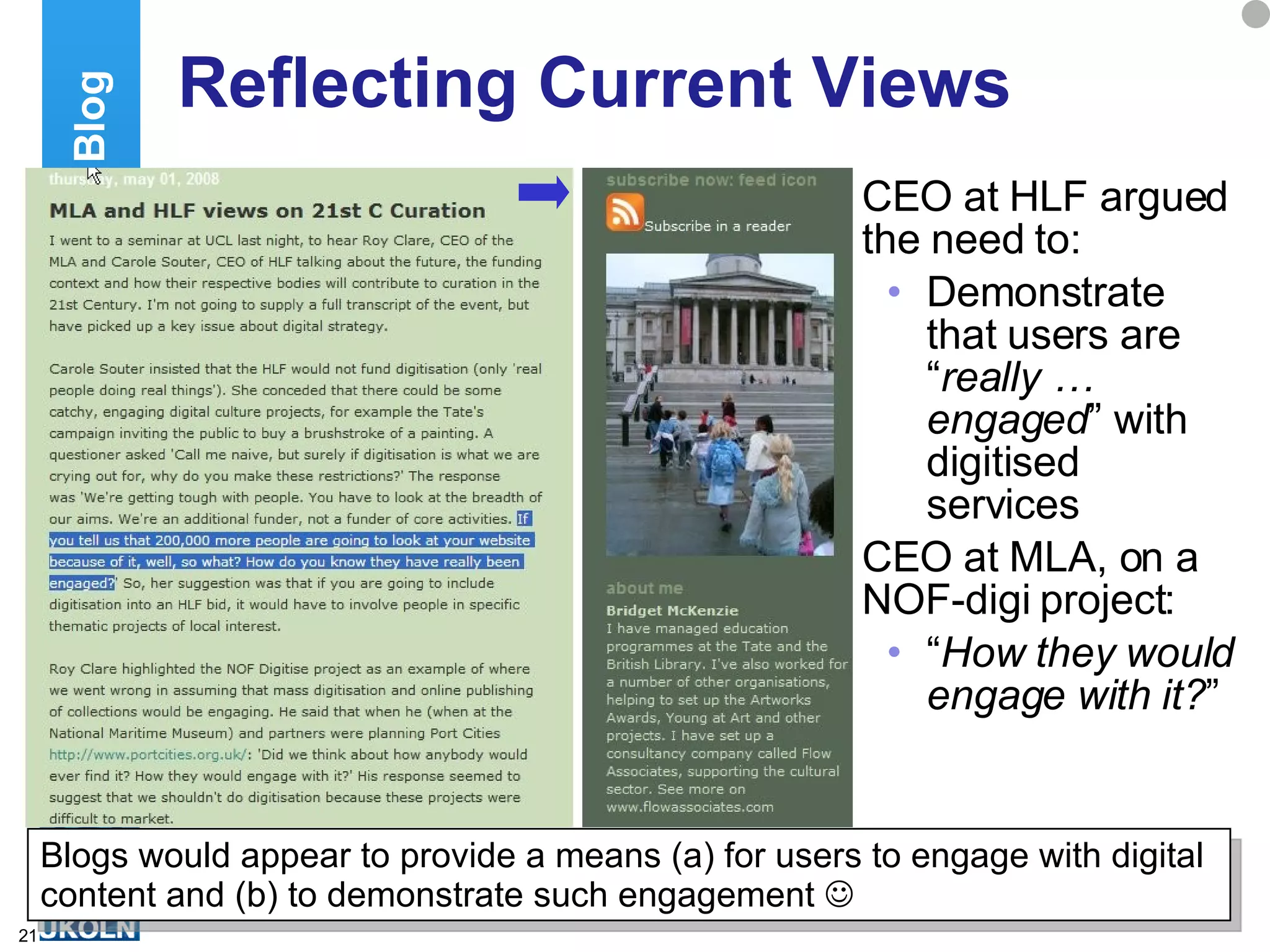
Reflecting Current Views CEO at HLF argued the need to: Demonstrate that users are “ really … engaged ” with digitised services CEO at MLA, on a NOF-digi project: “ How they would engage with it? ” Establishing A Blog Blogs would appear to provide a means (a) for users to engage with digital content and (b) to demonstrate such engagement  
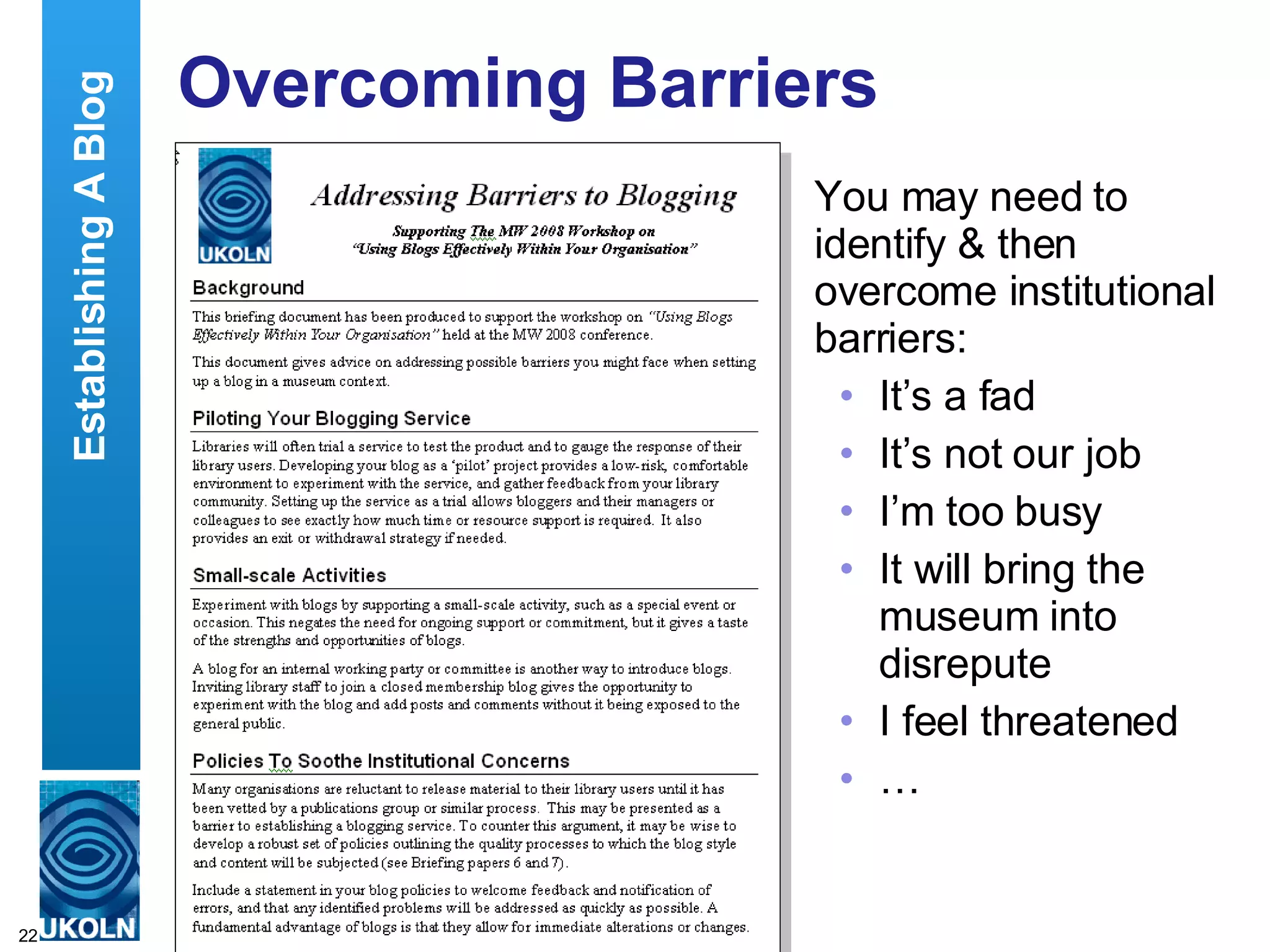
Overcoming Barriers You may need to identify & then overcome institutional barriers: It’s a fad It’s not our job I’m too busy It will bring the museum into disrepute I feel threatened … Establishing A Blog
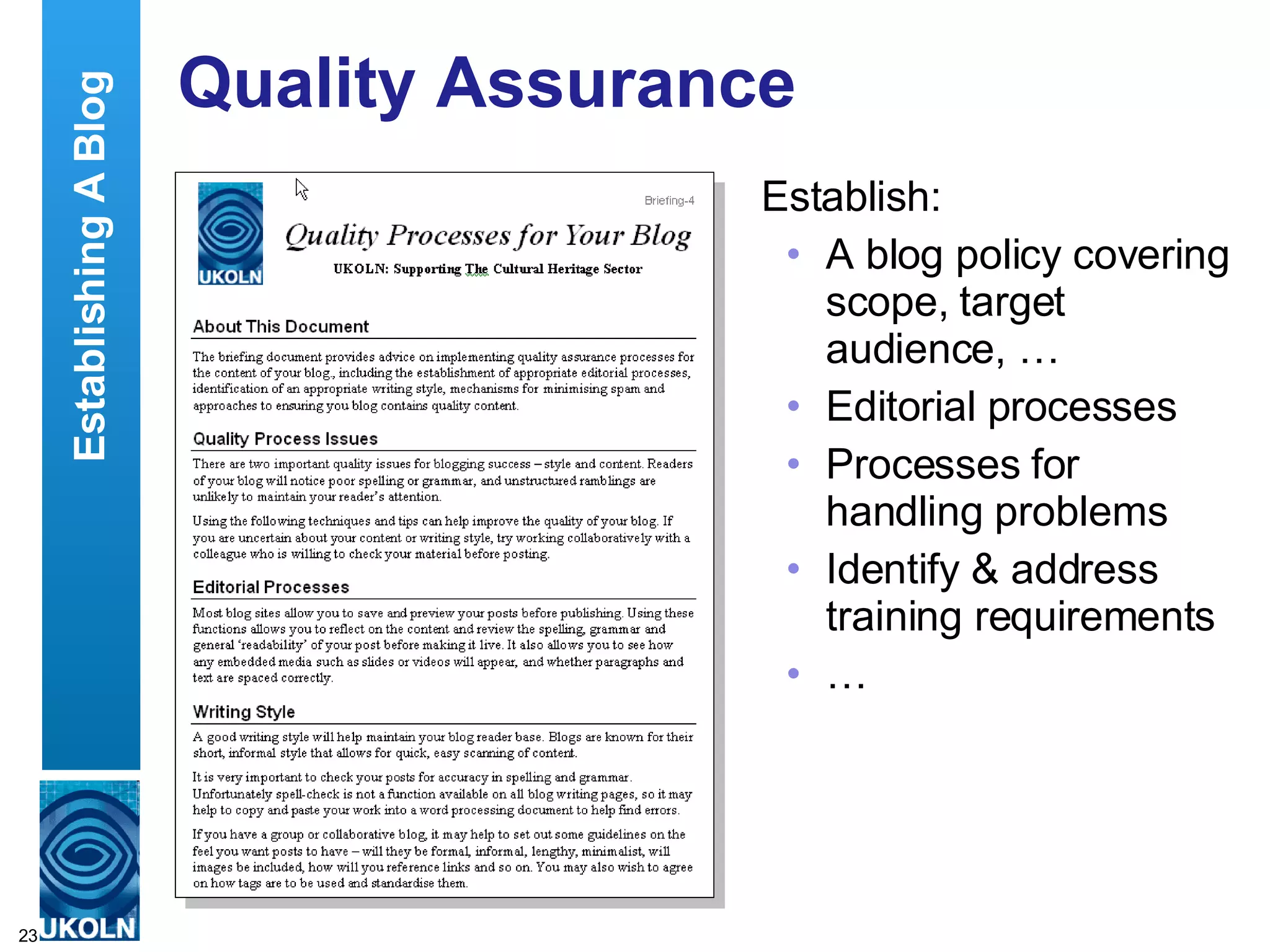
Quality Assurance Establish: A blog policy covering scope, target audience, … Editorial processes Processes for handling problems Identify & address training requirements … Establishing A Blog
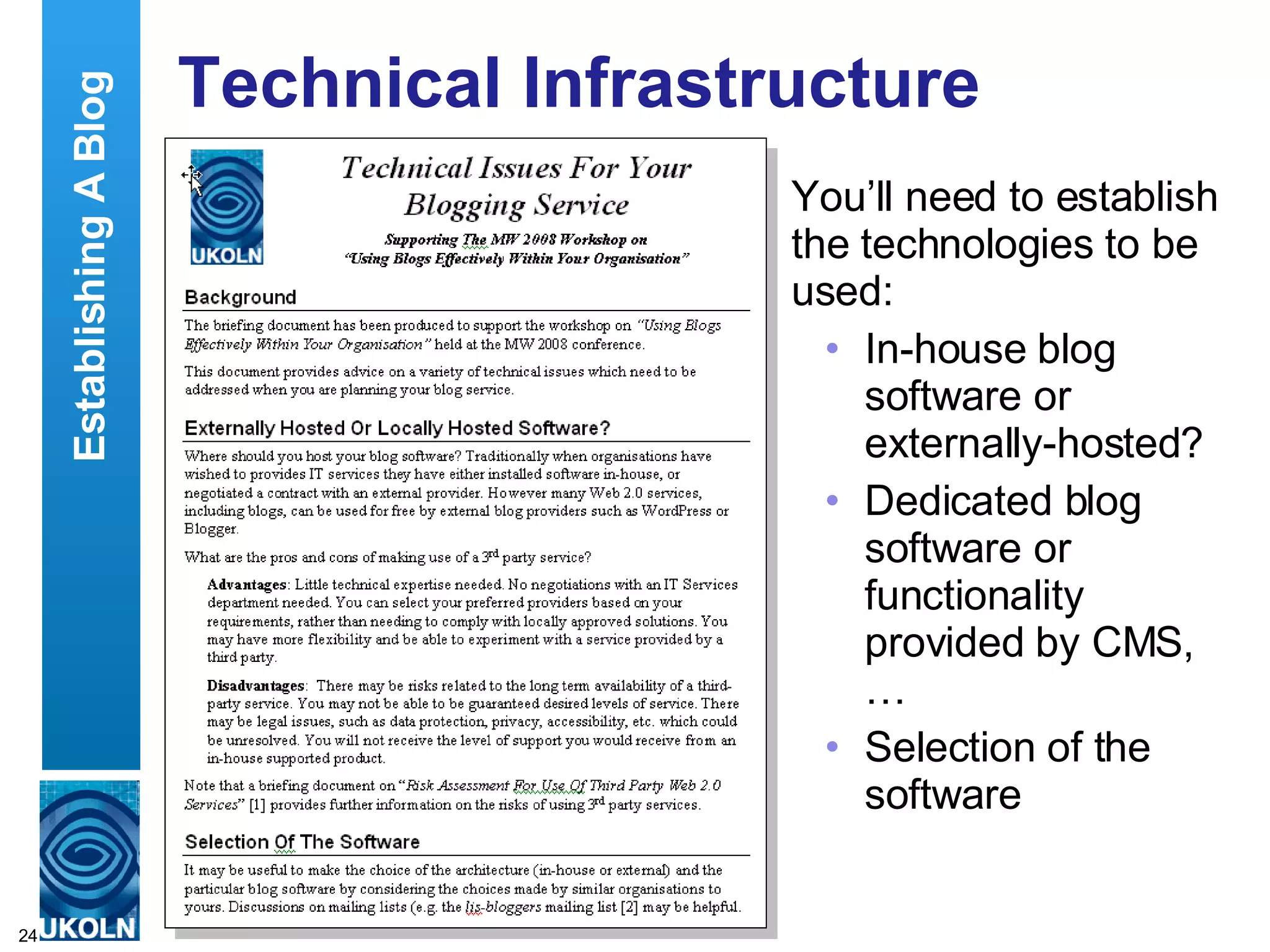
Technical Infrastructure You’ll need to establish the technologies to be used: In-house blog software or externally-hosted? Dedicated blog software or functionality provided by CMS, … Selection of the software  Establishing A Blog
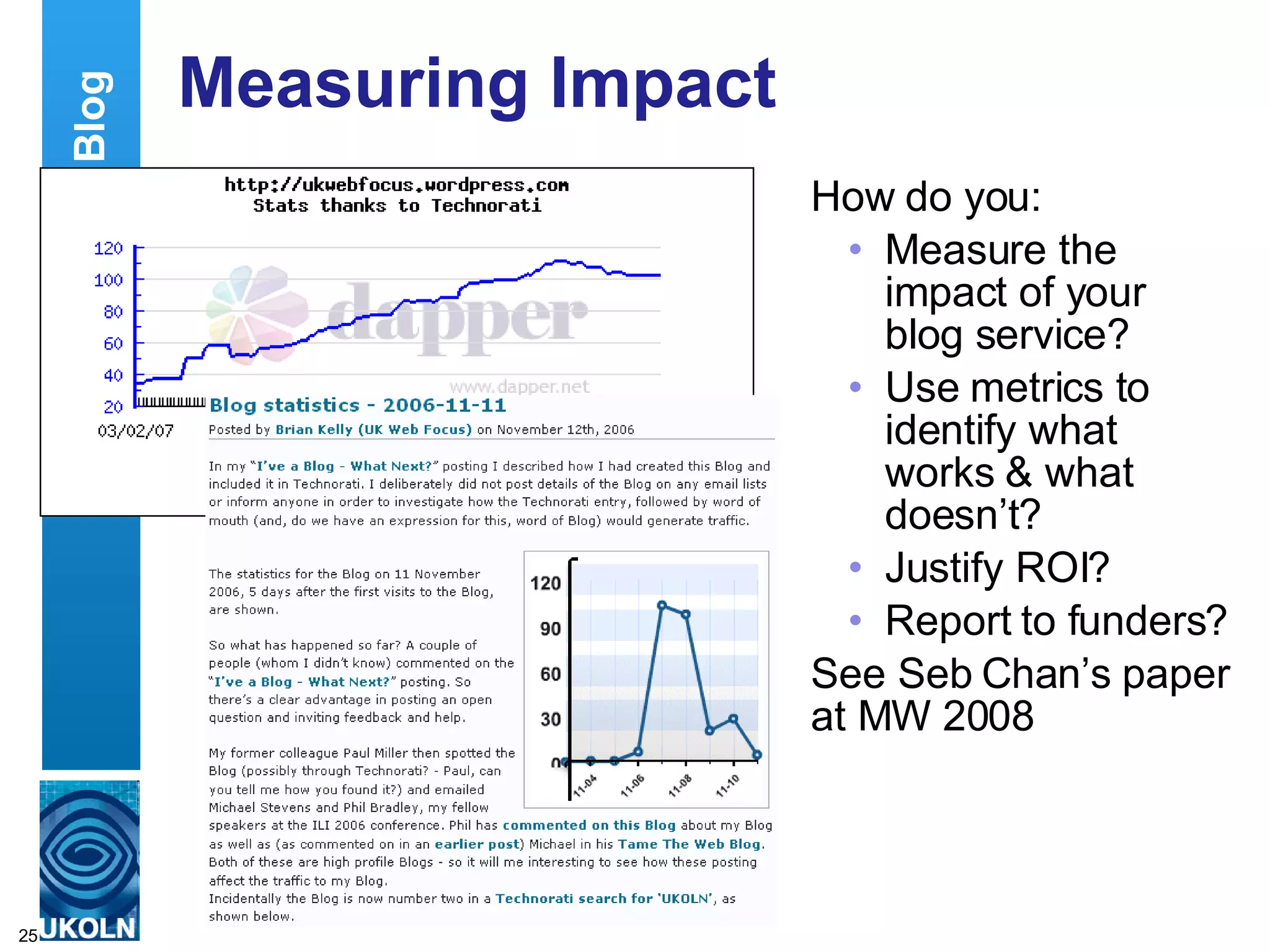
Measuring Impact How do you: Measure the impact of your blog service? Use metrics to identify what works & what doesn’t? Justify ROI? Report to funders? See Seb Chan’s paper at MW 2008 Establishing A Blog
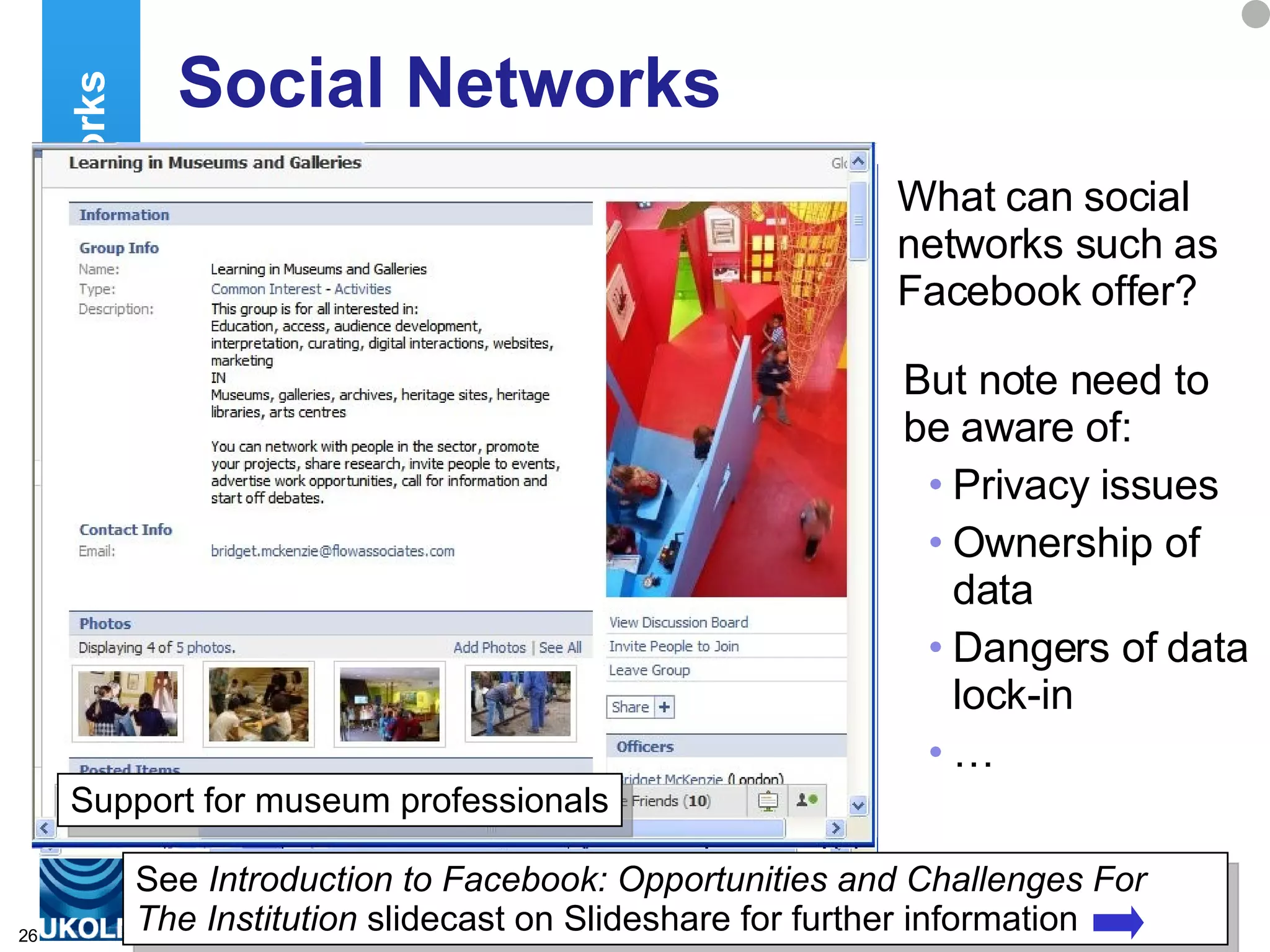
Social Networks What can social networks such as Facebook offer? Social Networks User groups – which may support you, or not But note need to be aware of: Privacy issues Ownership of data Dangers of data lock-in … See  Introduction to Facebook: Opportunities and Challenges For The Institution  slidecast on Slideshare for further information A presence for your institution Support for museum professionals
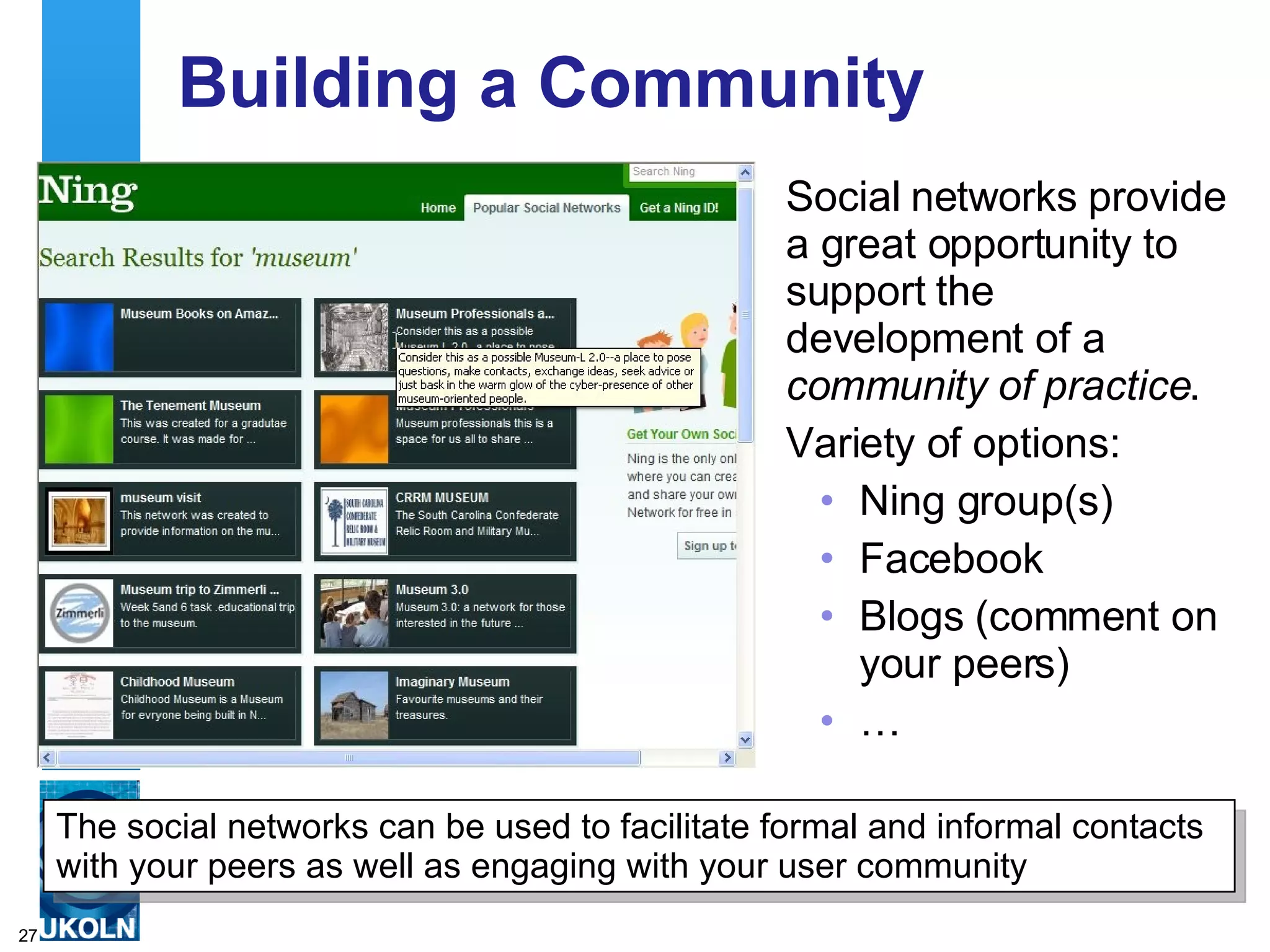
Building a Community  Social networks provide a great opportunity to support the development of a  community of practice . Variety of options: Ning group(s) Facebook Blogs (comment on your peers) … The social networks can be used to facilitate formal and informal contacts with your peers as well as engaging with your user community
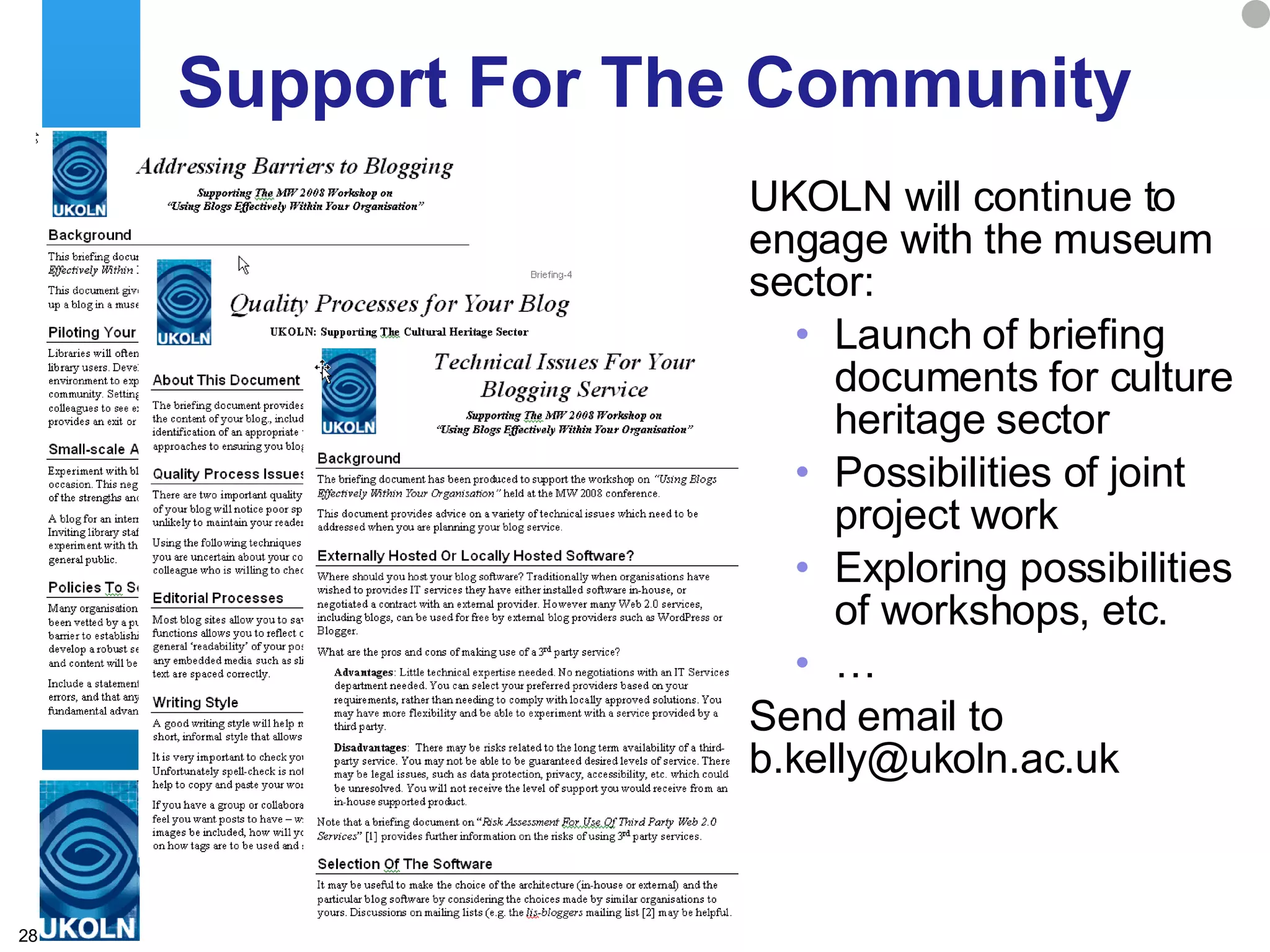
Support For The Community UKOLN will continue to engage with the museum sector: Launch of briefing documents for culture heritage sector Possibilities of joint project work Exploring possibilities of workshops, etc.  … Send email to b.kelly@ukoln.ac.uk
Conclusions To conclude: Blogs are starting to be used within museums There’s a need to clarify the purpose and establish best practises There may be institutional barriers to overcome But it’s worth it – isn’t it?
Questions Any questions or comments? What will you do differently?

Exploiting The Potential of Blogs and Social Networks

  • 1.
    Exploiting the Potentialof Blogs and Social Networks Brian Kelly UKOLN University of Bath Bath, UK [email_address] UKOLN is supported by: http://www.ukoln.ac.uk/web-focus/events/seminars/museum-heritage-show-2008/ This work is licensed under a Attribution-NonCommercial-ShareAlike 2.0 licence (but note caveat) Resources bookmarked using ‘ museum-heritage-show-2008 ' tag by-nc-sa Acceptable Use Policy Recording/broadcasting of this talk, taking photographs, discussing the content using email, instant messaging, blogs, SMS, etc. is permitted providing distractions to others is minimised.
  • 2.
    Contents Introduction AboutMe • About the Talk About You What’s It All About? Overview • Example of Museum Blogs We Should Be Doing This! Reasons For Having a Blog • Policies & QA Technical Infrastructure • Sharing Best Practices Where Do Social Networks Fit In? What are Social Networks? Using Social Networks Conclusions What Next? Questions Introduction
  • 3.
    About Me BrianKelly: UK Web Focus: a national advisory post Long-standing Web evangelist (since Jan 1993) Based at UKOLN, University of Bath, with remit to advise HE/FE and cultural heritage sectors Interests include Web 2.0, standards, accessibility and overcoming institutional inertia Blogger since November 2006 Awarded the IWR Information Professional of the Year in December 2007 Facilitated half day workshops on Using Blogs Effectively Within Your Organisation at Museum & Web 2008 and Using Blogs Effectively Within Your Library at ILI 2007 conferences Introduction
  • 4.
    About The TalkBy the end of the talk you should: Be aware of key blogging concepts and tool Have learnt about ways in which blogs can be used within a library environment Have identified potential barriers to the deployment of blogs within an institution Have heard about and discussed strategies for overcoming barriers Have learnt about tools and techniques for measuring a blog’s impact and success. Have heard about and discussed best practices for developing a sustainable blogging service Have had the opportunity to make plans for launching or enhancing your blog service Introduction And have a set of materials & resources which you can use for in-house training purposes 
  • 5.
    About You Inbrief: Do you have a work-related blog? Do you have a social blog? Do you use social networks (e.g. Facebook, MySpace, …) for work-related purposes or for social purposes? Is your organisation intending to set up a blog? What you hope to gain from this talk? Introduction
  • 6.
    Key Blog Concepts(1 of 5) What Is A Blog? A blog (a portmanteau of web log) is a website where entries are written in chronological order and commonly displayed in reverse chronological order. Blogs provide commentary or news on a particular subject such as food, politics, or local news; some function as more personal online diaries. A typical blog combines text, images, and links to other blogs, web pages, and other media related to its topic. The ability for readers to leave comments in an interactive format is an important part of many blogs. Blog Concepts Wikipedia definition Note that blog software can be used for other purposes (including building conventional Web sites). We will focus on conventional understanding of a blog. See also handout
  • 7.
    Key Blog Concepts(2 of 5) Providing a Blog Blogs can be provided by: Installing software locally (open source or licensed) Using an externally hosted service (Blogger.com and Wordpress.com are popular) Using existing systems (e.g. a VLE, a CMS, etc.) which has blog functionality provided Using social networking services (e.g. Facebook, MySpace) which providing blogging or similar functionality Blogging
  • 8.
    Key Blog Concepts(3 of 5) Reading Blogs Blog readers can: Visit a blog site (conventional approach) Use an RSS reader, which can be web-based (e.g. Bloglines, Google Reader, etc.) or a desktop RSS reader (e.g. Blogbridge) Via a blog aggregator – view posts from lots of blogs Use a mobile device (e.g. PDA, mobile phone, etc.) Have blog posts delivered using email Blog Concepts
  • 9.
    Key Blog Concepts(4 of 5) Finding Blogs I find blog posts (including links to my posts) using: Technorati Google blogger web comments Blog directories Referrer links to my blog … Blog Concepts Technorati is to the blogosphere what Google is to Web space
  • 10.
    Key Blog Concepts(5 of 5) Since last year we now have ‘ micro-blogs ’: Form of blogging that allows users to write brief text updates (usually < 200 characters) and publish them, either to be viewed by anyone or by a restricted group which can be chosen by the user. These messages can be submitted by a variety of means, including IM, SMS, email or the Web Micro-blogging helps to focus on the question: is a blog a publishing or a communications tool? Twhirl Twitter app used at MW 2008
  • 11.
    Museum Blogs Typically“the museum Web site” is: “ official” formal marketing-driven and branded impersonal Whereas typically, “the blog” is: “ un-official” informal away from brand pressures personal Museum Blogs Acknowledgment to Mike Ellis, Eduserv Note see MuseumBlogs.org for a directory of over 270 museum blogs, an aggregation of 90,000+ posts and a search across the blogs
  • 12.
    Why Have ABlog? Reasons individuals & organisations have blogs: We want to communicate We have something to say Reasons museums might use blogs: Blogs are great at the niche or long tail Museums are great at the niche or long tail ... There is a compelling mystique about museums: “ why do they collect that and not this?” “ what made them choose that exhibition?” “ why is this particular object special?” “ how do they make their money?” Museums want to connect with audiences … … and blogs allow you to communicate with your most loyal and enthusiastic visitors Museum Blogs Acknowledgment to Mike Ellis, Eduserv
  • 13.
    What Makes AGood Blog? Want to be a successful blogger? Blog with passion and because you want to! Have a personality , a defined tone of voice Find a niche (or at least well-defined) area of interest Build your community: two-way engagement Create well written, intelligent posts Don’t just regurgitate , but find a new angle (be a thinker not a linker) Link a lot, and read the links you link to  Museum Blogs Like all simple rules, these can be broken – but may be a useful guide for your planning Acknowledgment to Mike Ellis, Eduserv
  • 14.
    Brooklyn Museum BrooklynMuseum blog: Engages with its audiences Reflects museum’s mission Part of wider use of Web 2.0 services (Flickr, …) Examples of Museum Blogs Papers about approaches published at MW 2007 and MW 2008 conferences
  • 15.
    fresh and new(er)– Seb Chan / Powerhouse fresh + new(er): Technology focussed A way of showcasing and “launching” A “sounding board” for discussion Strikes a good balance between institutional and personal Examples of Museum Blogs http://www.powerhousemuseum.com/dmsblog/ Thanks to Mike Ellis
  • 16.
    English Cut EnglishCut blog: Not a museum blog! It’s about a tailor! It’s “behind the scenes” – all the things you wanted to know but never asked Personal, engaging, different Has caused considerable stir, not to mention traffic (and hence business...!) Examples of Museum Blogs http://www.englishcut.com/ Thanks to Mike Ellis
  • 17.
    Bowers Museum BlogBowers museum blog: Showcases the “object of the week” Gives focus to posts ...and a defined “check back in X days” But not enough commenting or linking! Examples of Museum Blogs http://bowersmuseum.blogspot.com/ Thanks to Mike Ellis
  • 18.
    Reflections Thoughts onthese examples: Varieties of different approaches Personal aspect is what makes these tick .. finding out about the people behind the formality Perhaps that is what people want from museums?! Examples of Museum Blogs Do you now what to set up your own blogging service?
  • 19.
    The Purpose OfYour Blog (1) Why have a blog for your museum? See suggestions made at blog workshop at Museums and the Web 2008 conference Establishing A Blog
  • 20.
    The Purpose OfYour Blog (2) Establishing A Blog
  • 21.
    Reflecting Current ViewsCEO at HLF argued the need to: Demonstrate that users are “ really … engaged ” with digitised services CEO at MLA, on a NOF-digi project: “ How they would engage with it? ” Establishing A Blog Blogs would appear to provide a means (a) for users to engage with digital content and (b) to demonstrate such engagement 
  • 22.
    Overcoming Barriers Youmay need to identify & then overcome institutional barriers: It’s a fad It’s not our job I’m too busy It will bring the museum into disrepute I feel threatened … Establishing A Blog
  • 23.
    Quality Assurance Establish:A blog policy covering scope, target audience, … Editorial processes Processes for handling problems Identify & address training requirements … Establishing A Blog
  • 24.
    Technical Infrastructure You’llneed to establish the technologies to be used: In-house blog software or externally-hosted? Dedicated blog software or functionality provided by CMS, … Selection of the software Establishing A Blog
  • 25.
    Measuring Impact Howdo you: Measure the impact of your blog service? Use metrics to identify what works & what doesn’t? Justify ROI? Report to funders? See Seb Chan’s paper at MW 2008 Establishing A Blog
  • 26.
    Social Networks Whatcan social networks such as Facebook offer? Social Networks User groups – which may support you, or not But note need to be aware of: Privacy issues Ownership of data Dangers of data lock-in … See Introduction to Facebook: Opportunities and Challenges For The Institution slidecast on Slideshare for further information A presence for your institution Support for museum professionals
  • 27.
    Building a Community Social networks provide a great opportunity to support the development of a community of practice . Variety of options: Ning group(s) Facebook Blogs (comment on your peers) … The social networks can be used to facilitate formal and informal contacts with your peers as well as engaging with your user community
  • 28.
    Support For TheCommunity UKOLN will continue to engage with the museum sector: Launch of briefing documents for culture heritage sector Possibilities of joint project work Exploring possibilities of workshops, etc. … Send email to b.kelly@ukoln.ac.uk
  • 29.
    Conclusions To conclude:Blogs are starting to be used within museums There’s a need to clarify the purpose and establish best practises There may be institutional barriers to overcome But it’s worth it – isn’t it?
  • 30.
    Questions Any questionsor comments? What will you do differently?