BLOW MOULD
PROCESS
Blow molding is a manufacturing process that is used to produce hallow plastics parts
by inflated a heated plastics until it conforms to the mold shape and form the desired product.
PODUCTS OF BLOW MOLDING
Applications of Blow Molded Parts
Packaging for Milik, fluids, medicines, cosmetics, etc.
Automotive fuel tanks, oil bottles, air ducts and seat backs.
Consumer products like toys, house-wares, sports goods etc.
Drums for chemical industries.
Bellow shaped shield and double walled carrying case.
1). The blow moulding cycle starts
with the mould open.
A hollow length of plastic, called a
parison, is extruded down between
the two halves of the mould.
2). The mould closes over
the parison.
3). Compressed air inflates
the soft plastic.
Blow Moulding Process
Fig-1
Fig-2
Fig-3
Fig-4
4). Mould opens and
the moulding removed
Design of a blow moulded bottle & other shapes requires consideration
of the following factors :-
1) Material to be blown
2) Size & Weight of the product & mould
3) Contours on the part
4) Surface texture & engraving
5) Sharp corners & straight edges
6) Blow opening available & locations
7) Parting lines
Blow Moulded Part Design Considerations
Corner & Edge Rounding
Base Design
To avoid the rocking bottom phenomenon, in case of flat bottom parts, the typical solution is
to provide a doomed recess in the base, called push-up.
On stretch blown PET bottles/containers, the base must be spherical due to internal
pressure. Petaloid type base provides a self-standing container with several egg-shaped feet
on which it balances.
Materials for Blow Mould Construction
1). Aluminum alloy : Aircraft grade aluminum
2). Beryllium-Copper (Be-Cu) alloy
excellent thermal conductivity, corrosion-resistance
& mechanical toughness.
3). Steel : for blow moulds for PVC or engineering resins,
AISI-P20 pre-hardened steel is widely used.
For corrosive resins, AISI-420 stainless steel.
4). Miscellaneous Materials : Zinc alloy (Kirksite)
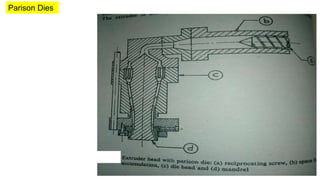
Parison Dies
PINCH OFF DESIGN
Blow Mould Unit-V.pptx

Blow Mould Unit-V.pptx

  • 1.
    BLOW MOULD PROCESS Blow moldingis a manufacturing process that is used to produce hallow plastics parts by inflated a heated plastics until it conforms to the mold shape and form the desired product. PODUCTS OF BLOW MOLDING
  • 2.
    Applications of BlowMolded Parts Packaging for Milik, fluids, medicines, cosmetics, etc. Automotive fuel tanks, oil bottles, air ducts and seat backs. Consumer products like toys, house-wares, sports goods etc. Drums for chemical industries. Bellow shaped shield and double walled carrying case.
  • 3.
    1). The blowmoulding cycle starts with the mould open. A hollow length of plastic, called a parison, is extruded down between the two halves of the mould. 2). The mould closes over the parison. 3). Compressed air inflates the soft plastic. Blow Moulding Process Fig-1 Fig-2 Fig-3 Fig-4 4). Mould opens and the moulding removed
  • 10.
    Design of ablow moulded bottle & other shapes requires consideration of the following factors :- 1) Material to be blown 2) Size & Weight of the product & mould 3) Contours on the part 4) Surface texture & engraving 5) Sharp corners & straight edges 6) Blow opening available & locations 7) Parting lines Blow Moulded Part Design Considerations
  • 11.
    Corner & EdgeRounding
  • 12.
    Base Design To avoidthe rocking bottom phenomenon, in case of flat bottom parts, the typical solution is to provide a doomed recess in the base, called push-up. On stretch blown PET bottles/containers, the base must be spherical due to internal pressure. Petaloid type base provides a self-standing container with several egg-shaped feet on which it balances.
  • 13.
    Materials for BlowMould Construction 1). Aluminum alloy : Aircraft grade aluminum 2). Beryllium-Copper (Be-Cu) alloy excellent thermal conductivity, corrosion-resistance & mechanical toughness. 3). Steel : for blow moulds for PVC or engineering resins, AISI-P20 pre-hardened steel is widely used. For corrosive resins, AISI-420 stainless steel. 4). Miscellaneous Materials : Zinc alloy (Kirksite)
  • 14.
  • 19.