VOLUNTARY MOVEMENTSVOLUNTARY MOVEMENTS
Pyramidal tract.Pyramidal tract.
Syndromes of disorders.Syndromes of disorders.
The chair of neurologyThe chair of neurology
HrybHryb Viktoriya AnatiliivnaViktoriya Anatiliivna
Movements which are the results ofMovements which are the results of
cortical innervation, made by lifecortical innervation, made by life
experiences are conditioned reflexes -experiences are conditioned reflexes -
they are called "voluntary" movements.they are called "voluntary" movements.
Automatic reflex movements are calledAutomatic reflex movements are called
"involuntary.""involuntary."
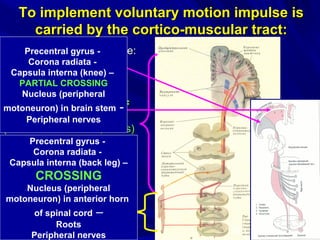
To implement voluntary motion impulse isTo implement voluntary motion impulse is
carried by the cortico-muscular tract:carried by the cortico-muscular tract:
11 neuron - central motive:neuron - central motive:
–– coricobulbar tractcoricobulbar tract
((for musclesfor muscles of cranialof cranial
nervesnerves))
–– coricospinal tractcoricospinal tract ==
pyramidal tractpyramidal tract
((forfor muscles of trunkmuscles of trunk,, limbslimbs))
- laterallateral inin spinalspinal
- anterioranterior cordcord
22 neuronneuron ––
peripheralperipheral
motivemotive
Precentral gyrus -
Corona radiata -
Capsula interna (knee) –
PARTIAL CROSSING
Nucleus (peripheral
motoneuron) in brain stem -
Peripheral nerves
Precentral gyrus -
Corona radiata -
Capsula interna (back leg) –
CROSSING
Nucleus (peripheral
motoneuron) in anterior horn
of spinal cord –
Roots
Peripheral nerves
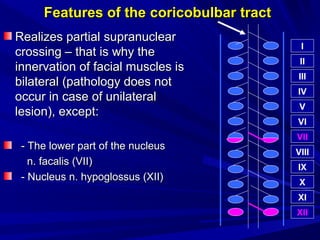
Features of theFeatures of the coricobulbarcoricobulbar tracttract
Realizes partialRealizes partial supranuclearsupranuclear
crossing – that is why thecrossing – that is why the
innervation of facial muscles isinnervation of facial muscles is
bilateralbilateral (pathology does not(pathology does not
occur in case of unilateraloccur in case of unilateral
lesion), except:lesion), except:
- The lower part of the nucleus- The lower part of the nucleus
n. facalis (VII)n. facalis (VII)
- Nucleus n. hypoglossus (XII)- Nucleus n. hypoglossus (XII)
V
IV
III
II
I
IX
VIII
VII
VI
XI
X
XII
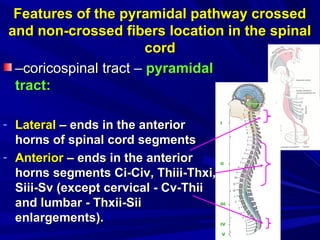
Features of the pyramidal pathway crossedFeatures of the pyramidal pathway crossed
and non-crossed fibers location in the spinaland non-crossed fibers location in the spinal
cordcord
––coricospinalcoricospinal tracttract –– pyramidalpyramidal
tracttract::
- LateralLateral –– ends in the anteriorends in the anterior
horns of spinal cord segmentshorns of spinal cord segments
- AnteriorAnterior –– ends in the anteriorends in the anterior
horns segments Ci-Civ, Thiii-Thxi,horns segments Ci-Civ, Thiii-Thxi,
Siii-Sv (except cervical - Cv-ThiiSiii-Sv (except cervical - Cv-Thii
and lumbar - Thxii-Siiand lumbar - Thxii-Sii
enlargementsenlargements).).
In case of the voluntary movementsIn case of the voluntary movements
pathway damage (both central andpathway damage (both central and
peripheral neurons) the following occurs:peripheral neurons) the following occurs:
Paralysis = plegia - complete loss ofParalysis = plegia - complete loss of
movementmovement
Paresis - reduction of motion range andParesis - reduction of motion range and
muscle strengthmuscle strength
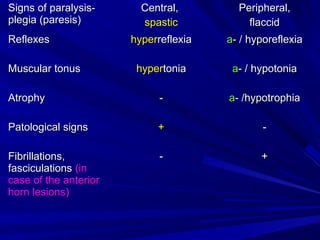
Signs of paralysis-Signs of paralysis-
plegia (paresis)plegia (paresis)
CentralCentral,,
spasticspastic
PeripheralPeripheral,,
flaccidflaccid
ReflexesReflexes hyperhyperreflexiareflexia аа- /- / hyporeflexiahyporeflexia
Muscular tonusMuscular tonus hyperhypertoniatonia аа- /- / hypotoniahypotonia
AtrophyAtrophy -- аа- /- /hypotrophiahypotrophia
Patological signsPatological signs ++ --
FibrillationsFibrillations,,
fasciculationsfasciculations ((inin
case of the anteriorcase of the anterior
horn lesionshorn lesions))
-- ++
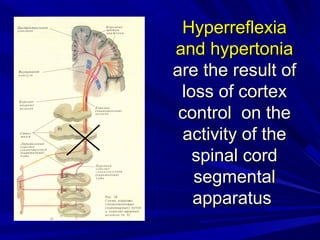
HyperreflexiaHyperreflexia
and hypertoniaand hypertonia
are the result ofare the result of
loss of cortexloss of cortex
control on thecontrol on the
activity of theactivity of the
spinal cordspinal cord
segmentalsegmental
apparatusapparatus
Pathological signsPathological signs
Pathological reflexesPathological reflexes
((in new-borns - the norm,until the nervein new-borns - the norm,until the nerve
fibers myelination of in the CNS isfibers myelination of in the CNS is
endedended))
The defenceThe defence reflexreflexeses
SynkineSynkinesissis
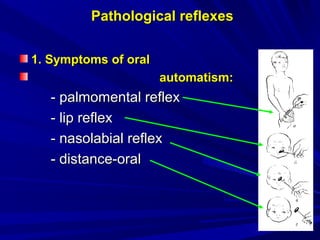
Pathological reflexesPathological reflexes
1.1. Symptoms of oralSymptoms of oral
automatism:automatism:
-- palmomental reflexpalmomental reflex
-- lip reflexlip reflex
-- nasolabial reflexnasolabial reflex
- distance-oral- distance-oral
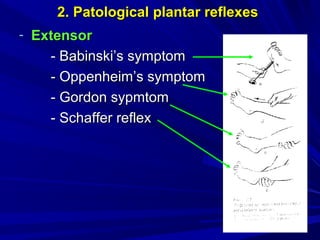
2.2. PatologicalPatological plantar reflexesplantar reflexes
- ExtensorExtensor
-- Babinski’s symptomBabinski’s symptom
-- Oppenheim’s symptomOppenheim’s symptom
-- Gordon sypmtomGordon sypmtom
-- Schaffer reflexSchaffer reflex
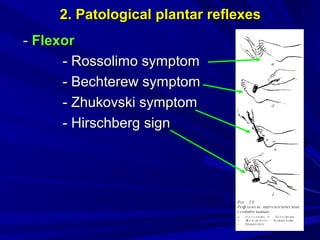
-- FlexorFlexor
-- Rossolimo symptomRossolimo symptom
-- Bechterew symptomBechterew symptom
-- Zhukovski symptomZhukovski symptom
-- Hirschberg signHirschberg sign
2.2. PatologicalPatological plantar reflexesplantar reflexes
DefenseDefense reflexes - spinal automatismreflexes - spinal automatism
reflexesreflexes
Marie-FuaMarie-Fua reflexreflex - in the supine position- in the supine position
of the patient, involuntary flexion of feet inof the patient, involuntary flexion of feet in
all joints is caused by the tactile irritationall joints is caused by the tactile irritation
of foot, the opposite leg extends. That isof foot, the opposite leg extends. That is
automatism motions.automatism motions.
Remak’s femoral reflexRemak’s femoral reflex – flexion of the– flexion of the
plantar and toes occurs in case of tactileplantar and toes occurs in case of tactile
irritation of femur anterior surfaceirritation of femur anterior surface
Synkinesis - concordant movement inSynkinesis - concordant movement in
paralyzed limbs, that accompany the voluntaryparalyzed limbs, that accompany the voluntary
movement by non-paralyzed limbmovement by non-paralyzed limb
GlobalGlobal –– occurs in paralyzed limb ,when theoccurs in paralyzed limb ,when the
patient tries to perform active movement bypatient tries to perform active movement by
non-paralyzed limb (pressing a fist causes thenon-paralyzed limb (pressing a fist causes the
elbow flection).elbow flection).
ІІmitationalmitational –– unvoluntary movements byunvoluntary movements by
paralized limb imitate voluntary movements ofparalized limb imitate voluntary movements of
the healthy limbthe healthy limb
CoordinationCoordination –– may be different.may be different.
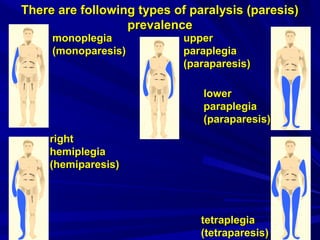
monoplegiamonoplegia
((monoparesismonoparesis))
upperupper
paraplegiaparaplegia
((paraparesisparaparesis))
lowerlower
рараraplegiaraplegia
(ра(раraparesisraparesis))
rightright
hemiplegiahemiplegia
((hemiparesishemiparesis))
tetraplegiatetraplegia
((tetraparesistetraparesis))
There are following types of paralysis (paresis)There are following types of paralysis (paresis)
prevalenceprevalence
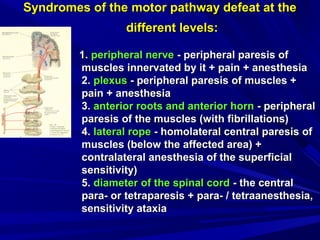
Syndromes of the motor pathway defeat at theSyndromes of the motor pathway defeat at the
different levels:different levels:
1.1. peripheral nerveperipheral nerve - peripheral paresis of- peripheral paresis of
muscles innervated by it + pain + anesthesiamuscles innervated by it + pain + anesthesia
2.2. plexusplexus - peripheral paresis of muscles +- peripheral paresis of muscles +
pain + anesthesiapain + anesthesia
3.3. anterior roots and anterior hornanterior roots and anterior horn - peripheral- peripheral
paresis of the muscles (with fibrillations)paresis of the muscles (with fibrillations)
4.4. lateral ropelateral rope - homolateral central paresis of- homolateral central paresis of
muscles (below the affected area) +muscles (below the affected area) +
contralateral anesthesia of the superficialcontralateral anesthesia of the superficial
sensitivity)sensitivity)
5.5. diameter of the spinal corddiameter of the spinal cord - the central- the central
para- or tetraparesis + para- / tetraanesthesia,para- or tetraparesis + para- / tetraanesthesia,
sensitivity ataxiasensitivity ataxia
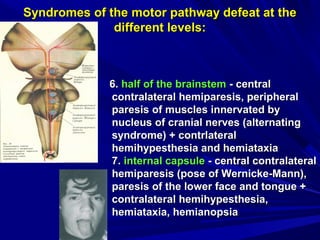
Syndromes of the motor pathway defeat at theSyndromes of the motor pathway defeat at the
different levels:different levels:
6.6. half of the brainstemhalf of the brainstem - central- central
contralateral hemiparesis, peripheralcontralateral hemiparesis, peripheral
paresis of muscles innervated byparesis of muscles innervated by
nucleus of cranial nerves (alternatingnucleus of cranial nerves (alternating
syndrome) + contrlateralsyndrome) + contrlateral
hemihypesthesia and hemiataxiahemihypesthesia and hemiataxia
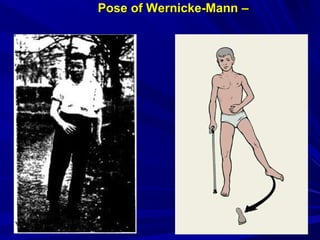
7.7. internal capsuleinternal capsule - central contralateral- central contralateral
hemiparesis (pose of Wernicke-Mann),hemiparesis (pose of Wernicke-Mann),
paresis of the lower face and tongue +paresis of the lower face and tongue +
contralateral hemihypesthesia,contralateral hemihypesthesia,
hemiataxia, hemianopsiahemiataxia, hemianopsia
Pose of Wernicke-MannPose of Wernicke-Mann ––
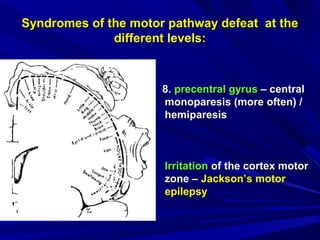
Syndromes of the motor pathway defeat at theSyndromes of the motor pathway defeat at the
different levels:different levels:
8.8. precentralprecentral gyrusgyrus –– centralcentral
monoparesismonoparesis ((more oftenmore often) /) /
hemiparesishemiparesis
IrritationIrritation of the cortex motorof the cortex motor
zone –zone – Jackson’s motorJackson’s motor
epilepsyepilepsy
Regulation of urinationRegulation of urination
Periodic incontinentio -Periodic incontinentio - incontinentio intermittensincontinentio intermittens --
urine is excreted periodically by portions. In mildurine is excreted periodically by portions. In mild
lesions - imperative call on urination with the inabilitylesions - imperative call on urination with the inability
to hold urine for a long time.to hold urine for a long time.
It’s normal for children untill the myelination of fibersIt’s normal for children untill the myelination of fibers
and until the formation of neatnessand until the formation of neatness
- it occurs when bilateral central neurons are- it occurs when bilateral central neurons are
damaged (from cortex up to Siii)damaged (from cortex up to Siii)
True incontinentio -True incontinentio - incontinentio veraincontinentio vera
- occurs when the peripheral neuron- occurs when the peripheral neuron
centrum vesico-spinale is damaged (Siii – Sv).centrum vesico-spinale is damaged (Siii – Sv).
Retention urineRetention urine ––
- occurs in lesions of the central or peripheral- occurs in lesions of the central or peripheral
neuronsneurons
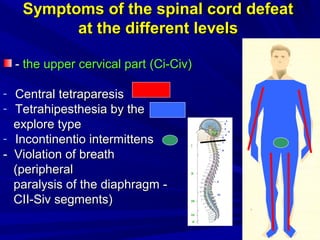
Symptoms of the spinal cord defeatSymptoms of the spinal cord defeat
at the different levelsat the different levels
-- the upper cervical partthe upper cervical part ((ССi-i-ССiv)iv)
- CentralCentral tetraparesistetraparesis
- Tetrahipesthesia by theTetrahipesthesia by the
explore typeexplore type
- ІІncontinentio intermittensncontinentio intermittens
- Violation of breath- Violation of breath
(peripheral(peripheral
paralysis of the diaphragm -paralysis of the diaphragm -
CII-Siv segments)CII-Siv segments)
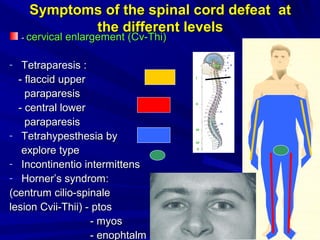
Symptoms of the spinal cord defeat atSymptoms of the spinal cord defeat at
the different levelsthe different levels
-- cervical enlargementcervical enlargement (С(Сvv--Thi)Thi)
- TetraparesisTetraparesis ::
-- flaccid upperflaccid upper
paraparesisparaparesis
-- centralcentral lowerlower
paraparesisparaparesis
- Tetrahypesthesia byTetrahypesthesia by
exploreexplore typetype
- ІІncontinentio intermittensncontinentio intermittens
- Horner’s syndromHorner’s syndrom::
((centrum cilio-spinalecentrum cilio-spinale
lesion Cvii-Thii)lesion Cvii-Thii) -- ptosptos
-- myosmyos
-- enophtalmenophtalm
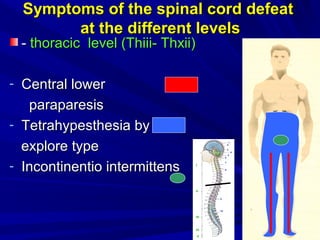
Symptoms of the spinal cord defeatSymptoms of the spinal cord defeat
at the different levelsat the different levels
-- thoracicthoracic levellevel ((ThiThiіі-іі- Thxii)Thxii)
- Central lowerCentral lower
paraparesisparaparesis
- Tetrahypesthesia byTetrahypesthesia by
explore typeexplore type
- ІІncontinentio intermittensncontinentio intermittens
Symptoms of the spinal cord defeatSymptoms of the spinal cord defeat
at the different levelsat the different levels
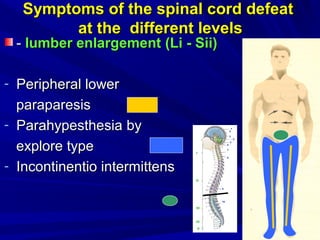
-- lumber enlargementlumber enlargement ((LLіі -- Sii)Sii)
- Peripheral lowerPeripheral lower
paraparesisparaparesis
- ParahypesthesiaParahypesthesia byby
explore typeexplore type
- ІІncontinentio intermittensncontinentio intermittens
Symptoms of the spinal cord defeatSymptoms of the spinal cord defeat
at the different levelsat the different levels
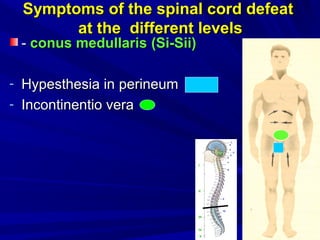
-- conus medullarisconus medullaris ((Si-Sii)Si-Sii)
- Hypesthesia inHypesthesia in perineumperineum
- ІІncontinentio verancontinentio vera
Symptoms of the spinal cord defeat atSymptoms of the spinal cord defeat at
the different levelsthe different levels
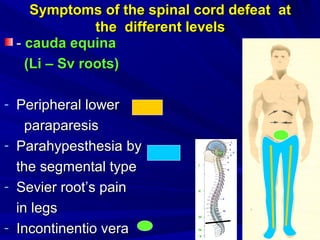
-- cauda equinacauda equina
((LLіі –– Sv roots)Sv roots)
- PeripheralPeripheral lowerlower
paraparesisparaparesis
- ParahypesthesiaParahypesthesia byby
the segmental typethe segmental type
- SevierSevier root’s painroot’s pain
in legsin legs
- ІІncontinentio verancontinentio vera
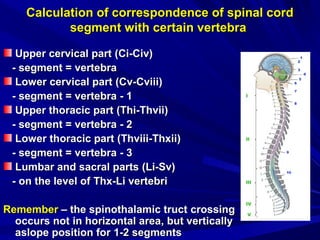
Calculation of correspondence of spinal cordCalculation of correspondence of spinal cord
segment with certain vertebrasegment with certain vertebra
Upper cervical partUpper cervical part (Сі-С(Сі-Сiv)iv)
- segment- segment == vertebravertebra
Lower cervical partLower cervical part (С(Сv-Cviiiv-Cviii))
-- segmentsegment == vertebravertebra - 1- 1
Upper thoracic partUpper thoracic part ((Thi-ThviiThi-Thvii))
-- segmentsegment == vertebravertebra - 2- 2
Lower thoracic partLower thoracic part ((Thviii-ThxiiThviii-Thxii))
- segment- segment == vertebravertebra - 3- 3
Lumbar and sacral partsLumbar and sacral parts ((Li-Sv)Li-Sv)
- on the level of- on the level of Thx-Li vertebriThx-Li vertebri
RememberRemember – the spinothalamic truct– the spinothalamic truct crossingcrossing
occurs notoccurs not in horizontal areain horizontal area,, but verticallybut vertically
aslope position foraslope position for 1-21-2 segmentssegments
CalculationCalculation of the defeat levelof the defeat level according to theaccording to the neurologicalneurological
status datastatus data
((where the CT scan must be donewhere the CT scan must be done?)?)
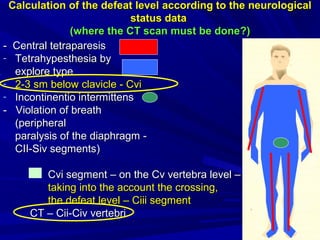
-- Central tetraparesisCentral tetraparesis
- Tetrahypesthesia byTetrahypesthesia by
exploreexplore typetype
- 2-32-3 smsm belowbelow clavicleclavicle -- CviCvi
- ІІncontinentio intermittensncontinentio intermittens
- Violation of breath- Violation of breath
(peripheral(peripheral
paralysis of the diaphragm -paralysis of the diaphragm -
CII-Siv segments)CII-Siv segments)
ССvi segmentvi segment –– on theon the ССvv vertebra levelvertebra level ––
taking into the account the crossing,taking into the account the crossing,
the defeat levelthe defeat level – С– Сiiiiii segmentsegment
CCТ – СТ – Сiiii-С-Сiviv vertebrivertebri
CalculationCalculation of the defeat levelof the defeat level according to theaccording to the neurologicalneurological
status datastatus data
((where the CT scan must be donewhere the CT scan must be done?)?)
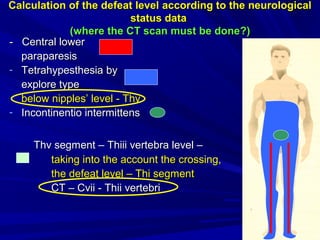
-- Central lowerCentral lower
paraparesisparaparesis
- TetrahypesthesiaTetrahypesthesia byby
explore typeexplore type
below nipples’ levelbelow nipples’ level -- ThvThv
- ІІncontinentio intermittensncontinentio intermittens
Thv segmentThv segment –– ThThіііііі vertebra levelvertebra level ––
taking into the account the crossing,taking into the account the crossing,
the defeat levelthe defeat level –– Thi segmentThi segment
CCТ – СТ – Сvvіі -іі - ThThііii vertebrivertebri
CalculationCalculation of the defeat levelof the defeat level according to theaccording to the
neurological status dataneurological status data
((where the CT scan must be donewhere the CT scan must be done?)?)
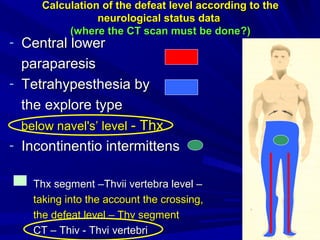
- Central lowerCentral lower
paraparesisparaparesis
- Tetrahypesthesia byTetrahypesthesia by
the explore typethe explore type
below navel's’ levelbelow navel's’ level -- ThxThx
- ІІncontinentio intermittensncontinentio intermittens
Thx segmentThx segment ––ThvThvіііі vertebra levelvertebra level ––
taking into the account the crossing,taking into the account the crossing,
the defeat levelthe defeat level –– Thv segmentThv segment
CCТ –Т – Thiv - ThviThiv - Thvi vertebrivertebri
CalculationCalculation of the defeat levelof the defeat level according to theaccording to the
neurological status dataneurological status data
((where the CT scan must be donewhere the CT scan must be done?)?)
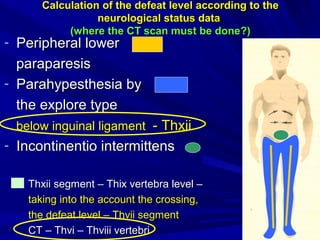
- PeripheralPeripheral lowerlower
paraparesisparaparesis
- Parahypesthesia byParahypesthesia by
the explore typethe explore type
below inguinal ligamentbelow inguinal ligament -- ThxiiThxii
- ІІncontinentio intermittensncontinentio intermittens
Thxii segmentThxii segment –– ThixThix vertebra levelvertebra level ––
taking into the account the crossing,taking into the account the crossing,
the defeat levelthe defeat level –– ThviiThvii segmentsegment
CCТ –Т – ThviThvi –– Thviii vertebriThviii vertebri
CalculationCalculation of the defeat levelof the defeat level according to theaccording to the
neurological status dataneurological status data
((where the CT scan must be donewhere the CT scan must be done?)?)
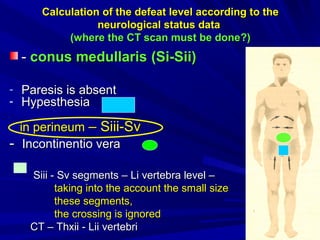
-- conus medullarisconus medullaris ((Si-Sii)Si-Sii)
- Paresis is absentParesis is absent
- HypesthesiaHypesthesia
inin perineumperineum –– Siii-SvSiii-Sv
-- ІІncontinentio verancontinentio vera
Siii - Sv segmentsSiii - Sv segments –– LiLi vertebra levelvertebra level ––
taking into the account the small sizetaking into the account the small size
these segmentsthese segments,,
the crossing is ignoredthe crossing is ignored
CCТ –Т – ThxThxіі -іі - LiiLii vertebrivertebri

Pyramidal

  • 1.
    VOLUNTARY MOVEMENTSVOLUNTARY MOVEMENTS Pyramidaltract.Pyramidal tract. Syndromes of disorders.Syndromes of disorders. The chair of neurologyThe chair of neurology HrybHryb Viktoriya AnatiliivnaViktoriya Anatiliivna
  • 2.
    Movements which arethe results ofMovements which are the results of cortical innervation, made by lifecortical innervation, made by life experiences are conditioned reflexes -experiences are conditioned reflexes - they are called "voluntary" movements.they are called "voluntary" movements. Automatic reflex movements are calledAutomatic reflex movements are called "involuntary.""involuntary."
  • 3.
    To implement voluntarymotion impulse isTo implement voluntary motion impulse is carried by the cortico-muscular tract:carried by the cortico-muscular tract: 11 neuron - central motive:neuron - central motive: –– coricobulbar tractcoricobulbar tract ((for musclesfor muscles of cranialof cranial nervesnerves)) –– coricospinal tractcoricospinal tract == pyramidal tractpyramidal tract ((forfor muscles of trunkmuscles of trunk,, limbslimbs)) - laterallateral inin spinalspinal - anterioranterior cordcord 22 neuronneuron –– peripheralperipheral motivemotive Precentral gyrus - Corona radiata - Capsula interna (knee) – PARTIAL CROSSING Nucleus (peripheral motoneuron) in brain stem - Peripheral nerves Precentral gyrus - Corona radiata - Capsula interna (back leg) – CROSSING Nucleus (peripheral motoneuron) in anterior horn of spinal cord – Roots Peripheral nerves
  • 4.
    Features of theFeaturesof the coricobulbarcoricobulbar tracttract Realizes partialRealizes partial supranuclearsupranuclear crossing – that is why thecrossing – that is why the innervation of facial muscles isinnervation of facial muscles is bilateralbilateral (pathology does not(pathology does not occur in case of unilateraloccur in case of unilateral lesion), except:lesion), except: - The lower part of the nucleus- The lower part of the nucleus n. facalis (VII)n. facalis (VII) - Nucleus n. hypoglossus (XII)- Nucleus n. hypoglossus (XII) V IV III II I IX VIII VII VI XI X XII
  • 5.
    Features of thepyramidal pathway crossedFeatures of the pyramidal pathway crossed and non-crossed fibers location in the spinaland non-crossed fibers location in the spinal cordcord ––coricospinalcoricospinal tracttract –– pyramidalpyramidal tracttract:: - LateralLateral –– ends in the anteriorends in the anterior horns of spinal cord segmentshorns of spinal cord segments - AnteriorAnterior –– ends in the anteriorends in the anterior horns segments Ci-Civ, Thiii-Thxi,horns segments Ci-Civ, Thiii-Thxi, Siii-Sv (except cervical - Cv-ThiiSiii-Sv (except cervical - Cv-Thii and lumbar - Thxii-Siiand lumbar - Thxii-Sii enlargementsenlargements).).
  • 6.
    In case ofthe voluntary movementsIn case of the voluntary movements pathway damage (both central andpathway damage (both central and peripheral neurons) the following occurs:peripheral neurons) the following occurs: Paralysis = plegia - complete loss ofParalysis = plegia - complete loss of movementmovement Paresis - reduction of motion range andParesis - reduction of motion range and muscle strengthmuscle strength
  • 7.
    Signs of paralysis-Signsof paralysis- plegia (paresis)plegia (paresis) CentralCentral,, spasticspastic PeripheralPeripheral,, flaccidflaccid ReflexesReflexes hyperhyperreflexiareflexia аа- /- / hyporeflexiahyporeflexia Muscular tonusMuscular tonus hyperhypertoniatonia аа- /- / hypotoniahypotonia AtrophyAtrophy -- аа- /- /hypotrophiahypotrophia Patological signsPatological signs ++ -- FibrillationsFibrillations,, fasciculationsfasciculations ((inin case of the anteriorcase of the anterior horn lesionshorn lesions)) -- ++
  • 8.
    HyperreflexiaHyperreflexia and hypertoniaand hypertonia arethe result ofare the result of loss of cortexloss of cortex control on thecontrol on the activity of theactivity of the spinal cordspinal cord segmentalsegmental apparatusapparatus
  • 9.
    Pathological signsPathological signs PathologicalreflexesPathological reflexes ((in new-borns - the norm,until the nervein new-borns - the norm,until the nerve fibers myelination of in the CNS isfibers myelination of in the CNS is endedended)) The defenceThe defence reflexreflexeses SynkineSynkinesissis
  • 10.
    Pathological reflexesPathological reflexes 1.1.Symptoms of oralSymptoms of oral automatism:automatism: -- palmomental reflexpalmomental reflex -- lip reflexlip reflex -- nasolabial reflexnasolabial reflex - distance-oral- distance-oral
  • 11.
    2.2. PatologicalPatological plantarreflexesplantar reflexes - ExtensorExtensor -- Babinski’s symptomBabinski’s symptom -- Oppenheim’s symptomOppenheim’s symptom -- Gordon sypmtomGordon sypmtom -- Schaffer reflexSchaffer reflex
  • 12.
    -- FlexorFlexor -- RossolimosymptomRossolimo symptom -- Bechterew symptomBechterew symptom -- Zhukovski symptomZhukovski symptom -- Hirschberg signHirschberg sign 2.2. PatologicalPatological plantar reflexesplantar reflexes
  • 13.
    DefenseDefense reflexes -spinal automatismreflexes - spinal automatism reflexesreflexes Marie-FuaMarie-Fua reflexreflex - in the supine position- in the supine position of the patient, involuntary flexion of feet inof the patient, involuntary flexion of feet in all joints is caused by the tactile irritationall joints is caused by the tactile irritation of foot, the opposite leg extends. That isof foot, the opposite leg extends. That is automatism motions.automatism motions. Remak’s femoral reflexRemak’s femoral reflex – flexion of the– flexion of the plantar and toes occurs in case of tactileplantar and toes occurs in case of tactile irritation of femur anterior surfaceirritation of femur anterior surface
  • 14.
    Synkinesis - concordantmovement inSynkinesis - concordant movement in paralyzed limbs, that accompany the voluntaryparalyzed limbs, that accompany the voluntary movement by non-paralyzed limbmovement by non-paralyzed limb GlobalGlobal –– occurs in paralyzed limb ,when theoccurs in paralyzed limb ,when the patient tries to perform active movement bypatient tries to perform active movement by non-paralyzed limb (pressing a fist causes thenon-paralyzed limb (pressing a fist causes the elbow flection).elbow flection). ІІmitationalmitational –– unvoluntary movements byunvoluntary movements by paralized limb imitate voluntary movements ofparalized limb imitate voluntary movements of the healthy limbthe healthy limb CoordinationCoordination –– may be different.may be different.
  • 15.
  • 16.
    Syndromes of themotor pathway defeat at theSyndromes of the motor pathway defeat at the different levels:different levels: 1.1. peripheral nerveperipheral nerve - peripheral paresis of- peripheral paresis of muscles innervated by it + pain + anesthesiamuscles innervated by it + pain + anesthesia 2.2. plexusplexus - peripheral paresis of muscles +- peripheral paresis of muscles + pain + anesthesiapain + anesthesia 3.3. anterior roots and anterior hornanterior roots and anterior horn - peripheral- peripheral paresis of the muscles (with fibrillations)paresis of the muscles (with fibrillations) 4.4. lateral ropelateral rope - homolateral central paresis of- homolateral central paresis of muscles (below the affected area) +muscles (below the affected area) + contralateral anesthesia of the superficialcontralateral anesthesia of the superficial sensitivity)sensitivity) 5.5. diameter of the spinal corddiameter of the spinal cord - the central- the central para- or tetraparesis + para- / tetraanesthesia,para- or tetraparesis + para- / tetraanesthesia, sensitivity ataxiasensitivity ataxia
  • 17.
    Syndromes of themotor pathway defeat at theSyndromes of the motor pathway defeat at the different levels:different levels: 6.6. half of the brainstemhalf of the brainstem - central- central contralateral hemiparesis, peripheralcontralateral hemiparesis, peripheral paresis of muscles innervated byparesis of muscles innervated by nucleus of cranial nerves (alternatingnucleus of cranial nerves (alternating syndrome) + contrlateralsyndrome) + contrlateral hemihypesthesia and hemiataxiahemihypesthesia and hemiataxia 7.7. internal capsuleinternal capsule - central contralateral- central contralateral hemiparesis (pose of Wernicke-Mann),hemiparesis (pose of Wernicke-Mann), paresis of the lower face and tongue +paresis of the lower face and tongue + contralateral hemihypesthesia,contralateral hemihypesthesia, hemiataxia, hemianopsiahemiataxia, hemianopsia
  • 18.
    Pose of Wernicke-MannPoseof Wernicke-Mann ––
  • 19.
    Syndromes of themotor pathway defeat at theSyndromes of the motor pathway defeat at the different levels:different levels: 8.8. precentralprecentral gyrusgyrus –– centralcentral monoparesismonoparesis ((more oftenmore often) /) / hemiparesishemiparesis IrritationIrritation of the cortex motorof the cortex motor zone –zone – Jackson’s motorJackson’s motor epilepsyepilepsy
  • 20.
    Regulation of urinationRegulationof urination Periodic incontinentio -Periodic incontinentio - incontinentio intermittensincontinentio intermittens -- urine is excreted periodically by portions. In mildurine is excreted periodically by portions. In mild lesions - imperative call on urination with the inabilitylesions - imperative call on urination with the inability to hold urine for a long time.to hold urine for a long time. It’s normal for children untill the myelination of fibersIt’s normal for children untill the myelination of fibers and until the formation of neatnessand until the formation of neatness - it occurs when bilateral central neurons are- it occurs when bilateral central neurons are damaged (from cortex up to Siii)damaged (from cortex up to Siii) True incontinentio -True incontinentio - incontinentio veraincontinentio vera - occurs when the peripheral neuron- occurs when the peripheral neuron centrum vesico-spinale is damaged (Siii – Sv).centrum vesico-spinale is damaged (Siii – Sv). Retention urineRetention urine –– - occurs in lesions of the central or peripheral- occurs in lesions of the central or peripheral neuronsneurons
  • 21.
    Symptoms of thespinal cord defeatSymptoms of the spinal cord defeat at the different levelsat the different levels -- the upper cervical partthe upper cervical part ((ССi-i-ССiv)iv) - CentralCentral tetraparesistetraparesis - Tetrahipesthesia by theTetrahipesthesia by the explore typeexplore type - ІІncontinentio intermittensncontinentio intermittens - Violation of breath- Violation of breath (peripheral(peripheral paralysis of the diaphragm -paralysis of the diaphragm - CII-Siv segments)CII-Siv segments)
  • 22.
    Symptoms of thespinal cord defeat atSymptoms of the spinal cord defeat at the different levelsthe different levels -- cervical enlargementcervical enlargement (С(Сvv--Thi)Thi) - TetraparesisTetraparesis :: -- flaccid upperflaccid upper paraparesisparaparesis -- centralcentral lowerlower paraparesisparaparesis - Tetrahypesthesia byTetrahypesthesia by exploreexplore typetype - ІІncontinentio intermittensncontinentio intermittens - Horner’s syndromHorner’s syndrom:: ((centrum cilio-spinalecentrum cilio-spinale lesion Cvii-Thii)lesion Cvii-Thii) -- ptosptos -- myosmyos -- enophtalmenophtalm
  • 23.
    Symptoms of thespinal cord defeatSymptoms of the spinal cord defeat at the different levelsat the different levels -- thoracicthoracic levellevel ((ThiThiіі-іі- Thxii)Thxii) - Central lowerCentral lower paraparesisparaparesis - Tetrahypesthesia byTetrahypesthesia by explore typeexplore type - ІІncontinentio intermittensncontinentio intermittens
  • 24.
    Symptoms of thespinal cord defeatSymptoms of the spinal cord defeat at the different levelsat the different levels -- lumber enlargementlumber enlargement ((LLіі -- Sii)Sii) - Peripheral lowerPeripheral lower paraparesisparaparesis - ParahypesthesiaParahypesthesia byby explore typeexplore type - ІІncontinentio intermittensncontinentio intermittens
  • 25.
    Symptoms of thespinal cord defeatSymptoms of the spinal cord defeat at the different levelsat the different levels -- conus medullarisconus medullaris ((Si-Sii)Si-Sii) - Hypesthesia inHypesthesia in perineumperineum - ІІncontinentio verancontinentio vera
  • 26.
    Symptoms of thespinal cord defeat atSymptoms of the spinal cord defeat at the different levelsthe different levels -- cauda equinacauda equina ((LLіі –– Sv roots)Sv roots) - PeripheralPeripheral lowerlower paraparesisparaparesis - ParahypesthesiaParahypesthesia byby the segmental typethe segmental type - SevierSevier root’s painroot’s pain in legsin legs - ІІncontinentio verancontinentio vera
  • 27.
    Calculation of correspondenceof spinal cordCalculation of correspondence of spinal cord segment with certain vertebrasegment with certain vertebra Upper cervical partUpper cervical part (Сі-С(Сі-Сiv)iv) - segment- segment == vertebravertebra Lower cervical partLower cervical part (С(Сv-Cviiiv-Cviii)) -- segmentsegment == vertebravertebra - 1- 1 Upper thoracic partUpper thoracic part ((Thi-ThviiThi-Thvii)) -- segmentsegment == vertebravertebra - 2- 2 Lower thoracic partLower thoracic part ((Thviii-ThxiiThviii-Thxii)) - segment- segment == vertebravertebra - 3- 3 Lumbar and sacral partsLumbar and sacral parts ((Li-Sv)Li-Sv) - on the level of- on the level of Thx-Li vertebriThx-Li vertebri RememberRemember – the spinothalamic truct– the spinothalamic truct crossingcrossing occurs notoccurs not in horizontal areain horizontal area,, but verticallybut vertically aslope position foraslope position for 1-21-2 segmentssegments
  • 28.
    CalculationCalculation of thedefeat levelof the defeat level according to theaccording to the neurologicalneurological status datastatus data ((where the CT scan must be donewhere the CT scan must be done?)?) -- Central tetraparesisCentral tetraparesis - Tetrahypesthesia byTetrahypesthesia by exploreexplore typetype - 2-32-3 smsm belowbelow clavicleclavicle -- CviCvi - ІІncontinentio intermittensncontinentio intermittens - Violation of breath- Violation of breath (peripheral(peripheral paralysis of the diaphragm -paralysis of the diaphragm - CII-Siv segments)CII-Siv segments) ССvi segmentvi segment –– on theon the ССvv vertebra levelvertebra level –– taking into the account the crossing,taking into the account the crossing, the defeat levelthe defeat level – С– Сiiiiii segmentsegment CCТ – СТ – Сiiii-С-Сiviv vertebrivertebri
  • 29.
    CalculationCalculation of thedefeat levelof the defeat level according to theaccording to the neurologicalneurological status datastatus data ((where the CT scan must be donewhere the CT scan must be done?)?) -- Central lowerCentral lower paraparesisparaparesis - TetrahypesthesiaTetrahypesthesia byby explore typeexplore type below nipples’ levelbelow nipples’ level -- ThvThv - ІІncontinentio intermittensncontinentio intermittens Thv segmentThv segment –– ThThіііііі vertebra levelvertebra level –– taking into the account the crossing,taking into the account the crossing, the defeat levelthe defeat level –– Thi segmentThi segment CCТ – СТ – Сvvіі -іі - ThThііii vertebrivertebri
  • 30.
    CalculationCalculation of thedefeat levelof the defeat level according to theaccording to the neurological status dataneurological status data ((where the CT scan must be donewhere the CT scan must be done?)?) - Central lowerCentral lower paraparesisparaparesis - Tetrahypesthesia byTetrahypesthesia by the explore typethe explore type below navel's’ levelbelow navel's’ level -- ThxThx - ІІncontinentio intermittensncontinentio intermittens Thx segmentThx segment ––ThvThvіііі vertebra levelvertebra level –– taking into the account the crossing,taking into the account the crossing, the defeat levelthe defeat level –– Thv segmentThv segment CCТ –Т – Thiv - ThviThiv - Thvi vertebrivertebri
  • 31.
    CalculationCalculation of thedefeat levelof the defeat level according to theaccording to the neurological status dataneurological status data ((where the CT scan must be donewhere the CT scan must be done?)?) - PeripheralPeripheral lowerlower paraparesisparaparesis - Parahypesthesia byParahypesthesia by the explore typethe explore type below inguinal ligamentbelow inguinal ligament -- ThxiiThxii - ІІncontinentio intermittensncontinentio intermittens Thxii segmentThxii segment –– ThixThix vertebra levelvertebra level –– taking into the account the crossing,taking into the account the crossing, the defeat levelthe defeat level –– ThviiThvii segmentsegment CCТ –Т – ThviThvi –– Thviii vertebriThviii vertebri
  • 32.
    CalculationCalculation of thedefeat levelof the defeat level according to theaccording to the neurological status dataneurological status data ((where the CT scan must be donewhere the CT scan must be done?)?) -- conus medullarisconus medullaris ((Si-Sii)Si-Sii) - Paresis is absentParesis is absent - HypesthesiaHypesthesia inin perineumperineum –– Siii-SvSiii-Sv -- ІІncontinentio verancontinentio vera Siii - Sv segmentsSiii - Sv segments –– LiLi vertebra levelvertebra level –– taking into the account the small sizetaking into the account the small size these segmentsthese segments,, the crossing is ignoredthe crossing is ignored CCТ –Т – ThxThxіі -іі - LiiLii vertebrivertebri