Localization Technique
Muhammed M. Nasser
Localization Technique
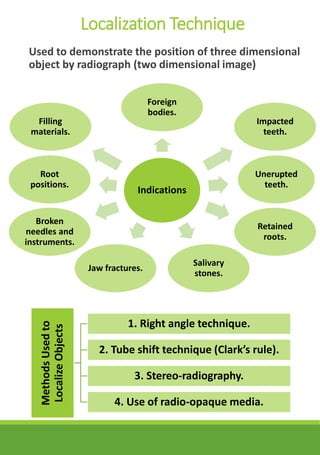
Used to demonstrate the position of three dimensional
object by radiograph (two dimensional image)
Indications
Foreign
bodies.
Impacted
teeth.
Unerupted
teeth.
Retained
roots.
Salivary
stones.
Jaw fractures.
Broken
needles and
instruments.
Root
positions.
Filling
materials.
Methods
Used
to
Localize
Objects
1. Right angle technique.
2. Tube shift technique (Clark’s rule).
3. Stereo-radiography.
4. Use of radio-opaque media.
Right Angle Technique
(Miller’s right angle technique)
Here two projections are taken at right angles to
each other, which helps to localize an object in the
maxilla or mandible.
Tube Shift Technique
(Buccal Object Rule / Clark’s Rule)
Two radiographs of the object are taken:
* First, using the proper technique and angulations
as prescribed.
* Second, changing the direction of the central ray
either with a different horizontal or vertical
angulation is used.
SLOB rule
(Same Lingual + Opposite Buccal)
When the dental structure or object seen in the
second radiograph appears to have moved in the
same direction as the shift of the position
indicating device (PID), the structure or the object
in question is said to be positioned lingually.
But, if the object appears to have moved in a
direction opposite to the shift of the PID, then the
object in question is said to be positioned buccally.
Horizontal movement
In the diagram,
the buccal
(yellow) and
lingual (red)
objects of
interest are
superimposed on
each other
because the
beam is directed
perpendicular to
both of them and
they are in the
same relative
position
mesiodistally and
vertically.Both
images are
located above the
second molar
Distal shift
In the diagram,
the tube head is
moved distally
and the beam is
directed mesially.
On the
radiograph, the
buccal object of
interest (yellow)
moves mesially
(opposite to tube
head movement)
in relation to the
second molar and
the lingual object
of interest (red)
moves distally
(same direction
as tube head) in
relation to the
second molar.
Mesial shift
In the diagram,
the tube head is
moved mesially
and the beam is
directed distally.
On the
radiograph, the
buccal object of
interest (yellow)
moves distally
(opposite to tube
head movement)
in relation to the
second molar and
the lingual object
of interest (red)
moves mesially
(same direction
as tube head) in
relation to the
second molar.
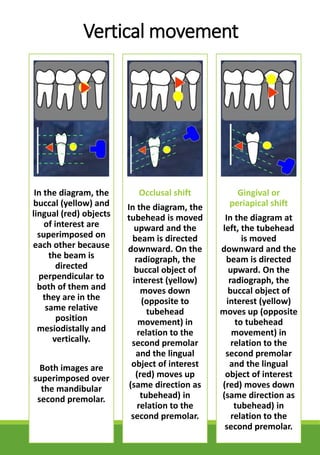
Vertical movement
In the diagram, the
buccal (yellow) and
lingual (red) objects
of interest are
superimposed on
each other because
the beam is
directed
perpendicular to
both of them and
they are in the
same relative
position
mesiodistally and
vertically.
Both images are
superimposed over
the mandibular
second premolar.
Occlusal shift
In the diagram, the
tubehead is moved
upward and the
beam is directed
downward. On the
radiograph, the
buccal object of
interest (yellow)
moves down
(opposite to
tubehead
movement) in
relation to the
second premolar
and the lingual
object of interest
(red) moves up
(same direction as
tubehead) in
relation to the
second premolar.
Gingival or
periapical shift
In the diagram at
left, the tubehead
is moved
downward and the
beam is directed
upward. On the
radiograph, the
buccal object of
interest (yellow)
moves up (opposite
to tubehead
movement) in
relation to the
second premolar
and the lingual
object of interest
(red) moves down
(same direction as
tubehead) in
relation to the
second premolar.
THANK
YOU

Localization Technique

  • 1.
  • 2.
    Localization Technique Used todemonstrate the position of three dimensional object by radiograph (two dimensional image) Indications Foreign bodies. Impacted teeth. Unerupted teeth. Retained roots. Salivary stones. Jaw fractures. Broken needles and instruments. Root positions. Filling materials. Methods Used to Localize Objects 1. Right angle technique. 2. Tube shift technique (Clark’s rule). 3. Stereo-radiography. 4. Use of radio-opaque media.
  • 3.
    Right Angle Technique (Miller’sright angle technique) Here two projections are taken at right angles to each other, which helps to localize an object in the maxilla or mandible.
  • 4.
    Tube Shift Technique (BuccalObject Rule / Clark’s Rule) Two radiographs of the object are taken: * First, using the proper technique and angulations as prescribed. * Second, changing the direction of the central ray either with a different horizontal or vertical angulation is used. SLOB rule (Same Lingual + Opposite Buccal) When the dental structure or object seen in the second radiograph appears to have moved in the same direction as the shift of the position indicating device (PID), the structure or the object in question is said to be positioned lingually. But, if the object appears to have moved in a direction opposite to the shift of the PID, then the object in question is said to be positioned buccally.
  • 5.
    Horizontal movement In thediagram, the buccal (yellow) and lingual (red) objects of interest are superimposed on each other because the beam is directed perpendicular to both of them and they are in the same relative position mesiodistally and vertically.Both images are located above the second molar Distal shift In the diagram, the tube head is moved distally and the beam is directed mesially. On the radiograph, the buccal object of interest (yellow) moves mesially (opposite to tube head movement) in relation to the second molar and the lingual object of interest (red) moves distally (same direction as tube head) in relation to the second molar. Mesial shift In the diagram, the tube head is moved mesially and the beam is directed distally. On the radiograph, the buccal object of interest (yellow) moves distally (opposite to tube head movement) in relation to the second molar and the lingual object of interest (red) moves mesially (same direction as tube head) in relation to the second molar.
  • 6.
    Vertical movement In thediagram, the buccal (yellow) and lingual (red) objects of interest are superimposed on each other because the beam is directed perpendicular to both of them and they are in the same relative position mesiodistally and vertically. Both images are superimposed over the mandibular second premolar. Occlusal shift In the diagram, the tubehead is moved upward and the beam is directed downward. On the radiograph, the buccal object of interest (yellow) moves down (opposite to tubehead movement) in relation to the second premolar and the lingual object of interest (red) moves up (same direction as tubehead) in relation to the second premolar. Gingival or periapical shift In the diagram at left, the tubehead is moved downward and the beam is directed upward. On the radiograph, the buccal object of interest (yellow) moves up (opposite to tubehead movement) in relation to the second premolar and the lingual object of interest (red) moves down (same direction as tubehead) in relation to the second premolar.
  • 7.