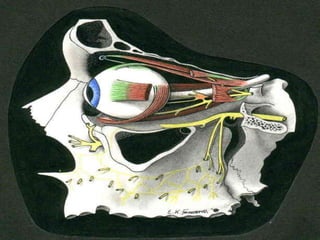
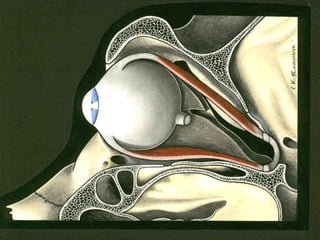
The Anatomy of the
Extraocular Muscles
Tukezban Huseynova, MD
Specialist in Strabismus and Refractive Cornea,
Briz-L Eye Clinic, Baku, Azerbaijan
Tukezban@gmail.com
Embryology of Extraocular Muscles
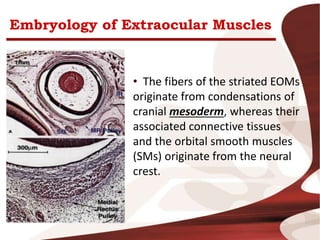
• The fibers of the striated EOMs
originate from condensations of
cranial mesoderm, whereas their
associated connective tissues
and the orbital smooth muscles
(SMs) originate from the neural
crest.
Embryology of Extraocular Muscles
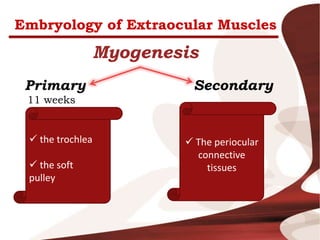
Myogenesis
Primary
11 weeks
Secondary
 the trochlea
 the soft
pulley
 The periocular
connective
tissues
Embryology of Extraocular Muscles
Adult skeletal muscles retain a quiescent stem cell
population that allows regeneration. After muscle
damage has occurred, the regenerative process
recapitulates development as the precursor cells in
the adult, now known as satellite cells, proliferate to
produce myoblasts, which fuse to form new muscles
fibers.
Embryology of Extraocular Muscles
1. The types of contractile proteins expressed in a given muscle
fiber
2. The apparatus that links activation of the muscle fiber from a
motor nerve to the production of a muscle contraction,
excitation-contraction coupling.
Contraction speed, in turn, is a function of
two factors
Embryology of Extraocular Muscles
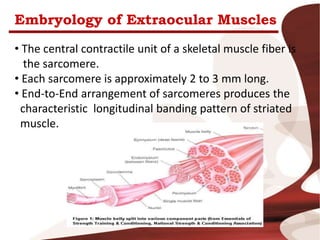
• The central contractile unit of a skeletal muscle fiber is
the sarcomere.
• Each sarcomere is approximately 2 to 3 mm long.
• End-to-End arrangement of sarcomeres produces the
characteristic longitudinal banding pattern of striated
muscle.
İnternal Structure of the EOM
The oculorotary EOMs, although not the levator
palpebrae superioris (LPS), consist of two distinct
layers:
 Global layer
 Orbital layer ( SIMFs and MIMFs)
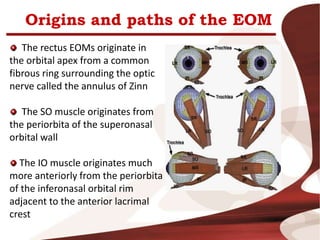
Origins and paths of the EOM
The rectus EOMs originate in
the orbital apex from a common
fibrous ring surrounding the optic
nerve called the annulus of Zinn
The SO muscle originates from
the periorbita of the superonasal
orbital wall
The IO muscle originates much
more anteriorly from the periorbita
of the inferonasal orbital rim
adjacent to the anterior lacrimal
crest
Pulleys of the EOM
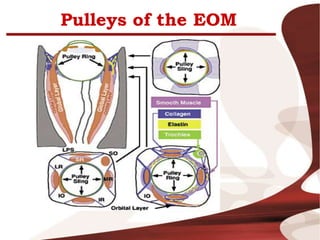
Pulleys consist of discrete rings of dense collagen encircling
the EOM and are about 2 mm in length coaxial
Has less substantial collagenous sleeves around the EOM.
Anteriorly, these sleeves thin to form slings convex to the
orbital wall, and
More posteriorly the sleeves thin to form slings convex
toward the center of the orbit.
The anterior pulley slings are also known as the intermuscular
septa.
The collagenous pulley ring forms the fulcrum of the pulley
that inflects the EOM path.
Pulleys of the EOM
Pulleys of the EOM
The pulleys function as the mechanical origins of
the EOMs and play a vital role in ocular kinematics,
the rotational properties of the eye.
Normal pulleys form a natural mechanical
substrate for Listing's law and other aspects of ocular
kinematics, and they render ocular rotations
effectively commutative.
Pulleys of the EOM
 Donder's law, stating that there is only one torsional
eye position for each com-bination of horizontal and
vertical eye positions.
 Listing's law, a specific case of the more general
Don-der's law, states that any physiologic eye
orientation can be reached from any other by rotation
about a single axis, and that all such possible axes lie
in a single velocity plane, Listing's plane.
Pulleys of the EOM
 Listing's law is satisfied if the axis of
ocular rotation shifts by exactly one half of
the shift in ocular orientation for any eye
movement.This is the so-called Listing's half-
angle rule.
Pulleys of the EOM
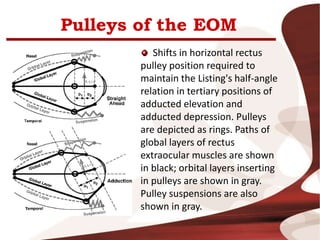
Shifts in horizontal rectus
pulley position required to
maintain the Listing's half-angle
relation in tertiary positions of
adducted elevation and
adducted depression. Pulleys
are depicted as rings. Paths of
global layers of rectus
extraocular muscles are shown
in black; orbital layers inserting
in pulleys are shown in gray.
Pulley suspensions are also
shown in gray.
Pulleys of the EOM
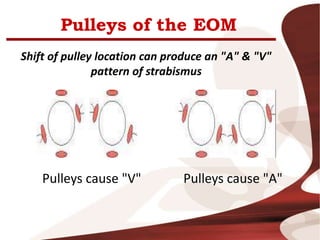
Shift of pulley location can produce an "A" & "V"
pattern of strabismus
Pulleys cause "V" Pulleys cause "A"
Pulleys of the EOM
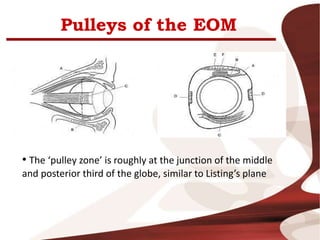
• The ‘pulley zone’ is roughly at the junction of the middle
and posterior third of the globe, similar to Listing’s plane
Pulleys of the EOM
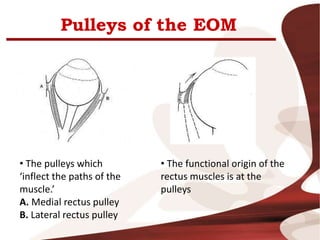
• The pulleys which
‘inflect the paths of the
muscle.’
A. Medial rectus pulley
B. Lateral rectus pulley
• The functional origin of the
rectus muscles is at the
pulleys
Pulleys of the EOM
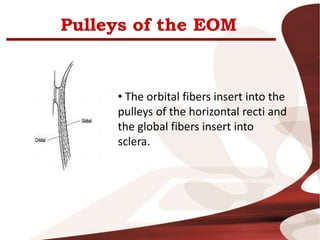
• The orbital fibers insert into the
pulleys of the horizontal recti and
the global fibers insert into
sclera.
Pulleys of the EOM
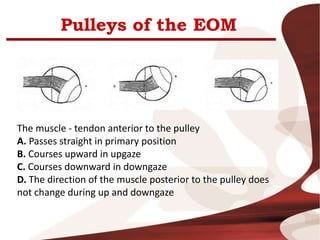
The muscle - tendon anterior to the pulley
A. Passes straight in primary position
B. Courses upward in upgaze
C. Courses downward in downgaze
D. The direction of the muscle posterior to the pulley does
not change during up and downgaze
Pulleys of the EOM
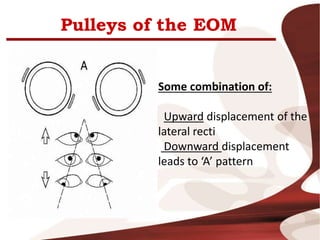
Some combination of:
Upward displacement of the
lateral recti
Downward displacement
leads to ‘A’ pattern
Pulleys of the EOM
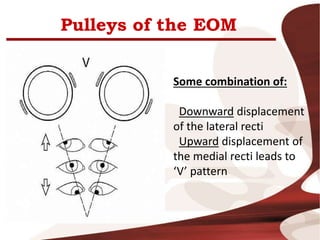
Some combination of:
Downward displacement
of the lateral recti
Upward displacement of
the medial recti leads to
‘V’ pattern
Pulleys of the EOM
The reasons that the strabismus surgeon is not
likely to see the pulleys are several.
First, surgery of the extraocular muscles is carried out beneath anterior
Tenon's capsule and in the plane of posterior Tenon's capsule.
Second, dissection carried posterior to the origin of anterior Tenon's
capsule will expose extraconal fat, which both complicates surgery and
obscures the surrounding anatomy, including the pulleys.
Third, although the pulleys are located in the orbital fat just behind the
insertion of anterior Tenon's capsule, they are virtually impossible to
identify for what they are.
Scleral İnsertion of EOM
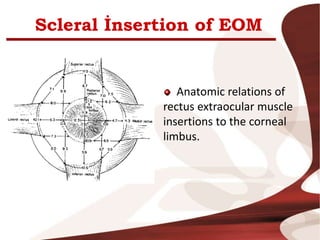
Anatomic relations of
rectus extraocular muscle
insertions to the corneal
limbus.
Smooth muscles of the orbit
SMs in four areas of the human orbit:
The inferior palpebral muscle,
The superior palpebral muscle,
The “orbital muscle” spanning the inferior orbital
fissure, and
The “peribulbar muscle” surrounding the anterior
aspect of the globe.
Physiology of EOM
Key traits of muscle function
1. Contraction speed
a. The types of contractile proteins expressed in a given muscle
fibers.
b. The apparatus that links activation of the muscle fiber from
a motor nerve to the productionof a muscle contraction,
excitation – contraction coupling.
2. Fatique resistance is a direct consequence of cellular
metabolism.
Physiology of EOM
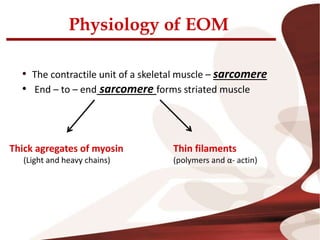
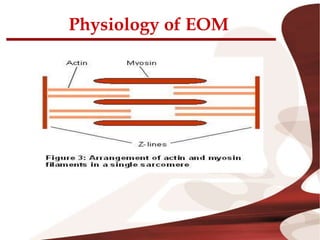
• The contractile unit of a skeletal muscle – sarcomere
• End – to – end sarcomere forms striated muscle
Thick agregates of myosin
(Light and heavy chains)
Thin filaments
(polymers and α- actin)
Physiology of EOM
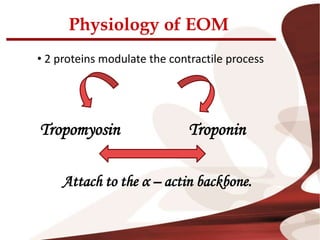
• 2 proteins modulate the contractile process
Tropomyosin Troponin
Attach to the α – actin backbone.
Physiology of EOM
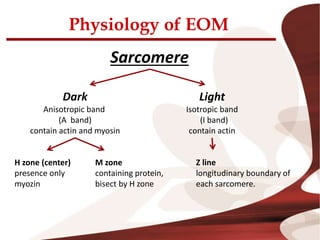
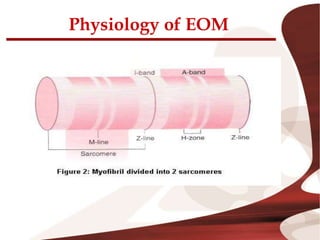
Sarcomere
Dark
Anisotropic band
(A band)
contain actin and myosin
Light
Isotropic band
(I band)
contain actin
H zone (center)
presence only
myozin
M zone
containing protein,
bisect by H zone
Z line
longitudinary boundary of
each sarcomere.
Physiology of EOM
Physiology of EOM
Physiology of EOM
• Each end – to – end sarcomere is known as
myofibril, myofibril are separated from each
other by a membranous calcium storage system,
the sarcoplasmic reticulum.
Physiology of EOM
Fiber Types:
1. Slow twitch, fatigue resistant (red or Type I)
2. Fast twitch, fatigue resistant (intermediate or Type II A)
3. Fast twitch, fatigable (white or type II B)
4. Fast twitch, intermediate (Type II C or II X/D)
Physiology of EOM
Six distinct fiber types
1. Orbital singly innervated fiber (predominant)
2. Orbital multiply innervated fiber
3. Global red singly innervated fiber (1/3 of global fiber)
4. Global intermediate singly innervated fiber (1/4 of global fiber)
5. Global white singly innervated fiber (1/3 of global fiber)
6. Global multiply innervated fiber
Physiology of EOM
• The energy requirement for muscle contraction is
by adenosine triphosphate (ATP) cleavage via a
myofibrillar ATPase. Both anaerobic (glycolytic) or
aerobic (mitochondrial oxidative) mechanism.
Surgical anatomy
Palpebral fissure size
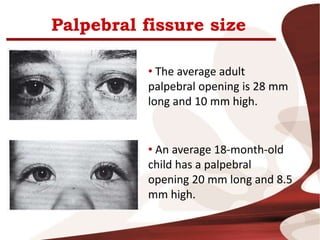
• The average adult
palpebral opening is 28 mm
long and 10 mm high.
• An average 18-month-old
child has a palpebral
opening 20 mm long and 8.5
mm high.
Palpebral fissure size
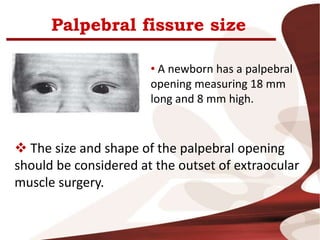
• A newborn has a palpebral
opening measuring 18 mm
long and 8 mm high.
 The size and shape of the palpebral opening
should be considered at the outset of extraocular
muscle surgery.
Extraocular muscles size
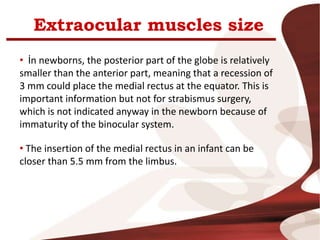
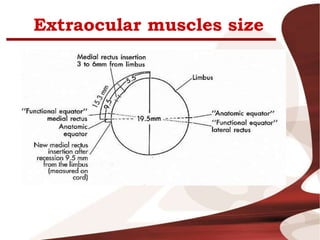
• İn newborns, the posterior part of the globe is relatively
smaller than the anterior part, meaning that a recession of
3 mm could place the medial rectus at the equator. This is
important information but not for strabismus surgery,
which is not indicated anyway in the newborn because of
immaturity of the binocular system.
• The insertion of the medial rectus in an infant can be
closer than 5.5 mm from the limbus.
Extraocular muscles size
Palpebral fissue shape
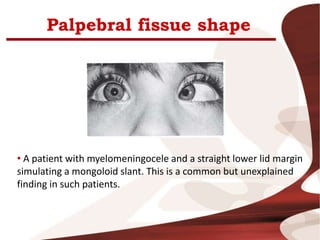
• A patient with myelomeningocele and a straight lower lid margin
simulating a mongoloid slant. This is a common but unexplained
finding in such patients.
Palpebral fissue shape
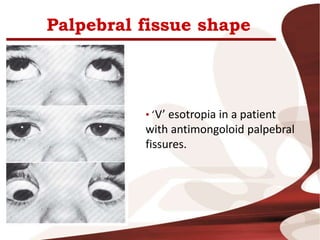
• ‘V’ esotropia in a patient
with antimongoloid palpebral
fissures.
Palpebral fissue shape
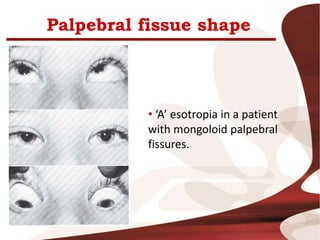
• ‘A’ esotropia in a patient
with mongoloid palpebral
fissures.
Palpebral fissue shape
• The palpebral fissure may be level, mongoloid, or
antimongoloid, depending on the relative positions
of the medial and lateral canthi.
• If the outer canthus is higher than the inner canthus,
a mongoloid palpebral slant exists (Figure 15). If the
outer canthus is lower than the inner canthus, an
antimongoloid palpebral slant exists.
Epicanthal folds
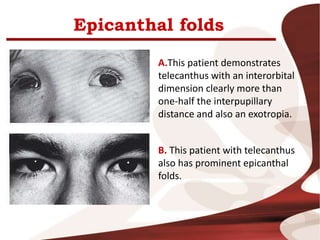
A.This patient demonstrates
telecanthus with an interorbital
dimension clearly more than
one-half the interpupillary
distance and also an exotropia.
B. This patient with telecanthus
also has prominent epicanthal
folds.
Epicanthal folds
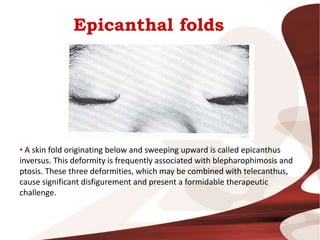
• A skin fold originating below and sweeping upward is called epicanthus
inversus. This deformity is frequently associated with blepharophimosis and
ptosis. These three deformities, which may be combined with telecanthus,
cause significant disfigurement and present a formidable therapeutic
challenge.
Epicanthal folds
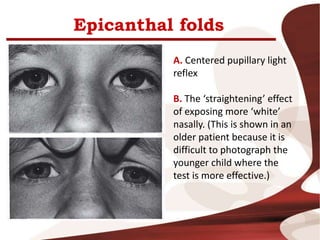
A. Centered pupillary light
reflex
B. The ‘straightening’ effect
of exposing more ‘white’
nasally. (This is shown in an
older patient because it is
difficult to photograph the
younger child where the
test is more effective.)
Epicanthal folds
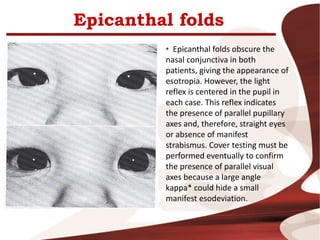
• Epicanthal folds obscure the
nasal conjunctiva in both
patients, giving the appearance of
esotropia. However, the light
reflex is centered in the pupil in
each case. This reflex indicates
the presence of parallel pupillary
axes and, therefore, straight eyes
or absence of manifest
strabismus. Cover testing must be
performed eventually to confirm
the presence of parallel visual
axes because a large angle
kappa* could hide a small
manifest esodeviation.
Epicanthal folds
• Epicanthal folds are present to some degree in
most infants and children during the first few years
of life.
• First, the examiner demonstrates the centered
pupillary reflexes with a muscle light. Second, the
examiner carefully pulls the skin forward over the bridge
of the nose to demonstrate the ‘straightening’ effect of
exposing the medial conjunctiva or ‘white of the eye’ .
Epicanthal folds
*Angle kappa is the angle formed by the pupillary axis
and the visual axis. A positive angle kappa is present
when the visual axis is nasal to the pupillary axis. This
simulates exotropia and is common. A negative angle
kappa is present when the visual axis is temporal to the
pupillary axis. This simulates esotropia and is much less
common than positive angle kappa.
Conjunctiva
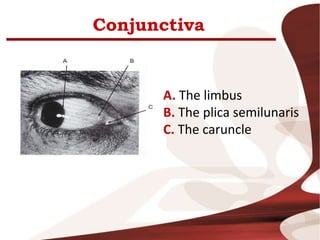
• The plica semilunaris is a fold in the conjunctiva
located far medially in the palpebral fissure and is
mostly below the midline. The caruncle, located just
medial to the plica, is about 3 mm in diameter,
covered with squamous epithelium, and often
contains small hairs.
Conjunctiva
• The topographic landmarks of
the conjunctiva important to the
strabismus surgeon are the
following:
A The fusion of the conjunctiva
and anterior Tenon’s capsule with
the sclera at the limbus
Conjunctiva
A. The limbus
B. The plica semilunaris
C. The caruncle
Tennon’s capsule
• Tenon's capsule is a structure with definite body
and substance in childhood which gradually atrophies
in old age but not to the same degree as conjunctiva.
• Tenon's capsule has an anterior and posterior part.
• Anterior Tenon's capsule is the vestigial
capsulopalpebral head of the rectus muscles.
• This covers the anterior half to two-thirds of the
rectus muscles in their sheaths as well as the
intermuscular membrane.
Tennon’s capsule
Tennon’s capsule
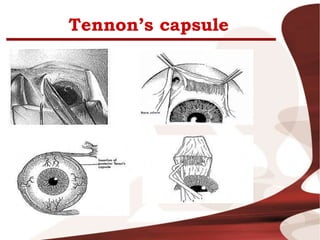
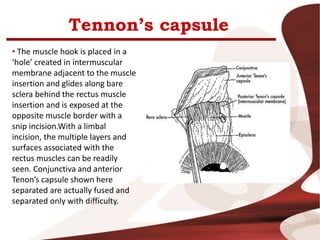
• The muscle hook is placed in a
‘hole’ created in intermuscular
membrane adjacent to the muscle
insertion and glides along bare
sclera behind the rectus muscle
insertion and is exposed at the
opposite muscle border with a
snip incision.With a limbal
incision, the multiple layers and
surfaces associated with the
rectus muscles can be readily
seen. Conjunctiva and anterior
Tenon’s capsule shown here
separated are actually fused and
separated only with difficulty.
Tennon’s capsule
• Anterior Tenon's capsule is fused with the
undersurface of conjunctiva and attaches to sclera
at the limbus.
• Posterior Tenon's capsule is made up of the fibrous
sheath of the rectus muscles together with the
intermuscular membrane.
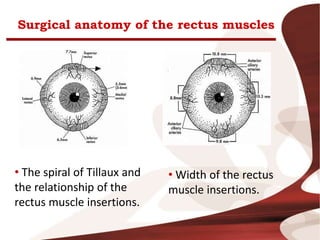
Surgical anatomy of the rectus muscles
• The spiral of Tillaux and
the relationship of the
rectus muscle insertions.
• Width of the rectus
muscle insertions.
Characteristics of EOM
• The extraocular muscles are similar to skeletal muscles though there are
differences undoubtedly related to the very specialized function of the
extraocular muscles.
• Both skeletal and extraocular muscles have several types of twitch fibers,
but the extraocular muscles are unique, having tonically contracting fibers
not found in skeletal muscle.
• The twitch fibers of extraocular muscles are called Fibrillenstruktur, and
the unique slow tonic fibers are called Felderstruktur.
• There are two muscle fiber layers in the medial and lateral recti. The
shorter orbital layer inserts in the muscle pulley, and the longer global
fibers insert into sclera at the muscle’s insertion.
Characteristics of EOM
• The shorter orbital layer inserts in the muscle pulley, and
the longer global fibers insert into sclera at the muscle’s
insertion.
• The muscle fibers are long, traversing the entire length of
the muscle, or in some cases, nearly so.
• The blood supply of the extraocular muscles is rich, coming
from the muscular branches of the ophthalmic artery.
• The extraocular muscles have the lowest innervation ratio
of any of the muscles of the body; that is, they have the most
nerve fibers per muscle fiber.
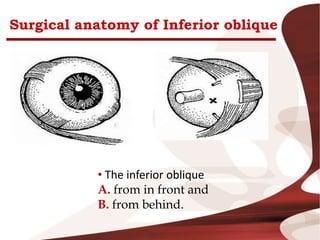
Surgical anatomy of Inferior oblique
• The inferior oblique
A. from in front and
B. from behind.
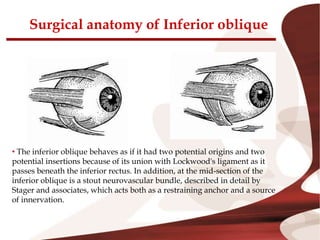
Surgical anatomy of Inferior oblique
• The inferior oblique behaves as if it had two potential origins and two
potential insertions because of its union with Lockwood's ligament as it
passes beneath the inferior rectus. In addition, at the mid-section of the
inferior oblique is a stout neurovascular bundle, described in detail by
Stager and associates, which acts both as a restraining anchor and a source
of innervation.
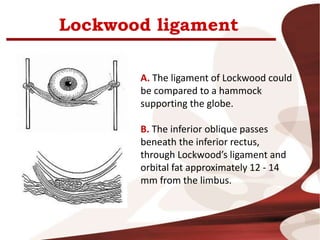
Lockwood ligament
A. The ligament of Lockwood could
be compared to a hammock
supporting the globe.
B. The inferior oblique passes
beneath the inferior rectus,
through Lockwood’s ligament and
orbital fat approximately 12 - 14
mm from the limbus.
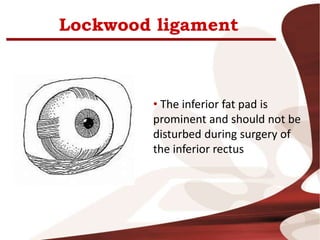
Lockwood ligament
• The inferior fat pad is
prominent and should not be
disturbed during surgery of
the inferior rectus
Superior oblique
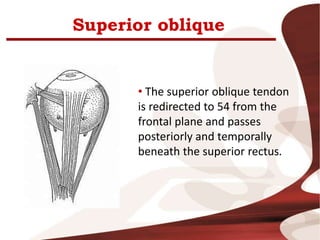
• The superior oblique tendon
is redirected to 54 from the
frontal plane and passes
posteriorly and temporally
beneath the superior rectus.
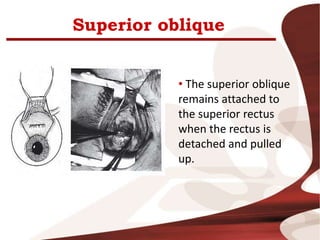
Superior oblique
• The superior oblique
remains attached to
the superior rectus
when the rectus is
detached and pulled
up.
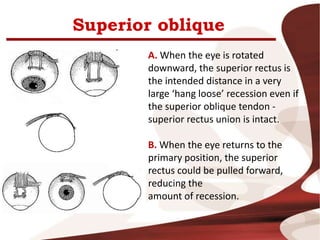
Superior oblique
A. When the eye is rotated
downward, the superior rectus is
the intended distance in a very
large ‘hang loose’ recession even if
the superior oblique tendon -
superior rectus union is intact.
B. When the eye returns to the
primary position, the superior
rectus could be pulled forward,
reducing the
amount of recession.
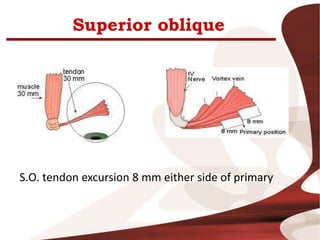
Superior oblique
S.O. tendon excursion 8 mm either side of primary
Superior oblique
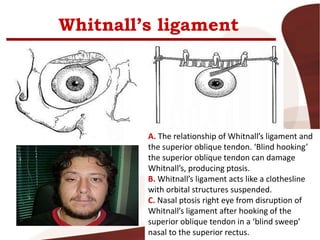
Whitnall’s ligament
A. The relationship of Whitnall’s ligament and
the superior oblique tendon. ‘Blind hooking’
the superior oblique tendon can damage
Whitnall’s, producing ptosis.
B. Whitnall’s ligament acts like a clothesline
with orbital structures suspended.
C. Nasal ptosis right eye from disruption of
Whitnall’s ligament after hooking of the
superior oblique tendon in a ‘blind sweep’
nasal to the superior rectus.
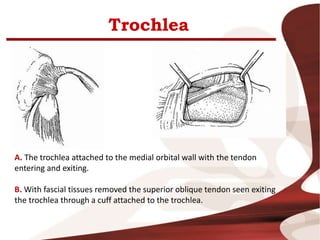
Trochlea
A. The trochlea attached to the medial orbital wall with the tendon
entering and exiting.
B. With fascial tissues removed the superior oblique tendon seen exiting
the trochlea through a cuff attached to the trochlea.
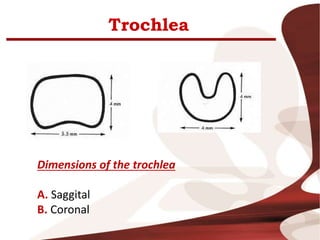
Trochlea
Dimensions of the trochlea
A. Saggital
B. Coronal
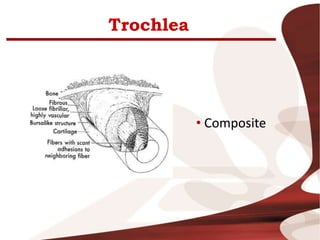
Trochlea
• Composite
Trochlea
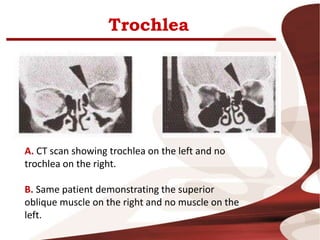
A. CT scan showing trochlea on the left and no
trochlea on the right.
B. Same patient demonstrating the superior
oblique muscle on the right and no muscle on the
left.
Trochlea
Trochlea
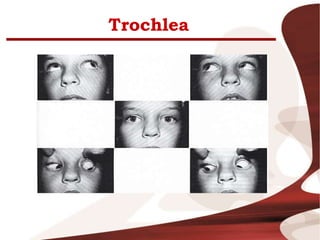
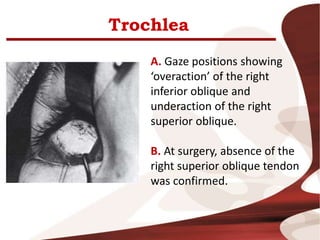
A. Gaze positions showing
‘overaction’ of the right
inferior oblique and
underaction of the right
superior oblique.
B. At surgery, absence of the
right superior oblique tendon
was confirmed.
Anterior segment blood supply
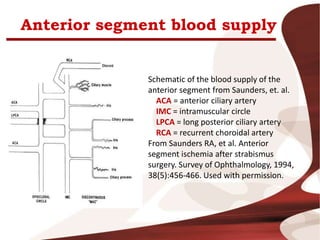
Schematic of the blood supply of the
anterior segment from Saunders, et. al.
ACA = anterior ciliary artery
IMC = intramuscular circle
LPCA = long posterior ciliary artery
RCA = recurrent choroidal artery
From Saunders RA, et al. Anterior
segment ischemia after strabismus
surgery. Survey of Ophthalmology, 1994,
38(5):456-466. Used with permission.
Anterior segment blood supply
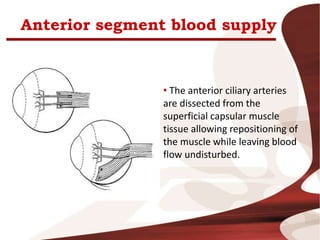
• The anterior ciliary arteries
are dissected from the
superficial capsular muscle
tissue allowing repositioning of
the muscle while leaving blood
flow undisturbed.
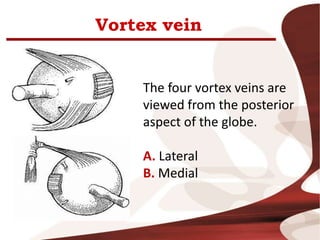
Vortex vein
The four vortex veins are
viewed from the posterior
aspect of the globe.
A. Lateral
B. Medial
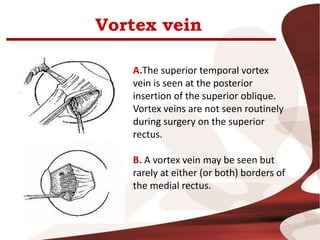
Vortex vein
A.The superior temporal vortex
vein is seen at the posterior
insertion of the superior oblique.
Vortex veins are not seen routinely
during surgery on the superior
rectus.
B. A vortex vein may be seen but
rarely at either (or both) borders of
the medial rectus.
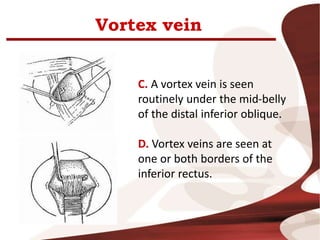
Vortex vein
C. A vortex vein is seen
routinely under the mid-belly
of the distal inferior oblique.
D. Vortex veins are seen at
one or both borders of the
inferior rectus.
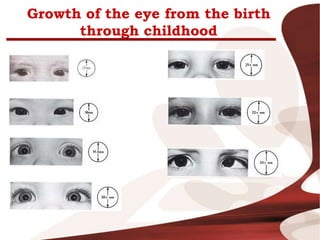
Growth of the eye from the birth
through childhood
Sclera
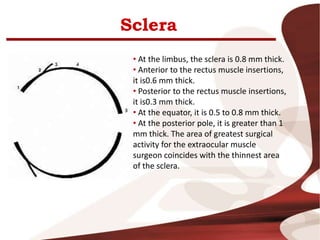
• At the limbus, the sclera is 0.8 mm thick.
• Anterior to the rectus muscle insertions,
it is0.6 mm thick.
• Posterior to the rectus muscle insertions,
it is0.3 mm thick.
• At the equator, it is 0.5 to 0.8 mm thick.
• At the posterior pole, it is greater than 1
mm thick. The area of greatest surgical
activity for the extraocular muscle
surgeon coincides with the thinnest area
of the sclera.
Sclera
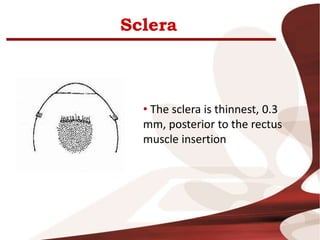
• The sclera is thinnest, 0.3
mm, posterior to the rectus
muscle insertion
Sclera
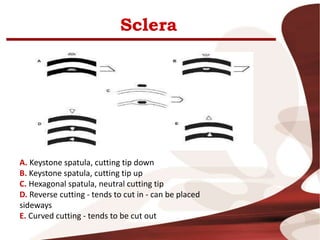
A. Keystone spatula, cutting tip down
B. Keystone spatula, cutting tip up
C. Hexagonal spatula, neutral cutting tip
D. Reverse cutting - tends to cut in - can be placed
sideways
E. Curved cutting - tends to be cut out
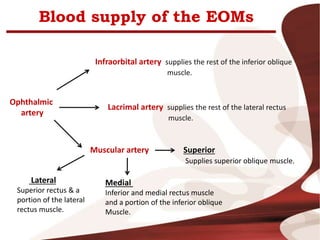
Blood supply of the EOMs
Ophthalmic
artery
Infraorbital artery supplies the rest of the inferior oblique
muscle.
Lacrimal artery supplies the rest of the lateral rectus
muscle.
Muscular artery
Lateral
Superior rectus & a
portion of the lateral
rectus muscle.
Medial
Inferior and medial rectus muscle
and a portion of the inferior oblique
Muscle.
Superior
Supplies superior oblique muscle.
Blood supply of the EOMs
The blood supply to the orbital layer is much more
extensive than that of the global layer.
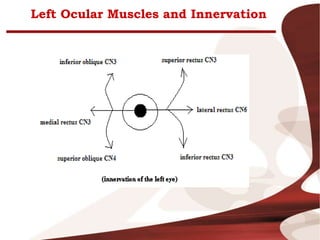
Left Ocular Muscles and Innervation
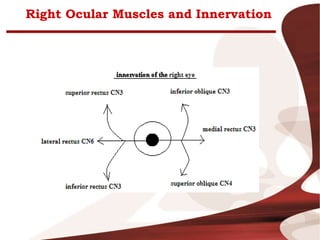
Right Ocular Muscles and Innervation
Thank you

Eye Muscles Anatomy

  • 1.
    The Anatomy ofthe Extraocular Muscles Tukezban Huseynova, MD Specialist in Strabismus and Refractive Cornea, Briz-L Eye Clinic, Baku, Azerbaijan Tukezban@gmail.com
  • 2.
    Embryology of ExtraocularMuscles • The fibers of the striated EOMs originate from condensations of cranial mesoderm, whereas their associated connective tissues and the orbital smooth muscles (SMs) originate from the neural crest.
  • 3.
    Embryology of ExtraocularMuscles Myogenesis Primary 11 weeks Secondary  the trochlea  the soft pulley  The periocular connective tissues
  • 4.
    Embryology of ExtraocularMuscles Adult skeletal muscles retain a quiescent stem cell population that allows regeneration. After muscle damage has occurred, the regenerative process recapitulates development as the precursor cells in the adult, now known as satellite cells, proliferate to produce myoblasts, which fuse to form new muscles fibers.
  • 5.
    Embryology of ExtraocularMuscles 1. The types of contractile proteins expressed in a given muscle fiber 2. The apparatus that links activation of the muscle fiber from a motor nerve to the production of a muscle contraction, excitation-contraction coupling. Contraction speed, in turn, is a function of two factors
  • 6.
    Embryology of ExtraocularMuscles • The central contractile unit of a skeletal muscle fiber is the sarcomere. • Each sarcomere is approximately 2 to 3 mm long. • End-to-End arrangement of sarcomeres produces the characteristic longitudinal banding pattern of striated muscle.
  • 7.
    İnternal Structure ofthe EOM The oculorotary EOMs, although not the levator palpebrae superioris (LPS), consist of two distinct layers:  Global layer  Orbital layer ( SIMFs and MIMFs)
  • 8.
    Origins and pathsof the EOM The rectus EOMs originate in the orbital apex from a common fibrous ring surrounding the optic nerve called the annulus of Zinn The SO muscle originates from the periorbita of the superonasal orbital wall The IO muscle originates much more anteriorly from the periorbita of the inferonasal orbital rim adjacent to the anterior lacrimal crest
  • 9.
    Pulleys of theEOM Pulleys consist of discrete rings of dense collagen encircling the EOM and are about 2 mm in length coaxial Has less substantial collagenous sleeves around the EOM. Anteriorly, these sleeves thin to form slings convex to the orbital wall, and More posteriorly the sleeves thin to form slings convex toward the center of the orbit. The anterior pulley slings are also known as the intermuscular septa. The collagenous pulley ring forms the fulcrum of the pulley that inflects the EOM path.
  • 10.
  • 11.
    Pulleys of theEOM The pulleys function as the mechanical origins of the EOMs and play a vital role in ocular kinematics, the rotational properties of the eye. Normal pulleys form a natural mechanical substrate for Listing's law and other aspects of ocular kinematics, and they render ocular rotations effectively commutative.
  • 12.
    Pulleys of theEOM  Donder's law, stating that there is only one torsional eye position for each com-bination of horizontal and vertical eye positions.  Listing's law, a specific case of the more general Don-der's law, states that any physiologic eye orientation can be reached from any other by rotation about a single axis, and that all such possible axes lie in a single velocity plane, Listing's plane.
  • 13.
    Pulleys of theEOM  Listing's law is satisfied if the axis of ocular rotation shifts by exactly one half of the shift in ocular orientation for any eye movement.This is the so-called Listing's half- angle rule.
  • 14.
    Pulleys of theEOM Shifts in horizontal rectus pulley position required to maintain the Listing's half-angle relation in tertiary positions of adducted elevation and adducted depression. Pulleys are depicted as rings. Paths of global layers of rectus extraocular muscles are shown in black; orbital layers inserting in pulleys are shown in gray. Pulley suspensions are also shown in gray.
  • 15.
    Pulleys of theEOM Shift of pulley location can produce an "A" & "V" pattern of strabismus Pulleys cause "V" Pulleys cause "A"
  • 16.
    Pulleys of theEOM • The ‘pulley zone’ is roughly at the junction of the middle and posterior third of the globe, similar to Listing’s plane
  • 17.
    Pulleys of theEOM • The pulleys which ‘inflect the paths of the muscle.’ A. Medial rectus pulley B. Lateral rectus pulley • The functional origin of the rectus muscles is at the pulleys
  • 18.
    Pulleys of theEOM • The orbital fibers insert into the pulleys of the horizontal recti and the global fibers insert into sclera.
  • 19.
    Pulleys of theEOM The muscle - tendon anterior to the pulley A. Passes straight in primary position B. Courses upward in upgaze C. Courses downward in downgaze D. The direction of the muscle posterior to the pulley does not change during up and downgaze
  • 20.
    Pulleys of theEOM Some combination of: Upward displacement of the lateral recti Downward displacement leads to ‘A’ pattern
  • 21.
    Pulleys of theEOM Some combination of: Downward displacement of the lateral recti Upward displacement of the medial recti leads to ‘V’ pattern
  • 22.
    Pulleys of theEOM The reasons that the strabismus surgeon is not likely to see the pulleys are several. First, surgery of the extraocular muscles is carried out beneath anterior Tenon's capsule and in the plane of posterior Tenon's capsule. Second, dissection carried posterior to the origin of anterior Tenon's capsule will expose extraconal fat, which both complicates surgery and obscures the surrounding anatomy, including the pulleys. Third, although the pulleys are located in the orbital fat just behind the insertion of anterior Tenon's capsule, they are virtually impossible to identify for what they are.
  • 23.
    Scleral İnsertion ofEOM Anatomic relations of rectus extraocular muscle insertions to the corneal limbus.
  • 24.
    Smooth muscles ofthe orbit SMs in four areas of the human orbit: The inferior palpebral muscle, The superior palpebral muscle, The “orbital muscle” spanning the inferior orbital fissure, and The “peribulbar muscle” surrounding the anterior aspect of the globe.
  • 25.
    Physiology of EOM Keytraits of muscle function 1. Contraction speed a. The types of contractile proteins expressed in a given muscle fibers. b. The apparatus that links activation of the muscle fiber from a motor nerve to the productionof a muscle contraction, excitation – contraction coupling. 2. Fatique resistance is a direct consequence of cellular metabolism.
  • 26.
    Physiology of EOM •The contractile unit of a skeletal muscle – sarcomere • End – to – end sarcomere forms striated muscle Thick agregates of myosin (Light and heavy chains) Thin filaments (polymers and α- actin)
  • 27.
    Physiology of EOM •2 proteins modulate the contractile process Tropomyosin Troponin Attach to the α – actin backbone.
  • 28.
    Physiology of EOM Sarcomere Dark Anisotropicband (A band) contain actin and myosin Light Isotropic band (I band) contain actin H zone (center) presence only myozin M zone containing protein, bisect by H zone Z line longitudinary boundary of each sarcomere.
  • 29.
  • 30.
  • 31.
    Physiology of EOM •Each end – to – end sarcomere is known as myofibril, myofibril are separated from each other by a membranous calcium storage system, the sarcoplasmic reticulum.
  • 32.
    Physiology of EOM FiberTypes: 1. Slow twitch, fatigue resistant (red or Type I) 2. Fast twitch, fatigue resistant (intermediate or Type II A) 3. Fast twitch, fatigable (white or type II B) 4. Fast twitch, intermediate (Type II C or II X/D)
  • 33.
    Physiology of EOM Sixdistinct fiber types 1. Orbital singly innervated fiber (predominant) 2. Orbital multiply innervated fiber 3. Global red singly innervated fiber (1/3 of global fiber) 4. Global intermediate singly innervated fiber (1/4 of global fiber) 5. Global white singly innervated fiber (1/3 of global fiber) 6. Global multiply innervated fiber
  • 34.
    Physiology of EOM •The energy requirement for muscle contraction is by adenosine triphosphate (ATP) cleavage via a myofibrillar ATPase. Both anaerobic (glycolytic) or aerobic (mitochondrial oxidative) mechanism.
  • 35.
  • 36.
    Palpebral fissure size •The average adult palpebral opening is 28 mm long and 10 mm high. • An average 18-month-old child has a palpebral opening 20 mm long and 8.5 mm high.
  • 37.
    Palpebral fissure size •A newborn has a palpebral opening measuring 18 mm long and 8 mm high.  The size and shape of the palpebral opening should be considered at the outset of extraocular muscle surgery.
  • 38.
    Extraocular muscles size •İn newborns, the posterior part of the globe is relatively smaller than the anterior part, meaning that a recession of 3 mm could place the medial rectus at the equator. This is important information but not for strabismus surgery, which is not indicated anyway in the newborn because of immaturity of the binocular system. • The insertion of the medial rectus in an infant can be closer than 5.5 mm from the limbus.
  • 39.
  • 40.
    Palpebral fissue shape •A patient with myelomeningocele and a straight lower lid margin simulating a mongoloid slant. This is a common but unexplained finding in such patients.
  • 41.
    Palpebral fissue shape •‘V’ esotropia in a patient with antimongoloid palpebral fissures.
  • 42.
    Palpebral fissue shape •‘A’ esotropia in a patient with mongoloid palpebral fissures.
  • 43.
    Palpebral fissue shape •The palpebral fissure may be level, mongoloid, or antimongoloid, depending on the relative positions of the medial and lateral canthi. • If the outer canthus is higher than the inner canthus, a mongoloid palpebral slant exists (Figure 15). If the outer canthus is lower than the inner canthus, an antimongoloid palpebral slant exists.
  • 44.
    Epicanthal folds A.This patientdemonstrates telecanthus with an interorbital dimension clearly more than one-half the interpupillary distance and also an exotropia. B. This patient with telecanthus also has prominent epicanthal folds.
  • 45.
    Epicanthal folds • Askin fold originating below and sweeping upward is called epicanthus inversus. This deformity is frequently associated with blepharophimosis and ptosis. These three deformities, which may be combined with telecanthus, cause significant disfigurement and present a formidable therapeutic challenge.
  • 46.
    Epicanthal folds A. Centeredpupillary light reflex B. The ‘straightening’ effect of exposing more ‘white’ nasally. (This is shown in an older patient because it is difficult to photograph the younger child where the test is more effective.)
  • 47.
    Epicanthal folds • Epicanthalfolds obscure the nasal conjunctiva in both patients, giving the appearance of esotropia. However, the light reflex is centered in the pupil in each case. This reflex indicates the presence of parallel pupillary axes and, therefore, straight eyes or absence of manifest strabismus. Cover testing must be performed eventually to confirm the presence of parallel visual axes because a large angle kappa* could hide a small manifest esodeviation.
  • 48.
    Epicanthal folds • Epicanthalfolds are present to some degree in most infants and children during the first few years of life. • First, the examiner demonstrates the centered pupillary reflexes with a muscle light. Second, the examiner carefully pulls the skin forward over the bridge of the nose to demonstrate the ‘straightening’ effect of exposing the medial conjunctiva or ‘white of the eye’ .
  • 49.
    Epicanthal folds *Angle kappais the angle formed by the pupillary axis and the visual axis. A positive angle kappa is present when the visual axis is nasal to the pupillary axis. This simulates exotropia and is common. A negative angle kappa is present when the visual axis is temporal to the pupillary axis. This simulates esotropia and is much less common than positive angle kappa.
  • 50.
    Conjunctiva • The plicasemilunaris is a fold in the conjunctiva located far medially in the palpebral fissure and is mostly below the midline. The caruncle, located just medial to the plica, is about 3 mm in diameter, covered with squamous epithelium, and often contains small hairs.
  • 51.
    Conjunctiva • The topographiclandmarks of the conjunctiva important to the strabismus surgeon are the following: A The fusion of the conjunctiva and anterior Tenon’s capsule with the sclera at the limbus
  • 52.
    Conjunctiva A. The limbus B.The plica semilunaris C. The caruncle
  • 53.
    Tennon’s capsule • Tenon'scapsule is a structure with definite body and substance in childhood which gradually atrophies in old age but not to the same degree as conjunctiva. • Tenon's capsule has an anterior and posterior part. • Anterior Tenon's capsule is the vestigial capsulopalpebral head of the rectus muscles. • This covers the anterior half to two-thirds of the rectus muscles in their sheaths as well as the intermuscular membrane.
  • 54.
  • 55.
    Tennon’s capsule • Themuscle hook is placed in a ‘hole’ created in intermuscular membrane adjacent to the muscle insertion and glides along bare sclera behind the rectus muscle insertion and is exposed at the opposite muscle border with a snip incision.With a limbal incision, the multiple layers and surfaces associated with the rectus muscles can be readily seen. Conjunctiva and anterior Tenon’s capsule shown here separated are actually fused and separated only with difficulty.
  • 56.
    Tennon’s capsule • AnteriorTenon's capsule is fused with the undersurface of conjunctiva and attaches to sclera at the limbus. • Posterior Tenon's capsule is made up of the fibrous sheath of the rectus muscles together with the intermuscular membrane.
  • 57.
    Surgical anatomy ofthe rectus muscles • The spiral of Tillaux and the relationship of the rectus muscle insertions. • Width of the rectus muscle insertions.
  • 58.
    Characteristics of EOM •The extraocular muscles are similar to skeletal muscles though there are differences undoubtedly related to the very specialized function of the extraocular muscles. • Both skeletal and extraocular muscles have several types of twitch fibers, but the extraocular muscles are unique, having tonically contracting fibers not found in skeletal muscle. • The twitch fibers of extraocular muscles are called Fibrillenstruktur, and the unique slow tonic fibers are called Felderstruktur. • There are two muscle fiber layers in the medial and lateral recti. The shorter orbital layer inserts in the muscle pulley, and the longer global fibers insert into sclera at the muscle’s insertion.
  • 59.
    Characteristics of EOM •The shorter orbital layer inserts in the muscle pulley, and the longer global fibers insert into sclera at the muscle’s insertion. • The muscle fibers are long, traversing the entire length of the muscle, or in some cases, nearly so. • The blood supply of the extraocular muscles is rich, coming from the muscular branches of the ophthalmic artery. • The extraocular muscles have the lowest innervation ratio of any of the muscles of the body; that is, they have the most nerve fibers per muscle fiber.
  • 60.
    Surgical anatomy ofInferior oblique • The inferior oblique A. from in front and B. from behind.
  • 61.
    Surgical anatomy ofInferior oblique • The inferior oblique behaves as if it had two potential origins and two potential insertions because of its union with Lockwood's ligament as it passes beneath the inferior rectus. In addition, at the mid-section of the inferior oblique is a stout neurovascular bundle, described in detail by Stager and associates, which acts both as a restraining anchor and a source of innervation.
  • 62.
    Lockwood ligament A. Theligament of Lockwood could be compared to a hammock supporting the globe. B. The inferior oblique passes beneath the inferior rectus, through Lockwood’s ligament and orbital fat approximately 12 - 14 mm from the limbus.
  • 63.
    Lockwood ligament • Theinferior fat pad is prominent and should not be disturbed during surgery of the inferior rectus
  • 64.
    Superior oblique • Thesuperior oblique tendon is redirected to 54 from the frontal plane and passes posteriorly and temporally beneath the superior rectus.
  • 65.
    Superior oblique • Thesuperior oblique remains attached to the superior rectus when the rectus is detached and pulled up.
  • 66.
    Superior oblique A. Whenthe eye is rotated downward, the superior rectus is the intended distance in a very large ‘hang loose’ recession even if the superior oblique tendon - superior rectus union is intact. B. When the eye returns to the primary position, the superior rectus could be pulled forward, reducing the amount of recession.
  • 67.
    Superior oblique S.O. tendonexcursion 8 mm either side of primary
  • 69.
  • 72.
    Whitnall’s ligament A. Therelationship of Whitnall’s ligament and the superior oblique tendon. ‘Blind hooking’ the superior oblique tendon can damage Whitnall’s, producing ptosis. B. Whitnall’s ligament acts like a clothesline with orbital structures suspended. C. Nasal ptosis right eye from disruption of Whitnall’s ligament after hooking of the superior oblique tendon in a ‘blind sweep’ nasal to the superior rectus.
  • 73.
    Trochlea A. The trochleaattached to the medial orbital wall with the tendon entering and exiting. B. With fascial tissues removed the superior oblique tendon seen exiting the trochlea through a cuff attached to the trochlea.
  • 74.
    Trochlea Dimensions of thetrochlea A. Saggital B. Coronal
  • 75.
  • 76.
    Trochlea A. CT scanshowing trochlea on the left and no trochlea on the right. B. Same patient demonstrating the superior oblique muscle on the right and no muscle on the left.
  • 77.
  • 78.
    Trochlea A. Gaze positionsshowing ‘overaction’ of the right inferior oblique and underaction of the right superior oblique. B. At surgery, absence of the right superior oblique tendon was confirmed.
  • 79.
    Anterior segment bloodsupply Schematic of the blood supply of the anterior segment from Saunders, et. al. ACA = anterior ciliary artery IMC = intramuscular circle LPCA = long posterior ciliary artery RCA = recurrent choroidal artery From Saunders RA, et al. Anterior segment ischemia after strabismus surgery. Survey of Ophthalmology, 1994, 38(5):456-466. Used with permission.
  • 80.
    Anterior segment bloodsupply • The anterior ciliary arteries are dissected from the superficial capsular muscle tissue allowing repositioning of the muscle while leaving blood flow undisturbed.
  • 81.
    Vortex vein The fourvortex veins are viewed from the posterior aspect of the globe. A. Lateral B. Medial
  • 82.
    Vortex vein A.The superiortemporal vortex vein is seen at the posterior insertion of the superior oblique. Vortex veins are not seen routinely during surgery on the superior rectus. B. A vortex vein may be seen but rarely at either (or both) borders of the medial rectus.
  • 83.
    Vortex vein C. Avortex vein is seen routinely under the mid-belly of the distal inferior oblique. D. Vortex veins are seen at one or both borders of the inferior rectus.
  • 84.
    Growth of theeye from the birth through childhood
  • 85.
    Sclera • At thelimbus, the sclera is 0.8 mm thick. • Anterior to the rectus muscle insertions, it is0.6 mm thick. • Posterior to the rectus muscle insertions, it is0.3 mm thick. • At the equator, it is 0.5 to 0.8 mm thick. • At the posterior pole, it is greater than 1 mm thick. The area of greatest surgical activity for the extraocular muscle surgeon coincides with the thinnest area of the sclera.
  • 86.
    Sclera • The sclerais thinnest, 0.3 mm, posterior to the rectus muscle insertion
  • 87.
    Sclera A. Keystone spatula,cutting tip down B. Keystone spatula, cutting tip up C. Hexagonal spatula, neutral cutting tip D. Reverse cutting - tends to cut in - can be placed sideways E. Curved cutting - tends to be cut out
  • 88.
    Blood supply ofthe EOMs Ophthalmic artery Infraorbital artery supplies the rest of the inferior oblique muscle. Lacrimal artery supplies the rest of the lateral rectus muscle. Muscular artery Lateral Superior rectus & a portion of the lateral rectus muscle. Medial Inferior and medial rectus muscle and a portion of the inferior oblique Muscle. Superior Supplies superior oblique muscle.
  • 89.
    Blood supply ofthe EOMs The blood supply to the orbital layer is much more extensive than that of the global layer.
  • 90.
    Left Ocular Musclesand Innervation
  • 91.
    Right Ocular Musclesand Innervation
  • 94.