Copyright©2004 South-Western
Externalities
Copyright © 2004 South-Western
Externalities
• Recall: Adam Smith’s “invisible hand” of the
marketplace leads self-interested buyers and
sellers in a market to maximize the total benefit
that society can derive from a market.
But market failures can still happen.
Copyright © 2004 South-Western
EXTERNALITIES AND MARKET INEFFICIENCY
• An externality refers to the uncompensated impact of
one person’s actions on the well-being of a bystander.
• Externalities cause markets to be inefficient, and thus fail
to maximize total surplus.
• An externality arises...
. . . when a person engages in an activity that influences the
well-being of a bystander and yet neither pays nor receives
any compensation for that effect.
• When the impact on the bystander is adverse, the
externality is called a negative externality.
• When the impact on the bystander is beneficial, the
externality is called a positive externality.
Copyright © 2004 South-Western
EXTERNALITIES AND MARKET INEFFICIENCY
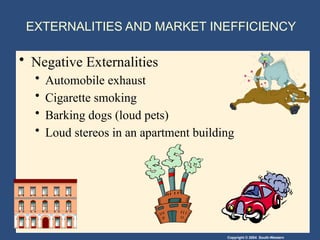
• Negative Externalities
• Automobile exhaust
• Cigarette smoking
• Barking dogs (loud pets)
• Loud stereos in an apartment building
Copyright © 2004 South-Western
EXTERNALITIES AND MARKET INEFFICIENCY
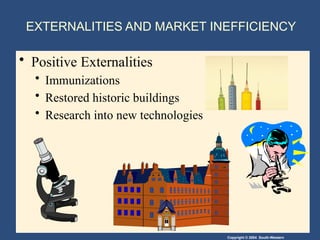
• Positive Externalities
• Immunizations
• Restored historic buildings
• Research into new technologies
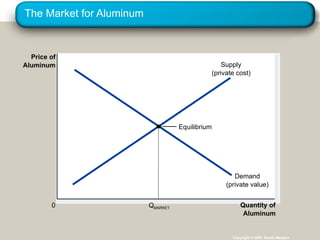
The Market for Aluminum
Copyright © 2004 South-Western
Quantity of
Aluminum
0
Price of
Aluminum
Equilibrium
Demand
(private value)
Supply
(private cost)
QMARKET
Copyright © 2004 South-Western
EXTERNALITIES AND MARKET INEFFICIENCY
• Negative externalities lead markets to produce
a larger quantity than is socially desirable.
• Positive externalities lead markets to produce a
smaller quantity than is socially desirable.
Copyright © 2004 South-Western
Welfare Economics: A Recap
• The Market for Aluminum
• The quantity produced and consumed in the market
equilibrium is efficient in the sense that it
maximizes the sum of producer and consumer
surplus.
• If the aluminum factories emit pollution (a negative
externality), then the cost to society of producing
aluminum is larger than the cost to aluminum
producers.
Copyright © 2004 South-Western
Welfare Economics: A Recap
• The Market for Aluminum
• For each unit of aluminum produced, the social cost
includes the private costs of the producers plus the
cost to those bystanders adversely affected by the
pollution.
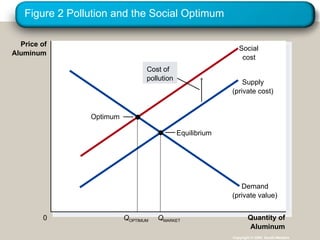
Figure 2 Pollution and the Social Optimum
Copyright © 2004 South-Western
Equilibrium
Quantity of
Aluminum
0
Price of
Aluminum
Demand
(private value)
Supply
(private cost)
Social
cost
QOPTIMUM
Optimum
Cost of
pollution
QMARKET
Copyright © 2004 South-Western
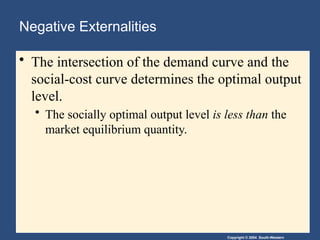
Negative Externalities
• The intersection of the demand curve and the
social-cost curve determines the optimal output
level.
• The socially optimal output level is less than the
market equilibrium quantity.
Copyright © 2004 South-Western
Negative Externalities
• Internalizing an externality involves altering
incentives so that people take account of the
external effects of their actions.
Copyright © 2004 South-Western
Negative Externalities
• Achieving the Socially Optimal Output
• The government can internalize an externality
by imposing a tax on the producer to reduce the
equilibrium quantity to the socially desirable
quantity.
Copyright © 2004 South-Western
Positive Externalities
• When an externality benefits the bystanders, a
positive externality exists.
• The social value of the good exceeds the private
value.
Copyright © 2004 South-Western
Positive Externalities
• A technology spillover is a type of positive
externality that exists when a firm’s innovation
or design not only benefits the firm, but enters
society’s pool of technological knowledge and
benefits society as a whole.
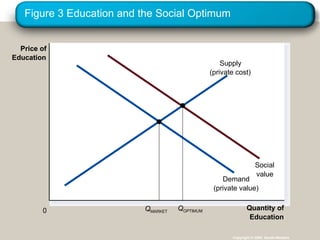
Figure 3 Education and the Social Optimum
Copyright © 2004 South-Western
Quantity of
Education
0
Price of
Education
Demand
(private value)
Social
value
Supply
(private cost)
QMARKET
QOPTIMUM
Copyright © 2004 South-Western
Positive Externalities
• The intersection of the supply curve and the
social-value curve determines the optimal
output level.
• The optimal output level is more than the
equilibrium quantity.
• The market produces a smaller quantity than is
socially desirable.
• The social value of the good exceeds the private
value of the good.
Copyright © 2004 South-Western
Positive Externalities
• Internalizing Externalities: Subsidies
• Used as the primary method for attempting to
internalize positive externalities.
• Industrial Policy
• Government intervention in the economy that aims
to promote technology-enhancing industries
• Patent laws are a form of technology policy that give the
individual (or firm) with patent protection a property
right over its invention.
• The patent is then said to internalize the externality.
Copyright © 2004 South-Western
PRIVATE SOLUTIONS TO EXTERNALITIES
• Government action is not always needed to
solve the problem of externalities.
Copyright © 2004 South-Western
PRIVATE SOLUTIONS TO EXTERNALITIES
• Moral codes and social sanctions
• Charitable organizations
• Integrating different types of businesses
• Contracting between parties
Copyright © 2004 South-Western
The Coase Theorem
• The Coase Theorem is a proposition that if
private parties can bargain without cost over the
allocation of resources, they can solve the
problem of externalities on their own.
• Transactions Costs
• Transaction costs are the costs that parties incur in
the process of agreeing to and following through on
a bargain.
Copyright © 2004 South-Western
Why Private Solutions Do Not Always Work
• Sometimes the private solution approach fails
because transaction costs can be so high that
private agreement is not possible.
Copyright © 2004 South-Western
PUBLIC POLICY TOWARD EXTERNALITIES
• When externalities are significant and private
solutions are not found, government may
attempt to solve the problem through . . .
• command-and-control policies.
• market-based policies.
Copyright © 2004 South-Western
PUBLIC POLICY TOWARD EXTERNALITIES
• Command-and-Control Policies
• Usually take the form of regulations:
• Forbid certain behaviors.
• Require certain behaviors.
• Examples:
• Requirements that all students be immunized.
• Stipulations on pollution emission levels set by the
Environmental Protection Agency (EPA).
Copyright © 2004 South-Western
PUBLIC POLICY TOWARD EXTERNALITIES
• Market-Based Policies
• Government uses taxes and subsidies to align
private incentives with social efficiency.
• Pigovian taxes are taxes enacted to correct the
effects of a negative externality.
Copyright © 2004 South-Western
PUBLIC POLICY TOWARD EXTERNALITIES
• Examples of Regulation versus Pigovian Tax
• If the EPA decides it wants to reduce the amount of
pollution coming from a specific plant. The EPA
could…
• tell the firm to reduce its pollution by a specific
amount (i.e. regulation).
• levy a tax of a given amount for each unit of
pollution the firm emits (i.e. Pigovian tax).
Copyright © 2004 South-Western
PUBLIC POLICY TOWARD EXTERNALITIES
• Market-Based Policies
• Tradable pollution permits allow the voluntary
transfer of the right to pollute from one firm to
another.
• A market for these permits will eventually develop.
• A firm that can reduce pollution at a low cost may
prefer to sell its permit to a firm that can reduce
pollution only at a high cost.
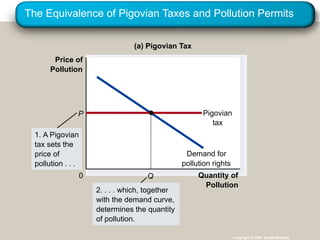
The Equivalence of Pigovian Taxes and Pollution Permits
Copyright © 2004 South-Western
Quantity of
Pollution
0
Price of
Pollution
Demand for
pollution rights
P Pigovian
tax
(a) Pigovian Tax
2. . . . which, together
with the demand curve,
determines the quantity
of pollution.
1. A Pigovian
tax sets the
price of
pollution . . .
Q
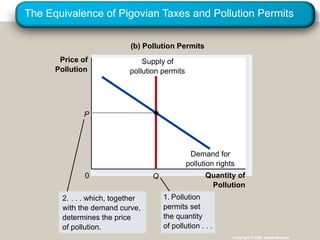
The Equivalence of Pigovian Taxes and Pollution Permits
Copyright © 2004 South-Western
Quantity of
Pollution
0
Demand for
pollution rights
Q
Supply of
pollution permits
(b) Pollution Permits
Price of
Pollution
2. . . . which, together
with the demand curve,
determines the price
of pollution.
1. Pollution
permits set
the quantity
of pollution . . .
P
Copyright © 2004 South-Western
Summary
• When a transaction between a buyer and a
seller directly affects a third party, the effect is
called an externality.
• Negative externalities cause the socially
optimal quantity in a market to be less than the
equilibrium quantity.
• Positive externalities cause the socially optimal
quantity in a market to be greater than the
equilibrium quantity.
Copyright © 2004 South-Western
Summary
• Those affected by externalities can sometimes solve
the problem privately.
• The Coase theorem states that if people can bargain
without a cost, then they can always reach an
agreement in which resources are allocated
efficiently.
• When private parties cannot adequately deal with
externalities, then the government steps in.
• The government can either regulate behavior or
internalize the externality by using Pigovian taxes or
by issuing pollution permits.

Externalitiesssssssssss economicssssssss

  • 1.
  • 2.
    Copyright © 2004South-Western Externalities • Recall: Adam Smith’s “invisible hand” of the marketplace leads self-interested buyers and sellers in a market to maximize the total benefit that society can derive from a market. But market failures can still happen.
  • 3.
    Copyright © 2004South-Western EXTERNALITIES AND MARKET INEFFICIENCY • An externality refers to the uncompensated impact of one person’s actions on the well-being of a bystander. • Externalities cause markets to be inefficient, and thus fail to maximize total surplus. • An externality arises... . . . when a person engages in an activity that influences the well-being of a bystander and yet neither pays nor receives any compensation for that effect. • When the impact on the bystander is adverse, the externality is called a negative externality. • When the impact on the bystander is beneficial, the externality is called a positive externality.
  • 4.
    Copyright © 2004South-Western EXTERNALITIES AND MARKET INEFFICIENCY • Negative Externalities • Automobile exhaust • Cigarette smoking • Barking dogs (loud pets) • Loud stereos in an apartment building
  • 5.
    Copyright © 2004South-Western EXTERNALITIES AND MARKET INEFFICIENCY • Positive Externalities • Immunizations • Restored historic buildings • Research into new technologies
  • 6.
    The Market forAluminum Copyright © 2004 South-Western Quantity of Aluminum 0 Price of Aluminum Equilibrium Demand (private value) Supply (private cost) QMARKET
  • 7.
    Copyright © 2004South-Western EXTERNALITIES AND MARKET INEFFICIENCY • Negative externalities lead markets to produce a larger quantity than is socially desirable. • Positive externalities lead markets to produce a smaller quantity than is socially desirable.
  • 8.
    Copyright © 2004South-Western Welfare Economics: A Recap • The Market for Aluminum • The quantity produced and consumed in the market equilibrium is efficient in the sense that it maximizes the sum of producer and consumer surplus. • If the aluminum factories emit pollution (a negative externality), then the cost to society of producing aluminum is larger than the cost to aluminum producers.
  • 9.
    Copyright © 2004South-Western Welfare Economics: A Recap • The Market for Aluminum • For each unit of aluminum produced, the social cost includes the private costs of the producers plus the cost to those bystanders adversely affected by the pollution.
  • 10.
    Figure 2 Pollutionand the Social Optimum Copyright © 2004 South-Western Equilibrium Quantity of Aluminum 0 Price of Aluminum Demand (private value) Supply (private cost) Social cost QOPTIMUM Optimum Cost of pollution QMARKET
  • 11.
    Copyright © 2004South-Western Negative Externalities • The intersection of the demand curve and the social-cost curve determines the optimal output level. • The socially optimal output level is less than the market equilibrium quantity.
  • 12.
    Copyright © 2004South-Western Negative Externalities • Internalizing an externality involves altering incentives so that people take account of the external effects of their actions.
  • 13.
    Copyright © 2004South-Western Negative Externalities • Achieving the Socially Optimal Output • The government can internalize an externality by imposing a tax on the producer to reduce the equilibrium quantity to the socially desirable quantity.
  • 14.
    Copyright © 2004South-Western Positive Externalities • When an externality benefits the bystanders, a positive externality exists. • The social value of the good exceeds the private value.
  • 15.
    Copyright © 2004South-Western Positive Externalities • A technology spillover is a type of positive externality that exists when a firm’s innovation or design not only benefits the firm, but enters society’s pool of technological knowledge and benefits society as a whole.
  • 16.
    Figure 3 Educationand the Social Optimum Copyright © 2004 South-Western Quantity of Education 0 Price of Education Demand (private value) Social value Supply (private cost) QMARKET QOPTIMUM
  • 17.
    Copyright © 2004South-Western Positive Externalities • The intersection of the supply curve and the social-value curve determines the optimal output level. • The optimal output level is more than the equilibrium quantity. • The market produces a smaller quantity than is socially desirable. • The social value of the good exceeds the private value of the good.
  • 18.
    Copyright © 2004South-Western Positive Externalities • Internalizing Externalities: Subsidies • Used as the primary method for attempting to internalize positive externalities. • Industrial Policy • Government intervention in the economy that aims to promote technology-enhancing industries • Patent laws are a form of technology policy that give the individual (or firm) with patent protection a property right over its invention. • The patent is then said to internalize the externality.
  • 19.
    Copyright © 2004South-Western PRIVATE SOLUTIONS TO EXTERNALITIES • Government action is not always needed to solve the problem of externalities.
  • 20.
    Copyright © 2004South-Western PRIVATE SOLUTIONS TO EXTERNALITIES • Moral codes and social sanctions • Charitable organizations • Integrating different types of businesses • Contracting between parties
  • 21.
    Copyright © 2004South-Western The Coase Theorem • The Coase Theorem is a proposition that if private parties can bargain without cost over the allocation of resources, they can solve the problem of externalities on their own. • Transactions Costs • Transaction costs are the costs that parties incur in the process of agreeing to and following through on a bargain.
  • 22.
    Copyright © 2004South-Western Why Private Solutions Do Not Always Work • Sometimes the private solution approach fails because transaction costs can be so high that private agreement is not possible.
  • 23.
    Copyright © 2004South-Western PUBLIC POLICY TOWARD EXTERNALITIES • When externalities are significant and private solutions are not found, government may attempt to solve the problem through . . . • command-and-control policies. • market-based policies.
  • 24.
    Copyright © 2004South-Western PUBLIC POLICY TOWARD EXTERNALITIES • Command-and-Control Policies • Usually take the form of regulations: • Forbid certain behaviors. • Require certain behaviors. • Examples: • Requirements that all students be immunized. • Stipulations on pollution emission levels set by the Environmental Protection Agency (EPA).
  • 25.
    Copyright © 2004South-Western PUBLIC POLICY TOWARD EXTERNALITIES • Market-Based Policies • Government uses taxes and subsidies to align private incentives with social efficiency. • Pigovian taxes are taxes enacted to correct the effects of a negative externality.
  • 26.
    Copyright © 2004South-Western PUBLIC POLICY TOWARD EXTERNALITIES • Examples of Regulation versus Pigovian Tax • If the EPA decides it wants to reduce the amount of pollution coming from a specific plant. The EPA could… • tell the firm to reduce its pollution by a specific amount (i.e. regulation). • levy a tax of a given amount for each unit of pollution the firm emits (i.e. Pigovian tax).
  • 27.
    Copyright © 2004South-Western PUBLIC POLICY TOWARD EXTERNALITIES • Market-Based Policies • Tradable pollution permits allow the voluntary transfer of the right to pollute from one firm to another. • A market for these permits will eventually develop. • A firm that can reduce pollution at a low cost may prefer to sell its permit to a firm that can reduce pollution only at a high cost.
  • 28.
    The Equivalence ofPigovian Taxes and Pollution Permits Copyright © 2004 South-Western Quantity of Pollution 0 Price of Pollution Demand for pollution rights P Pigovian tax (a) Pigovian Tax 2. . . . which, together with the demand curve, determines the quantity of pollution. 1. A Pigovian tax sets the price of pollution . . . Q
  • 29.
    The Equivalence ofPigovian Taxes and Pollution Permits Copyright © 2004 South-Western Quantity of Pollution 0 Demand for pollution rights Q Supply of pollution permits (b) Pollution Permits Price of Pollution 2. . . . which, together with the demand curve, determines the price of pollution. 1. Pollution permits set the quantity of pollution . . . P
  • 30.
    Copyright © 2004South-Western Summary • When a transaction between a buyer and a seller directly affects a third party, the effect is called an externality. • Negative externalities cause the socially optimal quantity in a market to be less than the equilibrium quantity. • Positive externalities cause the socially optimal quantity in a market to be greater than the equilibrium quantity.
  • 31.
    Copyright © 2004South-Western Summary • Those affected by externalities can sometimes solve the problem privately. • The Coase theorem states that if people can bargain without a cost, then they can always reach an agreement in which resources are allocated efficiently. • When private parties cannot adequately deal with externalities, then the government steps in. • The government can either regulate behavior or internalize the externality by using Pigovian taxes or by issuing pollution permits.