Submitted to:
Dr. S. S. Bukhari
PhD (usa); Post-doc (USA)
Department of Agricultural Education
Extension and Short Courses
Faculty of Agricultural Social Sciences
Sindh Agriculture University, Tandojam
Course Code: AEE-604
Subject: Introduction to
Programme Planning
Submitted By:
Salman Akber
Chachar
2K11-SS-108
ASSIGNMENT
Programme
Planning
Submitted to:
Dr. S. S. Bukhari
PhD (usa); Post-doc (USA)
Department of Agricultural Education
Extension and Short Courses
Faculty of Agricultural Social Sciences
Sindh Agriculture University, Tandojam
Course Code: AEE-604
Subject: Introduction to
Programme Planning
Submitted By:
Salman Akber
Chachar
2K11-SS-108
PRACTICAL
Programme
Planning
Submitted to:
Dr. S. S. Bukhari
PhD (usa); Post-doc (USA)
Department of Agricultural Education
Extension and Short Courses
Faculty of Agricultural Social Sciences
Sindh Agriculture University, Tandojam
Course Code: AEE-604
Subject: Introduction to
Programme Planning
Submitted By:
Salman Akber
Chachar
2K11-SS-108
ASSIGNMENT
Programme
Planning
Submitted to:
Dr. S. S. Bukhari
PhD (usa); Post-doc (USA)
Department of Agricultural Education
Extension and Short Courses
Faculty of Agricultural Social Sciences
Sindh Agriculture University, Tandojam
Course Code: AEE-604
Subject: Introduction to
Programme Planning
Submitted By:
Salman Akber
Chachar
2K11-SS-108
PRACTICAL
Programme
Planning
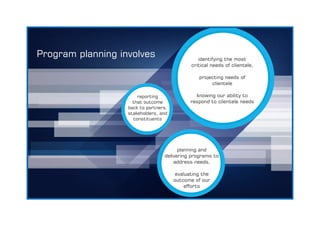
Program planning involves identifying the most
critical needs of clientele,
projecting needs of
clientele
knowing our ability to
respond to clientele needs
planning and
delivering programs to
address needs,
evaluating the
outcome of our
efforts
reporting
that outcome
back to partners,
stakeholders, and
constituents
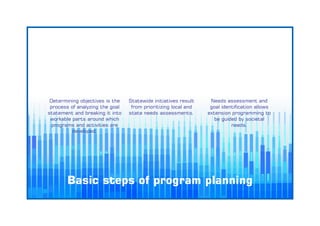
Basic steps of program planning
Needs assessment and
goal identication allows
extension programming to
be guided by societal
needs.
Statewide initiatives result
from prioritizing local and
state needs assessments.
Determining objectives is the
process of analyzing the goal
statement and breaking it into
workable parts around which
programs and activities are
developed.
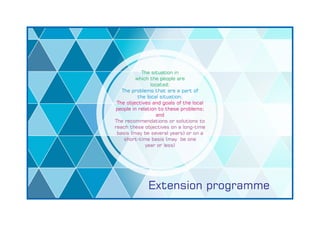
Extension programme
The situation in
which the people are
located;
The problems that are a part of
the local situation;
The objectives and goals of the local
people in relation to these problems;
and
The recommendations or solutions to
reach these objectives on a long-time
basis (may be several years) or on a
short-time basis (may be one
year or less)
Planning
The basic concept of planing appears
to be well accepted in our culture.
It is regarded as an integral and
important dimension of our culture's
rational value orientation.
Rational value orientation assumes a
conscious systematic approach to
problem solving, i.e., problem denition,
data gathering and choosing between
alternative ends and means on the basis
of predetermined criteria.
Assumptions on Extension Planning
Planning change is a
necessary prerequisite to
effective social progress
for people and
communities
The most desirable change is
predetermined and democratically
achieved.
Extension education programmes, if
properly planned and implemented, can
make a signicant contribution to
planned change.
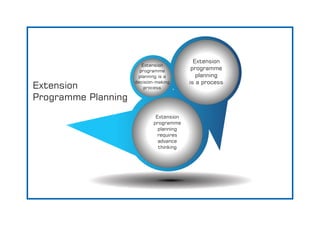
Extension
Programme Planning
Extension
programme
planning
is a process
Extension
programme
planning is a
decision-making
process
Extension
programme
planning
requires
advance
thinking
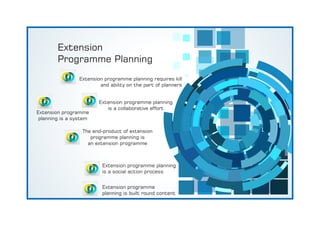
Extension
Programme Planning
Extension programme planning requires kill
and ability on the part of planners
Extension programme
planning is built round content
Extension programme planning
is a social action process
Extension programme planning
is a collaborative effort
Extension programme
planning is a system
The end-product of extension
programme planning is
an extension programme
Extension programme
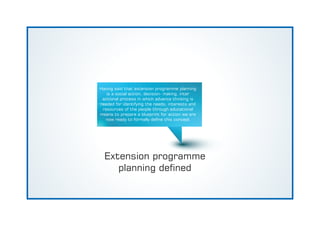
planning dened
Having said that extension programme planning
is a social action, decision- making, inter
actional process in which advance thinking is
needed for identifying the needs, interests and
resources of the people through educational
means to prepare a blueprint for action we are
now ready to formally dene this concept
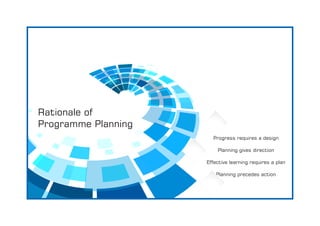
Rationale of
Programme Planning
Progress requires a design
Planning gives direction
Effective learning requires a plan
Planning precedes action
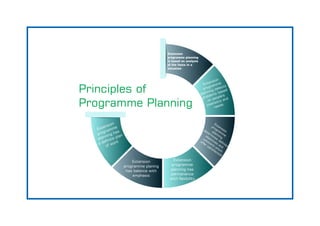
Principles of
Programme Planning
Extension
programme planning
is based on analysis
of the facts in a
situation
Extension
programme
planning selects
problems based
on people's
interests and
needs
Extension
programme
planning
determines
denite
objectives
and
solutions
which
offer satisfaction
Extension
programme
planning has
permanence
with exibility
Extension
programme planing
has balance with
emphasis
Extension
programme
planning has
a denite plan
of work
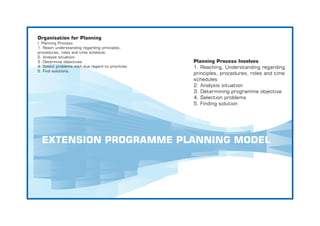
EXTENSION PROGRAMME PLANNING MODEL
Planning Process Involves
1. Reaching, Understanding regarding
principles, procedures, roles and time
schedules
2. Analysis situation
3. Determining programme objective
4. Selection problems
5. Finding solution
Organisation for Planning
I. Planning Process
1. Reach understanding regarding principles,
procedures, roles and time schedule.
2. Analyse situation.
3. Determine objectives.
4. Select problems with due regard to priorities.
5. Find solutions.
Select problems with
due regard to priorities
·Problems which can be solved by the
people themselves
with no outside nancial aid.
·Problems which can be solved by
the people with the aid of
the Panchayat Samiti
Problems which can only be
solved with the
help of Government funds
Planned Programme
As Leagans (1961) pointed out, it is of utmost
importance that the staff and the people in each
area not only develop an extension programme,
but also prepare the programme in a written
form that is readily understood and is suitable
for obtaining approval and use as a guide for
ofcials and non-ofcials.

Program Planning

  • 1.
    Submitted to: Dr. S.S. Bukhari PhD (usa); Post-doc (USA) Department of Agricultural Education Extension and Short Courses Faculty of Agricultural Social Sciences Sindh Agriculture University, Tandojam Course Code: AEE-604 Subject: Introduction to Programme Planning Submitted By: Salman Akber Chachar 2K11-SS-108 ASSIGNMENT Programme Planning
  • 2.
    Submitted to: Dr. S.S. Bukhari PhD (usa); Post-doc (USA) Department of Agricultural Education Extension and Short Courses Faculty of Agricultural Social Sciences Sindh Agriculture University, Tandojam Course Code: AEE-604 Subject: Introduction to Programme Planning Submitted By: Salman Akber Chachar 2K11-SS-108 PRACTICAL Programme Planning
  • 3.
    Submitted to: Dr. S.S. Bukhari PhD (usa); Post-doc (USA) Department of Agricultural Education Extension and Short Courses Faculty of Agricultural Social Sciences Sindh Agriculture University, Tandojam Course Code: AEE-604 Subject: Introduction to Programme Planning Submitted By: Salman Akber Chachar 2K11-SS-108 ASSIGNMENT Programme Planning Submitted to: Dr. S. S. Bukhari PhD (usa); Post-doc (USA) Department of Agricultural Education Extension and Short Courses Faculty of Agricultural Social Sciences Sindh Agriculture University, Tandojam Course Code: AEE-604 Subject: Introduction to Programme Planning Submitted By: Salman Akber Chachar 2K11-SS-108 PRACTICAL Programme Planning
  • 4.
    Program planning involvesidentifying the most critical needs of clientele, projecting needs of clientele knowing our ability to respond to clientele needs planning and delivering programs to address needs, evaluating the outcome of our efforts reporting that outcome back to partners, stakeholders, and constituents
  • 5.
    Basic steps ofprogram planning Needs assessment and goal identication allows extension programming to be guided by societal needs. Statewide initiatives result from prioritizing local and state needs assessments. Determining objectives is the process of analyzing the goal statement and breaking it into workable parts around which programs and activities are developed.
  • 6.
    Extension programme The situationin which the people are located; The problems that are a part of the local situation; The objectives and goals of the local people in relation to these problems; and The recommendations or solutions to reach these objectives on a long-time basis (may be several years) or on a short-time basis (may be one year or less)
  • 7.
    Planning The basic conceptof planing appears to be well accepted in our culture. It is regarded as an integral and important dimension of our culture's rational value orientation. Rational value orientation assumes a conscious systematic approach to problem solving, i.e., problem denition, data gathering and choosing between alternative ends and means on the basis of predetermined criteria.
  • 8.
    Assumptions on ExtensionPlanning Planning change is a necessary prerequisite to effective social progress for people and communities The most desirable change is predetermined and democratically achieved. Extension education programmes, if properly planned and implemented, can make a signicant contribution to planned change.
  • 9.
    Extension Programme Planning Extension programme planning is aprocess Extension programme planning is a decision-making process Extension programme planning requires advance thinking
  • 10.
    Extension Programme Planning Extension programmeplanning requires kill and ability on the part of planners Extension programme planning is built round content Extension programme planning is a social action process Extension programme planning is a collaborative effort Extension programme planning is a system The end-product of extension programme planning is an extension programme
  • 11.
    Extension programme planning dened Havingsaid that extension programme planning is a social action, decision- making, inter actional process in which advance thinking is needed for identifying the needs, interests and resources of the people through educational means to prepare a blueprint for action we are now ready to formally dene this concept
  • 12.
    Rationale of Programme Planning Progressrequires a design Planning gives direction Effective learning requires a plan Planning precedes action
  • 13.
    Principles of Programme Planning Extension programmeplanning is based on analysis of the facts in a situation Extension programme planning selects problems based on people's interests and needs Extension programme planning determines denite objectives and solutions which offer satisfaction Extension programme planning has permanence with exibility Extension programme planing has balance with emphasis Extension programme planning has a denite plan of work
  • 14.
    EXTENSION PROGRAMME PLANNINGMODEL Planning Process Involves 1. Reaching, Understanding regarding principles, procedures, roles and time schedules 2. Analysis situation 3. Determining programme objective 4. Selection problems 5. Finding solution Organisation for Planning I. Planning Process 1. Reach understanding regarding principles, procedures, roles and time schedule. 2. Analyse situation. 3. Determine objectives. 4. Select problems with due regard to priorities. 5. Find solutions.
  • 15.
    Select problems with dueregard to priorities ·Problems which can be solved by the people themselves with no outside nancial aid. ·Problems which can be solved by the people with the aid of the Panchayat Samiti Problems which can only be solved with the help of Government funds
  • 16.
    Planned Programme As Leagans(1961) pointed out, it is of utmost importance that the staff and the people in each area not only develop an extension programme, but also prepare the programme in a written form that is readily understood and is suitable for obtaining approval and use as a guide for ofcials and non-ofcials.