
Lecture 8
Extension Programs Planning
Dr/ Heba Nour el din Mohamed
is a written statement which contains the following four elements:
Objectives which the agent expects to be achieved in the area within a
specified period of time. This will often be a one-year period, to enable
the agent to review the program at the start of each farming year.
Means of achieving these objectives.
Resources that are needed to fulfil the program.
Work plan indicating the schedule of extension activities that will lead
to the fulfilment of the program objectives.
An extension program
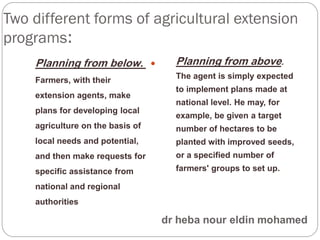
Two different forms of agricultural extension
:programs
.Planning from below
Farmers, with their
extension agents, make
plans for developing local
agriculture on the basis of
local needs and potential,
and then make requests for
specific assistance from
national and regional
authorities
Planning from above.
The agent is simply expected
to implement plans made at
national level. He may, for
example, be given a target
number of hectares to be
planted with improved seeds,
or a specified number of
farmers' groups to set up.
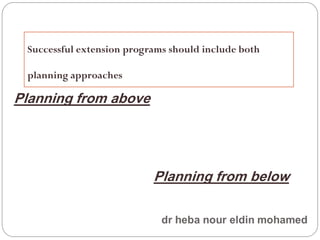
Successful extension programs should include both
planning approaches
Planning from below
Planning from above
. Advantages of Extension Program Planning are as
follows:
1. it makes the farmer to know what to expect when, how and
why
2. it forms the basis for planning for the extension agent.
3. it reveals the resource needed
4. it an instrument to use in justifying requests for resources.
5. it will enhance continuity.
6. it form the basis for evaluation.
7. it serves as a link for early co-ordination
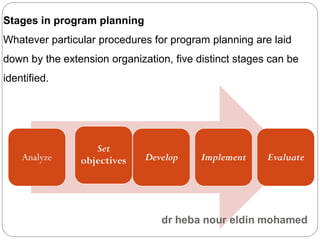
Stages in program planning
Whatever particular procedures for program planning are laid
down by the extension organization, five distinct stages can be
identified.
Analyze
Set
objectives Develop Implement Evaluate
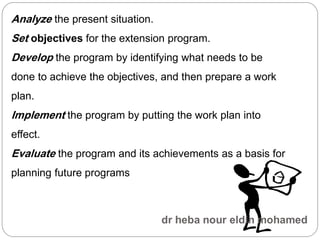
Analyze the present situation.
Set objectives for the extension program.
Develop the program by identifying what needs to be
done to achieve the objectives, and then prepare a work
plan.
Implement the program by putting the work plan into
effect.
Evaluate the program and its achievements as a basis for
planning future programs
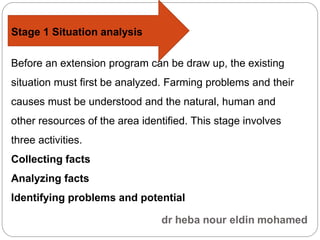
Before an extension program can be draw up, the existing
situation must first be analyzed. Farming problems and their
causes must be understood and the natural, human and
other resources of the area identified. This stage involves
three activities.
Collecting facts
Analyzing facts
Identifying problems and potential
Stage 1 Situation analysis
These facts can be collected from a variety of sources. Reports of soil
classification and land-use surveys, farm management studies, social surveys
and previous programs can provide a lot of useful background information. If
the agent keeps good records of the farms in his area, he will have at his
fingertips much of the information he needs. He can also obtain a lot of his
information from farmers and local leaders. At public meetings, in group
discussions and in contact with individual farmers, the agent should listen, ask
questions and gradually build up a fuller understanding of the social,
agricultural and economic features of the area.
Collecting facts
Analyzing facts
Facts do not speak for themselves. It is necessary to ask why things happen
in the way they do. If farmers report that yields have declined in recent
years, the agent must look for other information that would suggest an
explanation. Is it because of low rainfall, declining soil fertility, or poor seed?
The agent must also separate fact from opinion and guesswork. He may
obtain conflicting information from two different sources, and must judge
which is the more reliable
Identifying problems and potential
It should now be possible to decide what the main problems facing farmers in
the area are, and what potential there is for agricultural improvement. This is
where the agent's technical knowledge becomes important. Farmers may
know what their problems are, but the agent can bring his own perception of
local problems based on a more scientific understanding of farming. He will
be able to explain problems more fully and relate them to processes which
farmers may not realize are in any way connected. Because of his training
and experience, he will also have more suggestions to make about how the
resources of the area could be used more productively.
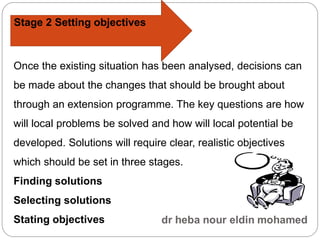
Once the existing situation has been analysed, decisions can
be made about the changes that should be brought about
through an extension programme. The key questions are how
will local problems be solved and how will local potential be
developed. Solutions will require clear, realistic objectives
which should be set in three stages.
Finding solutions
Selecting solutions
Stating objectives
Stage 2 Setting objectives
The sources of ideas for developing an area's potential
include:
- the agent's own technical knowledge;
- farmers and agents from other areas who have tackled
similar problems successfully;
- applied research which tests new ideas under farm
conditions;
- national priorities and directives;
- projects which make funds available for particular
activities.
Finding solutions
When selecting from among the range of solutions and possible
improvements, agent and farmers should ensure that proposed solutions
are:
Acceptable to farmers in the area.
Technically sound and tested by research and experience elsewhere.
Consistent with national policy, and with the local activities of other
agencies.
Feasible within the time and with the resources available to farmers and
the extension service.
Within the scope of the agent's ability and job description.
Selecting solutions
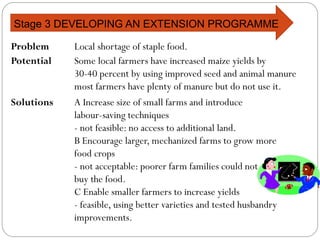
Stage 3 DEVELOPING AN EXTENSION PROGRAMME
Problem Local shortage of staple food.
Potential Some local farmers have increased maize yields by
30-40 percent by using improved seed and animal manure
most farmers have plenty of manure but do not use it.
Solutions A Increase size of small farms and introduce
labour-saving techniques
- not feasible: no access to additional land.
B Encourage larger, mechanized farms to grow more
food crops
- not acceptable: poorer farm families could not
buy the food.
C Enable smaller farmers to increase yields
- feasible, using better varieties and tested husbandry
improvements.
Preferred solution C
Objective Raise yields by 30 percent on 20 percent of the farms in
the area in the first year.
Intermediate
objectives
50 percent of farmers will learn of the benefits, and will
acquire the skill, of using manure.
50 percent of farmers will learn the benefits of new varieties.
20 percent of farmers will plant improved varieties.
Plan of work - Establish demonstration plots on ten farms.
- Hold public meetings and film shows in ten villages to
show the benefits of new varieties and improved
husbandry.
- Hold method demonstrations of manuring and correct
spacing at the appropriate times.
-Visit farms during planting season.
- Hold result demonstrations on selected plots to
encourage more farmers to try the new varieties and
practices next year.
Support needed - Subject-matter specialist to speak at public meetings,
attend demonstrations and answer farmers' questions.
-Adequate supplies of seeds, at the right time, at local
stores.
- Farm broadcasts to include relevant items at the
To implement the program, the agent carries out the activities
specified in the work plan. His detailed monthly and weekly
plans will take account of progress and problems encountered
in previous months. For example, the timing of some activities
may have to be changed, or additional method demonstrations
may be planned if more farmers than expected want to take
part. An extension program should be flexible enough to allow
the agent to respond to circumstances in this way.
Stage 4 Implementation
The agent will be constantly reviewing and evaluating his
progress during the year. At the end of the year, a more
thorough evaluation should be carried out in which the agent
identifies how fully each objective has been achieved, and the
reasons for any lack of progress. This evaluation, together
with an up-dated situation analysis, provides the basis for
planning the next year's program.
Stage 5 Evaluation

Extension Programs Planning

  • 1.
    Lecture 8 Extension ProgramsPlanning Dr/ Heba Nour el din Mohamed
  • 2.
    is a writtenstatement which contains the following four elements: Objectives which the agent expects to be achieved in the area within a specified period of time. This will often be a one-year period, to enable the agent to review the program at the start of each farming year. Means of achieving these objectives. Resources that are needed to fulfil the program. Work plan indicating the schedule of extension activities that will lead to the fulfilment of the program objectives. An extension program
  • 3.
    Two different formsof agricultural extension :programs .Planning from below Farmers, with their extension agents, make plans for developing local agriculture on the basis of local needs and potential, and then make requests for specific assistance from national and regional authorities Planning from above. The agent is simply expected to implement plans made at national level. He may, for example, be given a target number of hectares to be planted with improved seeds, or a specified number of farmers' groups to set up.
  • 4.
    Successful extension programsshould include both planning approaches Planning from below Planning from above
  • 5.
    . Advantages ofExtension Program Planning are as follows: 1. it makes the farmer to know what to expect when, how and why 2. it forms the basis for planning for the extension agent. 3. it reveals the resource needed 4. it an instrument to use in justifying requests for resources. 5. it will enhance continuity. 6. it form the basis for evaluation. 7. it serves as a link for early co-ordination
  • 6.
    Stages in programplanning Whatever particular procedures for program planning are laid down by the extension organization, five distinct stages can be identified. Analyze Set objectives Develop Implement Evaluate
  • 7.
    Analyze the presentsituation. Set objectives for the extension program. Develop the program by identifying what needs to be done to achieve the objectives, and then prepare a work plan. Implement the program by putting the work plan into effect. Evaluate the program and its achievements as a basis for planning future programs
  • 8.
    Before an extensionprogram can be draw up, the existing situation must first be analyzed. Farming problems and their causes must be understood and the natural, human and other resources of the area identified. This stage involves three activities. Collecting facts Analyzing facts Identifying problems and potential Stage 1 Situation analysis
  • 9.
    These facts canbe collected from a variety of sources. Reports of soil classification and land-use surveys, farm management studies, social surveys and previous programs can provide a lot of useful background information. If the agent keeps good records of the farms in his area, he will have at his fingertips much of the information he needs. He can also obtain a lot of his information from farmers and local leaders. At public meetings, in group discussions and in contact with individual farmers, the agent should listen, ask questions and gradually build up a fuller understanding of the social, agricultural and economic features of the area. Collecting facts
  • 10.
    Analyzing facts Facts donot speak for themselves. It is necessary to ask why things happen in the way they do. If farmers report that yields have declined in recent years, the agent must look for other information that would suggest an explanation. Is it because of low rainfall, declining soil fertility, or poor seed? The agent must also separate fact from opinion and guesswork. He may obtain conflicting information from two different sources, and must judge which is the more reliable
  • 11.
    Identifying problems andpotential It should now be possible to decide what the main problems facing farmers in the area are, and what potential there is for agricultural improvement. This is where the agent's technical knowledge becomes important. Farmers may know what their problems are, but the agent can bring his own perception of local problems based on a more scientific understanding of farming. He will be able to explain problems more fully and relate them to processes which farmers may not realize are in any way connected. Because of his training and experience, he will also have more suggestions to make about how the resources of the area could be used more productively.
  • 12.
    Once the existingsituation has been analysed, decisions can be made about the changes that should be brought about through an extension programme. The key questions are how will local problems be solved and how will local potential be developed. Solutions will require clear, realistic objectives which should be set in three stages. Finding solutions Selecting solutions Stating objectives Stage 2 Setting objectives
  • 13.
    The sources ofideas for developing an area's potential include: - the agent's own technical knowledge; - farmers and agents from other areas who have tackled similar problems successfully; - applied research which tests new ideas under farm conditions; - national priorities and directives; - projects which make funds available for particular activities. Finding solutions
  • 14.
    When selecting fromamong the range of solutions and possible improvements, agent and farmers should ensure that proposed solutions are: Acceptable to farmers in the area. Technically sound and tested by research and experience elsewhere. Consistent with national policy, and with the local activities of other agencies. Feasible within the time and with the resources available to farmers and the extension service. Within the scope of the agent's ability and job description. Selecting solutions
  • 15.
    Stage 3 DEVELOPINGAN EXTENSION PROGRAMME Problem Local shortage of staple food. Potential Some local farmers have increased maize yields by 30-40 percent by using improved seed and animal manure most farmers have plenty of manure but do not use it. Solutions A Increase size of small farms and introduce labour-saving techniques - not feasible: no access to additional land. B Encourage larger, mechanized farms to grow more food crops - not acceptable: poorer farm families could not buy the food. C Enable smaller farmers to increase yields - feasible, using better varieties and tested husbandry improvements.
  • 16.
    Preferred solution C ObjectiveRaise yields by 30 percent on 20 percent of the farms in the area in the first year. Intermediate objectives 50 percent of farmers will learn of the benefits, and will acquire the skill, of using manure. 50 percent of farmers will learn the benefits of new varieties. 20 percent of farmers will plant improved varieties. Plan of work - Establish demonstration plots on ten farms. - Hold public meetings and film shows in ten villages to show the benefits of new varieties and improved husbandry. - Hold method demonstrations of manuring and correct spacing at the appropriate times. -Visit farms during planting season. - Hold result demonstrations on selected plots to encourage more farmers to try the new varieties and practices next year. Support needed - Subject-matter specialist to speak at public meetings, attend demonstrations and answer farmers' questions. -Adequate supplies of seeds, at the right time, at local stores. - Farm broadcasts to include relevant items at the
  • 17.
    To implement theprogram, the agent carries out the activities specified in the work plan. His detailed monthly and weekly plans will take account of progress and problems encountered in previous months. For example, the timing of some activities may have to be changed, or additional method demonstrations may be planned if more farmers than expected want to take part. An extension program should be flexible enough to allow the agent to respond to circumstances in this way. Stage 4 Implementation
  • 18.
    The agent willbe constantly reviewing and evaluating his progress during the year. At the end of the year, a more thorough evaluation should be carried out in which the agent identifies how fully each objective has been achieved, and the reasons for any lack of progress. This evaluation, together with an up-dated situation analysis, provides the basis for planning the next year's program. Stage 5 Evaluation