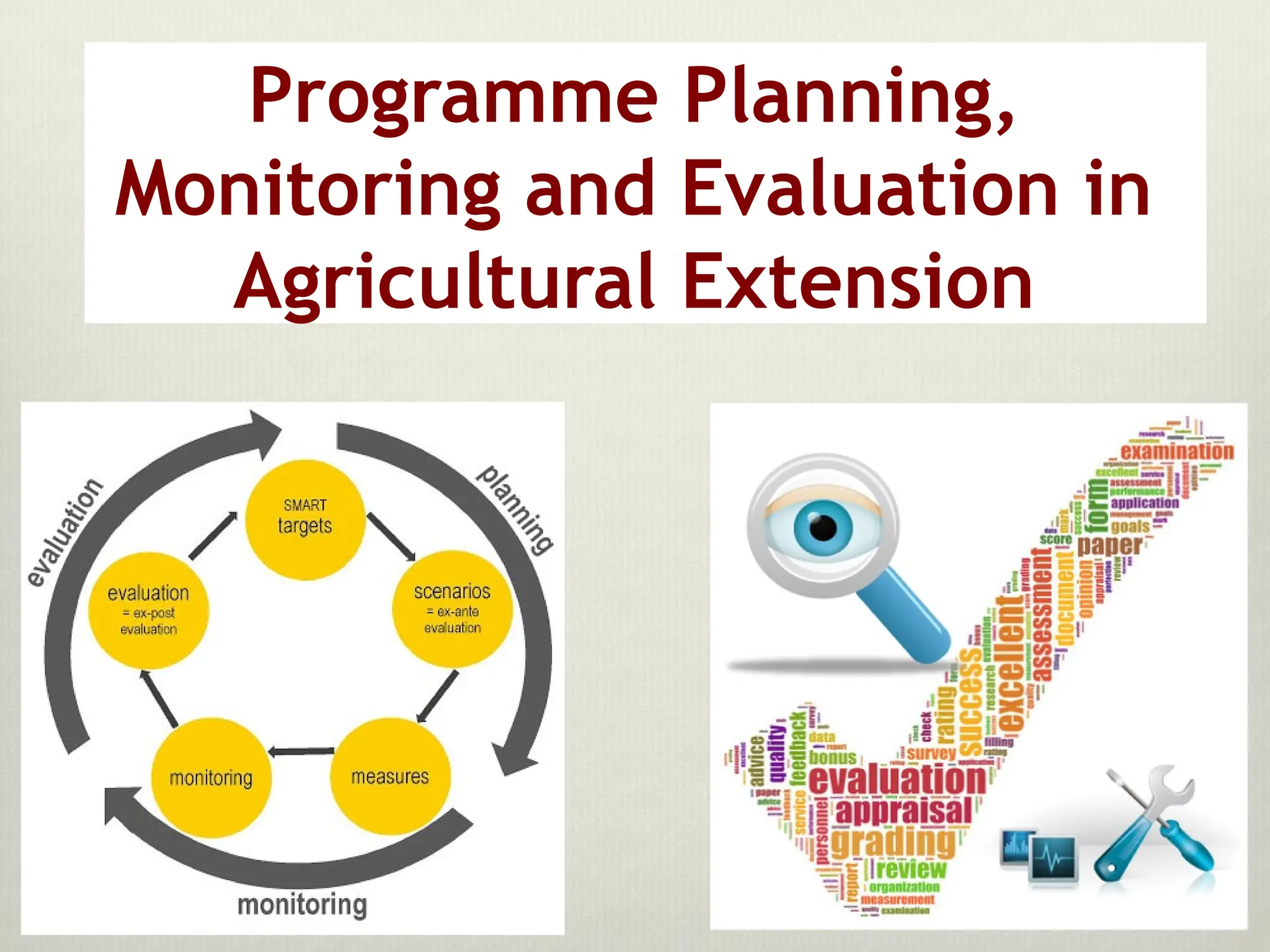
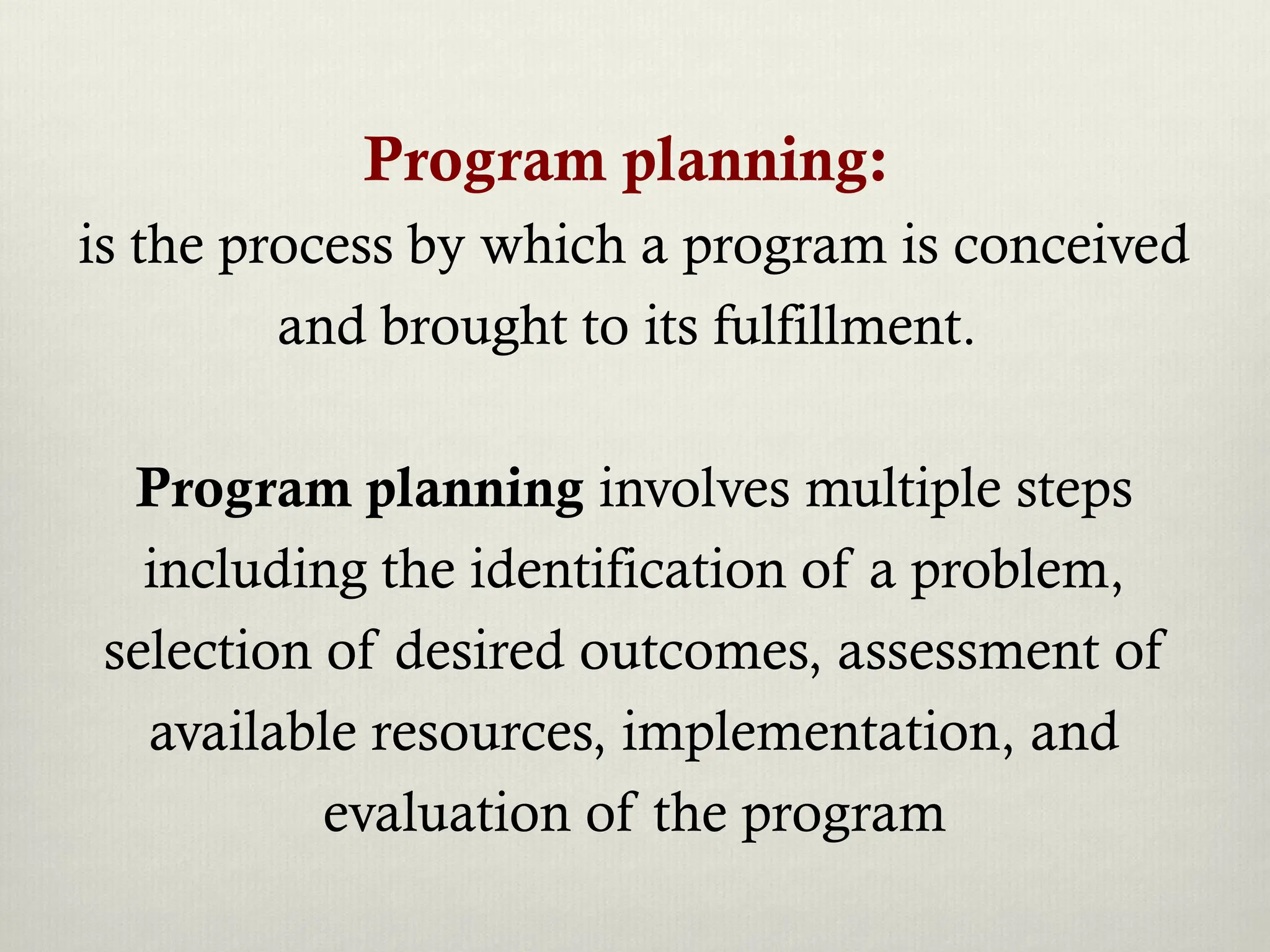
Programme Planning,
Monitoring and Evaluation in
Agricultural Extension
Planning
Planning is the process of thinking about the
activities required to achieve a desired goal. It is the
first and foremost activity to achieve desired results.
It involves the creation and maintenance of plan,
such as psychological aspects that require
conceptual skills.
Program planning:
is the process by which a program is conceived
and brought to its fulfillment.
Program planning involves multiple steps
including the identification of a problem,
selection of desired outcomes, assessment of
available resources, implementation, and
evaluation of the program
 PRINCIPLES OF PROGRAM PLANNING
 1:- Extension program should be based on past
experience, present situation and future needs:
 Adequate information about the people and their
situation have to be collected.
 Present situation is to be analyzed.
 Interpreted on the basis of past experiences.
 Help in arriving at the future needs.
 2:- Extension program should have clear objectives
based on needs of the people:
 Ultimate objective is to satisfy the needs of the people.
 Significant objectives pertaining to important needs of
the people.
 What is attainable rather than what is
ideal.
 3:- Extension program should be based on priority
considering available human and natural resources:
 Rural people have multitude of problems.
 All problems can not be taken up at a time for solution
because of
Limitation :
 Trained personnel
 Availability of funds.
 Facilities and other resources.
 Time.
 Wherefrom the funds, facilities, supplies and needed
personnel shall be available.
 How these shall be Utilized.
 Programme practical and workable.
4:- Extension program should clearly
define available resources and their
utilization:
 5:- Extension programme should have a some rules
and procedures at different level

 Extension programme prepared at levels should
conform to each other.
 Extension programme of a particular department
shouldnot be in conflict or
 contradiction with the extension programme of other
department.
 Local people should be involved:
 Programme formulation to
 Programme implementation level.
 6:- Extension Program should ensure participation of
local people
 Extension programmes implemented in isolation
 Requires the support of many institutions and
organizations to be involved.
 How they shall contribute in attaining the
programme.
 7:- Extension program should involve related
departments, institutions, and organizations
 8:- Extension program should have well
managed plan of work
 Plan of work may be separately drawn up or
incorporated in the programme.
 How it will be executed.
 Unless the plan of work is drawn up, the
programme remains a theoretical exercise.
 Not a static outline of activities.
 Periodical monitoring and evaluation of
results to judge its progress.
 On the basis of findings of evaluation,
programme should be suitably modified to
facilitate its reaching the objectives.
 9:- Extension program should use
evaluation procedures to analyse
results & to use for reconsideration
 Resource rich persons benefits more in
comparison to resource poor.
 Adequate emphasis on weaker section of the
society.

 10:- Extension program should ensure
equal benefits among community
members
 PROGRAM PLANNING PROCESS
① Collection of facts
② Analysis of situation
③ Identification of problems
④ Determination of objectives and goals
⑤ Development plan of work and calendar of
operations
⑥ Follow through plan of work and calendar of
operations.
⑦ Evaluation of progress.
⑧ Reconsideration and revision of the
programme
Program Planning Process
Collection
of facts
Identification
of problems
Determination
of objectives
and goals
Analysis
of
situation
Evaluation
of progress
Follow through
plan of work and
calendar of
operations
Development
plan of work and
calendar of
operations
Reconsideration and
revision of the
programme
 Starting point of programme planning
 Pertinent data may be collected from the
available records.
 Information: enterprise, levels of technology, facilities
and constraints, values etc.
 Collected from panchayats, cooperatives and other
organizations in the areas
 Data and information collected are then
analyzed with the local people
 Understanding the situation in a proper
way
 A proper analysis and interpretation of data
shall help in correctly identifying the
problems
 Only urgent and significant ones
 Which may be solved with the available
resources
 And with in the limits of time,
 should be selected and properly managed
 Objectives are then set forth on the basis of significant
need identified.
 Direct and clear needs
To make the objectives realistic and actionable:
 Go through the data and information analysis
 To find what could actually be done in existing situation,
 with the available resources and time
 Which will be compatible.
 Plan of work should be in written form and shall
indicate who shall do what job, what the change
agent system, client system shall do, which
institution, organizations, service department shall be
involved.
 Plan should have essential details and no important
point should be left out
 Calendar of operations shall be prepared on the basis
of plan of work
 Not a routine type of work.
 Training of participants, communication of
information, conducting
method demonstration, making regular visits
and monitoring are some important functions.
 Solving unforeseen problems and taking
corrective steps where needed.
 Evaluation is the process of determining the extent to
which we have been able to attain our objectives.
Evaluation has number of advantages:
 Help to establish a bench mark-the situation at the start of
the programme.
 Shows how far our plans have progressed.
 Whether we are proceeding in the right direction.
 Indicate the effectiveness of a programme.
 Help to locate strong and weak points in any programme
or plan.
 On the basis of results of evaluation, the
programme should be reconsidered and revised if
needed.
 This reconsideration should be done not only with
the participants but also with the scientists,
extension managers etc.
 The purpose of such an exercise is to make the
extension programme more effective removing the
defects.
MONITORING AND EVALUATION OF
EXTENSION PROGRAM
 Evaluation as applied to the field of extension education
defined as a process of systematic appraisal by which we
determine the value, worth or meaning of an activity or an
enterprise.
 Evaluation is a process by which the values of an enterprise
are ascertained or analyzed by which one is able to
understand and appreciate the relative merits or
deficiencies of persons, groups, programmes, situations,
method and processes.
 Supervising activities in progress to ensure they
are on-course and on-schedule in meeting the
objectives and performance targets.
 Monitoring and evaluation (M&E) is a process that
helps improve performance and achieve results.
 Its goal is to improve current and future
management of outputs, outcomes and impact.
 It is mainly used to assess the performance of
projects, institutions and programmes set up by
governments, international organizations and NGOs.
 It establishes links between the past, present and
future actions.
Self Evaluation:
 This is to be carried out every extension worker.
 This require self critical attitude which is essential for
extension worker.
 Chances of extension worker growing and continuously
improving his professional competency become greater.
Internal Evaluation:
 Evaluation
responsible
carried
for
to by the
the
planning
agency
and
implementation of the programme.
 Other methods are: Systematic use of diaries,
reports of workers, planned visit of staff
member, use of special questionnaire.
 External Evaluation: Evaluation conducted by
a person or a committee outside the area of
operation.
ensures that a program or
 Formative evaluation:
program activity
is
feasible, appropriate, and
acceptable before it is fully implemented. It is
usually conducted when a new program or activity is
being developed or when an existing one is being
adapted or modified.
 Process/implementation evaluation: determines
whether program activities have been implemented
as intended.
 Outcome evaluation: measures program effects in
the target population by assessing the progress in the
outcomes or outcome objectives that the program is
to achieve.
 Impact evaluation: assesses program effectiveness in
achieving its ultimate goals.

Monitoring, Planning and extension program planningpptx

  • 1.
    Programme Planning, Monitoring andEvaluation in Agricultural Extension
  • 2.
    Planning Planning is theprocess of thinking about the activities required to achieve a desired goal. It is the first and foremost activity to achieve desired results. It involves the creation and maintenance of plan, such as psychological aspects that require conceptual skills.
  • 3.
    Program planning: is theprocess by which a program is conceived and brought to its fulfillment. Program planning involves multiple steps including the identification of a problem, selection of desired outcomes, assessment of available resources, implementation, and evaluation of the program
  • 4.
     PRINCIPLES OFPROGRAM PLANNING
  • 5.
     1:- Extensionprogram should be based on past experience, present situation and future needs:  Adequate information about the people and their situation have to be collected.  Present situation is to be analyzed.  Interpreted on the basis of past experiences.  Help in arriving at the future needs.
  • 6.
     2:- Extensionprogram should have clear objectives based on needs of the people:  Ultimate objective is to satisfy the needs of the people.  Significant objectives pertaining to important needs of the people.  What is attainable rather than what is ideal.
  • 7.
     3:- Extensionprogram should be based on priority considering available human and natural resources:  Rural people have multitude of problems.  All problems can not be taken up at a time for solution because of Limitation :  Trained personnel  Availability of funds.  Facilities and other resources.  Time.
  • 8.
     Wherefrom thefunds, facilities, supplies and needed personnel shall be available.  How these shall be Utilized.  Programme practical and workable. 4:- Extension program should clearly define available resources and their utilization:
  • 9.
     5:- Extensionprogramme should have a some rules and procedures at different level   Extension programme prepared at levels should conform to each other.  Extension programme of a particular department shouldnot be in conflict or  contradiction with the extension programme of other department.
  • 10.
     Local peopleshould be involved:  Programme formulation to  Programme implementation level.  6:- Extension Program should ensure participation of local people
  • 11.
     Extension programmesimplemented in isolation  Requires the support of many institutions and organizations to be involved.  How they shall contribute in attaining the programme.  7:- Extension program should involve related departments, institutions, and organizations
  • 12.
     8:- Extensionprogram should have well managed plan of work  Plan of work may be separately drawn up or incorporated in the programme.  How it will be executed.  Unless the plan of work is drawn up, the programme remains a theoretical exercise.
  • 13.
     Not astatic outline of activities.  Periodical monitoring and evaluation of results to judge its progress.  On the basis of findings of evaluation, programme should be suitably modified to facilitate its reaching the objectives.  9:- Extension program should use evaluation procedures to analyse results & to use for reconsideration
  • 14.
     Resource richpersons benefits more in comparison to resource poor.  Adequate emphasis on weaker section of the society.   10:- Extension program should ensure equal benefits among community members
  • 15.
  • 16.
    ① Collection offacts ② Analysis of situation ③ Identification of problems ④ Determination of objectives and goals ⑤ Development plan of work and calendar of operations ⑥ Follow through plan of work and calendar of operations. ⑦ Evaluation of progress. ⑧ Reconsideration and revision of the programme
  • 17.
    Program Planning Process Collection offacts Identification of problems Determination of objectives and goals Analysis of situation Evaluation of progress Follow through plan of work and calendar of operations Development plan of work and calendar of operations Reconsideration and revision of the programme
  • 18.
     Starting pointof programme planning  Pertinent data may be collected from the available records.  Information: enterprise, levels of technology, facilities and constraints, values etc.  Collected from panchayats, cooperatives and other organizations in the areas
  • 19.
     Data andinformation collected are then analyzed with the local people  Understanding the situation in a proper way
  • 20.
     A properanalysis and interpretation of data shall help in correctly identifying the problems  Only urgent and significant ones  Which may be solved with the available resources  And with in the limits of time,  should be selected and properly managed
  • 21.
     Objectives arethen set forth on the basis of significant need identified.  Direct and clear needs To make the objectives realistic and actionable:  Go through the data and information analysis  To find what could actually be done in existing situation,  with the available resources and time  Which will be compatible.
  • 22.
     Plan ofwork should be in written form and shall indicate who shall do what job, what the change agent system, client system shall do, which institution, organizations, service department shall be involved.  Plan should have essential details and no important point should be left out  Calendar of operations shall be prepared on the basis of plan of work
  • 23.
     Not aroutine type of work.  Training of participants, communication of information, conducting method demonstration, making regular visits and monitoring are some important functions.  Solving unforeseen problems and taking corrective steps where needed.
  • 24.
     Evaluation isthe process of determining the extent to which we have been able to attain our objectives. Evaluation has number of advantages:  Help to establish a bench mark-the situation at the start of the programme.  Shows how far our plans have progressed.  Whether we are proceeding in the right direction.  Indicate the effectiveness of a programme.  Help to locate strong and weak points in any programme or plan.
  • 25.
     On thebasis of results of evaluation, the programme should be reconsidered and revised if needed.  This reconsideration should be done not only with the participants but also with the scientists, extension managers etc.  The purpose of such an exercise is to make the extension programme more effective removing the defects.
  • 26.
    MONITORING AND EVALUATIONOF EXTENSION PROGRAM
  • 27.
     Evaluation asapplied to the field of extension education defined as a process of systematic appraisal by which we determine the value, worth or meaning of an activity or an enterprise.  Evaluation is a process by which the values of an enterprise are ascertained or analyzed by which one is able to understand and appreciate the relative merits or deficiencies of persons, groups, programmes, situations, method and processes.
  • 28.
     Supervising activitiesin progress to ensure they are on-course and on-schedule in meeting the objectives and performance targets.
  • 29.
     Monitoring andevaluation (M&E) is a process that helps improve performance and achieve results.  Its goal is to improve current and future management of outputs, outcomes and impact.  It is mainly used to assess the performance of projects, institutions and programmes set up by governments, international organizations and NGOs.  It establishes links between the past, present and future actions.
  • 30.
    Self Evaluation:  Thisis to be carried out every extension worker.  This require self critical attitude which is essential for extension worker.  Chances of extension worker growing and continuously improving his professional competency become greater.
  • 31.
    Internal Evaluation:  Evaluation responsible carried for toby the the planning agency and implementation of the programme.  Other methods are: Systematic use of diaries, reports of workers, planned visit of staff member, use of special questionnaire.  External Evaluation: Evaluation conducted by a person or a committee outside the area of operation.
  • 32.
    ensures that aprogram or  Formative evaluation: program activity is feasible, appropriate, and acceptable before it is fully implemented. It is usually conducted when a new program or activity is being developed or when an existing one is being adapted or modified.  Process/implementation evaluation: determines whether program activities have been implemented as intended.  Outcome evaluation: measures program effects in the target population by assessing the progress in the outcomes or outcome objectives that the program is to achieve.  Impact evaluation: assesses program effectiveness in achieving its ultimate goals.