Growth of Extension
Dr. Debashis Dash
Ph.D. (Agricultural Extension and Communication)
GBPUA&T, Pantnagar
Email: debashis.agext@gmail.com
History of Growth of Extension
1867-68: 1st practical steps to give lectures to Women’s
Associations and Working Men’s Club by JAMES STEWATT
1866: Term EXTENSION was originated in England
1728:The first Society established for spread of academic
knowledge of agriculture through lectures and publications.
1862: Morril Act was passed to start educational opportunities
for working men. Land grant Colleges were established.
1875: Philadelphia Committee was established to give “Out of
School Education” to keep rural people in rural areas
1873,1876,1878: University Extension was accepted by
Cambridge University, London University and Oxford University
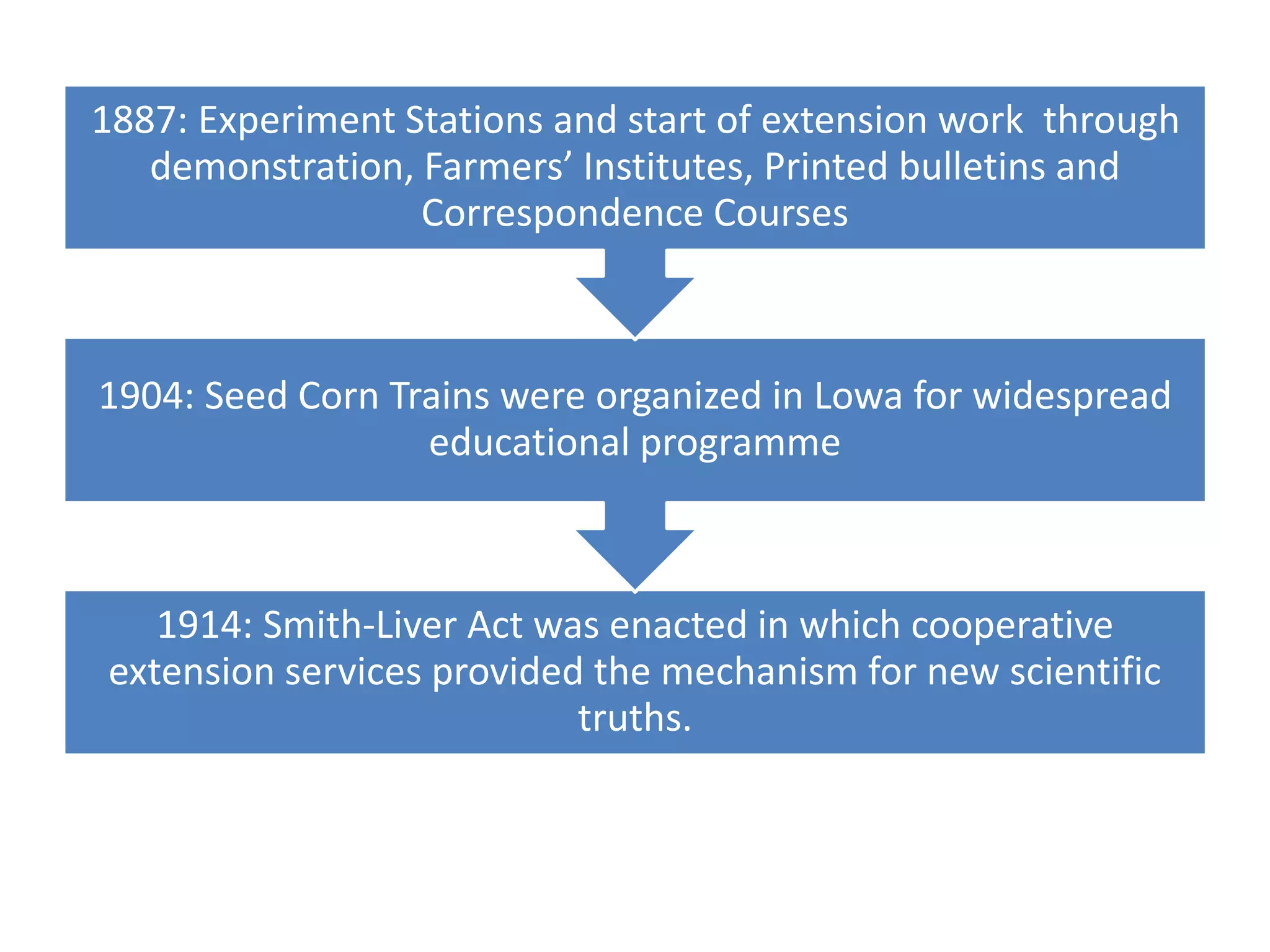
1914: Smith-Liver Act was enacted in which cooperative
extension services provided the mechanism for new scientific
truths.
1904: Seed Corn Trains were organized in Lowa for widespread
educational programme
1887: Experiment Stations and start of extension work through
demonstration, Farmers’ Institutes, Printed bulletins and
Correspondence Courses
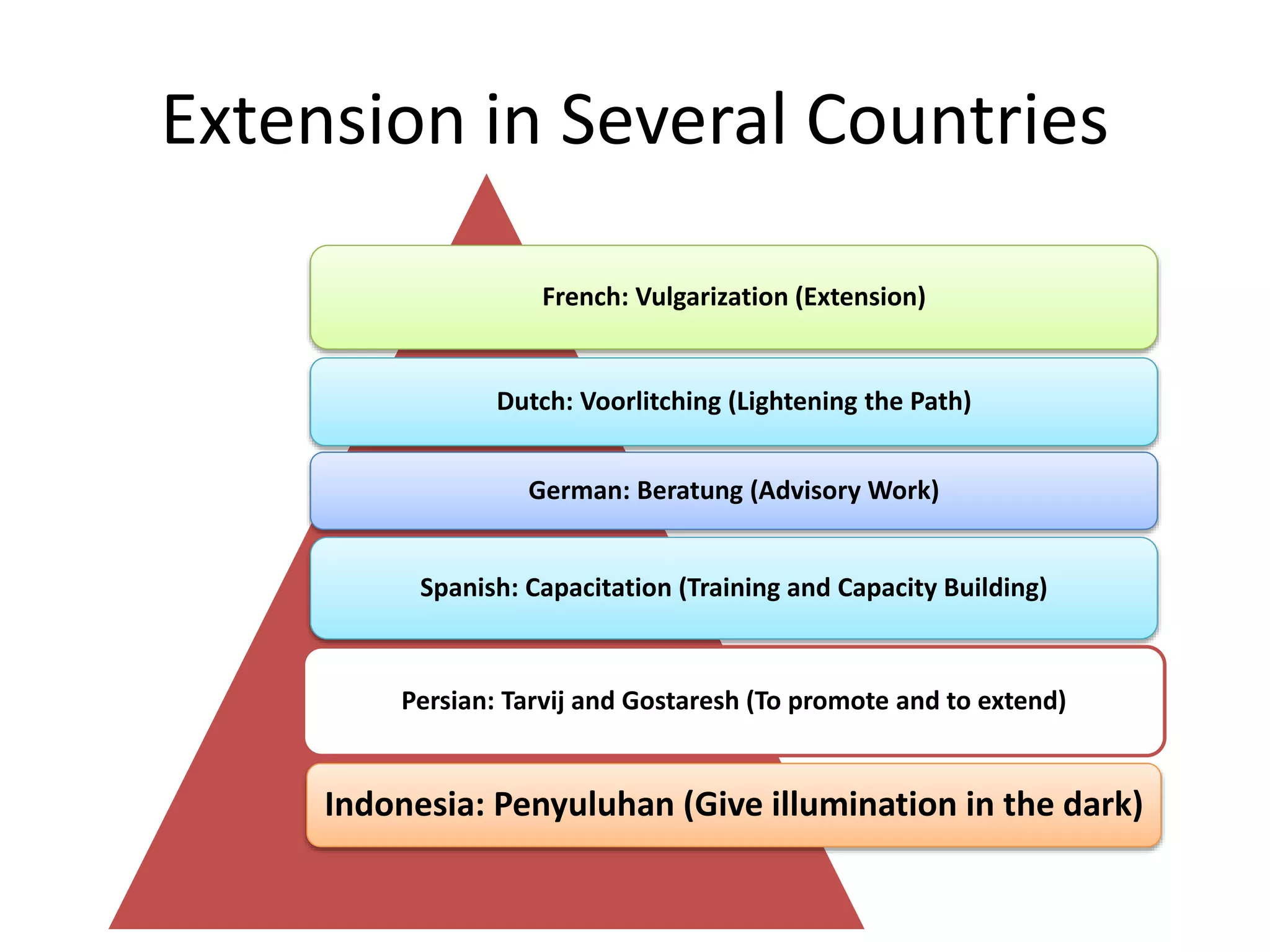
Extension in Several Countries
French: Vulgarization (Extension)
Dutch: Voorlitching (Lightening the Path)
German: Beratung (Advisory Work)
Spanish: Capacitation (Training and Capacity Building)
Persian: Tarvij and Gostaresh (To promote and to extend)
Indonesia: Penyuluhan (Give illumination in the dark)
Extension as:
Education
(Saville,1965;Mosher,1978;Supe,1983)
Communication
(Rolling,1986;Van den Ban and Hawkins,
1988)
Science
(Leagans,1961;Sinha,1972;Sinha,1980)
Extension as Education:
Out-of-School, Non-formal Education, Form of Adult Education and problem
oriented education.
Education has no shape. It reflects the characteristics of society.
Aim of Extension Education: Overall development of man through appropriate
technologies
Bringing desirable changes in human behaviour.
Emphasis on Learning by Doing
Voluntary in nature.
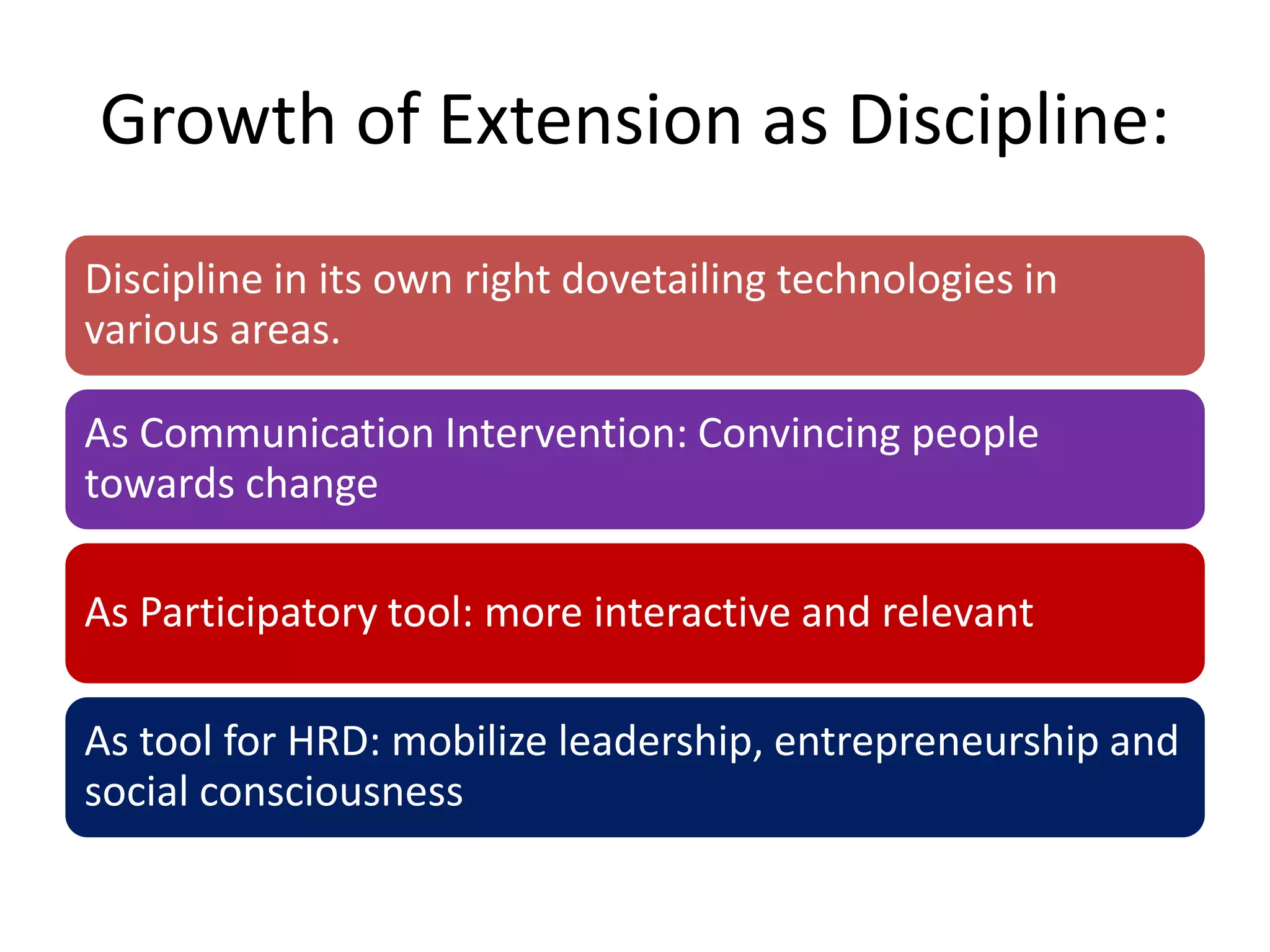
Growth of Extension as Discipline:
Discipline in its own right dovetailing technologies in
various areas.
As Communication Intervention: Convincing people
towards change
As Participatory tool: more interactive and relevant
As tool for HRD: mobilize leadership, entrepreneurship and
social consciousness
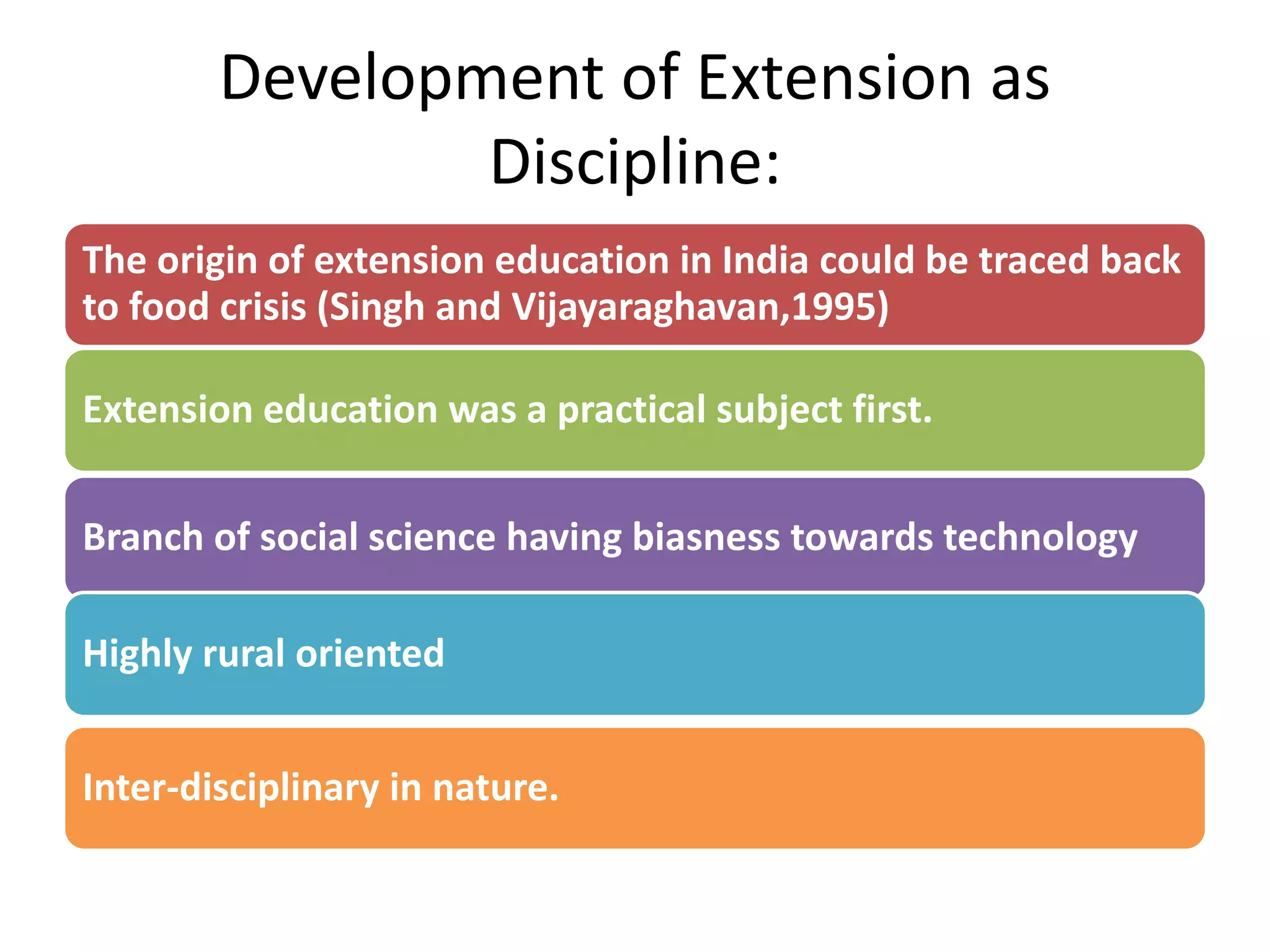
Development of Extension as
Discipline:
The origin of extension education in India could be traced back
to food crisis (Singh and Vijayaraghavan,1995)
Extension education was a practical subject first.
Branch of social science having biasness towards technology
Highly rural oriented
Inter-disciplinary in nature.
Development as Academic discipline in
India:
1st under
graduate
programme:
Kolkatta
1955: 1st
ever Post-
graduate
programme
started in
Bihar Agril.
college
(Sabour)
1958: Next
Post
graduate
programme
after Bihar
in Nagpur.
1961:Ph.D
programme
in I.A.R.I
was
initiated
1963: PAU
started
post-
graduation
and
doctorate
degree
programme
with trained
faculty from
abroad.
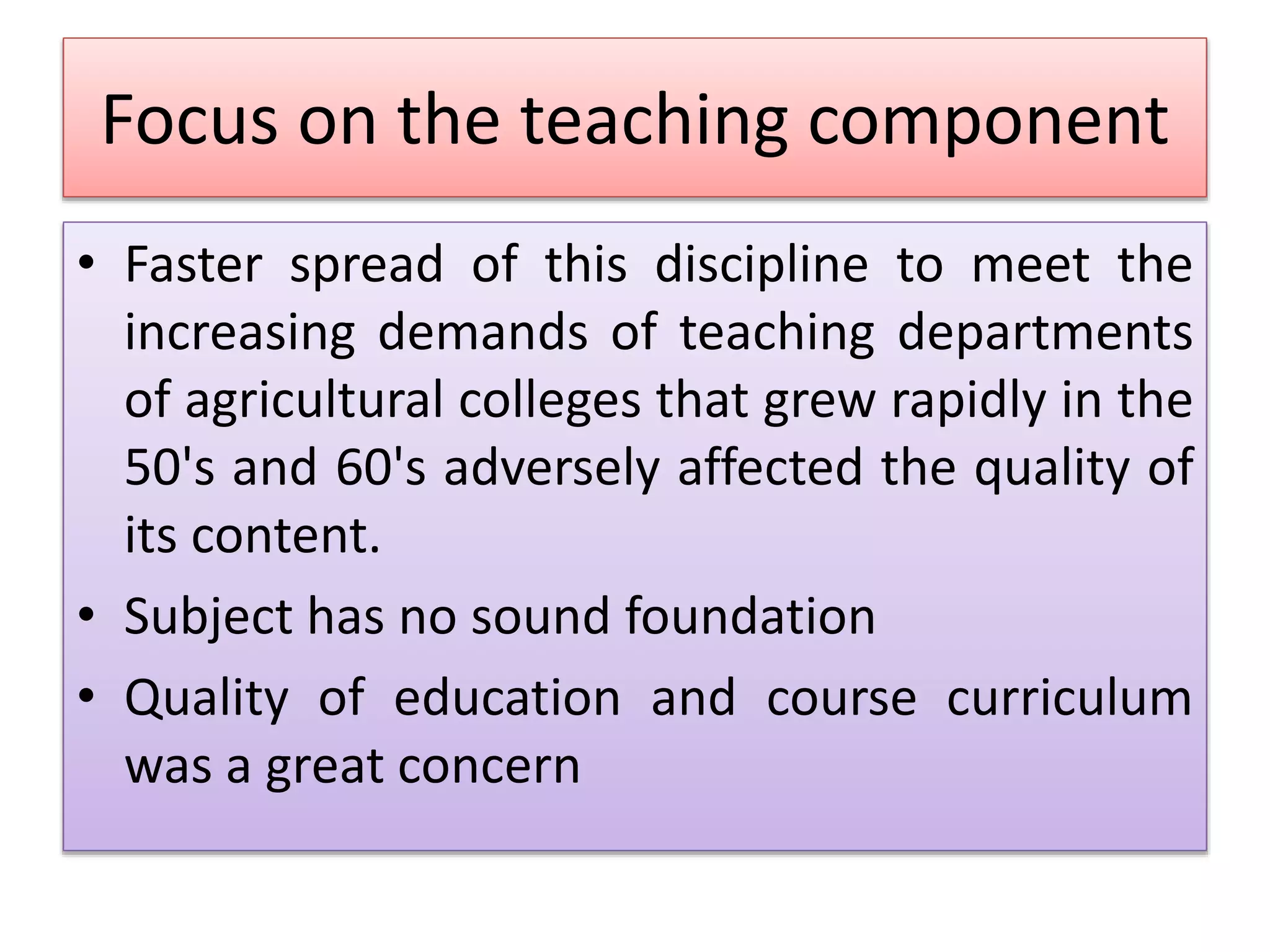
Focus on the teaching component
• Faster spread of this discipline to meet the
increasing demands of teaching departments
of agricultural colleges that grew rapidly in the
50's and 60's adversely affected the quality of
its content.
• Subject has no sound foundation
• Quality of education and course curriculum
was a great concern
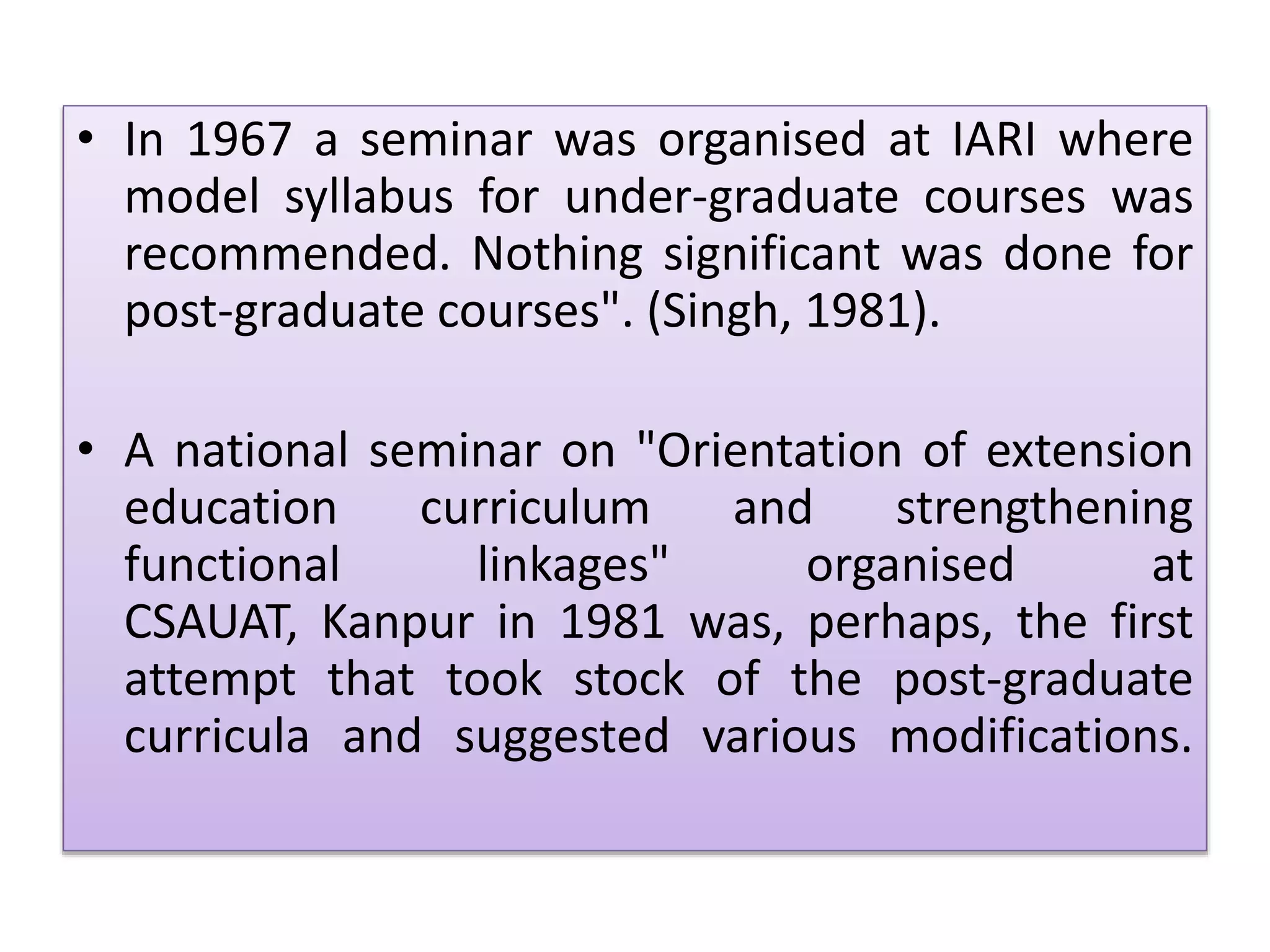
• In 1967 a seminar was organised at IARI where
model syllabus for under-graduate courses was
recommended. Nothing significant was done for
post-graduate courses". (Singh, 1981).
• A national seminar on "Orientation of extension
education curriculum and strengthening
functional linkages" organised at
CSAUAT, Kanpur in 1981 was, perhaps, the first
attempt that took stock of the post-graduate
curricula and suggested various modifications.
Researches highlighted:
Creswell and Martin (1993) examined the teaching
strategies perceived by agents to be effective for teaching
pesticide application courses. They found that agents tended
to limit their teaching to the use of a few strategies rather
than a wide variety.
Dollisso and Martin (1999) found that hands-on experience
was the most preferred strategy by farmers for learning,
while learning in groups was least preferred.
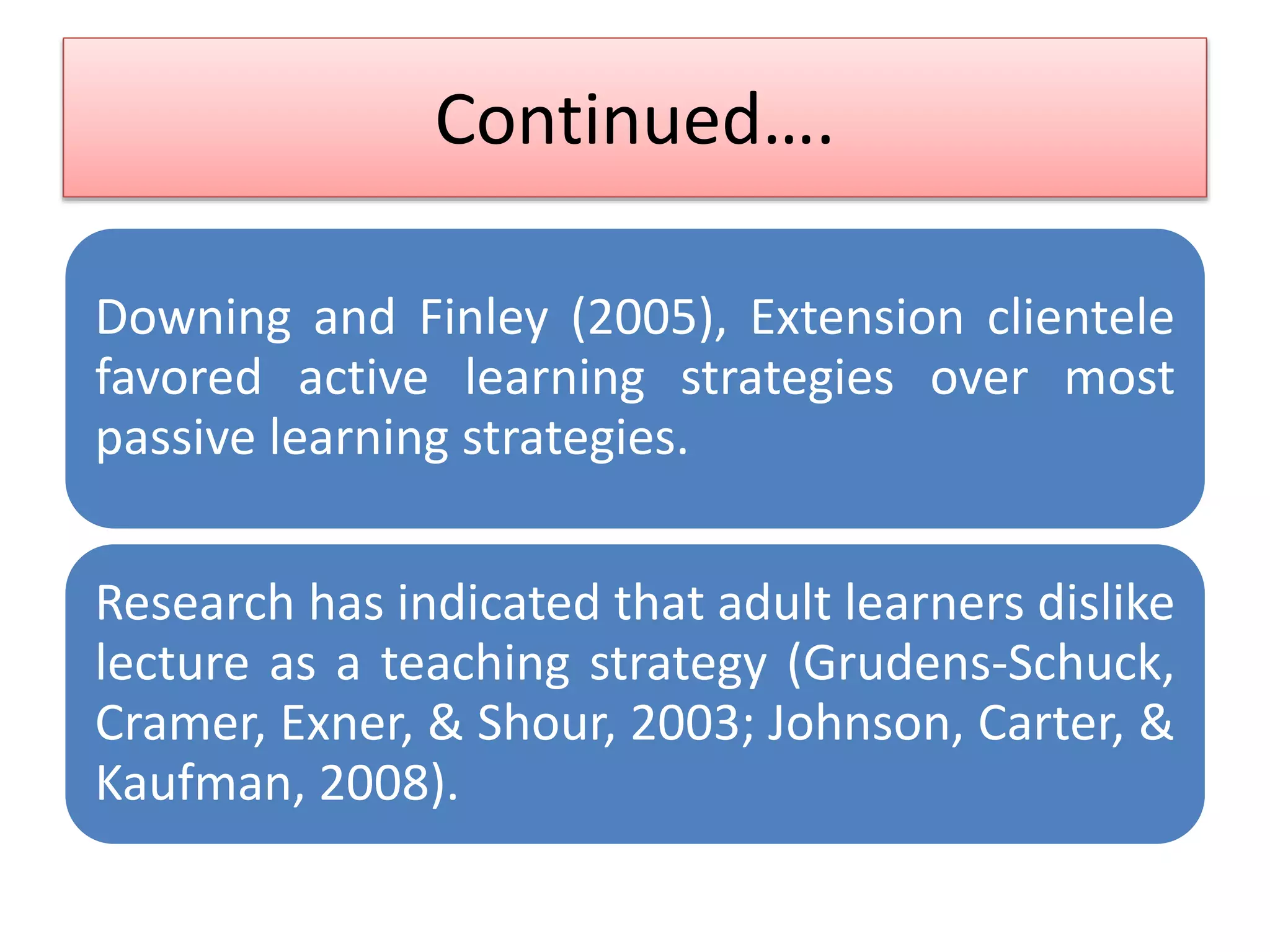
Continued….
Downing and Finley (2005), Extension clientele
favored active learning strategies over most
passive learning strategies.
Research has indicated that adult learners dislike
lecture as a teaching strategy (Grudens-Schuck,
Cramer, Exner, & Shour, 2003; Johnson, Carter, &
Kaufman, 2008).
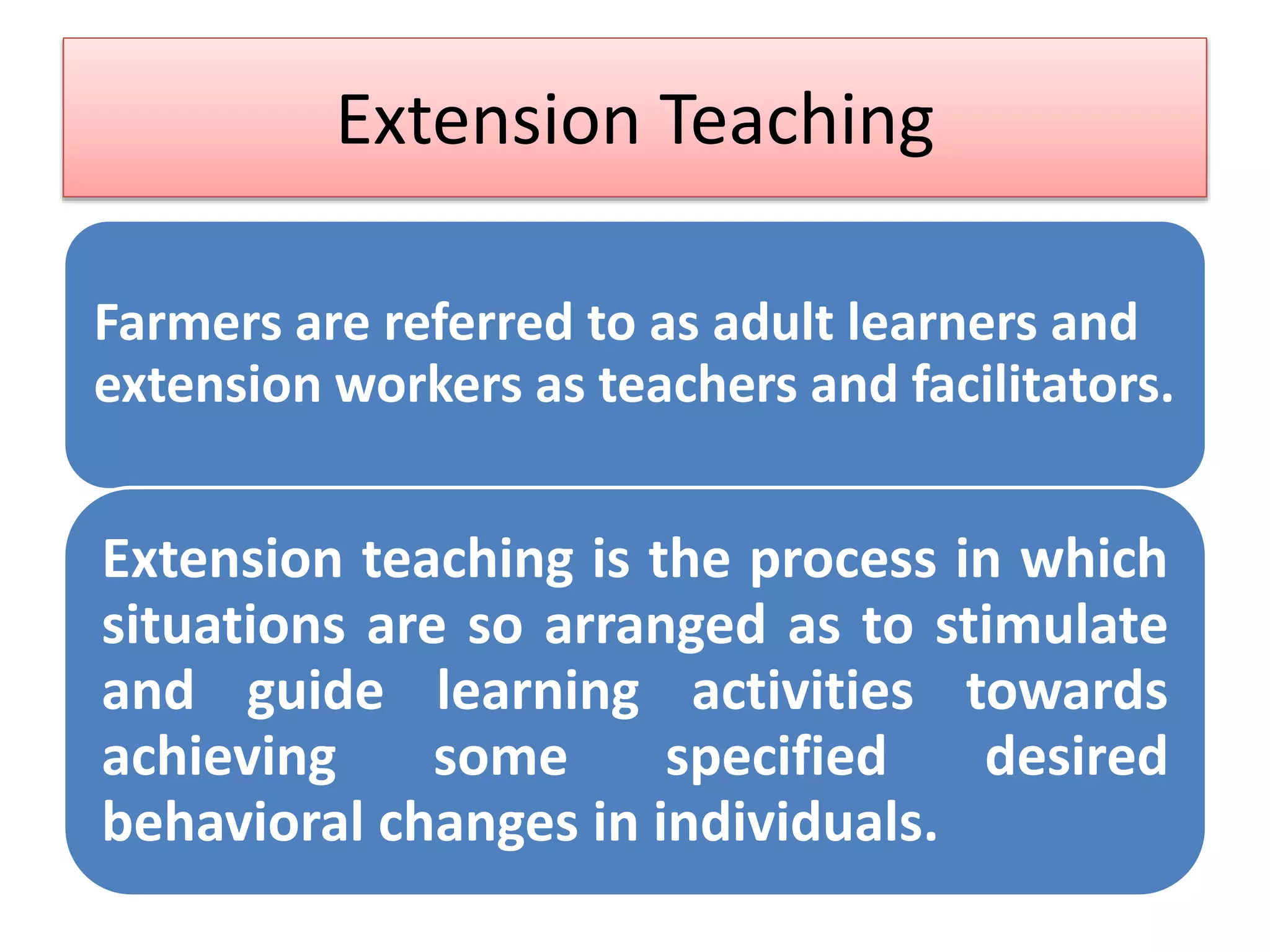
Extension Teaching
Farmers are referred to as adult learners and
extension workers as teachers and facilitators.
Extension teaching is the process in which
situations are so arranged as to stimulate
and guide learning activities towards
achieving some specified desired
behavioral changes in individuals.
EXTENSION TEACHING PROCESS
• Getting the ATTENTION of the learners.
• Stimulating the learners’ INTERESTS.
• Arousing the Learner’s DESIRE for Information.
• CONVINCING the Learner that he should act.
• Getting ACTION by the learner.
• Making certain that the learner derives
SATISFACTION from his action.
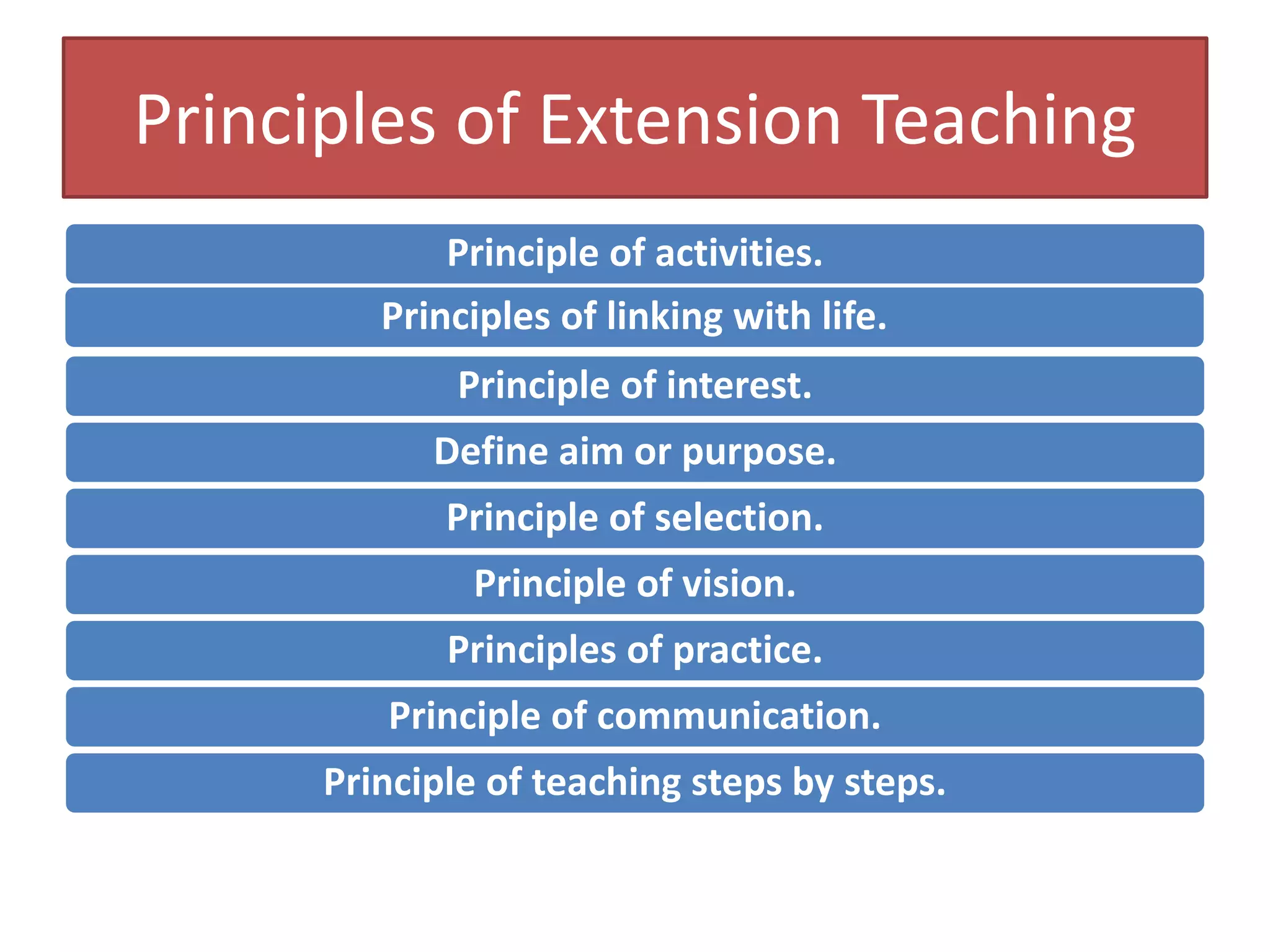
Principles of Extension Teaching
Principle of activities.
Principles of linking with life.
Principle of interest.
Define aim or purpose.
Principle of selection.
Principle of vision.
Principles of practice.
Principle of communication.
Principle of teaching steps by steps.
Procedure for Effective Teaching in
Extension Work
• Ensure VISIBILITY for all.
• Speaker should SPEAK CLEARLY.
• Always start with the present NEEDS AND
PROBLEMS of the farmers.
• Presentation should be LOGICAL in sequence.
• Use practical devices to show relationship
between ideas.
• REPEAT IDEAS being presented
• Make physical environment CONDUCIVE
• SUMMARIZE your presentation
Subject Matter Coverage in Master’s Level in 12 Universities
(APAU,AU,CSAUAT,IARI,IGKV,JNKV,KAU,OUAT,PAU,POKV,TNAU,T
NVASU) {REFERENCE:http://www.ncap.res.in}
• Extension Education
Fundamentals(concepts,Objectives,Principles)
• Rural Development Programmes
• Programme Planning and Evaluation
• Diffusion and Adoption of Innovations
• Group Dynamics
• Leadership
• Rural youth
• Communication Fundamentals
(models,types,elements etc)
• Extension Methods
• Audio-Visual Aids
• Photography
• Agricultural-Journalism
• Information Management
• Training for HRD
• Administration/Management
• Research methodology
• Sociology and Psychology
• Educational psychology
• Social Change
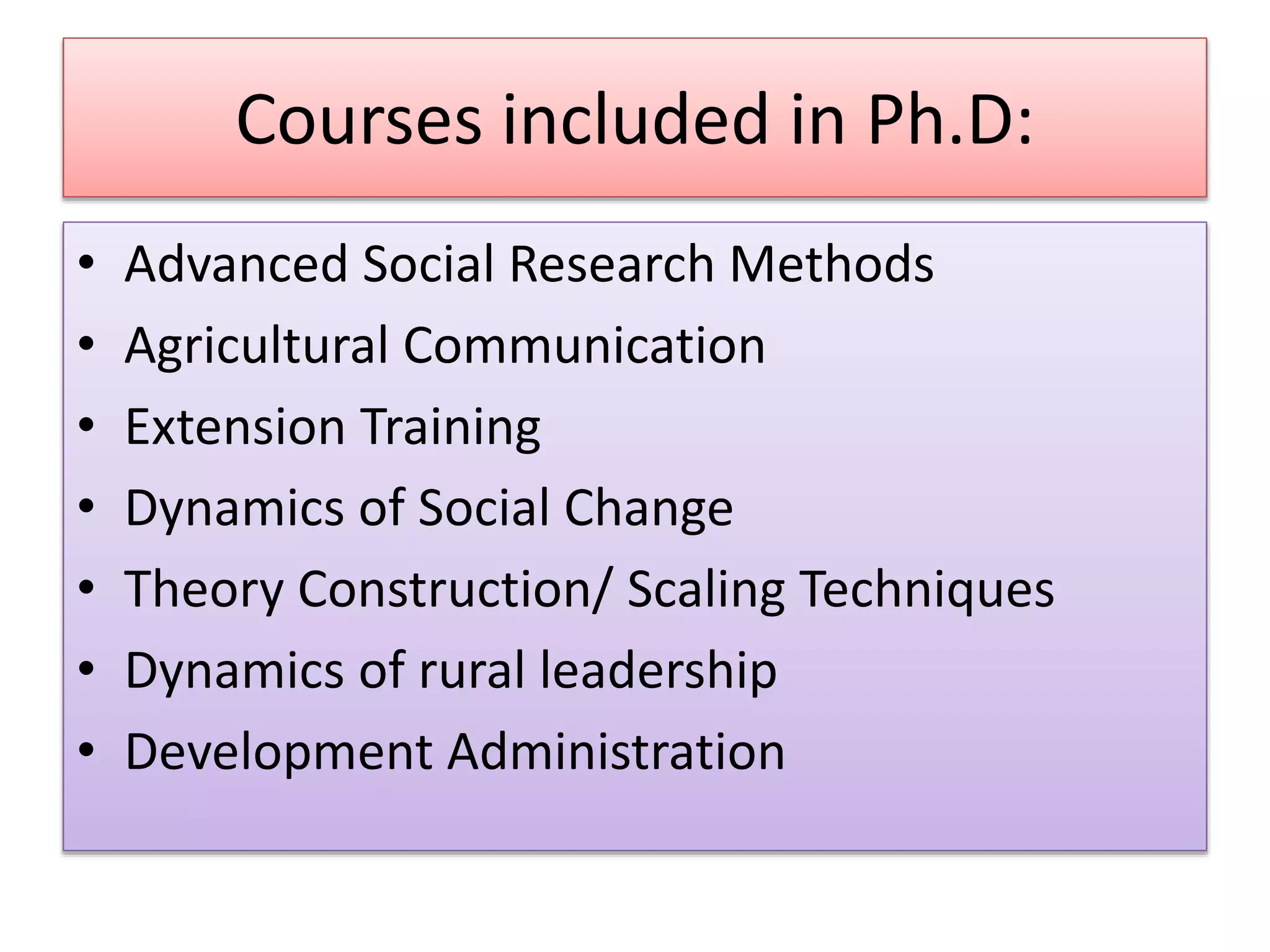
Courses included in Ph.D:
• Advanced Social Research Methods
• Agricultural Communication
• Extension Training
• Dynamics of Social Change
• Theory Construction/ Scaling Techniques
• Dynamics of rural leadership
• Development Administration
Gaps in Extension Teaching Curriculum
• Repetition of the UG curricula.
• Post-graduates in extension education have no
distinctive qualification to make him distinct as
they are not exposed to advanced training in
extension education.
• The extension content at the UG level are less
in programs such as veterinary, fisheries etc.
even within the same university compared to
agriculture.
CONT…..
• Lack of focus: static nature of the curriculum,
lack of a clear perception on the nature of
skills needed to tackle the emerging
professional needs and challenges.
• Absence of specialization in courses like
Extension management ,Development
communication, Human resource
management and training.
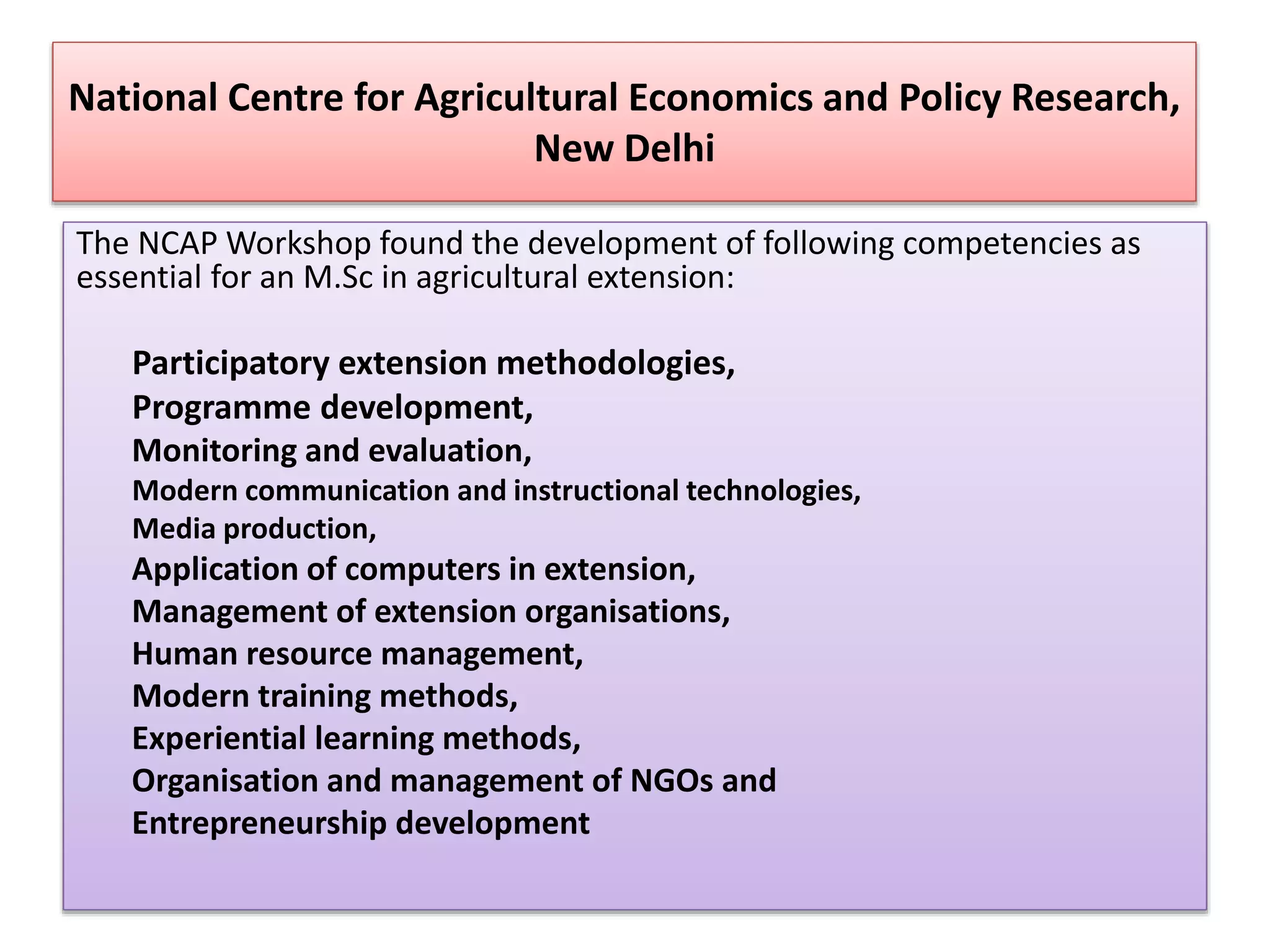
National Centre for Agricultural Economics and Policy Research,
New Delhi
The NCAP Workshop found the development of following competencies as
essential for an M.Sc in agricultural extension:
Participatory extension methodologies,
Programme development,
Monitoring and evaluation,
Modern communication and instructional technologies,
Media production,
Application of computers in extension,
Management of extension organisations,
Human resource management,
Modern training methods,
Experiential learning methods,
Organisation and management of NGOs and
Entrepreneurship development
CONCLUSION
• Improved farming technologies should be a
part of extension teaching.
• Training, multiple teaching tools and effective
management tools should be well developed.
• Continued adoption of best teaching practices
available.
• Hands on experiences should be incorporated
into the educational programme.
THANKS

Stages of growth of extension

  • 1.
    Growth of Extension Dr.Debashis Dash Ph.D. (Agricultural Extension and Communication) GBPUA&T, Pantnagar Email: debashis.agext@gmail.com
  • 2.
    History of Growthof Extension 1867-68: 1st practical steps to give lectures to Women’s Associations and Working Men’s Club by JAMES STEWATT 1866: Term EXTENSION was originated in England 1728:The first Society established for spread of academic knowledge of agriculture through lectures and publications.
  • 3.
    1862: Morril Actwas passed to start educational opportunities for working men. Land grant Colleges were established. 1875: Philadelphia Committee was established to give “Out of School Education” to keep rural people in rural areas 1873,1876,1878: University Extension was accepted by Cambridge University, London University and Oxford University
  • 4.
    1914: Smith-Liver Actwas enacted in which cooperative extension services provided the mechanism for new scientific truths. 1904: Seed Corn Trains were organized in Lowa for widespread educational programme 1887: Experiment Stations and start of extension work through demonstration, Farmers’ Institutes, Printed bulletins and Correspondence Courses
  • 5.
    Extension in SeveralCountries French: Vulgarization (Extension) Dutch: Voorlitching (Lightening the Path) German: Beratung (Advisory Work) Spanish: Capacitation (Training and Capacity Building) Persian: Tarvij and Gostaresh (To promote and to extend) Indonesia: Penyuluhan (Give illumination in the dark)
  • 6.
    Extension as: Education (Saville,1965;Mosher,1978;Supe,1983) Communication (Rolling,1986;Van denBan and Hawkins, 1988) Science (Leagans,1961;Sinha,1972;Sinha,1980)
  • 7.
    Extension as Education: Out-of-School,Non-formal Education, Form of Adult Education and problem oriented education. Education has no shape. It reflects the characteristics of society. Aim of Extension Education: Overall development of man through appropriate technologies Bringing desirable changes in human behaviour. Emphasis on Learning by Doing Voluntary in nature.
  • 8.
    Growth of Extensionas Discipline: Discipline in its own right dovetailing technologies in various areas. As Communication Intervention: Convincing people towards change As Participatory tool: more interactive and relevant As tool for HRD: mobilize leadership, entrepreneurship and social consciousness
  • 9.
    Development of Extensionas Discipline: The origin of extension education in India could be traced back to food crisis (Singh and Vijayaraghavan,1995) Extension education was a practical subject first. Branch of social science having biasness towards technology Highly rural oriented Inter-disciplinary in nature.
  • 10.
    Development as Academicdiscipline in India: 1st under graduate programme: Kolkatta 1955: 1st ever Post- graduate programme started in Bihar Agril. college (Sabour) 1958: Next Post graduate programme after Bihar in Nagpur. 1961:Ph.D programme in I.A.R.I was initiated 1963: PAU started post- graduation and doctorate degree programme with trained faculty from abroad.
  • 11.
    Focus on theteaching component • Faster spread of this discipline to meet the increasing demands of teaching departments of agricultural colleges that grew rapidly in the 50's and 60's adversely affected the quality of its content. • Subject has no sound foundation • Quality of education and course curriculum was a great concern
  • 12.
    • In 1967a seminar was organised at IARI where model syllabus for under-graduate courses was recommended. Nothing significant was done for post-graduate courses". (Singh, 1981). • A national seminar on "Orientation of extension education curriculum and strengthening functional linkages" organised at CSAUAT, Kanpur in 1981 was, perhaps, the first attempt that took stock of the post-graduate curricula and suggested various modifications.
  • 13.
    Researches highlighted: Creswell andMartin (1993) examined the teaching strategies perceived by agents to be effective for teaching pesticide application courses. They found that agents tended to limit their teaching to the use of a few strategies rather than a wide variety. Dollisso and Martin (1999) found that hands-on experience was the most preferred strategy by farmers for learning, while learning in groups was least preferred.
  • 14.
    Continued…. Downing and Finley(2005), Extension clientele favored active learning strategies over most passive learning strategies. Research has indicated that adult learners dislike lecture as a teaching strategy (Grudens-Schuck, Cramer, Exner, & Shour, 2003; Johnson, Carter, & Kaufman, 2008).
  • 15.
    Extension Teaching Farmers arereferred to as adult learners and extension workers as teachers and facilitators. Extension teaching is the process in which situations are so arranged as to stimulate and guide learning activities towards achieving some specified desired behavioral changes in individuals.
  • 16.
    EXTENSION TEACHING PROCESS •Getting the ATTENTION of the learners. • Stimulating the learners’ INTERESTS. • Arousing the Learner’s DESIRE for Information. • CONVINCING the Learner that he should act. • Getting ACTION by the learner. • Making certain that the learner derives SATISFACTION from his action.
  • 17.
    Principles of ExtensionTeaching Principle of activities. Principles of linking with life. Principle of interest. Define aim or purpose. Principle of selection. Principle of vision. Principles of practice. Principle of communication. Principle of teaching steps by steps.
  • 18.
    Procedure for EffectiveTeaching in Extension Work • Ensure VISIBILITY for all. • Speaker should SPEAK CLEARLY. • Always start with the present NEEDS AND PROBLEMS of the farmers. • Presentation should be LOGICAL in sequence. • Use practical devices to show relationship between ideas. • REPEAT IDEAS being presented • Make physical environment CONDUCIVE • SUMMARIZE your presentation
  • 19.
    Subject Matter Coveragein Master’s Level in 12 Universities (APAU,AU,CSAUAT,IARI,IGKV,JNKV,KAU,OUAT,PAU,POKV,TNAU,T NVASU) {REFERENCE:http://www.ncap.res.in} • Extension Education Fundamentals(concepts,Objectives,Principles) • Rural Development Programmes • Programme Planning and Evaluation • Diffusion and Adoption of Innovations • Group Dynamics • Leadership • Rural youth
  • 20.
    • Communication Fundamentals (models,types,elementsetc) • Extension Methods • Audio-Visual Aids • Photography • Agricultural-Journalism • Information Management • Training for HRD
  • 21.
    • Administration/Management • Researchmethodology • Sociology and Psychology • Educational psychology • Social Change
  • 22.
    Courses included inPh.D: • Advanced Social Research Methods • Agricultural Communication • Extension Training • Dynamics of Social Change • Theory Construction/ Scaling Techniques • Dynamics of rural leadership • Development Administration
  • 23.
    Gaps in ExtensionTeaching Curriculum • Repetition of the UG curricula. • Post-graduates in extension education have no distinctive qualification to make him distinct as they are not exposed to advanced training in extension education. • The extension content at the UG level are less in programs such as veterinary, fisheries etc. even within the same university compared to agriculture.
  • 24.
    CONT….. • Lack offocus: static nature of the curriculum, lack of a clear perception on the nature of skills needed to tackle the emerging professional needs and challenges. • Absence of specialization in courses like Extension management ,Development communication, Human resource management and training.
  • 25.
    National Centre forAgricultural Economics and Policy Research, New Delhi The NCAP Workshop found the development of following competencies as essential for an M.Sc in agricultural extension: Participatory extension methodologies, Programme development, Monitoring and evaluation, Modern communication and instructional technologies, Media production, Application of computers in extension, Management of extension organisations, Human resource management, Modern training methods, Experiential learning methods, Organisation and management of NGOs and Entrepreneurship development
  • 26.
    CONCLUSION • Improved farmingtechnologies should be a part of extension teaching. • Training, multiple teaching tools and effective management tools should be well developed. • Continued adoption of best teaching practices available. • Hands on experiences should be incorporated into the educational programme.
  • 27.