Course: Dimensions of Agricultural
Extension
Dr. Arpita Sharma
Assistant Professor,
GBPUA&T, Pantnagar
 An Extension programme
 is a statement of
Situation, objectives, problems and
solutions.
 Is a set of clearly defined, consciously
conceived objectives or ends derived from an
adequate analysis of the situation, which are
to be achieved through extension teaching
activities.
 An extension programme is arrived at co-
operatively by the local people and the
extension staff and includes a statement of :
 The situation in which the people are
located.
 The problems that are a part of the local
situation.
 The objectives and goal of the local people
in relation to these problems.
 The recommendations or solutions to reach
these objectives on along time basis or on a
short time basis.
 Planning is designing courses of action to achieve
ends.
 Planning is a progressive step by step process.
It is never completed.
 Social planning has been defined as a conscious,
collaborative, interactional process combining
investigation, discussion, agreement and
action in order to achieve the conditions,
relationship and values regarded as desirable.
 The concept of extension planning is based
on a number of assumptions. Boyle (1965)
has listed the following assumptions in this
regards:
 Planning is a necessary prerequisite for
social progress of people and communities.
 The most desirable change is predetermined
and democratically achieved.
 People and communities need the guidance,
leadership and help of extension educators
to solve their problems in a planned and
systematic way.
 Programme planning is viewed as a process through which
representatives of the people are intensively involved with
extension personnel and other professional people in four
activities (Boyle, 1965).
 Studying facts and trends.
 Identifying problems and opportunities based on these
facts and trends.
 Making decisions about problems and opportunities that
should be given priority and
 Establishing objectives and recommendations for future
economic and social development of a community through
educational programmes.
 Extension programme planning is a process.
 Extension programme planning is a decision
making process.
 Extension programme planning requires
advance thinking.
 Extension programme planning requires skill
and ability on the part of planners.
 Extension programme planning is social
action process.
 Extension programme planning is
collaborative efforts.
 Extension programme planning is system.
 The end product of Extension programme
planning is an extension programme.
 Adequate information about the people and
their situation have to be collected.
 Present situation is to be analyzed.
 Interpreted on the basis of past experiences.
 Help in arriving at the future needs.
 Ultimate objective is to satisfy the needs of
the people.
 Significant objectives pertaining to
important needs of the people.
 What is attainable rather than what is
ideal.
 Rural people have multitude of problems.
 All problems can not be taken up at a time
for solution because of
Limitation :
 Trained personnel
 Availability of funds.
 Facilities and other resources.
 Time.
 Wherefrom the funds, facilities, supplies
and needed personnel shall be available.
 How these shall be Utilized.
 Programme practical and workable.
 Extension programme prepared at various
levels should conform to each other.
 Extension programme of a particular
department should not be in conflict or
contradiction with the extension programme
of other department.
 Local people should be involved:
 Programme formulation to
 Programme implementation level.
 Extension programmes can not be
implemented in isolation.
 Requires the support of many institutions
and organizations to be involved.
 How they shall contribute in attaining the
programme.
 Plan of work may be separately drawn up or
incorporated in the programme.
 How it will be executed.
 Unless the plan of work is drawn up, the
programme remains a theoretical exercise.
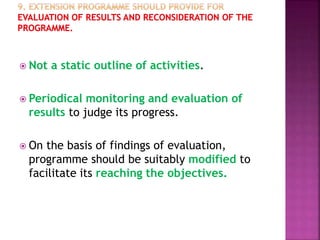
 Not a static outline of activities.
 Periodical monitoring and evaluation of
results to judge its progress.
 On the basis of findings of evaluation,
programme should be suitably modified to
facilitate its reaching the objectives.
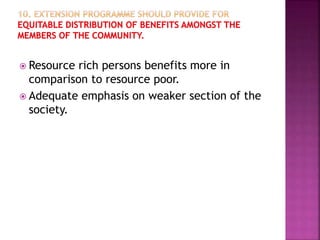
 Resource rich persons benefits more in
comparison to resource poor.
 Adequate emphasis on weaker section of the
society.
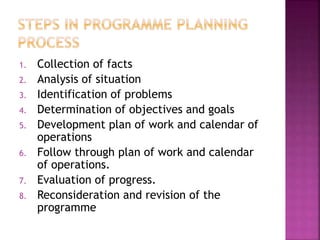
1. Collection of facts
2. Analysis of situation
3. Identification of problems
4. Determination of objectives and goals
5. Development plan of work and calendar of
operations
6. Follow through plan of work and calendar
of operations.
7. Evaluation of progress.
8. Reconsideration and revision of the
programme

Extension Programme Planning

  • 1.
    Course: Dimensions ofAgricultural Extension Dr. Arpita Sharma Assistant Professor, GBPUA&T, Pantnagar
  • 2.
     An Extensionprogramme  is a statement of Situation, objectives, problems and solutions.  Is a set of clearly defined, consciously conceived objectives or ends derived from an adequate analysis of the situation, which are to be achieved through extension teaching activities.
  • 3.
     An extensionprogramme is arrived at co- operatively by the local people and the extension staff and includes a statement of :  The situation in which the people are located.  The problems that are a part of the local situation.  The objectives and goal of the local people in relation to these problems.  The recommendations or solutions to reach these objectives on along time basis or on a short time basis.
  • 4.
     Planning isdesigning courses of action to achieve ends.  Planning is a progressive step by step process. It is never completed.  Social planning has been defined as a conscious, collaborative, interactional process combining investigation, discussion, agreement and action in order to achieve the conditions, relationship and values regarded as desirable.
  • 5.
     The conceptof extension planning is based on a number of assumptions. Boyle (1965) has listed the following assumptions in this regards:  Planning is a necessary prerequisite for social progress of people and communities.  The most desirable change is predetermined and democratically achieved.  People and communities need the guidance, leadership and help of extension educators to solve their problems in a planned and systematic way.
  • 6.
     Programme planningis viewed as a process through which representatives of the people are intensively involved with extension personnel and other professional people in four activities (Boyle, 1965).  Studying facts and trends.  Identifying problems and opportunities based on these facts and trends.  Making decisions about problems and opportunities that should be given priority and  Establishing objectives and recommendations for future economic and social development of a community through educational programmes.
  • 7.
     Extension programmeplanning is a process.  Extension programme planning is a decision making process.  Extension programme planning requires advance thinking.  Extension programme planning requires skill and ability on the part of planners.
  • 8.
     Extension programmeplanning is social action process.  Extension programme planning is collaborative efforts.  Extension programme planning is system.  The end product of Extension programme planning is an extension programme.
  • 10.
     Adequate informationabout the people and their situation have to be collected.  Present situation is to be analyzed.  Interpreted on the basis of past experiences.  Help in arriving at the future needs.
  • 11.
     Ultimate objectiveis to satisfy the needs of the people.  Significant objectives pertaining to important needs of the people.  What is attainable rather than what is ideal.
  • 12.
     Rural peoplehave multitude of problems.  All problems can not be taken up at a time for solution because of Limitation :  Trained personnel  Availability of funds.  Facilities and other resources.  Time.
  • 13.
     Wherefrom thefunds, facilities, supplies and needed personnel shall be available.  How these shall be Utilized.  Programme practical and workable.
  • 14.
     Extension programmeprepared at various levels should conform to each other.  Extension programme of a particular department should not be in conflict or contradiction with the extension programme of other department.
  • 15.
     Local peopleshould be involved:  Programme formulation to  Programme implementation level.
  • 16.
     Extension programmescan not be implemented in isolation.  Requires the support of many institutions and organizations to be involved.  How they shall contribute in attaining the programme.
  • 17.
     Plan ofwork may be separately drawn up or incorporated in the programme.  How it will be executed.  Unless the plan of work is drawn up, the programme remains a theoretical exercise.
  • 18.
     Not astatic outline of activities.  Periodical monitoring and evaluation of results to judge its progress.  On the basis of findings of evaluation, programme should be suitably modified to facilitate its reaching the objectives.
  • 19.
     Resource richpersons benefits more in comparison to resource poor.  Adequate emphasis on weaker section of the society.
  • 20.
    1. Collection offacts 2. Analysis of situation 3. Identification of problems 4. Determination of objectives and goals 5. Development plan of work and calendar of operations 6. Follow through plan of work and calendar of operations. 7. Evaluation of progress. 8. Reconsideration and revision of the programme