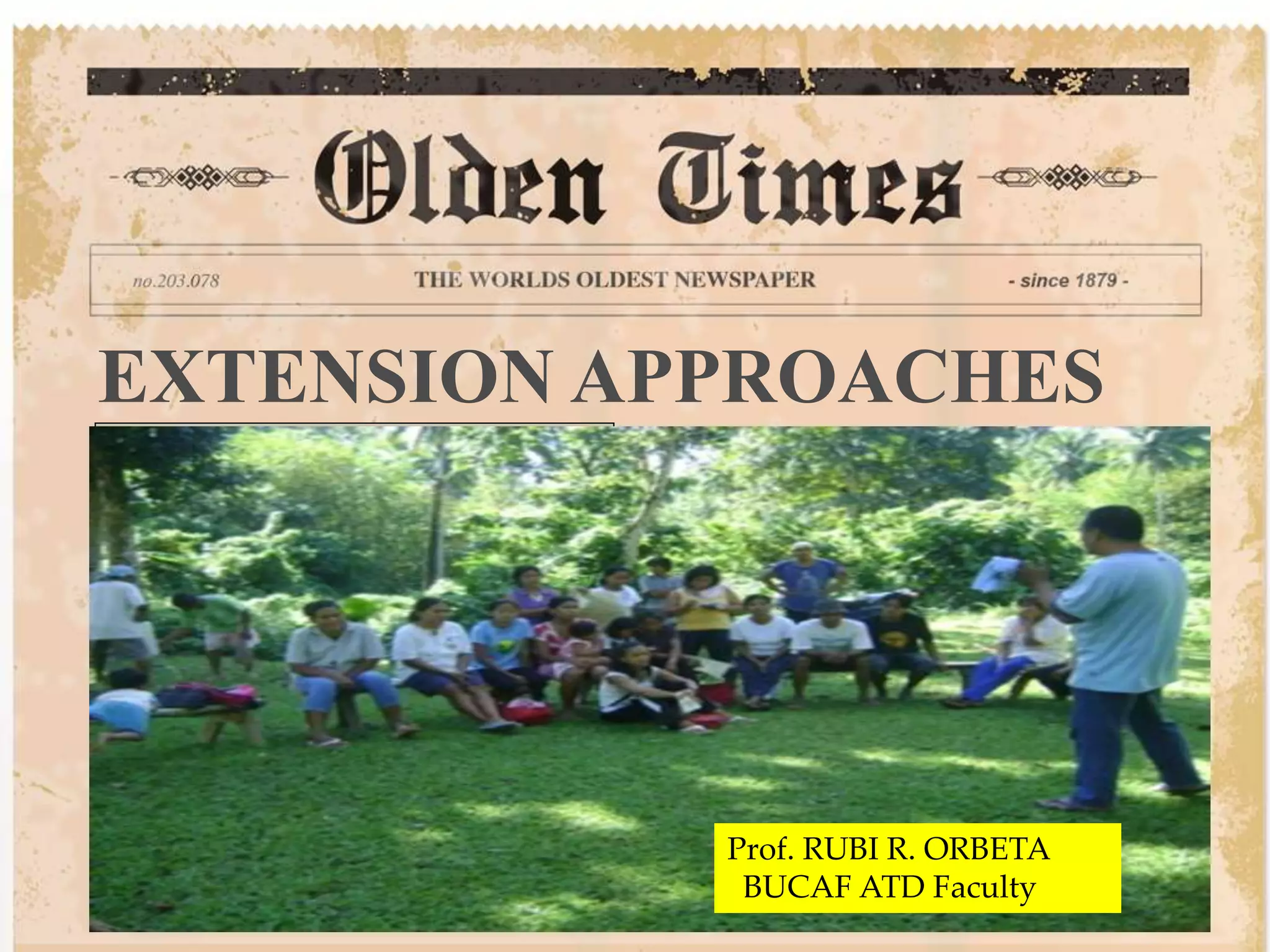
EXTENSION APPROACHES
In libris graecis appetere mea.
At vim odio lorem omnes, pri
id iuvaret partiendo. Vivendo
menandri et sed. Lorem
volumus blandit cu has.Sit cu
alia porro fuisset.
Ea pro natum invidunt
repudiandae, his et facilisis
vituperatoribus. Mei eu ubique
altera senserit, consul eripuit
accusata has ne. Ignota
verterem te nam, eu cibo
causae menandri vim. Sit
rebum erant dolorem et, sed
odio error ad.Vel molestie
corrumpit deterruisset ad,
mollis ceteros ad sea.Prof. RUBI R. ORBETA
BUCAF ATD Faculty
DEFINITION
APPROACH – embraces the entire spectrum of the process. It
states a point of view, a philosophy, an article of faith. Within an
approach, there can be several methods.
METHOD – it is procedural consisting of a series of actions
arranged logically for the smooth operation of a particular
teaching task or techno promotion.
TECHNIQUES – it is implemental, having an immediate
applicability to the EW/teacher owning to its specificity, feasibility
and convenience to the one using it.
Guides in the use of an
approach
1. The objective or target adoptors
2. The cost in using an approach
3. The nature or the long-range impact
4. Techno-promotion capabilities
5. Applicability of the approach
6. Should be parallel or in accordance with the diffusion
stage of the clientele
7. Approaches to be used must ultimately develop/change
the persons: knowledge, skills, abilities and habits and
attitudes and values
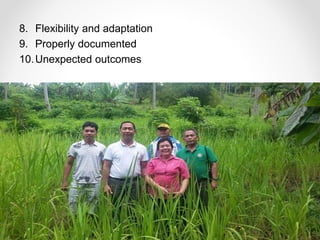
8. Flexibility and adaptation
9. Properly documented
10.Unexpected outcomes
APPROACHES IN
EXTENSION
1. PARTICIPATORY APPROACH
“How participatory is participatory approach?”
Meaning:
PA is the inclusion of intended beneficiaries in solving their
problems. The benefits derived from participation are: lower
costs; greater likelihood of user acceptance of the
technology; appropriate and socially accepted designs;
users care and maintenance of the facilities; assumption by
users and some if not all of the O & M responsibilities.
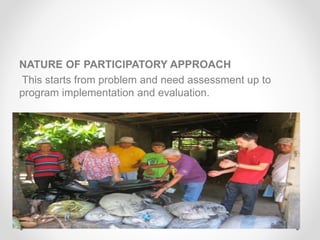
NATURE OF PARTICIPATORY APPROACH
This starts from problem and need assessment up to
program implementation and evaluation.
GUIDES IN THE USE OF
PA
1. Who are the people to be involved?
- provincial/city/municipal /barangay/purok leaders, local
dev council, members of organizations, traders,
bankers/financiers, contractors and the development
worker
2. What aspects of the project/activity will people
participate in? and How will they participate?
3. How will you train/educate/motivate people to
participate?
4. Why do we need people participation? The need to
participate must come from people.
BENEFITS OF PEOPLE
PARTICIPATION
• Acceptance and understanding of projects
• Fast adoption and/or greater support to the project
• Project sustainability
• Protection and concern of the project
• Project management by the people not outsiders
• High benefits from the project
• Full control of project operation
• Less graft and corruption
• Transparency in implementation
2. MASS APPROACH
(MA)
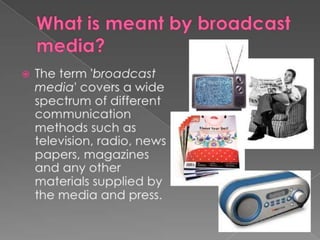
If an extension agency utilizes the mass
approach, the target adoptors of technology
are the mass of people whose identity and
number are unknown. This mass approach
utilizes strategies/methods that can reach a
number of people in a short period of time
like the print or broadcast media.
Guides in using MA
1. Adequate funds must be available
2. Technologies are simple
3. Techno promotion activities can be packaged and
implemented nationwide
4. MA is used in creating awareness and interest among
target adoptors/users.
5. Provide ways of interaction
• BENEFITS IN USING MA
1. Less manpower requirements
2. Fast and can reach greater number of people
3. Moderate interaction between source and receiver
3. SINGLE PURPOSE
APPROACH (SPA)
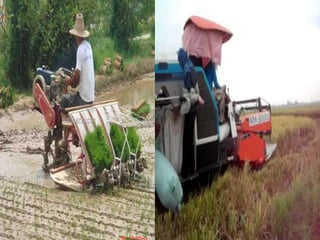
• The extension agency (GO/NGO/PO) as
the initiator of techno promotion is
promoting a single technology like organic
fertilizer, pioneer corn seed, tissue culture
banana, Kubota reaper, rice seeder and
many others. As the name implies, the
promotion is single purpose (one
product/practice/equipment)
GUIDES IN USING SPA
The single technology promoted and
adopted by users will not affect other
practices. Adoption of single technology
promoted will make a big difference in
production and profit.
Technology is readily available, can be
acquired easily and less cost
4. COMMODITY
APPROACH
• The agency is promoting a POT for a specific commodity
like corn, soybean, super peanut, rice. The POT starts
from production, storing, processing, and marketing .
The concept of seed to shelf technology is the essence
of this approach.
• Guides
1. There must be POT for – production, storage, transport,
processing, marketing
2. Well trained staff must be available
3. Other factors like capital, labor, soil, irrigation and
source of quality seeds/ breeds.
4. Quality and quantity are primary concerns which will
contribute to overall profitability.
5. Production of great volume is planned and implemented
6. Strengthened farmer coops, producers and traders
7. Farm inputs must be controlled by the farmers
8. Explore market potential before producing in great
volume
9. Storage must be well planned
10.Continuous technical assistance until self reliance is
achieved.
5. COMMUNITY
APPROACH
The main objective is total community development. The
initiating agency may use a combination of commodity,
participatory, multi-agency and integrated approaches to
achieve holistic community development.
APPROACHES
-design the development program
-analyze problems and needs
Using the IRA and other fund sources ,
barangay/municipal/city development plans are prepared
to answer the needs of communities.
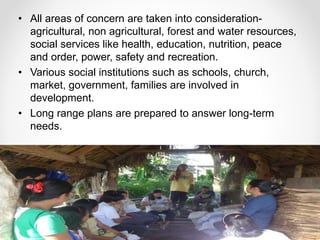
• All areas of concern are taken into consideration-
agricultural, non agricultural, forest and water resources,
social services like health, education, nutrition, peace
and order, power, safety and recreation.
• Various social institutions such as schools, church,
market, government, families are involved in
development.
• Long range plans are prepared to answer long-term
needs.
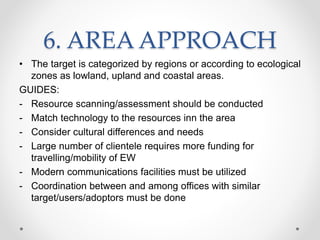
6. AREA APPROACH
• The target is categorized by regions or according to ecological
zones as lowland, upland and coastal areas.
GUIDES:
- Resource scanning/assessment should be conducted
- Match technology to the resources inn the area
- Consider cultural differences and needs
- Large number of clientele requires more funding for
travelling/mobility of EW
- Modern communications facilities must be utilized
- Coordination between and among offices with similar
target/users/adoptors must be done
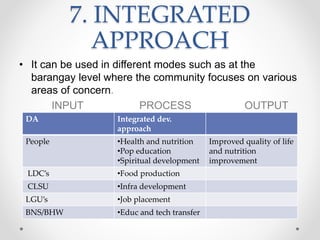
7. INTEGRATED
APPROACH
• It can be used in different modes such as at the
barangay level where the community focuses on various
areas of concern.
INPUT PROCESS OUTPUT
DA Integrated dev.
approach
People •Health and nutrition
•Pop education
•Spiritual development
Improved quality of life
and nutrition
improvement
LDC’s •Food production
CLSU •Infra development
LGU’s •Job placement
BNS/BHW •Educ and tech transfer
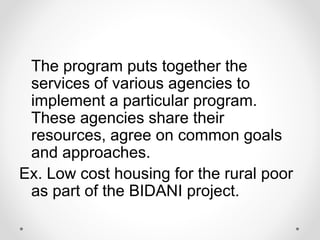
The program puts together the
services of various agencies to
implement a particular program.
These agencies share their
resources, agree on common goals
and approaches.
Ex. Low cost housing for the rural poor
as part of the BIDANI project.
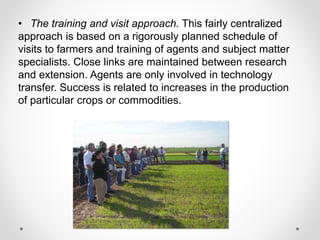
• The training and visit approach. This fairly centralized
approach is based on a rigorously planned schedule of
visits to farmers and training of agents and subject matter
specialists. Close links are maintained between research
and extension. Agents are only involved in technology
transfer. Success is related to increases in the production
of particular crops or commodities.
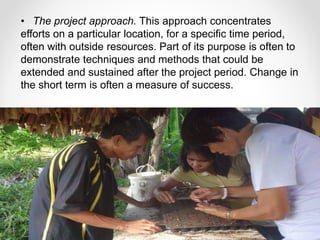
• The project approach. This approach concentrates
efforts on a particular location, for a specific time period,
often with outside resources. Part of its purpose is often to
demonstrate techniques and methods that could be
extended and sustained after the project period. Change in
the short term is often a measure of success.
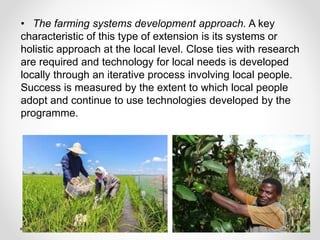
• The farming systems development approach. A key
characteristic of this type of extension is its systems or
holistic approach at the local level. Close ties with research
are required and technology for local needs is developed
locally through an iterative process involving local people.
Success is measured by the extent to which local people
adopt and continue to use technologies developed by the
programme.
• The cost-sharing approach. This approach assumes that
cost-sharing with local people (who do not have the means
to pay the full cost) will promote a programme that is more
likely to meet local situations and where extension agents
are more accountable to local interests. Its purpose is to
provide advice and information to facilitate farmers' self-
improvement. Success is often measured by the
willingness to pay.
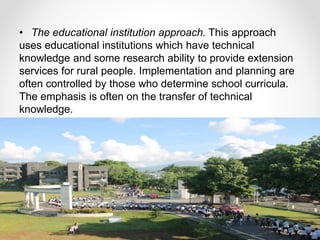
• The educational institution approach. This approach
uses educational institutions which have technical
knowledge and some research ability to provide extension
services for rural people. Implementation and planning are
often controlled by those who determine school curricula.
The emphasis is often on the transfer of technical
knowledge.
ACTIVITY
Illustrate one project and
identify specific variables using
the input-process-output
model.
Approaches in Extension - Prof. Rubi R. Orbeta

Approaches in Extension - Prof. Rubi R. Orbeta

  • 1.
    EXTENSION APPROACHES In librisgraecis appetere mea. At vim odio lorem omnes, pri id iuvaret partiendo. Vivendo menandri et sed. Lorem volumus blandit cu has.Sit cu alia porro fuisset. Ea pro natum invidunt repudiandae, his et facilisis vituperatoribus. Mei eu ubique altera senserit, consul eripuit accusata has ne. Ignota verterem te nam, eu cibo causae menandri vim. Sit rebum erant dolorem et, sed odio error ad.Vel molestie corrumpit deterruisset ad, mollis ceteros ad sea.Prof. RUBI R. ORBETA BUCAF ATD Faculty
  • 2.
    DEFINITION APPROACH – embracesthe entire spectrum of the process. It states a point of view, a philosophy, an article of faith. Within an approach, there can be several methods. METHOD – it is procedural consisting of a series of actions arranged logically for the smooth operation of a particular teaching task or techno promotion. TECHNIQUES – it is implemental, having an immediate applicability to the EW/teacher owning to its specificity, feasibility and convenience to the one using it.
  • 3.
    Guides in theuse of an approach 1. The objective or target adoptors 2. The cost in using an approach 3. The nature or the long-range impact 4. Techno-promotion capabilities 5. Applicability of the approach 6. Should be parallel or in accordance with the diffusion stage of the clientele 7. Approaches to be used must ultimately develop/change the persons: knowledge, skills, abilities and habits and attitudes and values
  • 4.
    8. Flexibility andadaptation 9. Properly documented 10.Unexpected outcomes
  • 5.
    APPROACHES IN EXTENSION 1. PARTICIPATORYAPPROACH “How participatory is participatory approach?” Meaning: PA is the inclusion of intended beneficiaries in solving their problems. The benefits derived from participation are: lower costs; greater likelihood of user acceptance of the technology; appropriate and socially accepted designs; users care and maintenance of the facilities; assumption by users and some if not all of the O & M responsibilities.
  • 6.
    NATURE OF PARTICIPATORYAPPROACH This starts from problem and need assessment up to program implementation and evaluation.
  • 7.
    GUIDES IN THEUSE OF PA 1. Who are the people to be involved? - provincial/city/municipal /barangay/purok leaders, local dev council, members of organizations, traders, bankers/financiers, contractors and the development worker 2. What aspects of the project/activity will people participate in? and How will they participate? 3. How will you train/educate/motivate people to participate? 4. Why do we need people participation? The need to participate must come from people.
  • 8.
    BENEFITS OF PEOPLE PARTICIPATION •Acceptance and understanding of projects • Fast adoption and/or greater support to the project • Project sustainability • Protection and concern of the project • Project management by the people not outsiders • High benefits from the project • Full control of project operation • Less graft and corruption • Transparency in implementation
  • 9.
    2. MASS APPROACH (MA) Ifan extension agency utilizes the mass approach, the target adoptors of technology are the mass of people whose identity and number are unknown. This mass approach utilizes strategies/methods that can reach a number of people in a short period of time like the print or broadcast media.
  • 10.
    Guides in usingMA 1. Adequate funds must be available 2. Technologies are simple 3. Techno promotion activities can be packaged and implemented nationwide 4. MA is used in creating awareness and interest among target adoptors/users. 5. Provide ways of interaction
  • 12.
    • BENEFITS INUSING MA 1. Less manpower requirements 2. Fast and can reach greater number of people 3. Moderate interaction between source and receiver
  • 13.
    3. SINGLE PURPOSE APPROACH(SPA) • The extension agency (GO/NGO/PO) as the initiator of techno promotion is promoting a single technology like organic fertilizer, pioneer corn seed, tissue culture banana, Kubota reaper, rice seeder and many others. As the name implies, the promotion is single purpose (one product/practice/equipment)
  • 14.
    GUIDES IN USINGSPA The single technology promoted and adopted by users will not affect other practices. Adoption of single technology promoted will make a big difference in production and profit. Technology is readily available, can be acquired easily and less cost
  • 16.
    4. COMMODITY APPROACH • Theagency is promoting a POT for a specific commodity like corn, soybean, super peanut, rice. The POT starts from production, storing, processing, and marketing . The concept of seed to shelf technology is the essence of this approach. • Guides 1. There must be POT for – production, storage, transport, processing, marketing 2. Well trained staff must be available 3. Other factors like capital, labor, soil, irrigation and source of quality seeds/ breeds.
  • 17.
    4. Quality andquantity are primary concerns which will contribute to overall profitability. 5. Production of great volume is planned and implemented 6. Strengthened farmer coops, producers and traders 7. Farm inputs must be controlled by the farmers 8. Explore market potential before producing in great volume 9. Storage must be well planned 10.Continuous technical assistance until self reliance is achieved.
  • 18.
    5. COMMUNITY APPROACH The mainobjective is total community development. The initiating agency may use a combination of commodity, participatory, multi-agency and integrated approaches to achieve holistic community development. APPROACHES -design the development program -analyze problems and needs Using the IRA and other fund sources , barangay/municipal/city development plans are prepared to answer the needs of communities.
  • 19.
    • All areasof concern are taken into consideration- agricultural, non agricultural, forest and water resources, social services like health, education, nutrition, peace and order, power, safety and recreation. • Various social institutions such as schools, church, market, government, families are involved in development. • Long range plans are prepared to answer long-term needs.
  • 21.
    6. AREA APPROACH •The target is categorized by regions or according to ecological zones as lowland, upland and coastal areas. GUIDES: - Resource scanning/assessment should be conducted - Match technology to the resources inn the area - Consider cultural differences and needs - Large number of clientele requires more funding for travelling/mobility of EW - Modern communications facilities must be utilized - Coordination between and among offices with similar target/users/adoptors must be done
  • 22.
    7. INTEGRATED APPROACH • Itcan be used in different modes such as at the barangay level where the community focuses on various areas of concern. INPUT PROCESS OUTPUT DA Integrated dev. approach People •Health and nutrition •Pop education •Spiritual development Improved quality of life and nutrition improvement LDC’s •Food production CLSU •Infra development LGU’s •Job placement BNS/BHW •Educ and tech transfer
  • 23.
    The program putstogether the services of various agencies to implement a particular program. These agencies share their resources, agree on common goals and approaches. Ex. Low cost housing for the rural poor as part of the BIDANI project.
  • 24.
    • The trainingand visit approach. This fairly centralized approach is based on a rigorously planned schedule of visits to farmers and training of agents and subject matter specialists. Close links are maintained between research and extension. Agents are only involved in technology transfer. Success is related to increases in the production of particular crops or commodities.
  • 25.
    • The projectapproach. This approach concentrates efforts on a particular location, for a specific time period, often with outside resources. Part of its purpose is often to demonstrate techniques and methods that could be extended and sustained after the project period. Change in the short term is often a measure of success.
  • 26.
    • The farmingsystems development approach. A key characteristic of this type of extension is its systems or holistic approach at the local level. Close ties with research are required and technology for local needs is developed locally through an iterative process involving local people. Success is measured by the extent to which local people adopt and continue to use technologies developed by the programme.
  • 27.
    • The cost-sharingapproach. This approach assumes that cost-sharing with local people (who do not have the means to pay the full cost) will promote a programme that is more likely to meet local situations and where extension agents are more accountable to local interests. Its purpose is to provide advice and information to facilitate farmers' self- improvement. Success is often measured by the willingness to pay.
  • 28.
    • The educationalinstitution approach. This approach uses educational institutions which have technical knowledge and some research ability to provide extension services for rural people. Implementation and planning are often controlled by those who determine school curricula. The emphasis is often on the transfer of technical knowledge.
  • 29.
    ACTIVITY Illustrate one projectand identify specific variables using the input-process-output model.