EXTENSION & PROGRAMME
PLANNING
Presented by
Shital. M. Rathod
Assistant Professor
Department of Home Economics.
Bar. R.D.I.K & N.K.D. College, Badnera
1
2
CONTENT
Meaning and Definitions
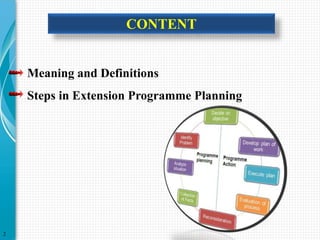
Steps in Extension Programme Planning
• The word 'extension' is derived from the Latin
roots 'ex' meaning 'out' and 'tension meaning
'stretching'.
• Extension is that type of education which is
stretched out to people in the rural areas far
and near, beyond the limits of the educational
institutions to which the formal type of
education is usually confined.
3
Meaning of Extension
Objectives of the Extension
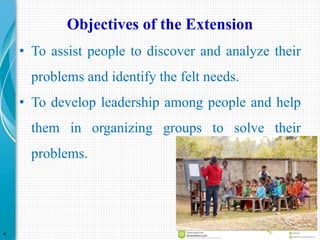
• To assist people to discover and analyze their
problems and identify the felt needs.
• To develop leadership among people and help
them in organizing groups to solve their
problems.
4
• To disseminate research information of
economic and practical importance in a way
people would be able to understand and use.
• To assist people in mobilizing and utilizing the
resources which they have and which they
need from outside.
• To collect and transmit feedback information
for solving management problems.
5
Cont..
Programme :
It means a proclamation, a prospectus, a list of
events, a plan of procedures, a course of actions
prepared or announced before hand, a logical
sequence of operations to be performed in
solving a problem.
6
Meaning and Definitions
Planning :
Planning is designing a course of action to
achieve ends. (Myserson and Banfield, 1935)
Programme Planning:
Programme Planning is the process in which
outline of procedure of work is arranged as to
enable efficient execution. (J. S. Garg)
Cont..
7
Programme Planning:
Programme Planning consist of two words.
Programme
• Is the symbol of different activities
Planning
• Consist of “what should be done, how
should be done, and why should it be done.”
Cont..
8
Objectives of the Programme
1. To create a real interest in people for rural
welfare work.
2. To study rural problems and to translate
conclusions into action.
3. To help villagers develop their resources.
4. To improve village sanitation.
9
 Extension Programme is a statement of situation,
objective, problems and solution. It is relatively
permanent but requires constant revision. It forms
the basis for extension plans. (Kelsey &
Hearne,1967)
10
EXTENSION PROGRAMME
11
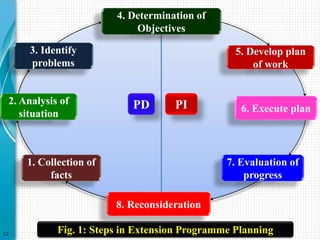
STEPS IN EXTENSION PROGRAMME
PLANNING
12
4. Determination of
Objectives
5. Develop plan
of work
6. Execute plan
7. Evaluation of
progress
8. Reconsideration
1. Collection of
facts
2. Analysis of
situation
3. Identify
problems
PD PI
Fig. 1: Steps in Extension Programme Planning
 References
Debabrata Das Gupta (2012). Extension Education: Core
contents and emerging areas. pp: 122-124.
G.L. Ray (2008). Extension communication and
management. Kalyani publ. pp:13-18.
R.R. Chole, P.R. Deshmukh and P.S. Kapse (2010).
Transfer of agricultural technology. Scientific Publ. pp:
53-77.
L.D. Kelsey and C.C. Hearne (1967). Cooperative
Extension work. New York, Cornell University Press,
Ithaca.
14

EXTENSION & PROGRAMME PLANNING.ppt

  • 1.
    EXTENSION & PROGRAMME PLANNING Presentedby Shital. M. Rathod Assistant Professor Department of Home Economics. Bar. R.D.I.K & N.K.D. College, Badnera 1
  • 2.
    2 CONTENT Meaning and Definitions Stepsin Extension Programme Planning
  • 3.
    • The word'extension' is derived from the Latin roots 'ex' meaning 'out' and 'tension meaning 'stretching'. • Extension is that type of education which is stretched out to people in the rural areas far and near, beyond the limits of the educational institutions to which the formal type of education is usually confined. 3 Meaning of Extension
  • 4.
    Objectives of theExtension • To assist people to discover and analyze their problems and identify the felt needs. • To develop leadership among people and help them in organizing groups to solve their problems. 4
  • 5.
    • To disseminateresearch information of economic and practical importance in a way people would be able to understand and use. • To assist people in mobilizing and utilizing the resources which they have and which they need from outside. • To collect and transmit feedback information for solving management problems. 5 Cont..
  • 6.
    Programme : It meansa proclamation, a prospectus, a list of events, a plan of procedures, a course of actions prepared or announced before hand, a logical sequence of operations to be performed in solving a problem. 6 Meaning and Definitions
  • 7.
    Planning : Planning isdesigning a course of action to achieve ends. (Myserson and Banfield, 1935) Programme Planning: Programme Planning is the process in which outline of procedure of work is arranged as to enable efficient execution. (J. S. Garg) Cont.. 7
  • 8.
    Programme Planning: Programme Planningconsist of two words. Programme • Is the symbol of different activities Planning • Consist of “what should be done, how should be done, and why should it be done.” Cont.. 8
  • 9.
    Objectives of theProgramme 1. To create a real interest in people for rural welfare work. 2. To study rural problems and to translate conclusions into action. 3. To help villagers develop their resources. 4. To improve village sanitation. 9
  • 10.
     Extension Programmeis a statement of situation, objective, problems and solution. It is relatively permanent but requires constant revision. It forms the basis for extension plans. (Kelsey & Hearne,1967) 10 EXTENSION PROGRAMME
  • 11.
    11 STEPS IN EXTENSIONPROGRAMME PLANNING
  • 12.
    12 4. Determination of Objectives 5.Develop plan of work 6. Execute plan 7. Evaluation of progress 8. Reconsideration 1. Collection of facts 2. Analysis of situation 3. Identify problems PD PI Fig. 1: Steps in Extension Programme Planning
  • 13.
     References Debabrata DasGupta (2012). Extension Education: Core contents and emerging areas. pp: 122-124. G.L. Ray (2008). Extension communication and management. Kalyani publ. pp:13-18. R.R. Chole, P.R. Deshmukh and P.S. Kapse (2010). Transfer of agricultural technology. Scientific Publ. pp: 53-77. L.D. Kelsey and C.C. Hearne (1967). Cooperative Extension work. New York, Cornell University Press, Ithaca.
  • 14.