Exposure Timer And Switches
By Ravi Aditya
Reg. No – 240513004
Course – M.Sc. Radio-Imaging Technology
Department of Radio-Diagnosis
Faculty Of Allied Health Sciences
SGT University
Timers
• The device used to control the length of x-ray
exposure in low-powered x-ray machines is
quite simple.
• This is because the exposure time is usually
longer, often over 1 second.
• Small timing errors do not make a big
difference for such long exposures, so the
timing mechanism doesn't need to be very
complex.
• But with high powered x-ray sets ,exposure
time is very short and minimum time
interval i.e . >0.01 sec or less in some cases.
• So, the timer should be with high degree of
accuracy.
• The basic exposure timers are :
1. Mechanical Timer
2. Synchronous Timer
3. Electronic Timer
4. Automatic Exposure Control(AEC)
5. Pulse Counting Timer
Mechanical Timer
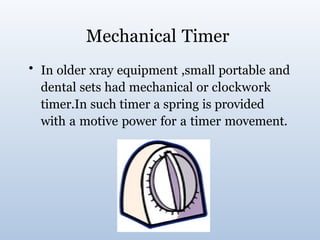
• In older xray equipment ,small portable and
dental sets had mechanical or clockwork
timer.In such timer a spring is provided
with a motive power for a timer movement.
Synchronous Timer
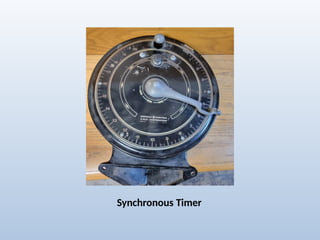
• These are the type of mechanical timers
,have an electric motor called synchronous
motor which is accurate than clockwork
timer.
• This is designed to drive a shaft at precisely
60rev/sec.
Synchronous Timer
Electronic Timers
• These are the most sophisticated ,most
complicated and the most accurate X-
RAY exposure timer.
• They consist of complex circuitary based on the
time required to change a capacitor through a
variable resistance.
• These devices allow you to choose a wide range of time
intervals and can be accurate to as small as 1 millisecond.
They can handle quick, repeated exposures, making them
ideal for angio-interventional procedures.
• The main basis of ET is charging and discharging of a
capacitor .The length of the xray exposure is determined
by the time required to charge or discharge a capacitor
through a selected resistance.
A charging capacitor
• The exposure button starts the exposure and
also starts charging the capacitor .
• Exposure terminates when the capacitor is
charged to a value necessary to turn on
the associated electronic circuit.
• The exp. time is determined by the length
of the time to charge the capacitor.
• This time can be varied by varying the
value of resistance in the charging circuit.
• If the resistance is low the capacitor take
shorter time to charge thus giving low
exposure time.
A discharging capacitor
• The capacitor is fully charged before the
exposure .When the exposure button starts
the charged capacitor begins to discharge
the selected resistance .When the voltage
has fallen to the specific value the exposure
stops.If resistance decreases the
capacitor discharges in shorter time.
AEC
• Called Automatic Exposure Control
• Accurate than electrical and mechanical.
• AEC was developed to correct the errors by
the radiology technologists under the
exposure factors .
• They measure the amount of radiation
required to produce correct exposure for a
radiographic exam.
• It is first necessary to select the kvp that
will produce satisfactory penetration of the
part to be examined.Once kvp is selected
either the technologist or photo timer must
select the mAs that will produce the proper
exposure.
• An automatic timer overcomes the
difficulties of varying absorption in the
patient because the exposure is terminated
only when the film has that dose of
radiation necessary to give it required range
of densities after processing.
• If the timer is properly used and is
functioning correctly all radiograph should
receive standarized exposure and be
correctly exposed.
• The essential element in phototimer is a
device that can detect radiation and in
response to this produce a small electric
current.
• There are 3 such devices which are :
2. Photomultiplier Detector
3. Ionization Chamber Detector
4. Solid State Detector
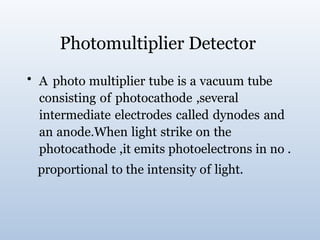
Photomultiplier Detector
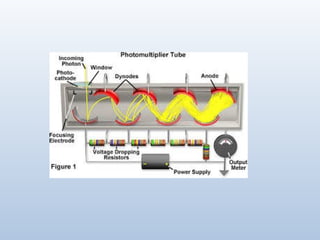
• A photo multiplier tube is a vacuum tube
consisting of photocathode ,several
intermediate electrodes called dynodes and
an anode.When light strike on the
photocathode ,it emits photoelectrons in no .
proportional to the intensity of light.
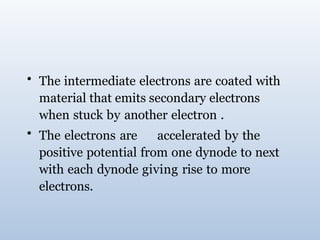
• The intermediate electrons are coated with
material that emits secondary electrons
when stuck by another electron .
• The electrons are accelerated by the
positive potential from one dynode to next
with each dynode giving rise to more
electrons.
• The final no of electron collected at the
anode represents the output current and is
proportional to the intensity of light that
stuck the photo cathode.
• Photomultiplier detector is the most
common type of AEC .The detector is made
up of Lucite and is covered with black
paper except for an area which is used as
detector field for X-ray.
Ionization Chamber Autotimer
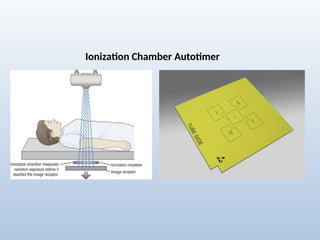
The Ionization Chamber System consists of a hollow
cell with air, connected to a timer circuit. It has parallel
plates with gas and uses detectors placed before the
image receptor. X-rays ionize the gas, neutralizing the
plate's charge, causing a voltage drop that stops
exposure at a preset threshold. It is reliable, widely
used in modern AEC systems, and measures radiation
by generating an electric charge proportional to the
radiation.
Ionization Chamber Autotimer
Solid State Autotimer
• A variety of SSA is used in the marked
today that operates on the basis of radiation
producing ionization in or near the receptor.
• This offers the advantage of small
size,almost no X-ray beam absorption
and a consistent rapid response.
Pulse Counting Timer
• In this type,timing is accomplished by
counting the pulse of a regular periodic
voltage.When it is necessary the exposure
of few ms.,a convenient way is to
measure such a time would be to count
voltage pulses of high frequency.
• The higher the frequency ,the more the
pulses that are counted for a given
exposure period.
• The higher frequency has a tendency to
reduce the error in the time period .So,this
device is used to control the time of short
exposure technique.
Switches
• It is a control device designed to interrupt
the power automatically when pressure
by the operator's hand or foot is
released. The purpose is to prevent
accidental continuing exposure of the
patient to radiation.
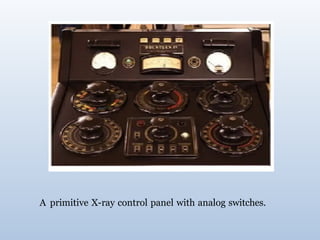
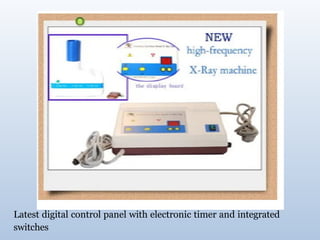
A primitive X-ray control panel with analog switches.
Latest digital control panel with electronic timer and integrated
switches
Switches contd..
• Based on the location on the circuit of the
transformer they are fitted they are
divided into two types.These are :
2. Primary and
3. Secondary
Primary Switching
1. Electromechanical Contractors
2. Electronic
iii. Gas filled switches or thyratrons
iv. Silicon Controlled Rectifier(SCR) or
thrysistors
Electromechanical Contractors
• These are spring loaded so that they close
firmly and without bounce,the spring acting
strongly to contact pieces together.These
contact to close a circuit and remove
contact to open the circuit.
• These should be heat resistant and also the
springs should be strong.
• Nowadays these are replaced by
the electronic switching.
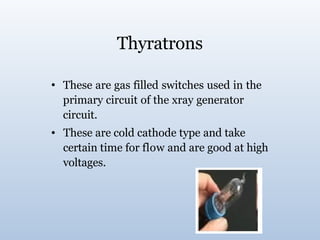
Thyratrons
• These are gas filled switches used in the
primary circuit of the xray generator
circuit.
These are cold cathode type and take
certain time for flow and are good at high
voltages.
•
Thyristors
• Suitable for switching big current ie can be
made to switch between 250 A at 500 V so
can be used in the primary circuit of the
xray generators.Mostly used nowadays .
Secondary Switching Circuit
•
•
These are fitted within the high tension
circuit .
These must be wholly electronic and they
must be vacuum valve devices.These are
mainly:
3. Triode Valve
4. Grided X-ray tubes
Triode Valve
• These are mainly used to Switch the circuit
and may also act to stabilize the kilovoltage.
• These triode valves are designed to act as
electronic switches operating at high
kilovoltages and they directly close at teh
start the exposure and open at the end of the
exposure.
• The grid is responsible for the switching
mechanism ie the voltage in the grid.
• When grid is sufficiently negative with
respect to the cathode ,no electron can pass
throgh it causing open circuit.
• When voltage in the grid is decreased the
valve is conductive ie the switch is open.
Grided X-ray tubes
• In this case a control grid is kept in between
the anode and cathode of the x-ray tube
making the x-ray tube itself as a switch.
• At the beginning of the exposure it provides
a continuous pathway for its own flow of
electrons by becoming conductive through
change in negative bias voltage in the grid.
• At the end of the exposure it becomes non
conductive and again through the grid bias
voltage ,it instantaneously opens the high
tension circuit and the exposure stops.
• It is the method of exposure switching that
gives precise control for short exposures of
a few milliseconds only.
THANK YOU

EXPOSURE TIMER AND SWITCHES RAVI_msc_004.pptx

  • 1.
    Exposure Timer AndSwitches By Ravi Aditya Reg. No – 240513004 Course – M.Sc. Radio-Imaging Technology Department of Radio-Diagnosis Faculty Of Allied Health Sciences SGT University
  • 2.
    Timers • The deviceused to control the length of x-ray exposure in low-powered x-ray machines is quite simple. • This is because the exposure time is usually longer, often over 1 second. • Small timing errors do not make a big difference for such long exposures, so the timing mechanism doesn't need to be very complex.
  • 3.
    • But withhigh powered x-ray sets ,exposure time is very short and minimum time interval i.e . >0.01 sec or less in some cases.
  • 4.
    • So, thetimer should be with high degree of accuracy. • The basic exposure timers are : 1. Mechanical Timer 2. Synchronous Timer 3. Electronic Timer 4. Automatic Exposure Control(AEC) 5. Pulse Counting Timer
  • 5.
    Mechanical Timer • Inolder xray equipment ,small portable and dental sets had mechanical or clockwork timer.In such timer a spring is provided with a motive power for a timer movement.
  • 6.
    Synchronous Timer • Theseare the type of mechanical timers ,have an electric motor called synchronous motor which is accurate than clockwork timer. • This is designed to drive a shaft at precisely 60rev/sec.
  • 7.
  • 8.
    Electronic Timers • Theseare the most sophisticated ,most complicated and the most accurate X- RAY exposure timer. • They consist of complex circuitary based on the time required to change a capacitor through a variable resistance.
  • 9.
    • These devicesallow you to choose a wide range of time intervals and can be accurate to as small as 1 millisecond. They can handle quick, repeated exposures, making them ideal for angio-interventional procedures. • The main basis of ET is charging and discharging of a capacitor .The length of the xray exposure is determined by the time required to charge or discharge a capacitor through a selected resistance.
  • 10.
    A charging capacitor •The exposure button starts the exposure and also starts charging the capacitor . • Exposure terminates when the capacitor is charged to a value necessary to turn on the associated electronic circuit. • The exp. time is determined by the length of the time to charge the capacitor.
  • 11.
    • This timecan be varied by varying the value of resistance in the charging circuit. • If the resistance is low the capacitor take shorter time to charge thus giving low exposure time.
  • 12.
    A discharging capacitor •The capacitor is fully charged before the exposure .When the exposure button starts the charged capacitor begins to discharge the selected resistance .When the voltage has fallen to the specific value the exposure stops.If resistance decreases the capacitor discharges in shorter time.
  • 13.
    AEC • Called AutomaticExposure Control • Accurate than electrical and mechanical. • AEC was developed to correct the errors by the radiology technologists under the exposure factors . • They measure the amount of radiation required to produce correct exposure for a radiographic exam.
  • 14.
    • It isfirst necessary to select the kvp that will produce satisfactory penetration of the part to be examined.Once kvp is selected either the technologist or photo timer must select the mAs that will produce the proper exposure.
  • 15.
    • An automatictimer overcomes the difficulties of varying absorption in the patient because the exposure is terminated only when the film has that dose of radiation necessary to give it required range of densities after processing.
  • 16.
    • If thetimer is properly used and is functioning correctly all radiograph should receive standarized exposure and be correctly exposed. • The essential element in phototimer is a device that can detect radiation and in response to this produce a small electric current.
  • 17.
    • There are3 such devices which are : 2. Photomultiplier Detector 3. Ionization Chamber Detector 4. Solid State Detector
  • 18.
    Photomultiplier Detector • Aphoto multiplier tube is a vacuum tube consisting of photocathode ,several intermediate electrodes called dynodes and an anode.When light strike on the photocathode ,it emits photoelectrons in no . proportional to the intensity of light.
  • 20.
    • The intermediateelectrons are coated with material that emits secondary electrons when stuck by another electron . • The electrons are accelerated by the positive potential from one dynode to next with each dynode giving rise to more electrons.
  • 21.
    • The finalno of electron collected at the anode represents the output current and is proportional to the intensity of light that stuck the photo cathode.
  • 22.
    • Photomultiplier detectoris the most common type of AEC .The detector is made up of Lucite and is covered with black paper except for an area which is used as detector field for X-ray.
  • 23.
    Ionization Chamber Autotimer TheIonization Chamber System consists of a hollow cell with air, connected to a timer circuit. It has parallel plates with gas and uses detectors placed before the image receptor. X-rays ionize the gas, neutralizing the plate's charge, causing a voltage drop that stops exposure at a preset threshold. It is reliable, widely used in modern AEC systems, and measures radiation by generating an electric charge proportional to the radiation.
  • 24.
  • 25.
    Solid State Autotimer •A variety of SSA is used in the marked today that operates on the basis of radiation producing ionization in or near the receptor. • This offers the advantage of small size,almost no X-ray beam absorption and a consistent rapid response.
  • 26.
    Pulse Counting Timer •In this type,timing is accomplished by counting the pulse of a regular periodic voltage.When it is necessary the exposure of few ms.,a convenient way is to measure such a time would be to count voltage pulses of high frequency.
  • 27.
    • The higherthe frequency ,the more the pulses that are counted for a given exposure period. • The higher frequency has a tendency to reduce the error in the time period .So,this device is used to control the time of short exposure technique.
  • 28.
    Switches • It isa control device designed to interrupt the power automatically when pressure by the operator's hand or foot is released. The purpose is to prevent accidental continuing exposure of the patient to radiation.
  • 29.
    A primitive X-raycontrol panel with analog switches.
  • 30.
    Latest digital controlpanel with electronic timer and integrated switches
  • 31.
    Switches contd.. • Basedon the location on the circuit of the transformer they are fitted they are divided into two types.These are : 2. Primary and 3. Secondary
  • 32.
    Primary Switching 1. ElectromechanicalContractors 2. Electronic iii. Gas filled switches or thyratrons iv. Silicon Controlled Rectifier(SCR) or thrysistors
  • 33.
    Electromechanical Contractors • Theseare spring loaded so that they close firmly and without bounce,the spring acting strongly to contact pieces together.These contact to close a circuit and remove contact to open the circuit. • These should be heat resistant and also the springs should be strong.
  • 34.
    • Nowadays theseare replaced by the electronic switching.
  • 35.
    Thyratrons • These aregas filled switches used in the primary circuit of the xray generator circuit. These are cold cathode type and take certain time for flow and are good at high voltages. •
  • 36.
    Thyristors • Suitable forswitching big current ie can be made to switch between 250 A at 500 V so can be used in the primary circuit of the xray generators.Mostly used nowadays .
  • 37.
    Secondary Switching Circuit • • Theseare fitted within the high tension circuit . These must be wholly electronic and they must be vacuum valve devices.These are mainly: 3. Triode Valve 4. Grided X-ray tubes
  • 38.
    Triode Valve • Theseare mainly used to Switch the circuit and may also act to stabilize the kilovoltage. • These triode valves are designed to act as electronic switches operating at high kilovoltages and they directly close at teh start the exposure and open at the end of the exposure.
  • 39.
    • The gridis responsible for the switching mechanism ie the voltage in the grid. • When grid is sufficiently negative with respect to the cathode ,no electron can pass throgh it causing open circuit. • When voltage in the grid is decreased the valve is conductive ie the switch is open.
  • 40.
    Grided X-ray tubes •In this case a control grid is kept in between the anode and cathode of the x-ray tube making the x-ray tube itself as a switch. • At the beginning of the exposure it provides a continuous pathway for its own flow of electrons by becoming conductive through change in negative bias voltage in the grid.
  • 41.
    • At theend of the exposure it becomes non conductive and again through the grid bias voltage ,it instantaneously opens the high tension circuit and the exposure stops. • It is the method of exposure switching that gives precise control for short exposures of a few milliseconds only.
  • 42.