The X-ray Imaging
System
Week 4-5
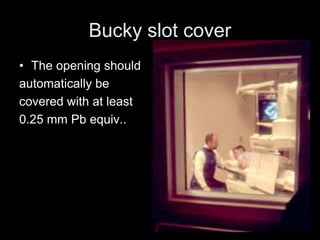
Bucky slot cover
 During fluoroscopy the Bucky tray is
moved to the end of the table
 This leaves an opening in the side of the
table about 5cm
 Approximately at what level is the bucky?
Bucky slot cover
• The opening should
automatically be
covered with at least
0.25 mm Pb equiv..
Fluoroscopy
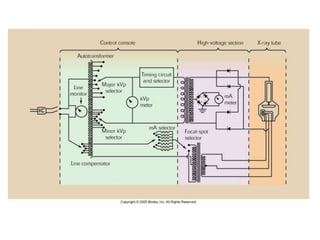
The Control Console
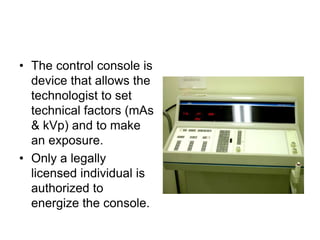
• The control console is
device that allows the
technologist to set
technical factors (mAs
& kVp) and to make
an exposure.
• Only a legally
licensed individual is
authorized to
energize the console.
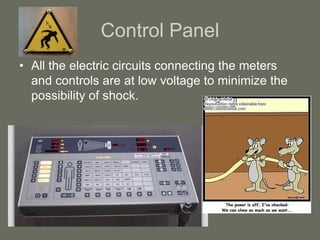
Control Panel
• All the electric circuits connecting the meters
and controls are at low voltage to minimize the
possibility of shock.
Operating Console
Controls:
 Line Compensation, kVp, mA and time
 Quantity = # of x-rays
 Milliroentges (mR) or (mR/mAs)
 Quality = the pentrability
 Kilovolts peak (kVp)
Operating Console has
meters to measure
 kVp, mA, & exposure time
 Modern units only display mAs
 Units with ACE’s will have a separate
meter for mAs
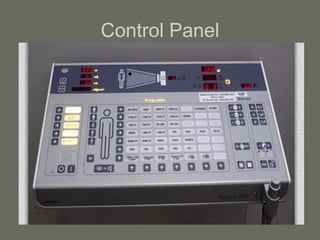
Control Panel
AEC
 Automatic Exposure Control
 Uses an ionization chamber
 Technologist sets kVp, mA, back-up
time & sensors
 Exposure terminates the IR has proper
OD
 Patient positioning must be absolutely
accurate
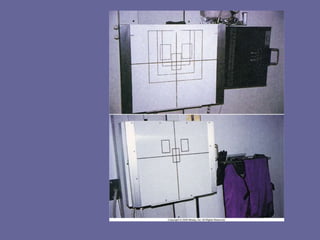
AEC
Sensors
APR
 Anatomically Programmed Radiography
(Ch 15)
 Radiologic Technologist selects on the
console a picture or a written
description of the anatomic part to be
imaged and the patient body habitus
 A computer selects the appropriate
kVp and mAs.
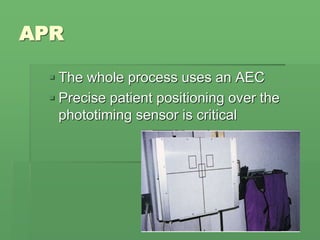
APR
 The whole process uses an AEC
 Precise patient positioning over the
phototiming sensor is critical
APR
X-RAY CIRCUITY
Contributions by Mosby, Thompson Publisher, Carlton, Bushberg, and the WWW.
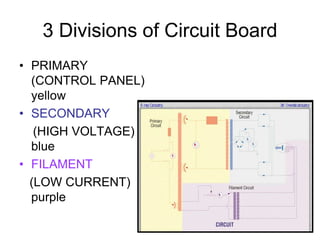
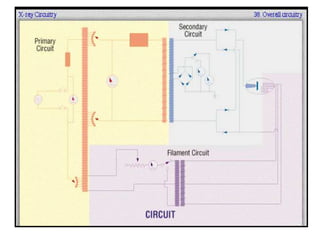
3 Divisions of Circuit Board
• PRIMARY
(CONTROL PANEL)
yellow
• SECONDARY
(HIGH VOLTAGE)
blue
• FILAMENT
(LOW CURRENT)
purple
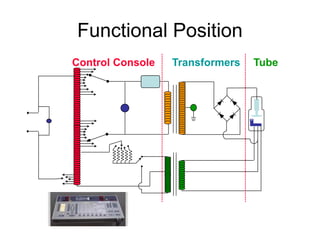
Functional Position
Control Console Transformers Tube
Line Compensation
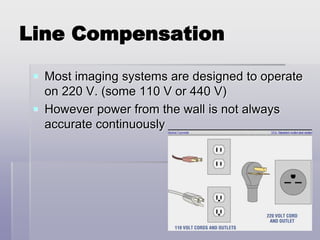
 Most imaging systems are designed to operate
on 220 V. (some 110 V or 440 V)
 However power from the wall is not always
accurate continuously
Line Compensation
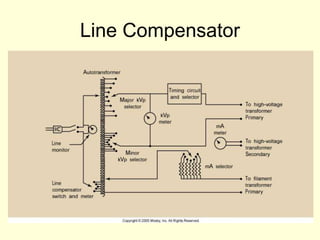
 Wired to the autotransformer is the line
compensator
 Designed to maintain the accurate
voltage required for consistent production
of high-quality images
 Today’s line compensators are automatic
and are not displayed on the control panel
Line Compensator
Autotransformer
 The power for the x-ray imaging system
is delivered first to the autotransformer
 The autotransformer works on the
principle of electromagnetic induction
 It has one winding and one core
 There are a number of connections along
its length
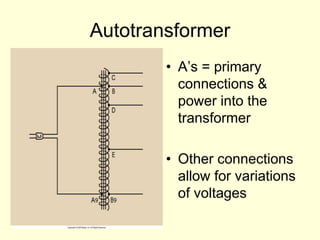
Autotransformer
• A’s = primary
connections &
power into the
transformer
• Other connections
allow for variations
of voltages
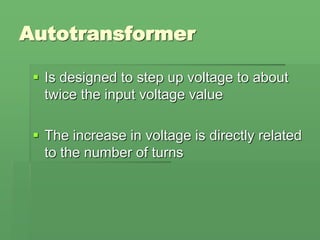
Autotransformer
 Is designed to step up voltage to about
twice the input voltage value
 The increase in voltage is directly related
to the number of turns
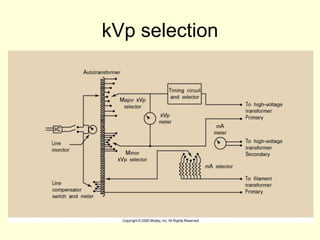
kVp selection
X-ray tube current or
Filament circuit
 A separate circuit crossing from cathode
to anode
 Measured in milliampers (mA)
 What determines how many x-rays are
created?
X-ray tube current or
Filament circuit
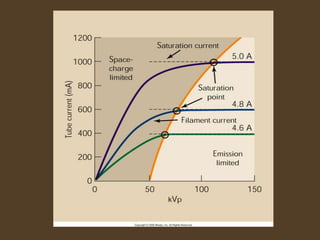
 # of e- is determined by the temperature
of the filament. The hotter the filament
the more e-
 Are their any limiting factors to thermionic
emission?
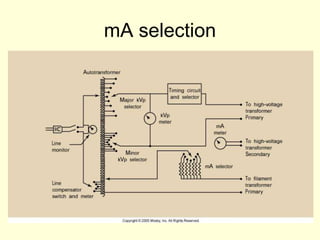
mA selection
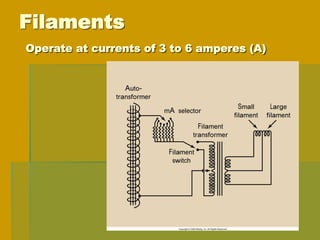
Filaments
Operate at currents of 3 to 6 amperes (A)
Question?
What is directly proportional to
the number of x-rays reaching
the IR?
Exposure Timers
 The timer circuit is separate from the other
main circuits of the imaging system
 It is a mechanical or electronic device
whose action is to “make” and “break” the
high voltage across the x-ray tube
 This is done on the primary side of the high
voltage transformer.
mAs Timers
 Monitors the product of mA and exposure
time
 Terminates the exposure when the
desired mAs value is reached
 Located on the secondary side of the
high-voltage transformer since actual
tube current must be monitored
mAs Timers
 Designed to proved the highest mA for
the shortest exposure
 Modern X-ray machines have falling-load
generator
 Automatically adjusts to the highest mA at
the shortest exposure time possible
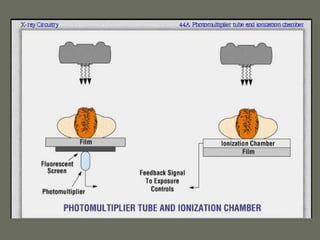
AEC Control
 AEC measure the quantity of radiation
reaching the IR
 Automatically terminates when the IR has
received enough radiation for desired OD
 Two types are common
Flat, parallel plate
ionization chamber
 Located between the patient and the IR
 Made radiolucent
 Ionization w/in the chamber creates a
charge; calibrated to produce a given OD
on the IR
Photomultiplier (Photodiode)
detector assembly
 Located behind the IR
 Contains a fluorescent screen and a
photomultiplier
 The photomultiplier detects the light from
the fluorescent screen until the desired
OD on the IR is reached terminating the
exposure
AEC’s
 Upon instillation must be calibrated by
the service engineer
 Technologists selects the desired OD
which then sets the mA & kVp
AEC’s
 A back up timer usually automatically set
to prevent over exposure if the AEC fails
 Should be set to 1.5 times the expected
exposure time Why?
 When the ionization chamber or
photodiode reaches the preset level, a
signal is returned to the operating
console to terminate the exposure
High-Voltage Generator
 Responsible for increasing the output
voltage from the autotransformer to the
kVp necessary for x-ray production
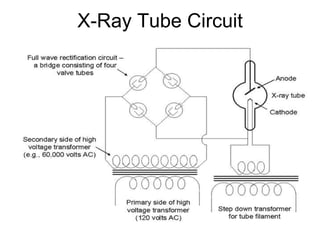
 3 parts: High-voltage transformer (step-
up), filament transformer (step-down) and
rectifiers
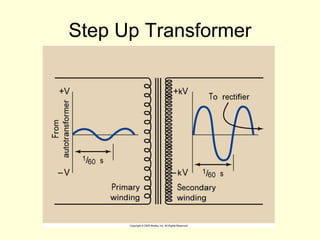
High voltage transformer
 Or step up transformer
 Connected to the Major and Minor kVp
selector
 Increases the volts from the
autotransformer to kilovolts
Step Up Transformer
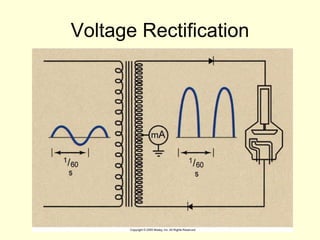
Voltage Rectification
 Converts AC to DC current
 During the negative cycle current can
only flow from anode to cathode
 E- must travel cathode to anode – DC
current keeps e- traveling in the correct
direction, cathode to anode
 Attracted to the positive anode
Voltage Rectification
X-Ray Tube Circuit
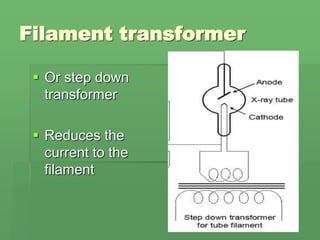
Filament transformer
 Or step down
transformer
 Reduces the
current to the
filament
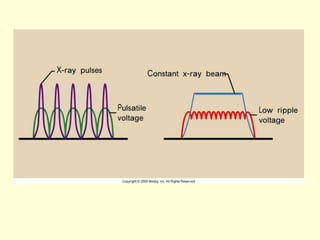
High-Voltage Generation – converts
220 volts of AC to kilovolts of DC
 The generator is a FIXED component of
the imaging system, not under the
control of the technologist
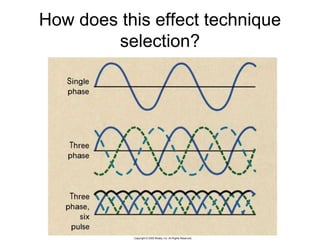
 Three basic types: single phase, three
phase, and high frequency
 The generator affects the quality and
quantity of photons produced
How does this effect technique
selection?
Questions on imaging systems?

X RAY IMAGING.ppt

  • 1.
  • 2.
    Bucky slot cover During fluoroscopy the Bucky tray is moved to the end of the table  This leaves an opening in the side of the table about 5cm  Approximately at what level is the bucky?
  • 3.
    Bucky slot cover •The opening should automatically be covered with at least 0.25 mm Pb equiv..
  • 4.
  • 5.
    The Control Console •The control console is device that allows the technologist to set technical factors (mAs & kVp) and to make an exposure. • Only a legally licensed individual is authorized to energize the console.
  • 6.
    Control Panel • Allthe electric circuits connecting the meters and controls are at low voltage to minimize the possibility of shock.
  • 7.
    Operating Console Controls:  LineCompensation, kVp, mA and time  Quantity = # of x-rays  Milliroentges (mR) or (mR/mAs)  Quality = the pentrability  Kilovolts peak (kVp)
  • 8.
    Operating Console has metersto measure  kVp, mA, & exposure time  Modern units only display mAs  Units with ACE’s will have a separate meter for mAs
  • 9.
  • 10.
    AEC  Automatic ExposureControl  Uses an ionization chamber  Technologist sets kVp, mA, back-up time & sensors  Exposure terminates the IR has proper OD  Patient positioning must be absolutely accurate
  • 11.
  • 12.
    APR  Anatomically ProgrammedRadiography (Ch 15)  Radiologic Technologist selects on the console a picture or a written description of the anatomic part to be imaged and the patient body habitus  A computer selects the appropriate kVp and mAs.
  • 13.
    APR  The wholeprocess uses an AEC  Precise patient positioning over the phototiming sensor is critical
  • 14.
  • 15.
    X-RAY CIRCUITY Contributions byMosby, Thompson Publisher, Carlton, Bushberg, and the WWW.
  • 16.
    3 Divisions ofCircuit Board • PRIMARY (CONTROL PANEL) yellow • SECONDARY (HIGH VOLTAGE) blue • FILAMENT (LOW CURRENT) purple
  • 19.
  • 20.
    Line Compensation  Mostimaging systems are designed to operate on 220 V. (some 110 V or 440 V)  However power from the wall is not always accurate continuously
  • 21.
    Line Compensation  Wiredto the autotransformer is the line compensator  Designed to maintain the accurate voltage required for consistent production of high-quality images  Today’s line compensators are automatic and are not displayed on the control panel
  • 22.
  • 23.
    Autotransformer  The powerfor the x-ray imaging system is delivered first to the autotransformer  The autotransformer works on the principle of electromagnetic induction  It has one winding and one core  There are a number of connections along its length
  • 24.
    Autotransformer • A’s =primary connections & power into the transformer • Other connections allow for variations of voltages
  • 25.
    Autotransformer  Is designedto step up voltage to about twice the input voltage value  The increase in voltage is directly related to the number of turns
  • 26.
  • 27.
    X-ray tube currentor Filament circuit  A separate circuit crossing from cathode to anode  Measured in milliampers (mA)  What determines how many x-rays are created?
  • 28.
    X-ray tube currentor Filament circuit  # of e- is determined by the temperature of the filament. The hotter the filament the more e-  Are their any limiting factors to thermionic emission?
  • 30.
  • 31.
    Filaments Operate at currentsof 3 to 6 amperes (A)
  • 32.
    Question? What is directlyproportional to the number of x-rays reaching the IR?
  • 33.
    Exposure Timers  Thetimer circuit is separate from the other main circuits of the imaging system  It is a mechanical or electronic device whose action is to “make” and “break” the high voltage across the x-ray tube  This is done on the primary side of the high voltage transformer.
  • 34.
    mAs Timers  Monitorsthe product of mA and exposure time  Terminates the exposure when the desired mAs value is reached  Located on the secondary side of the high-voltage transformer since actual tube current must be monitored
  • 35.
    mAs Timers  Designedto proved the highest mA for the shortest exposure  Modern X-ray machines have falling-load generator  Automatically adjusts to the highest mA at the shortest exposure time possible
  • 36.
    AEC Control  AECmeasure the quantity of radiation reaching the IR  Automatically terminates when the IR has received enough radiation for desired OD  Two types are common
  • 37.
    Flat, parallel plate ionizationchamber  Located between the patient and the IR  Made radiolucent  Ionization w/in the chamber creates a charge; calibrated to produce a given OD on the IR
  • 38.
    Photomultiplier (Photodiode) detector assembly Located behind the IR  Contains a fluorescent screen and a photomultiplier  The photomultiplier detects the light from the fluorescent screen until the desired OD on the IR is reached terminating the exposure
  • 40.
    AEC’s  Upon instillationmust be calibrated by the service engineer  Technologists selects the desired OD which then sets the mA & kVp
  • 41.
    AEC’s  A backup timer usually automatically set to prevent over exposure if the AEC fails  Should be set to 1.5 times the expected exposure time Why?  When the ionization chamber or photodiode reaches the preset level, a signal is returned to the operating console to terminate the exposure
  • 42.
    High-Voltage Generator  Responsiblefor increasing the output voltage from the autotransformer to the kVp necessary for x-ray production  3 parts: High-voltage transformer (step- up), filament transformer (step-down) and rectifiers
  • 43.
    High voltage transformer Or step up transformer  Connected to the Major and Minor kVp selector  Increases the volts from the autotransformer to kilovolts
  • 44.
  • 45.
    Voltage Rectification  ConvertsAC to DC current  During the negative cycle current can only flow from anode to cathode  E- must travel cathode to anode – DC current keeps e- traveling in the correct direction, cathode to anode  Attracted to the positive anode
  • 46.
  • 47.
  • 48.
    Filament transformer  Orstep down transformer  Reduces the current to the filament
  • 49.
    High-Voltage Generation –converts 220 volts of AC to kilovolts of DC  The generator is a FIXED component of the imaging system, not under the control of the technologist  Three basic types: single phase, three phase, and high frequency  The generator affects the quality and quantity of photons produced
  • 51.
    How does thiseffect technique selection?
  • 52.