OPTIMIZING FACULTY WORKLOAD
AND LEARNING EFFECTIVENESS
2010 WCET Conference
Karen Hutcheson – 212.251.5381
Dana Offerman, PhD – 518.464.8583
Karan Powell, PhD – 304.724.2816
November 12, 2010
Copyright ©2010 by The Segal Group, Inc., parent of The Segal Company and its Sibson Consulting Division. All Rights Reserved
1
Session Objectives
Present preliminary data on survey for assessing online faculty workload
 Workload definitions as they relate to full time and to adjunct faculty
 Optimal workload for full-time online faculty and for online adjunct faculty
 Effect workload has on student learning outcomes and success
Discuss interrelationship between these issues and other factors that
relate to faculty and student success
Participate in ongoing national dialogue around this topic:
 Dialogue about the findings
 Discuss further research and next steps based upon these findings
2
Introduction to the Survey
 Study began in 2007 with questions:
 At APUS: optimal workload for online faculty
 At Excelsior: faculty workload satisfaction
 APUS Pilot Study 2008 – 2009
 Faculty survey: self rating on perception of workload
 Classroom observations of top 20 performing faculty based upon complexity, size and interactivity
 Interviews with faculty regarding observations and their experience
 Establish a baseline norm for optimal student load and course load for further testing
 Nationwide study 2009 – 2012
 Refine survey
 WCET email list—29 institutions responding to date
 Extend survey to other venues for participation in survey and qualitative discussion
– Elearn in Orlando October 2010
– WCET in LaJolla November 2010
– Online Education Conference in Honolulu January 2011
– Others TBD
 Collect additional data for surveys (nationally and extend it internationally)
 Analyze findings
 Publish findings late 2011 – early 2012
3
Questions and Data Gathering Methodology
 Type of Institution: On ground / online / hybrid of both
 Faculty teaching load:
 Typical teaching load
– Full time / adjunct
– On ground / On-Line
– Semester Hours
– Number of Students
 Factors influencing optimal annual faculty workload
 Comparisons between on-line and on-ground
 Time spent preparing
– First time course is taught
– Each term taught
 Time spent communicating with students
 Time spent traveling
 Optimal number of students
– Simultaneously in one semester
– Over the year
 Differences in presentation, assessment and instruction
Survey Respondents
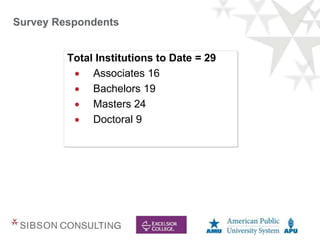
Total Institutions to Date = 29
 Associates 16
 Bachelors 19
 Masters 24
 Doctoral 9
5
Initial Findings: Current Workload
Adjunct Faculty Only
Teaching Load Per Year
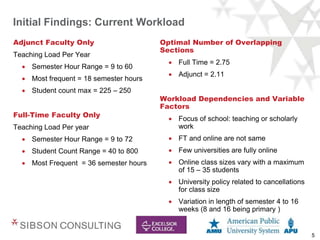
 Semester Hour Range = 9 to 60
 Most frequent = 18 semester hours
 Student count max = 225 – 250
Full-Time Faculty Only
Teaching Load Per year
 Semester Hour Range = 9 to 72
 Student Count Range = 40 to 800
 Most Frequent = 36 semester hours
Optimal Number of Overlapping
Sections
 Full Time = 2.75
 Adjunct = 2.11
Workload Dependencies and Variable
Factors
 Focus of school: teaching or scholarly
work
 FT and online are not same
 Few universities are fully online
 Online class sizes vary with a maximum
of 15 – 35 students
 University policy related to cancellations
for class size
 Variation in length of semester 4 to 16
weeks (8 and 16 being primary )
6
Initial Findings: Factors Influencing
Teaching Load and Student Success
Sum of All Responses
(Sum of 3 and 2 responses)
Factor Full Time Adjunct
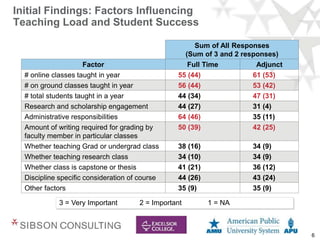
# online classes taught in year 55 (44) 61 (53)
# on ground classes taught in year 56 (44) 53 (42)
# total students taught in a year 44 (34) 47 (31)
Research and scholarship engagement 44 (27) 31 (4)
Administrative responsibilities 64 (46) 35 (11)
Amount of writing required for grading by
faculty member in particular classes
50 (39) 42 (25)
Whether teaching Grad or undergrad class 38 (16) 34 (9)
Whether teaching research class 34 (10) 34 (9)
Whether class is capstone or thesis 41 (21) 36 (12)
Discipline specific consideration of course 44 (26) 43 (24)
Other factors 35 (9) 35 (9)
3 = Very Important 2 = Important 1 = NA
7
Course and Section Load
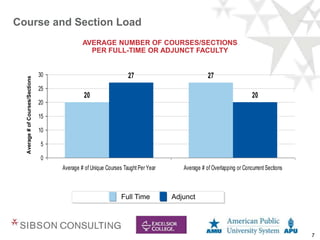
AVERAGE NUMBER OF COURSES/SECTIONS
PER FULL-TIME OR ADJUNCT FACULTY
20
27
27
20
0
5
10
15
20
25
30
Average # of Unique Courses Taught Per Year Average # of Overlapping or Concurrent Sections
Average
#
of
Courses/Sections
Full Time Adjunct
8
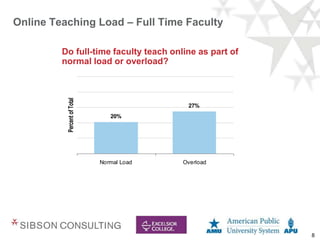
Online Teaching Load – Full Time Faculty
Do full-time faculty teach online as part of
normal load or overload?
20%
27%
Normal Load Overload
Percent
of
Total
9
20%
27%
20%
27%
Weekly Quarterly/Semester Annual
Average
Percent
of
Time
Research and Scholarship Applied Practice
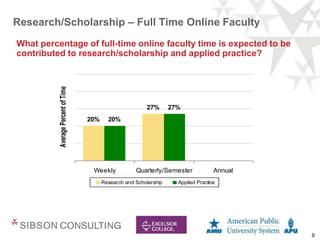
Research/Scholarship – Full Time Online Faculty
What percentage of full-time online faculty time is expected to be
contributed to research/scholarship and applied practice?
10
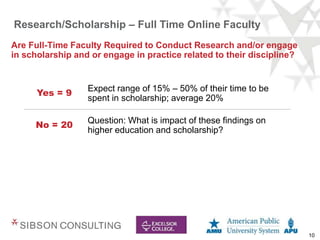
Are Full-Time Faculty Required to Conduct Research and/or engage
in scholarship and or engage in practice related to their discipline?
Yes = 9
Expect range of 15% – 50% of their time to be
spent in scholarship; average 20%
No = 20
Question: What is impact of these findings on
higher education and scholarship?
Research/Scholarship – Full Time Online Faculty
11
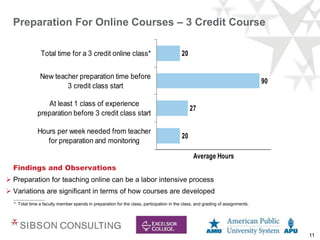
Preparation For Online Courses – 3 Credit Course
Findings and Observations
 Preparation for teaching online can be a labor intensive process
 Variations are significant in terms of how courses are developed
* Total time a faculty member spends in preparation for the class, participation in the class, and grading of assignments.
20
27
90
20
Hours per week needed from teacher
for preparation and monitoring
At least 1 class of experience
preparation before 3 credit class start
New teacher preparation time before
3 credit class start
Total time for a 3 credit online class*
Average Hours
12
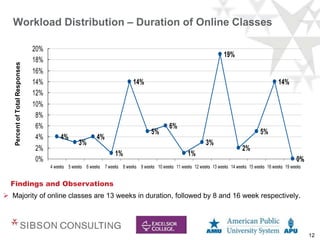
Workload Distribution – Duration of Online Classes
Findings and Observations
 Majority of online classes are 13 weeks in duration, followed by 8 and 16 week respectively.
4%
3%
4%
1%
14%
5%
6%
1%
3%
19%
2%
5%
14%
0%
0%
2%
4%
6%
8%
10%
12%
14%
16%
18%
20%
4 weeks 5 weeks 6 weeks 7 weeks 8 weeks 9 weeks 10 weeks 11 weeks 12 weeks 13 weeks 14 weeks 15 weeks 16 weeks 19 weeks
Percent
of
Total
Responses
13
Measures Used to Assess Quality
of Learning as Related to Faculty Workload
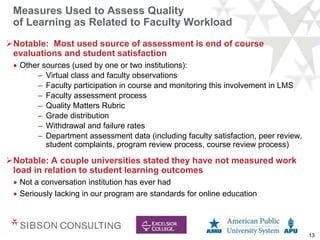
Notable: Most used source of assessment is end of course
evaluations and student satisfaction
 Other sources (used by one or two institutions):
– Virtual class and faculty observations
– Faculty participation in course and monitoring this involvement in LMS
– Faculty assessment process
– Quality Matters Rubric
– Grade distribution
– Withdrawal and failure rates
– Department assessment data (including faculty satisfaction, peer review,
student complaints, program review process, course review process)
Notable: A couple universities stated they have not measured work
load in relation to student learning outcomes
 Not a conversation institution has ever had
 Seriously lacking in our program are standards for online education
14
Write-in Factors Identified by Respondents as Impacting
Faculty Workload
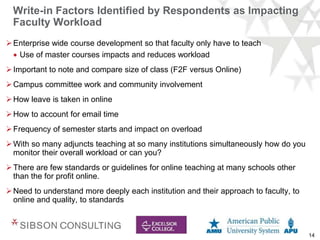
Enterprise wide course development so that faculty only have to teach
 Use of master courses impacts and reduces workload
Important to note and compare size of class (F2F versus Online)
Campus committee work and community involvement
How leave is taken in online
How to account for email time
Frequency of semester starts and impact on overload
With so many adjuncts teaching at so many institutions simultaneously how do you
monitor their overall workload or can you?
There are few standards or guidelines for online teaching at many schools other
than the for profit online.
Need to understand more deeply each institution and their approach to faculty, to
online and quality, to standards
15
Summary Findings To Date
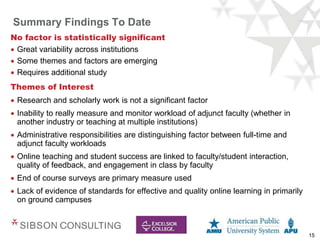
No factor is statistically significant
 Great variability across institutions
 Some themes and factors are emerging
 Requires additional study
Themes of Interest
 Research and scholarly work is not a significant factor
 Inability to really measure and monitor workload of adjunct faculty (whether in
another industry or teaching at multiple institutions)
 Administrative responsibilities are distinguishing factor between full-time and
adjunct faculty workloads
 Online teaching and student success are linked to faculty/student interaction,
quality of feedback, and engagement in class by faculty
 End of course surveys are primary measure used
 Lack of evidence of standards for effective and quality online learning in primarily
on ground campuses
16
Discussion of Open Ended Questions
What are the similarities and differences in online and F2F
faculty teaching workload?
How does faculty workload in online courses impact student
learning and student success?
What measures do you use to assess the quality of learning as
related to faculty workload?
What other factors about faculty workload were not addressed
here that you believe should be included in this study?
Describe why they are important
17
Thank You!
What additional questions do you have?
333 West 34th Street
New York, NY 10001-2402
212.251.5381
www.sibson.com
Karen Hutcheson
Senior Vice President, Sibson Consulting
khutcheson@sibson.com
Karan Powell
American Public University System
American Military University | American Public University
111 West Congress Street
Charles Town, WV 25414
304-724 2816 (office) 304 919 0423 (blackberry)
kpowell@apus.edu

2010 Exploring online faculty workload

  • 1.
    OPTIMIZING FACULTY WORKLOAD ANDLEARNING EFFECTIVENESS 2010 WCET Conference Karen Hutcheson – 212.251.5381 Dana Offerman, PhD – 518.464.8583 Karan Powell, PhD – 304.724.2816 November 12, 2010 Copyright ©2010 by The Segal Group, Inc., parent of The Segal Company and its Sibson Consulting Division. All Rights Reserved
  • 2.
    1 Session Objectives Present preliminarydata on survey for assessing online faculty workload  Workload definitions as they relate to full time and to adjunct faculty  Optimal workload for full-time online faculty and for online adjunct faculty  Effect workload has on student learning outcomes and success Discuss interrelationship between these issues and other factors that relate to faculty and student success Participate in ongoing national dialogue around this topic:  Dialogue about the findings  Discuss further research and next steps based upon these findings
  • 3.
    2 Introduction to theSurvey  Study began in 2007 with questions:  At APUS: optimal workload for online faculty  At Excelsior: faculty workload satisfaction  APUS Pilot Study 2008 – 2009  Faculty survey: self rating on perception of workload  Classroom observations of top 20 performing faculty based upon complexity, size and interactivity  Interviews with faculty regarding observations and their experience  Establish a baseline norm for optimal student load and course load for further testing  Nationwide study 2009 – 2012  Refine survey  WCET email list—29 institutions responding to date  Extend survey to other venues for participation in survey and qualitative discussion – Elearn in Orlando October 2010 – WCET in LaJolla November 2010 – Online Education Conference in Honolulu January 2011 – Others TBD  Collect additional data for surveys (nationally and extend it internationally)  Analyze findings  Publish findings late 2011 – early 2012
  • 4.
    3 Questions and DataGathering Methodology  Type of Institution: On ground / online / hybrid of both  Faculty teaching load:  Typical teaching load – Full time / adjunct – On ground / On-Line – Semester Hours – Number of Students  Factors influencing optimal annual faculty workload  Comparisons between on-line and on-ground  Time spent preparing – First time course is taught – Each term taught  Time spent communicating with students  Time spent traveling  Optimal number of students – Simultaneously in one semester – Over the year  Differences in presentation, assessment and instruction
  • 5.
    Survey Respondents Total Institutionsto Date = 29  Associates 16  Bachelors 19  Masters 24  Doctoral 9
  • 6.
    5 Initial Findings: CurrentWorkload Adjunct Faculty Only Teaching Load Per Year  Semester Hour Range = 9 to 60  Most frequent = 18 semester hours  Student count max = 225 – 250 Full-Time Faculty Only Teaching Load Per year  Semester Hour Range = 9 to 72  Student Count Range = 40 to 800  Most Frequent = 36 semester hours Optimal Number of Overlapping Sections  Full Time = 2.75  Adjunct = 2.11 Workload Dependencies and Variable Factors  Focus of school: teaching or scholarly work  FT and online are not same  Few universities are fully online  Online class sizes vary with a maximum of 15 – 35 students  University policy related to cancellations for class size  Variation in length of semester 4 to 16 weeks (8 and 16 being primary )
  • 7.
    6 Initial Findings: FactorsInfluencing Teaching Load and Student Success Sum of All Responses (Sum of 3 and 2 responses) Factor Full Time Adjunct # online classes taught in year 55 (44) 61 (53) # on ground classes taught in year 56 (44) 53 (42) # total students taught in a year 44 (34) 47 (31) Research and scholarship engagement 44 (27) 31 (4) Administrative responsibilities 64 (46) 35 (11) Amount of writing required for grading by faculty member in particular classes 50 (39) 42 (25) Whether teaching Grad or undergrad class 38 (16) 34 (9) Whether teaching research class 34 (10) 34 (9) Whether class is capstone or thesis 41 (21) 36 (12) Discipline specific consideration of course 44 (26) 43 (24) Other factors 35 (9) 35 (9) 3 = Very Important 2 = Important 1 = NA
  • 8.
    7 Course and SectionLoad AVERAGE NUMBER OF COURSES/SECTIONS PER FULL-TIME OR ADJUNCT FACULTY 20 27 27 20 0 5 10 15 20 25 30 Average # of Unique Courses Taught Per Year Average # of Overlapping or Concurrent Sections Average # of Courses/Sections Full Time Adjunct
  • 9.
    8 Online Teaching Load– Full Time Faculty Do full-time faculty teach online as part of normal load or overload? 20% 27% Normal Load Overload Percent of Total
  • 10.
    9 20% 27% 20% 27% Weekly Quarterly/Semester Annual Average Percent of Time Researchand Scholarship Applied Practice Research/Scholarship – Full Time Online Faculty What percentage of full-time online faculty time is expected to be contributed to research/scholarship and applied practice?
  • 11.
    10 Are Full-Time FacultyRequired to Conduct Research and/or engage in scholarship and or engage in practice related to their discipline? Yes = 9 Expect range of 15% – 50% of their time to be spent in scholarship; average 20% No = 20 Question: What is impact of these findings on higher education and scholarship? Research/Scholarship – Full Time Online Faculty
  • 12.
    11 Preparation For OnlineCourses – 3 Credit Course Findings and Observations  Preparation for teaching online can be a labor intensive process  Variations are significant in terms of how courses are developed * Total time a faculty member spends in preparation for the class, participation in the class, and grading of assignments. 20 27 90 20 Hours per week needed from teacher for preparation and monitoring At least 1 class of experience preparation before 3 credit class start New teacher preparation time before 3 credit class start Total time for a 3 credit online class* Average Hours
  • 13.
    12 Workload Distribution –Duration of Online Classes Findings and Observations  Majority of online classes are 13 weeks in duration, followed by 8 and 16 week respectively. 4% 3% 4% 1% 14% 5% 6% 1% 3% 19% 2% 5% 14% 0% 0% 2% 4% 6% 8% 10% 12% 14% 16% 18% 20% 4 weeks 5 weeks 6 weeks 7 weeks 8 weeks 9 weeks 10 weeks 11 weeks 12 weeks 13 weeks 14 weeks 15 weeks 16 weeks 19 weeks Percent of Total Responses
  • 14.
    13 Measures Used toAssess Quality of Learning as Related to Faculty Workload Notable: Most used source of assessment is end of course evaluations and student satisfaction  Other sources (used by one or two institutions): – Virtual class and faculty observations – Faculty participation in course and monitoring this involvement in LMS – Faculty assessment process – Quality Matters Rubric – Grade distribution – Withdrawal and failure rates – Department assessment data (including faculty satisfaction, peer review, student complaints, program review process, course review process) Notable: A couple universities stated they have not measured work load in relation to student learning outcomes  Not a conversation institution has ever had  Seriously lacking in our program are standards for online education
  • 15.
    14 Write-in Factors Identifiedby Respondents as Impacting Faculty Workload Enterprise wide course development so that faculty only have to teach  Use of master courses impacts and reduces workload Important to note and compare size of class (F2F versus Online) Campus committee work and community involvement How leave is taken in online How to account for email time Frequency of semester starts and impact on overload With so many adjuncts teaching at so many institutions simultaneously how do you monitor their overall workload or can you? There are few standards or guidelines for online teaching at many schools other than the for profit online. Need to understand more deeply each institution and their approach to faculty, to online and quality, to standards
  • 16.
    15 Summary Findings ToDate No factor is statistically significant  Great variability across institutions  Some themes and factors are emerging  Requires additional study Themes of Interest  Research and scholarly work is not a significant factor  Inability to really measure and monitor workload of adjunct faculty (whether in another industry or teaching at multiple institutions)  Administrative responsibilities are distinguishing factor between full-time and adjunct faculty workloads  Online teaching and student success are linked to faculty/student interaction, quality of feedback, and engagement in class by faculty  End of course surveys are primary measure used  Lack of evidence of standards for effective and quality online learning in primarily on ground campuses
  • 17.
    16 Discussion of OpenEnded Questions What are the similarities and differences in online and F2F faculty teaching workload? How does faculty workload in online courses impact student learning and student success? What measures do you use to assess the quality of learning as related to faculty workload? What other factors about faculty workload were not addressed here that you believe should be included in this study? Describe why they are important
  • 18.
    17 Thank You! What additionalquestions do you have? 333 West 34th Street New York, NY 10001-2402 212.251.5381 www.sibson.com Karen Hutcheson Senior Vice President, Sibson Consulting khutcheson@sibson.com Karan Powell American Public University System American Military University | American Public University 111 West Congress Street Charles Town, WV 25414 304-724 2816 (office) 304 919 0423 (blackberry) kpowell@apus.edu

Editor's Notes

  • #4 Study began in 2007 with question at APUS: What is the Optimal Online Faculty Workload? And at Excelsior about faculty workload satisfaction APUS Pilot Study 2008 – 2009 Faculty survey: self rating on perception of workload Classroom observations of top 20 performing faculty based upon complexity, size and interactivity Interviews with faculty regarding observations and their experience Establish a baseline norm for optimal student load and course load for further testing Nationwide study 2009 – 2012 Refine survey WCET email list—29 institutions responding to date Extend survey to other venues for participation in survey and qualitative discussion Elearn in Orlando October 2010 WCET in LaJolla November 2010 Online Education Conference in Honolulu January 2011 Others TBD Collect additional data for surveys (nationally and extend it internationally) Analyze findings Publish findings late 2011 – early 2012
  • #5 Type of Institution: On ground/online/hybrid of both Faculty teaching Load: What is typical annual teaching load for full time on ground? Online? For adjuncts on line? On ground? Number of semester hours annually? Number of students annually? What is optimal annual teaching load for full time online? For adjuncts online? On ground? Number of semester hours annually? Number of students annually? Dependent factors: What factors do you consider when determining optimal annual faculty workload? Factors of Online Compared to OnGround: How much time do you spend preparing for an online class vs an on ground class the first time it is taught? How much time do you spend preparing for an online vs an on ground class each term it is taught? How much time do you spend communicating with students face to face vs online each week? How much time do you spend traveling to and from face to face classes each week? How many students can an instructor effectively teach in your discipline area face to face simultaneously in one semester? Over the course of one academic year? How about online? In what ways do you present, assess, or instruct differently on ground versus online?
  • #7 Measures reported as ways to evaluate onlinei faculty workload and student success End of course evals and student satisfaction XXXXXXXXX Virtual Class and faculty observations XX Faculty participation in course and monitoring this involvement in LMS X Faculty assessment process X Quality Matters Rubric X Blackboard Exemplary Course Program Established National Standards for Online Courses Grade distribution X Withdrawal and failure rates X Success in later courses Department assessment data Faculty satisfaction Peer review Student Complaints Program Review Process Course Review Process Have not measured work load in relation to student learning outcomes Not a conversation institution has ever had Seriously lacking in our program Online Class length weeks = 14 16 weeks = 14 10 weeks = 6 15 weeks = 5 4 weeks = 4 6 weeks = 4 5 weeks = 3 12 weeks = 3 14 weeks = 2 7 weeks = 1 11 weeks = 1 13 weeks = 1 9 weeks = 0
  • #8 Full Time Want FT faculty engaged in on campus life and not teaching online all the time Teaching online provides room to teach a variety of courses Accelerated learning classes are more intense, discussions are ongoing, assignments come in all the time More than 2 classes per semester detracts from other faculty responsibilities Online workload is heavy at times Depends on total teaching load and whether faculty teach solely on line or a mix of online and on ground Excessive faculty workload will result in poor student learning outcomes Faculty need to remain fresh with current ideas and practice . . Only one new course per year should be allowed Mission as a teaching institution Balance workload to provide attention to students and Adjuncts Recognition of Work of faculty in addition to adjunct teaching X X X X Quality of instruction XXX Encourage student and faculty interaction and engagement XXX Student success X X Demand of accelerated courses Limit faculty preparations to two How does faculty workload in online courses impact student learning and student success? Requires effective student and faculty engagement X X X X Too much work impacts student success –less time to pay attention to students X X X X Provide sufficient feedback X X Facilitate, guide discussions Need for more time in corresponding with students impacts student success Mission of university is care for person workload impacts quality of care Need a balance between instruction and scholarly activities to support student learning Faculty need time to think, reflect, respond to students and too great a workload impacts this time Class sizes of 30 – 35 have better completion rates and better grades than smaller class sizes (according to eCollege statistics) Larger class sizes actually reduces faculty workload as faculty have fewer preps and students engage in more peer to peer learning Outlier: Faculty workload does not correlate to student success
  • #17 Are Full Time Faculty Required to Conduct Research and/or engaged in scholarship and/or engage in practice related to their discipline? Yes = 9 Expect range of 15 - 50% of their time to be spent in scholarship; average 20% No = 20 Questions this raises: What is impact for future of disciplines and quality of teaching and learning with lack of scholarly, current and evolving knowledge and theory How do we encourage practitioner scholarship for online faculty?