Making the link and seizing
opportunities: the PGCert and my
development as a teacher (so far)
      Sarah Oxford
      Academic Liaison Librarian
      Institute of Education, University of
      Worcester

                 LILAC, April 2011
What’s coming...
 Background
 Why  the PG Cert?
 What’s involved
 The reality!
 Where I am now
 Opportunities and developments during the
  course and beyond
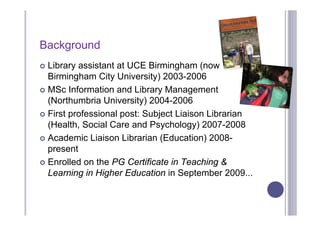
Background
 Library assistant at UCE Birmingham (now
  Birmingham City University) 2003-2006
 MSc Information and Library Management
  (Northumbria University) 2004-2006
 First professional post: Subject Liaison Librarian
  (Health, Social Care and Psychology) 2007-2008
 Academic Liaison Librarian (Education) 2008-
  present
 Enrolled on the PG Certificate in Teaching &
  Learning in Higher Education in September 2009...
Why the PG Cert? (1)
 Course compulsory for ‘inexperienced’ new
  academic staff
 What about librarians? Greater educational role but
  lack of formal training and knowledge (Bewick and
  Corrall 2010; Petrinic & Urquhart 2007)
 Acquire new ideas and offer a better learning
  experience
 Opportunity to reflect

 Something else for the CV!

 (...And library management gently encouraged us)
Why the PG Cert? (2)
 Accredited by Staff and Educational Development
  Association (http://www.seda.ac.uk/) and Higher
  Education Academy (http://www.heacademy.ac.uk/)
 “The PG Cert is accredited as the learning teaching
  and assessment SEDA named award and at
  Fellowship level with the HE Academy.”
 “Completion of the PG Cert meets level 2 of the UK
  Professional Standards for Teachers in HE.”
 First module MEDD4144 = level 1 of Standards/
  Associate Fellowship
What’s involved
   3 modules:
     MEDD4144 Supporting Student Learning
     MEDD4142 Learning, Teaching and Assessment
     MEDD4143 Introduction to Academic Practice

 Minimum six peer observations
 Lots of reflection and discussion on taught days

 Starts with an audit of experience and needs as a
  starting point
 Assessment – demonstrate that you have met the
  learning outcomes and professional values through
  your practice
The reality!
 ‘What do you teach?’ .... ‘Why are you here then?’
 From student to teacher

 Librarian seeks guinea pigs, will work for PG Cert
  grades
 Formative assessment counts

 ‘Study leave’

 More teaching – is it sustainable? Expectations

 Putting yourself in context

(see reference lists)
Where I am now
                                                   (not me,
                                                   yet)
   Completed and passed first two
    modules (hurrah)

   About to write up the action research
    project for the third module (due June, eek)

 Closer working relationships with
academic staff and tutors on the
course, and within the Institute
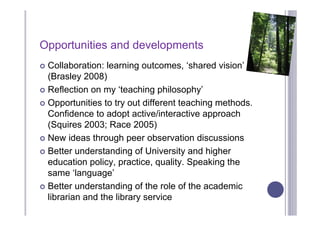
Opportunities and developments
 Collaboration: learning outcomes, ‘shared vision’
  (Brasley 2008)
 Reflection on my ‘teaching philosophy’

 Opportunities to try out different teaching methods.
  Confidence to adopt active/interactive approach
  (Squires 2003; Race 2005)
 New ideas through peer observation discussions

 Better understanding of University and higher
  education policy, practice, quality. Speaking the
  same ‘language’
 Better understanding of the role of the academic
  librarian and the library service
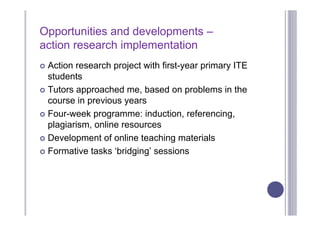
Opportunities and developments –
action research implementation
 Action research project with first-year primary ITE
  students
 Tutors approached me, based on problems in the
  course in previous years
 Four-week programme: induction, referencing,
  plagiarism, online resources
 Development of online teaching materials

 Formative tasks ‘bridging’ sessions
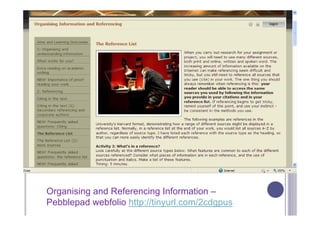
Organising and Referencing Information –
Pebblepad webfolio http://tinyurl.com/2cdgpus
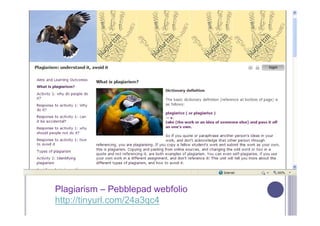
Plagiarism – Pebblepad webfolio
http://tinyurl.com/24a3qc4
Opportunities and developments –
action research evaluation
 Initial survey of students’ needs and prior
  experience in referencing, plagiarism, finding and
  using information
 Teaching materials and handouts developed based
  on student feedback
 More teaching in semester 2 because of demand

 Follow-up surveys to assess impact of the teaching
  programme
 Grade comparisons (due July)
Opportunities and developments
 – the word spreads
 Lots of student queries, greater awareness of librarian
  and library service
 New materials for the team to use/adapt
 Challenged assumptions of what new undergraduates
  already know
 Requests from tutors on other courses for similar
  teaching for their students – or themselves!
“The extra sessions with Sarah have made a big difference to year 1
  students academic work… Please could you run a session for the
  PDRP and Research methods staff in early September so that we
  can support the students in their literature reviews.” (comment from
  tutor survey, Feb 2011)
Because it’s worth it
 Might never have done all this if not for the course
 Networking opportunities are priceless

 Addresses the ‘missing element’ of librarianship
  courses?
 Embedding IL teaching in university curricula – a
  step toward making it a reality?
 Consider use of terminology carefully e.g. wider set
  of ‘academic skills’ vs ‘information literacy’?
    (“If faculty do not have information literacy properly defined for
    them, it can be difficult to understand how it fits into the
    mission of the university.” Travis 2008: p.18)
References
   Academic Development and Practice Unit (2011) PG Cert in Learning & Teaching in HE. [Online] Available from: 
    http://www.worc.ac.uk/adpu/631.htm [Accessed 28th March 2011].
   Brasley, S.S. (2008) Effective librarian and discipline faculty collaboration models for integrating information literacy 
    into the fabric of an academic institution. New Directions in Teaching and Learning. [Online] 114, 71‐88. Available from: 
    Academic Search Complete [Accessed 4th April 2011].
   Bewick, L. & Corrall, S. (2010) Developing librarians as teachers: A study of their pedagogical knowledge. Journal of 
    Librarianship and Information Science. [Online] 42 (2), 97‐110. Available from Sage Journals Online [Accessed 4th April 
    2011].
   Higher Education Academy  (2007)  The UK Professional Standards Framework  for teaching and supporting learning in 
    higher education. [Online] Available from: 
    http://www.heacademy.ac.uk/assets/York/documents/ourwork/rewardandrecog/ProfessionalStandardsFramework.pd
    f [Accessed 28th March 2011].
   KitAy (2008) Glade. Flickr. [Online] Available from: http://www.flickr.com/photos/kitpfish/2699511537/ [Accessed 9th
    December 2010].
   Petrinic, T. & Urquhart, C. (2007) The education and training needs of health librarians—the generalist versus specialist 
    dilemma. Health Information and Libraries Journal. [Online] 24, 167‐16. Available from Academic Search Complete 
    [Accessed 5th April 2011].
   Race, P. (2005) Making learning happen: a guide for post‐compulsory education. London, SAGE.
   ralph and jenny (2010) Graduated! Flckr. [Online] Available from: 
    http://www.flickr.com/photos/ralphandjenny/4612732045/ [Accessed 28th March 2011].
   Squires, G. (2003) Trouble‐shooting your teaching: a step‐by‐step guide to analysing and improving your practice. 
    London and USA, Kogan Page.
   Travis, T.A. (2008) Librarians as Agents of Change: Working with Curriculum Committees Using Change Agency Theory. 
    New Directions in Teaching and Learning. [Online] 114, 17‐33. Available from: Academic Search Complete [Accessed 4th
    April 2011].
   Unknown (2011)  Thesis still not done,huh? [Online] Available from: 
    http://icanhascheezburger.files.wordpress.com/2011/04/funny‐pictures‐thesis‐still‐not‐done‐huh.jpg [Accessed 8th April 2011].
   Unknown (2010) I not crazy. My reality  jus diffrent. [Online] Available from: 
    http://dogs.icanhascheezburger.com/2010/07/17/funny‐dog‐pictures‐i‐not‐crazy/ [Accessed 8th April 2011].
Useful references relating to the PG Cert
(See also: module handbooks at http://www.worc.ac.uk/adpu/631.htm)
    Biggs, J. & Tang, C. (2007) Teaching for Quality Learning at University. 3rd edition. Maidenhead, Open 
     University Press.
    Brockbank, A. and McGill, I. (2007) Facilitating reflective learning in higher education. 2nd edition. 
     Maidenhead, Open University Press.
    Butcher, C., Davies, C. and Highton, M. (2006) Designing learning: from module outline to effective 
     teaching. Abingdon, Routledge. 
    Fry, H., Ketteridge, S. and Marshall, S. (2009) (eds.) A handbook for teaching and learning in higher 
     education: enhancing academic practice. 3rd edition. Abingdon, Routledge.
    HEA: Academy Exchange. Publication at: http://www.heacademy.ac.uk/resources/publications/exchange
    HEA: EvidenceNet repository. Available from: http://www.heacademy.ac.uk/evidencenet/
    Lupton, M. (2008) Evidence, argument and social responsibility: first‐year students’ experiences of 
     information literacy when researching an essay. Higher Education Research and Development. [Online] 27 
     (4), 399‐414. Available from: Academic Search Complete [Accessed 21st December 2009].
    Librarians as Teachers Network: http://latnetwork.spruz.com
    Mackey, T.P. and Jacobsen, T.E. (2010) (eds.) Collaborative information literacy assessments: strategies for 
     evaluating teaching and learning. London, Facet.
    Norton, L.S. (2009) Action Research in Teaching and Learning. A Practical Guide to Conducting Pedagogical 
     Research in Universities. Abingdon, Routledge
    Orme, W.A. (2008) Information literacy and first‐year students. New Directions for Teaching and Learning. 
     [Online] 114, 63‐70. Available from: Wiley Interscience [Accessed 2nd June 2010].
    QAA (2008) Framework for Higher Education Qualifications in England, Wales and Northern Ireland (FHEQ).
     Revised edition. QAA 264 08/08. [Online] Available from 
     http://www.qaa.ac.uk/academicinfrastructure/FHEQ/EWNI08/default.asp [Accessed 4th April 2011].
    Webb, J. and Powis, C. (2004) Teaching information skills: theory and practice. London, Facet. 

Oxford - Making the link and seizing opportunities: the PGCert and my development as a teacher (so far)

  • 1.
    Making the linkand seizing opportunities: the PGCert and my development as a teacher (so far) Sarah Oxford Academic Liaison Librarian Institute of Education, University of Worcester LILAC, April 2011
  • 2.
    What’s coming...  Background Why the PG Cert?  What’s involved  The reality!  Where I am now  Opportunities and developments during the course and beyond
  • 3.
    Background  Library assistantat UCE Birmingham (now Birmingham City University) 2003-2006  MSc Information and Library Management (Northumbria University) 2004-2006  First professional post: Subject Liaison Librarian (Health, Social Care and Psychology) 2007-2008  Academic Liaison Librarian (Education) 2008- present  Enrolled on the PG Certificate in Teaching & Learning in Higher Education in September 2009...
  • 4.
    Why the PGCert? (1)  Course compulsory for ‘inexperienced’ new academic staff  What about librarians? Greater educational role but lack of formal training and knowledge (Bewick and Corrall 2010; Petrinic & Urquhart 2007)  Acquire new ideas and offer a better learning experience  Opportunity to reflect  Something else for the CV!  (...And library management gently encouraged us)
  • 5.
    Why the PGCert? (2)  Accredited by Staff and Educational Development Association (http://www.seda.ac.uk/) and Higher Education Academy (http://www.heacademy.ac.uk/)  “The PG Cert is accredited as the learning teaching and assessment SEDA named award and at Fellowship level with the HE Academy.”  “Completion of the PG Cert meets level 2 of the UK Professional Standards for Teachers in HE.”  First module MEDD4144 = level 1 of Standards/ Associate Fellowship
  • 6.
    What’s involved  3 modules:  MEDD4144 Supporting Student Learning  MEDD4142 Learning, Teaching and Assessment  MEDD4143 Introduction to Academic Practice  Minimum six peer observations  Lots of reflection and discussion on taught days  Starts with an audit of experience and needs as a starting point  Assessment – demonstrate that you have met the learning outcomes and professional values through your practice
  • 7.
    The reality!  ‘Whatdo you teach?’ .... ‘Why are you here then?’  From student to teacher  Librarian seeks guinea pigs, will work for PG Cert grades  Formative assessment counts  ‘Study leave’  More teaching – is it sustainable? Expectations  Putting yourself in context (see reference lists)
  • 8.
    Where I amnow (not me, yet)  Completed and passed first two modules (hurrah)  About to write up the action research project for the third module (due June, eek)  Closer working relationships with academic staff and tutors on the course, and within the Institute
  • 9.
    Opportunities and developments Collaboration: learning outcomes, ‘shared vision’ (Brasley 2008)  Reflection on my ‘teaching philosophy’  Opportunities to try out different teaching methods. Confidence to adopt active/interactive approach (Squires 2003; Race 2005)  New ideas through peer observation discussions  Better understanding of University and higher education policy, practice, quality. Speaking the same ‘language’  Better understanding of the role of the academic librarian and the library service
  • 10.
    Opportunities and developments– action research implementation  Action research project with first-year primary ITE students  Tutors approached me, based on problems in the course in previous years  Four-week programme: induction, referencing, plagiarism, online resources  Development of online teaching materials  Formative tasks ‘bridging’ sessions
  • 11.
    Organising and ReferencingInformation – Pebblepad webfolio http://tinyurl.com/2cdgpus
  • 12.
    Plagiarism – Pebblepadwebfolio http://tinyurl.com/24a3qc4
  • 13.
    Opportunities and developments– action research evaluation  Initial survey of students’ needs and prior experience in referencing, plagiarism, finding and using information  Teaching materials and handouts developed based on student feedback  More teaching in semester 2 because of demand  Follow-up surveys to assess impact of the teaching programme  Grade comparisons (due July)
  • 14.
    Opportunities and developments – the word spreads  Lots of student queries, greater awareness of librarian and library service  New materials for the team to use/adapt  Challenged assumptions of what new undergraduates already know  Requests from tutors on other courses for similar teaching for their students – or themselves! “The extra sessions with Sarah have made a big difference to year 1 students academic work… Please could you run a session for the PDRP and Research methods staff in early September so that we can support the students in their literature reviews.” (comment from tutor survey, Feb 2011)
  • 15.
    Because it’s worthit  Might never have done all this if not for the course  Networking opportunities are priceless  Addresses the ‘missing element’ of librarianship courses?  Embedding IL teaching in university curricula – a step toward making it a reality?  Consider use of terminology carefully e.g. wider set of ‘academic skills’ vs ‘information literacy’? (“If faculty do not have information literacy properly defined for them, it can be difficult to understand how it fits into the mission of the university.” Travis 2008: p.18)
  • 16.
    References  Academic Development and Practice Unit (2011) PG Cert in Learning & Teaching in HE. [Online] Available from:  http://www.worc.ac.uk/adpu/631.htm [Accessed 28th March 2011].  Brasley, S.S. (2008) Effective librarian and discipline faculty collaboration models for integrating information literacy  into the fabric of an academic institution. New Directions in Teaching and Learning. [Online] 114, 71‐88. Available from:  Academic Search Complete [Accessed 4th April 2011].  Bewick, L. & Corrall, S. (2010) Developing librarians as teachers: A study of their pedagogical knowledge. Journal of  Librarianship and Information Science. [Online] 42 (2), 97‐110. Available from Sage Journals Online [Accessed 4th April  2011].  Higher Education Academy  (2007)  The UK Professional Standards Framework  for teaching and supporting learning in  higher education. [Online] Available from:  http://www.heacademy.ac.uk/assets/York/documents/ourwork/rewardandrecog/ProfessionalStandardsFramework.pd f [Accessed 28th March 2011].  KitAy (2008) Glade. Flickr. [Online] Available from: http://www.flickr.com/photos/kitpfish/2699511537/ [Accessed 9th December 2010].  Petrinic, T. & Urquhart, C. (2007) The education and training needs of health librarians—the generalist versus specialist  dilemma. Health Information and Libraries Journal. [Online] 24, 167‐16. Available from Academic Search Complete  [Accessed 5th April 2011].  Race, P. (2005) Making learning happen: a guide for post‐compulsory education. London, SAGE.  ralph and jenny (2010) Graduated! Flckr. [Online] Available from:  http://www.flickr.com/photos/ralphandjenny/4612732045/ [Accessed 28th March 2011].  Squires, G. (2003) Trouble‐shooting your teaching: a step‐by‐step guide to analysing and improving your practice.  London and USA, Kogan Page.  Travis, T.A. (2008) Librarians as Agents of Change: Working with Curriculum Committees Using Change Agency Theory.  New Directions in Teaching and Learning. [Online] 114, 17‐33. Available from: Academic Search Complete [Accessed 4th April 2011].  Unknown (2011)  Thesis still not done,huh? [Online] Available from:  http://icanhascheezburger.files.wordpress.com/2011/04/funny‐pictures‐thesis‐still‐not‐done‐huh.jpg [Accessed 8th April 2011].  Unknown (2010) I not crazy. My reality  jus diffrent. [Online] Available from:  http://dogs.icanhascheezburger.com/2010/07/17/funny‐dog‐pictures‐i‐not‐crazy/ [Accessed 8th April 2011].
  • 17.
    Useful references relatingto the PG Cert (See also: module handbooks at http://www.worc.ac.uk/adpu/631.htm)  Biggs, J. & Tang, C. (2007) Teaching for Quality Learning at University. 3rd edition. Maidenhead, Open  University Press.  Brockbank, A. and McGill, I. (2007) Facilitating reflective learning in higher education. 2nd edition.  Maidenhead, Open University Press.  Butcher, C., Davies, C. and Highton, M. (2006) Designing learning: from module outline to effective  teaching. Abingdon, Routledge.   Fry, H., Ketteridge, S. and Marshall, S. (2009) (eds.) A handbook for teaching and learning in higher  education: enhancing academic practice. 3rd edition. Abingdon, Routledge.  HEA: Academy Exchange. Publication at: http://www.heacademy.ac.uk/resources/publications/exchange  HEA: EvidenceNet repository. Available from: http://www.heacademy.ac.uk/evidencenet/  Lupton, M. (2008) Evidence, argument and social responsibility: first‐year students’ experiences of  information literacy when researching an essay. Higher Education Research and Development. [Online] 27  (4), 399‐414. Available from: Academic Search Complete [Accessed 21st December 2009].  Librarians as Teachers Network: http://latnetwork.spruz.com  Mackey, T.P. and Jacobsen, T.E. (2010) (eds.) Collaborative information literacy assessments: strategies for  evaluating teaching and learning. London, Facet.  Norton, L.S. (2009) Action Research in Teaching and Learning. A Practical Guide to Conducting Pedagogical  Research in Universities. Abingdon, Routledge  Orme, W.A. (2008) Information literacy and first‐year students. New Directions for Teaching and Learning.  [Online] 114, 63‐70. Available from: Wiley Interscience [Accessed 2nd June 2010].  QAA (2008) Framework for Higher Education Qualifications in England, Wales and Northern Ireland (FHEQ). Revised edition. QAA 264 08/08. [Online] Available from  http://www.qaa.ac.uk/academicinfrastructure/FHEQ/EWNI08/default.asp [Accessed 4th April 2011].  Webb, J. and Powis, C. (2004) Teaching information skills: theory and practice. London, Facet.