240-373
Image Processing

240-373: Chapter

Montri
Karnjanadecha
montri@coe.psu.ac.t
h
http://
fivedots.coe.psu.ac.t
h/~montri
1
Chapter 14
The Frequency
Domain
240-373: Chapter

2
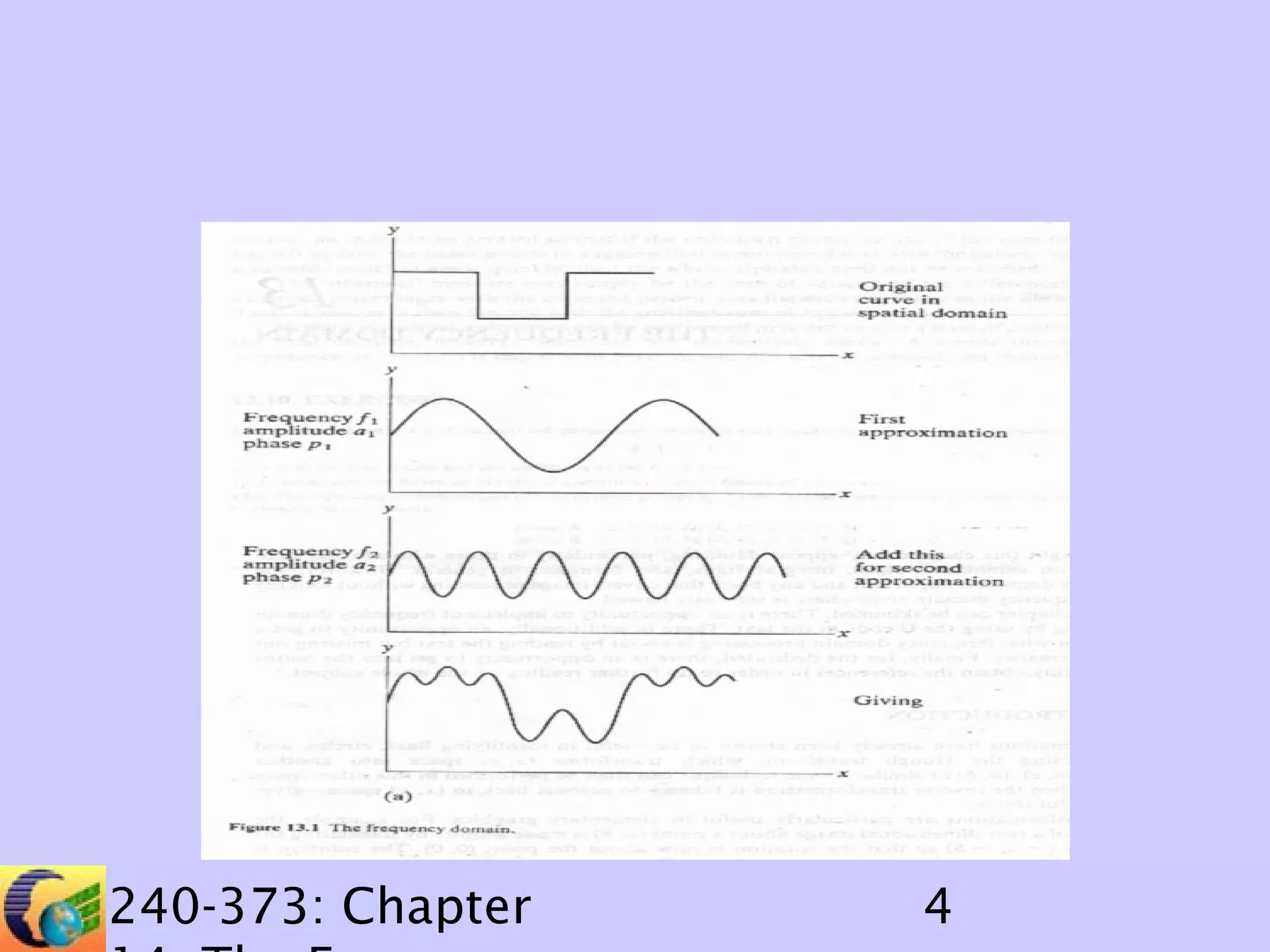
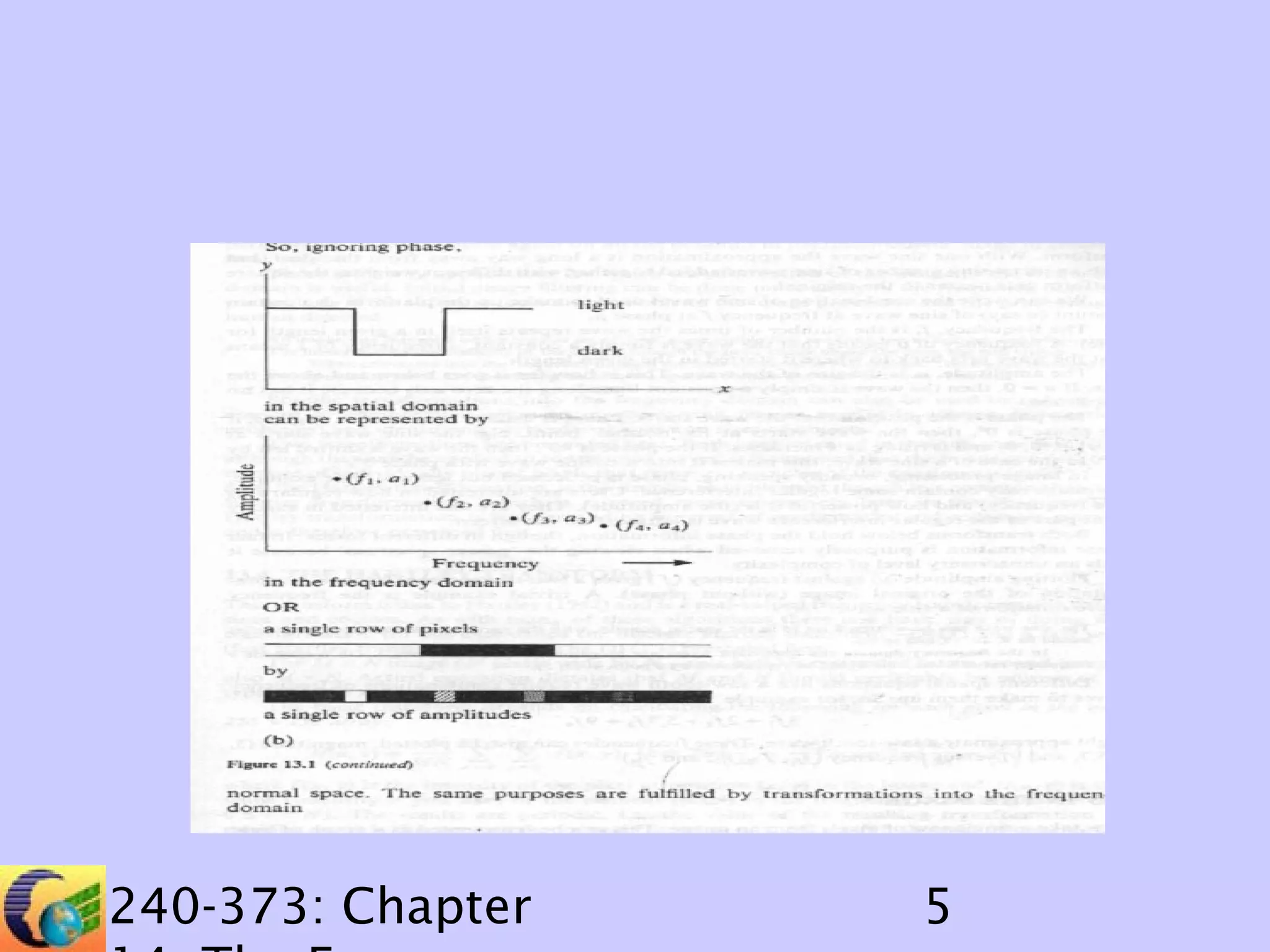
The Frequency Domain
• Any wave shape can be approximated by a
sum of periodic (such as sine and cosine)
functions.
• a--amplitude of waveform
• f-- frequency (number of times the wave
repeats itself in a given length)
• p--phase (position that the wave starts)
• Usually phase is ignored in image processing
240-373: Chapter

3
240-373: Chapter

4
240-373: Chapter

5
The Hartley Transform
• Discrete Hartley Transform (DHT)
– The M x N image is converted into a second
image (also M x N)
– M and N should be power of 2 (e.g. .., 128, 256,
512, etc.)
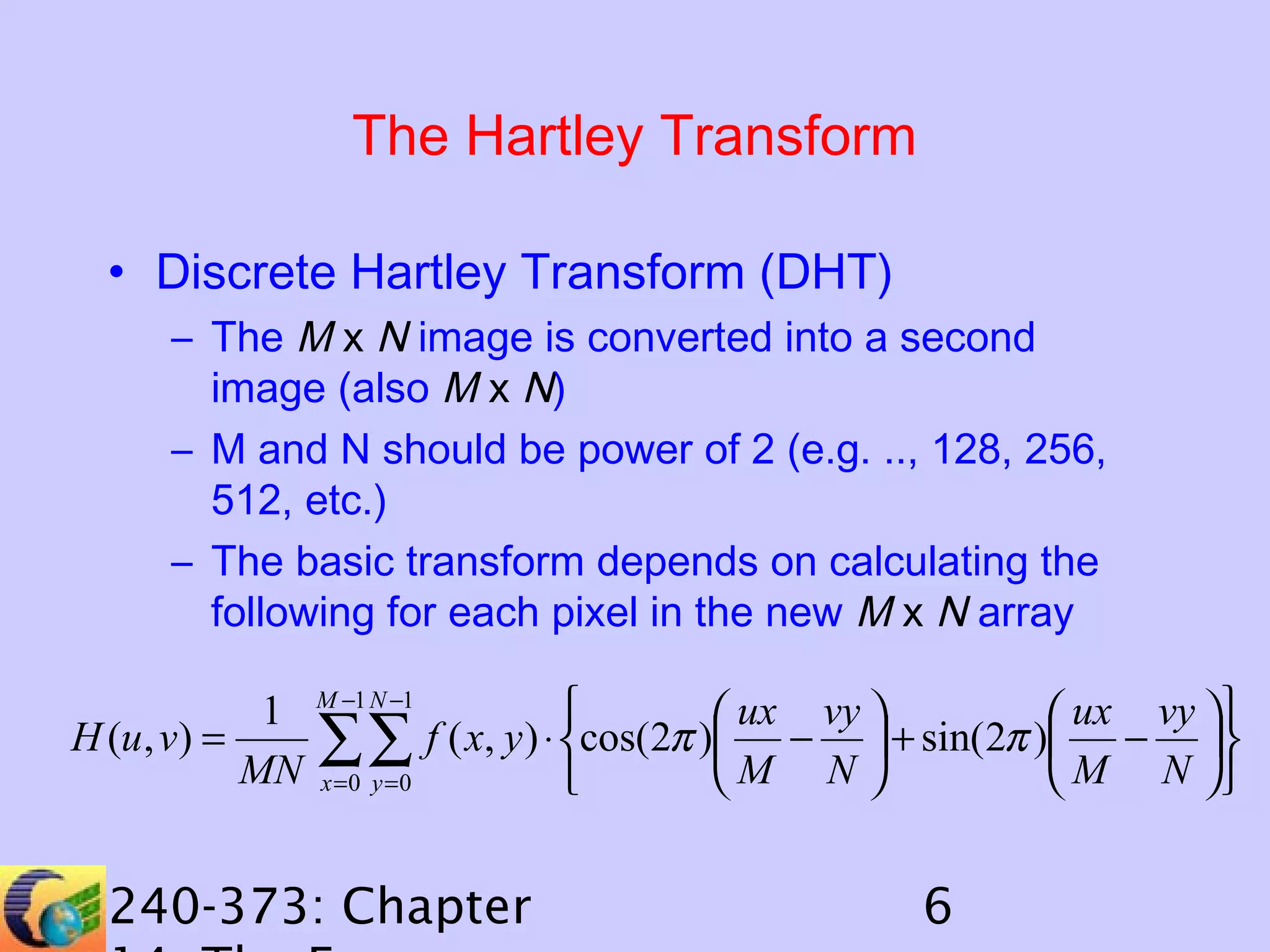
– The basic transform depends on calculating the
following for each pixel in the new M x N array
1
H (u , v) =
MN

M −1 N −1

∑∑
x =0 y =0


 ux vy 
 ux vy 
f ( x, y ) ⋅ cos(2π ) −  + sin( 2π ) − 
M N 
 M N 


240-373: Chapter

6
The Hartley Transform
where f(x,y) is the intensity of the pixel at position
(x,y)
H(u,v) is the value of element in frequency domain
– The results are periodic
– The cosine+sine (CAS) term is call “the kernel of
the transformation” (or ”basis function”)

240-373: Chapter

7
The Hartley Transform
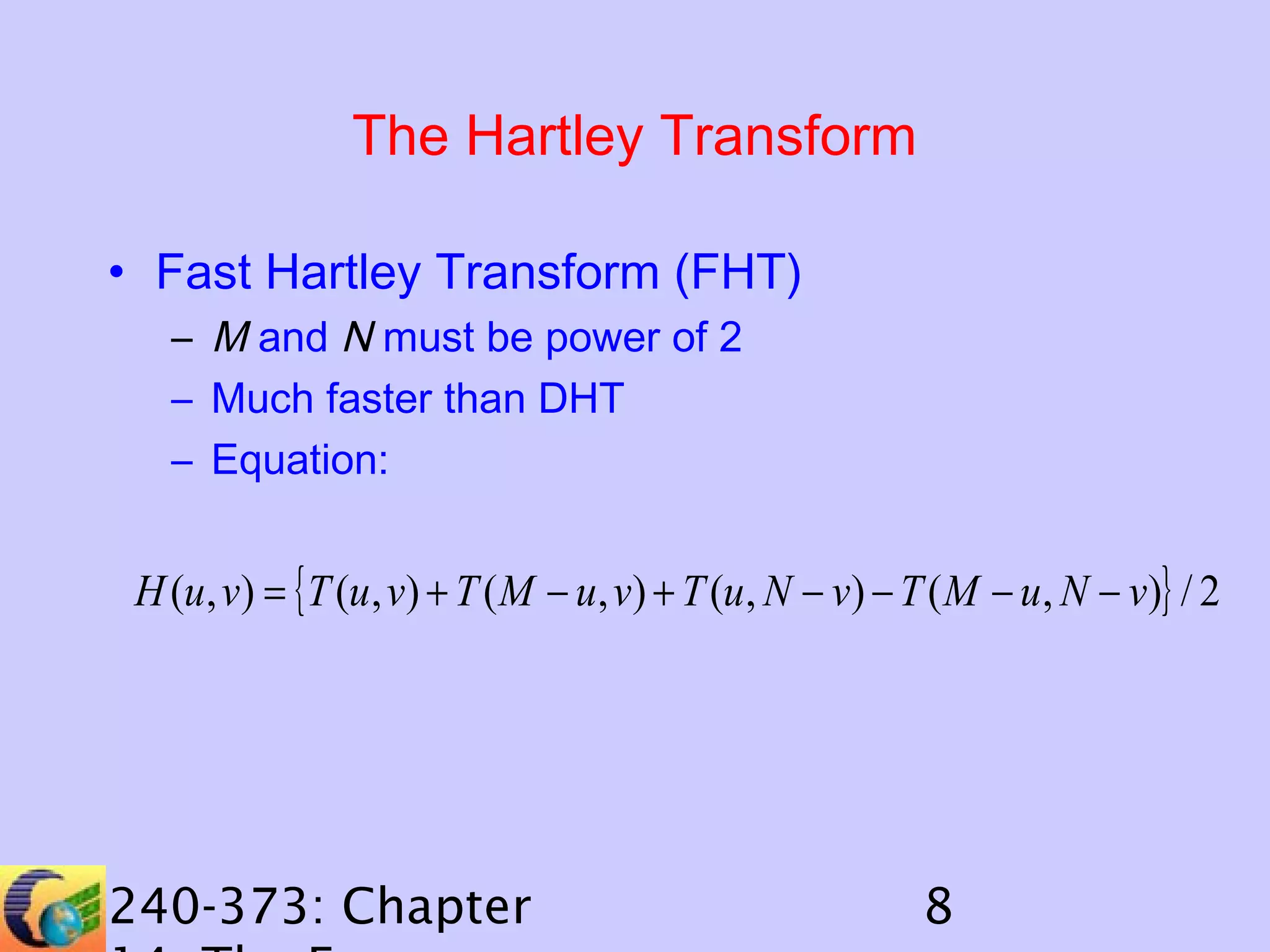
• Fast Hartley Transform (FHT)
– M and N must be power of 2
– Much faster than DHT
– Equation:

H (u, v) = { T (u , v) + T ( M − u, v) + T (u , N − v) − T ( M − u , N − v)} / 2

240-373: Chapter

8
The Fourier Transform
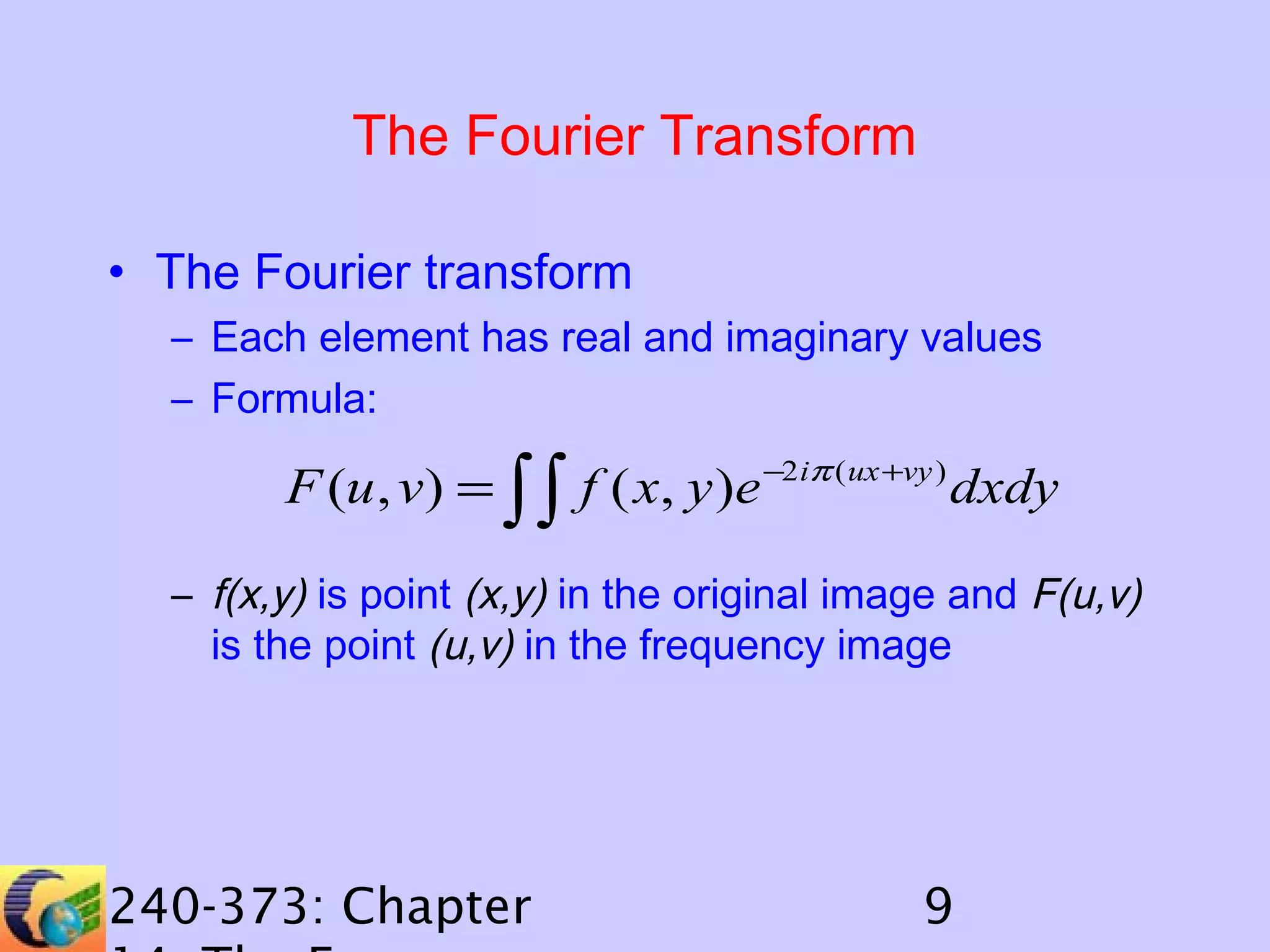
• The Fourier transform
– Each element has real and imaginary values
– Formula:

F (u , v) = ∫∫ f ( x, y )e −2iπ ( ux +vy ) dxdy
– f(x,y) is point (x,y) in the original image and F(u,v)
is the point (u,v) in the frequency image

240-373: Chapter

9
The Fourier Transform
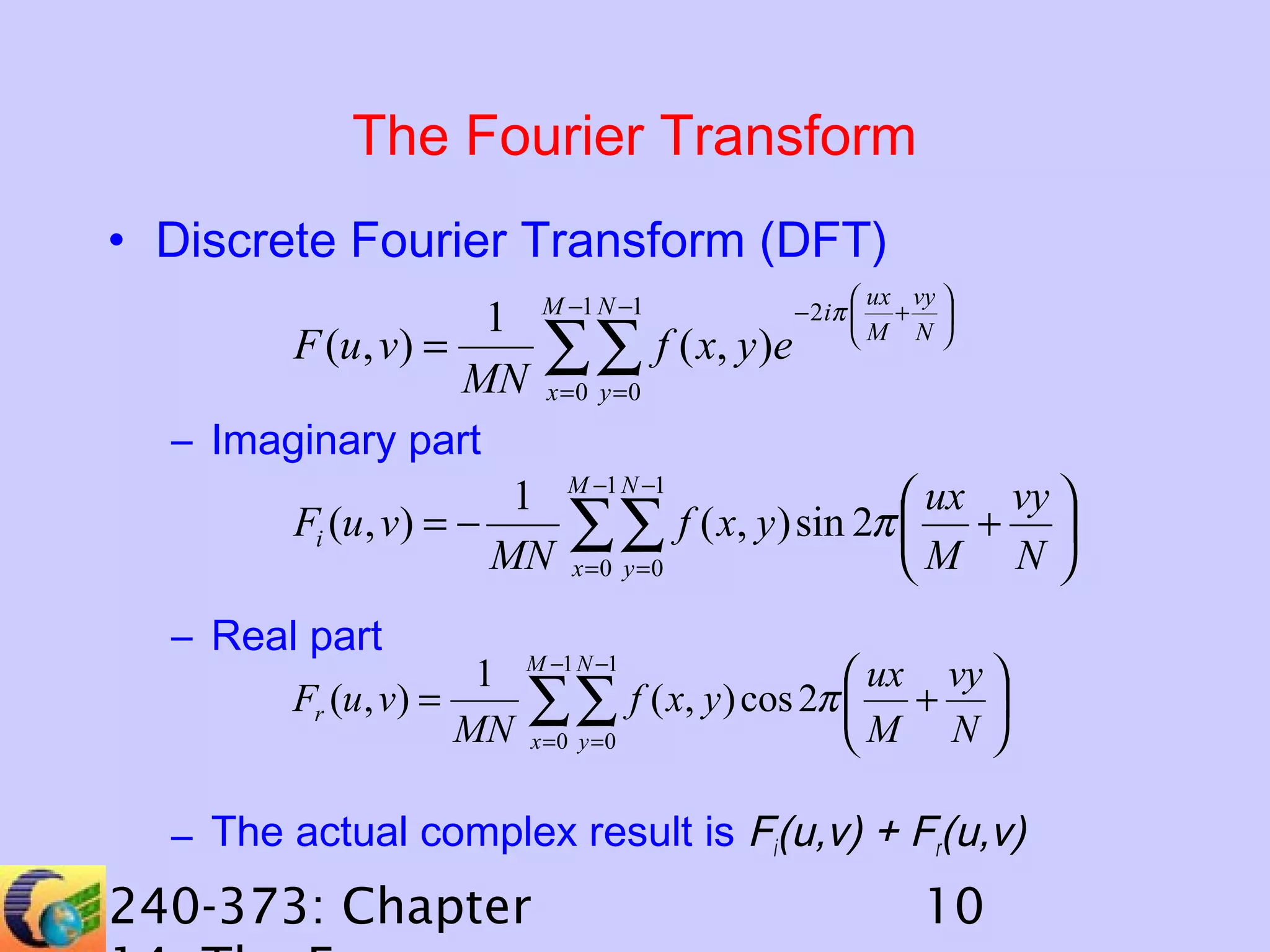
• Discrete Fourier Transform (DFT)
 ux vy 

− 2 iπ  + 
1 M −1 N −1
F (u, v) =
f ( x, y )e  M N 
∑∑
MN x =0 y =0
– Imaginary part
1 M −1 N −1
 ux vy 
Fi (u, v) = −
f ( x, y ) sin 2π  + 
∑∑
MN x =0 y =0
M N 

– Real part

1
Fr (u , v) =
MN

M −1 N −1

∑∑
x =0 y =0

 ux vy 
f ( x, y ) cos 2π  + 
M N 

– The actual complex result is Fi(u,v) + Fr(u,v)

240-373: Chapter

10
Fourier Power Spectrum and Inverse
Fourier Transform
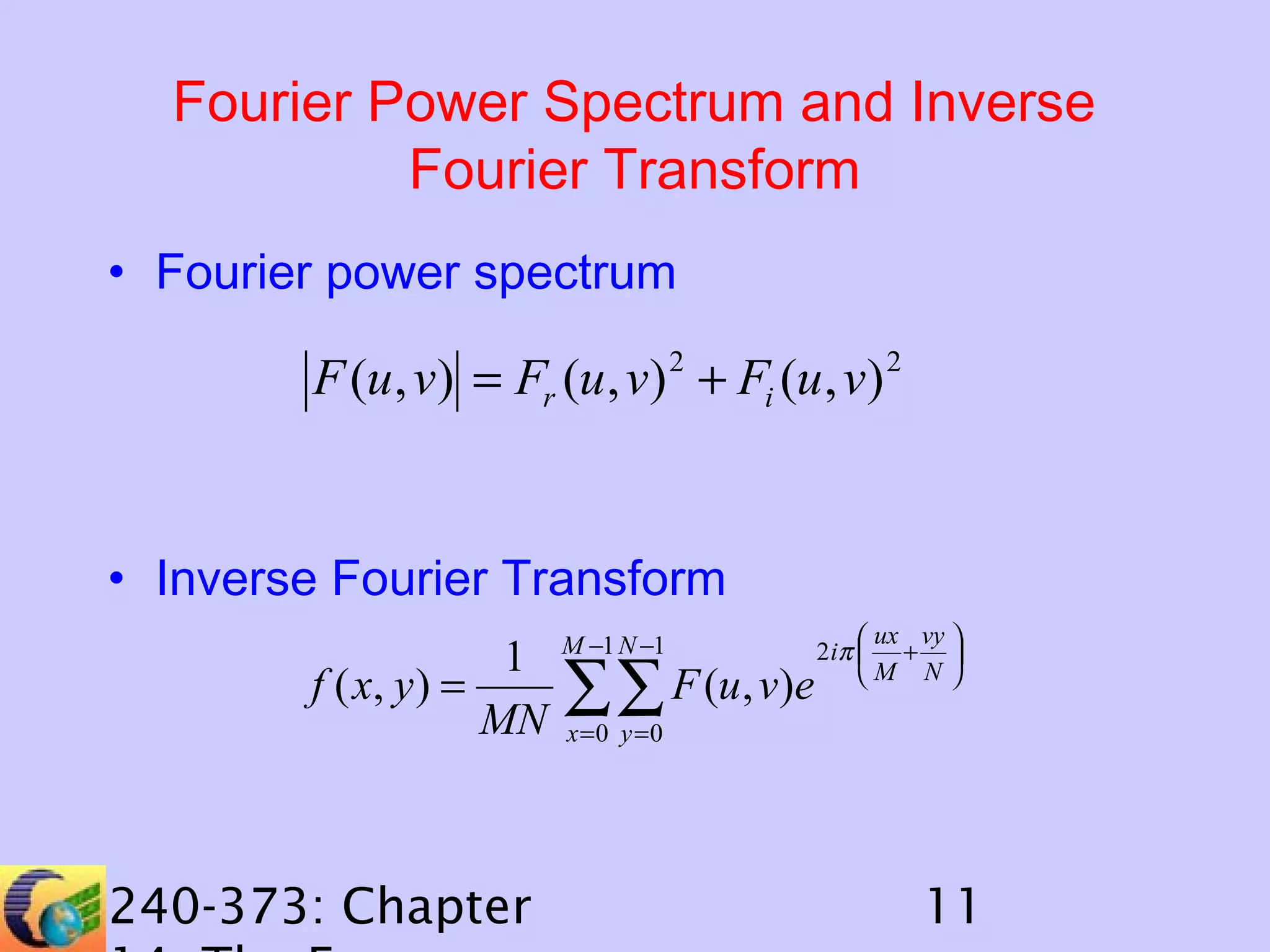
• Fourier power spectrum

F (u , v) = Fr (u , v) 2 + Fi (u , v) 2

• Inverse Fourier Transform
1
f ( x, y ) =
MN

240-373: Chapter

M −1 N −1

∑∑ F (u, v)e

 ux vy 
2 iπ  + 
M N 

x =0 y =0

11
Fourier Power Spectrum and Inverse
Fourier Transform
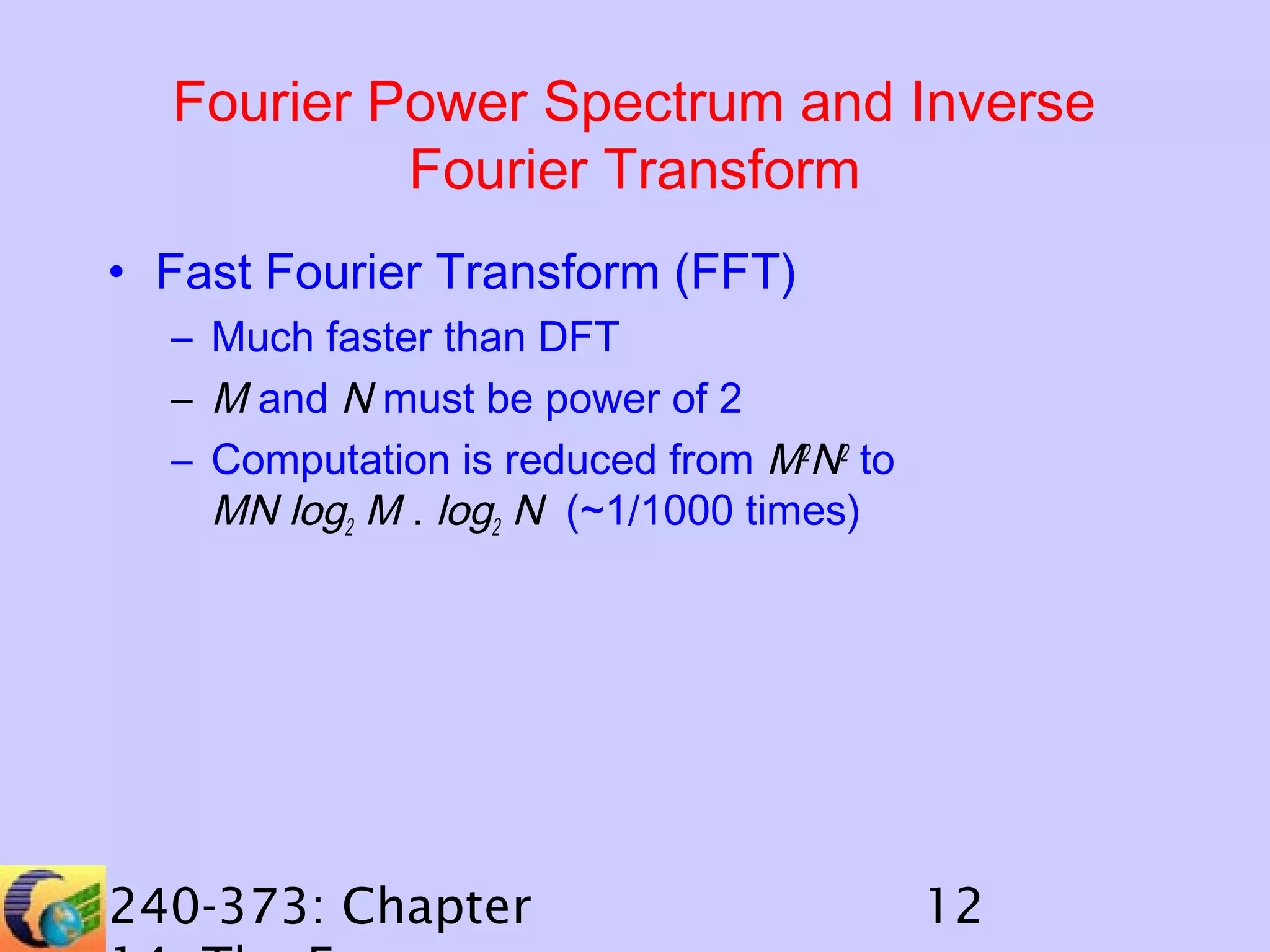
• Fast Fourier Transform (FFT)
– Much faster than DFT
– M and N must be power of 2
– Computation is reduced from M2N2 to
MN log2 M . log2 N (~1/1000 times)

240-373: Chapter

12
Fourier Power Spectrum and Inverse
Fourier Transform
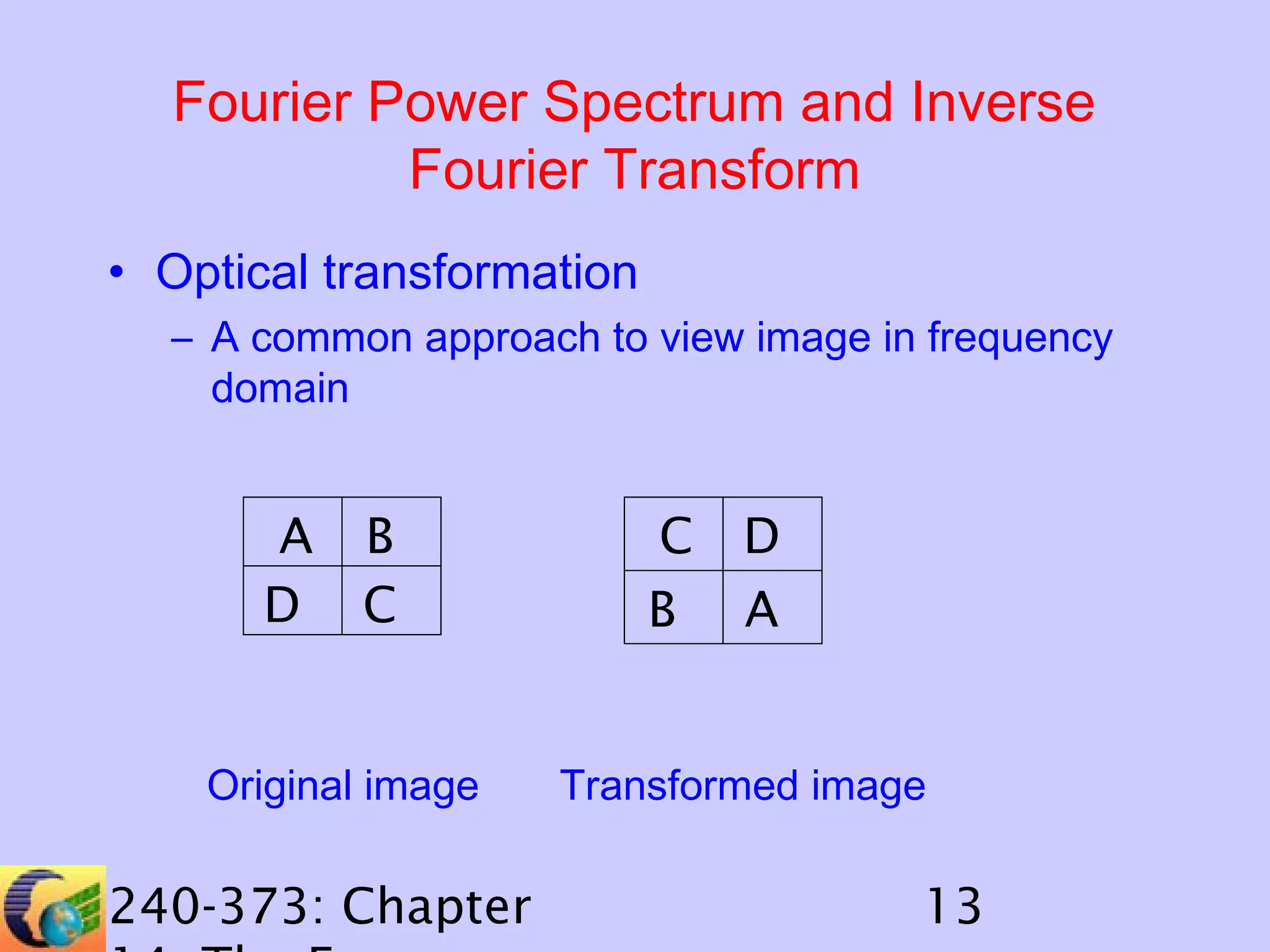
• Optical transformation
– A common approach to view image in frequency
domain

A
D

B
C

Original image

240-373: Chapter

C
B

D
A

Transformed image

13
Power and Autocorrelation Functions
• Power function:

[

1
P (u , v) = F (u , v) = H (u , v) 2 + H (−u ,−v) 2
2

• Autocorrelation function
F (u , v)

2

– Inverse Fourier transform of
or
1
[ H (u, v) 2 + H (−u,−v) 2 ]
– Hartley transform of 2

240-373: Chapter

14

]
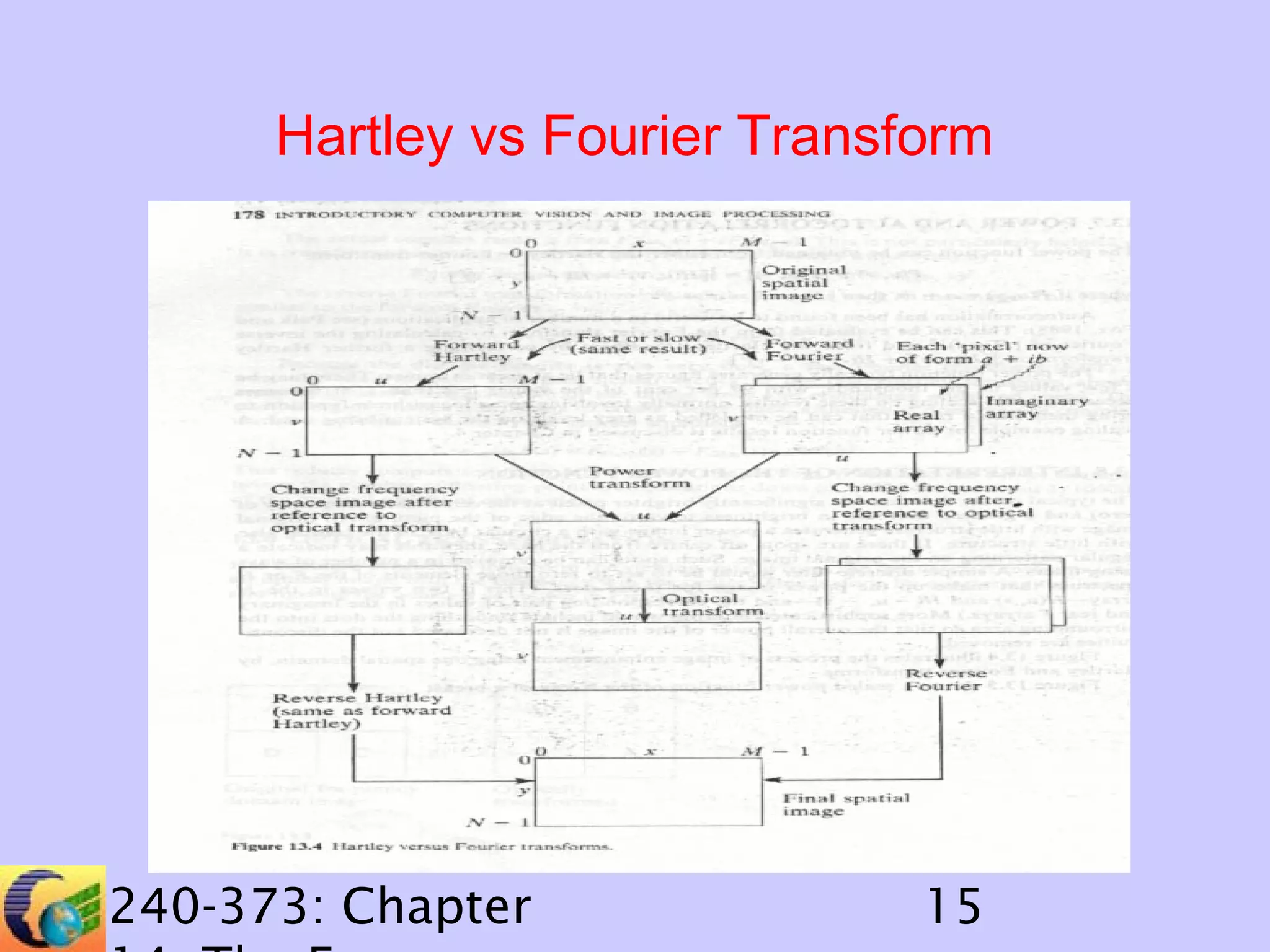
Hartley vs Fourier Transform

240-373: Chapter

15
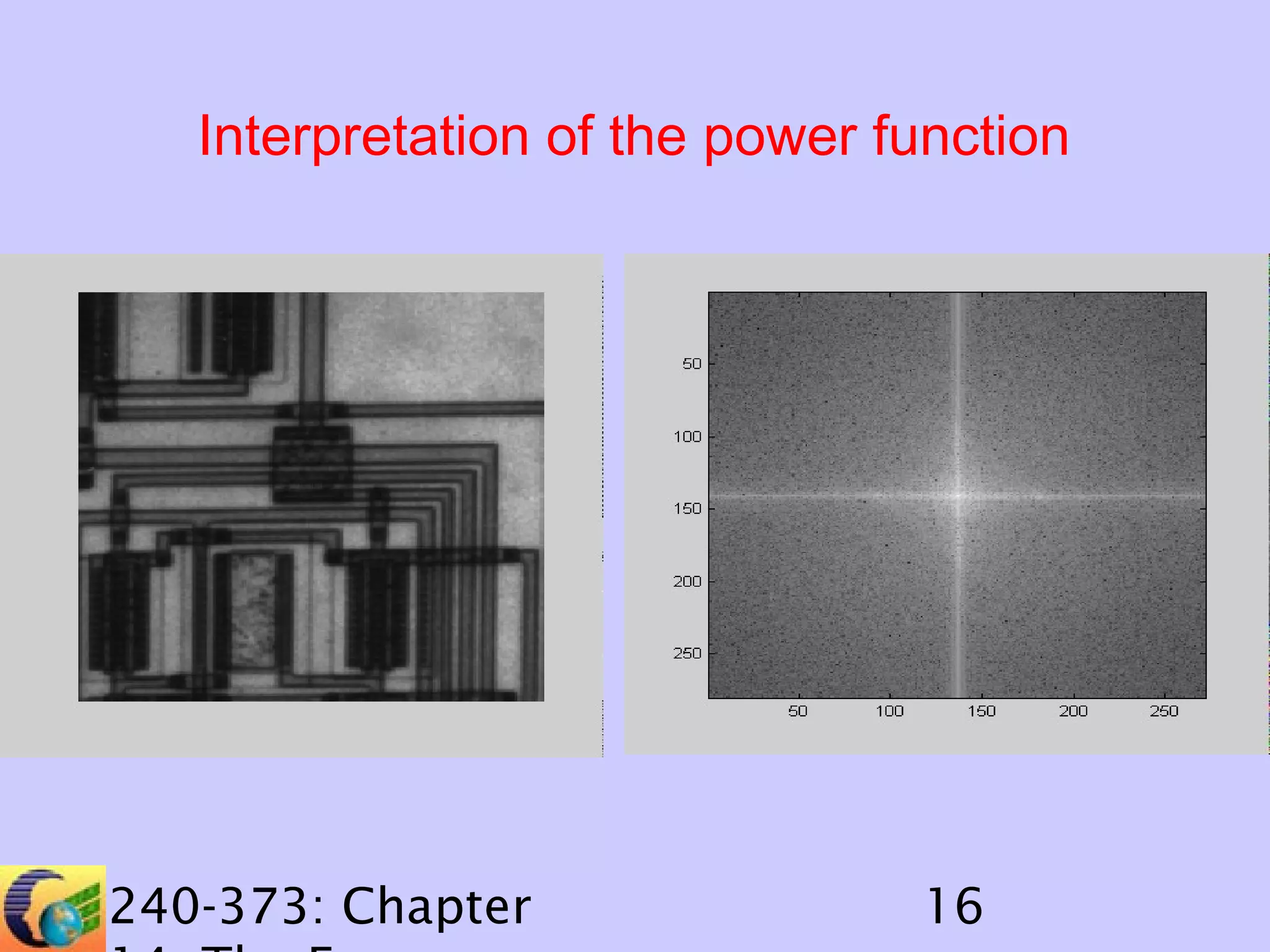
Interpretation of the power function

240-373: Chapter

16
Applications of Frequency Domain
Processing
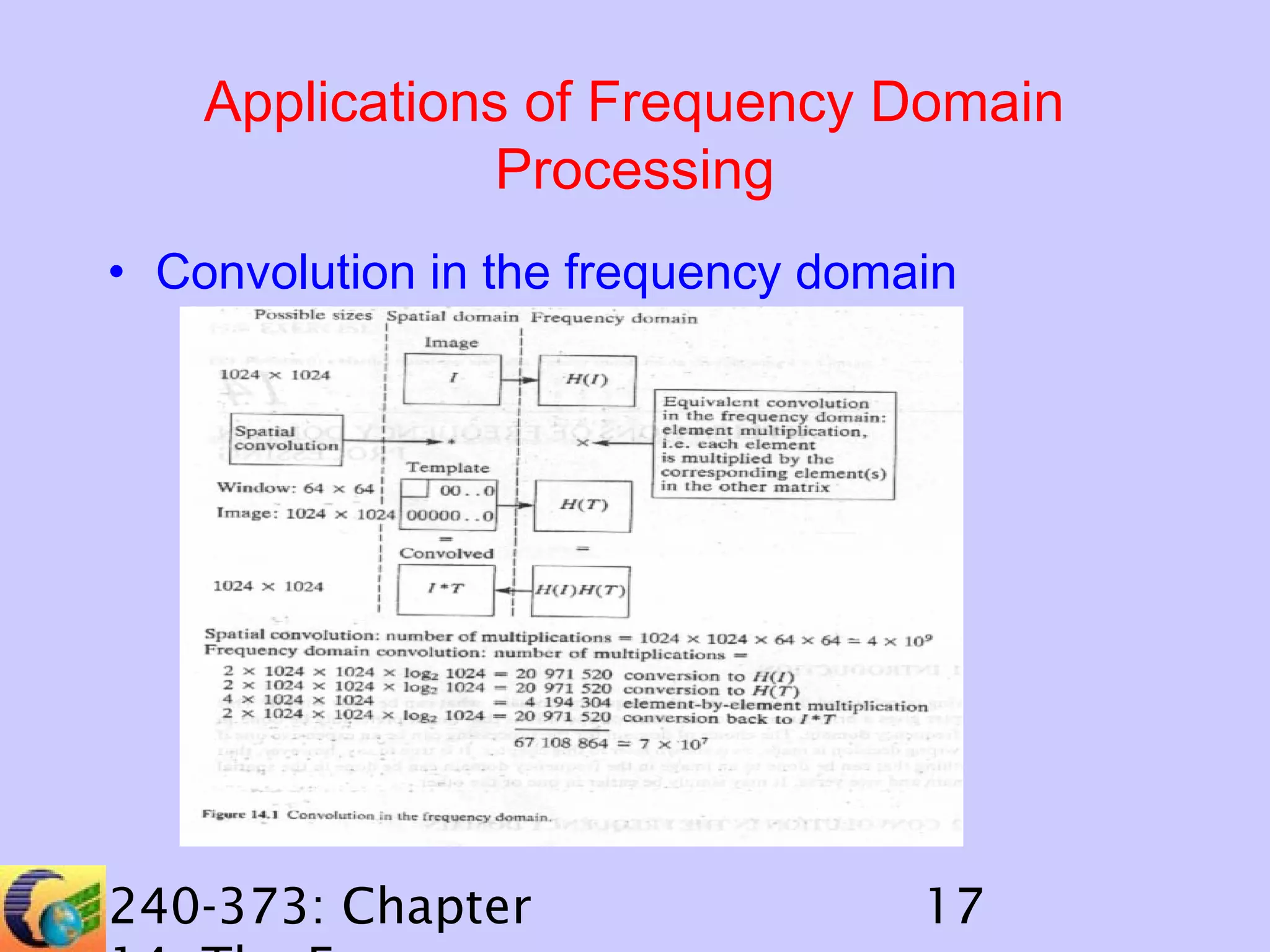
• Convolution in the frequency domain

240-373: Chapter

17
Applications of Frequency Domain
Processing
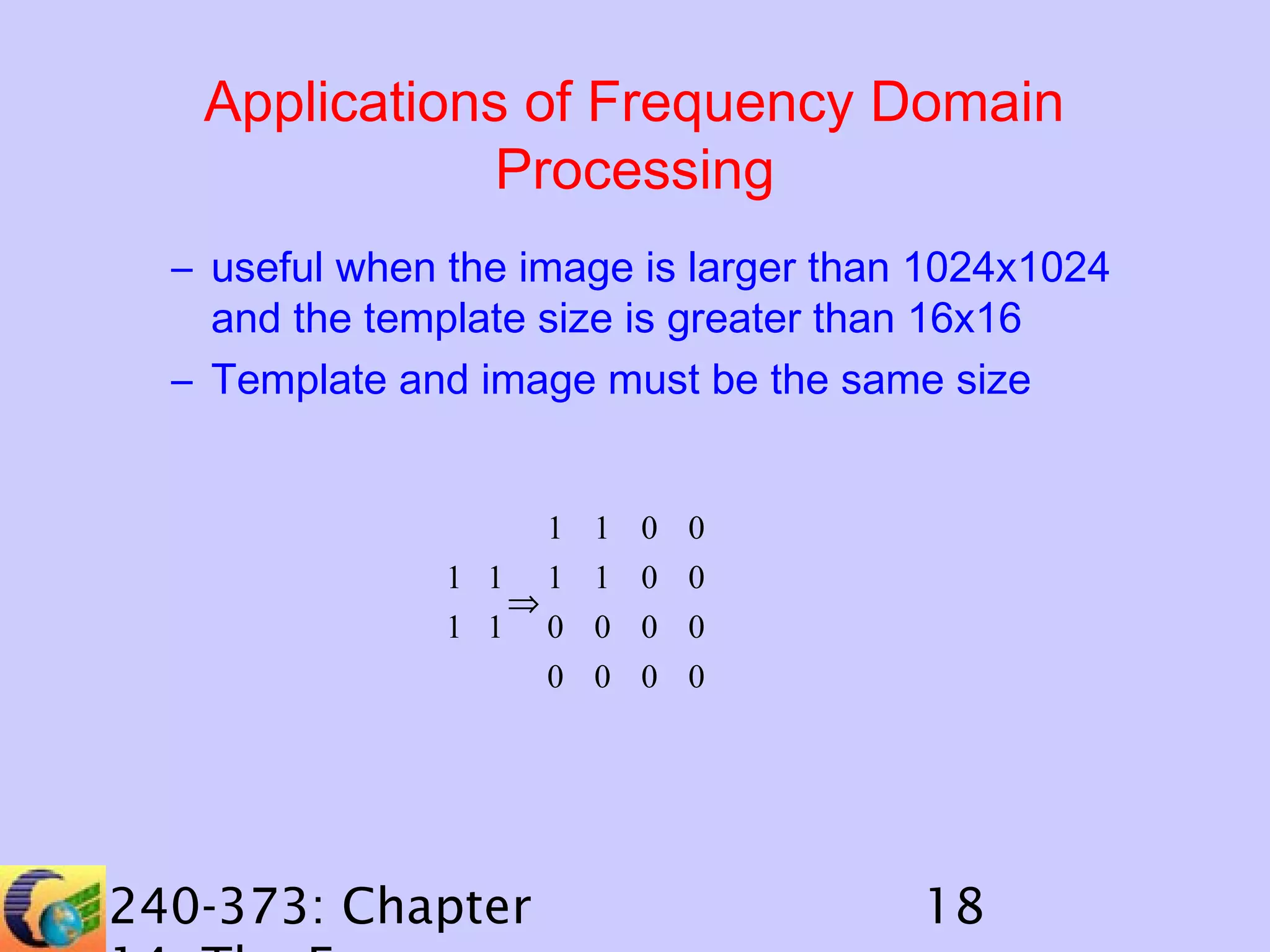
– useful when the image is larger than 1024x1024
and the template size is greater than 16x16
– Template and image must be the same size
1
1 1 1
⇒
1 1 0
0

240-373: Chapter

1
1
0
0

0
0
0
0

0
0
0
0

18
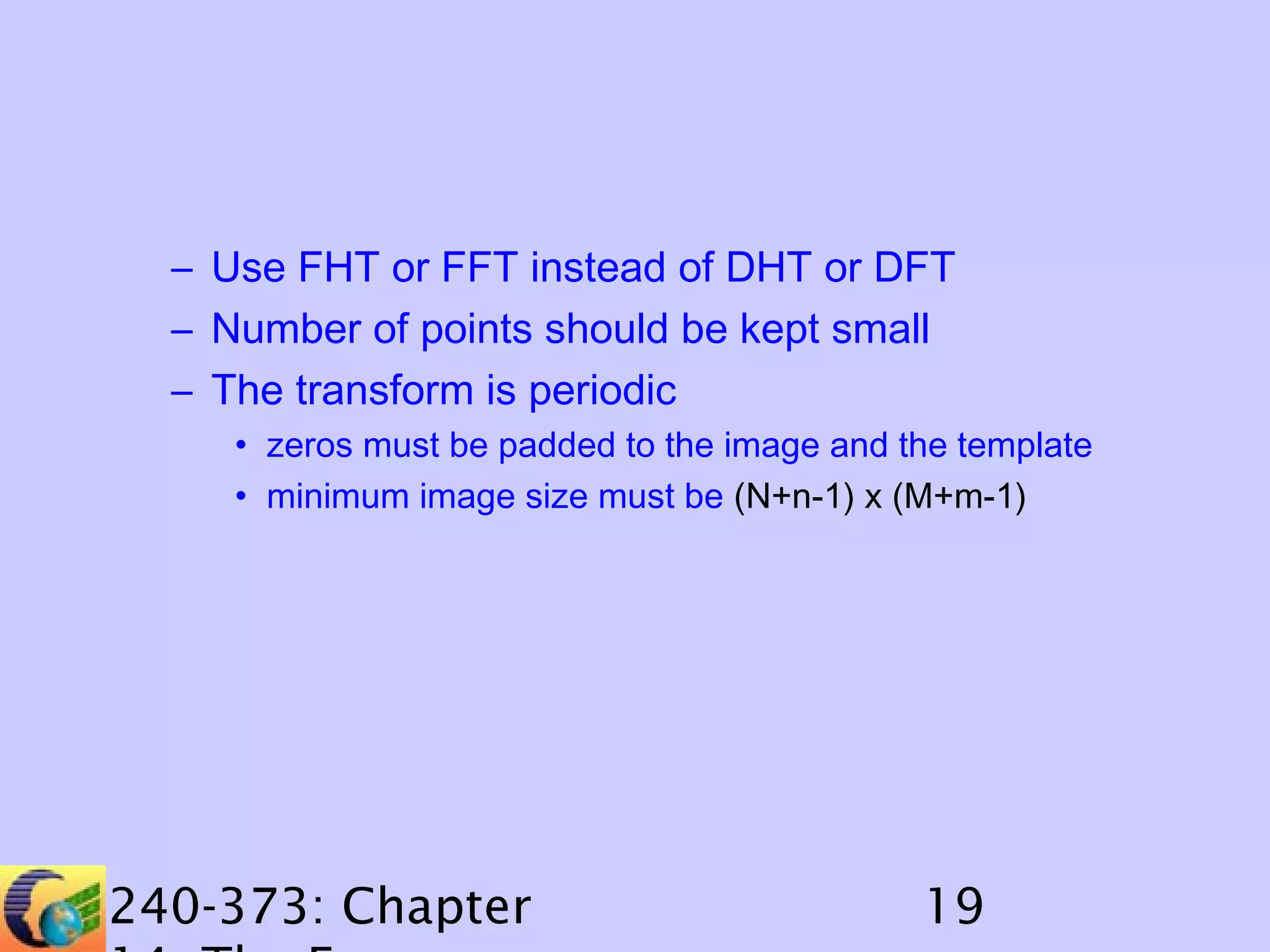
– Use FHT or FFT instead of DHT or DFT
– Number of points should be kept small
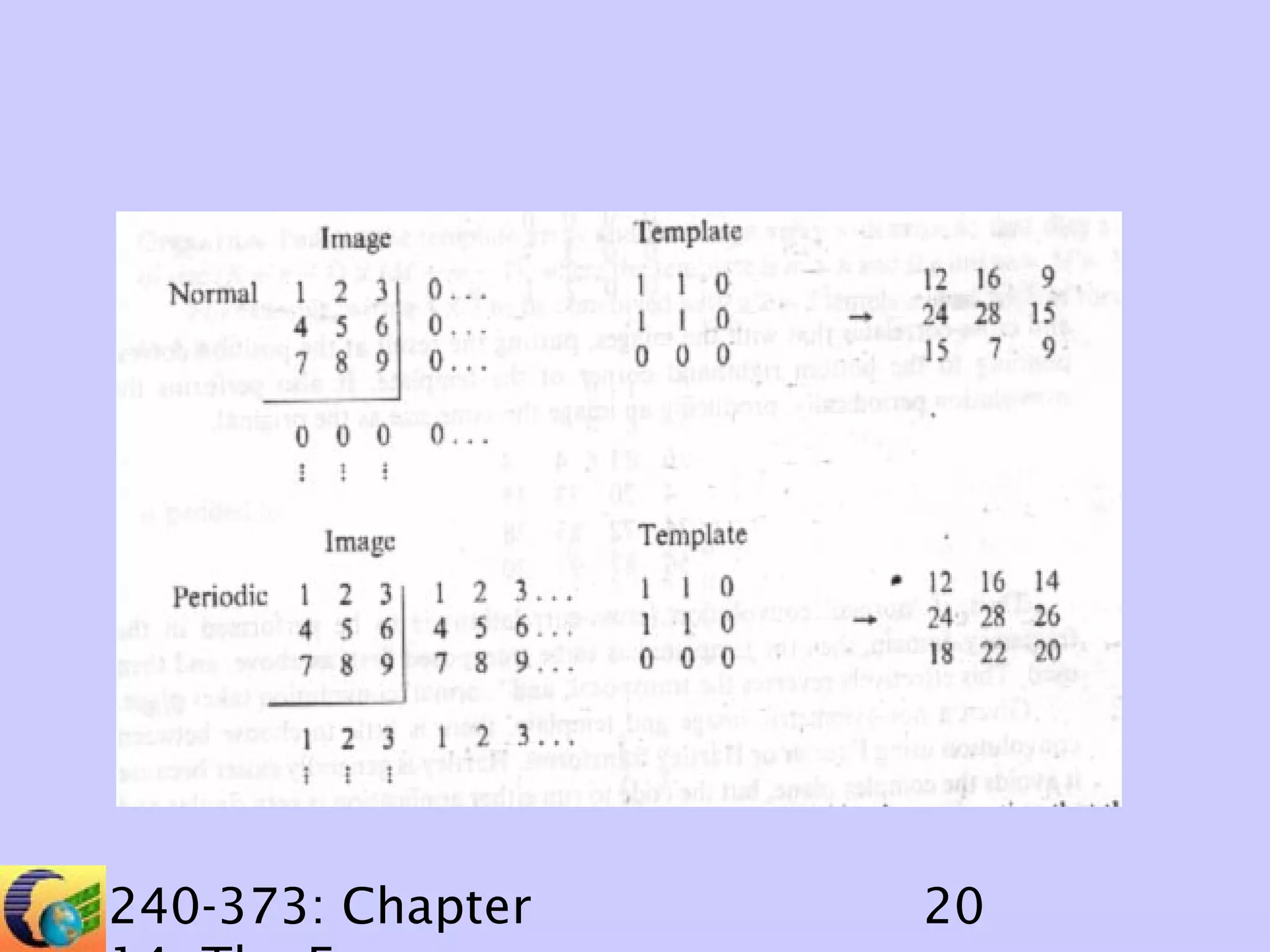
– The transform is periodic
• zeros must be padded to the image and the template
• minimum image size must be (N+n-1) x (M+m-1)

240-373: Chapter

19
0 1

2

0

4 5 6 0
8 9 10 0
0 0 0 0

240-373: Chapter

1 2 0 0
⊗

45

58

44 12

7 3 0 0
97 110 76 32
=
0 0 0 0
26 29 10 16
0 0 0 0
3 13 14 0

20
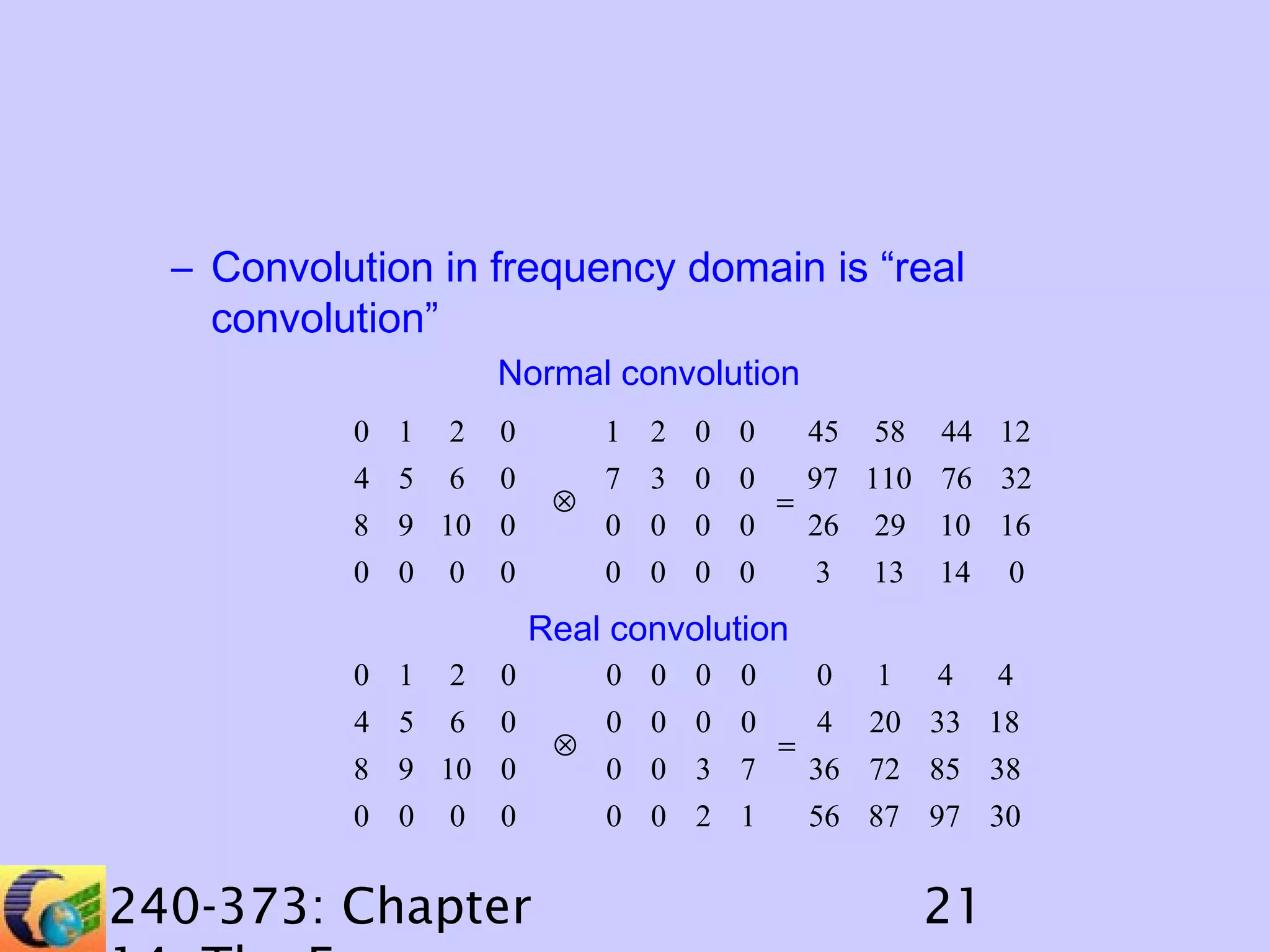
– Convolution in frequency domain is “real
convolution”
Normal convolution
0 1

2

0

4 5

6

1 2 0 0

0

⊗

8 9 10 0
0 0

0

0

7 3 0 0
0 0 0 0

45
=

0 0 0 0

58

44 12

97 110 76 32
26

29

10 16

3

13

14

0

Real convolution
0
4
8
0

1 2 0
5 6 0
9 10 0
0 0 0

240-373: Chapter

0
0
⊗
0
0

0
0
0
0

0
0
3
2

0
0 1 4 4
0
4 20 33 18
=
7
36 72 85 38
1
56 87 97 30

21
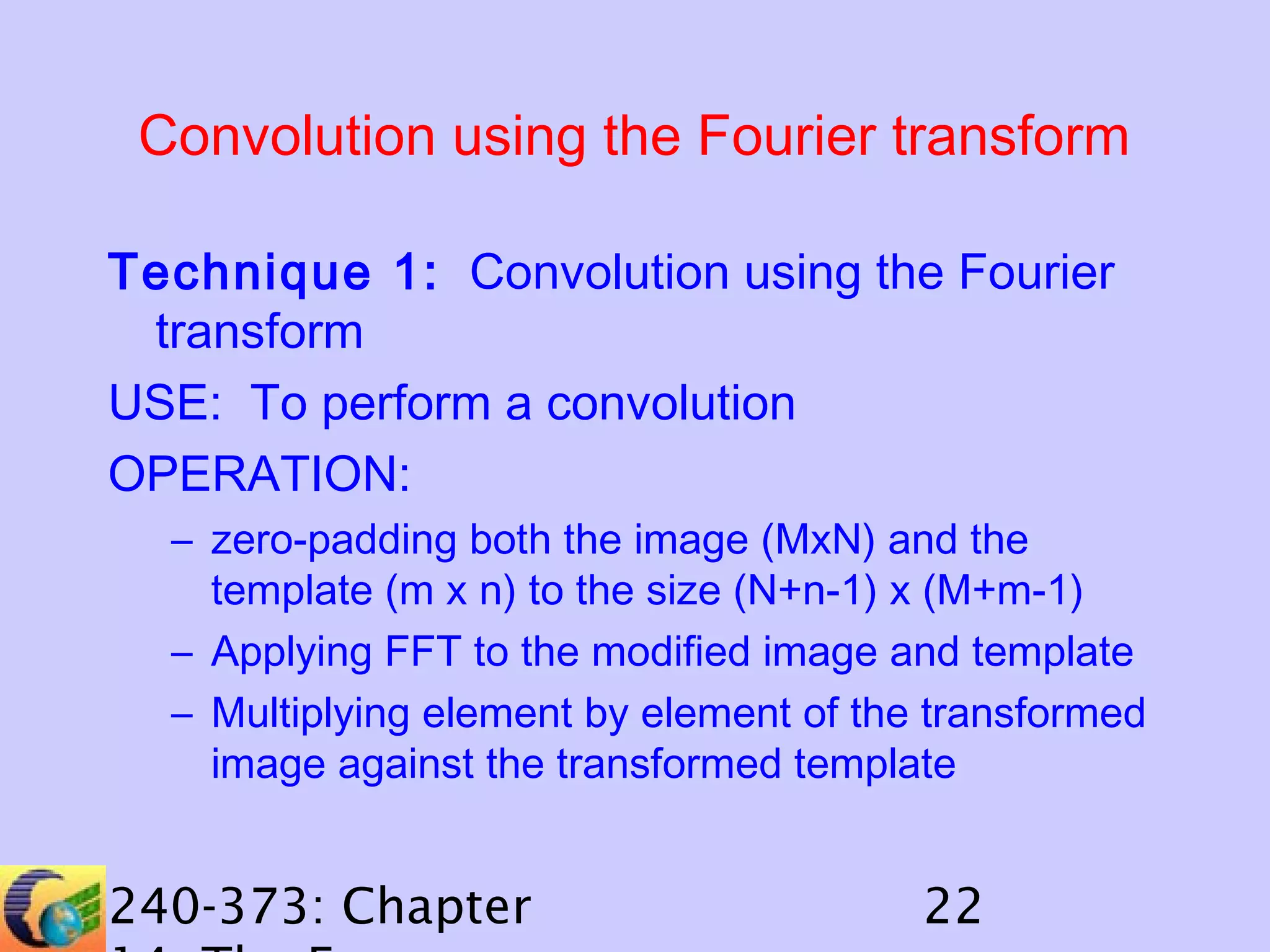
Convolution using the Fourier transform
Technique 1: Convolution using the Fourier
transform
USE: To perform a convolution
OPERATION:
– zero-padding both the image (MxN) and the
template (m x n) to the size (N+n-1) x (M+m-1)
– Applying FFT to the modified image and template
– Multiplying element by element of the transformed
image against the transformed template

240-373: Chapter

22
Convolution using the Fourier transform
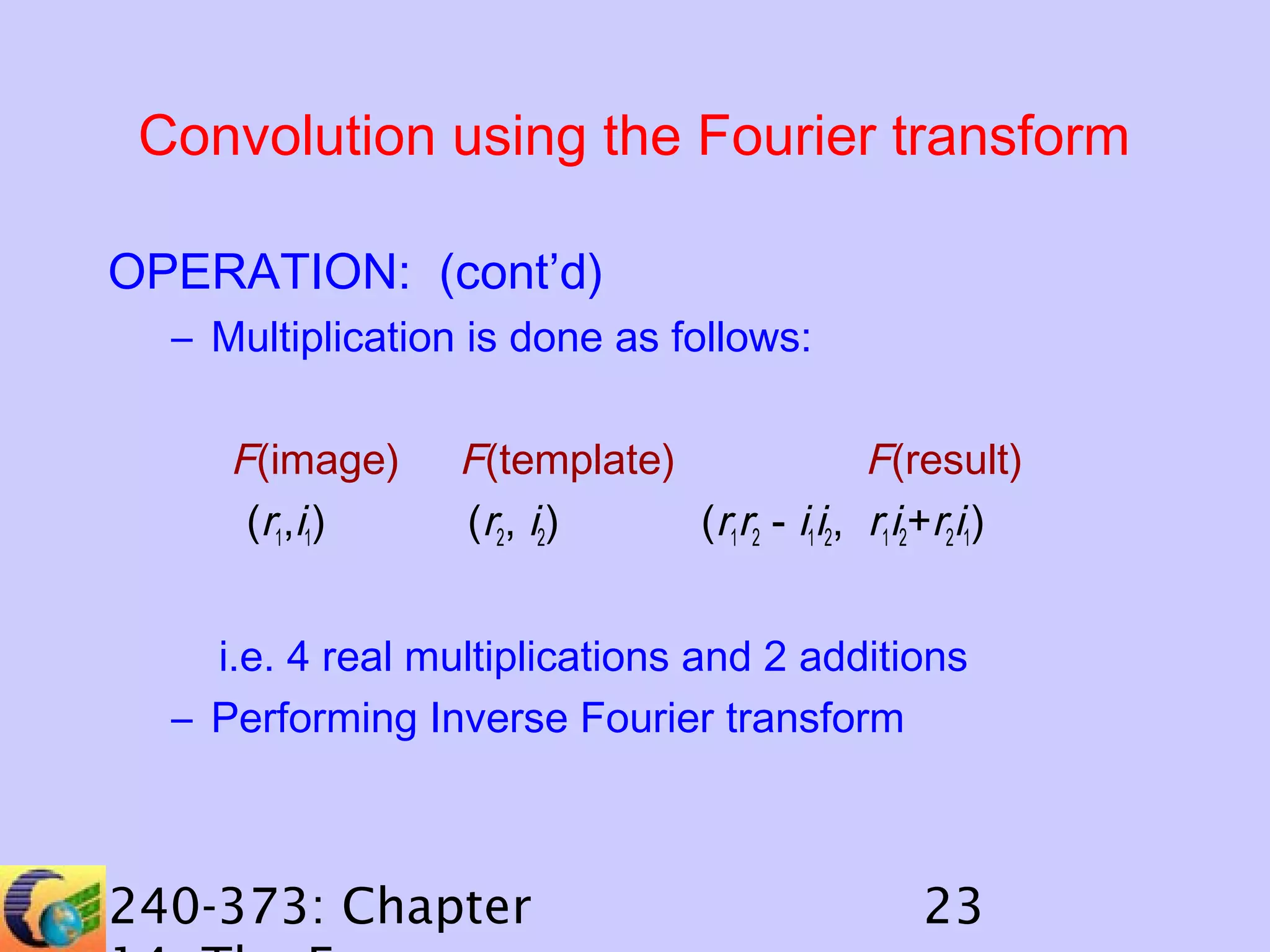
OPERATION: (cont’d)
– Multiplication is done as follows:

F(image)
(r1,i1)

F(template)
F(result)
(r2, i2)
(r1r2 - i1i2, r1i2+r2i1)

i.e. 4 real multiplications and 2 additions
– Performing Inverse Fourier transform

240-373: Chapter

23
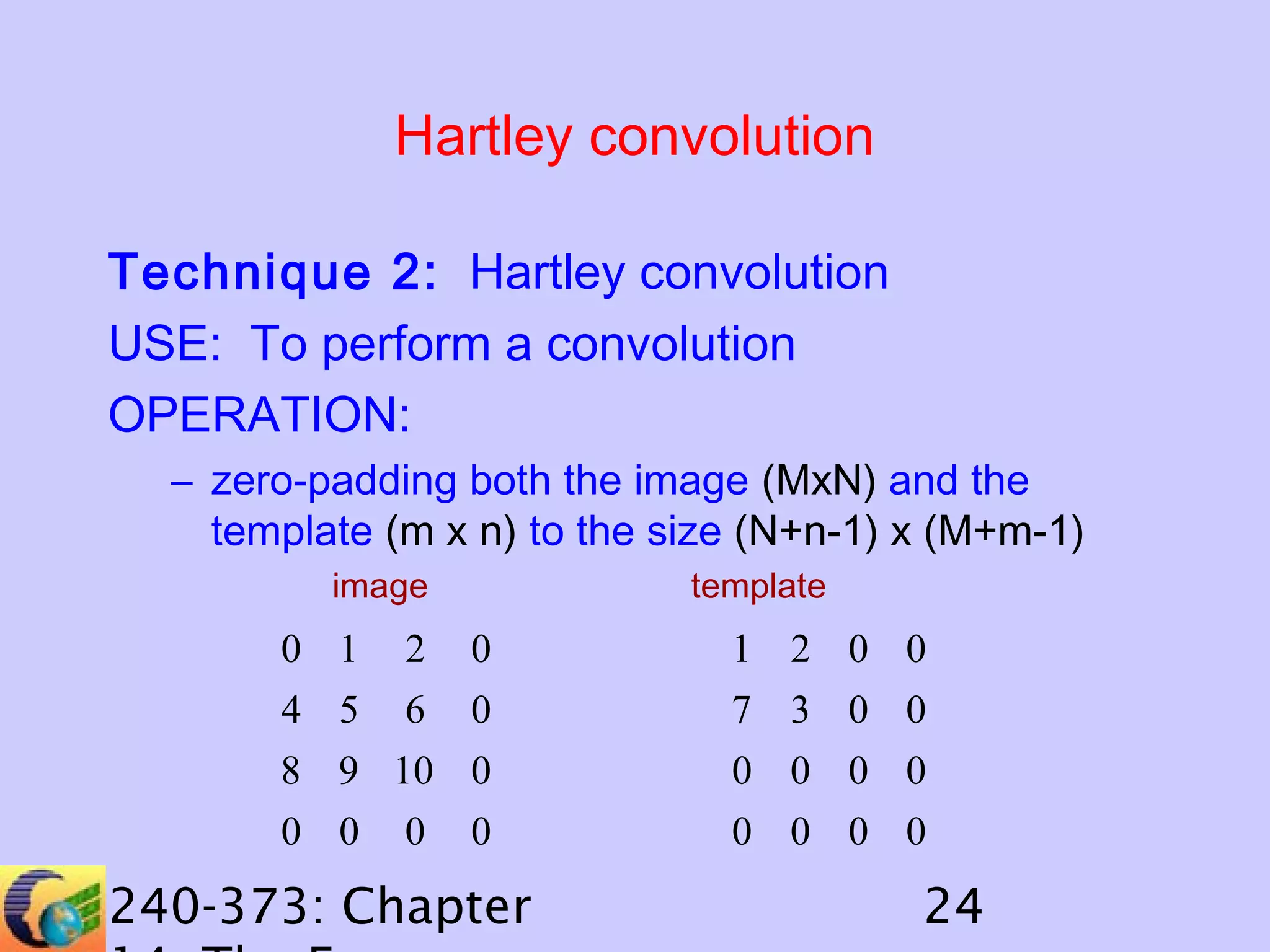
Hartley convolution
Technique 2: Hartley convolution
USE: To perform a convolution
OPERATION:
– zero-padding both the image (MxN) and the
template (m x n) to the size (N+n-1) x (M+m-1)
image

0 1

2

template

0

1 2 0 0

4 5 6 0
8 9 10 0
0 0 0 0

7 3 0 0
0 0 0 0
0 0 0 0

240-373: Chapter

24
Hartley convolution
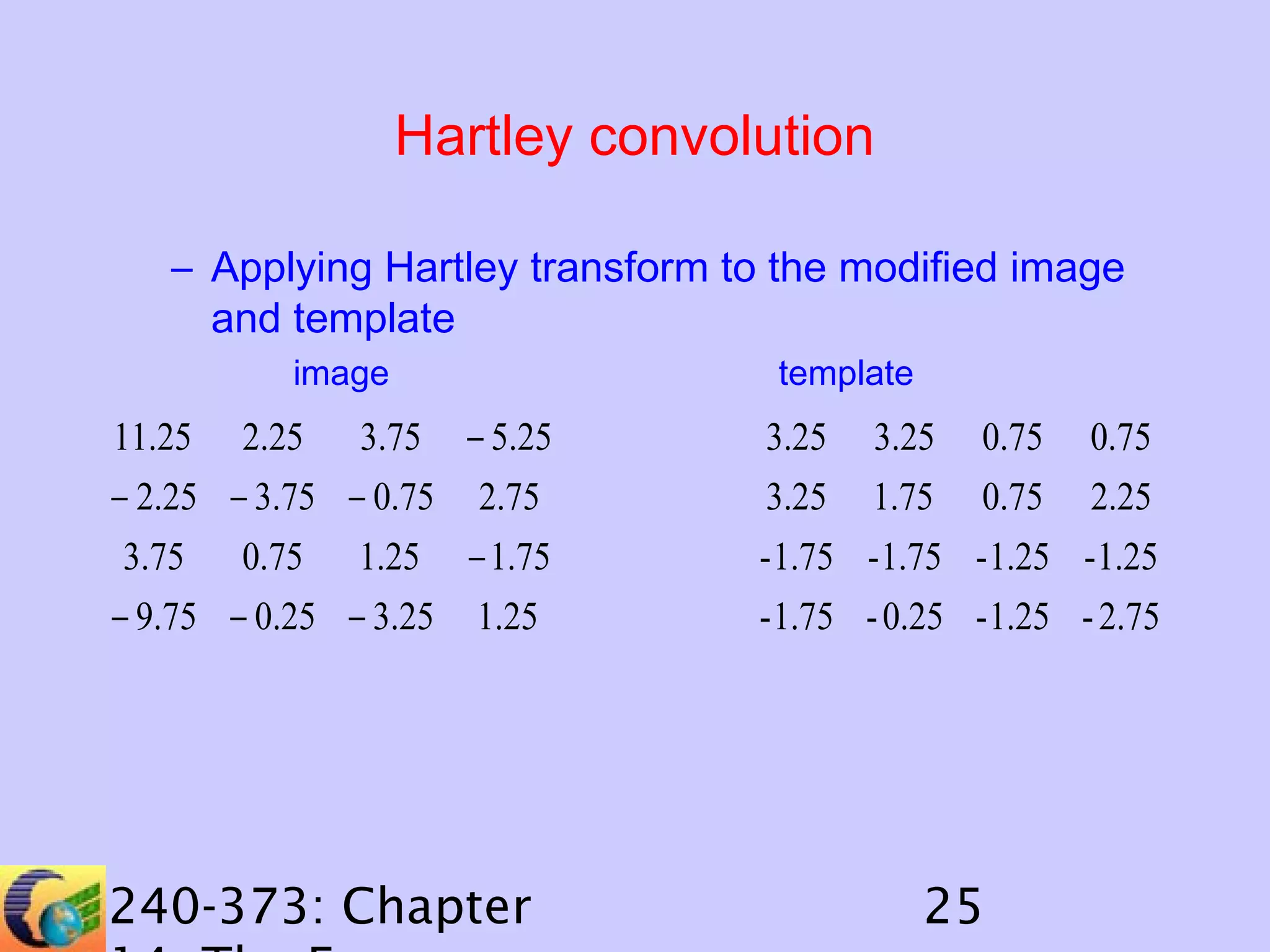
– Applying Hartley transform to the modified image
and template
image

template

11.25 2.25 3.75 − 5.25
− 2.25 − 3.75 − 0.75 2.75

3.25
3.25

3.75 0.75 1.25 − 1.75
− 9.75 − 0.25 − 3.25 1.25

- 1.75 - 1.75 - 1.25 - 1.25
- 1.75 - 0.25 - 1.25 - 2.75

240-373: Chapter

25

3.25
1.75

0.75
0.75

0.75
2.25
Hartley convolution
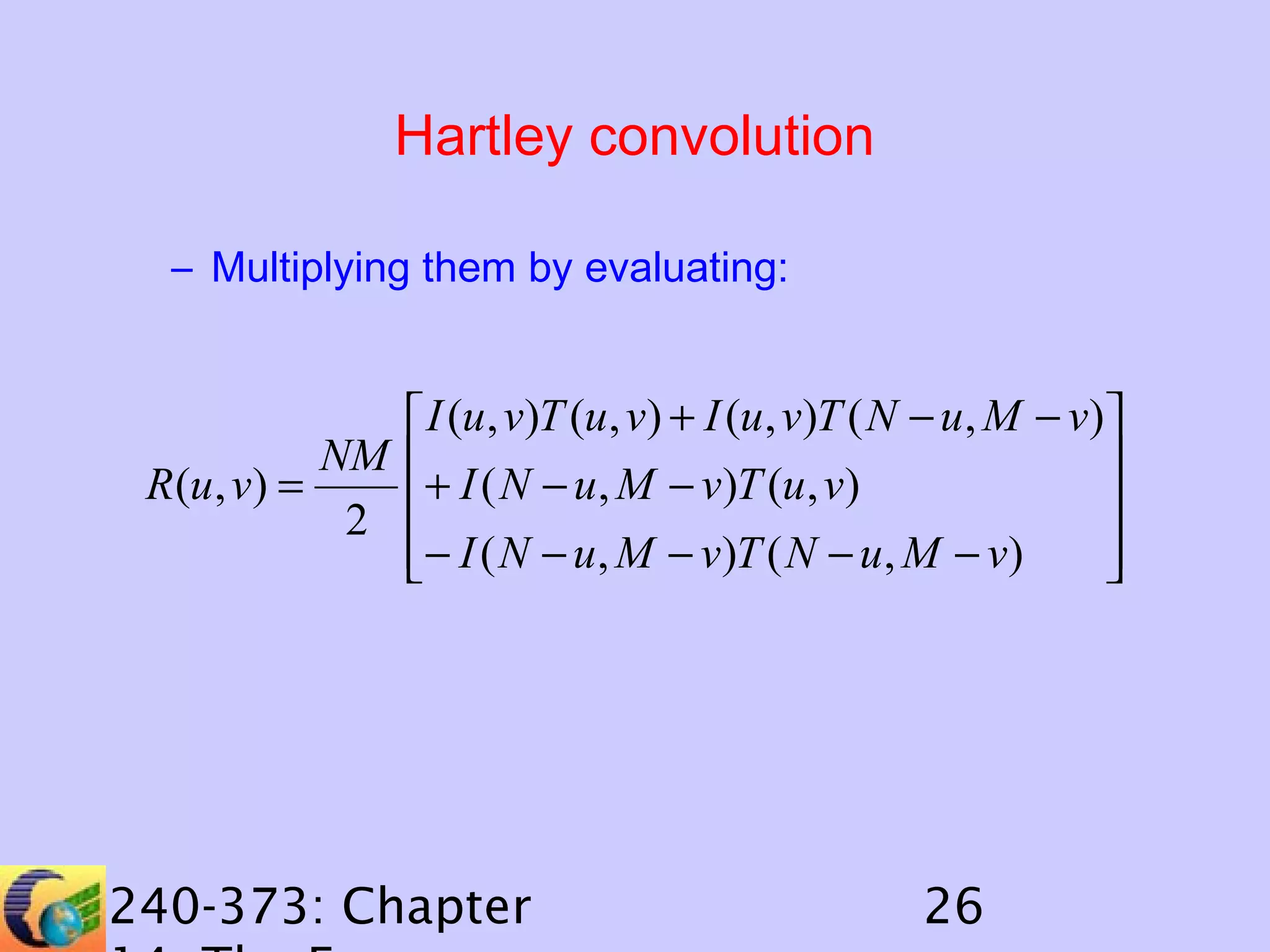
– Multiplying them by evaluating:

 I (u , v)T (u, v) + I (u , v)T ( N − u , M − v)
NM 

R (u , v) =
+ I ( N − u , M − v)T (u , v)

2 
− I ( N − u , M − v)T ( N − u, M − v)




240-373: Chapter

26
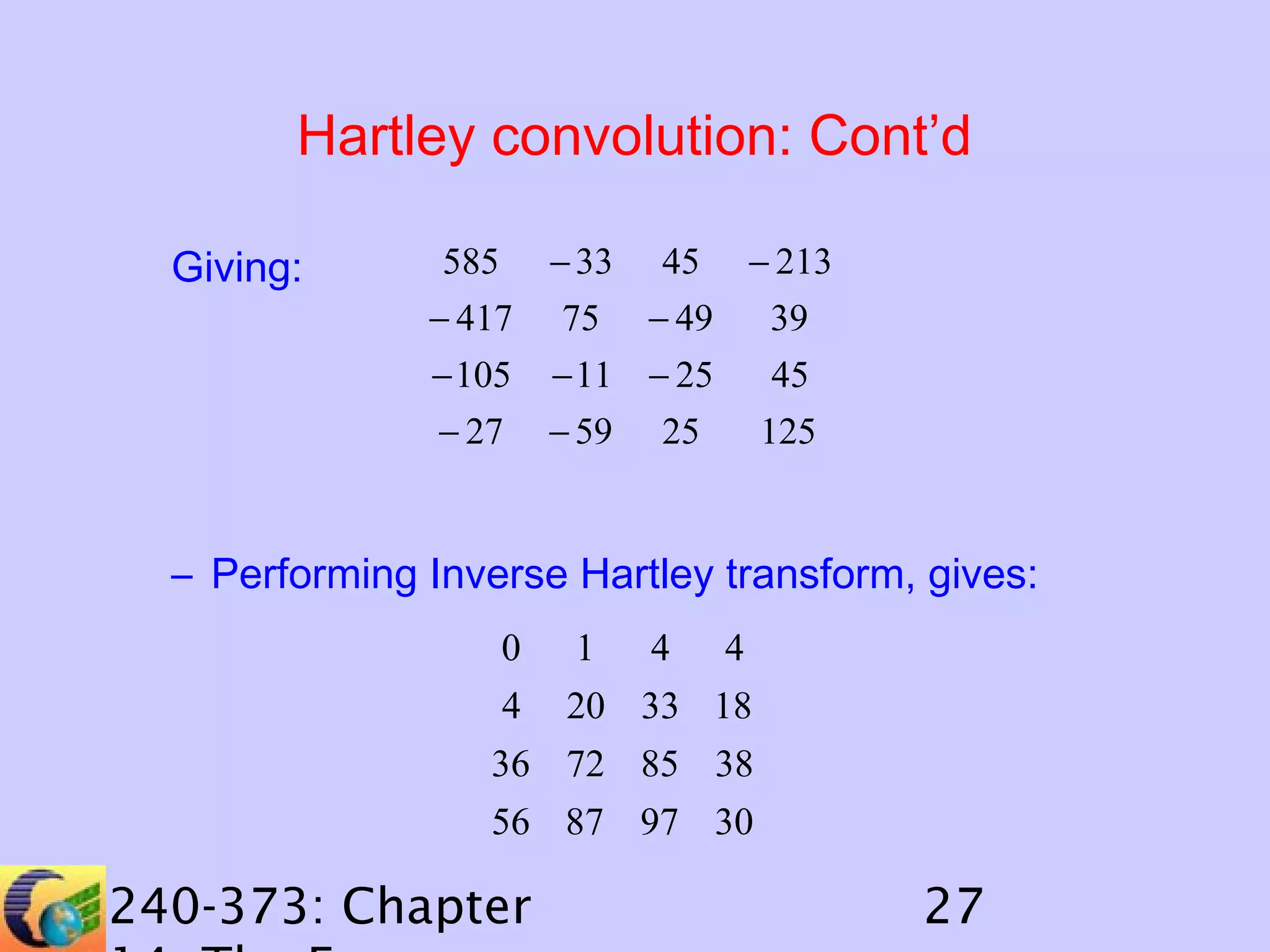
Hartley convolution: Cont’d
585

− 33

45

− 213

− 417

75

− 49

39

− 105

− 11 − 25

45

− 27

Giving:

− 59

25

125

– Performing Inverse Hartley transform, gives:
0

1

4

4

4

20 33 18

36 72 85 38
56 87 97 30

240-373: Chapter

27
Hartley convolution: Cont’d

240-373: Chapter

28
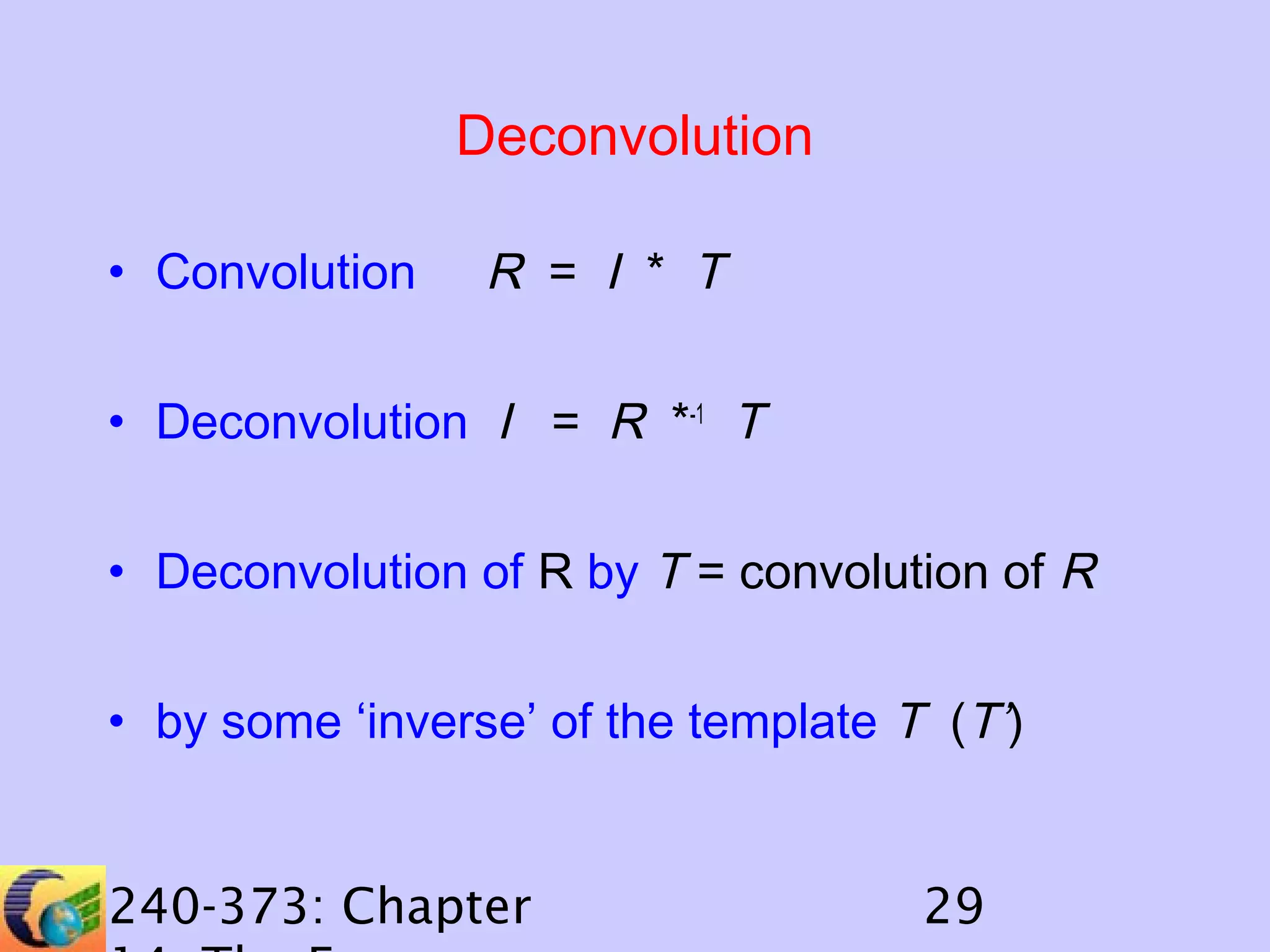
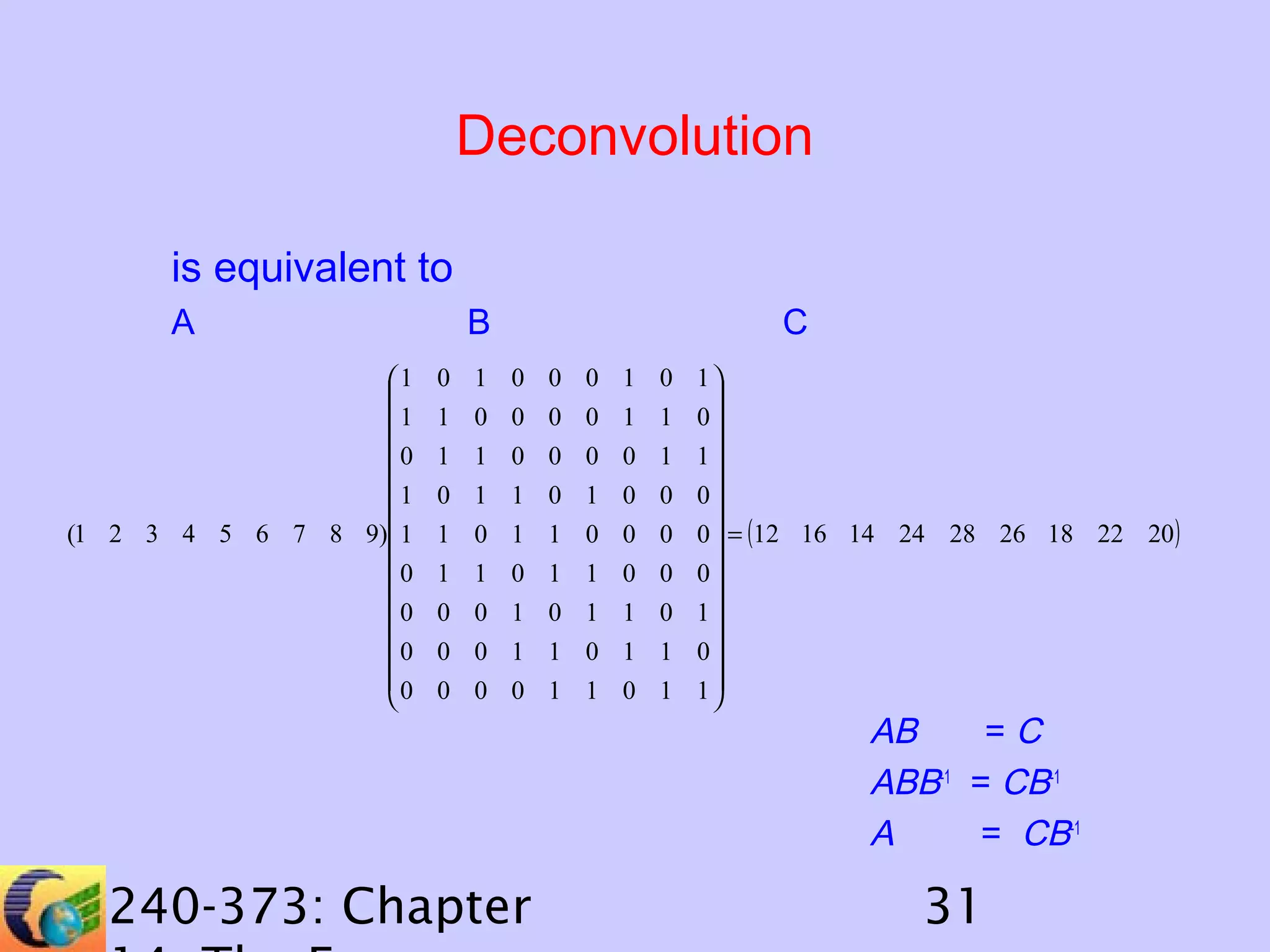
Deconvolution
• Convolution

R = I * T

• Deconvolution I = R *-1 T
• Deconvolution of R by T = convolution of R
• by some ‘inverse’ of the template T (T’)

240-373: Chapter

29
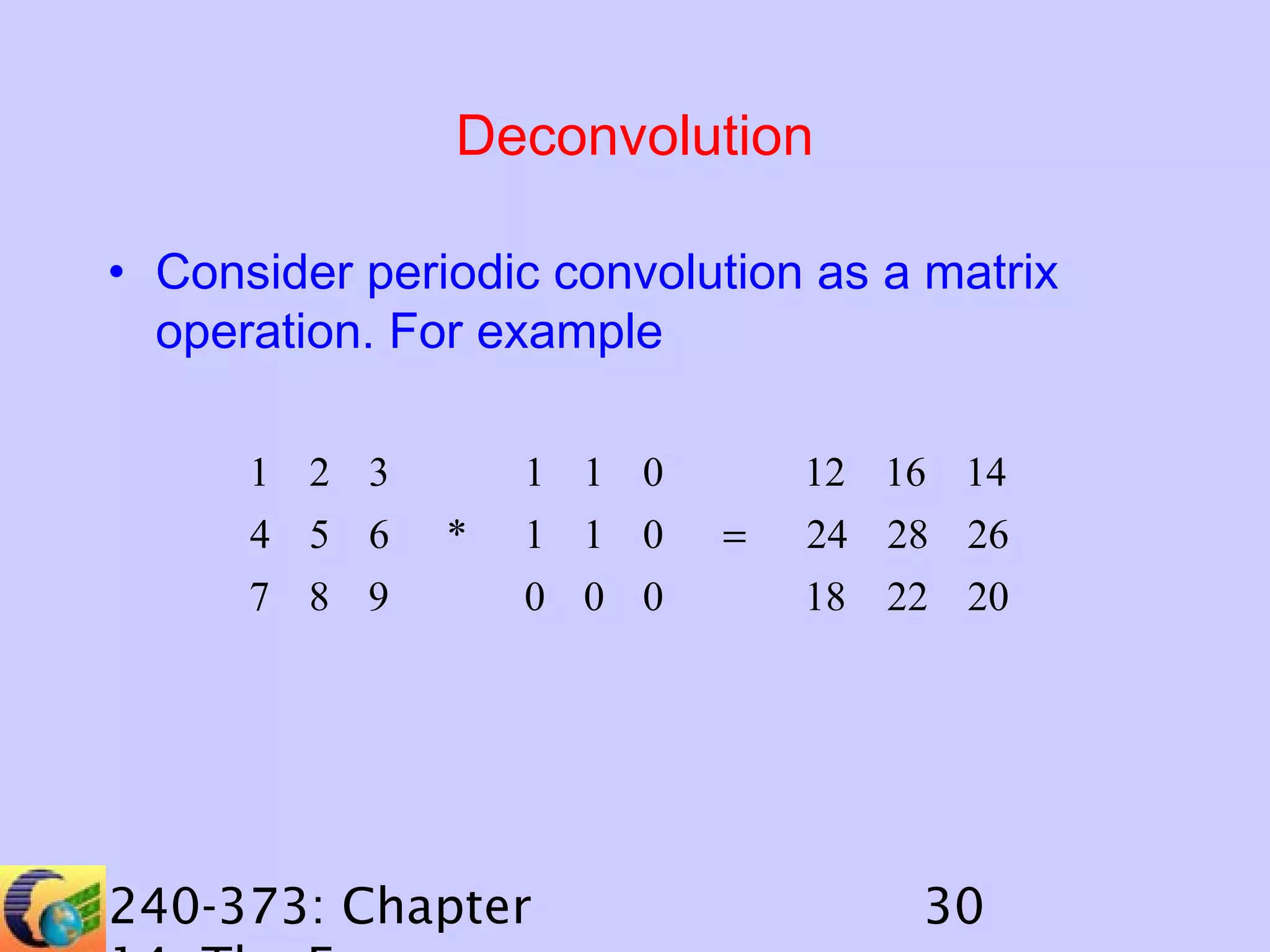
Deconvolution
• Consider periodic convolution as a matrix
operation. For example
1 2 3
4 5 6
7 8 9

1 1 0
*

1 1 0
0 0 0

240-373: Chapter

12 16 14
=

24 28 26
18 22 20

30
Deconvolution
is equivalent to
A
1

1
0

1
(1 2 3 4 5 6 7 8 9) 1

0

0
0

0


B

C

0 1 0 0 0 1 0 1

1 0 0 0 0 1 1 0
1 1 0 0 0 0 1 1

0 1 1 0 1 0 0 0
1 0 1 1 0 0 0 0  = (12 16 14 24 28 26 18 22 20 )

1 1 0 1 1 0 0 0

0 0 1 0 1 1 0 1
0 0 1 1 0 1 1 0

0 0 0 1 1 0 1 1


240-373: Chapter

AB
=C
ABB-1 = CB-1
A
= CB-1

31

Chapter14

  • 1.
  • 2.
  • 3.
    The Frequency Domain •Any wave shape can be approximated by a sum of periodic (such as sine and cosine) functions. • a--amplitude of waveform • f-- frequency (number of times the wave repeats itself in a given length) • p--phase (position that the wave starts) • Usually phase is ignored in image processing 240-373: Chapter 3
  • 4.
  • 5.
  • 6.
    The Hartley Transform •Discrete Hartley Transform (DHT) – The M x N image is converted into a second image (also M x N) – M and N should be power of 2 (e.g. .., 128, 256, 512, etc.) – The basic transform depends on calculating the following for each pixel in the new M x N array 1 H (u , v) = MN M −1 N −1 ∑∑ x =0 y =0   ux vy   ux vy  f ( x, y ) ⋅ cos(2π ) −  + sin( 2π ) −  M N   M N   240-373: Chapter 6
  • 7.
    The Hartley Transform wheref(x,y) is the intensity of the pixel at position (x,y) H(u,v) is the value of element in frequency domain – The results are periodic – The cosine+sine (CAS) term is call “the kernel of the transformation” (or ”basis function”) 240-373: Chapter 7
  • 8.
    The Hartley Transform •Fast Hartley Transform (FHT) – M and N must be power of 2 – Much faster than DHT – Equation: H (u, v) = { T (u , v) + T ( M − u, v) + T (u , N − v) − T ( M − u , N − v)} / 2 240-373: Chapter 8
  • 9.
    The Fourier Transform •The Fourier transform – Each element has real and imaginary values – Formula: F (u , v) = ∫∫ f ( x, y )e −2iπ ( ux +vy ) dxdy – f(x,y) is point (x,y) in the original image and F(u,v) is the point (u,v) in the frequency image 240-373: Chapter 9
  • 10.
    The Fourier Transform •Discrete Fourier Transform (DFT)  ux vy  − 2 iπ  +  1 M −1 N −1 F (u, v) = f ( x, y )e  M N  ∑∑ MN x =0 y =0 – Imaginary part 1 M −1 N −1  ux vy  Fi (u, v) = − f ( x, y ) sin 2π  +  ∑∑ MN x =0 y =0 M N  – Real part 1 Fr (u , v) = MN M −1 N −1 ∑∑ x =0 y =0  ux vy  f ( x, y ) cos 2π  +  M N  – The actual complex result is Fi(u,v) + Fr(u,v) 240-373: Chapter 10
  • 11.
    Fourier Power Spectrumand Inverse Fourier Transform • Fourier power spectrum F (u , v) = Fr (u , v) 2 + Fi (u , v) 2 • Inverse Fourier Transform 1 f ( x, y ) = MN 240-373: Chapter M −1 N −1 ∑∑ F (u, v)e  ux vy  2 iπ  +  M N  x =0 y =0 11
  • 12.
    Fourier Power Spectrumand Inverse Fourier Transform • Fast Fourier Transform (FFT) – Much faster than DFT – M and N must be power of 2 – Computation is reduced from M2N2 to MN log2 M . log2 N (~1/1000 times) 240-373: Chapter 12
  • 13.
    Fourier Power Spectrumand Inverse Fourier Transform • Optical transformation – A common approach to view image in frequency domain A D B C Original image 240-373: Chapter C B D A Transformed image 13
  • 14.
    Power and AutocorrelationFunctions • Power function: [ 1 P (u , v) = F (u , v) = H (u , v) 2 + H (−u ,−v) 2 2 • Autocorrelation function F (u , v) 2 – Inverse Fourier transform of or 1 [ H (u, v) 2 + H (−u,−v) 2 ] – Hartley transform of 2 240-373: Chapter 14 ]
  • 15.
    Hartley vs FourierTransform 240-373: Chapter 15
  • 16.
    Interpretation of thepower function 240-373: Chapter 16
  • 17.
    Applications of FrequencyDomain Processing • Convolution in the frequency domain 240-373: Chapter 17
  • 18.
    Applications of FrequencyDomain Processing – useful when the image is larger than 1024x1024 and the template size is greater than 16x16 – Template and image must be the same size 1 1 1 1 ⇒ 1 1 0 0 240-373: Chapter 1 1 0 0 0 0 0 0 0 0 0 0 18
  • 19.
    – Use FHTor FFT instead of DHT or DFT – Number of points should be kept small – The transform is periodic • zeros must be padded to the image and the template • minimum image size must be (N+n-1) x (M+m-1) 240-373: Chapter 19
  • 20.
    0 1 2 0 4 56 0 8 9 10 0 0 0 0 0 240-373: Chapter 1 2 0 0 ⊗ 45 58 44 12 7 3 0 0 97 110 76 32 = 0 0 0 0 26 29 10 16 0 0 0 0 3 13 14 0 20
  • 21.
    – Convolution infrequency domain is “real convolution” Normal convolution 0 1 2 0 4 5 6 1 2 0 0 0 ⊗ 8 9 10 0 0 0 0 0 7 3 0 0 0 0 0 0 45 = 0 0 0 0 58 44 12 97 110 76 32 26 29 10 16 3 13 14 0 Real convolution 0 4 8 0 1 2 0 5 6 0 9 10 0 0 0 0 240-373: Chapter 0 0 ⊗ 0 0 0 0 0 0 0 0 3 2 0 0 1 4 4 0 4 20 33 18 = 7 36 72 85 38 1 56 87 97 30 21
  • 22.
    Convolution using theFourier transform Technique 1: Convolution using the Fourier transform USE: To perform a convolution OPERATION: – zero-padding both the image (MxN) and the template (m x n) to the size (N+n-1) x (M+m-1) – Applying FFT to the modified image and template – Multiplying element by element of the transformed image against the transformed template 240-373: Chapter 22
  • 23.
    Convolution using theFourier transform OPERATION: (cont’d) – Multiplication is done as follows: F(image) (r1,i1) F(template) F(result) (r2, i2) (r1r2 - i1i2, r1i2+r2i1) i.e. 4 real multiplications and 2 additions – Performing Inverse Fourier transform 240-373: Chapter 23
  • 24.
    Hartley convolution Technique 2:Hartley convolution USE: To perform a convolution OPERATION: – zero-padding both the image (MxN) and the template (m x n) to the size (N+n-1) x (M+m-1) image 0 1 2 template 0 1 2 0 0 4 5 6 0 8 9 10 0 0 0 0 0 7 3 0 0 0 0 0 0 0 0 0 0 240-373: Chapter 24
  • 25.
    Hartley convolution – ApplyingHartley transform to the modified image and template image template 11.25 2.25 3.75 − 5.25 − 2.25 − 3.75 − 0.75 2.75 3.25 3.25 3.75 0.75 1.25 − 1.75 − 9.75 − 0.25 − 3.25 1.25 - 1.75 - 1.75 - 1.25 - 1.25 - 1.75 - 0.25 - 1.25 - 2.75 240-373: Chapter 25 3.25 1.75 0.75 0.75 0.75 2.25
  • 26.
    Hartley convolution – Multiplyingthem by evaluating:  I (u , v)T (u, v) + I (u , v)T ( N − u , M − v) NM   R (u , v) = + I ( N − u , M − v)T (u , v)  2  − I ( N − u , M − v)T ( N − u, M − v)    240-373: Chapter 26
  • 27.
    Hartley convolution: Cont’d 585 −33 45 − 213 − 417 75 − 49 39 − 105 − 11 − 25 45 − 27 Giving: − 59 25 125 – Performing Inverse Hartley transform, gives: 0 1 4 4 4 20 33 18 36 72 85 38 56 87 97 30 240-373: Chapter 27
  • 28.
  • 29.
    Deconvolution • Convolution R =I * T • Deconvolution I = R *-1 T • Deconvolution of R by T = convolution of R • by some ‘inverse’ of the template T (T’) 240-373: Chapter 29
  • 30.
    Deconvolution • Consider periodicconvolution as a matrix operation. For example 1 2 3 4 5 6 7 8 9 1 1 0 * 1 1 0 0 0 0 240-373: Chapter 12 16 14 = 24 28 26 18 22 20 30
  • 31.
    Deconvolution is equivalent to A 1  1 0  1 (12 3 4 5 6 7 8 9) 1  0  0 0  0  B C 0 1 0 0 0 1 0 1  1 0 0 0 0 1 1 0 1 1 0 0 0 0 1 1  0 1 1 0 1 0 0 0 1 0 1 1 0 0 0 0  = (12 16 14 24 28 26 18 22 20 )  1 1 0 1 1 0 0 0  0 0 1 0 1 1 0 1 0 0 1 1 0 1 1 0  0 0 0 1 1 0 1 1  240-373: Chapter AB =C ABB-1 = CB-1 A = CB-1 31