Benchmarking Online Learning:


Perceptions of University Faculty
      and Administrators
Muriel Oaks
Washington State University


APLU-Sloan National Commission on
         Online Learning

          October 23, 2009
       WCET Annual Conference
              Denver
APLU Initiative in Online Learning


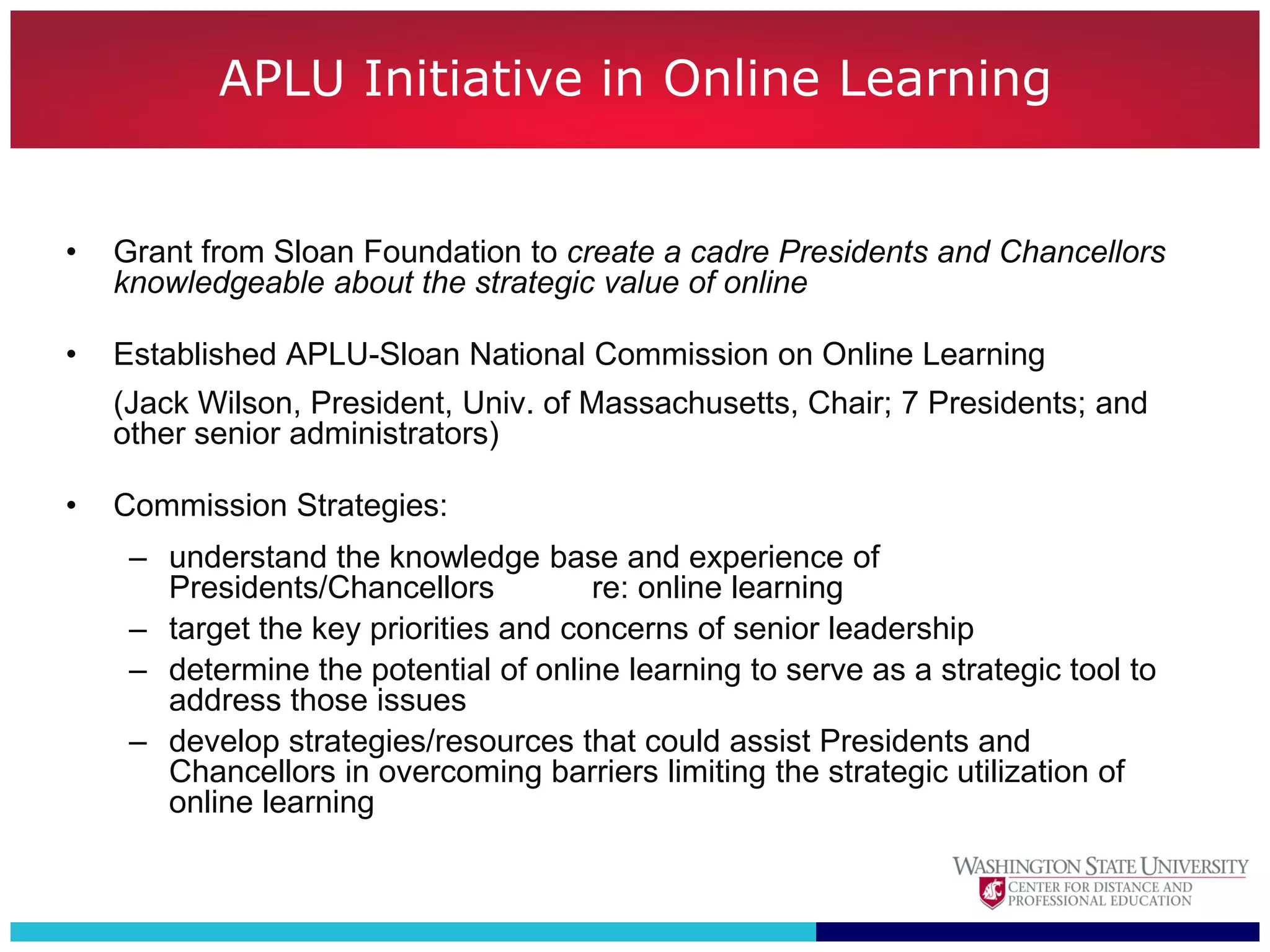
•   Grant from Sloan Foundation to create a cadre Presidents and Chancellors
    knowledgeable about the strategic value of online

•   Established APLU-Sloan National Commission on Online Learning
    (Jack Wilson, President, Univ. of Massachusetts, Chair; 7 Presidents; and
    other senior administrators)

•   Commission Strategies:
     – understand the knowledge base and experience of
       Presidents/Chancellors          re: online learning
     – target the key priorities and concerns of senior leadership
     – determine the potential of online learning to serve as a strategic tool to
       address those issues
     – develop strategies/resources that could assist Presidents and
       Chancellors in overcoming barriers limiting the strategic utilization of
       online learning
APLU-Sloan National
       Commission on Online Learning


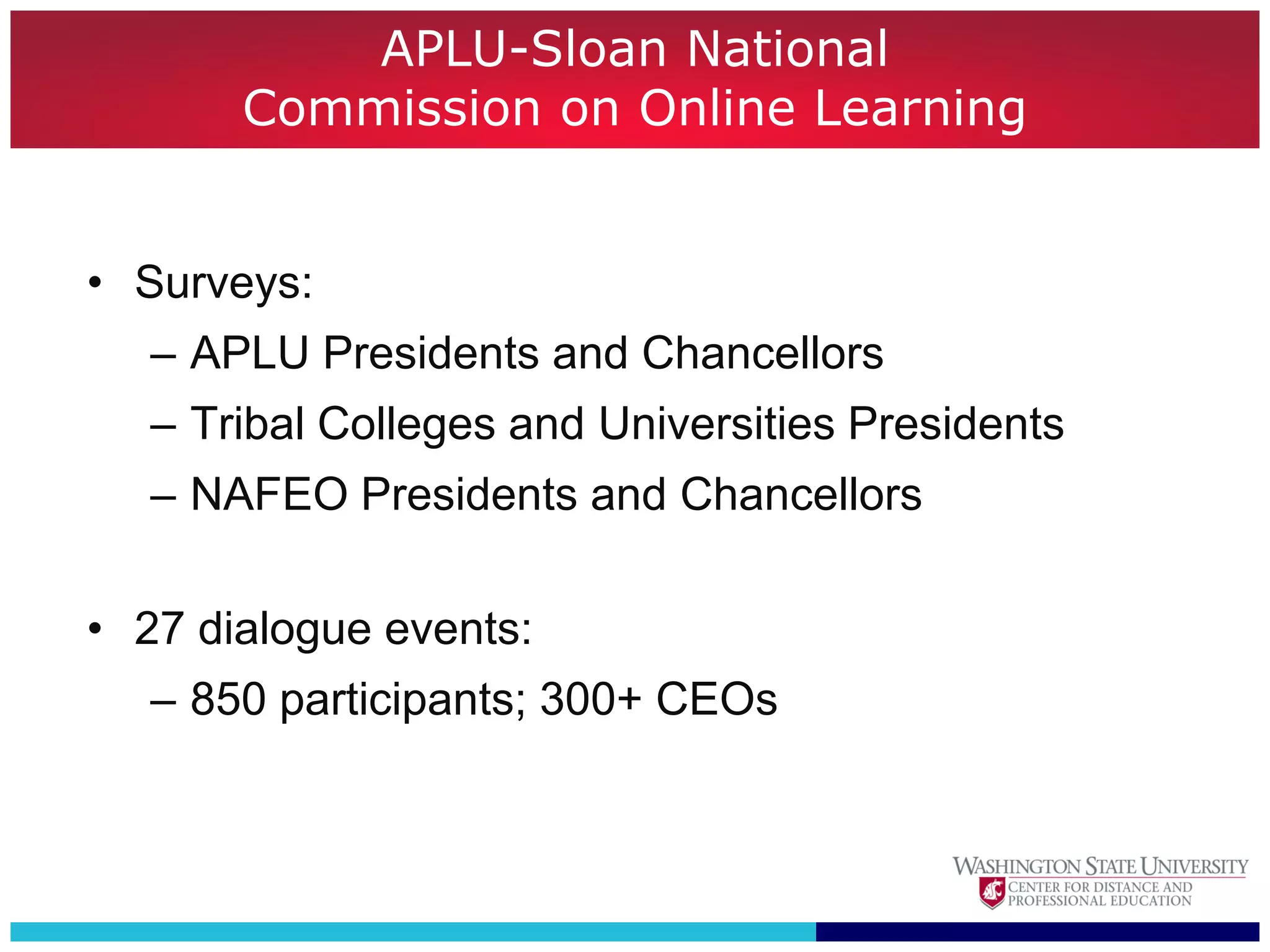
• Surveys:
  – APLU Presidents and Chancellors
  – Tribal Colleges and Universities Presidents
  – NAFEO Presidents and Chancellors

• 27 dialogue events:
  – 850 participants; 300+ CEOs
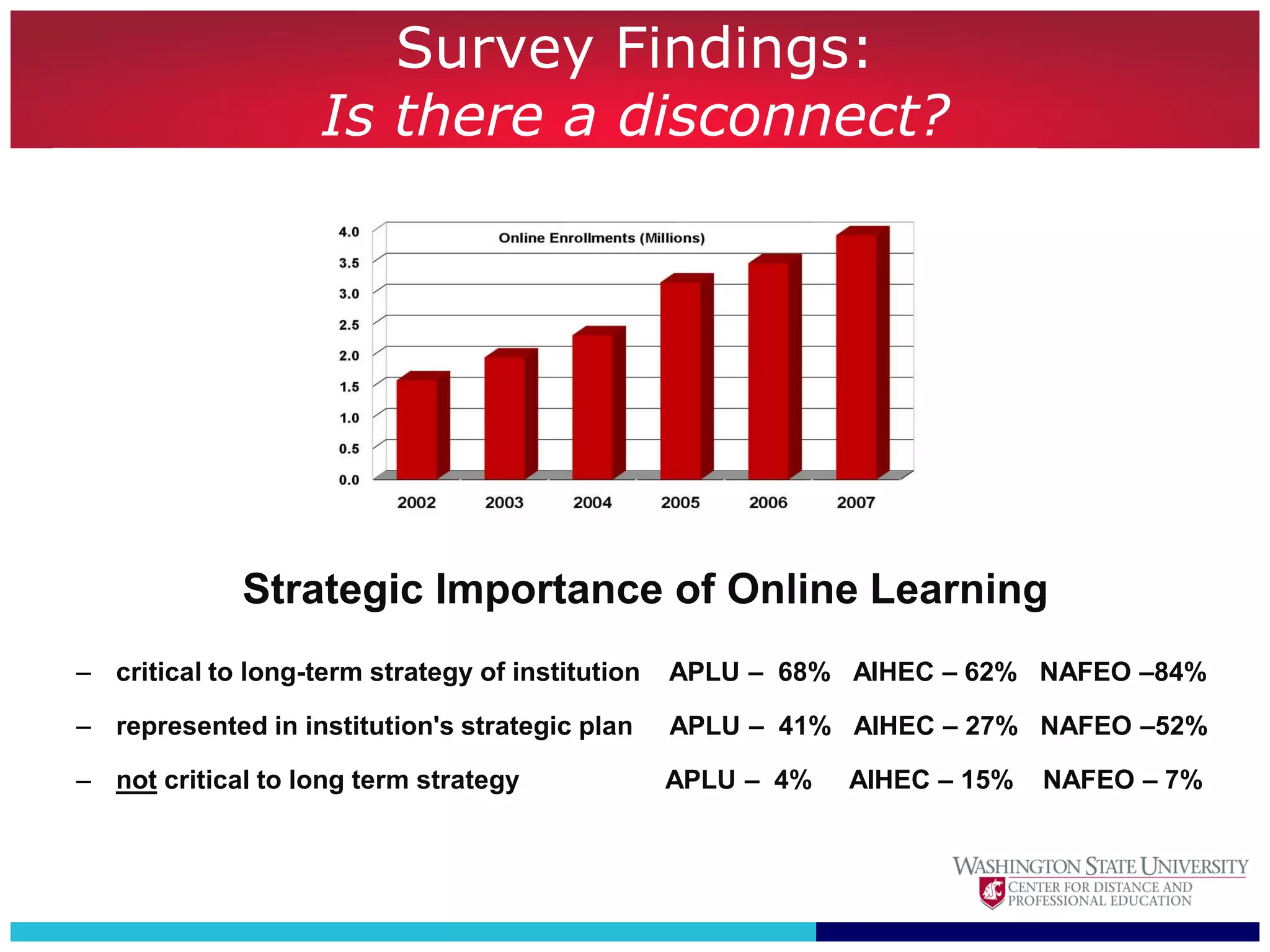
Survey Findings:
                    Is there a disconnect?


             Strategic Importance of Online Learning
– critical to long-term strategy of institution   APLU – 68% AIHEC – 62% NAFEO –84%

– represented in institution's strategic plan     APLU – 41% AIHEC – 27% NAFEO –52%

– not critical to long term strategy              APLU – 4%   AIHEC – 15%   NAFEO – 7%
Institutional Interviews

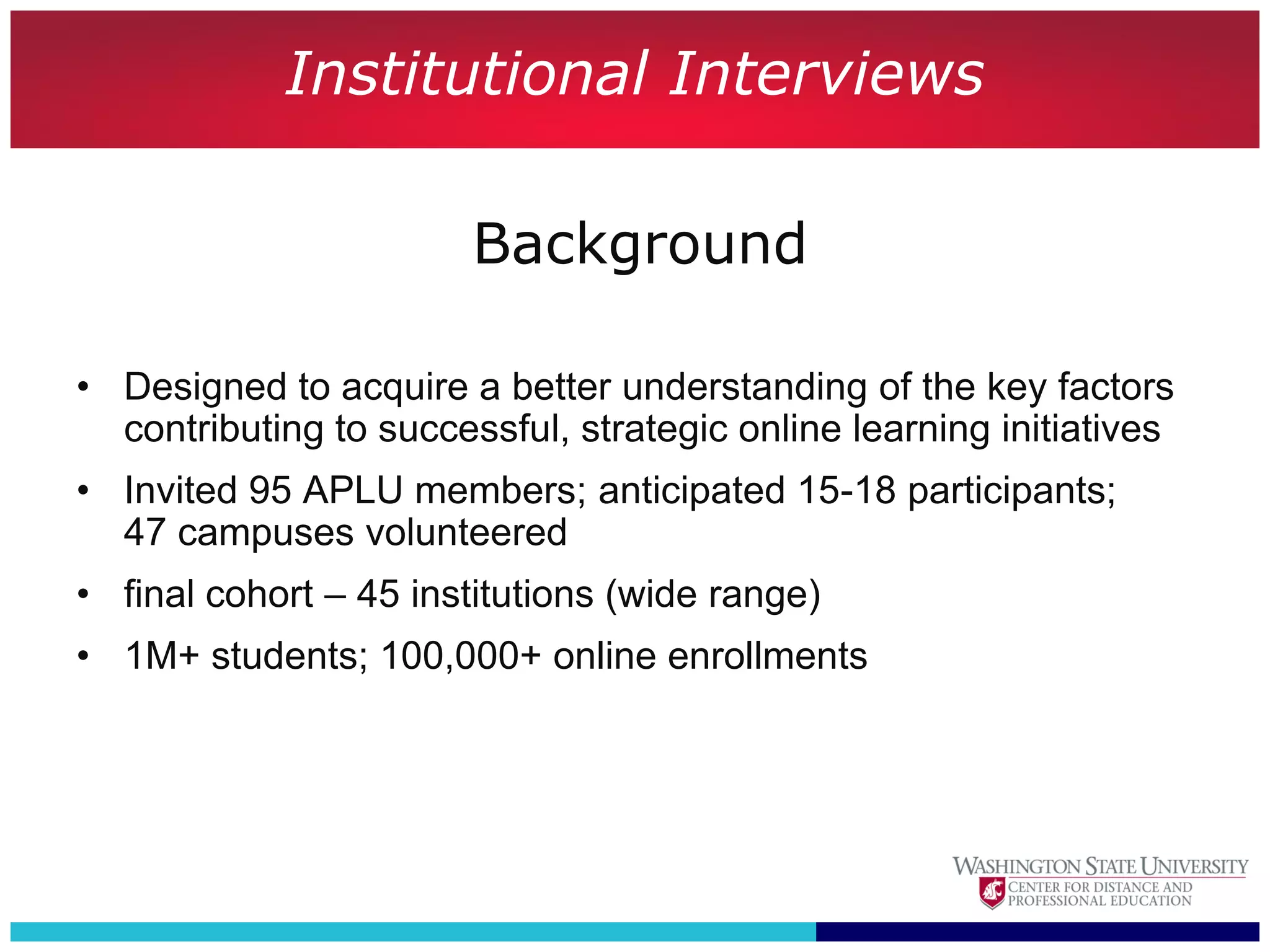
                        Background

• Designed to acquire a better understanding of the key factors
  contributing to successful, strategic online learning initiatives
• Invited 95 APLU members; anticipated 15-18 participants;
  47 campuses volunteered
• final cohort – 45 institutions (wide range)
• 1M+ students; 100,000+ online enrollments
Institutional Interviews

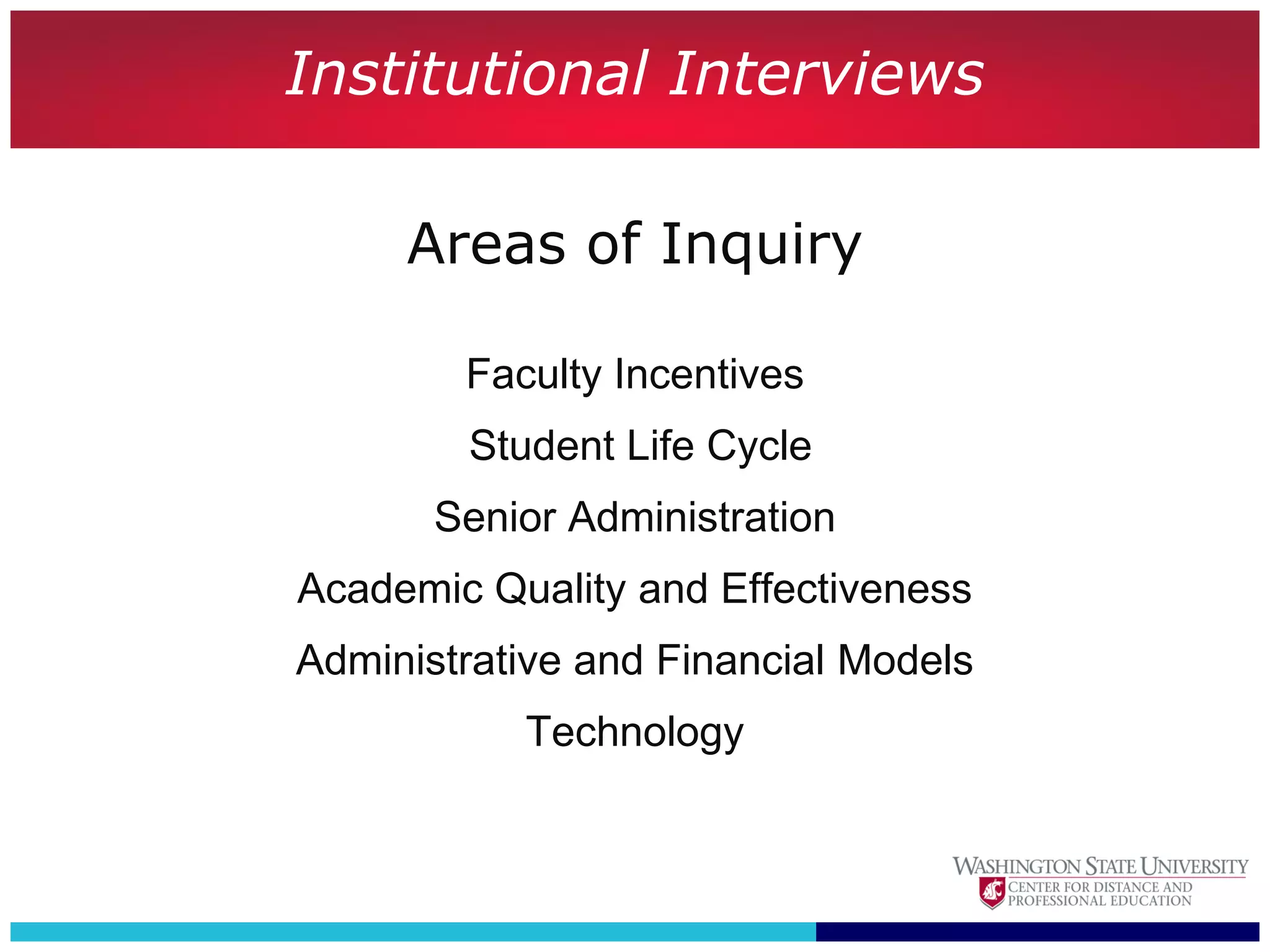
     Areas of Inquiry

        Faculty Incentives
        Student Life Cycle
       Senior Administration
Academic Quality and Effectiveness
Administrative and Financial Models
           Technology
Institutional Interviews

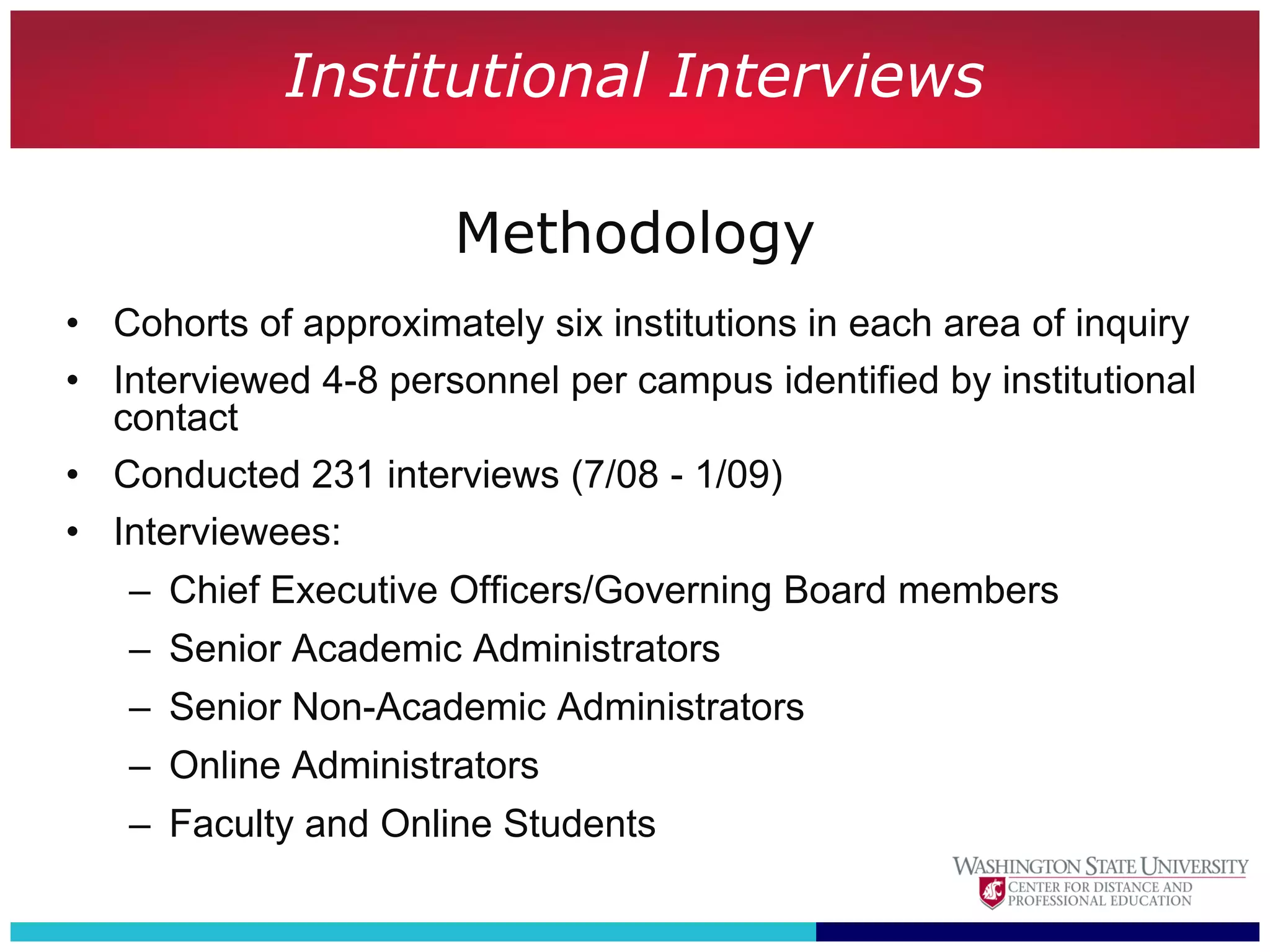
                       Methodology
• Cohorts of approximately six institutions in each area of inquiry
• Interviewed 4-8 personnel per campus identified by institutional
  contact
• Conducted 231 interviews (7/08 - 1/09)
• Interviewees:
   – Chief Executive Officers/Governing Board members
   – Senior Academic Administrators
   – Senior Non-Academic Administrators
   – Online Administrators
   – Faculty and Online Students
Institutional Interviews

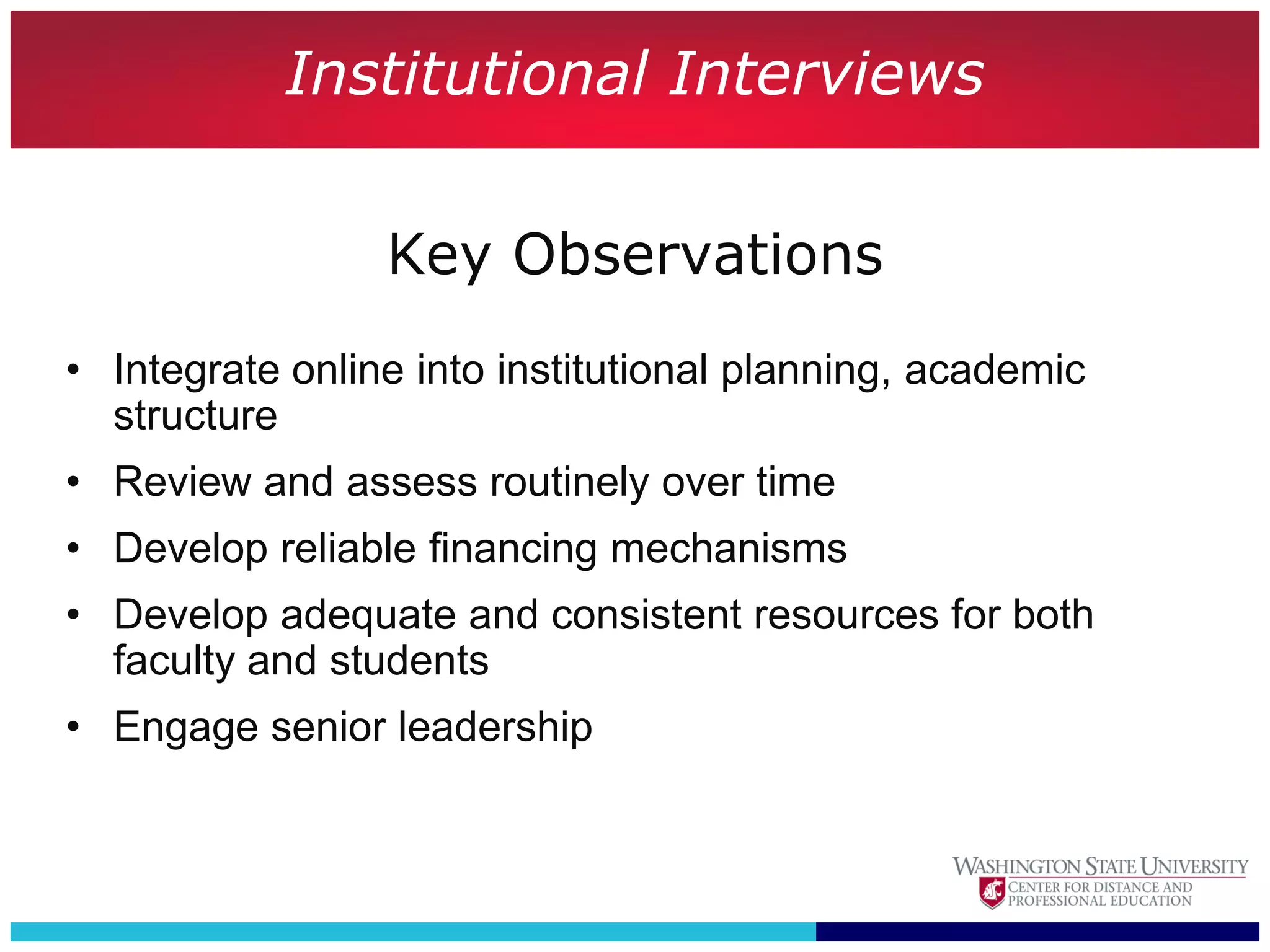
                 Key Observations
• Integrate online into institutional planning, academic
  structure
• Review and assess routinely over time
• Develop reliable financing mechanisms
• Develop adequate and consistent resources for both
  faculty and students
• Engage senior leadership
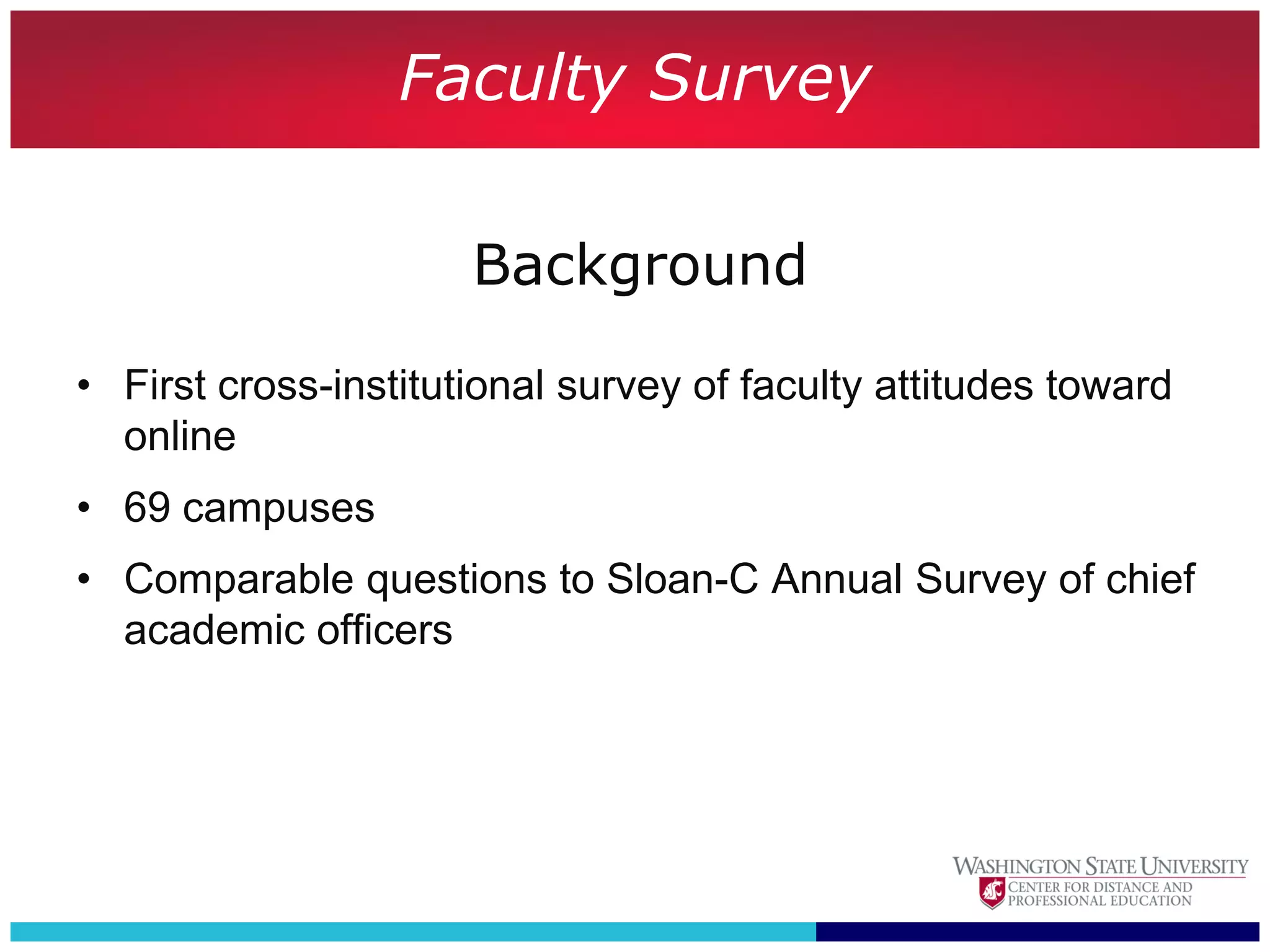
Faculty Survey

                      Background

• First cross-institutional survey of faculty attitudes toward
  online
• 69 campuses
• Comparable questions to Sloan-C Annual Survey of chief
  academic officers
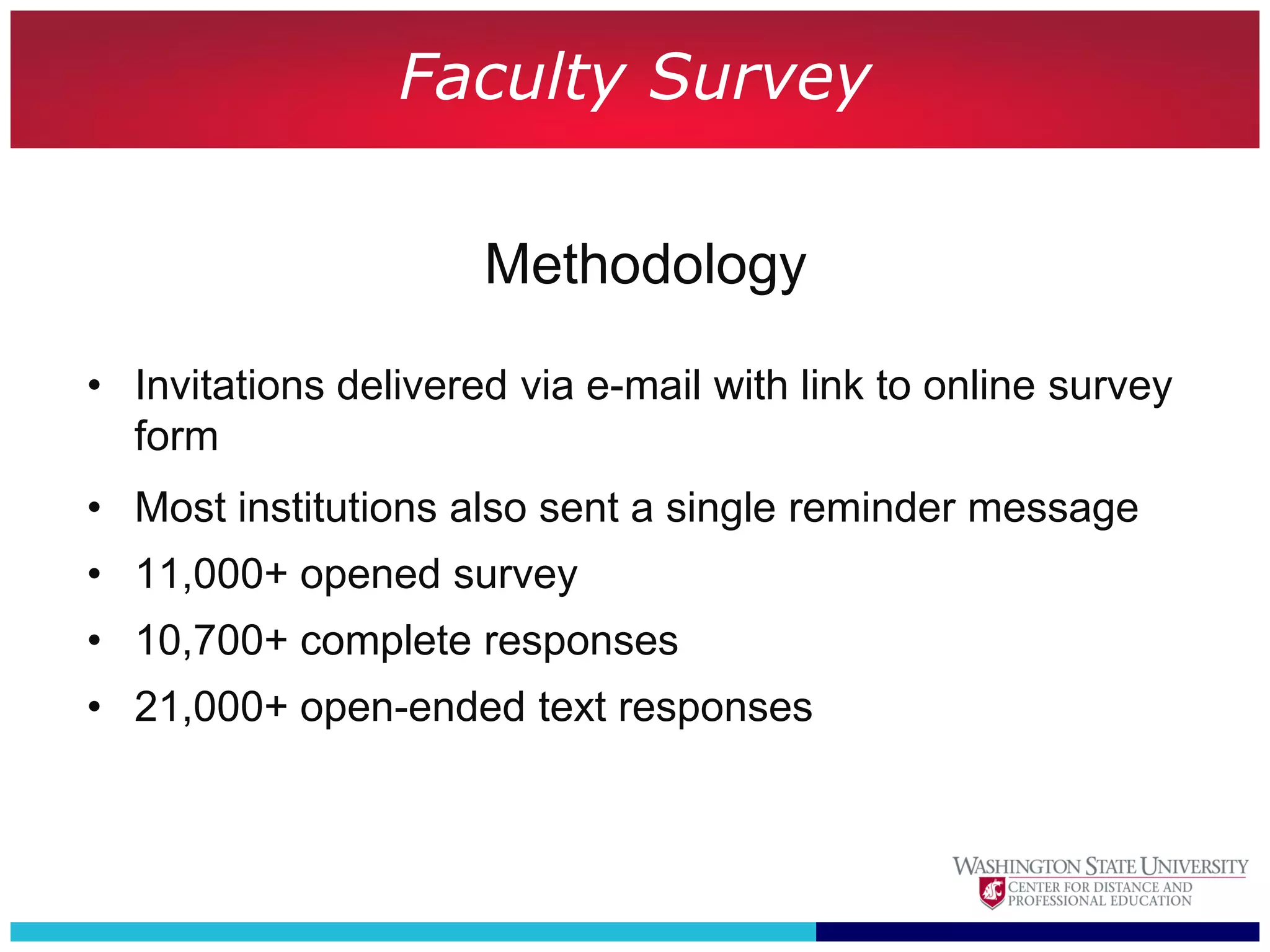
Faculty Survey

                      Methodology

• Invitations delivered via e-mail with link to online survey
  form
• Most institutions also sent a single reminder message
• 11,000+ opened survey
• 10,700+ complete responses
• 21,000+ open-ended text responses
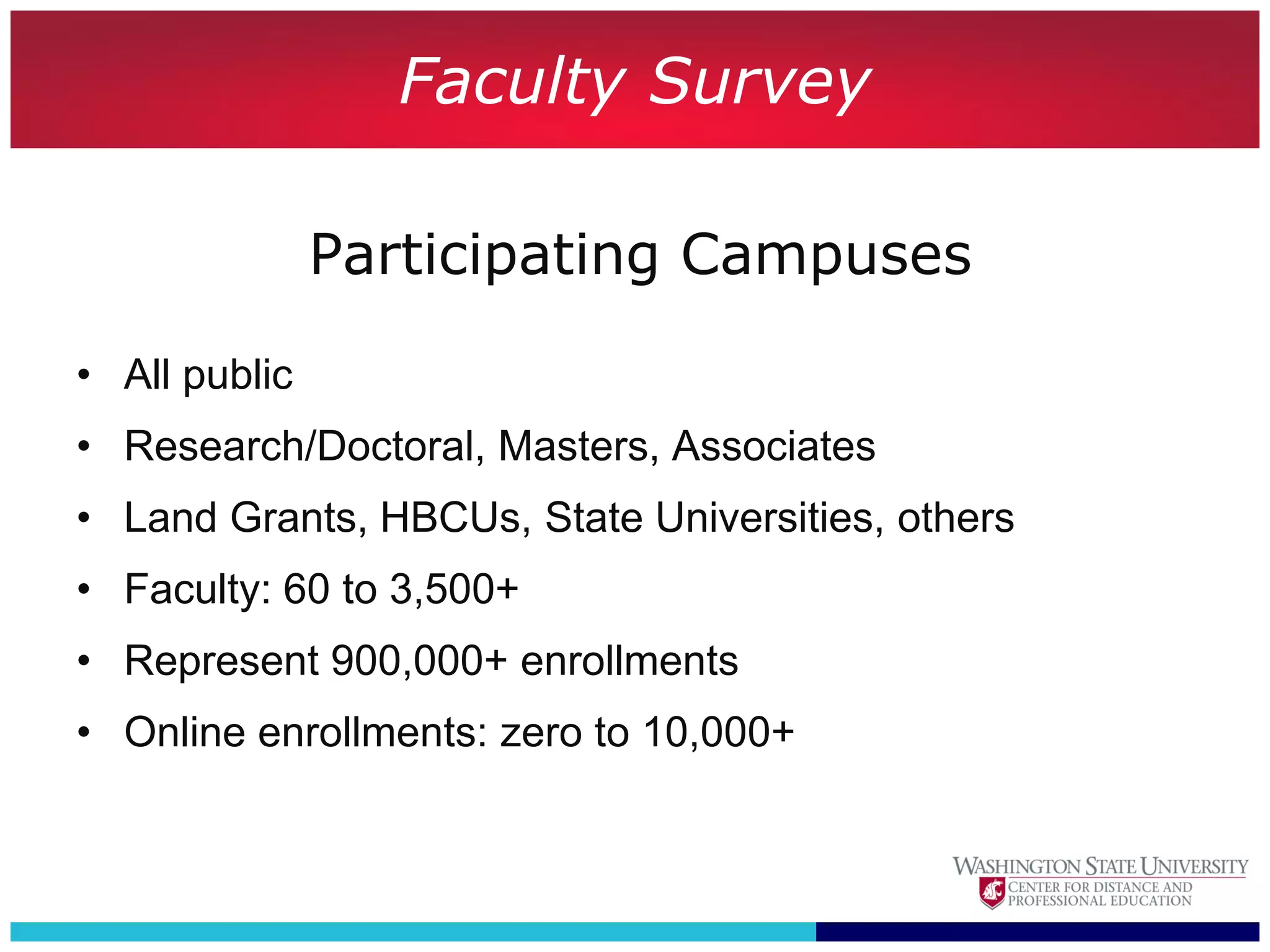
Faculty Survey

               Participating Campuses

• All public
• Research/Doctoral, Masters, Associates
• Land Grants, HBCUs, State Universities, others
• Faculty: 60 to 3,500+
• Represent 900,000+ enrollments
• Online enrollments: zero to 10,000+
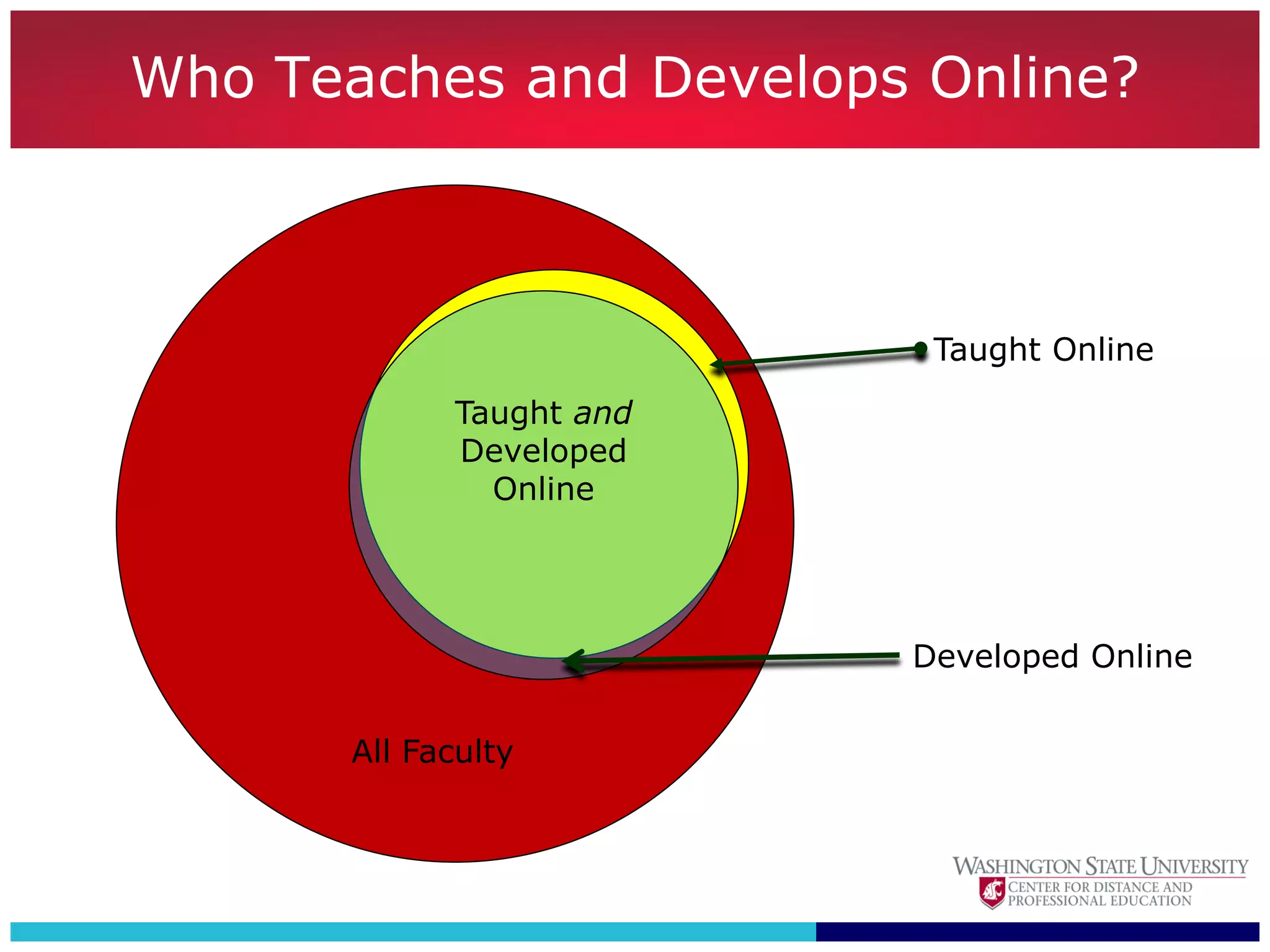
Who Teaches and Develops Online?


                            Taught Online
              Taught and
              Developed
                Online


                           Developed Online

       All Faculty
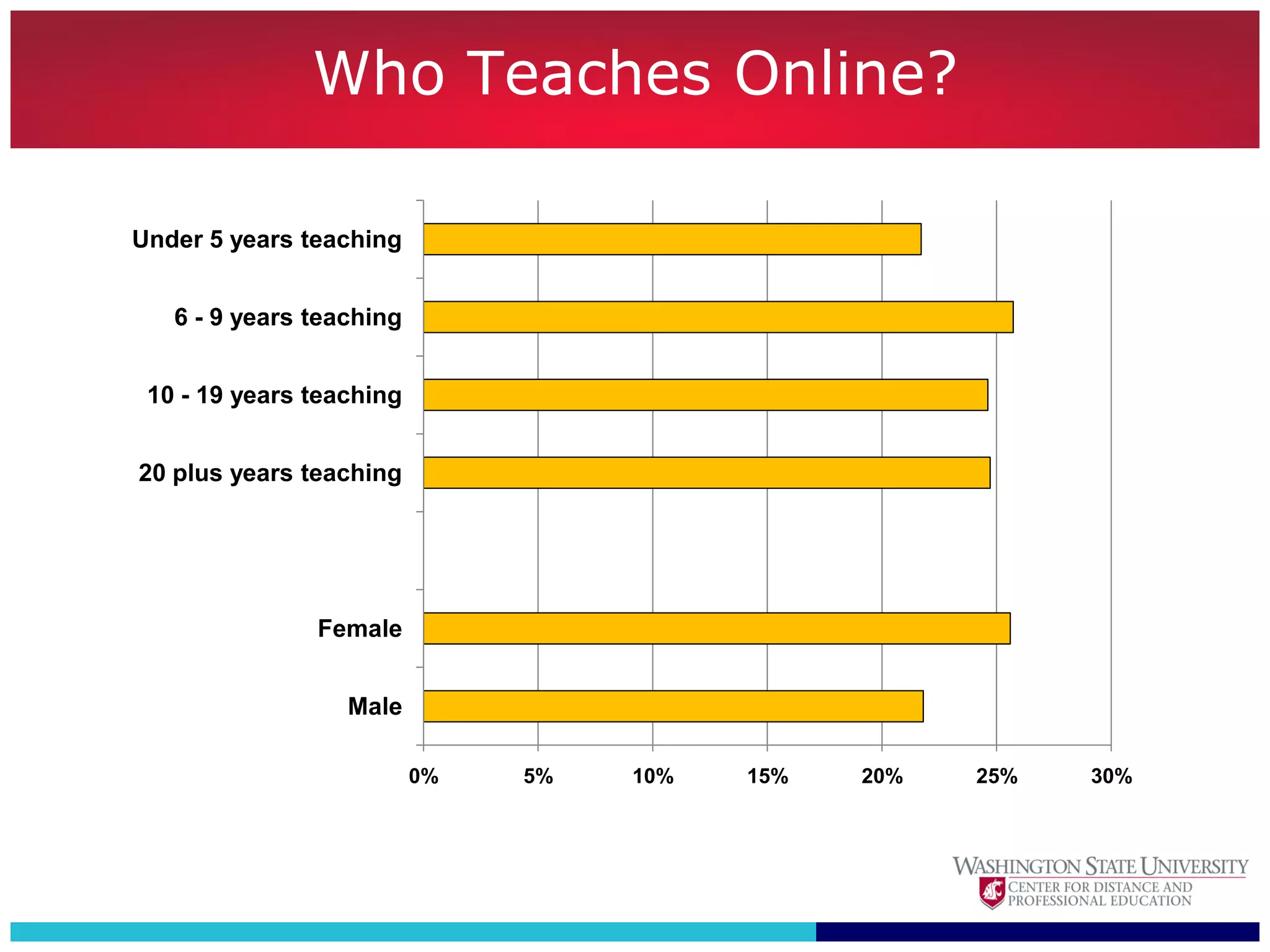
Who Teaches Online?

Under 5 years teaching


   6 - 9 years teaching


 10 - 19 years teaching


20 plus years teaching


               Female


                  Male

                          0%   5%   10%   15%   20%   25%   30%
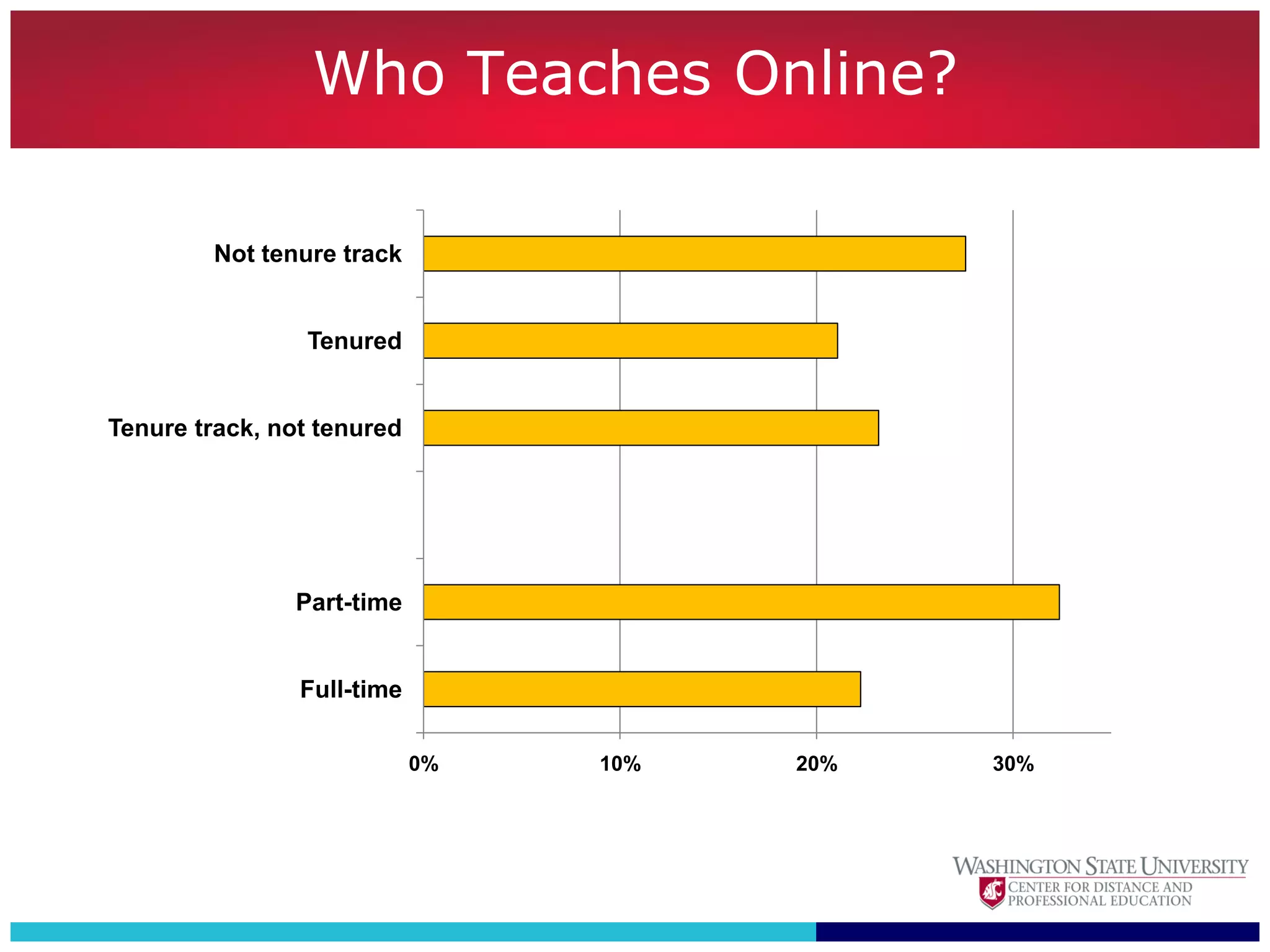
Who Teaches Online?

         Not tenure track


                Tenured


Tenure track, not tenured


               Part-time


                Full-time

                            0%   10%   20%   30%
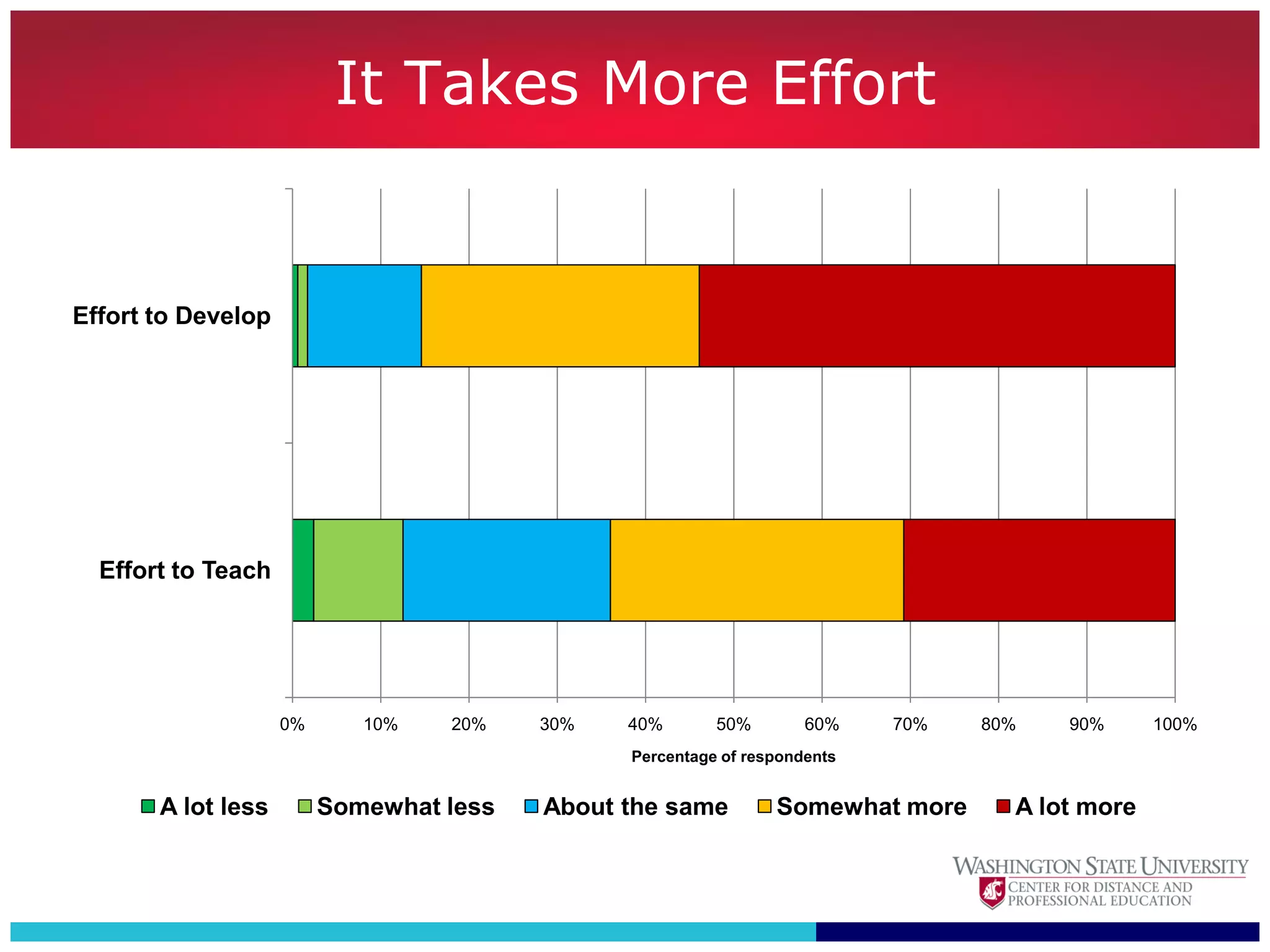
It Takes More Effort


Effort to Develop


  Effort to Teach


                    0%      10%   20%    30%   40%       50%        60%    70%   80%   90%      100%
                                               Percentage of respondents


       A lot less        Somewhat less   About the same         Somewhat more      A lot more
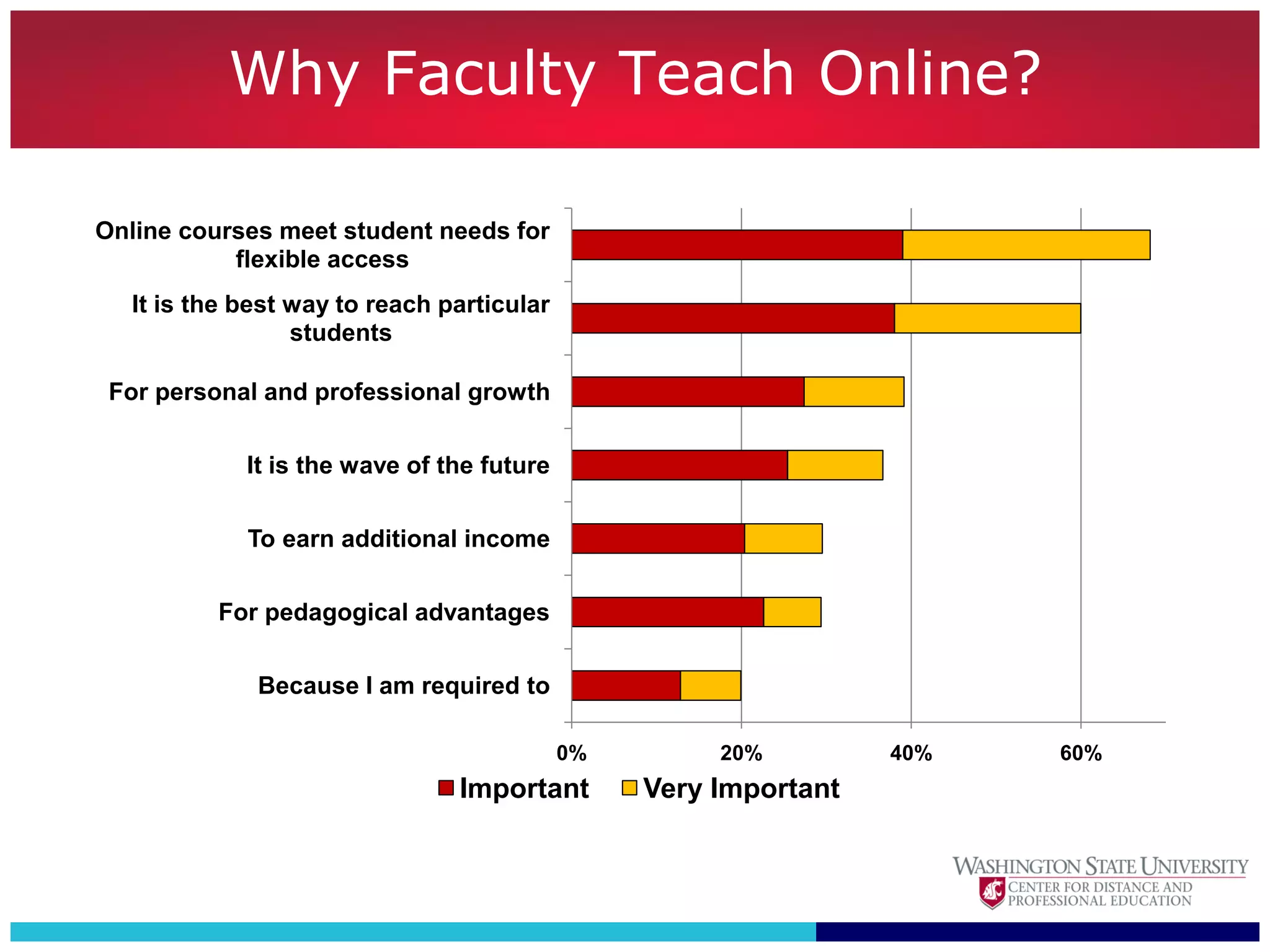
Why Faculty Teach Online?

Online courses meet student needs for
           flexible access
  It is the best way to reach particular
                 students

 For personal and professional growth

            It is the wave of the future

            To earn additional income

          For pedagogical advantages

             Because I am required to

                                           0%        20%         40%   60%
                               Important        Very Important
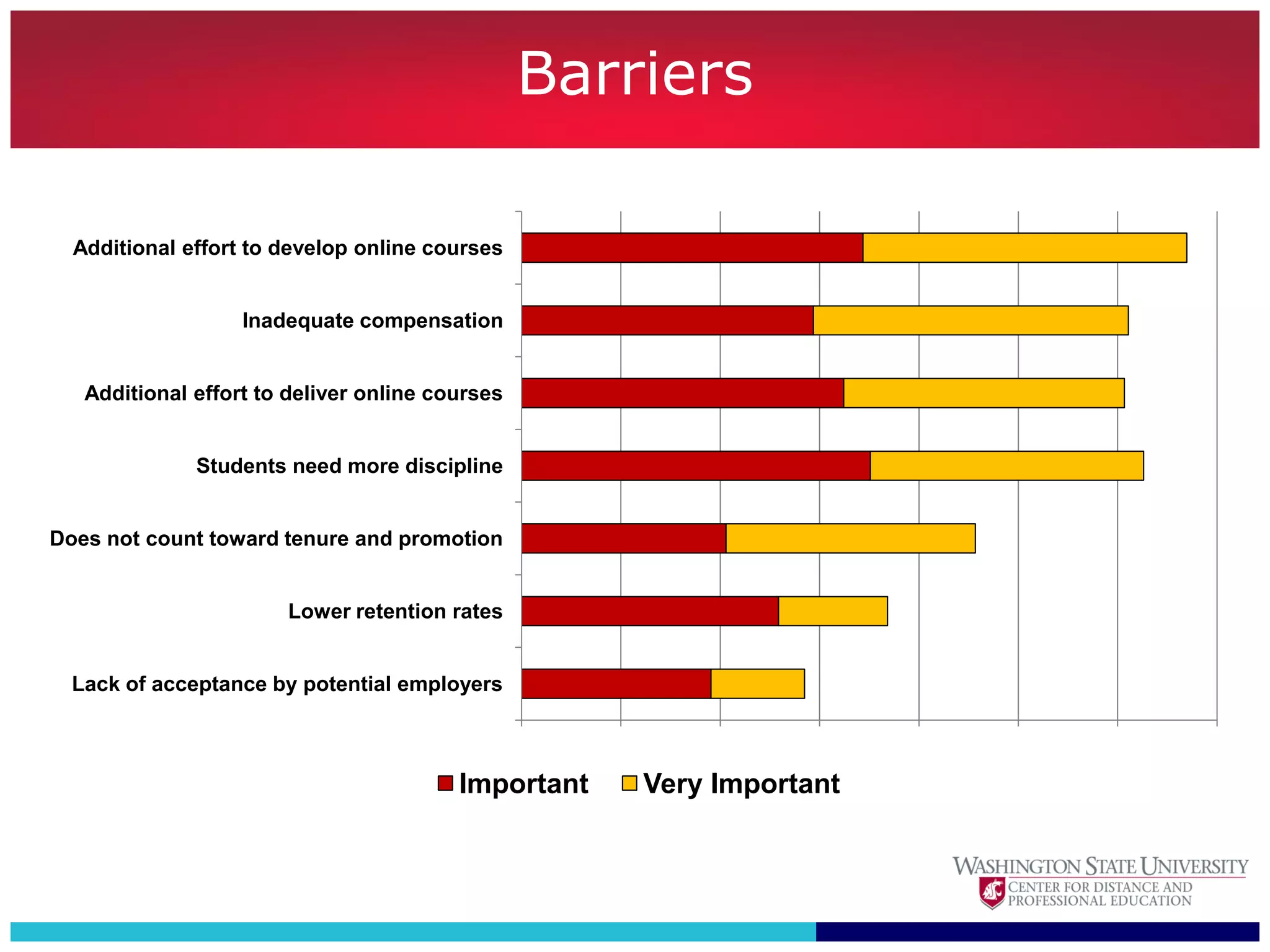
Barriers

  Additional effort to develop online courses


                   Inadequate compensation


   Additional effort to deliver online courses


              Students need more discipline


Does not count toward tenure and promotion


                       Lower retention rates


  Lack of acceptance by potential employers


                                                 0%   10%      20%     30%   40%   50%   60%   70%
                                         Important          Very Important
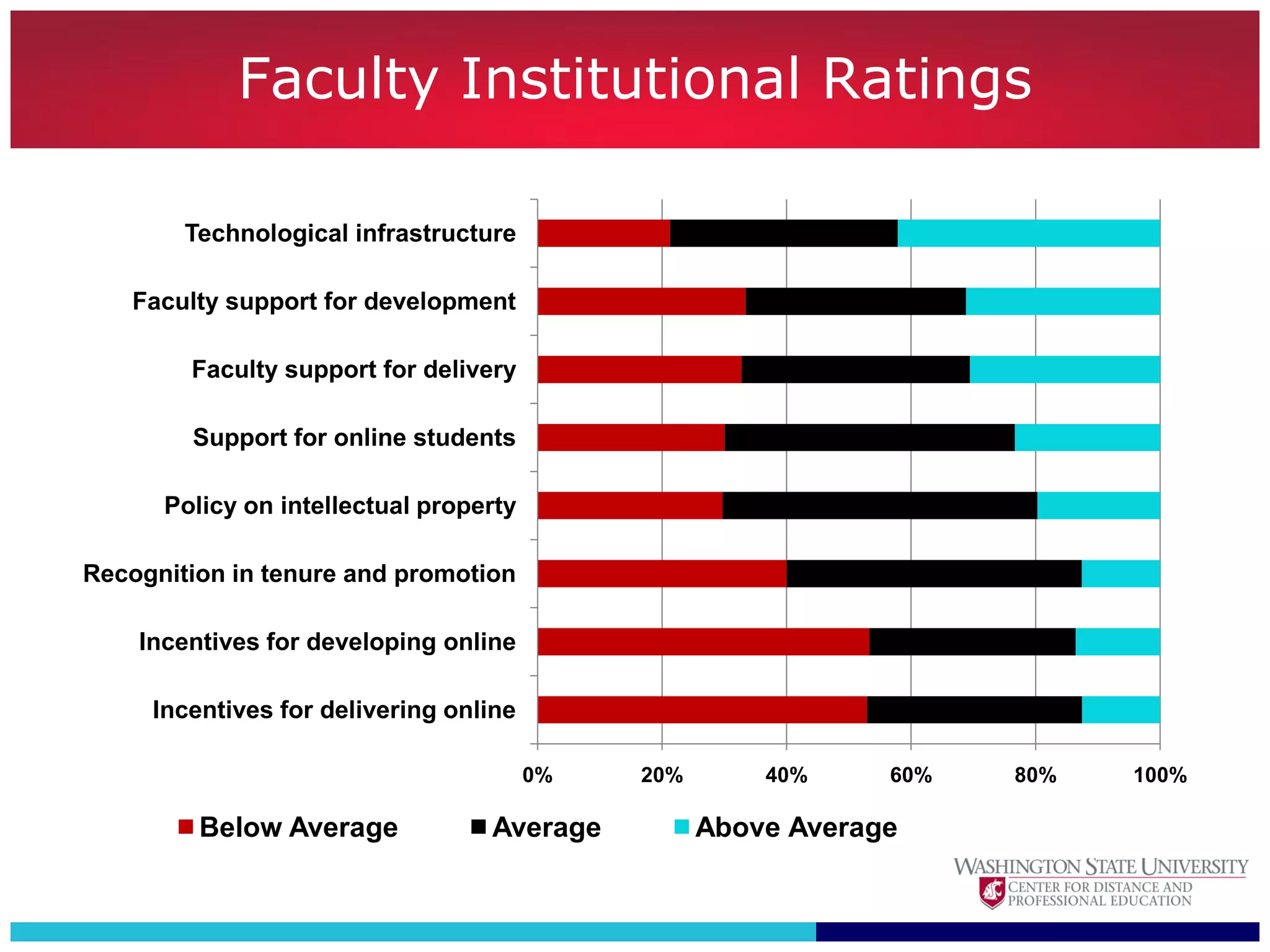
Faculty Institutional Ratings

        Technological infrastructure

   Faculty support for development

        Faculty support for delivery

        Support for online students

      Policy on intellectual property

Recognition in tenure and promotion

    Incentives for developing online

     Incentives for delivering online

                                        0%   20%       40%     60%   80%   100%

         Below Average            Average          Above Average
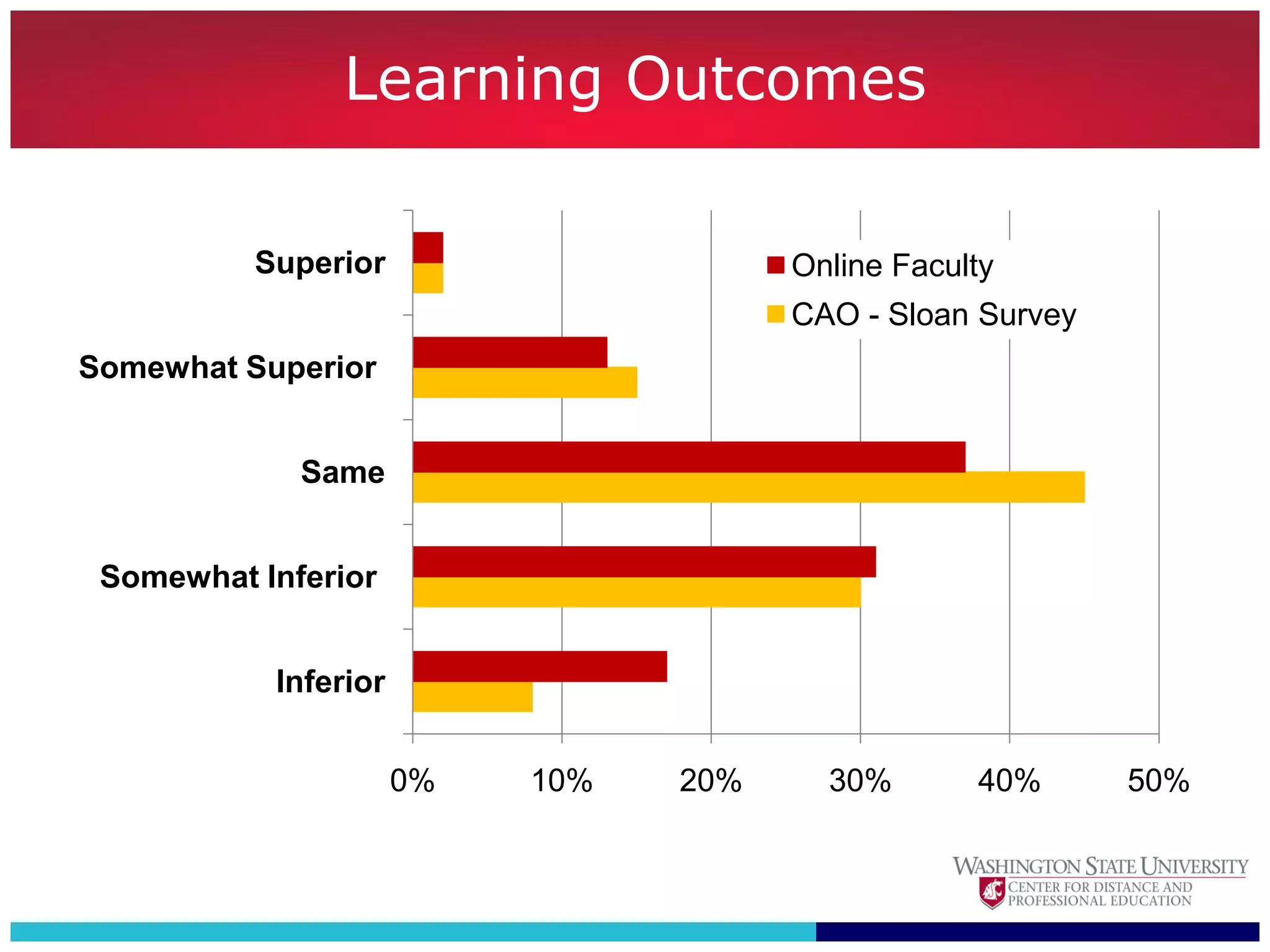
Learning Outcomes

          Superior                     Online Faculty
                                       CAO - Sloan Survey
Somewhat Superior


             Same


 Somewhat Inferior


           Inferior


                      0%   10%   20%     30%       40%      50%
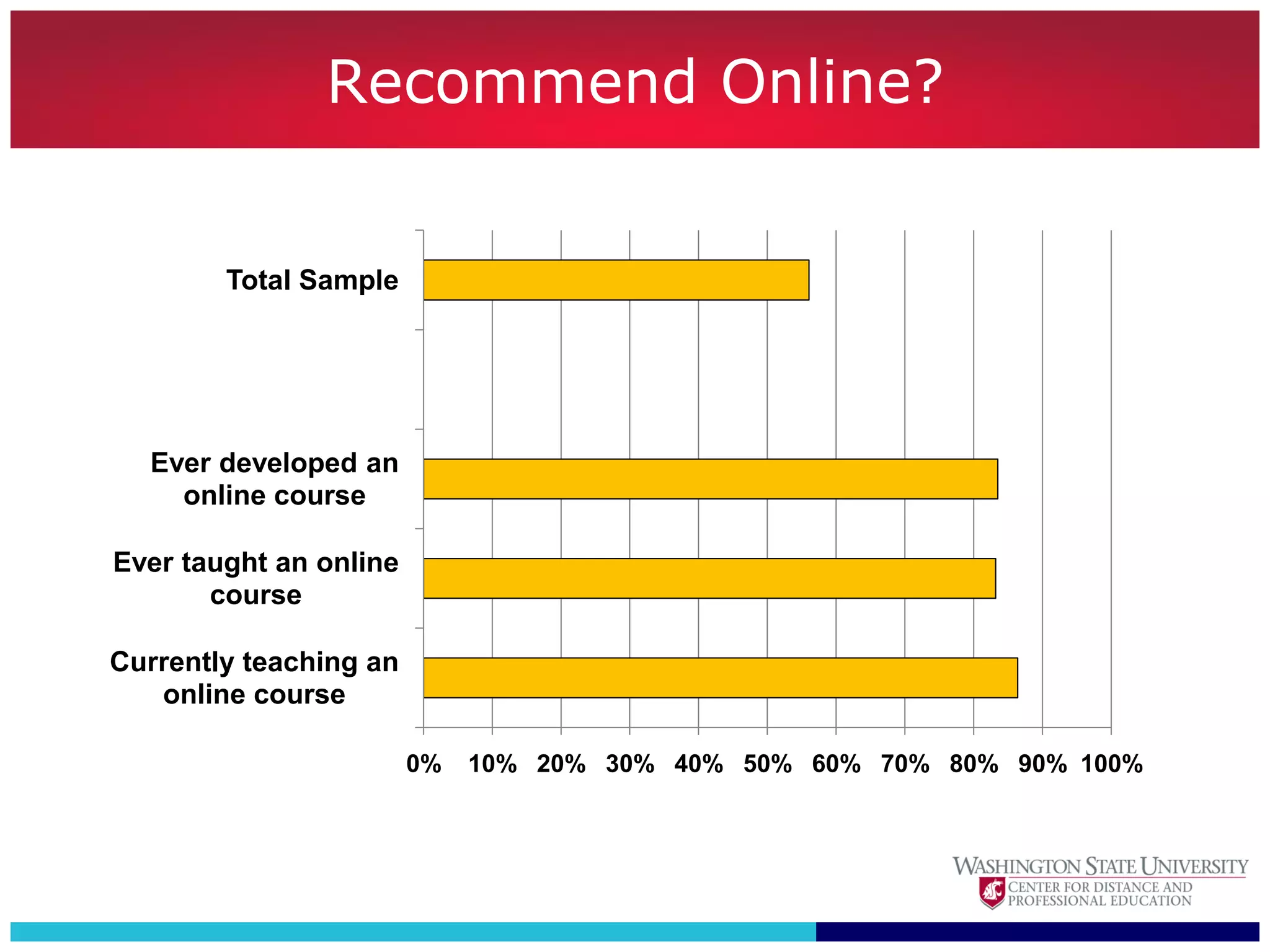
Recommend Online?


        Total Sample


  Ever developed an
    online course

Ever taught an online
       course

Currently teaching an
   online course

                        0%   10% 20% 30% 40% 50% 60% 70% 80% 90% 100%
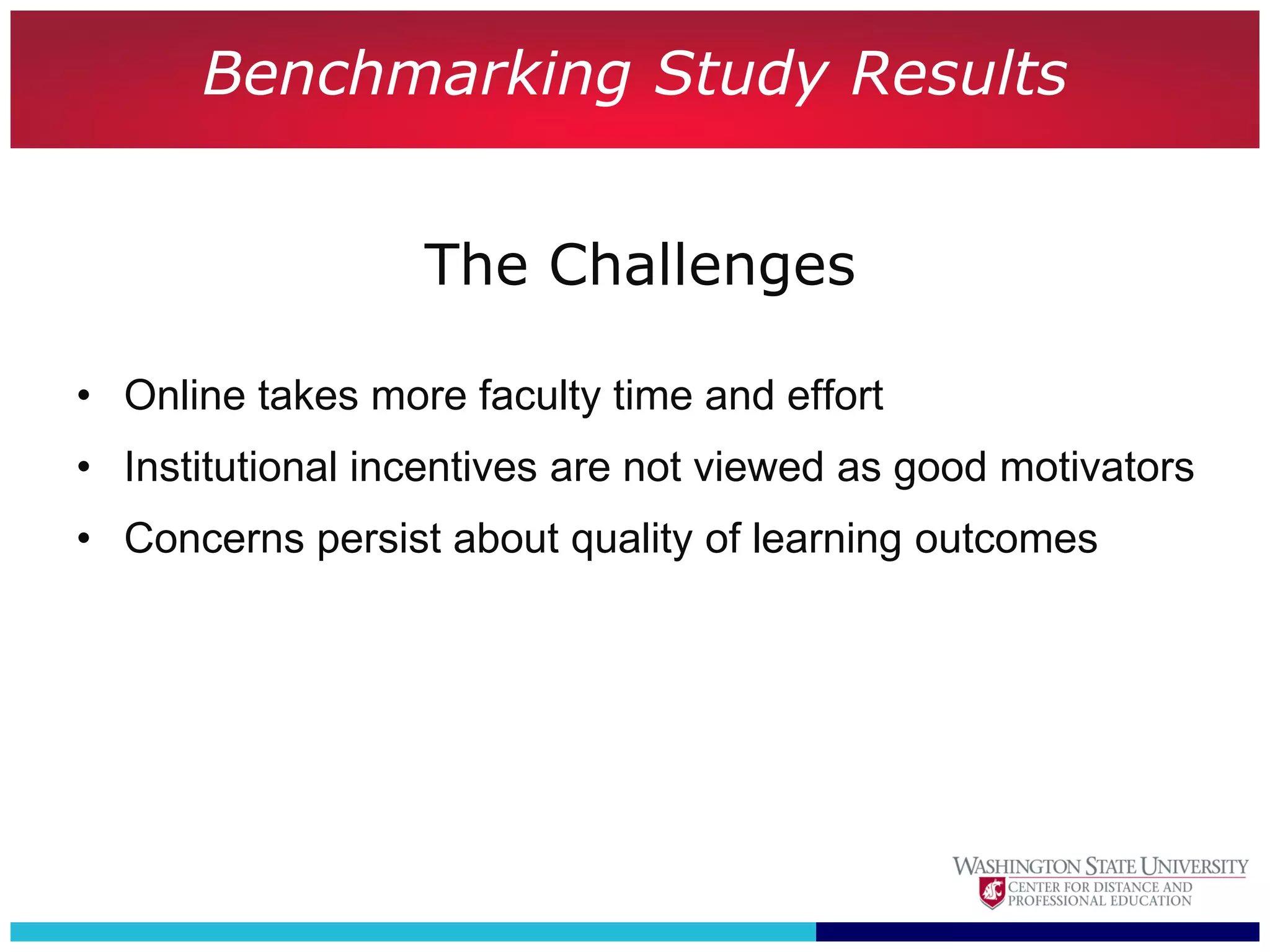
Benchmarking Study Results


                  The Challenges

• Online takes more faculty time and effort
• Institutional incentives are not viewed as good motivators
• Concerns persist about quality of learning outcomes
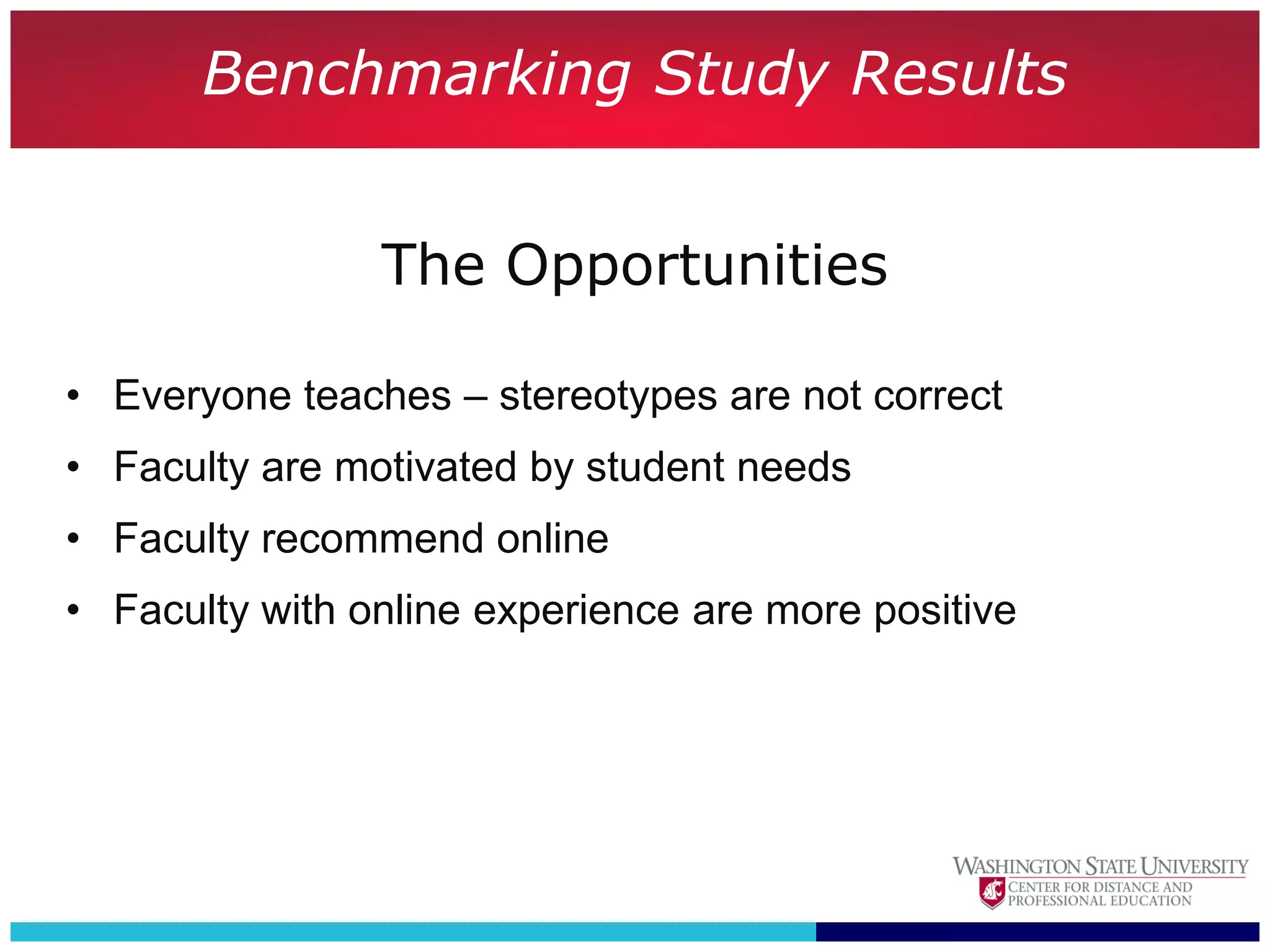
Benchmarking Study Results


                The Opportunities

• Everyone teaches – stereotypes are not correct
• Faculty are motivated by student needs
• Faculty recommend online
• Faculty with online experience are more positive
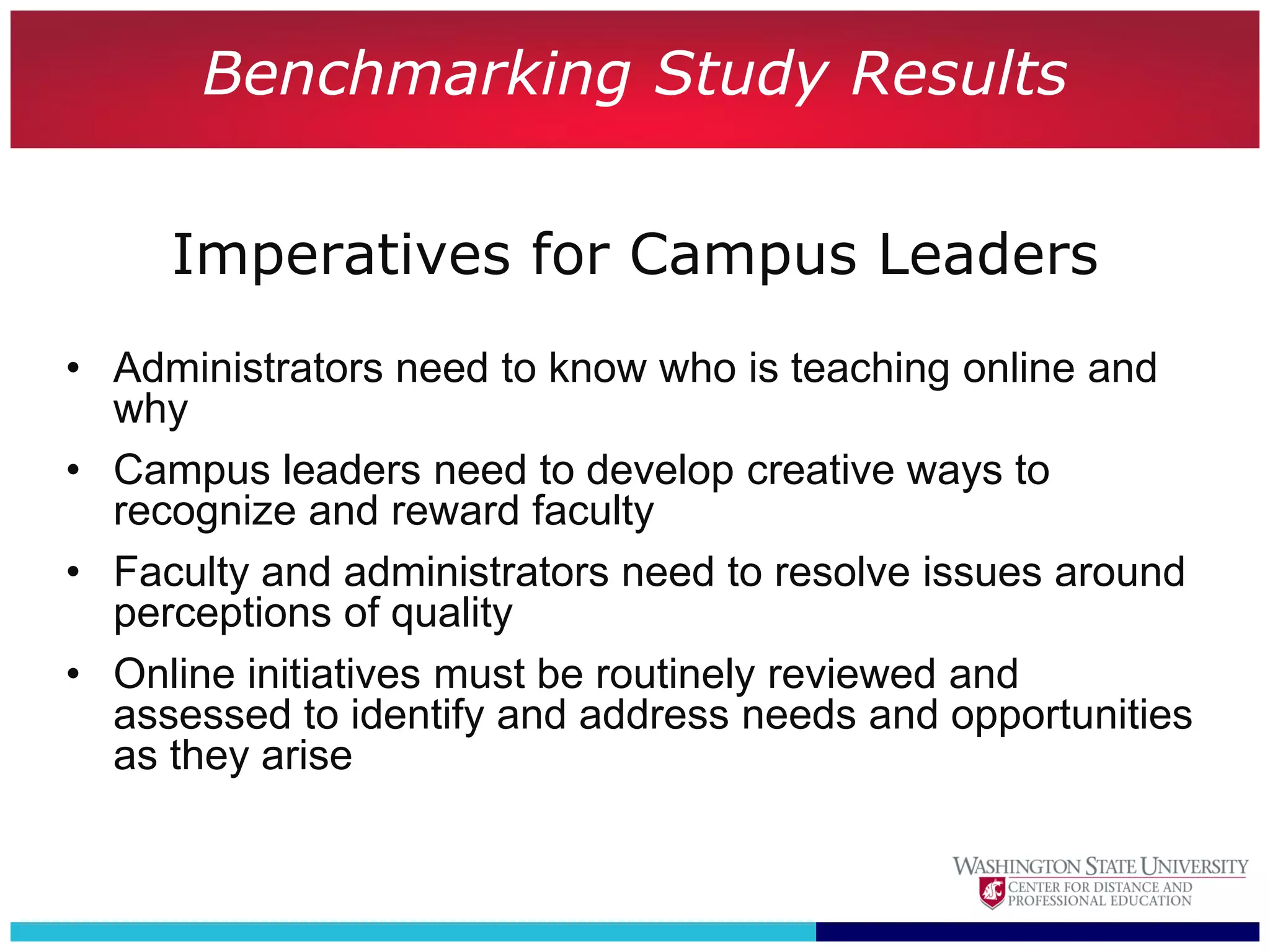
Benchmarking Study Results

     Imperatives for Campus Leaders
• Administrators need to know who is teaching online and
  why
• Campus leaders need to develop creative ways to
  recognize and reward faculty
• Faculty and administrators need to resolve issues around
  perceptions of quality
• Online initiatives must be routinely reviewed and
  assessed to identify and address needs and opportunities
  as they arise
Link to Survey Reports:
   http://www.aplu.org/NetCommunity/Page.aspx?pid=282
Questions?
Thank you!
    For more information, please contact:

             Muriel Oaks, Dean
Center for Distance and Professional Education
         Washington State University
               oaks@wsu.edu
Additional Slides
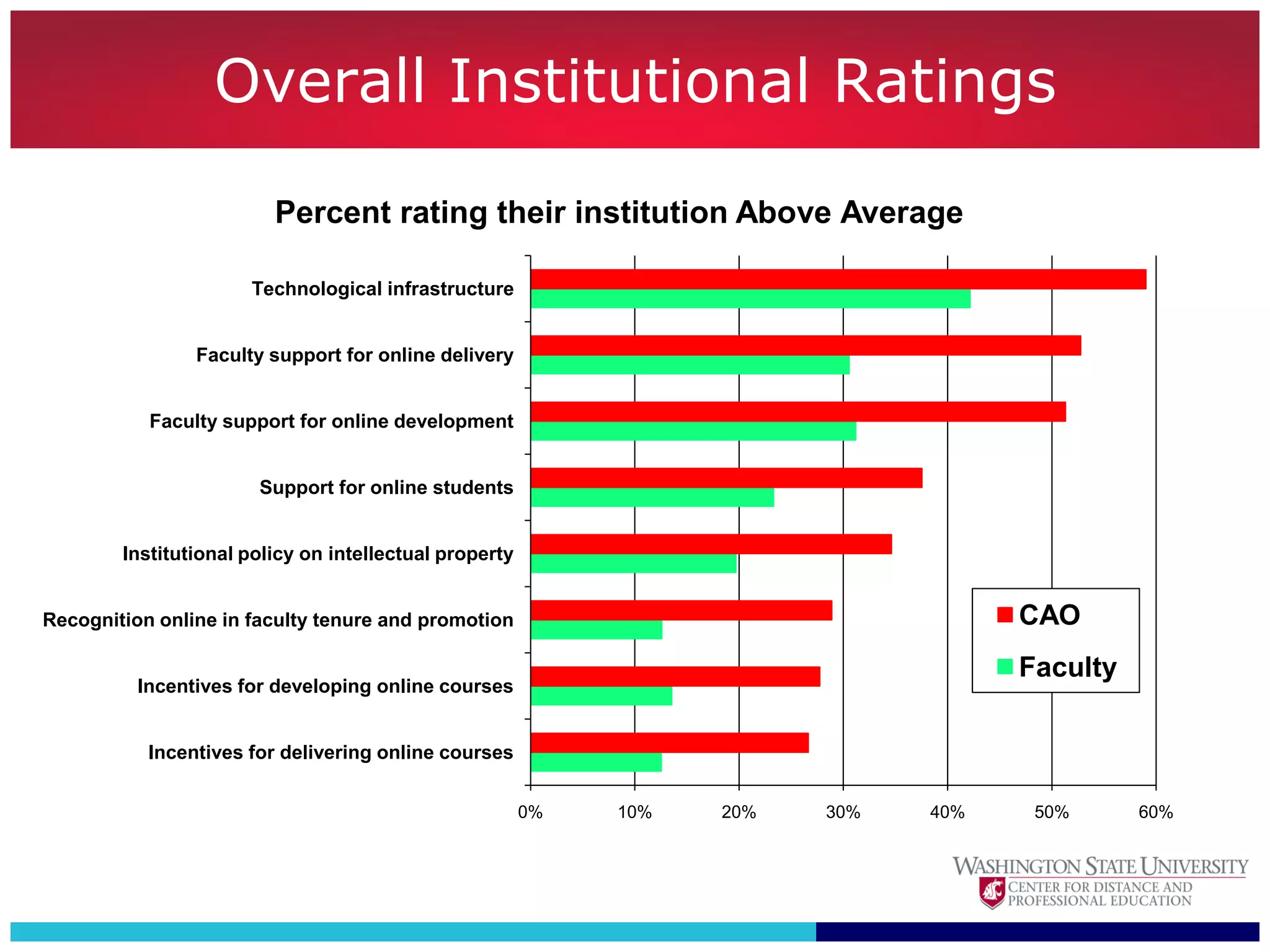
Overall Institutional Ratings

                         Percent rating their institution Above Average

                      Technological infrastructure


                Faculty support for online delivery


           Faculty support for online development


                       Support for online students


        Institutional policy on intellectual property


Recognition online in faculty tenure and promotion                                   CAO
                                                                                     Faculty
          Incentives for developing online courses


           Incentives for delivering online courses


                                                        0%   10%   20%   30%   40%    50%      60%
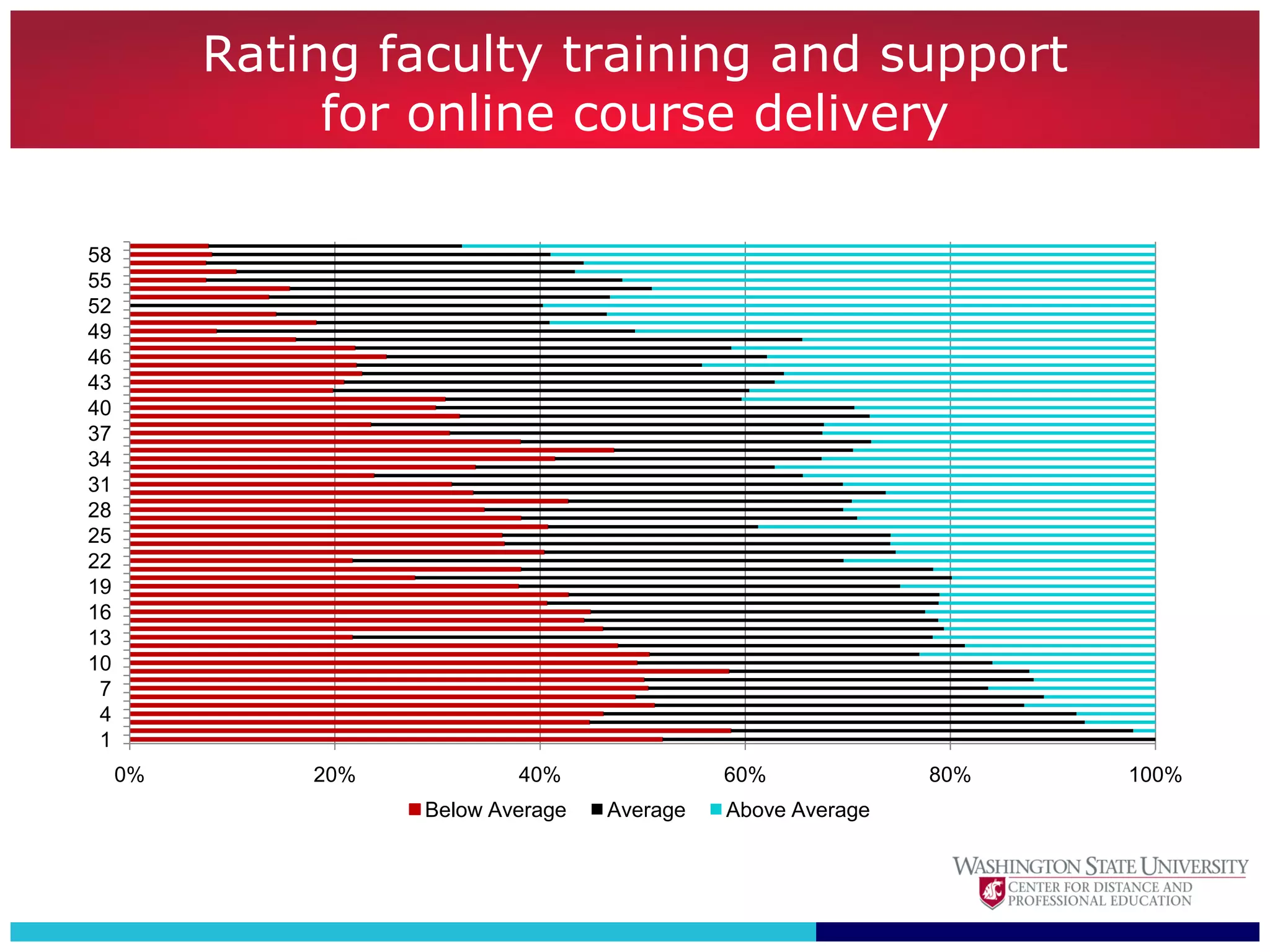
Rating faculty training and support
               for online course delivery

58
55
52
49
46
43
40
37
34
31
28
25
22
19
16
13
10
 7
 4
 1
     0%       20%           40%               60%             80%   100%
                    Below Average   Average   Above Average
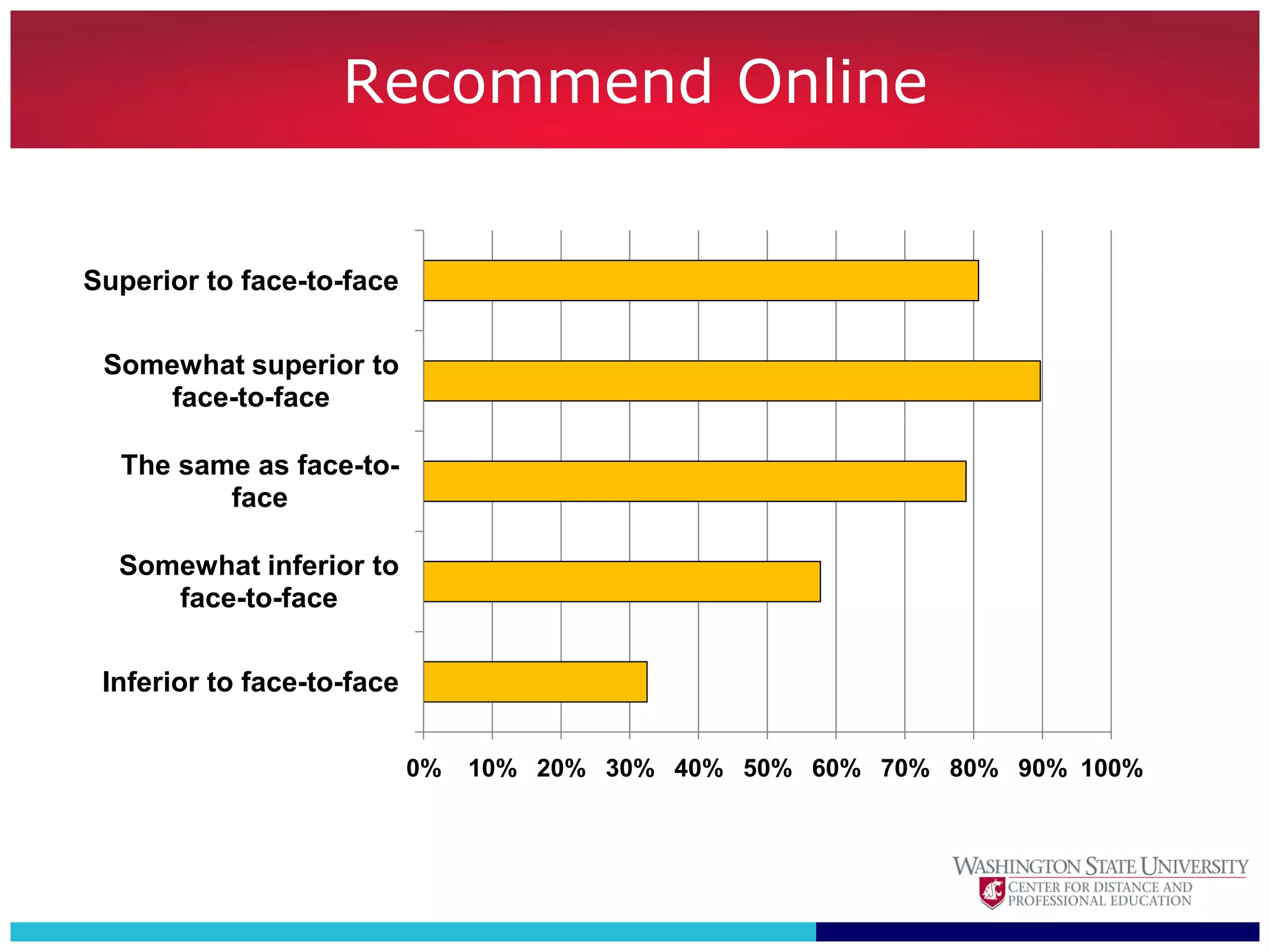
Recommend Online


Superior to face-to-face

 Somewhat superior to
     face-to-face

  The same as face-to-
         face

  Somewhat inferior to
     face-to-face

 Inferior to face-to-face


                            0%   10% 20% 30% 40% 50% 60% 70% 80% 90% 100%

Benchmarking Online Learning Oaks

  • 1.
    Benchmarking Online Learning: Perceptionsof University Faculty and Administrators
  • 2.
    Muriel Oaks Washington StateUniversity APLU-Sloan National Commission on Online Learning October 23, 2009 WCET Annual Conference Denver
  • 3.
    APLU Initiative inOnline Learning • Grant from Sloan Foundation to create a cadre Presidents and Chancellors knowledgeable about the strategic value of online • Established APLU-Sloan National Commission on Online Learning (Jack Wilson, President, Univ. of Massachusetts, Chair; 7 Presidents; and other senior administrators) • Commission Strategies: – understand the knowledge base and experience of Presidents/Chancellors re: online learning – target the key priorities and concerns of senior leadership – determine the potential of online learning to serve as a strategic tool to address those issues – develop strategies/resources that could assist Presidents and Chancellors in overcoming barriers limiting the strategic utilization of online learning
  • 4.
    APLU-Sloan National Commission on Online Learning • Surveys: – APLU Presidents and Chancellors – Tribal Colleges and Universities Presidents – NAFEO Presidents and Chancellors • 27 dialogue events: – 850 participants; 300+ CEOs
  • 5.
    Survey Findings: Is there a disconnect? Strategic Importance of Online Learning – critical to long-term strategy of institution APLU – 68% AIHEC – 62% NAFEO –84% – represented in institution's strategic plan APLU – 41% AIHEC – 27% NAFEO –52% – not critical to long term strategy APLU – 4% AIHEC – 15% NAFEO – 7%
  • 6.
    Institutional Interviews Background • Designed to acquire a better understanding of the key factors contributing to successful, strategic online learning initiatives • Invited 95 APLU members; anticipated 15-18 participants; 47 campuses volunteered • final cohort – 45 institutions (wide range) • 1M+ students; 100,000+ online enrollments
  • 7.
    Institutional Interviews Areas of Inquiry Faculty Incentives Student Life Cycle Senior Administration Academic Quality and Effectiveness Administrative and Financial Models Technology
  • 8.
    Institutional Interviews Methodology • Cohorts of approximately six institutions in each area of inquiry • Interviewed 4-8 personnel per campus identified by institutional contact • Conducted 231 interviews (7/08 - 1/09) • Interviewees: – Chief Executive Officers/Governing Board members – Senior Academic Administrators – Senior Non-Academic Administrators – Online Administrators – Faculty and Online Students
  • 9.
    Institutional Interviews Key Observations • Integrate online into institutional planning, academic structure • Review and assess routinely over time • Develop reliable financing mechanisms • Develop adequate and consistent resources for both faculty and students • Engage senior leadership
  • 10.
    Faculty Survey Background • First cross-institutional survey of faculty attitudes toward online • 69 campuses • Comparable questions to Sloan-C Annual Survey of chief academic officers
  • 11.
    Faculty Survey Methodology • Invitations delivered via e-mail with link to online survey form • Most institutions also sent a single reminder message • 11,000+ opened survey • 10,700+ complete responses • 21,000+ open-ended text responses
  • 12.
    Faculty Survey Participating Campuses • All public • Research/Doctoral, Masters, Associates • Land Grants, HBCUs, State Universities, others • Faculty: 60 to 3,500+ • Represent 900,000+ enrollments • Online enrollments: zero to 10,000+
  • 13.
    Who Teaches andDevelops Online? Taught Online Taught and Developed Online Developed Online All Faculty
  • 14.
    Who Teaches Online? Under5 years teaching 6 - 9 years teaching 10 - 19 years teaching 20 plus years teaching Female Male 0% 5% 10% 15% 20% 25% 30%
  • 15.
    Who Teaches Online? Not tenure track Tenured Tenure track, not tenured Part-time Full-time 0% 10% 20% 30%
  • 16.
    It Takes MoreEffort Effort to Develop Effort to Teach 0% 10% 20% 30% 40% 50% 60% 70% 80% 90% 100% Percentage of respondents A lot less Somewhat less About the same Somewhat more A lot more
  • 17.
    Why Faculty TeachOnline? Online courses meet student needs for flexible access It is the best way to reach particular students For personal and professional growth It is the wave of the future To earn additional income For pedagogical advantages Because I am required to 0% 20% 40% 60% Important Very Important
  • 18.
    Barriers Additionaleffort to develop online courses Inadequate compensation Additional effort to deliver online courses Students need more discipline Does not count toward tenure and promotion Lower retention rates Lack of acceptance by potential employers 0% 10% 20% 30% 40% 50% 60% 70% Important Very Important
  • 19.
    Faculty Institutional Ratings Technological infrastructure Faculty support for development Faculty support for delivery Support for online students Policy on intellectual property Recognition in tenure and promotion Incentives for developing online Incentives for delivering online 0% 20% 40% 60% 80% 100% Below Average Average Above Average
  • 20.
    Learning Outcomes Superior Online Faculty CAO - Sloan Survey Somewhat Superior Same Somewhat Inferior Inferior 0% 10% 20% 30% 40% 50%
  • 21.
    Recommend Online? Total Sample Ever developed an online course Ever taught an online course Currently teaching an online course 0% 10% 20% 30% 40% 50% 60% 70% 80% 90% 100%
  • 22.
    Benchmarking Study Results The Challenges • Online takes more faculty time and effort • Institutional incentives are not viewed as good motivators • Concerns persist about quality of learning outcomes
  • 23.
    Benchmarking Study Results The Opportunities • Everyone teaches – stereotypes are not correct • Faculty are motivated by student needs • Faculty recommend online • Faculty with online experience are more positive
  • 24.
    Benchmarking Study Results Imperatives for Campus Leaders • Administrators need to know who is teaching online and why • Campus leaders need to develop creative ways to recognize and reward faculty • Faculty and administrators need to resolve issues around perceptions of quality • Online initiatives must be routinely reviewed and assessed to identify and address needs and opportunities as they arise
  • 25.
    Link to SurveyReports: http://www.aplu.org/NetCommunity/Page.aspx?pid=282
  • 26.
  • 27.
    Thank you! For more information, please contact: Muriel Oaks, Dean Center for Distance and Professional Education Washington State University oaks@wsu.edu
  • 28.
  • 29.
    Overall Institutional Ratings Percent rating their institution Above Average Technological infrastructure Faculty support for online delivery Faculty support for online development Support for online students Institutional policy on intellectual property Recognition online in faculty tenure and promotion CAO Faculty Incentives for developing online courses Incentives for delivering online courses 0% 10% 20% 30% 40% 50% 60%
  • 30.
    Rating faculty trainingand support for online course delivery 58 55 52 49 46 43 40 37 34 31 28 25 22 19 16 13 10 7 4 1 0% 20% 40% 60% 80% 100% Below Average Average Above Average
  • 31.
    Recommend Online Superior toface-to-face Somewhat superior to face-to-face The same as face-to- face Somewhat inferior to face-to-face Inferior to face-to-face 0% 10% 20% 30% 40% 50% 60% 70% 80% 90% 100%