STUDENT SATISFACTION SURVEY
(SSS)
Dr. Anil V Dusane
Sir Parashurambhau College,
Pune, India
anildusane@gmail.com
1
Need of Student Satisfaction Survey
• World Trade Organization (WTO) has recognized education as a commodity and
treated it as a business enterprise.
• In India Education industry is rapidly growing and it is estimated that it will reach to
US$ 144 billion by 2020.
• In India there are about 833 Universities, 42,047 colleges and 35.7 million students so
there is need to get real feedback from the student community to impart quality
education.
• Student satisfaction is an integral component of management process in addition to
academic standards, accreditation, teaching and research.
2
Need of Student Satisfaction Survey
• It provides an auditable evidence that students have had the opportunity to
pass comment on their programmes and courses.
• It allows the institutions to benchmark and to provide indicators that will
contribute to the reputation of the institute in the marketplace.
• Students get an opportunity to express their level of satisfaction on their
academic experiences, strengths and weakness of teaching-Learning
process.
3
Level of Student Satisfaction•
Satisfaction level of students is decided by
• Kinds of “experiences” they undergo,
• Extent of “comfort” feeling,
• Opportunity for “Intellectual stimulation”.
• Showcasing of “actual quality of Teaching-learning process”.
It is impractical to capture satisfaction from every student
so random sample survey is carried out.
4
Some facts about Students satisfaction survey
• Customer satisfaction has been defined as “An overall feeling or attitude, a
person has about a product after it has been purchased”
• Student satisfaction is an attitude that results from the evaluation of
students experience with the education service they received.
• Satisfaction survey is valid and reliable tool for Service-product model and it
is based on SERVQUAL’’ framework.
• Students' satisfaction mainly depends on course quality, interaction with
teachers, peer collaboration and student support services.
5
Some facts about Students satisfaction survey
• Students’ opinions about academic life are sought in the form of a SSS.
• Lectures, practicals and tutorials are the core services provided by college and
students express their opinion about teaching, assessment and support services
through SSS.
• Students express their satisfaction as long as the teaching is at acceptable level and
students get a good quality of infrastructural facilities.
• Student feedback confirms whether they do receive high quality teaching.
• SSS allows the management to target the resources at those areas that are perceived
to be low satisfaction and with high importance. 6
SERVQUAL Model of SSS
• SERVQUAL Model (1985) provides a technology for measuring and managing service quality.
• SQ=P-E
SQ is Service Quality, P is the individual's perceptions of given service delivery and
E is the individual's expectations of a given service delivery
• It measures the gap between what the customers expect and their perceptions.
• The service quality is important because of its relationship to costs, profitability, customer
satisfaction, customer retention and a positive word of mouth.
• SERVQUAL’’ model uses reliability, assurance, tangibles, empathy and responsiveness to
measure the service quality.
7
SERVQUAL Model of SSS
• Student satisfaction involves three major elements i.e. Physical or
facilitating goods, sensory service(explicit service) and psychological
service(implicit service).
• SSS has two major components i.e. students information and responses
towards questionnaire.
• Services Service quality perception  Student satisfaction  Student
Satisfaction Index (SSI)
• SSI is a measure of student satisfaction. 8
e-SSS Questionnaire
• e SSS questionnaire (20 objective & 01 subjective) e-mailed to students.
• Responses less than 10% of the student population are not considered for
evaluation.
• Questionnaire is in English Or may be in translated in local language.
• In a stratified sampling, the students are spread across different classes,
year of enrolment, programmes and gender.
9
Primary data of students
10
• Name of the student, gender, student ID number, programme, email id,
enrolment number, mobile number and year of joining this information is
collected in ‘’Excel sheet’’.
• No column or cell is left blank.
• Institute must ensure that the total entries should be more than the
students marked in Institutional Information for Quality Assessment
(IIQA).
e-SSS Questionnaire
• In NAAC accreditation cycle student satisfaction survey consists of 21 questions out
of which 20 are multiple choice questions while one Open ended question’.
• 20 objective questions are responded on a scale of 4 to 0, with the most positive
response rated as 4 and most negative response rated as 0.
• In Open end question student has to give three observations /suggestions/
expectations to improve the overall teaching learning experience of the institution.
• In SSS, questions are asked about specific teaching skills of the teacher, academic
environment, opportunity for growth, motivation, interpersonal relationships, etc.
11
e-SSS Questionnaire
• Teacher skills such as subject knowledge, communication skills, class
preparation, fairness of the internal evaluation process and use of ICT tools
are of primary importance in the questionnaire.
• Analysis of questionnaire is carried out by aggregating the most occurring
suggestions in the student responses.
• The mean score for each question is calculated and the overall mean is computed.
• Output of SSS is provided to NAAC peer team and the NAAC Peer team uses it for
validation as well as for evaluation report preparation.
12
Problems of SSS
• Student satisfaction survey has been least practiced in the education sector of India.
• SSS is administered to institutions that qualify for the Peer Team visit i.e. after clearing
the pre-qualifier stage.
• NAAC assessment depends on SSS.
• There is big question on the validity of the SSS due to dwindling student attendance in
the class rooms.
• Difficulties in uploading of data of all currently enrolled students as per data template.
• Computer illiteracy and network availability in the tribal and rural areas.
• Casual approach of student in filling questionnaire.
• Unrealistic expectations of students.
13
Solutions
• Student satisfaction survey should be conducted every year based on the NAAC pattern so the
students we be acquainted with the system.
• Efforts should be made by institute to increase the involvement of the students in the curricular and
extracurricular activities.
• Serious efforts should be made to increase the attendance in the class rooms and laboratories.
• College should collect all the primary data that is required at the time of Student satisfaction survey
at the time of the admission process.
• Computer literacy and network availability must be increased in the tribal and rural areas through
special drives.
• Students should be educated to fill up the SSS questionnaire.
• Student should be made aware of realities in the education so that their expections will not be
unrealistic. 14
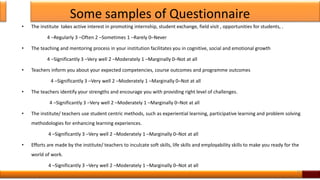
Some samples of Questionnaire
• The institute takes active interest in promoting internship, student exchange, field visit , opportunities for students, .
4 –Regularly 3 –Often 2 –Sometimes 1 –Rarely 0–Never
• The teaching and mentoring process in your institution facilitates you in cognitive, social and emotional growth
4 –Significantly 3 –Very well 2 –Moderately 1 –Marginally 0–Not at all
• Teachers inform you about your expected competencies, course outcomes and programme outcomes
4 –Significantly 3 –Very well 2 –Moderately 1 –Marginally 0–Not at all
• The teachers identify your strengths and encourage you with providing right level of challenges.
4 –Significantly 3 –Very well 2 –Moderately 1 –Marginally 0–Not at all
• The institute/ teachers use student centric methods, such as experiential learning, participative learning and problem solving
methodologies for enhancing learning experiences.
4 –Significantly 3 –Very well 2 –Moderately 1 –Marginally 0–Not at all
• Efforts are made by the institute/ teachers to inculcate soft skills, life skills and employability skills to make you ready for the
world of work.
4 –Significantly 3 –Very well 2 –Moderately 1 –Marginally 0–Not at all
15

Student satisfaction survey(SSS)

  • 1.
    STUDENT SATISFACTION SURVEY (SSS) Dr.Anil V Dusane Sir Parashurambhau College, Pune, India anildusane@gmail.com 1
  • 2.
    Need of StudentSatisfaction Survey • World Trade Organization (WTO) has recognized education as a commodity and treated it as a business enterprise. • In India Education industry is rapidly growing and it is estimated that it will reach to US$ 144 billion by 2020. • In India there are about 833 Universities, 42,047 colleges and 35.7 million students so there is need to get real feedback from the student community to impart quality education. • Student satisfaction is an integral component of management process in addition to academic standards, accreditation, teaching and research. 2
  • 3.
    Need of StudentSatisfaction Survey • It provides an auditable evidence that students have had the opportunity to pass comment on their programmes and courses. • It allows the institutions to benchmark and to provide indicators that will contribute to the reputation of the institute in the marketplace. • Students get an opportunity to express their level of satisfaction on their academic experiences, strengths and weakness of teaching-Learning process. 3
  • 4.
    Level of StudentSatisfaction• Satisfaction level of students is decided by • Kinds of “experiences” they undergo, • Extent of “comfort” feeling, • Opportunity for “Intellectual stimulation”. • Showcasing of “actual quality of Teaching-learning process”. It is impractical to capture satisfaction from every student so random sample survey is carried out. 4
  • 5.
    Some facts aboutStudents satisfaction survey • Customer satisfaction has been defined as “An overall feeling or attitude, a person has about a product after it has been purchased” • Student satisfaction is an attitude that results from the evaluation of students experience with the education service they received. • Satisfaction survey is valid and reliable tool for Service-product model and it is based on SERVQUAL’’ framework. • Students' satisfaction mainly depends on course quality, interaction with teachers, peer collaboration and student support services. 5
  • 6.
    Some facts aboutStudents satisfaction survey • Students’ opinions about academic life are sought in the form of a SSS. • Lectures, practicals and tutorials are the core services provided by college and students express their opinion about teaching, assessment and support services through SSS. • Students express their satisfaction as long as the teaching is at acceptable level and students get a good quality of infrastructural facilities. • Student feedback confirms whether they do receive high quality teaching. • SSS allows the management to target the resources at those areas that are perceived to be low satisfaction and with high importance. 6
  • 7.
    SERVQUAL Model ofSSS • SERVQUAL Model (1985) provides a technology for measuring and managing service quality. • SQ=P-E SQ is Service Quality, P is the individual's perceptions of given service delivery and E is the individual's expectations of a given service delivery • It measures the gap between what the customers expect and their perceptions. • The service quality is important because of its relationship to costs, profitability, customer satisfaction, customer retention and a positive word of mouth. • SERVQUAL’’ model uses reliability, assurance, tangibles, empathy and responsiveness to measure the service quality. 7
  • 8.
    SERVQUAL Model ofSSS • Student satisfaction involves three major elements i.e. Physical or facilitating goods, sensory service(explicit service) and psychological service(implicit service). • SSS has two major components i.e. students information and responses towards questionnaire. • Services Service quality perception  Student satisfaction  Student Satisfaction Index (SSI) • SSI is a measure of student satisfaction. 8
  • 9.
    e-SSS Questionnaire • eSSS questionnaire (20 objective & 01 subjective) e-mailed to students. • Responses less than 10% of the student population are not considered for evaluation. • Questionnaire is in English Or may be in translated in local language. • In a stratified sampling, the students are spread across different classes, year of enrolment, programmes and gender. 9
  • 10.
    Primary data ofstudents 10 • Name of the student, gender, student ID number, programme, email id, enrolment number, mobile number and year of joining this information is collected in ‘’Excel sheet’’. • No column or cell is left blank. • Institute must ensure that the total entries should be more than the students marked in Institutional Information for Quality Assessment (IIQA).
  • 11.
    e-SSS Questionnaire • InNAAC accreditation cycle student satisfaction survey consists of 21 questions out of which 20 are multiple choice questions while one Open ended question’. • 20 objective questions are responded on a scale of 4 to 0, with the most positive response rated as 4 and most negative response rated as 0. • In Open end question student has to give three observations /suggestions/ expectations to improve the overall teaching learning experience of the institution. • In SSS, questions are asked about specific teaching skills of the teacher, academic environment, opportunity for growth, motivation, interpersonal relationships, etc. 11
  • 12.
    e-SSS Questionnaire • Teacherskills such as subject knowledge, communication skills, class preparation, fairness of the internal evaluation process and use of ICT tools are of primary importance in the questionnaire. • Analysis of questionnaire is carried out by aggregating the most occurring suggestions in the student responses. • The mean score for each question is calculated and the overall mean is computed. • Output of SSS is provided to NAAC peer team and the NAAC Peer team uses it for validation as well as for evaluation report preparation. 12
  • 13.
    Problems of SSS •Student satisfaction survey has been least practiced in the education sector of India. • SSS is administered to institutions that qualify for the Peer Team visit i.e. after clearing the pre-qualifier stage. • NAAC assessment depends on SSS. • There is big question on the validity of the SSS due to dwindling student attendance in the class rooms. • Difficulties in uploading of data of all currently enrolled students as per data template. • Computer illiteracy and network availability in the tribal and rural areas. • Casual approach of student in filling questionnaire. • Unrealistic expectations of students. 13
  • 14.
    Solutions • Student satisfactionsurvey should be conducted every year based on the NAAC pattern so the students we be acquainted with the system. • Efforts should be made by institute to increase the involvement of the students in the curricular and extracurricular activities. • Serious efforts should be made to increase the attendance in the class rooms and laboratories. • College should collect all the primary data that is required at the time of Student satisfaction survey at the time of the admission process. • Computer literacy and network availability must be increased in the tribal and rural areas through special drives. • Students should be educated to fill up the SSS questionnaire. • Student should be made aware of realities in the education so that their expections will not be unrealistic. 14
  • 15.
    Some samples ofQuestionnaire • The institute takes active interest in promoting internship, student exchange, field visit , opportunities for students, . 4 –Regularly 3 –Often 2 –Sometimes 1 –Rarely 0–Never • The teaching and mentoring process in your institution facilitates you in cognitive, social and emotional growth 4 –Significantly 3 –Very well 2 –Moderately 1 –Marginally 0–Not at all • Teachers inform you about your expected competencies, course outcomes and programme outcomes 4 –Significantly 3 –Very well 2 –Moderately 1 –Marginally 0–Not at all • The teachers identify your strengths and encourage you with providing right level of challenges. 4 –Significantly 3 –Very well 2 –Moderately 1 –Marginally 0–Not at all • The institute/ teachers use student centric methods, such as experiential learning, participative learning and problem solving methodologies for enhancing learning experiences. 4 –Significantly 3 –Very well 2 –Moderately 1 –Marginally 0–Not at all • Efforts are made by the institute/ teachers to inculcate soft skills, life skills and employability skills to make you ready for the world of work. 4 –Significantly 3 –Very well 2 –Moderately 1 –Marginally 0–Not at all 15