Moderator:
                                  Matthew Prineas, Ph.D.


                                  Presenters:
                                  Shirley Adams, Ph.D.
                                  Scott Howell, Ph.D.
Aligning Institutional Policies   Lisa Marie Johnson, Ph.D.
and Faculty Support               Deborah Romero, Ph.D.
Shirley Adams, Ph.D.
    Charter Oak State College


                                2
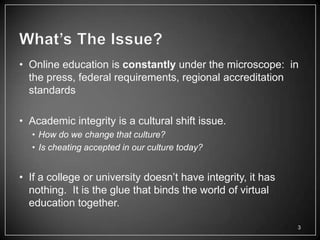
• Online education is constantly under the microscope: in
  the press, federal requirements, regional accreditation
  standards

• Academic integrity is a cultural shift issue.
  • How do we change that culture?
  • Is cheating accepted in our culture today?


• If a college or university doesn‘t have integrity, it has
  nothing. It is the glue that binds the world of virtual
  education together.

                                                              3
• Academic integrity is absolutely essential to the success
  of the educational enterprise.

  • Establishing a proper climate to achieve this goal must include
    unwavering support by the administration of the faculty efforts to
    maintain ethical standards for academic integrity (Heberling,
    2002). It starts with making a commitment to ―doing the online
    program the right way.‖


                                                                         4
•   The administration is responsible for making academic integrity an institutional
    priority and for establishing equitable and effective procedures to deal with violations
    of academic integrity.

•   The faculty shares the responsibility for educating students about the importance and
    principles of academic integrity and for reporting violations.

       ―91 Ways to Maintain Academic Integrity in Online Courses‖ by Lori McNabb and Michael
       Anderson, University of Texas TeleCampus, Faculty Focus Special Report, Promoting
       Academic Integrity in Online Education May 2010.
•   The Students are responsible for understanding the principles of academic integrity
    fully and abiding by them. How do we get them to accept this responsibility when the
    cost benefit is in favor of the student who cheats?

     • Prof. Kitahara from Troy University suggests putting ―academic dishonesty‖ on the student‘s
       transcript as one part of the solution

Sources:  Rutgers University Interim Academic Integrity Policy,
          http://rutgers-newark.rutgers.edu/dsanwk/pdf/aip.pdf
          ―Promoting Academic Integrity in Online Education, Faculty Focus Special Report, May 2010,
    Magna Publication

                                                                                                       5
Scott Howell, Ph.D.
Salt Lake Center at Brigham Young University


                                               6
7
Essays from faculty who actually
taught correspondence courses

• Instances of cheating rare
• No greater than the classroom
• Worst offenders - Resident
  students
                        (Bittner and Mallory)
10
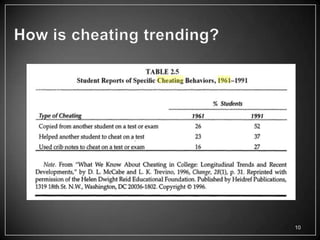
"Rates of academic cheating have skyrocketed
during the past decade. In a huge study (Duke
University‘s Center for Academic Integrity) of 50,000
college and 18,000 high-school students. More than
70 percent admitted to having cheated. That's up
from about 56 percent in 1993 and just 26 percent
in 1963. Internet plagiarism has quadrupled in the
past six years, . . .”

                                NEWSWEEK, March 27, 2006


                                                     11
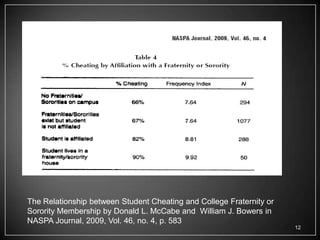
The Relationship between Student Cheating and College Fraternity or
Sorority Membership by Donald L. McCabe and William J. Bowers in
NASPA Journal, 2009, Vol. 46, no. 4, p. 583
                                                                      12
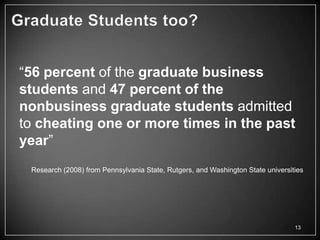
―56 percent of the graduate business
students and 47 percent of the
nonbusiness graduate students admitted
to cheating one or more times in the past
year‖
 Research (2008) from Pennsylvania State, Rutgers, and Washington State universities


                                                                                 13
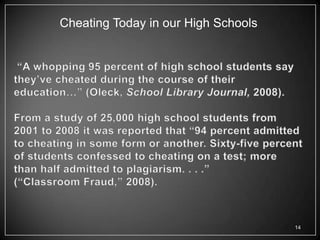
Cheating Today in our High Schools


                                     14
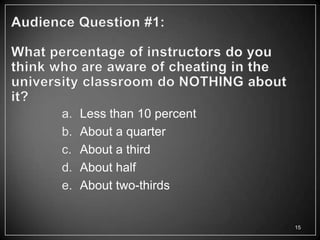
a.   Less than 10 percent
b.   About a quarter
c.   About a third
d.   About half
e.   About two-thirds


                            15
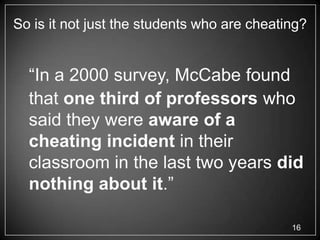
So is it not just the students who are cheating?


  ―In a 2000 survey, McCabe found
  that one third of professors who
  said they were aware of a
  cheating incident in their
  classroom in the last two years did
  nothing about it.‖

                                             16
17
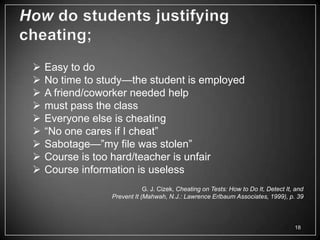
   Easy to do
   No time to study—the student is employed
   A friend/coworker needed help
   must pass the class
   Everyone else is cheating
   ―No one cares if I cheat‖
   Sabotage—‖my file was stolen‖
   Course is too hard/teacher is unfair
   Course information is useless
                             G. J. Cizek, Cheating on Tests: How to Do It, Detect It, and
                 Prevent It (Mahwah, N.J.: Lawrence Erlbaum Associates, 1999), p. 39


                                                                                     18
19
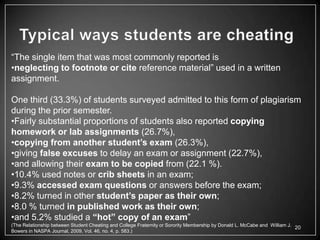
―The single item that was most commonly reported is
•neglecting to footnote or cite reference material‖ used in a written
assignment.

One third (33.3%) of students surveyed admitted to this form of plagiarism
during the prior semester.
•Fairly substantial proportions of students also reported copying
homework or lab assignments (26.7%),
•copying from another student’s exam (26.3%),
•giving false excuses to delay an exam or assignment (22.7%),
•and allowing their exam to be copied from (22.1 %).
•10.4% used notes or crib sheets in an exam;
•9.3% accessed exam questions or answers before the exam;
•8.2% turned in other student’s paper as their own;
•8.0 % turned in published work as their own;
•and 5.2% studied a “hot” copy of an exam‖
(The Relationship between Student Cheating and College Fraternity or Sorority Membership by Donald L. McCabe and William J.
                                                                                                                            20
Bowers in NASPA Journal, 2009, Vol. 46, no. 4, p. 583.)
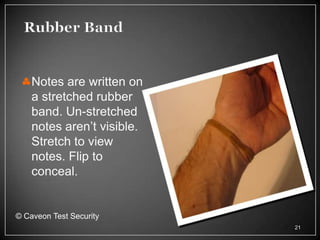
Notes are written on
    a stretched rubber
    band. Un-stretched
    notes aren‘t visible.
    Stretch to view
    notes. Flip to
    conceal.


© Caveon Test Security
                            21
© Caveon Test Security
                         22
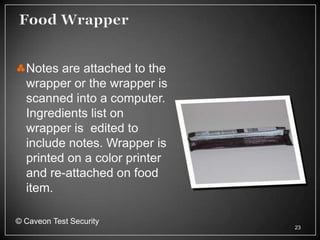
Notes are attached to the
  wrapper or the wrapper is
  scanned into a computer.
  Ingredients list on
  wrapper is edited to
  include notes. Wrapper is
  printed on a color printer
  and re-attached on food
  item.

© Caveon Test Security
                               23
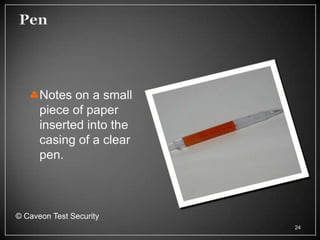
Notes on a small
      piece of paper
      inserted into the
      casing of a clear
      pen.


© Caveon Test Security
                          24
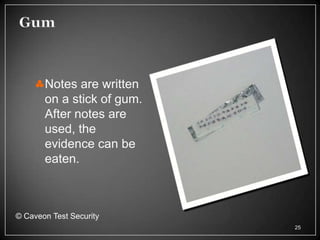
Notes are written
       on a stick of gum.
       After notes are
       used, the
       evidence can be
       eaten.


© Caveon Test Security
                            25
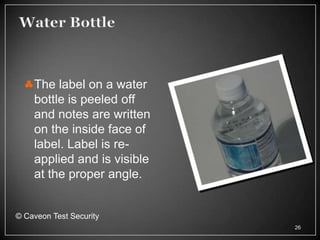
The label on a water
    bottle is peeled off
    and notes are written
    on the inside face of
    label. Label is re-
    applied and is visible
    at the proper angle.


© Caveon Test Security
                             26
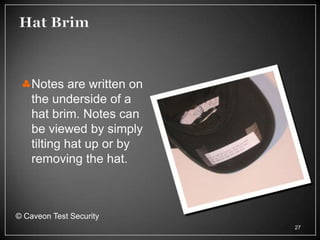
Notes are written on
    the underside of a
    hat brim. Notes can
    be viewed by simply
    tilting hat up or by
    removing the hat.


© Caveon Test Security
                           27
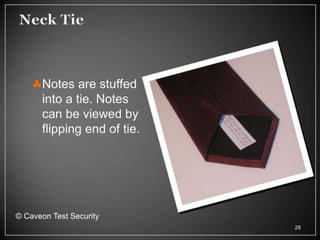
Notes are stuffed
      into a tie. Notes
      can be viewed by
      flipping end of tie.


© Caveon Test Security
                             28
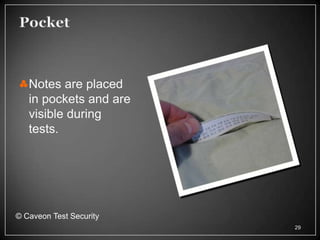
Notes are placed
   in pockets and are
   visible during
   tests.


© Caveon Test Security
                         29
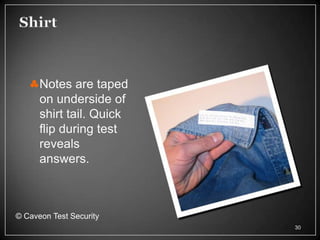
Notes are taped
      on underside of
      shirt tail. Quick
      flip during test
      reveals
      answers.


© Caveon Test Security
                          30
•Palm             •Band-aid
•Forearm          •Pencil Case
•Fingernail       •Calculator Case
•Thigh            •Calculator Battery
•Skirt            Compartment
•Shirt            •Desk
•Pant Waistband   •Chair
                                        31
32
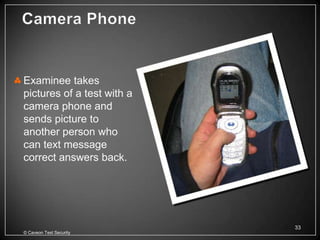
Examinee takes
pictures of a test with a
camera phone and
sends picture to
another person who
can text message
correct answers back.


                            33
© Caveon Test Security
―More than one-third of teens with cell
phones admit to having stored information
on them to look at during a test or texting
friends about answers.‖

               U.S. News and World Report (June 23, 2009)


                                                       34
―Only 3 percent of parents ‗believe their own teen
is using a cell phone to cheat‘ Even though 75
percent of them assumed that cheating was
taking place at their children‘s school. The results
should be a wake-up call for educators and
parents, says James Steyer, CEO and founder of
Common Sense Media.‖

                     U.S. News and World Report (June 23, 2009)


                                                             35
Notes are
   entered into
   calculators that
   have memory
   for storing
   notes.

                         36
© Caveon Test Security
Song names are
renamed with notes or
test answers for viewing
on the screen.
Text files can be stored.
Audio notes can be
stored.
Video notes can be
stored.


                            37
© Caveon Test Security
PDA stores test notes or
answers. Examinee can
gather answers during
test from web sources.
Examinee may setup
their own website with
notes to access during
test.


                           38
 © Caveon Test Security
39
© Caveon Test Security
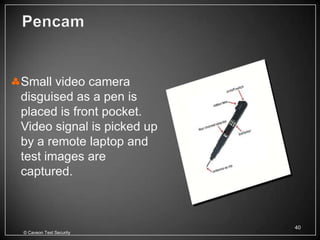
Small video camera
disguised as a pen is
placed is front pocket.
Video signal is picked up
by a remote laptop and
test images are
captured.


                            40
© Caveon Test Security
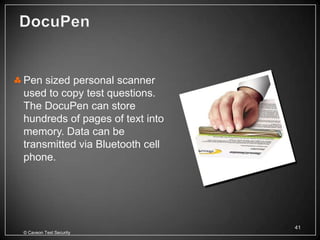
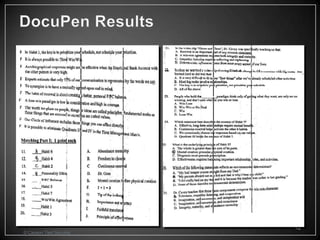
Pen sized personal scanner
used to copy test questions.
The DocuPen can store
hundreds of pages of text into
memory. Data can be
transmitted via Bluetooth cell
phone.


                                 41
© Caveon Test Security
42
© Caveon Test Security
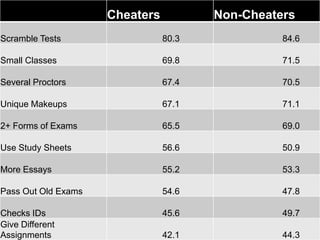
Audience Question #2:

Which of the following countermeasures do
you think cheaters considered most effective?


  a. Identification
  b. Assigned seating
  c. Randomly presenting questions
  d. ―Hot line‖ to report cheating
                                                43
Cheaters          Non-Cheaters
Scramble Tests                  80.3             84.6

Small Classes                   69.8             71.5

Several Proctors                67.4             70.5

Unique Makeups                  67.1             71.1

2+ Forms of Exams               65.5             69.0

Use Study Sheets                56.6             50.9

More Essays                     55.2             53.3

Pass Out Old Exams              54.6             47.8

Checks IDs                      45.6             49.7
Give Different
Assignments                     42.1             44.3
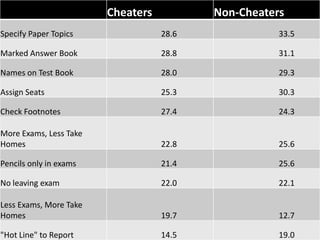
Cheaters          Non-Cheaters
Specify Paper Topics               28.6              33.5

Marked Answer Book                 28.8              31.1

Names on Test Book                 28.0              29.3

Assign Seats                       25.3              30.3

Check Footnotes                    27.4              24.3

More Exams, Less Take
Homes                              22.8              25.6

Pencils only in exams              21.4              25.6

No leaving exam                    22.0              22.1

Less Exams, More Take
Homes                              19.7              12.7

"Hot Line" to Report               14.5              19.0
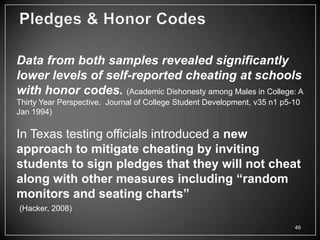
Data from both samples revealed significantly
lower levels of self-reported cheating at schools
with honor codes. (Academic Dishonesty among Males in College: A
Thirty Year Perspective. Journal of College Student Development, v35 n1 p5-10
Jan 1994)

In Texas testing officials introduced a new
approach to mitigate cheating by inviting
students to sign pledges that they will not cheat
along with other measures including “random
monitors and seating charts”
(Hacker, 2008)

                                                                           46
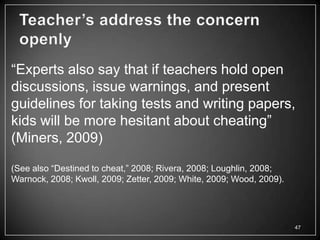
―Experts also say that if teachers hold open
discussions, issue warnings, and present
guidelines for taking tests and writing papers,
kids will be more hesitant about cheating‖
(Miners, 2009)

(See also ―Destined to cheat,‖ 2008; Rivera, 2008; Loughlin, 2008;
Warnock, 2008; Kwoll, 2009; Zetter, 2009; White, 2009; Wood, 2009).


                                                                      47
Control the assessment situation. Prohibit all
 handheld devices (calculators, personal
 organizers, pagers, cell phones, headphones,
 etc.) since all can store and transmit
 information from outside the assessment room
 (Lathrop and Foss, 2000).

Cheating in Online Student Assessment: Beyond Plagiarism
by NC Rowe – 2004, www.westga.edu/~distance/ojdla/summer72/rowe72.html


                                                                         48
Lisa Marie Johnson, Ph.D.
             Pearson eCollege
         Colorado Mountain College
    Colorado Community Colleges Online


                                         49
• Who can I talk with about my skills and concerns?

• What are the expectations in this class? That class?

• Where is the policy and procedure information?

• When do the policies matter?

• Why aren‘t they being punished?


                                                         50
Materials and Activities     Set the Tone
  1.    Model Expectations
  2.    No-Stakes Options – e.g., Check My Draft
  3.    Collaboration
  4.    Guided Research
  5.    Formative Assessment
  6.    Just in Time Reminders – not threats
  7.    Reasonable Deadlines & Workloads
  8.    Discuss the Policies and Consequences
  9.    Explore honesty, ethics, and ―academic integrity‖
  10.   Student generated content and activities

                                                            51
Deborah Romero, Ph.D.
   University of Northern Colorado


                                     52
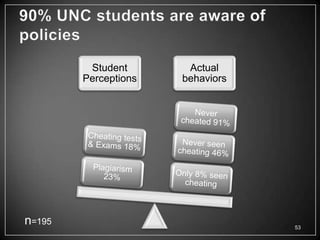
Student       Actual
        Perceptions   behaviors


n=195                             53
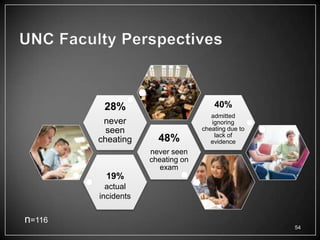
28%                          40%
                                     admitted
         never                       ignoring
          seen                    cheating due to
                                      lack of
        cheating      48%            evidence
                    never seen
                    cheating on
                       exam
         19%
          actual
        incidents

n=116
                                                    54
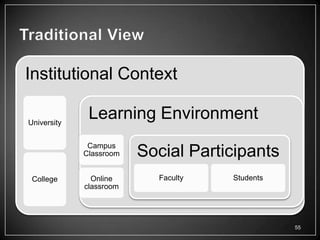
Institutional Context

University
              Learning Environment
              Campus
             Classroom   Social Participants
 College       Online      Faculty   Students
             classroom


                                                55
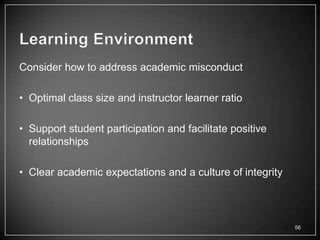
Consider how to address academic misconduct

• Optimal class size and instructor learner ratio

• Support student participation and facilitate positive
  relationships

• Clear academic expectations and a culture of integrity


                                                           56
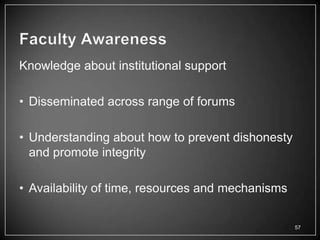
Knowledge about institutional support

• Disseminated across range of forums

• Understanding about how to prevent dishonesty
  and promote integrity

• Availability of time, resources and mechanisms

                                                   57
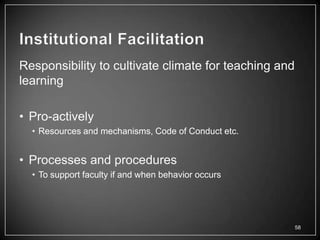
Responsibility to cultivate climate for teaching and
learning

• Pro-actively
  • Resources and mechanisms, Code of Conduct etc.


• Processes and procedures
  • To support faculty if and when behavior occurs


                                                       58
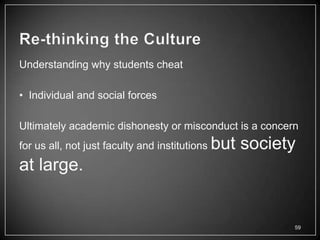
Understanding why students cheat

• Individual and social forces

Ultimately academic dishonesty or misconduct is a concern
for us all, not just faculty and institutions   but society
at large.


                                                          59
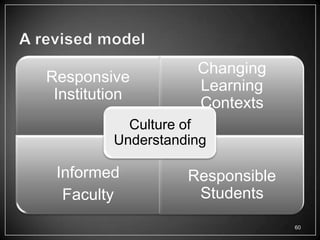
Changing
Responsive
                    Learning
 Institution
                    Contexts
           Culture of
         Understanding

 Informed          Responsible
  Faculty           Students
                                 60
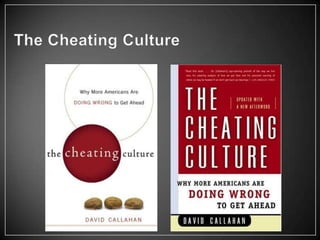
Callahan, D. (2004). The Cheating Culture. Why more Americans doing wrong to get
ahead. Orlando, FL: Houghton Mifflin Harcourt.
Follendore III, R. D. (2002). Why Students Cheat. An essay concerning the systemic
origins and           implications of academic cheating from a socially contextual view.
Retrieved from
           http://www.noisetoknowledge.com/why_students_cheat.htm
Glassner, Barry. (2000) The Culture of Fear: Why Americans are afraid of the wrong
things. Basic         Books.
Jenkins, R. (2011). Toward a Rational Response to Plagiarism. The Chronicle of Higher
Education.            Retrieved from http://chronicle.com/article/Toward-a-Rational-
Response-to/128611/
Kozol, Jonathan (1991) Savage Inequalities. New York: Crown.
Reagle, J. M. (2010). Good Faith Collaboration: The culture of Wikipedia: MIT Press.
Waryold, D. (2003). Report on cheating and plagiarism. Durham, NC: Duke University,
Center for            Academic Integrity.


                                                                                           61
Brigham Young University
http://saas.byu.edu/catalog/2009-2010ucat/GeneralInfo/HonorCode.php

Charter Oak State College
https://acorn.charteroak.edu/ICS/Students/Academic_Integrity_Policy.jnz

Colorado Community Colleges Online Policy, Procedures, and Tutorials
http://links.ccconline.org/integrity

Michigan State University
https://www.msu.edu/unit/ombud/dishonestyFAQ.html

University of Northern Colorado
http://www.unco.edu/dos/academicIntegrity/index.html
http://www.unco.edu/dos/communityStandards/student_code_conduct/index.html
                                                                          62
Moderator:
                                  Matthew Prineas, Ph.D.


                                  Presenters:
                                  Shirley Adams, Ph.D.
                                  Scott Howell, Ph.D.
Aligning Institutional Policies   Lisa Marie Johnson, Ph.D.
and Faculty Support               Deborah Romero, Ph.D.

2011Changing contextethicalbehavior634

  • 1.
    Moderator: Matthew Prineas, Ph.D. Presenters: Shirley Adams, Ph.D. Scott Howell, Ph.D. Aligning Institutional Policies Lisa Marie Johnson, Ph.D. and Faculty Support Deborah Romero, Ph.D.
  • 2.
    Shirley Adams, Ph.D. Charter Oak State College 2
  • 3.
    • Online educationis constantly under the microscope: in the press, federal requirements, regional accreditation standards • Academic integrity is a cultural shift issue. • How do we change that culture? • Is cheating accepted in our culture today? • If a college or university doesn‘t have integrity, it has nothing. It is the glue that binds the world of virtual education together. 3
  • 4.
    • Academic integrityis absolutely essential to the success of the educational enterprise. • Establishing a proper climate to achieve this goal must include unwavering support by the administration of the faculty efforts to maintain ethical standards for academic integrity (Heberling, 2002). It starts with making a commitment to ―doing the online program the right way.‖ 4
  • 5.
    The administration is responsible for making academic integrity an institutional priority and for establishing equitable and effective procedures to deal with violations of academic integrity. • The faculty shares the responsibility for educating students about the importance and principles of academic integrity and for reporting violations. ―91 Ways to Maintain Academic Integrity in Online Courses‖ by Lori McNabb and Michael Anderson, University of Texas TeleCampus, Faculty Focus Special Report, Promoting Academic Integrity in Online Education May 2010. • The Students are responsible for understanding the principles of academic integrity fully and abiding by them. How do we get them to accept this responsibility when the cost benefit is in favor of the student who cheats? • Prof. Kitahara from Troy University suggests putting ―academic dishonesty‖ on the student‘s transcript as one part of the solution Sources: Rutgers University Interim Academic Integrity Policy, http://rutgers-newark.rutgers.edu/dsanwk/pdf/aip.pdf ―Promoting Academic Integrity in Online Education, Faculty Focus Special Report, May 2010, Magna Publication 5
  • 6.
    Scott Howell, Ph.D. SaltLake Center at Brigham Young University 6
  • 7.
  • 9.
    Essays from facultywho actually taught correspondence courses • Instances of cheating rare • No greater than the classroom • Worst offenders - Resident students (Bittner and Mallory)
  • 10.
  • 11.
    "Rates of academiccheating have skyrocketed during the past decade. In a huge study (Duke University‘s Center for Academic Integrity) of 50,000 college and 18,000 high-school students. More than 70 percent admitted to having cheated. That's up from about 56 percent in 1993 and just 26 percent in 1963. Internet plagiarism has quadrupled in the past six years, . . .” NEWSWEEK, March 27, 2006 11
  • 12.
    The Relationship betweenStudent Cheating and College Fraternity or Sorority Membership by Donald L. McCabe and William J. Bowers in NASPA Journal, 2009, Vol. 46, no. 4, p. 583 12
  • 13.
    ―56 percent ofthe graduate business students and 47 percent of the nonbusiness graduate students admitted to cheating one or more times in the past year‖ Research (2008) from Pennsylvania State, Rutgers, and Washington State universities 13
  • 14.
    Cheating Today inour High Schools 14
  • 15.
    a. Less than 10 percent b. About a quarter c. About a third d. About half e. About two-thirds 15
  • 16.
    So is itnot just the students who are cheating? ―In a 2000 survey, McCabe found that one third of professors who said they were aware of a cheating incident in their classroom in the last two years did nothing about it.‖ 16
  • 17.
  • 18.
    Easy to do  No time to study—the student is employed  A friend/coworker needed help  must pass the class  Everyone else is cheating  ―No one cares if I cheat‖  Sabotage—‖my file was stolen‖  Course is too hard/teacher is unfair  Course information is useless G. J. Cizek, Cheating on Tests: How to Do It, Detect It, and Prevent It (Mahwah, N.J.: Lawrence Erlbaum Associates, 1999), p. 39 18
  • 19.
  • 20.
    ―The single itemthat was most commonly reported is •neglecting to footnote or cite reference material‖ used in a written assignment. One third (33.3%) of students surveyed admitted to this form of plagiarism during the prior semester. •Fairly substantial proportions of students also reported copying homework or lab assignments (26.7%), •copying from another student’s exam (26.3%), •giving false excuses to delay an exam or assignment (22.7%), •and allowing their exam to be copied from (22.1 %). •10.4% used notes or crib sheets in an exam; •9.3% accessed exam questions or answers before the exam; •8.2% turned in other student’s paper as their own; •8.0 % turned in published work as their own; •and 5.2% studied a “hot” copy of an exam‖ (The Relationship between Student Cheating and College Fraternity or Sorority Membership by Donald L. McCabe and William J. 20 Bowers in NASPA Journal, 2009, Vol. 46, no. 4, p. 583.)
  • 21.
    Notes are writtenon a stretched rubber band. Un-stretched notes aren‘t visible. Stretch to view notes. Flip to conceal. © Caveon Test Security 21
  • 22.
    © Caveon TestSecurity 22
  • 23.
    Notes are attachedto the wrapper or the wrapper is scanned into a computer. Ingredients list on wrapper is edited to include notes. Wrapper is printed on a color printer and re-attached on food item. © Caveon Test Security 23
  • 24.
    Notes on asmall piece of paper inserted into the casing of a clear pen. © Caveon Test Security 24
  • 25.
    Notes are written on a stick of gum. After notes are used, the evidence can be eaten. © Caveon Test Security 25
  • 26.
    The label ona water bottle is peeled off and notes are written on the inside face of label. Label is re- applied and is visible at the proper angle. © Caveon Test Security 26
  • 27.
    Notes are writtenon the underside of a hat brim. Notes can be viewed by simply tilting hat up or by removing the hat. © Caveon Test Security 27
  • 28.
    Notes are stuffed into a tie. Notes can be viewed by flipping end of tie. © Caveon Test Security 28
  • 29.
    Notes are placed in pockets and are visible during tests. © Caveon Test Security 29
  • 30.
    Notes are taped on underside of shirt tail. Quick flip during test reveals answers. © Caveon Test Security 30
  • 31.
    •Palm •Band-aid •Forearm •Pencil Case •Fingernail •Calculator Case •Thigh •Calculator Battery •Skirt Compartment •Shirt •Desk •Pant Waistband •Chair 31
  • 32.
  • 33.
    Examinee takes pictures ofa test with a camera phone and sends picture to another person who can text message correct answers back. 33 © Caveon Test Security
  • 34.
    ―More than one-thirdof teens with cell phones admit to having stored information on them to look at during a test or texting friends about answers.‖ U.S. News and World Report (June 23, 2009) 34
  • 35.
    ―Only 3 percentof parents ‗believe their own teen is using a cell phone to cheat‘ Even though 75 percent of them assumed that cheating was taking place at their children‘s school. The results should be a wake-up call for educators and parents, says James Steyer, CEO and founder of Common Sense Media.‖ U.S. News and World Report (June 23, 2009) 35
  • 36.
    Notes are entered into calculators that have memory for storing notes. 36 © Caveon Test Security
  • 37.
    Song names are renamedwith notes or test answers for viewing on the screen. Text files can be stored. Audio notes can be stored. Video notes can be stored. 37 © Caveon Test Security
  • 38.
    PDA stores testnotes or answers. Examinee can gather answers during test from web sources. Examinee may setup their own website with notes to access during test. 38 © Caveon Test Security
  • 39.
  • 40.
    Small video camera disguisedas a pen is placed is front pocket. Video signal is picked up by a remote laptop and test images are captured. 40 © Caveon Test Security
  • 41.
    Pen sized personalscanner used to copy test questions. The DocuPen can store hundreds of pages of text into memory. Data can be transmitted via Bluetooth cell phone. 41 © Caveon Test Security
  • 42.
  • 43.
    Audience Question #2: Whichof the following countermeasures do you think cheaters considered most effective? a. Identification b. Assigned seating c. Randomly presenting questions d. ―Hot line‖ to report cheating 43
  • 44.
    Cheaters Non-Cheaters Scramble Tests 80.3 84.6 Small Classes 69.8 71.5 Several Proctors 67.4 70.5 Unique Makeups 67.1 71.1 2+ Forms of Exams 65.5 69.0 Use Study Sheets 56.6 50.9 More Essays 55.2 53.3 Pass Out Old Exams 54.6 47.8 Checks IDs 45.6 49.7 Give Different Assignments 42.1 44.3
  • 45.
    Cheaters Non-Cheaters Specify Paper Topics 28.6 33.5 Marked Answer Book 28.8 31.1 Names on Test Book 28.0 29.3 Assign Seats 25.3 30.3 Check Footnotes 27.4 24.3 More Exams, Less Take Homes 22.8 25.6 Pencils only in exams 21.4 25.6 No leaving exam 22.0 22.1 Less Exams, More Take Homes 19.7 12.7 "Hot Line" to Report 14.5 19.0
  • 46.
    Data from bothsamples revealed significantly lower levels of self-reported cheating at schools with honor codes. (Academic Dishonesty among Males in College: A Thirty Year Perspective. Journal of College Student Development, v35 n1 p5-10 Jan 1994) In Texas testing officials introduced a new approach to mitigate cheating by inviting students to sign pledges that they will not cheat along with other measures including “random monitors and seating charts” (Hacker, 2008) 46
  • 47.
    ―Experts also saythat if teachers hold open discussions, issue warnings, and present guidelines for taking tests and writing papers, kids will be more hesitant about cheating‖ (Miners, 2009) (See also ―Destined to cheat,‖ 2008; Rivera, 2008; Loughlin, 2008; Warnock, 2008; Kwoll, 2009; Zetter, 2009; White, 2009; Wood, 2009). 47
  • 48.
    Control the assessmentsituation. Prohibit all handheld devices (calculators, personal organizers, pagers, cell phones, headphones, etc.) since all can store and transmit information from outside the assessment room (Lathrop and Foss, 2000). Cheating in Online Student Assessment: Beyond Plagiarism by NC Rowe – 2004, www.westga.edu/~distance/ojdla/summer72/rowe72.html 48
  • 49.
    Lisa Marie Johnson,Ph.D. Pearson eCollege Colorado Mountain College Colorado Community Colleges Online 49
  • 50.
    • Who canI talk with about my skills and concerns? • What are the expectations in this class? That class? • Where is the policy and procedure information? • When do the policies matter? • Why aren‘t they being punished? 50
  • 51.
    Materials and Activities Set the Tone 1. Model Expectations 2. No-Stakes Options – e.g., Check My Draft 3. Collaboration 4. Guided Research 5. Formative Assessment 6. Just in Time Reminders – not threats 7. Reasonable Deadlines & Workloads 8. Discuss the Policies and Consequences 9. Explore honesty, ethics, and ―academic integrity‖ 10. Student generated content and activities 51
  • 52.
    Deborah Romero, Ph.D. University of Northern Colorado 52
  • 53.
    Student Actual Perceptions behaviors n=195 53
  • 54.
    28% 40% admitted never ignoring seen cheating due to lack of cheating 48% evidence never seen cheating on exam 19% actual incidents n=116 54
  • 55.
    Institutional Context University Learning Environment Campus Classroom Social Participants College Online Faculty Students classroom 55
  • 56.
    Consider how toaddress academic misconduct • Optimal class size and instructor learner ratio • Support student participation and facilitate positive relationships • Clear academic expectations and a culture of integrity 56
  • 57.
    Knowledge about institutionalsupport • Disseminated across range of forums • Understanding about how to prevent dishonesty and promote integrity • Availability of time, resources and mechanisms 57
  • 58.
    Responsibility to cultivateclimate for teaching and learning • Pro-actively • Resources and mechanisms, Code of Conduct etc. • Processes and procedures • To support faculty if and when behavior occurs 58
  • 59.
    Understanding why studentscheat • Individual and social forces Ultimately academic dishonesty or misconduct is a concern for us all, not just faculty and institutions but society at large. 59
  • 60.
    Changing Responsive Learning Institution Contexts Culture of Understanding Informed Responsible Faculty Students 60
  • 61.
    Callahan, D. (2004).The Cheating Culture. Why more Americans doing wrong to get ahead. Orlando, FL: Houghton Mifflin Harcourt. Follendore III, R. D. (2002). Why Students Cheat. An essay concerning the systemic origins and implications of academic cheating from a socially contextual view. Retrieved from http://www.noisetoknowledge.com/why_students_cheat.htm Glassner, Barry. (2000) The Culture of Fear: Why Americans are afraid of the wrong things. Basic Books. Jenkins, R. (2011). Toward a Rational Response to Plagiarism. The Chronicle of Higher Education. Retrieved from http://chronicle.com/article/Toward-a-Rational- Response-to/128611/ Kozol, Jonathan (1991) Savage Inequalities. New York: Crown. Reagle, J. M. (2010). Good Faith Collaboration: The culture of Wikipedia: MIT Press. Waryold, D. (2003). Report on cheating and plagiarism. Durham, NC: Duke University, Center for Academic Integrity. 61
  • 62.
    Brigham Young University http://saas.byu.edu/catalog/2009-2010ucat/GeneralInfo/HonorCode.php CharterOak State College https://acorn.charteroak.edu/ICS/Students/Academic_Integrity_Policy.jnz Colorado Community Colleges Online Policy, Procedures, and Tutorials http://links.ccconline.org/integrity Michigan State University https://www.msu.edu/unit/ombud/dishonestyFAQ.html University of Northern Colorado http://www.unco.edu/dos/academicIntegrity/index.html http://www.unco.edu/dos/communityStandards/student_code_conduct/index.html 62
  • 63.
    Moderator: Matthew Prineas, Ph.D. Presenters: Shirley Adams, Ph.D. Scott Howell, Ph.D. Aligning Institutional Policies Lisa Marie Johnson, Ph.D. and Faculty Support Deborah Romero, Ph.D.

Editor's Notes

  • #9 New Afterword cites a professor who was told by his institution if he is sued by the students for enforcing cheating countermeasures he was on his own!From Wikipedia. . . Not restricted to professions, cheating now appears in all facets of American life. According to Callahan, cheating breeds upon a dynamic between a winner class, an upper-class so influential they effectively are exempt from most rules and standards, and an anxious class, often compelled to cheat during a period of downward social mobility, downsizing, and within a cultural climate that values money and power above personal integrity.Callahan shows, however, that large-scale cheating is most prevalent among the "Winner" upper class. Despite their high salaries and opulent lifestyles, they live in constant comparison with those who have more than them, and therefore exhibit lives characterized by high spending, severe anxiety, and countless opportunities and temptations to cheat.
  • #11 Now look at even more recent numbers
  • #13 “On both indices there is significantly more cheating among those who belong to either a fraternity or sorority than there is among non-members. Indeed this pattern was generally true for all analyses conducted in this study.”The Relationship between Student Cheating and College Fraternity or Sorority Membership by Donald L. McCabe and William J. Bowers in NASPA Journal, 2009, Vol. 46, no. 4, p. 578
  • #17 www.prism-magazine.org/.../feature_cheating.htm An awful lot of faculty [members] don't take cheating as seriously as they should," says Kris Pister, professor of electrical engineering and computer sciences at the University of California-Berkeley. "I don't believe the people who say there is no cheating in their class. I think they are all being naïve."
  • #34 VietnamCell phone cheating ring50 college students worked the ringPolice confiscated over 70 cell phonesShirts designed to hide cell phones15 wigs
  • #40 Two senior undergraduates at a major East Coast university. While one was taking the nationwide Graduate Record Examination, he used a wireless transmitter to send images of the test to his accomplice waiting in a van. The accomplice then ascertained the answers to the test questions, sending them back to the exam taker via walkie-talkies. The two young men supposedly invested $12,000 in equipment to implement their plan; they were arrested on charges of burglary and unlawful duplication of computer material.
  • #42 IndiaAll-India Post Graduate Medical Entrance Exam28 caught using DocuPensTransferred scans to cell phones using BluetoothSent scans to contacts on the outsideOutside contacts then sent answers back to examinees
  • #47 1. A high school principal from New Jersey said:  "If you have a culture in your school where . . . there is an expectation that students are honest about their academic achievements, where students and the administration promote it, I think you decrease the opportunities for students to cheat” (Miners, 2009).
  • #49 If computers are used for the assessment, communication should be made as difficult as possible between them and the rest of the Internet. Disable most networking capabilities on these machines, including wireless ones. Close all ports (critically ports 21 (file-transfer), 23 (remote-login), 25 (mail), and 443 (secure Internet connections)) except for the HTTP port which the grading server uses, and this port should be restricted to only connect to the server and not any other machines. All printer connections should also be disabled (so students cannot print screen shots) and removable-disk drives removed (so students cannot copy to or from their own storage media). Do not allow access by students to the testing computers except during the period of the test to prevent students from storing answers on it. Even with all these steps, proctoring is still important since there are so many ways to cheat electronically.
  • #61 Culture includes- discourse and tools (material and otherwise)