The University of Sydney Page 1
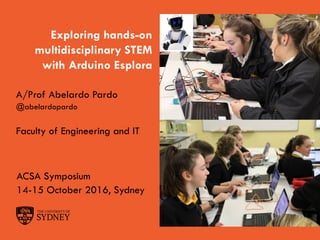
Exploring hands-on
multidisciplinary STEM
with Arduino Esplora
A/Prof Abelardo Pardo
@abelardopardo
Faculty of Engineering and IT
ACSA Symposium
14-15 October 2016, Sydney
The University of Sydney Page 2
Agenda
– The Context
– Design
– Teacher Training
– Delivery
– Outreach
– Evaluation
– Future Steps
FernandaGuerraflickr.com
The University of Sydney Page 3
The Context
The University of Sydney Page 4
The Problem
Steep decline in the achievement and attitude
towards STEM-related disciplines amongst
high school students across the country.
Partially due to students’ self-perception of
ability, subject difficulty and usefulness.
The impact of STEM fields to over 26% of the
Australian economic activity.
High school students need to be aware of the
connection between STEM subjects and the
innovation, creativity and problem solving skills
required to tackle the current social
challenges.
The University of Sydney Page 5
Vision
Address the steep decline in commitment and
interests in STEM subjects for every high school
student in Australia
The University of Sydney Page 6
Method
Our proven and integrated training and
delivery method provides high school students
and teachers with an inclusive, engaging,
hands-on and cross-disciplinary STEM
experience in a blended learning scenario
with real-time student and teacher support
suitable to be integrated as part of the
curriculum
Madmaker.com.au
The University of Sydney Page 7
Execution
• Focus groups with stakeholders
• Design and deployment plan to combine
teacher training, active learning inter-
disciplinary activities, on-line learning, a
simple hardware platform, and a rigorous
evaluation procedure.
• Program reached more than 3,000
students, 300 teachers from all STEM
disciplines in 130 schools from all sectors
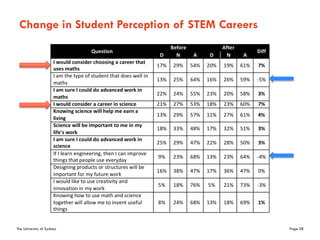
• Achieved a change in student perception
of STEM careers by the students.
• Clearly identified path to scale the
initiative to all High School students in
Australia.
The University of Sydney Page 8
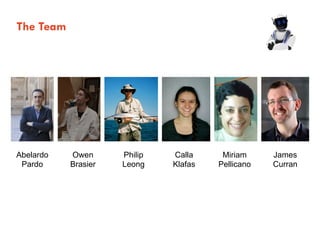
The Team
Abelardo
Pardo
Owen
Brasier
Miriam
Pellicano
Calla
Klafas
Philip
Leong
James
Curran
The University of Sydney Page 9
Design
The University of Sydney Page 10
Focus Groups
o Target audience
o Connection with the STEM
curriculum
o Barriers for adoption
o Communication strategy
o Adequate hardware
o Evaluation
The University of Sydney Page 11
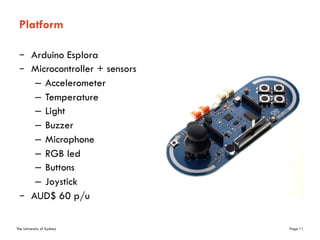
Platform
– Arduino Esplora
– Microcontroller + sensors
– Accelerometer
– Temperature
– Light
– Buzzer
– Microphone
– RGB led
– Buttons
– Joystick
– AUD$ 60 p/u
The University of Sydney Page 12
Teacher Training
The University of Sydney Page 13
Teacher Workshops
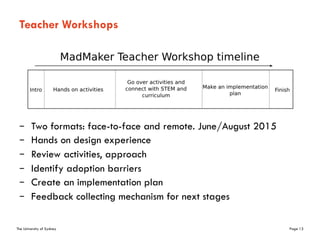
– Two formats: face-to-face and remote. June/August 2015
– Hands on design experience
– Review activities, approach
– Identify adoption barriers
– Create an implementation plan
– Feedback collecting mechanism for next stages
The University of Sydney Page 14
Teacher Workshops - Results
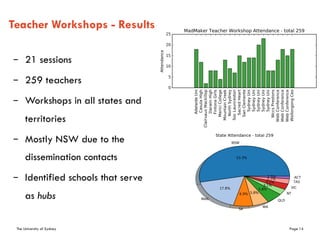
– 21 sessions
– 259 teachers
– Workshops in all states and
territories
– Mostly NSW due to the
dissemination contacts
– Identified schools that serve
as hubs
The University of Sydney Page 15
Teacher Workshops - Evaluation
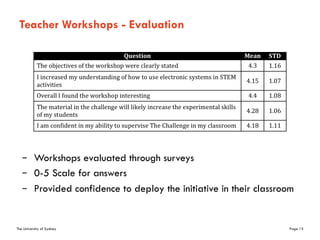
– Workshops evaluated through surveys
– 0-5 Scale for answers
– Provided confidence to deploy the initiative in their classroom
The University of Sydney Page 16
Delivery
The University of Sydney Page 17
The University of Sydney Page 18
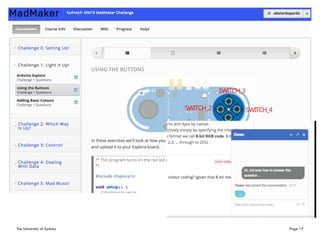
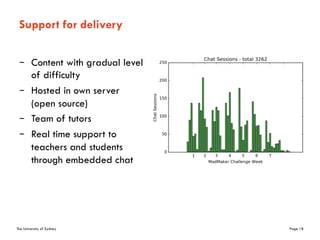
Support for delivery
– Content with gradual level
of difficulty
– Hosted in own server
(open source)
– Team of tutors
– Real time support to
teachers and students
through embedded chat
The University of Sydney Page 19
Outreach
The University of Sydney Page 20
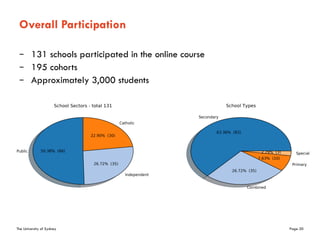
Overall Participation
– 131 schools participated in the online course
– 195 cohorts
– Approximately 3,000 students
The University of Sydney Page 21
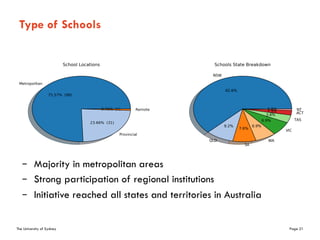
Type of Schools
– Majority in metropolitan areas
– Strong participation of regional institutions
– Initiative reached all states and territories in Australia
The University of Sydney Page 22
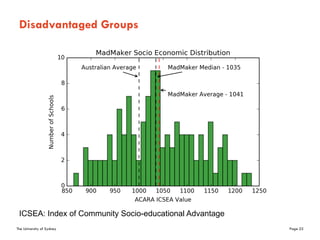
Disadvantaged Groups
ICSEA: Index of Community Socio-educational Advantage
The University of Sydney Page 23
Discipline Uptake
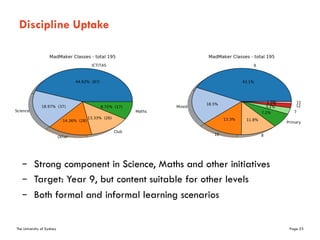
– Strong component in Science, Maths and other initiatives
– Target: Year 9, but content suitable for other levels
– Both formal and informal learning scenarios
The University of Sydney Page 24
Gender Balance
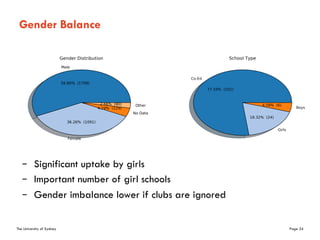
– Significant uptake by girls
– Important number of girl schools
– Gender imbalance lower if clubs are ignored
The University of Sydney Page 25
Indigenous Communities
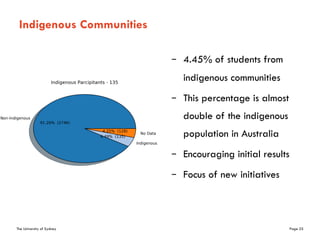
– 4.45% of students from
indigenous communities
– This percentage is almost
double of the indigenous
population in Australia
– Encouraging initial results
– Focus of new initiatives
The University of Sydney Page 26
Evaluation
The University of Sydney Page 27
Student Satisfaction
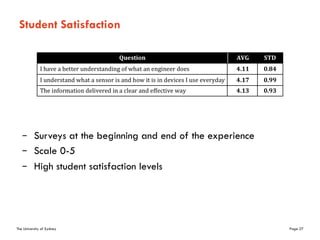
– Surveys at the beginning and end of the experience
– Scale 0-5
– High student satisfaction levels
The University of Sydney Page 28
Change in Student Perception of STEM Careers
The University of Sydney Page 29
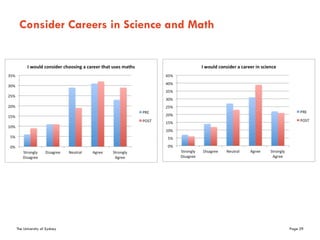
Consider Careers in Science and Math
The University of Sydney Page 30
Strategy for 2016
The University of Sydney Page 31
Current Support
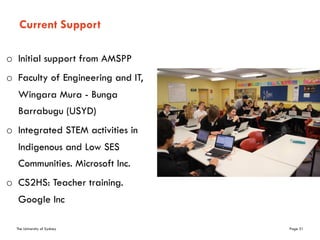
o Initial support from AMSPP
o Faculty of Engineering and IT,
Wingara Mura - Bunga
Barrabugu (USYD)
o Integrated STEM activities in
Indigenous and Low SES
Communities. Microsoft Inc.
o CS2HS: Teacher training.
Google Inc
The University of Sydney Page 32
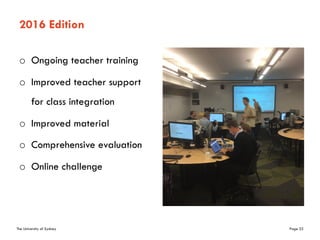
2016 Edition
o Ongoing teacher training
o Improved teacher support
for class integration
o Improved material
o Comprehensive evaluation
o Online challenge
The University of Sydney Page 33
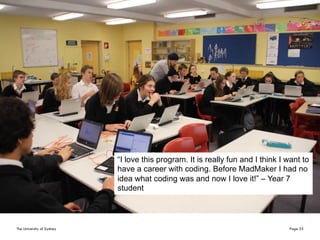
“I love this program. It is really fun and I think I want to
have a career with coding. Before MadMaker I had no
idea what coding was and now I love it!” – Year 7
student
The University of Sydney Page 34
Future Steps
The University of Sydney Page 35
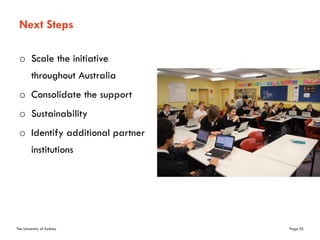
Next Steps
o Scale the initiative
throughout Australia
o Consolidate the support
o Sustainability
o Identify additional partner
institutions
The University of Sydney Page 36
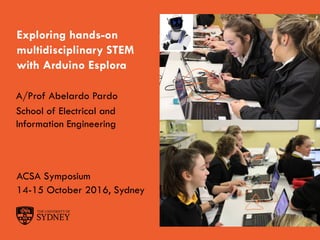
Exploring hands-on
multidisciplinary STEM
with Arduino Esplora
A/Prof Abelardo Pardo
School of Electrical and
Information Engineering
ACSA Symposium
14-15 October 2016, Sydney

Exploring hands-on multidisciplinary STEM with Arduino Esplora

  • 1.
    The University ofSydney Page 1 Exploring hands-on multidisciplinary STEM with Arduino Esplora A/Prof Abelardo Pardo @abelardopardo Faculty of Engineering and IT ACSA Symposium 14-15 October 2016, Sydney
  • 2.
    The University ofSydney Page 2 Agenda – The Context – Design – Teacher Training – Delivery – Outreach – Evaluation – Future Steps FernandaGuerraflickr.com
  • 3.
    The University ofSydney Page 3 The Context
  • 4.
    The University ofSydney Page 4 The Problem Steep decline in the achievement and attitude towards STEM-related disciplines amongst high school students across the country. Partially due to students’ self-perception of ability, subject difficulty and usefulness. The impact of STEM fields to over 26% of the Australian economic activity. High school students need to be aware of the connection between STEM subjects and the innovation, creativity and problem solving skills required to tackle the current social challenges.
  • 5.
    The University ofSydney Page 5 Vision Address the steep decline in commitment and interests in STEM subjects for every high school student in Australia
  • 6.
    The University ofSydney Page 6 Method Our proven and integrated training and delivery method provides high school students and teachers with an inclusive, engaging, hands-on and cross-disciplinary STEM experience in a blended learning scenario with real-time student and teacher support suitable to be integrated as part of the curriculum Madmaker.com.au
  • 7.
    The University ofSydney Page 7 Execution • Focus groups with stakeholders • Design and deployment plan to combine teacher training, active learning inter- disciplinary activities, on-line learning, a simple hardware platform, and a rigorous evaluation procedure. • Program reached more than 3,000 students, 300 teachers from all STEM disciplines in 130 schools from all sectors • Achieved a change in student perception of STEM careers by the students. • Clearly identified path to scale the initiative to all High School students in Australia.
  • 8.
    The University ofSydney Page 8 The Team Abelardo Pardo Owen Brasier Miriam Pellicano Calla Klafas Philip Leong James Curran
  • 9.
    The University ofSydney Page 9 Design
  • 10.
    The University ofSydney Page 10 Focus Groups o Target audience o Connection with the STEM curriculum o Barriers for adoption o Communication strategy o Adequate hardware o Evaluation
  • 11.
    The University ofSydney Page 11 Platform – Arduino Esplora – Microcontroller + sensors – Accelerometer – Temperature – Light – Buzzer – Microphone – RGB led – Buttons – Joystick – AUD$ 60 p/u
  • 12.
    The University ofSydney Page 12 Teacher Training
  • 13.
    The University ofSydney Page 13 Teacher Workshops – Two formats: face-to-face and remote. June/August 2015 – Hands on design experience – Review activities, approach – Identify adoption barriers – Create an implementation plan – Feedback collecting mechanism for next stages
  • 14.
    The University ofSydney Page 14 Teacher Workshops - Results – 21 sessions – 259 teachers – Workshops in all states and territories – Mostly NSW due to the dissemination contacts – Identified schools that serve as hubs
  • 15.
    The University ofSydney Page 15 Teacher Workshops - Evaluation – Workshops evaluated through surveys – 0-5 Scale for answers – Provided confidence to deploy the initiative in their classroom
  • 16.
    The University ofSydney Page 16 Delivery
  • 17.
    The University ofSydney Page 17
  • 18.
    The University ofSydney Page 18 Support for delivery – Content with gradual level of difficulty – Hosted in own server (open source) – Team of tutors – Real time support to teachers and students through embedded chat
  • 19.
    The University ofSydney Page 19 Outreach
  • 20.
    The University ofSydney Page 20 Overall Participation – 131 schools participated in the online course – 195 cohorts – Approximately 3,000 students
  • 21.
    The University ofSydney Page 21 Type of Schools – Majority in metropolitan areas – Strong participation of regional institutions – Initiative reached all states and territories in Australia
  • 22.
    The University ofSydney Page 22 Disadvantaged Groups ICSEA: Index of Community Socio-educational Advantage
  • 23.
    The University ofSydney Page 23 Discipline Uptake – Strong component in Science, Maths and other initiatives – Target: Year 9, but content suitable for other levels – Both formal and informal learning scenarios
  • 24.
    The University ofSydney Page 24 Gender Balance – Significant uptake by girls – Important number of girl schools – Gender imbalance lower if clubs are ignored
  • 25.
    The University ofSydney Page 25 Indigenous Communities – 4.45% of students from indigenous communities – This percentage is almost double of the indigenous population in Australia – Encouraging initial results – Focus of new initiatives
  • 26.
    The University ofSydney Page 26 Evaluation
  • 27.
    The University ofSydney Page 27 Student Satisfaction – Surveys at the beginning and end of the experience – Scale 0-5 – High student satisfaction levels
  • 28.
    The University ofSydney Page 28 Change in Student Perception of STEM Careers
  • 29.
    The University ofSydney Page 29 Consider Careers in Science and Math
  • 30.
    The University ofSydney Page 30 Strategy for 2016
  • 31.
    The University ofSydney Page 31 Current Support o Initial support from AMSPP o Faculty of Engineering and IT, Wingara Mura - Bunga Barrabugu (USYD) o Integrated STEM activities in Indigenous and Low SES Communities. Microsoft Inc. o CS2HS: Teacher training. Google Inc
  • 32.
    The University ofSydney Page 32 2016 Edition o Ongoing teacher training o Improved teacher support for class integration o Improved material o Comprehensive evaluation o Online challenge
  • 33.
    The University ofSydney Page 33 “I love this program. It is really fun and I think I want to have a career with coding. Before MadMaker I had no idea what coding was and now I love it!” – Year 7 student
  • 34.
    The University ofSydney Page 34 Future Steps
  • 35.
    The University ofSydney Page 35 Next Steps o Scale the initiative throughout Australia o Consolidate the support o Sustainability o Identify additional partner institutions
  • 36.
    The University ofSydney Page 36 Exploring hands-on multidisciplinary STEM with Arduino Esplora A/Prof Abelardo Pardo School of Electrical and Information Engineering ACSA Symposium 14-15 October 2016, Sydney