













Learning Analytics is about
Learning
Dragan Gasevic
@dgasevic
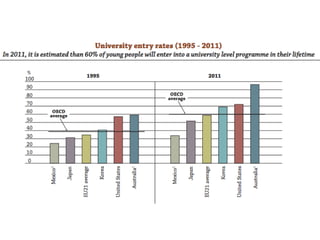
Growing demand for
education!
Scalability is possible
Low effect size of class-size
John Hattie
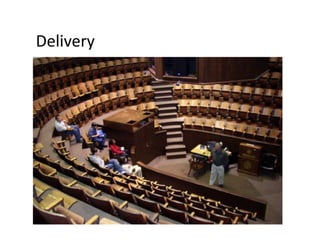
Delivery
Delivery
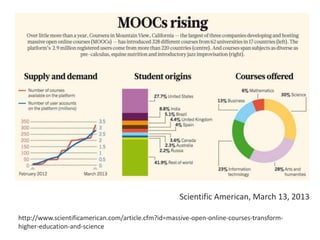
Scientific American, March 13, 2013
http://www.scientificamerican.com/article.cfm?id=massive-open-online-courses-transformhigher-education-and-science
MOTIVATION
Feedback loops between
students and instructors
are missing!

Hattie, J., & Timperley, H. (2007). The power of feedback. Review of educational
research, 77(1), 81-112.
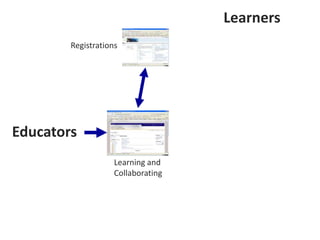
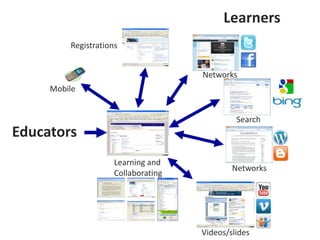
Learners
Registrations

Educators
Learning and
Collaborating
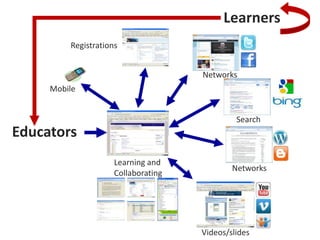
Learners
Registrations

Networks
Mobile
Search

Educators
Learning and
Collaborating

Networks

Videos/slides
Learners
Registrations

Networks
Mobile
Search

Educators
Learning and
Collaborating

Networks

Videos/slides
DANGER
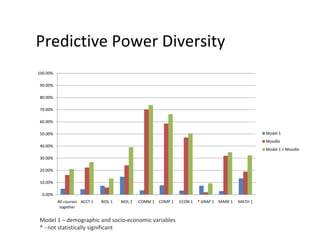
Predict-o-mania
The same predictive models for
everything and everyone
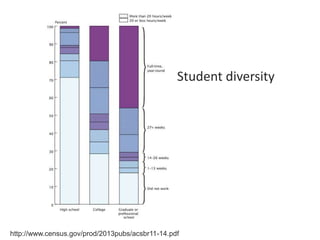
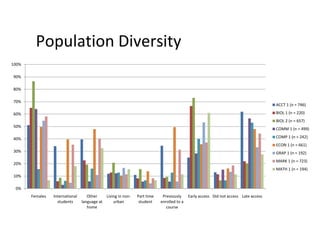
Student diversity

http://www.census.gov/prod/2013pubs/acsbr11-14.pdf
Population Diversity
100%
90%
80%
70%

ACCT 1 (n = 746)
BIOL 1 (n = 220)

60%

BIOL 2 (n = 657)
50%

COMM 1 (n = 499)
COMP 1 (n = 242)

40%

ECON 1 (n = 661)
30%

GRAP 1 (n = 192)
MARK 1 (n = 723)

20%

MATH 1 (n = 194)
10%
0%
Females

International
students

Other
Living in nonlanguage at
urban
home

Part time
student

Previously
enrolled to a
course

Early access Did not access Late access
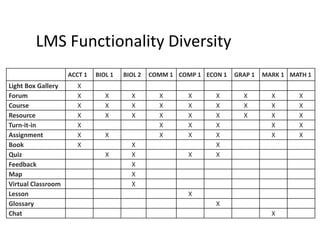
LMS Functionality Diversity
ACCT 1

Light Box Gallery
Forum
Course
Resource
Turn-it-in
Assignment
Book
Quiz
Feedback
Map
Virtual Classroom
Lesson
Glossary
Chat

X
X
X
X
X
X
X

BIOL 1

X
X
X

BIOL 2

X
X
X

X
X

X
X
X
X
X

COMM 1 COMP 1 ECON 1

X
X
X
X
X

X
X
X
X
X
X

X
X
X
X
X
X
X

GRAP 1

X
X
X

MARK 1 MATH 1

X
X
X
X
X

X
X
X

X
X
X
X
X
Predictive Power Diversity
100.00%
90.00%
80.00%
70.00%
60.00%
Model 1

50.00%

Moodle
40.00%

Model 1 + Moodle

30.00%
20.00%
10.00%
0.00%
All courses ACCT 1
together

BIOL 1

BIOL 2

COMM 1

COMP 1

Model 1 – demographic and socio-economic variables
* - not statistically significant

ECON 1

* GRAP 1 MARK 1

MATH 1
Retention is not
the only challenge
It is important, of course!

But, where is learning?
How do we
enhance learning
if the focus is on
outcomes only?
DIRECTION
Learning Analytics – What?

Measurement, collection,
analysis, and reporting of data
about learners and their contexts
Learning Analytics – Why?

Understanding and optimising
learning and the environments
in which learning occurs
Modern Educational Psychology

Human agency is
central to learning

Bandura, A. (1989). Human agency in social cognitive theory. American
psychologist, 44(9), 1175-1184.
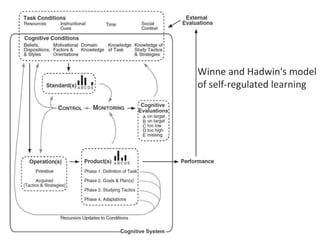
Winne and Hadwin's model
of self-regulated learning
Knowledge society and
knowledge economy
Why does it matter?!
Challenge
Metacognitive skills

Bjork, R. A., Dunlosky, J., & Kornell, N. (2013). Self-Regulated Learning: Beliefs, Techniques, and
Illusions. Annual Review of Psychology, 64, 417-444. doi:10.1146/annurev-psych-113011-143823
Why does it matter?!
Challenge
Information seeking skills

Judd, T., & Kennedy, G. (2011). Expediency-based practice? Medical students’ reliance on Google and
Wikipedia for biomedical inquiries. British Journal of Educational Technology, 42 (2), 351-360.
doi:10.1111/j.1467-8535.2009.01019.x
Why does it matter?!
Challenge
Sensemaking paradox

Butcher, K. R., & Sumner, R. (2011). Self-Directed Learning and the Sensemaking Paradox. Human–
Computer Interaction, 26(1-2), 123-159. doi:10.1080/07370024.2011.556552
Why does it matter?!
Challenge
Asking questions and critical thinking

Graesser, A. C., & Olde, B. (2003). How does one know whether a person understands a device? The
quality of the questions the person asks when the device breaks down. Journal of Educational
Psychology, 95(3), 524–536..
Process and context focus
for learning analytics needed
to understand learning
OPPORTUNITIES
Learning Analytics

Effects of learning context
External conditions (e.g., instructional design)
Cognitive presence

the extent to which the participants in any
particular configuration of a CoI are able to
construct meaning via sustained communication
Garrison, D. R., Anderson, T., & Archer, W. (2001). Critical Thinking and Computer Conferencing: A Model
and Tool to Assess Cognitive Presence. American Journal of Distance Education ,15(1), 7-23.
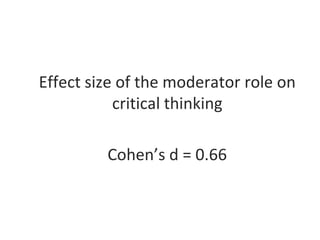
Effect size of the moderator role on
critical thinking
Cohen’s d = 0.66
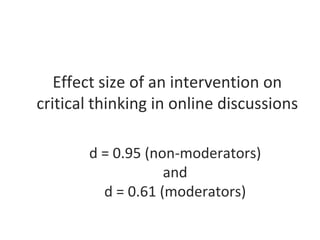
Effect size of an intervention on
critical thinking in online discussions
d = 0.95 (non-moderators)
and
d = 0.61 (moderators)
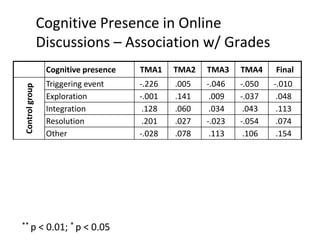
Cognitive presence

TMA1

TMA2

TMA3

TMA4

Final

Control group

Cognitive Presence in Online
Discussions – Association w/ Grades
Triggering event
Exploration
Integration
Resolution
Other

-.226
-.001
.128
.201
-.028

.005
.141
.060
.027
.078

-.046
.009
.034
-.023
.113

-.050
-.037
.043
-.054
.106

-.010
.048
.113
.074
.154

** p

< 0.01; * p < 0.05
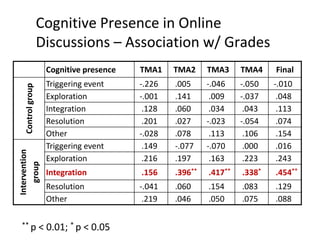
Cognitive Presence in Online
Discussions – Association w/ Grades

Intervention
group

Control group

Cognitive presence

** p

TMA1

TMA2

TMA3

TMA4

Final

Triggering event
Exploration
Integration
Resolution
Other
Triggering event
Exploration

-.226
-.001
.128
.201
-.028
.149
.216

.005
.141
.060
.027
.078
-.077
.197

-.046
.009
.034
-.023
.113
-.070
.163

-.050
-.037
.043
-.054
.106
.000
.223

-.010
.048
.113
.074
.154
.016
.243

Integration

.156

.396**

.417**

.338*

.454**

Resolution
Other

-.041
.219

.060
.046

.154
.050

.083
.075

.129
.088

< 0.01; * p < 0.05
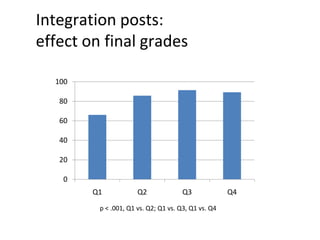
Integration posts:
effect on final grades
100
80
60
40
20
0
Q1

Q2

Q3

p < .001, Q1 vs. Q2; Q1 vs. Q3, Q1 vs. Q4

Q4
Learning Analytics

Are students only driven by
assessments?
Effects of external conditions
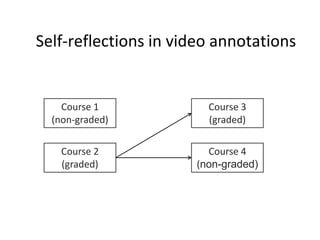
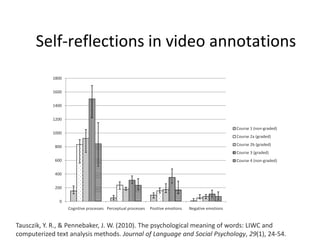
Self-reflections in video annotations

Course 1
(non-graded)

Course 3
(graded)

Course 2
(graded)

Course 4
(non-graded)
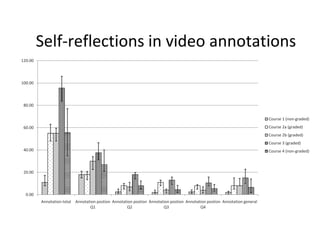
Self-reflections in video annotations
120.00

100.00

80.00

Course 1 (non-graded)
Course 2a (graded)

60.00

Course 2b (graded)
Course 3 (graded)

40.00

Course 4 (non-graded)

20.00

0.00
Annotation total Annotation postion Annotation postion Annotation postion Annotation postion Annotation general
Q1
Q2
Q3
Q4
Self-reflections in video annotations
1800
1600
1400
1200
Course 1 (non-graded)
1000

Course 2a (graded)

Course 2b (graded)

800

Course 3 (graded)
600

Course 4 (non-graded)

400
200
0
Cognitive processes Perceptual processes

Positive emotions

Negative emotions

Tausczik, Y. R., & Pennebaker, J. W. (2010). The psychological meaning of words: LIWC and
computerized text analysis methods. Journal of Language and Social Psychology, 29(1), 24-54.
Learning Analytics

Effects of
students’ own decisions
Beyond external conditions
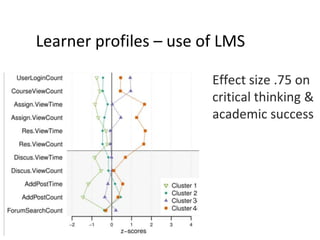
Learner profiles – use of LMS
Effect size .75 on
critical thinking &
academic success

3
4
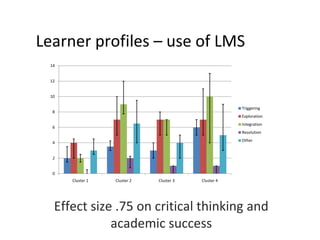
Learner profiles – use of LMS
14
12
10
Triggering

8

Exploration

Integration

6

Resolution
Other

4
2
0
Cluster 1

Cluster 2

Cluster 3

Cluster 4

Effect size .75 on critical thinking and
academic success
CHALLENGES
Learning Analytics

What to measure?
We don’t need page access counts only!
Wilson, T.D. (1999). Models in information behaviour research.
Journal of Documentation, 55(3), 249 - 270, doi:10.1108/EUM0000000007145
Instrumentation
About specific contexts and constructs
Instrumentation
Capturing interventions
Previous learning and (memory of) experience
Social networks (e.g., communication, cross-class)
Interaction types (e.g., transactional distances)
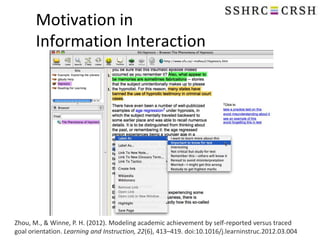
Motivation in
Information Interaction

Zhou, M., & Winne, P. H. (2012). Modeling academic achievement by self-reported versus traced
goal orientation. Learning and Instruction, 22(6), 413–419. doi:10.1016/j.learninstruc.2012.03.004
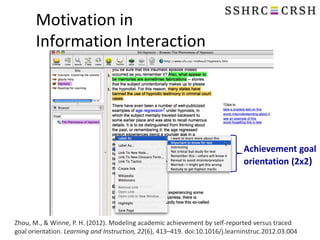
Motivation in
Information Interaction

Achievement goal
orientation (2x2)

Zhou, M., & Winne, P. H. (2012). Modeling academic achievement by self-reported versus traced
goal orientation. Learning and Instruction, 22(6), 413–419. doi:10.1016/j.learninstruc.2012.03.004
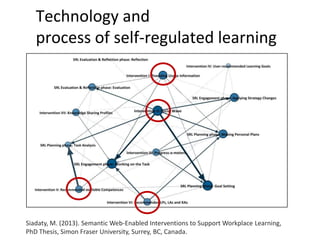
Technology and
process of self-regulated learning

Siadaty, M. (2013). Semantic Web-Enabled Interventions to Support Workplace Learning,
PhD Thesis, Simon Fraser University, Surrey, BC, Canada.
Scaling up qualitative analysis
Temporal processes
beyond coding and counting
Longitudinal studies
Generating
reports and nice visualization is
not enough
Building data-driven culture in
institutions

Manyika, J., et al., Big Data: The Next Frontier for Innovation, Competition, and Productivity,
2011, McKinsey Global Institute, http://goo.gl/Lue3qs
Privacy and ethics
Data sharing and mobility
Thank you!

Learning analytics are about learning

Editor's Notes

  • #17 http://www.census.gov/prod/2013pubs/acsbr11-14.pdf
  • #29 Students generally have poor self-regulation skills:Weak metacomprehension – assessment of own knowledge – stop learning, when they don’t know enoughConfusion of the rate of learning - stop learning, when they don’t know enoughExternally-generated self-monitoring prompts – AzevedoWeak metacognitive awareness – inefficient study tactics used
  • #30 Use of unreliable sources Poor querying skills
  • #31 Students are asked to seek information about domains they do not have sufficient background knowledge They will stop seeking information even if the proper one hasn’t been found
  • #32 Students are asked to seek information about domains they do not have sufficient background knowledge They will stop seeking information even if the proper one hasn’t been found
  • #49 Word count: Triggering - 82.03 (55.00, 99.50)Exploration - 122.71(73.25, 149.50)Integration - 185.53 (115.00, 221.00)Resolution 291.24 (168.00, 338.00)